Read before this
Read these direct prerequisites in order. Each guide lists any earlier context it assumes.
Before you start
Sign in and open Home before changing creation settings. The choices visible can depend on the source, video type, account, and plan. Gather permitted sources and check the displayed credit estimate before a large or high-stakes run.
What the setting does
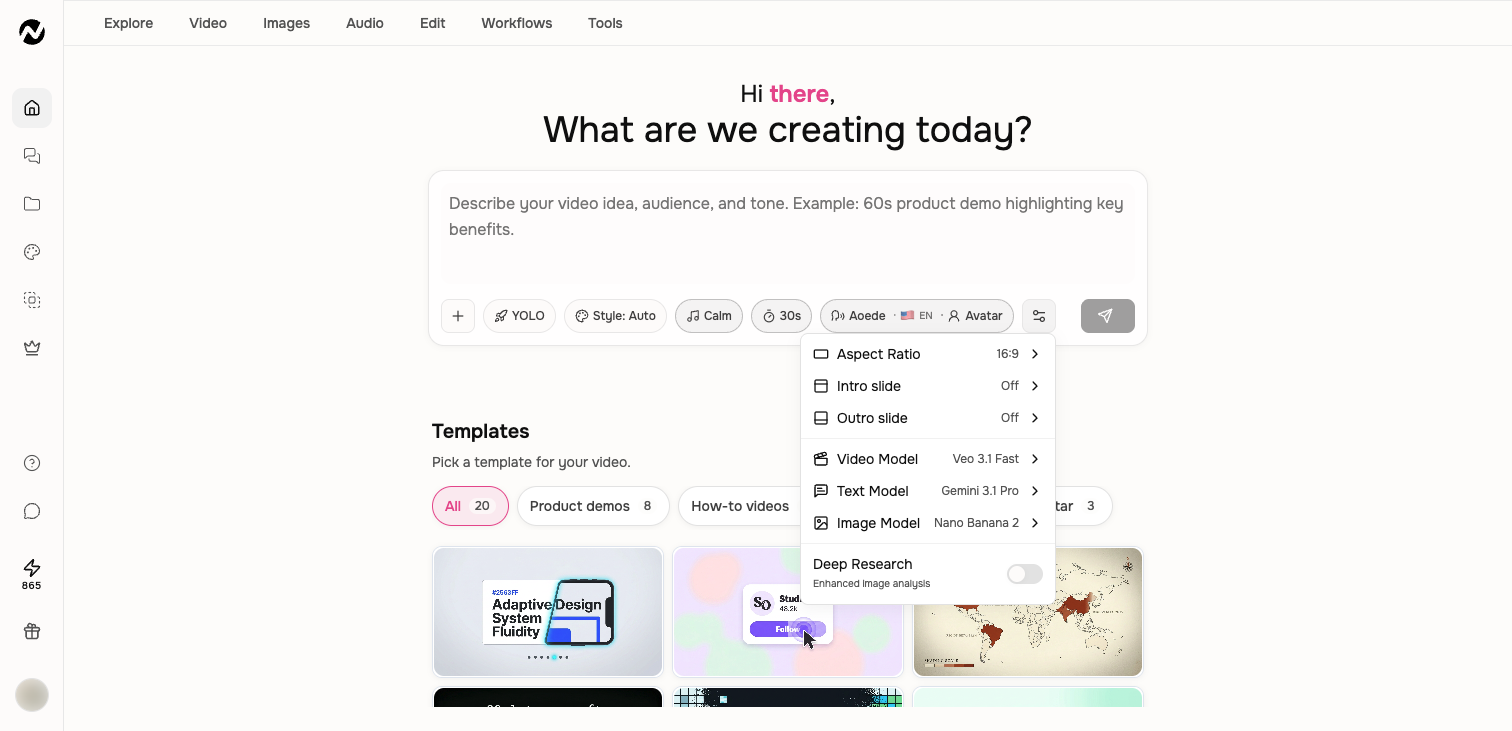
Normal source handling reads usable text and visual context. Deep Research increases the analysis applied to images in uploaded files, image-heavy PDFs, and webpages. It is a visual-source setting, not a promise of unrestricted web research or guaranteed factual accuracy.
When to turn it on
- A product or landing page contains important screenshots, diagrams, or visual details.
- A PDF or document uses charts, layouts, or images that carry meaning beyond selectable text.
- The video needs better visual grounding than pasted text alone provides.
- You have attached images whose relationships or details should influence the story.
What it does not replace
Deep Research is not permission to invent facts or use restricted material. Supply approved sources for private, regulated, or time-sensitive claims. It does not guarantee that a login-protected or blocked page can be read, and it should not be treated as a general research-depth switch for every prompt.
Turn it on
- Open Home and add the source URL or file.
- Open Settings under the prompt.
- Turn on Deep Research.
- In the prompt, name the questions or page details the analysis should prioritize.
Keep going
Add URLs, documents, images, recordings, and other reference material to a video request.
Write prompts that produce stronger scripts, visuals, pacing, and revisions.
Troubleshoot slow, stopped, failed, or disconnected video generation without relying on fixed time promises.