ngram blog
Product updates, best practices, and insights on AI-powered video creation for modern teams.
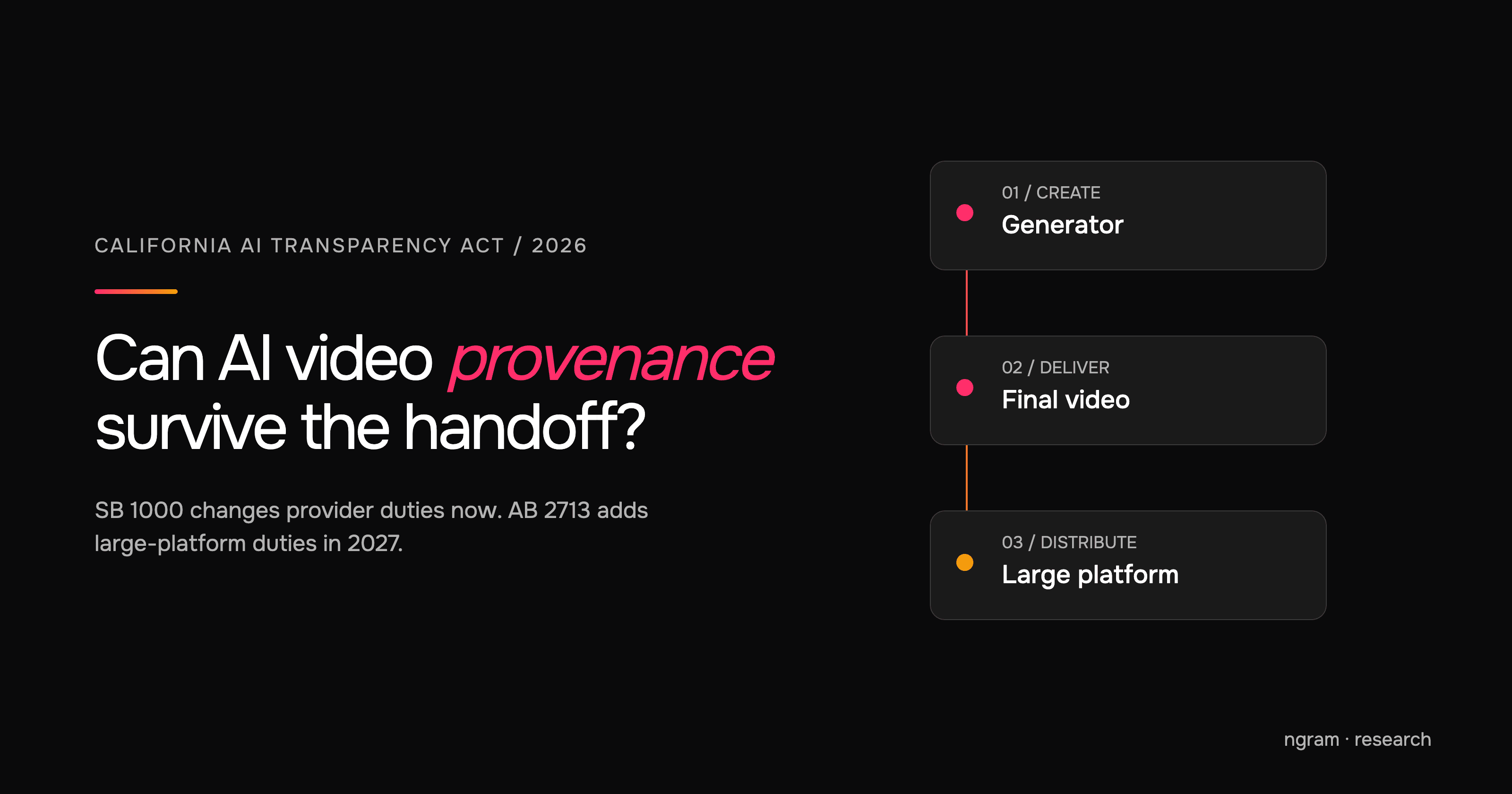
California amended its AI Transparency Act on September 30, 2026. Learn what SB 1000 requires of GenAI providers now and what AB 2713 will require of large platforms in 2027.
ElevenLabs launched Eleven v4 and Turbo on September 28. We examine language coverage, voice continuity, latency claims and the cost of revisions.
Made on YouTube 2026 connects AI editing, Studio feedback, video A/B testing, distribution, and likeness protection. Here is what that closed loop changes for creators and business video teams.
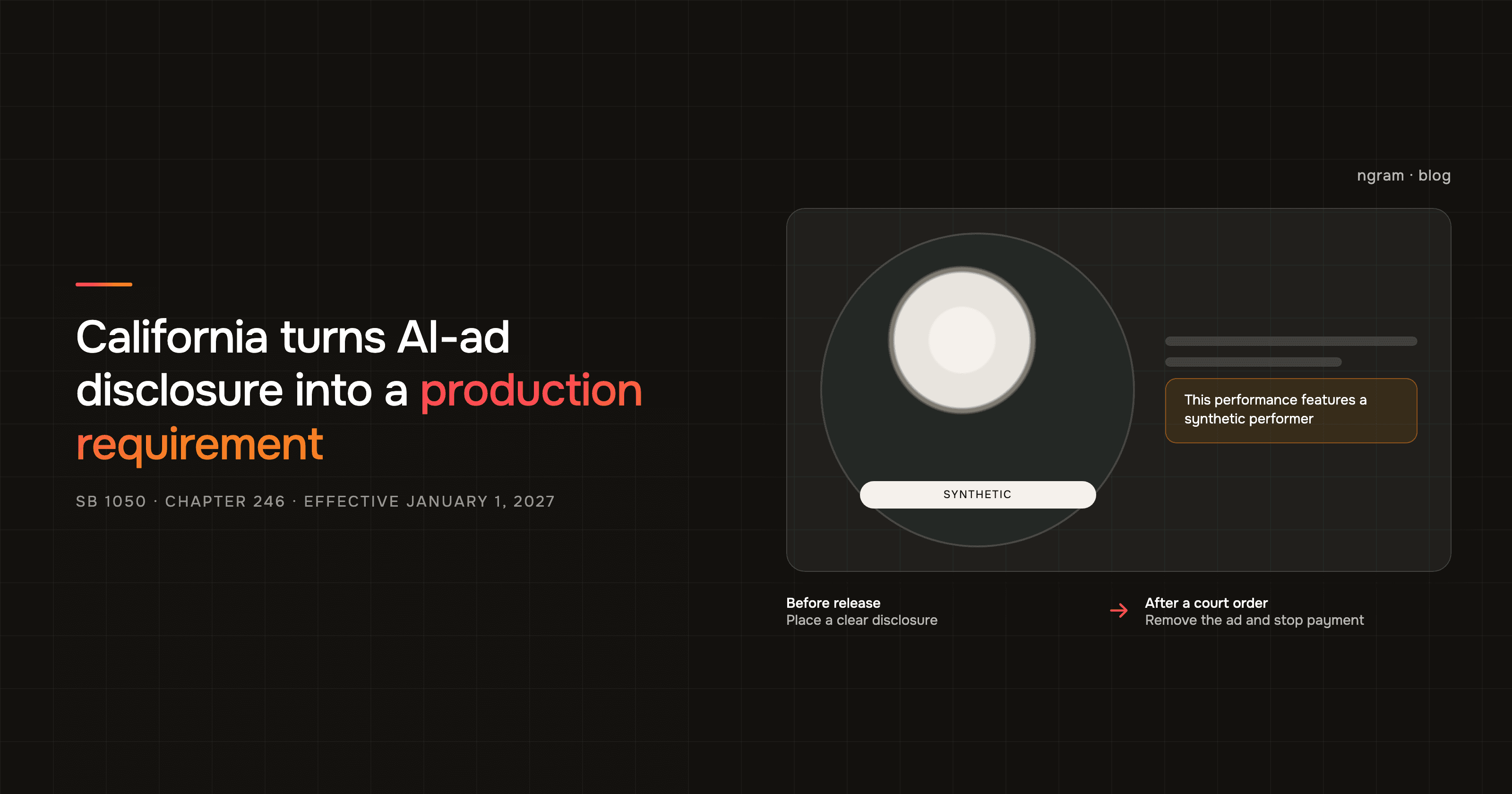
California SB 1050 makes synthetic-performer disclosure a production requirement for audio and video ads, with a January 1, 2027 effective date and a court-order removal process for advertising media.
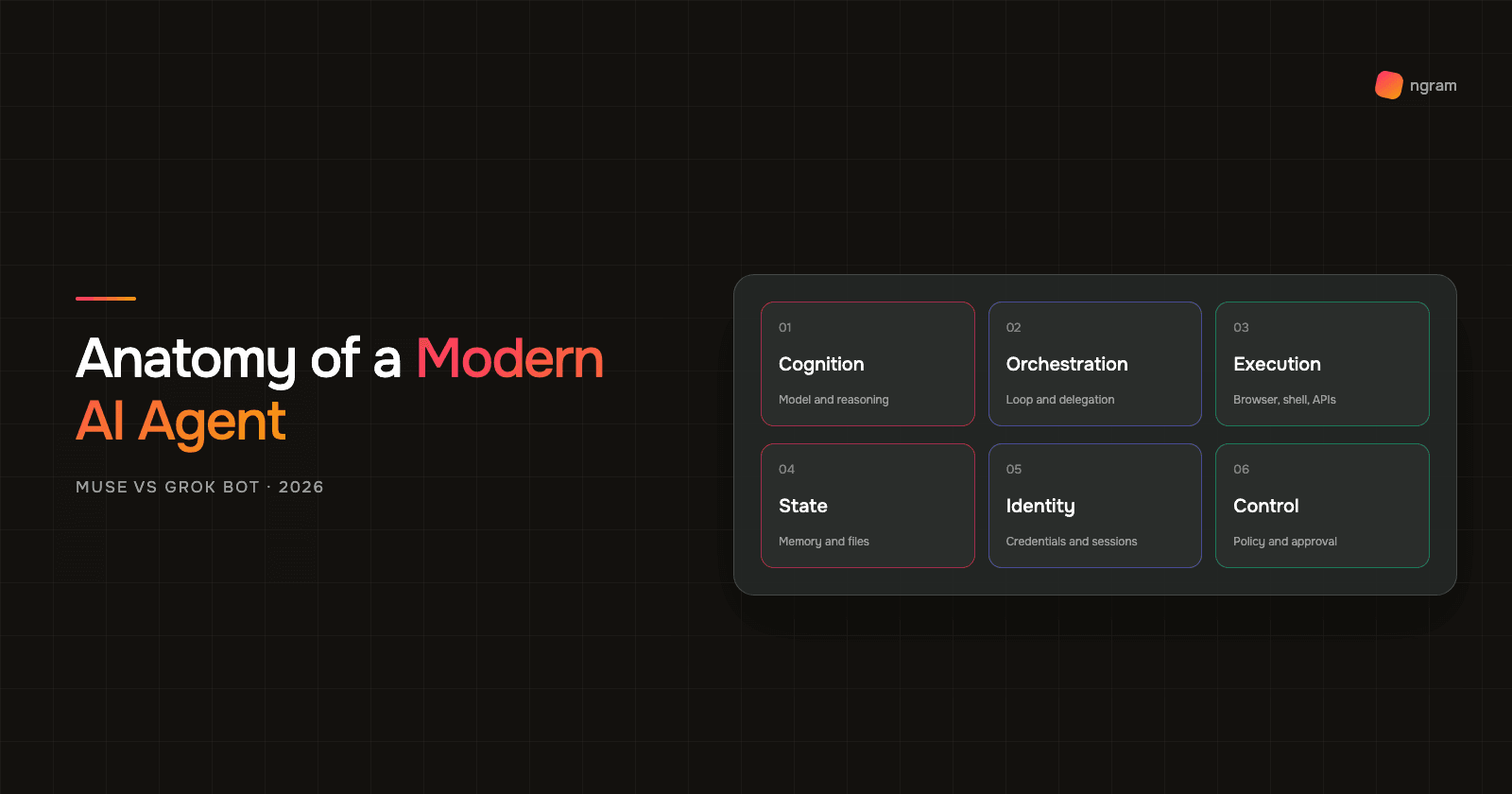
A technical teardown of modern AI agent architecture through Meta's Muse and Grok Bot: agent loops, persistent computers, memory, credentials, egress, approvals, and the public evidence gaps that still matter.
NVIDIA AI for Media now puts generation, enhancement, detection, localization, sports intelligence, and media exchange inside live broadcast workflows. Here is what changed at IBC 2026 and what real-time production still demands.
fal H3 Max and Yoroll H3 Superfast now generate video faster than playback. Here's what the claims mean and what interactive AI video still needs.
Google's agentic video understanding lets Gemini choose which moments, frames, audio, and transcript to inspect. The result could reset the cost of long-video search, QA, and editing, but Google's best numbers are ceilings, not production guarantees.
Google's Gemini Omni 1.1 Flash adds 360p drafts, first-and-last-frame control, cumulative 40-second extensions, and 4K upscaling. The real change is cheaper, more directed iteration.
A proposed class action against Twitch and Amazon turns AI training-data consent into an operational test: when consent begins, whose choice controls chat, and whether a future-only opt-out can address content already used.
Pika shipped four standalone audio models, SFX, Speech, Soundtrack, and Music, priced far below ElevenLabs and Hunyuan Foley on paper. Here's what that does to the cost of voicing, scoring, and sound-designing an AI video, and to the vendors selling audio on its own.
LTX-2.5 is a 22B-parameter open-weights video model that generates synchronized audio and video faster than Veo 3.1, Kling 3.0 Pro, and Gemini Omni Flash, and runs on a 16GB consumer GPU. Here's what that means for AI video's build-versus-buy math.
Alibaba's Tongyi Lab announced a public beta for Wan 3.0 on August 6, 2026, gated to invited accounts - the first major AI video model that reads PowerPoint decks, PDFs, and spreadsheets directly. Here's what that changes in production workflows, and what it doesn't.
MiniMax H3 ships 2K AI video with native stereo audio in a single pass. Here's what that collapses in a video production pipeline, what still doesn't work, and why the model layer is racing toward audio-native generation.
Runway's new Media Router auto-picks the right video, image, or audio model for a job, the same idea OpenRouter brought to text models three and a half years ago. Here's why it's arriving now, and why Runway is willing to route paying customers to its own competitors to make it work.
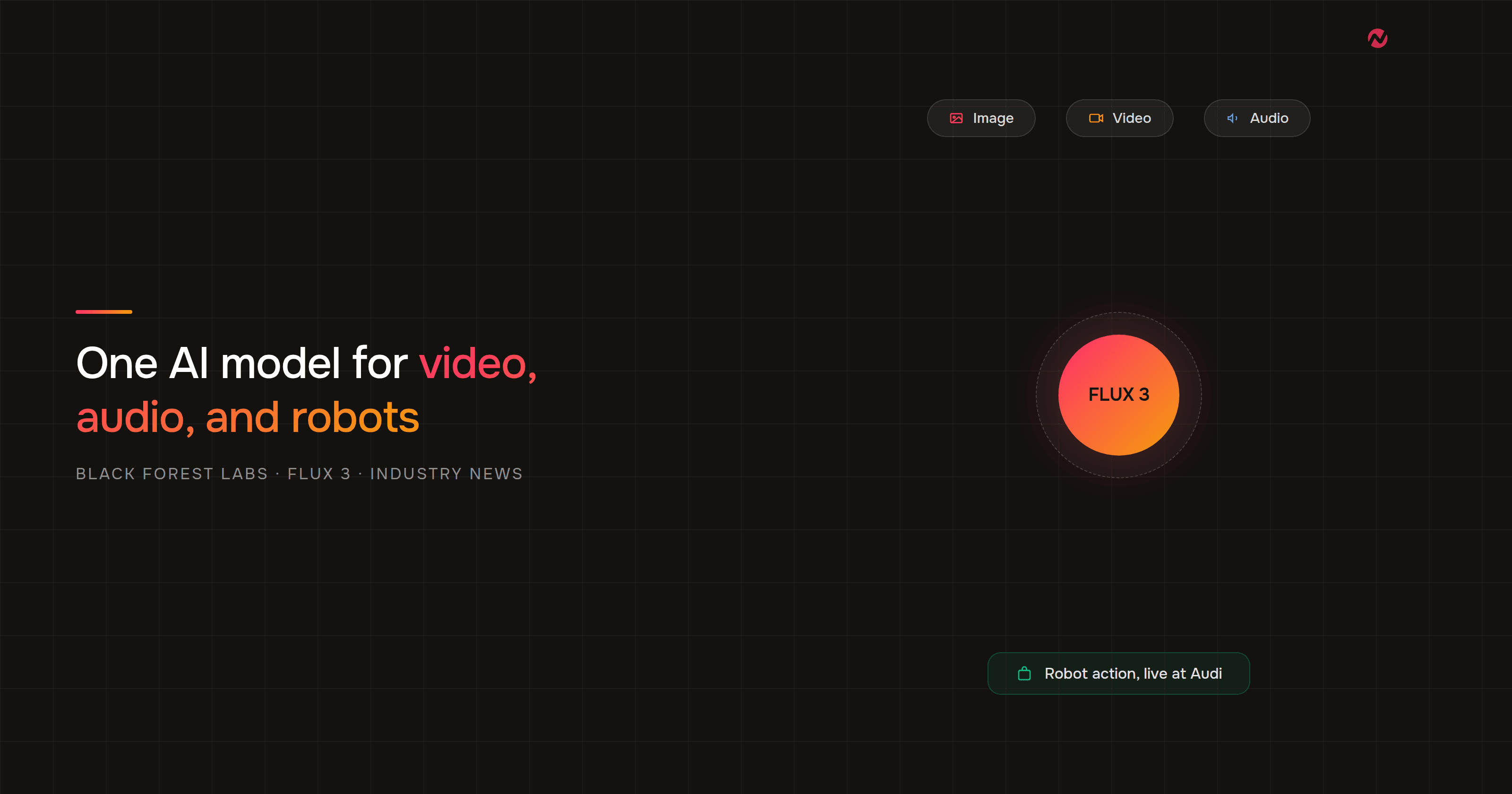
Black Forest Labs launched FLUX 3, its first multimodal frontier model unifying video, audio, and robotic action. Here's why the first production customer is a car factory, not a marketing team.
NVIDIA's Synthetic Video Detector, a NIM microservice announced at SIGGRAPH on July 20, 2026, is now embedded in Wowza's livestreaming infrastructure across 35,000+ deployments in 170+ countries. Here's what NVIDIA's own accuracy and latency numbers actually show.
PixVerse closed a $439 million Series C extension on July 13, 2026, crossing a $2 billion valuation and pivoting from clip generation toward real-time AI world models with its new PixVerse Game Engine. Here's what the round, the valuation math, and the world-model pivot mean for AI video.
Goldman Sachs ranked ByteDance's video-generation models above Zhipu, DeepSeek, and every other Chinese AI developer it evaluated, the first standalone investable ranking of AI video quality from a bulge-bracket bank. Here is what the ranking, the Zhipu coverage initiation, and the numbers behind Seedance actually show.
Runway shipped Agent 2.0 on June 25, 2026 and Agent Skills on July 2, letting one command turn a brief into a localized, multi-format ad campaign. Luma shipped the same shift first, in March. Here's what it means that AI video suppliers no longer compete on generation quality alone.
Google Photos Video Remix lets anyone restyle an existing clip with a text prompt, powered by Gemini Omni. Here is what the July 2026 launch reveals about AI video editing becoming a default consumer feature, five weeks after Google made AI video generation free on YouTube.
TwelveLabs raised $100M and signed a multiyear AWS Trainium chip deal on July 1, 2026, while 2026's biggest AI video headlines keep going to generation models. Here is what the funding map reveals about the video understanding layer.
Kuaishou's Kling AI raised $2B+ at an $18 billion valuation, the largest funding round in AI video generation's history. Here is what the ARR growth, peer valuations, and the 2027 IPO clock actually reveal about the economics of the model layer.
Google's June 30 launch of Nano Banana 2 Lite and Gemini Omni Flash public preview puts a real price tag on image-to-video for the first time: $0.034 per 1,000 images to draft, $0.10 per second to animate. Here's what a 15-second product video actually costs to generate, and what it means for commerce video economics.