Read before this
Read these direct prerequisites in order. Each guide lists any earlier context it assumes.
Use this when
Use this guide when a finished video has missing or muted narration, captions, music, or sound effects; the background music is too loud; or you want to change a scene's spoken script without replacing its visuals. It covers the quick Edit video switches, Edit → Music, and scene-by-scene narration in Edit → Script.
This guide does not select the original voice or language, fix an exported file that differs from the preview, or guarantee recovery of a missing generated track. Use the voice guide before generation and the export guide when only the downloaded file is wrong.
Before you start
Open the exact finished conversation from Projects, keep its URL, and replay the affected scene with device audio enabled. Note whether the problem is present in the Studio preview or only in a downloaded file. Preserve the current render before regenerating narration, and review any displayed credit estimate.
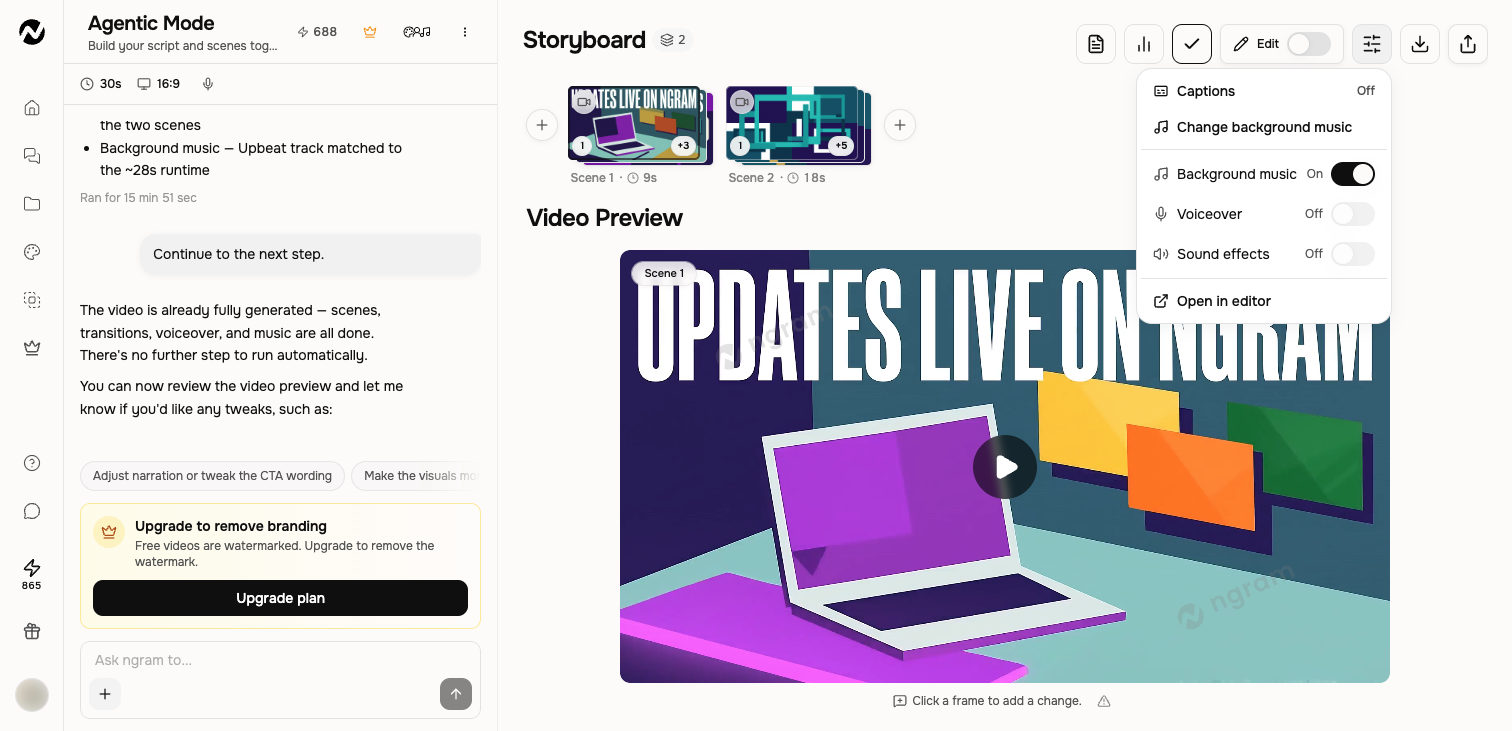
Open quick controls
- Open a finished agentic conversation.
- Select Edit video above the preview.
- Choose the caption option, change background music, or use the available audio switches. For a precise music-level adjustment, open Edit, select Music, set Background music volume with the slider, then select Save.
- Open the full editor when the change needs track-level control.
Replace or adjust music in a finished video
From the finished video, open the background-music selection to browse and replace the current track, or turn background music off. For volume, open Edit → Music and adjust Background music volume. The preview updates immediately; select Save to keep the selected track and level before export, then review the mix against narration.
Voiceover and sound effects
Availability depends on what the project contains. A disabled switch usually means the current video has no compatible generated layer or the control belongs in another editing surface. Use chat for a creative narration change and the editor for direct audio-layer work.
Turn a script into voiceover or change scene narration
- Open the finished conversation and select Edit.
- Open Script and select the affected scene.
- Edit the narration, then select Apply changes. ngram re-voices the affected scene while retaining its visuals.
- The new narration plays at a natural pace. In compatible motion-graphics and hybrid scenes, scene timing follows the revised audio while existing visuals stay in place. A scene built from rendered video may need regeneration, while screencast and slide-led projects keep their established timing rules.
- Replay the complete scene and confirm the voiceover, captions, music balance, and following transition before saving or exporting.
The words on screen need changing. Where do I edit them?
Use the caption option for the video's subtitles or auto-generated captions. To change words that appear as text inside one scene, turn on Edit, select that scene and its text element, update the wording, then select Save. Check names, product terms, numbers, line breaks, and the selected layer after any narration or scene-text change, then replay the scene before export.
Expected result
The Studio preview plays the selected narration, caption, music, and sound-effect state. Music-volume changes persist after Save. Direct script changes re-voice the affected scene at a natural pace, with compatible scene timing following the audio, and the fresh downloaded video matches the verified preview.
If audio or captions are missing
- Preserve the current project and record the affected scene or timestamp. Confirm whether the track is missing in the Studio preview or only after download.
- Open Edit video and confirm Voiceover, Captions, Background music, or Sound effects is not muted. A disabled switch means the current video has no compatible track for that control.
- If one generated voiceover scene is missing and the script is intact, use Apply changes or the offered scene regeneration once for only that scene after reviewing the displayed credit estimate.
- Replay the scene. If the track remains missing, the control stays unavailable, or captions remain out of sync, do not regenerate again; contact Support.
Contact Support after one failed audio recovery
Stop after one targeted recovery if voiceover, captions, music, or sound remains missing or fails again. Send Support the project URL, approximate time, affected scene and timestamp, missing track, visible error or disabled control, browser, whether the problem also appears in the preview, whether you retried once, and whether Usage shows a credit change.
Audio and captions FAQ
Keep going
Choose between chat revisions, frame-specific requests, inline editing, and a full-editor copy.
Edit scene content, layers, media, audio, interactivity, and timing inside a conversation.
Download an MP4 from an agentic video or editor project at the current plan resolution.
Select narration, language, presenter, and custom identity options for a video.
Choose the right help channel and include useful, privacy-safe diagnostic details.