Read before this
Read these direct prerequisites in order. Each guide lists any earlier context it assumes.
Use this when
Use this guide when you want to automate video creation, connect ngram to another app, publish without a manual download, or check whether an API or connector is available. It also explains why a card marked Coming Soon cannot be configured yet.
What this does not do
This guide does not activate a Coming Soon connector, remove the authentication rules of another service, or guarantee that a third-party account has permission to use every action. Use the live card and its setup screen as the availability check.
Before you start
Sign in to the ngram account that should own generated projects. Choose a small test input with no secrets or customer information, and make sure you can manage the destination account or the automation service's credentials. Open Settings → Integrations to compare the actions currently shown.
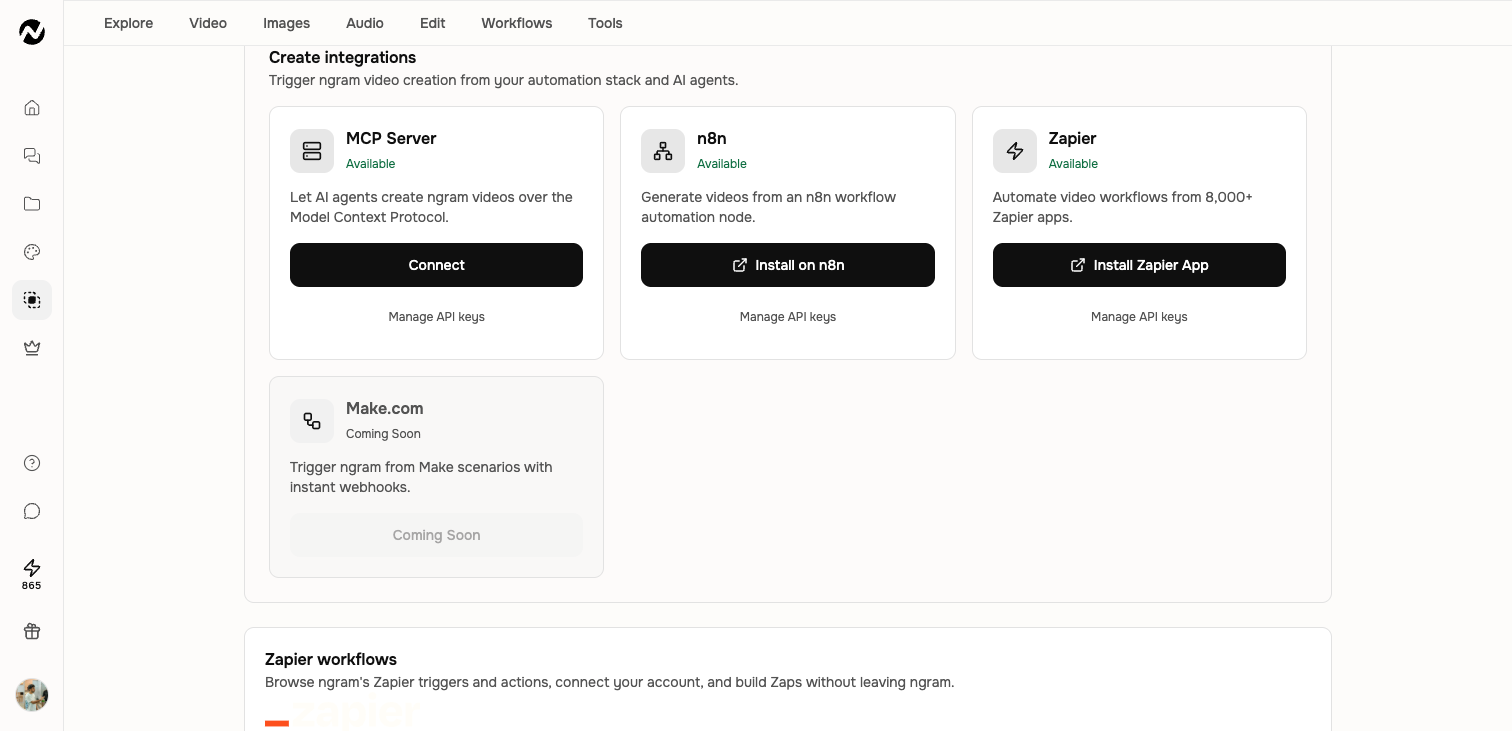
Integration groups
- Chrome extension: turn a webpage into a Studio video workflow.
- Publish integrations: LinkedIn, X, and YouTube connections.
- Create integrations: MCP, n8n, Zapier, and viaSocket entry points for starting work from another system.
- Make.com: currently shown as Coming Soon in the deployed UI.
Authentication access
Every signed-in user can create and manage credentials from Settings → API Keys. Some connectors, including supported Claude and ChatGPT flows, complete authentication inside the connector instead; follow the setup screen for the surface you are connecting.
Choose the right automation path
- API and webhooks: use the REST API for a custom integration. Every signed-in user can manage a bearer key, and public webhook events report video.completed or video.failed.
- MCP: let a compatible AI assistant call ngram account, catalog, video, and image tools. Authentication depends on the client.
- Zapier, n8n, and viaSocket: build workflow automations without maintaining a direct REST integration. Use the connector's current actions and authentication screen.
- Chrome extension: start a video workflow from the webpage you are viewing.
- LinkedIn, X, and YouTube: connect a destination for beta social publishing. Use the social-publishing guide for permission and publish checks.
Before connecting an automation
- Confirm that the card has a live Connect, install, or setup action rather than a Coming Soon label.
- Choose a small test input that contains no secrets or customer data.
- Complete one creation and retrieve the result before building a larger workflow.
- Record which account owns the connection and where the generated project is saved.
- Keep API keys and access tokens in the automation service's secret store, never in a prompt or shared screenshot.
Developer documentation
Use the API credentials, API getting-started, MCP, Zapier, and n8n guides in the Automations and developer category. API-key creation is self-service for every signed-in user; the availability and permissions of third-party connectors still depend on the connector and its current setup flow.
Connect and verify one test
- Open Settings → Integrations and confirm that the card has a Connect, install, or setup action rather than Coming Soon.
- Open the card's setup path. Connect a test account or store a self-service API credential in the integration's secure credential field.
- Run one minimal creation, then retrieve its status and completed result before expanding the workflow.
- Open Projects in the same ngram account and confirm that the test job and result are saved there. Record connection ownership and failure handling before using customer data or production volume.
What you should see
A successful connection shows the account or credential state expected by that integration. A successful creation returns a job or result and saves the generated work to the ngram account that owns the connection. Coming Soon cards do not provide a usable connection and should not be treated as active integrations.
If the connection or test fails
- Preserve the test input, job identifier, and visible error. Confirm the card is available and that you are signed in to the account that owns the connection.
- Review the connector's authentication, destination permissions, required fields, and ngram credit balance. Do not expose a token while copying an error.
- Reconnect or reauthorize the same integration once, then repeat the minimal test once. Do not scale the automation or keep starting jobs while ownership or status is uncertain.
Contact Support when
Contact Support when an available card cannot connect, one reauthorization does not restore access, a test job has no final state, or the result belongs to the wrong ngram account. Include the integration name, account or workspace, approximate time, job identifier, and sanitized error. Never send a bearer key, token, authorization header, or customer source data.
Integrations and automation FAQ
Keep going
Connect LinkedIn, X, and YouTube and distinguish available from coming-soon channels.
Continue with the developer-platform guide.
Continue with the developer-platform guide.
Continue with the developer-platform guide.
Continue with the developer-platform guide.