
On the evening of August 6, 2026, Alibaba's Tongyi Lab announced a public beta for Wan 3.0, the next model in its Wan video line. The listing went live on Alibaba Cloud Model Studio under the model ID wan3.0-video, with a parallel release on Qwen Cloud the same day. Alibaba's own surfaces describe that access two different ways: the Model Studio API reference labels wan3.0-video a preview, while the pricing page marks it invitation-only. Treat it as a public announcement with gated access, not an open signup.
The headline spec, native 30-second video generation in a single pass, isn't actually the interesting part anymore. ByteDance's Seedance 2.5 hit that same number first, and we covered the clip-length race in detail back in June, when Seedance 2.5 first closed the gap on stitched-together clips. Thirty seconds in a single pass is table stakes now.
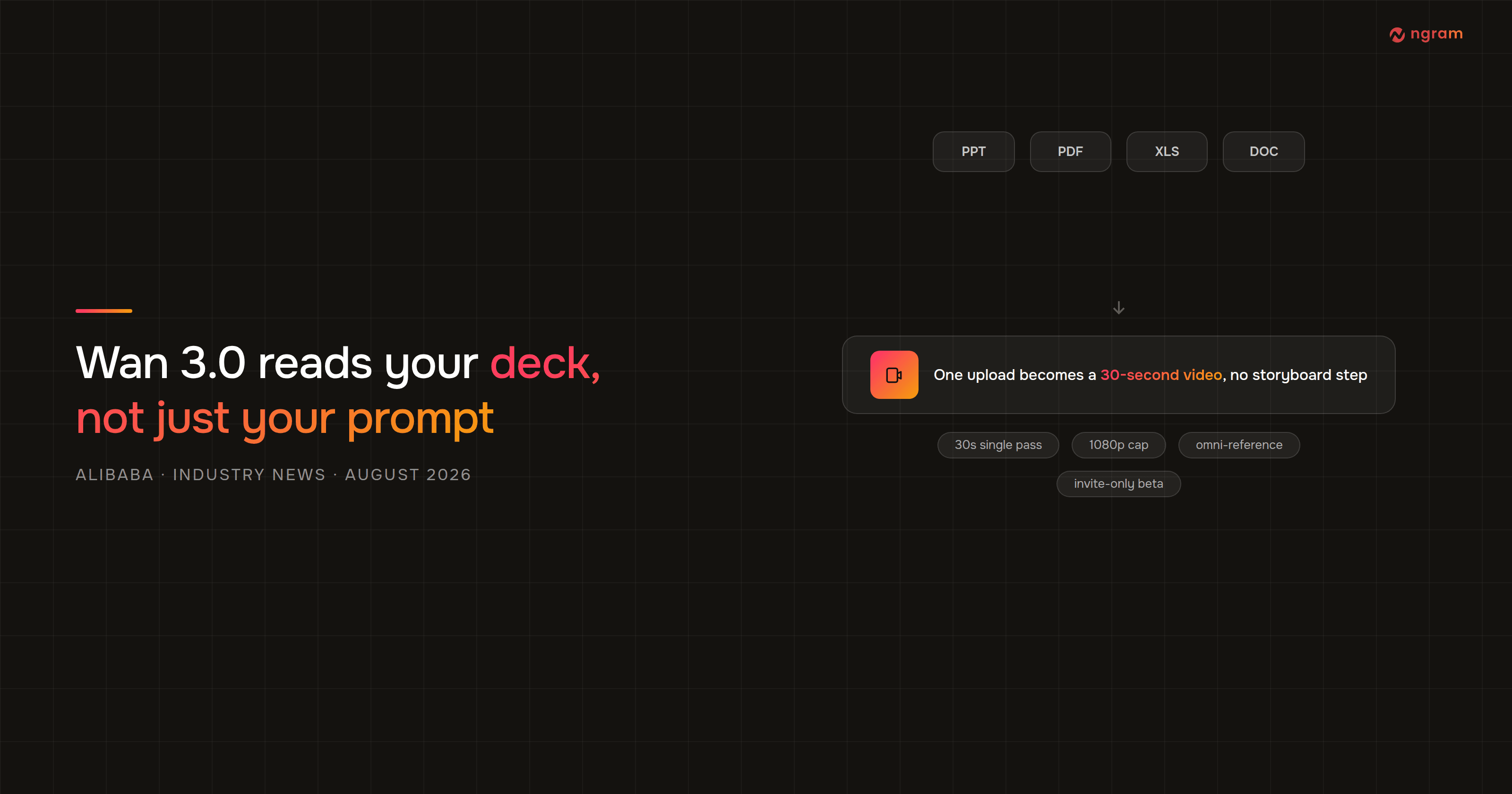
What's actually new is the input list. Wan 3.0 accepts doc, xls, ppt, pdf, txt, key, and pages files directly as creative source material - the first model in the Wan line, and one of the first AI video models at all, built to read a PowerPoint deck or a spreadsheet and generate from it, rather than waiting for a human to boil it down into a prompt first.
What Alibaba Actually Shipped
Wan 3.0 replaces the four-model split that defined Wan 2.7 - separate text-to-video, image-to-video, reference-to-video, and editing models - with a single unified model that handles all of it. That's an architecture change, not a repackaging: it removes the model-switching step from multi-stage pipelines, so reference, editing, replication, and motion driving all run through the same weights.
The confirmed specifications:
- Native 30-second single-pass generation, up from the shorter per-pass output Wan 2.7 needed multiple runs to cover
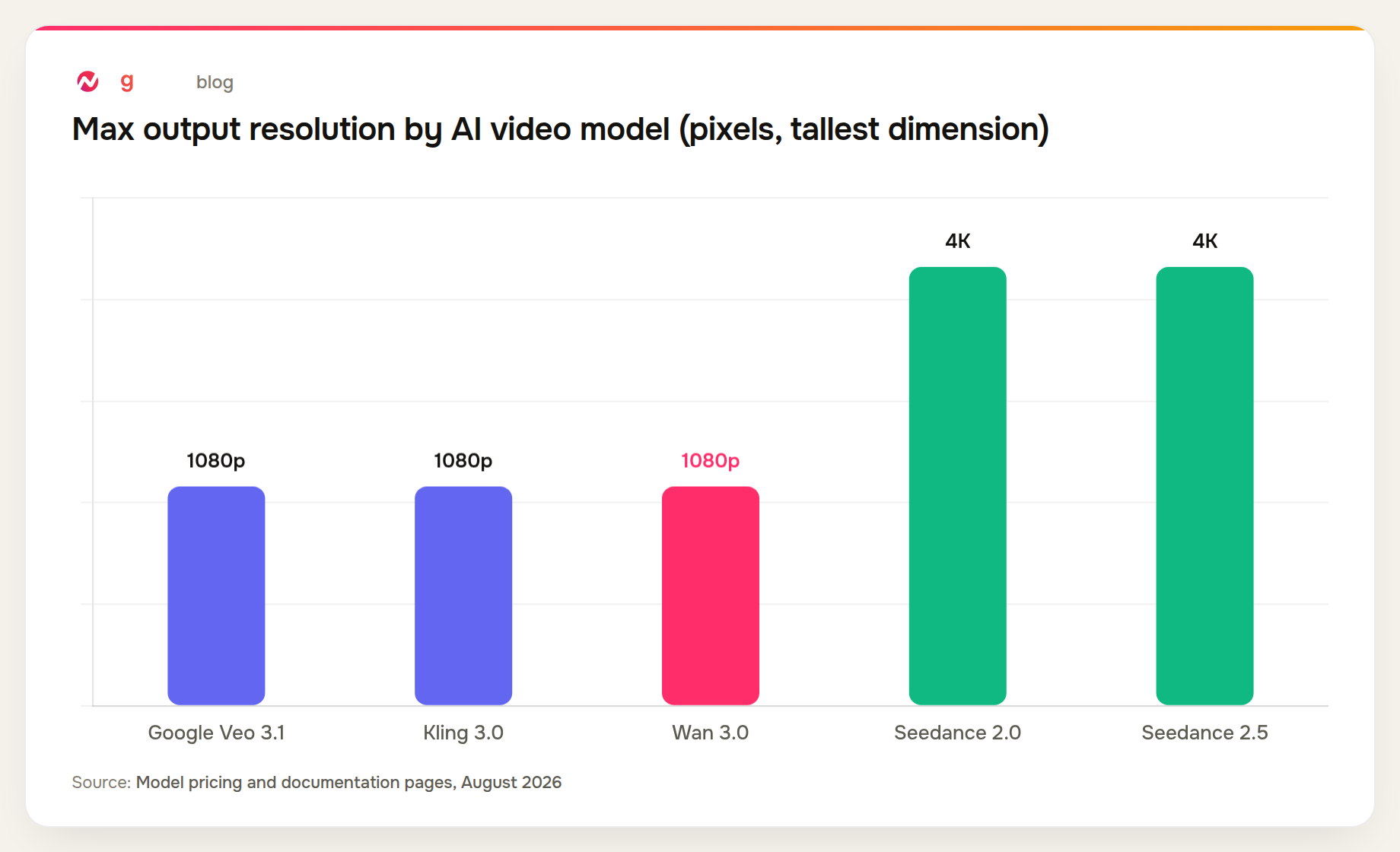
- Maximum output resolution of 1080p - no 4K tier, despite the number that circulated in pre-launch coverage (more on that rumor below)
- An omni-reference input system: text, image, audio, video, and now documents (doc, xls, ppt, pdf, txt, key, pages), all usable as creative references within the same generation
- Generation modes covering text-to-video, image-to-video, first-frame and first-and-last-frame control, and reference-to-video
- Reference limits of up to 10 images, 5 videos, and 5 audio files per generation; when a video reference is included, its duration plus the requested output is capped at 30 seconds combined
- Audio generation enabled by default on every clip, rather than as an opt-in add-on
Access is gated. Wan 3.0 is live on Alibaba Cloud Model Studio's Beijing and Singapore (ap-southeast-1) endpoints and on Qwen Cloud, but only for invited accounts, which is why the beta reads as public in the announcement and invitation-only on the pricing page. A members-only surface at wan.video is described as coming soon for consumer-facing access, and Alibaba hasn't published open-source weights or inference code for Wan 3.0 - a departure from Wan 2.1 and 2.2, which did ship openly.
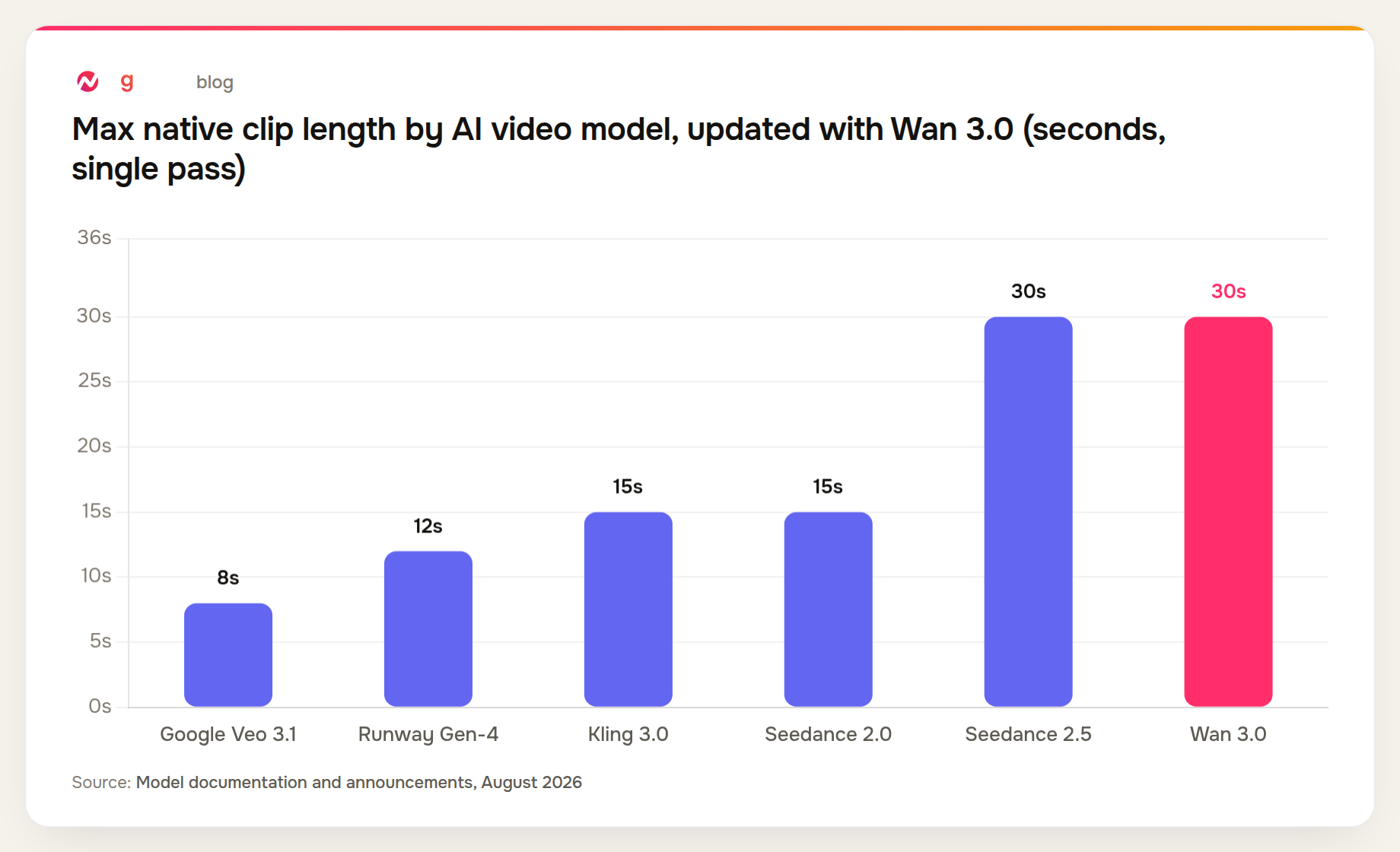
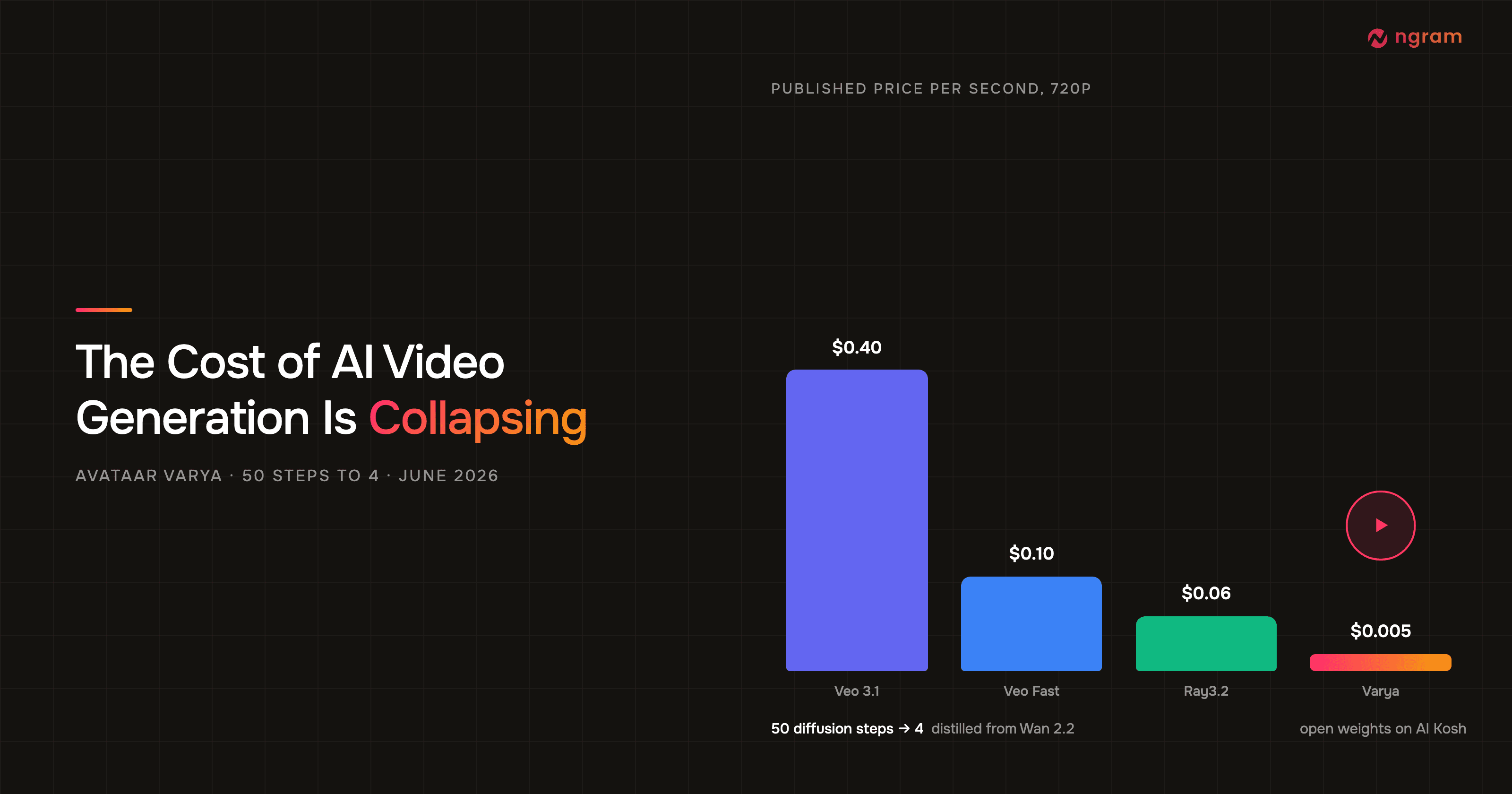
That chart is also why Wan 3.0's own marketing doesn't lead with clip length. By the time it shipped, 30 seconds in a single pass was already the number to match, not a number that wins anything on its own.
The Real News Is the Input
For most of 2025 and 2026, AI video models competed almost entirely on the output side of the pipeline: how long a clip could run, how sharp it looked, how well it held a character's face across a scene. That's a real axis of progress, and it's mostly played out for now. Veo 3.1 sits at 8 seconds, Kling 3.0 and Wan 2.7 topped out around 15, and Seedance 2.5 broke 30 first, in June.
Wan 3.0 arrives into that same race and, notably, doesn't try to win it again. Alibaba's own materials avoid direct comparative claims against Seedance 2.5, Kling, or Veo - there's no "faster than X" or "sharper than Y" framing anywhere in the beta announcement. Instead, the pitch leads with document input: hand the model a deck, a PDF, or a spreadsheet, and it reads the source content and generates from it.
That's a genuinely different axis, and as far as our research turned up, none of the other frontier video models accept office documents as a native input format the way Wan 3.0 does. Sora 2 and Veo 3.1 take text prompts and image references. Kling 3.0 and Seedance 2.5 add video references on top of that. None of them take a .pptx file.
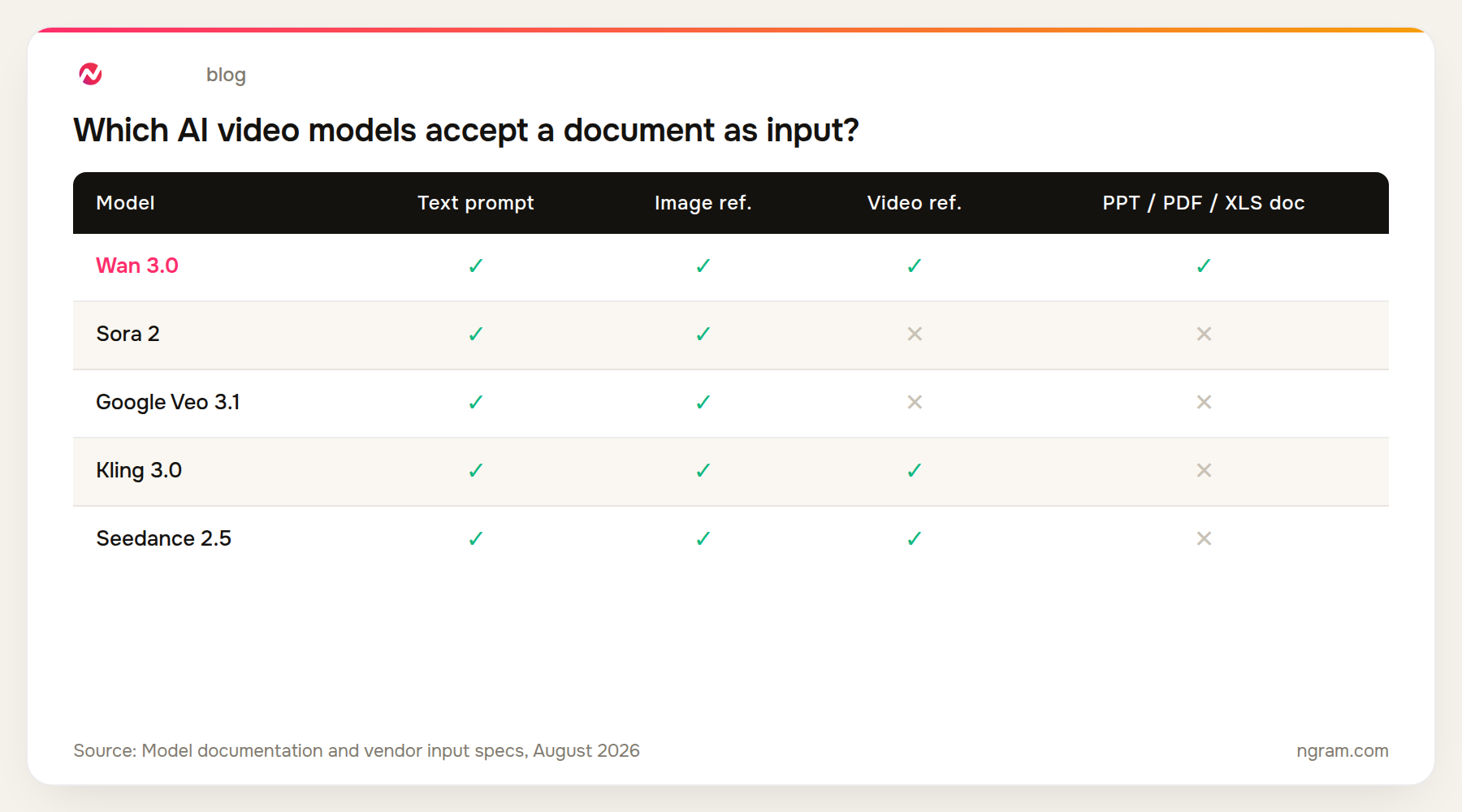
The gap is specific enough to matter in practice. A prompt-only model still needs a human to read the deck, decide what's worth keeping, and write it up as a description before generation even starts. Wan 3.0's omni-reference system does that first pass itself, using the model's own language understanding to parse the document's structure - headings, bullet points, table values - rather than treating it as a flat image or forcing someone to summarize it into a paragraph first.
What Document-to-Video Actually Collapses
It helps to lay out the pipeline this replaces. A team turning an existing slide deck into a video with a prompt-only model works through something like: read the deck end to end, decide which slides matter, write a script that captures the key points, break the script into a scene-by-scene storyboard, then generate against that storyboard scene by scene, since a single generation still can't hold an entire multi-topic deck's worth of content.
Wan 3.0 compresses that into upload the deck, add a prompt describing the tone or audience, and generate. The model's document parsing stands in for the "read it and decide what matters" step; its omni-reference conditioning stands in for the storyboard.
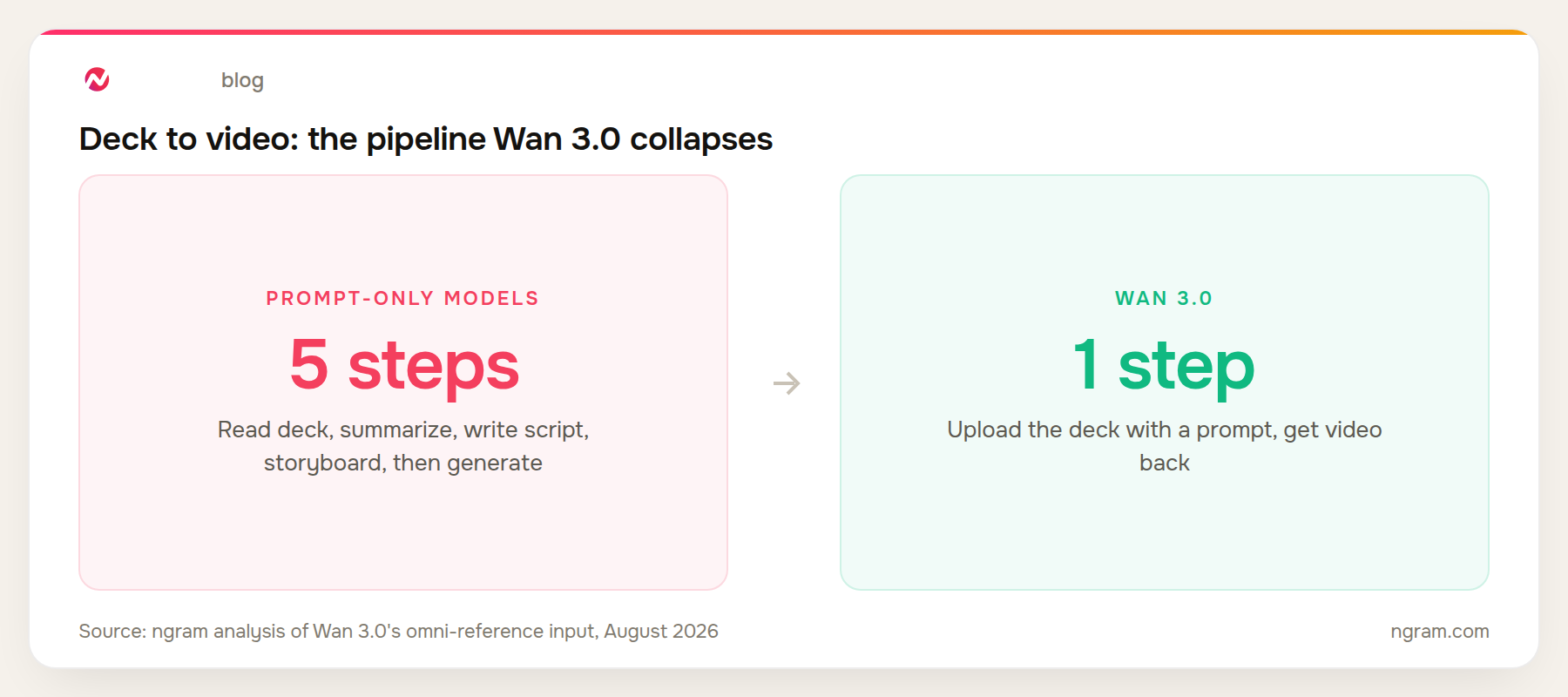
The editorial judgment still happens - the model does more of it by default, so the result needs a review pass more than a construction pass. A video generated from a 40-slide quarterly deck still needs someone checking that Wan 3.0 kept the right five points. Document input moves that judgment earlier in the process and makes it lighter, but the work remains.
Who Benefits Most (and Who Doesn't)
The teams best positioned to use this on day one are the ones already sitting on a stack of unused source material. Sales teams have pitch decks that never got turned into a shareable product demo video. L&D and support teams have SOPs and onboarding manuals that could become training video content. Finance and IR teams have quarterly decks that could become recap videos. For those teams, the bottleneck was never "we can't generate video" - it was "someone has to convert the deck into a prompt first," and that conversion step is exactly what document input removes.
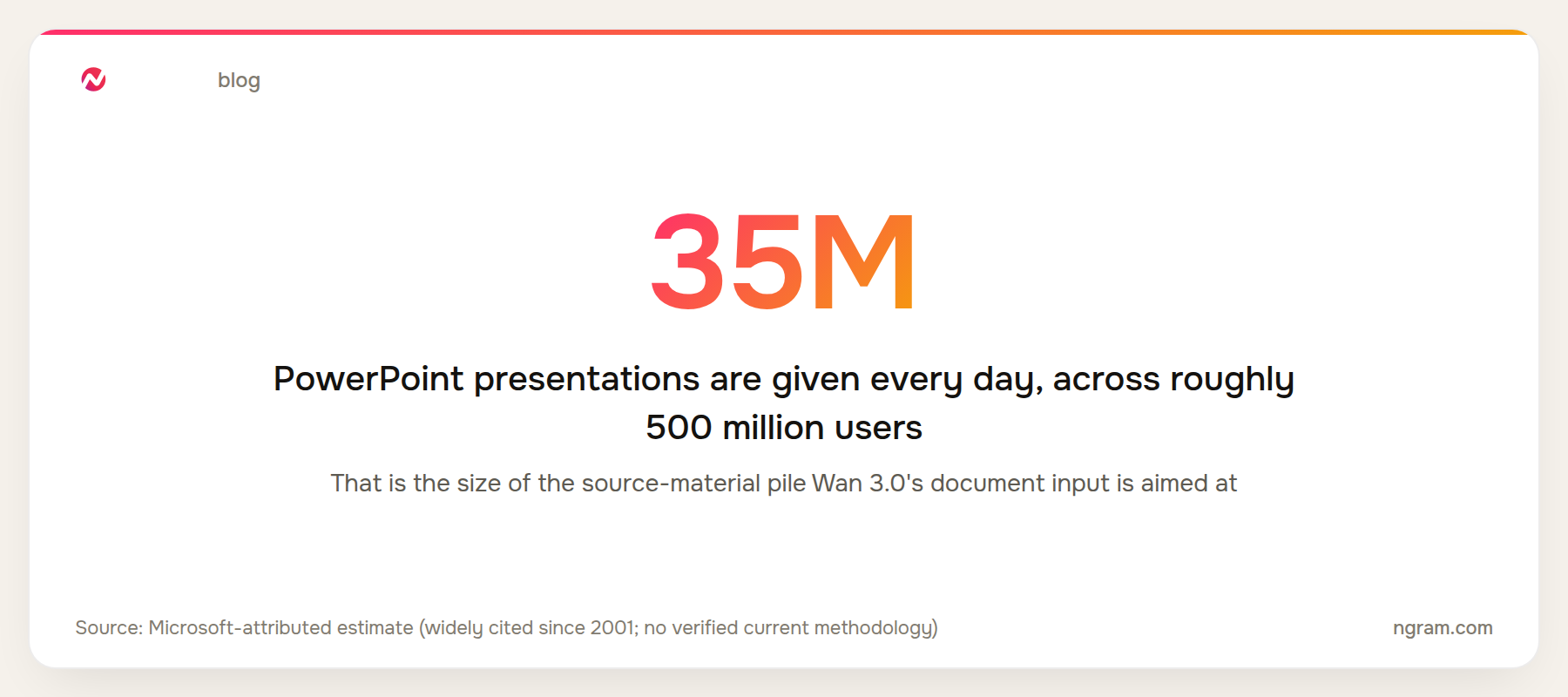
Solo creators and social-first teams get less out of this specific capability, mostly because they were never storyboard-blocked in the same way - a lot of that work starts from a blank prompt or a single image, not an existing 40-slide deck. For that audience, the invitation gate on the beta and the 1080p ceiling matter more than the document parsing does.
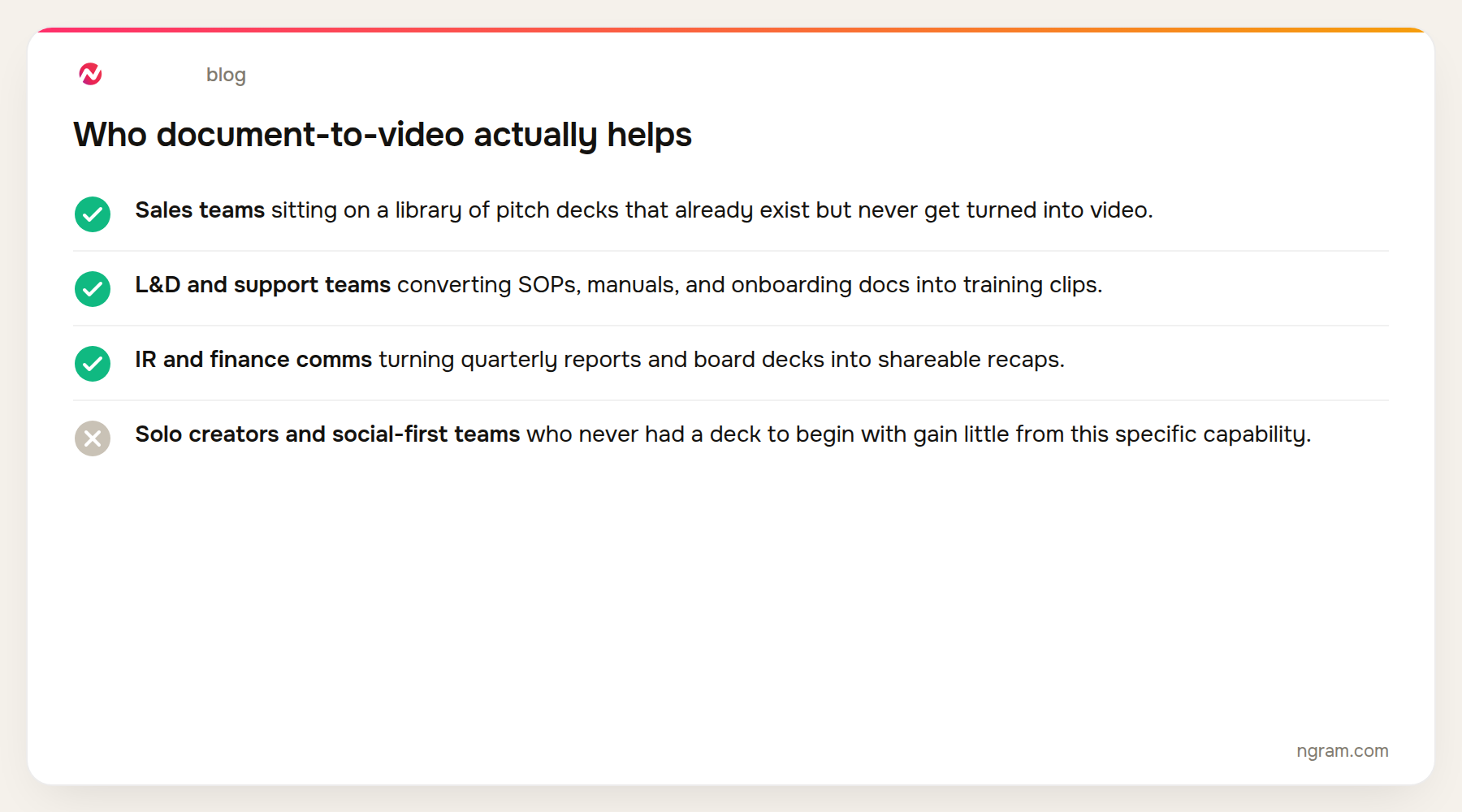
Who document-to-video helps most, and who it doesn't move the needle for.
The Trade-offs: What Wan 3.0 Doesn't Have Yet
Three things are worth flagging before treating this as a finished product.
No 4K, despite the rumor
Pre-launch coverage widely repeated a claim that Wan 3.0 would ship native 4K output. It doesn't. Alibaba's own pricing page stops at 1080p, with no 4K tier listed anywhere. The rumor appears to trace back to a mix-up with wan2.7-image-pro, which supports 4096x4096 output for text-to-image tasks only; that spec got carried over into video coverage incorrectly. ByteDance's Seedance 2.5, for comparison, was announced with native 4K in a single pass, though production API documentation reviewed in early August lists only 480p and 720p tiers for that model as well - so treat both 4K claims as announced specs rather than independently confirmed, shipped output.
Invite-gated, regional, and not open
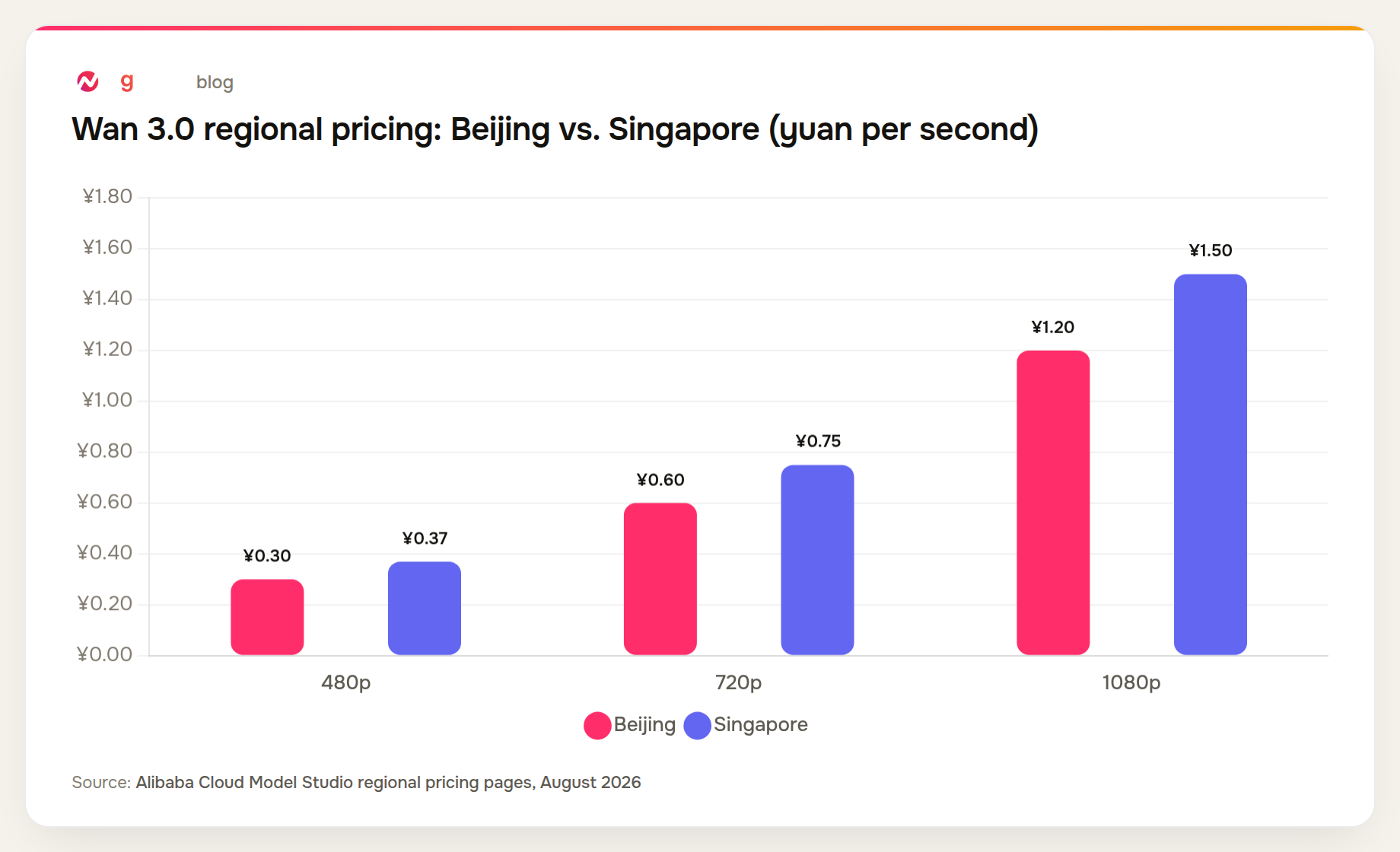
Wan 3.0 isn't broadly available. Access runs through Alibaba Cloud Model Studio's Beijing and Singapore endpoints and requires an invited account; the promised wan.video consumer surface hasn't shipped. Regional pricing isn't uniform either. Per Model Studio's published rates, Beijing charges ¥0.30, ¥0.60, and ¥1.20 per second at 480p, 720p, and 1080p against Singapore's ¥0.37, ¥0.75, and ¥1.50 - about 20% cheaper in Beijing at every tier, which matters if your team is deciding which endpoint to request access to.
No open weights, no independent benchmark
Wan 2.1 and 2.2 shipped with open weights; every version since, including 3.0, has stayed API-only. And as of this writing, Wan 3.0 doesn't appear on the Artificial Analysis video arena leaderboard - the closest reference point is its predecessor, Wan 2.7, which ranks fourth at an Elo of 1,161, behind MiniMax H3's 1,238. Until Wan 3.0 gets its own independent placement, quality claims rest on Alibaba's own demonstration material.
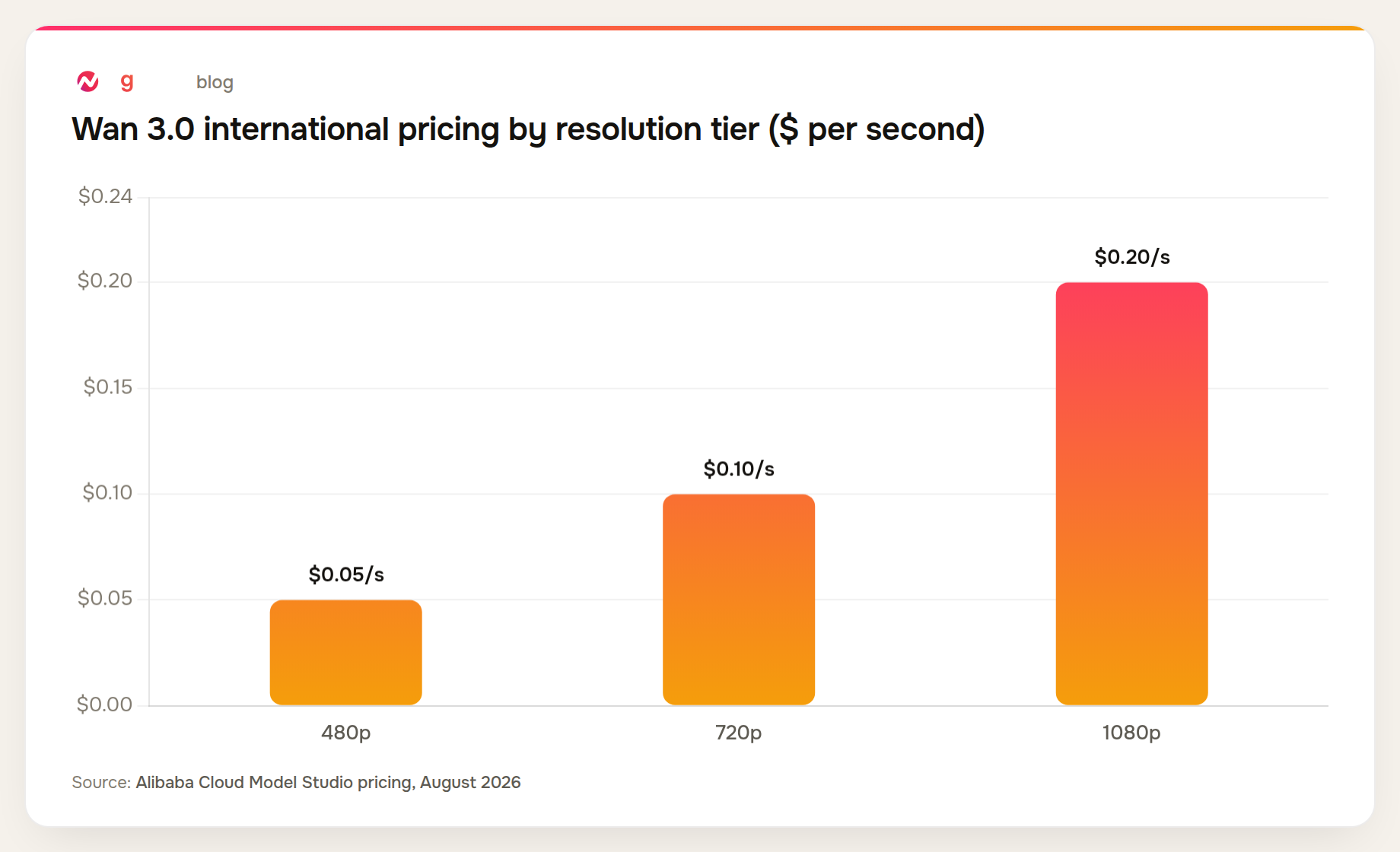
On pure compute cost, Wan 3.0's 1080p tier works out to $12 per minute, roughly a third more than Wan 2.7's 1080p rate, for the same resolution ceiling Wan 2.7 already had. The premium pays for the unified model and the document input; resolution stays exactly where Wan 2.7 left it.
How This Fits the Wider Production Stack
Wan 3.0 is a foundation model. Alibaba's own materials frame it as infrastructure other tools build on, distributed through Model Studio and Qwen Cloud rather than a consumer app. Its actual effect on video creation shows up in whatever gets built on top of it.
That's also where "document-to-video" turns out to be less new than it sounds at the model layer. At the product layer, ngram already parses PDF and Markdown documents as script source material, and extracts a PPTX or PDF deck slide by slide into a scene-by-scene blueprint that becomes the video itself. What changed on August 6 is that a foundation-model vendor is now racing to catch up to a capability that already ships at the orchestration layer, one underlying video model at a time.
Already sitting on a deck that never became a video? ngram turns a slide deck into a finished video today - script, scenes, voiceover, and captions included. Try it free.
What to Watch Next
A few open questions will decide whether Wan 3.0's document input becomes a genuine production input or stays an interesting beta feature. Does the wan.video consumer surface ship, and does access open up beyond invited accounts? Does Alibaba publish Wan 3.0 on the Artificial Analysis leaderboard, or does the model stay unranked while quality claims rest on demonstration material? Does a 4K tier eventually arrive, and does regional pricing converge? And does the document parsing hold up on messy, real-world decks, the ones with inconsistent formatting, embedded charts, and speaker notes that carry half the meaning, rather than just the clean four-bullet slides used in demos?
Wan 3.0 also lands in a market that's moved fast this year. OpenAI announced Sora's shutdown in March, with the app going fully dark in April. Seedance 2.0 was frozen globally that same March following a Hollywood cease-and-desist, before ByteDance shipped Seedance 2.5 with new IP guardrails in July. Alibaba has been filling the resulting gap - HappyHorse 1.1 shipped in June, and Wan 3.0 is the next move in that same push. The document input bet is Alibaba's attempt to compete on a dimension the rest of the field hasn't touched yet, instead of re-running the clip-length race a second time.
Frequently Asked Questions
What is Wan 3.0?
Wan 3.0 is Alibaba Tongyi Lab's latest AI video model, announced as a public beta on August 6, 2026. It generates up to 30 seconds of video in a single pass at up to 1080p and is the first model in the Wan line to accept office documents - PowerPoint decks, PDFs, spreadsheets, and more - directly as source material for generation.
What file formats can Wan 3.0 accept as input?
Beyond standard text prompts, images, audio, and video references, Wan 3.0's omni-reference system accepts doc, xls, ppt, pdf, txt, key, and pages files. A single generation can combine up to 10 images, 5 videos, and 5 audio files as references; if a video reference is used, its duration plus the requested output is capped at 30 seconds combined.
How is Wan 3.0 different from Wan 2.7?
Wan 2.7 split its capabilities across four separate models - text-to-video, image-to-video, reference-to-video, and editing. Wan 3.0 unifies all of that into a single model, adds native 30-second single-pass generation (up from Wan 2.7's shorter per-pass output), and adds document input, which Wan 2.7 didn't support at all.
Does Wan 3.0 support 4K video?
No. Despite widely circulated pre-launch claims, Wan 3.0's confirmed output tops out at 1080p, with pricing tiers at 480p, 720p, and 1080p and nothing higher. The 4K rumor traces back to a mix-up with a Wan 2.7 image model's 4096x4096 output, which applied to still images, not video.
How much does Wan 3.0 cost?
International pricing on Alibaba Cloud Model Studio runs $0.05 per second at 480p, $0.10 per second at 720p, and $0.20 per second at 1080p, so a full 30-second 1080p clip costs about $6. Regional pricing in China differs: Beijing charges ¥0.30, ¥0.60, and ¥1.20 per second across the same three tiers, with Singapore priced roughly 25% higher.
Is Wan 3.0 available to everyone?
Not yet. Alibaba announced a public beta, but access is gated to invited accounts on Alibaba Cloud Model Studio (Beijing and Singapore endpoints) and Qwen Cloud, where the API reference calls the model a preview and the pricing page marks it invitation-only. A consumer-facing surface at wan.video is described as coming soon, and Alibaba hasn't published open-source weights, unlike Wan 2.1 and 2.2.
How does Wan 3.0 compare to Seedance 2.5?
On native clip length, they're now tied - both generate 30 seconds in a single pass, after Seedance 2.5 reached that number first in June. On resolution, Seedance 2.5 was announced with native 4K, while Wan 3.0 confirms only 1080p. Wan 3.0's real differentiator is document input: neither Seedance 2.5 nor any other major model accepts office documents as a native reference format the way Wan 3.0 does.
Does document-to-video eliminate the need for a script or storyboard?
Not entirely. Wan 3.0's document parsing replaces the manual step of reading a deck and turning it into a prompt, but a generated video still needs human review - checking that the model picked the right points to keep from a long document, that the pacing works, and that the tone matches the audience. Most production teams, including those using tools like ngram that already turn decks into structured multi-scene videos with a script, voiceover, and captions attached, treat AI-driven document parsing as a fast first draft that still needs editorial judgment before publishing.