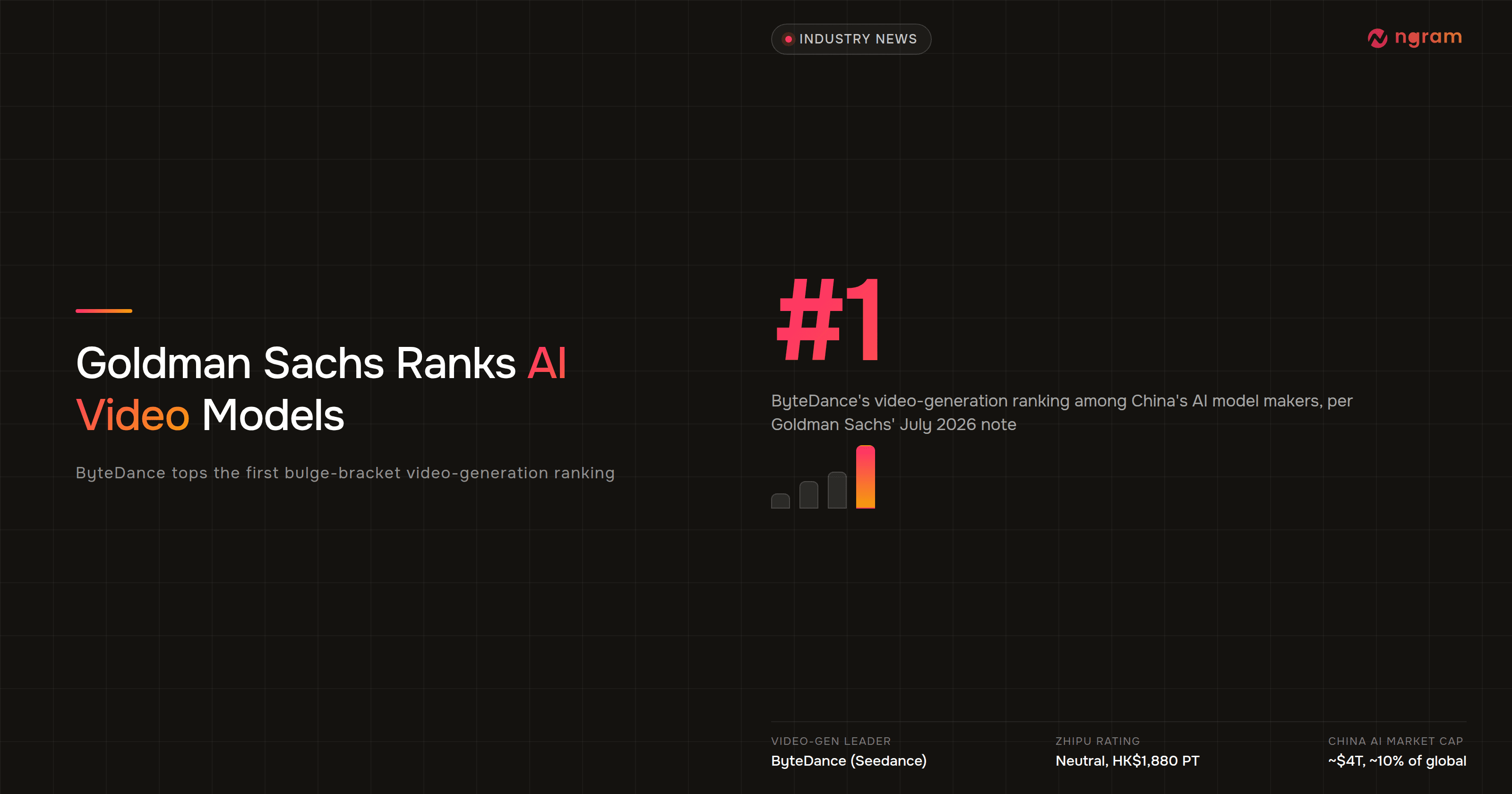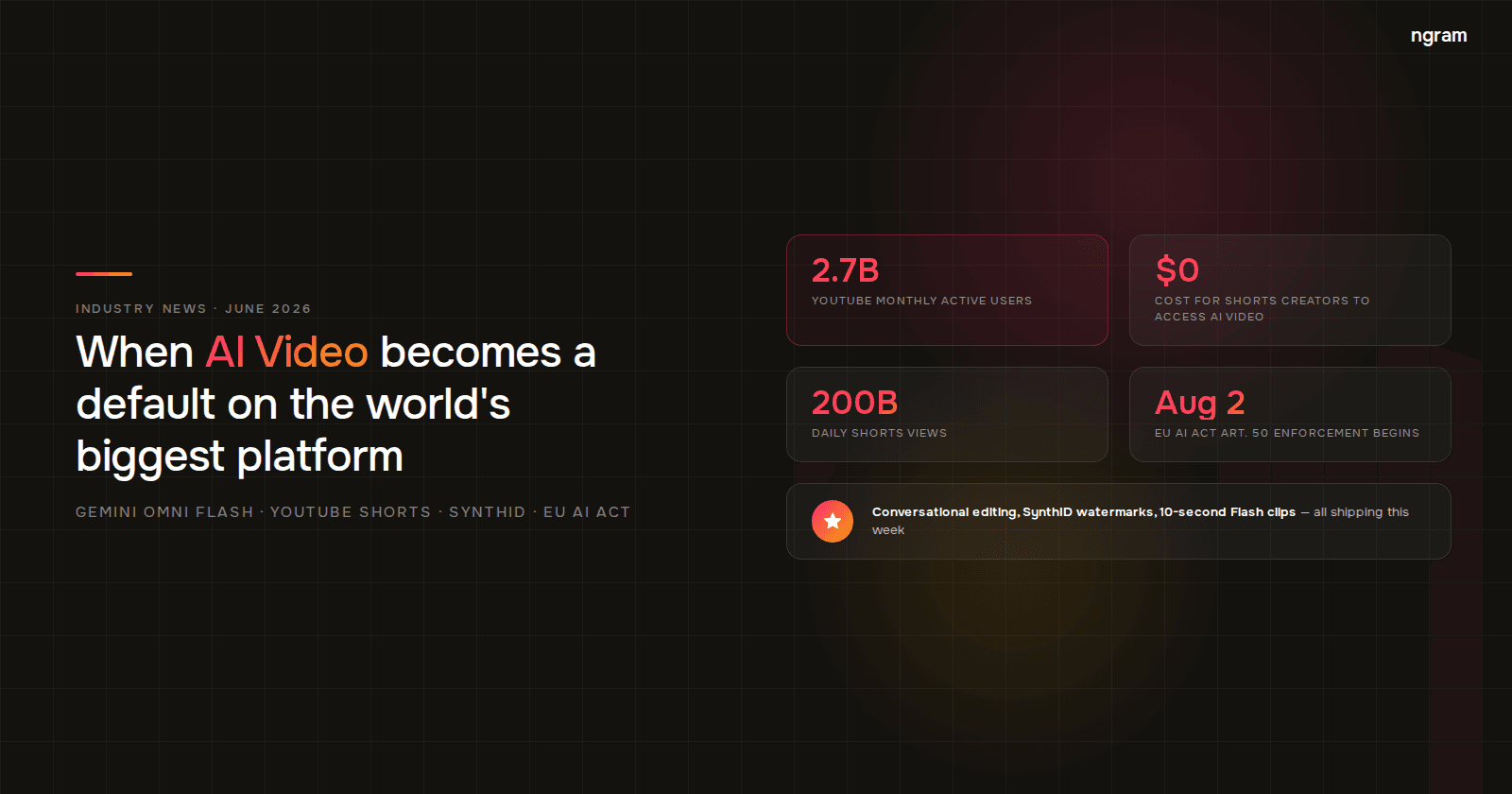

On June 2, 2026, Google did something that most AI video companies cannot do: it handed free AI video generation to 2.7 billion people who were already in the app.
Gemini Omni Flash, announced at Google I/O 2026 on May 19 and rolling out to YouTube Shorts and the YouTube Create App this week, is not a subscription add-on, not a professional tool hidden behind a paywall. It is a free default for every eligible creator on the world's largest video platform.
The model itself is interesting. What it reveals about where AI video is going is more interesting. This post is about the second thing.
What Gemini Omni Flash Actually Ships
Gemini Omni is Google's unified multimodal model: it takes text, images, audio, and video as inputs and generates video as output. Omni Flash is the first model in the family, and it ships with a specific set of capabilities and a specific set of holdbacks.
What launched this week in YouTube Shorts:
- Conversational video editing. Users describe changes in plain language, and each instruction builds on the previous one. Characters, objects, and environments stay consistent across iterations without starting over.
- Multi-input generation. Text, images, reference videos, and audio can all be used as starting material. The model blends them into a single coherent output.
- 10-second Flash clips. The clip length is capped as a distribution policy decision, not a model constraint, according to WaveSpeed's technical analysis.
- SynthID watermarking on every output. The watermark is imperceptible to viewers but detectable through the Gemini app, Chrome, and Google Search.
- Physics simulation improvements. The model shows better handling of gravity, kinetic energy, and fluid dynamics, which matters most for realistic-looking scene generation.
What did not launch, and why it matters:
- Voice and avatar editing of existing videos. The team confirmed this is being withheld because of deepfake and election integrity concerns. The architecture supports it; the deployment decision is a deliberate hold.
- Developer and enterprise API access. This is still "coming in the coming weeks," per the Google I/O 2026 announcement. Enterprise workflows, production pipelines, and third-party integrations wait.
For paid Gemini app subscribers (starting at $7.99 per month for AI Plus), Omni Flash also rolls out via the Gemini app and Google Flow. But the YouTube Shorts integration is where the scale story lives.
The Scale Is What Changes Everything
YouTube has over 2.7 billion monthly active users as of 2026. YouTube Shorts alone has crossed 2 billion monthly active users and now generates over 200 billion daily views, up from 70 billion in early 2024. More than 6.5 million creators actively upload Shorts every month.
No other AI video tool has reached this starting distribution point for content creators. Not even close.
The chart below shows how YouTube Shorts compares to other short-form platforms by monthly active users.
What Google has done here is not launch a competing AI video tool. It has embedded AI video generation into a platform people already use daily, removed the cost barrier entirely for Shorts creators, and done it while its model sits in the same competitive tier as Kling and other top performers on the Artificial Analysis video leaderboard.
Conversational Editing Is a Different Paradigm
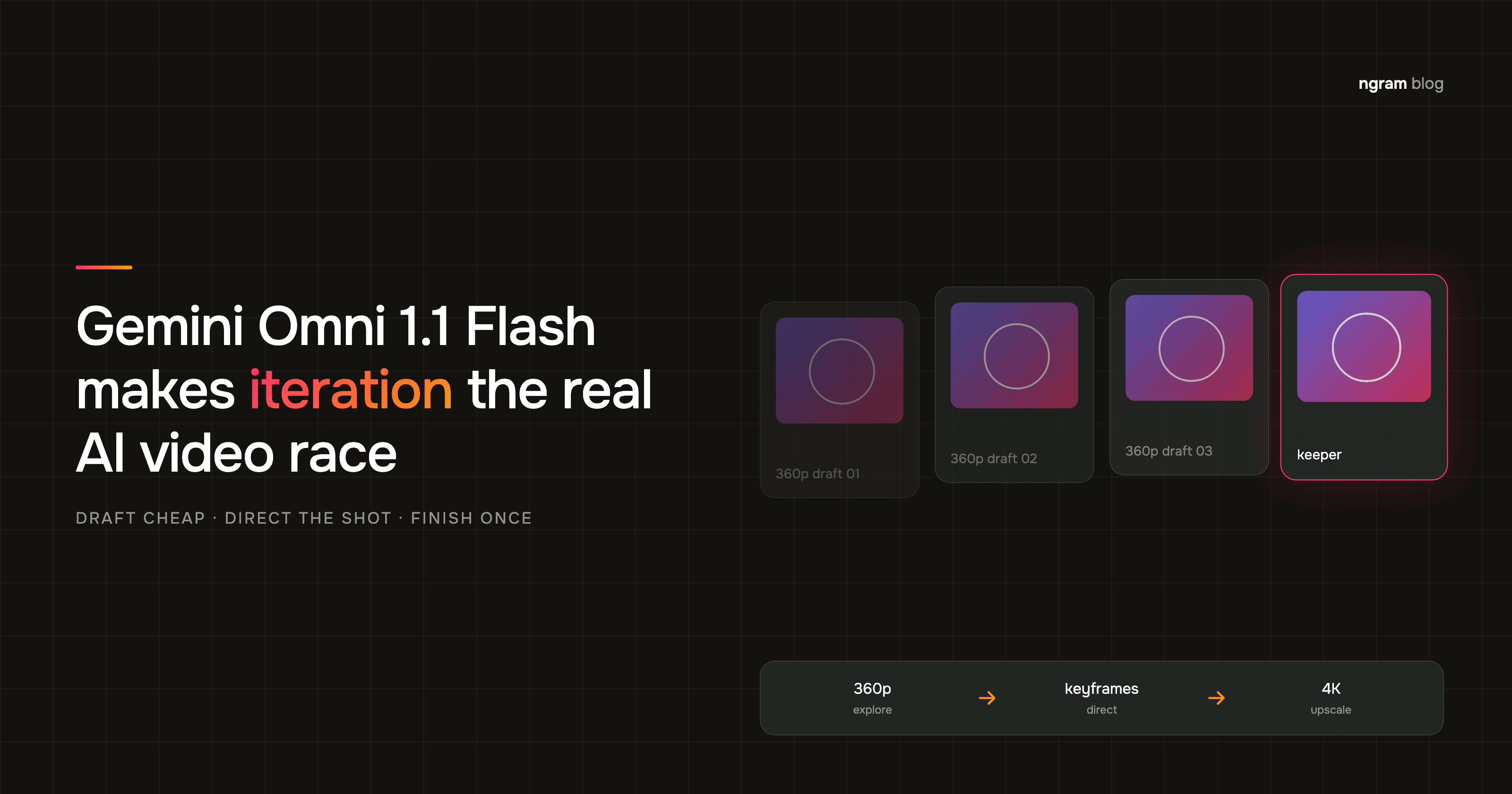
Most AI video generation today works the same way: you write a prompt, the model renders a clip, you decide whether to keep it or try again. It is fast, but it is also wasteful. Every unsatisfactory output is discarded.
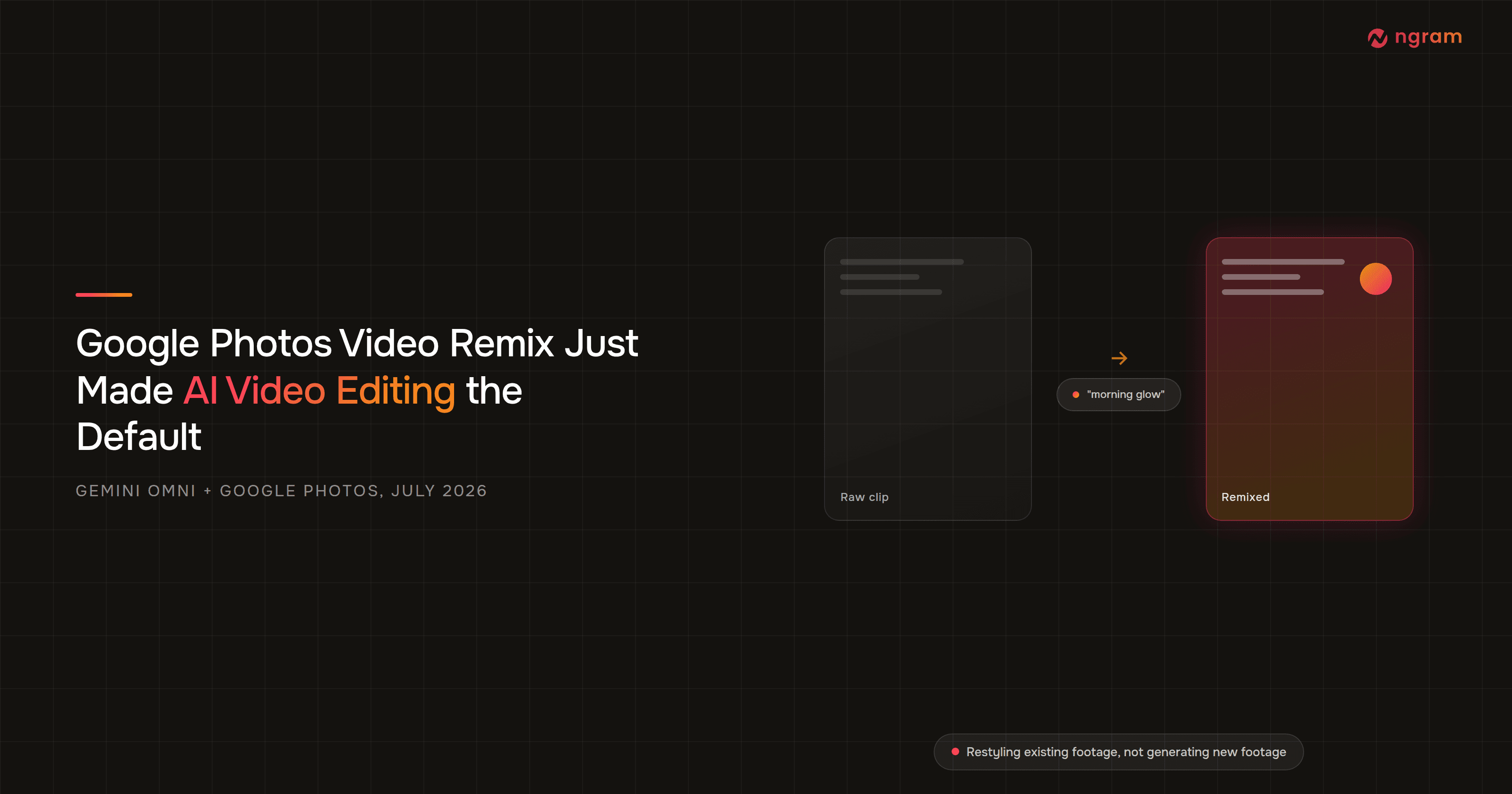
Omni Flash operates differently. The conversational interface means you can say "make the lighting warmer" or "change the background to a forest" and the system applies the change while keeping everything else consistent. Characters stay the same. The camera angle stays the same. The edit is incremental.
Sundar Pichai described the model's goal as being able to "create anything from any input" - the shift toward simulating reality rather than predicting text, per Google's I/O 2026 keynote recap. Google DeepMind's team framed Omni as "the next step towards the progression of combining the intelligence of Gemini with the rendering capabilities of our media models."
The practical implication: creators who previously needed multiple tools and multiple render cycles to get to an acceptable clip now have an iterative conversation instead. That is a workflow change, not just a speed improvement.
There is a known limitation worth flagging. Editing prompts need to be specific. Vague instructions can cause unintended changes to parts of the scene the creator wanted to preserve. This is the expected behavior at this stage of conversational video editing.
SynthID, the EU AI Act, and Why Platform-Level Watermarking Matters
Every Gemini Omni Flash output carries a SynthID watermark. The watermark is not visible to viewers, but it is detectable through Google's own tools and it ships whether the user wants it or not. There is no API toggle to disable it.
The timing is deliberate. EU AI Act Article 50 requires that all AI-generated audio, image, video, and text be marked in a machine-readable format and detectable as artificially generated or manipulated. Enforcement begins August 2, 2026. Google is not scrambling to comply in the weeks before the deadline. The infrastructure is being built into the model by design, at launch.
YouTube has also started auto-labeling AI-generated content from May 2026 onward. According to TechCrunch's coverage, if a creator does not disclose AI use but the platform's internal signals detect significant photorealistic AI generation, YouTube now automatically applies a label. For videos created with YouTube's own tools, including Veo and Gemini Omni, labels are permanent.
The chart below shows how fast AI content labeling has scaled on TikTok since its C2PA integration in January 2025, giving a sense of what YouTube is now building toward.
TikTok has labeled over 1.3 billion AI-generated videos since integrating C2PA in January 2025. YouTube is starting from a larger base with the same infrastructure principle baked in. At YouTube's scale, the question is not whether AI content gets labeled. It is what happens to the information ecosystem when it does.
The Deliberate Holdback: Voice and Avatar Editing
The highest-profile missing capability in this launch is the ability to edit voice and facial likeness in existing videos. Omni's architecture supports it. The decision not to ship it is deliberate, and WaveSpeed's technical analysis confirms it was withheld specifically because of deepfake and election integrity concerns.
This is a genuinely hard problem that scales with distribution. At 100 users, a bad actor creating a fake video is an incident. At 2.7 billion potential users, it becomes infrastructure risk. The holdback is not unusual for a careful release. But it is also not free. Holdbacks at launch tend to create demand for the withheld capability, and alternative channels for misuse often emerge faster than responsible deployment can.
What this moment surfaces is a pattern that shows up every time a high-capability AI tool ships to mass scale: the hardest deployment decisions are not about the model. They are about who has access to the most powerful features, under what conditions, with what accountability infrastructure in place.
Google's answer today is SynthID plus mandatory labels plus a withhold on the highest-risk features. That is a reasonable starting position. It is not a permanent solution.
YouTube Shorts Daily Views Have Grown 186% in Two Years
The Shorts ecosystem Google is plugging Omni into has been growing at rates that make the distribution number feel underappreciated.
YouTube Shorts now receives over 200 billion daily views, up from 70 billion in early 2024. That is nearly a 186% increase in roughly two years. Shorts engagement sits at a 5.91% engagement rate across the platform.
This is the platform into which Gemini Omni Flash just landed. For comparison, Veo 2 came to Dream Screen in early 2025, and Veo 3 arrived for a smaller creator set later that year. Each of those was additive to an existing creator audience. Omni Flash flips the direction: the feature is now default, not opt-in.
The API Gap and What It Means for Enterprise Workflows
The developer and enterprise API for Gemini Omni Flash is not live yet. Google has confirmed it is coming in "the coming weeks," with no specific date or pricing structure announced.
That gap matters. The Shorts integration works well for individual creators making 10-second clips from a phone. It does not address what production teams, marketers, and enterprises actually need: structured scripts, multi-scene output, branded voice-over, formatted exports, and an API that plugs into an existing workflow.
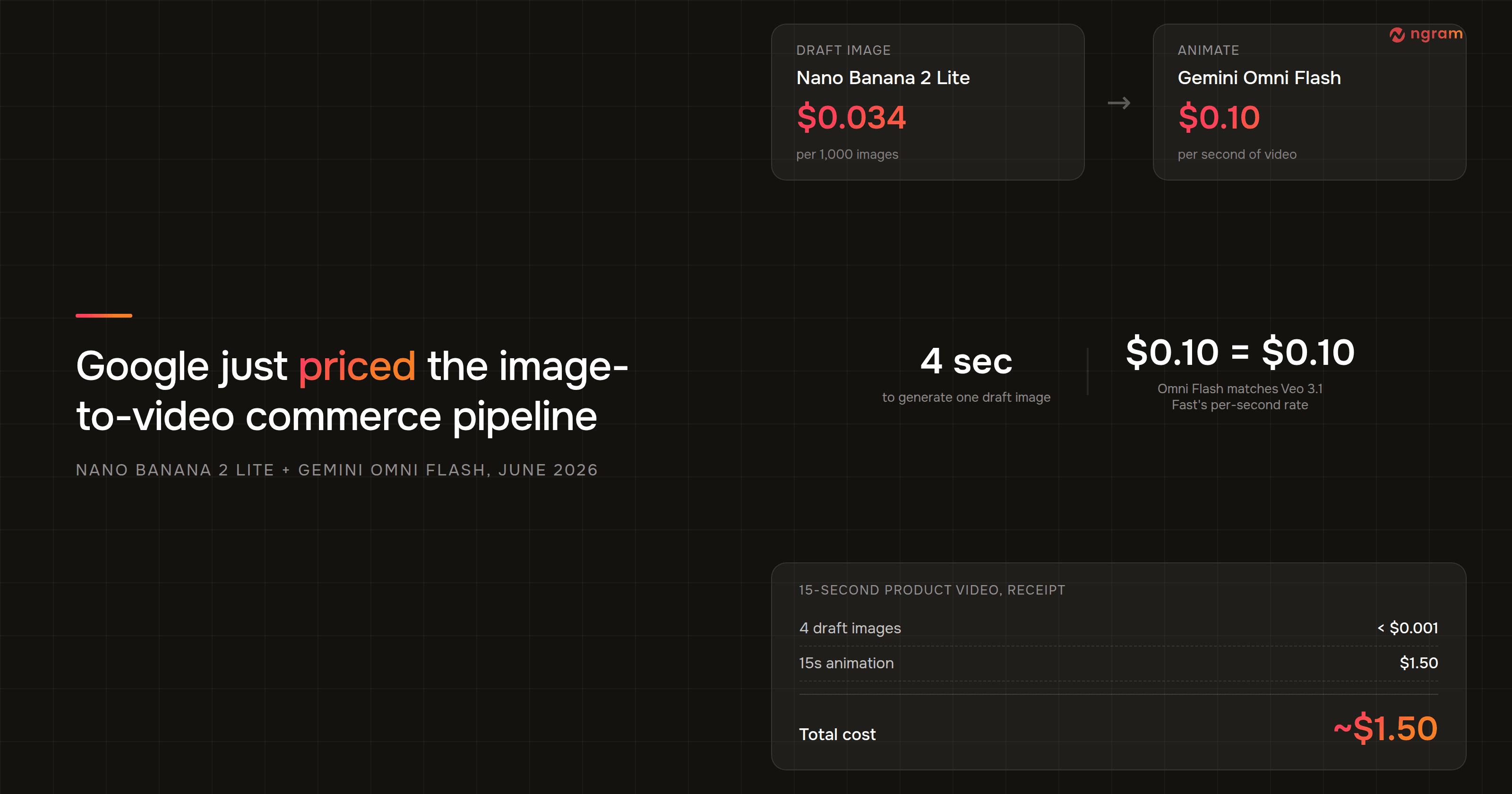
For that tier, Veo 3.1 remains the current production-grade API option. Veo 3.1 supports 720p, 1080p, and 4K output, natively generated audio, SynthID watermarking, and is available via the Gemini API and Vertex AI for enterprise accounts. According to Google's developer blog, Veo 3.1 Lite is also available at less than 50% of the Veo 3.1 Fast price, designed for high-volume production workflows.
The split is real: Omni Flash handles quick conversational creation inside the YouTube ecosystem at zero cost. Veo 3.1 handles structured API-driven production at a developer price point. They are not competing for the same use case.
What This Means for AI Video Tools Outside YouTube
The simplest take: free AI video inside YouTube will pull short clip creation toward native tools and away from standalone subscriptions. For creators who need a 10-second aesthetic Shorts clip, the path of least resistance is now already inside the app they are editing in.
The more useful frame is about what Omni does not replace. Generating a short clip from a vague prompt is a different task than building a structured product video, a multilingual training walkthrough, or a full-length explainer from a product URL or a script. Those workflows require planning before generation, voice-over aligned to script, brand consistency across multiple scenes, and export into formats built for specific channels.
Tools like ngram operate at a layer above the base model: prompt or URL in, script and storyboard planned first, AI scenes and voice-over composed across multiple scenes, final export in the right format and aspect ratio for each channel. That full-production pipeline is not what Omni Flash shipped this week. It is the workflow that enterprise and marketing teams need when a 10-second clip is the start of the story, not the end.
The broader pattern here is that as base-model AI video becomes a free default, the differentiation shifts to the layer above it: what gets planned, structured, and orchestrated before the generate button is pressed.
Frequently Asked Questions
Is Gemini Omni Flash the same as Veo?
No. Veo is Google's text-to-video model designed for developer and enterprise API access, currently at the Veo 3.1 version. Gemini Omni is a separate model family built around multimodal input and conversational editing, designed for consumer and platform integration. Veo converts prompts to video clips; Omni supports iterative conversation-driven generation across multiple input types.
Can AI videos be monetized on YouTube after this change?
Yes. YouTube confirmed that AI-labeled videos will not be penalized in the recommendation algorithm and will not lose access to monetization. The labels are informational, not punitive. Content created with YouTube's own tools, including Gemini Omni, receives a permanent label, but that does not affect revenue eligibility.
What is SynthID and why does every Omni output carry one?
SynthID is Google DeepMind's digital watermarking system. It embeds an imperceptible but detectable signal into AI-generated content. For Gemini Omni, SynthID is applied to every output without exception and there is no option to disable it. This is partly a safety choice and partly regulatory preparation, as EU AI Act Article 50 requires machine-readable labeling of AI-generated content starting August 2, 2026.
Why was voice and avatar editing withheld?
Per WaveSpeed's analysis, the holdback is driven by deepfake and election integrity concerns. Editing a person's voice or face in an existing video, at the distribution scale YouTube operates, creates accountability challenges that are not yet resolved. The capability exists in the model; the policy decision is to defer it until the safety infrastructure is more robust.
When will the Gemini Omni developer API launch?
Google has said the API is coming "in the coming weeks" from the June 2 rollout. No specific date, pricing, or enterprise terms have been announced. For developer workflows today, Veo 3.1 via the Gemini API and Vertex AI is the recommended production path.
How does Gemini Omni Flash compare to other top AI video models?
The current text-to-video leaderboard on Artificial Analysis (June 2026) shows HappyHorse-1.0 and Kling 3.0 among the top performers in blind user evaluations. Gemini Omni Flash's differentiation is not primarily about leaderboard position; it is about the conversational editing workflow and the distribution channel. A model embedded into YouTube's creator tools reaches a different audience than a model accessed via API.
What does EU AI Act Article 50 actually require for video content?
Article 50 requires providers of generative AI systems to ensure that audio, image, video, and text outputs are marked in a machine-readable format and detectable as artificially generated or manipulated. Deployers must disclose AI use when creating realistic synthetic content. Enforcement begins August 2, 2026, with a final Code of Practice expected by late June 2026. SynthID-embedded content from Gemini Omni addresses the provider obligation; creator disclosure policies on YouTube address the deployer side.
Does the Shorts integration replace standalone AI video tools for teams?
For quick 10-second aesthetic clips, Shorts native AI generation is now the easiest path for individual creators. For structured production workflows, including scripted multi-scene video, branded voice-over, MP4 export with separate channel-cut preparation, and team collaboration, the Shorts integration does not address those needs. Those workflows remain with purpose-built tools.