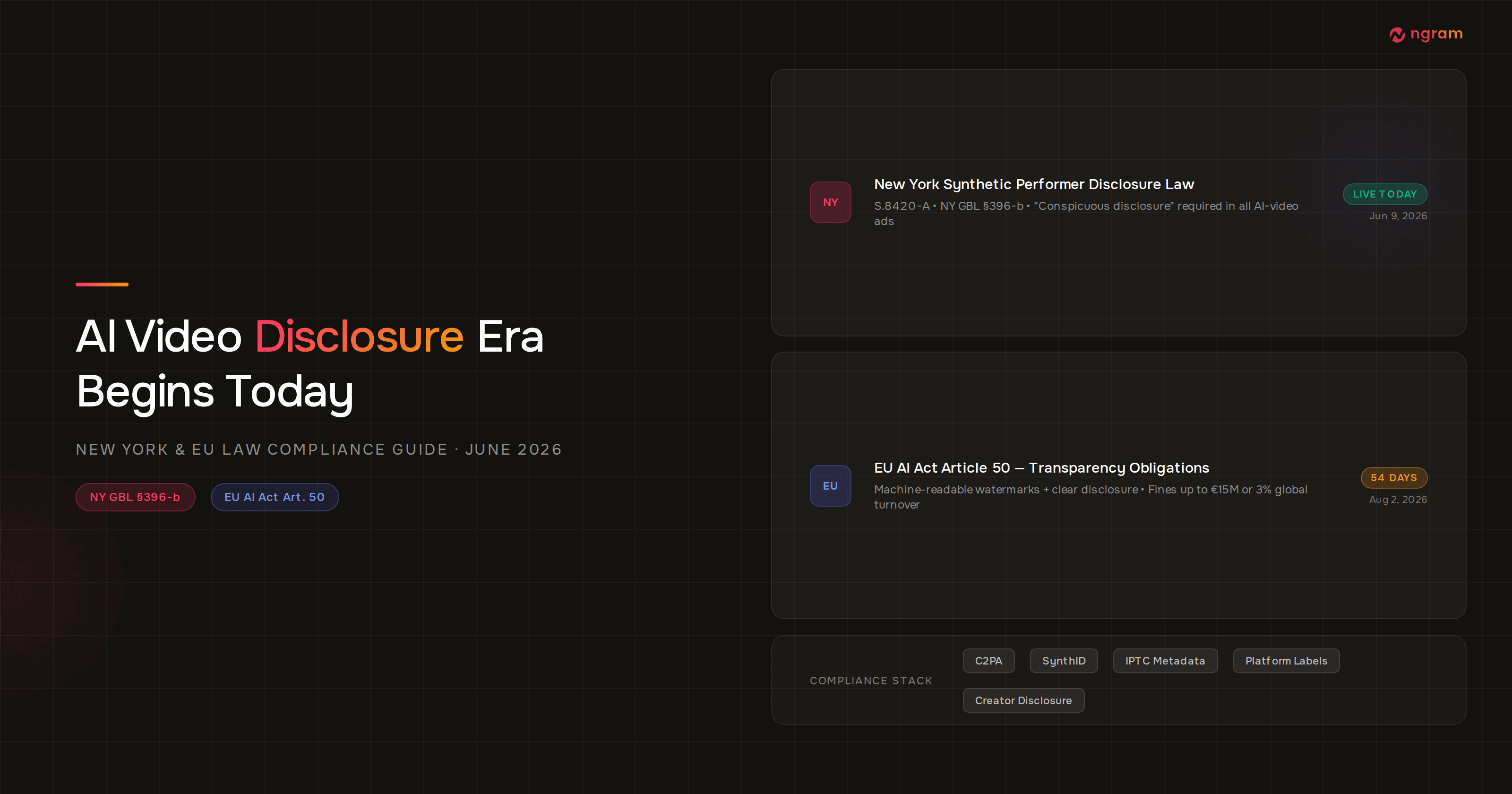

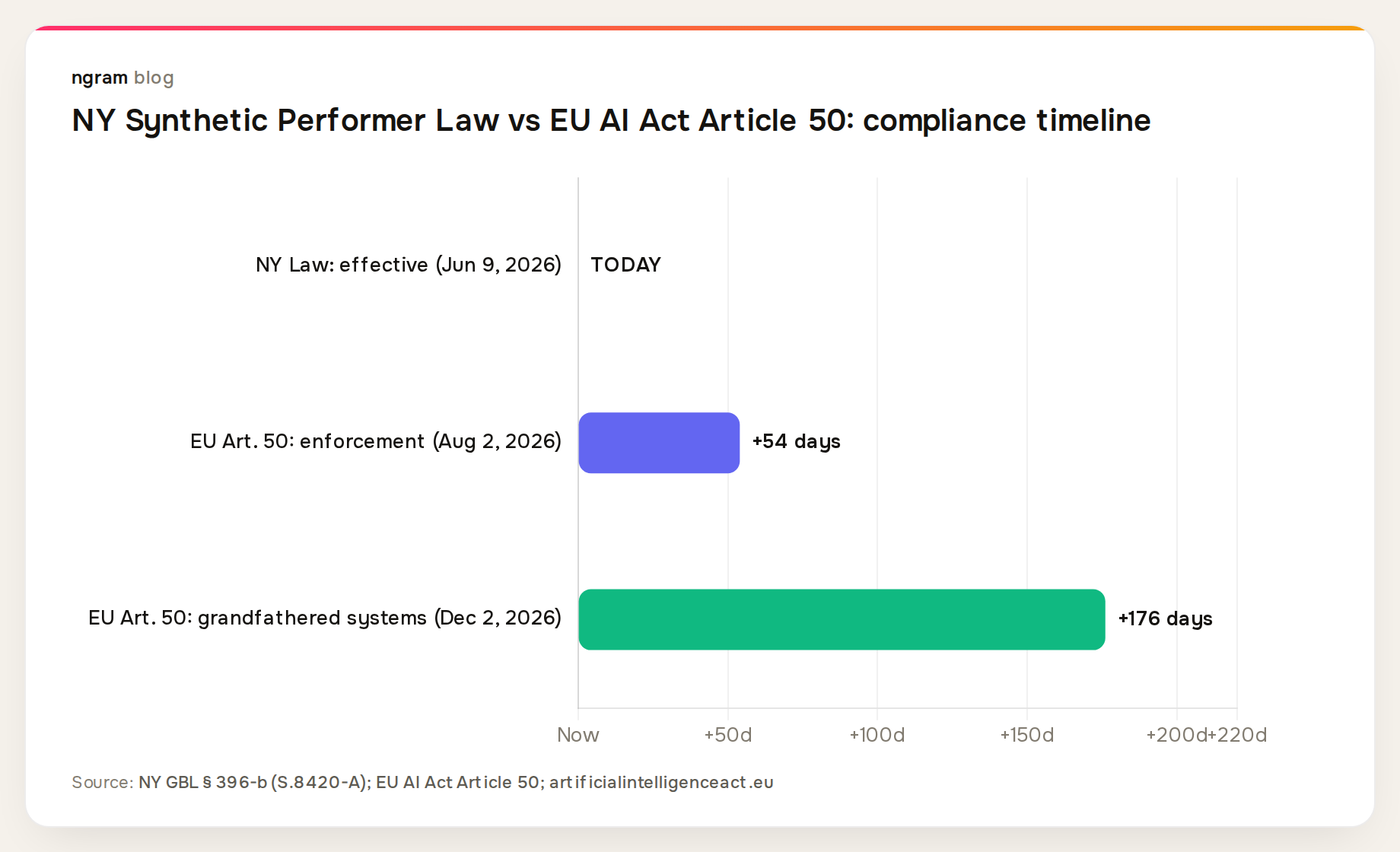
Today, June 9, 2026, something changes for every advertiser running AI-generated video. New York's Synthetic Performer Disclosure Law takes effect. It is the first US state law to require disclosure of AI-generated human likenesses in advertising. It applies to any commercial ad that could reach a New York audience.
Fifty-four days from now, EU AI Act Article 50 adds a second layer of obligation, this time with machine-readable watermarking requirements and fines that scale to 3% of global annual revenue. Both laws target the same content, the same creators, and often the same campaigns.
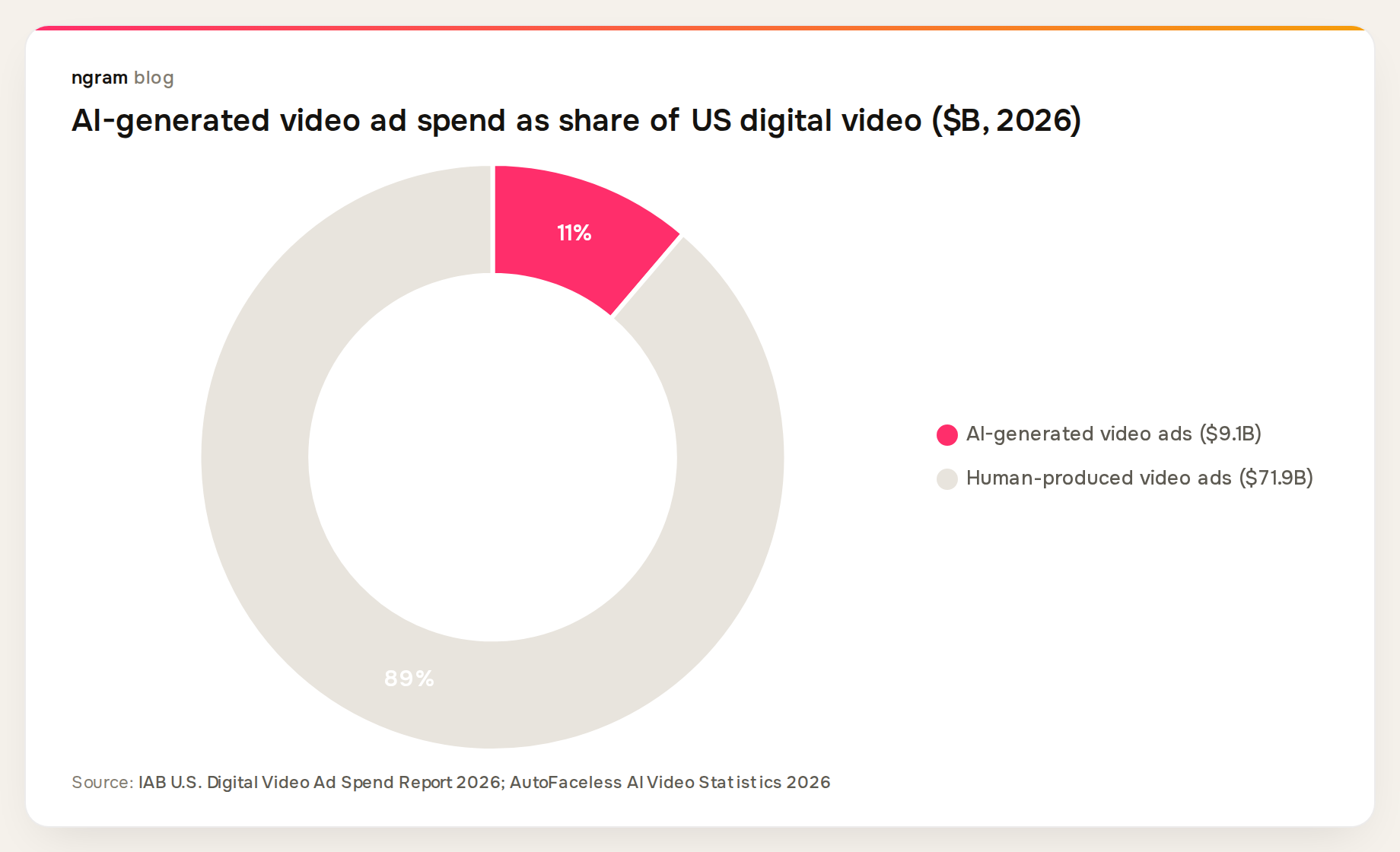
This post covers what both laws actually require (not the headlines, the legal text), who is in scope, what the $9.1 billion AI video ad market needs to change in the next 54 days, and where the compliance gap actually sits between where the industry is today and where it needs to be.
The Scale of What's In Scope
Before getting into the law text, the numbers help explain why regulators moved when they did.
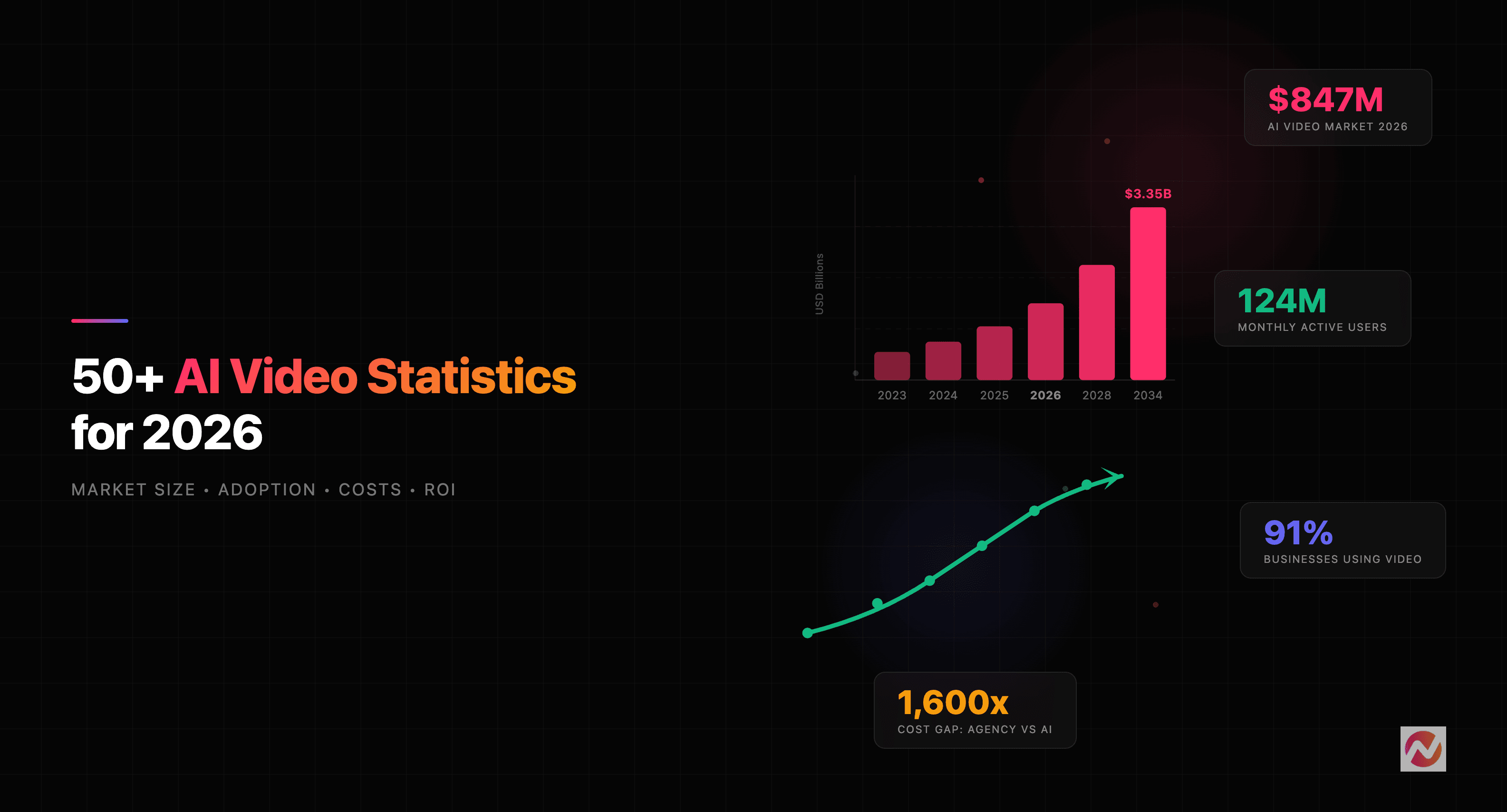
US digital video advertising crossed $80 billion in 2026, according to the Interactive Advertising Bureau. Of that, an estimated $9.1 billion (roughly 12% of that total) is AI-generated video advertising, according to AI video market research, a figure that has grown sharply as generative video tools became production-ready in 2024 and 2025. By the end of 2026, AI-generated content is projected to account for 40% of all digital video ads, according to current market projections.
Seventy-eight percent of marketing teams report using AI-generated video in at least one campaign per quarter, according to 2026 AI video adoption surveys. That is the population both laws address.
For a fuller picture of adoption rates, production cost trends, and the tools driving this shift, the AI video statistics report for 2026 covers the data layer underneath these numbers.
The technology that generates this content has moved faster than any disclosure framework. Until today, there was no legal obligation in the US to tell an audience that the human presenter in a video ad was not a real person.
That changes now.
What New York's Law Actually Requires
The law, codified at NY GBL §396-b (S.8420-A/A.8887-B), was signed by Governor Hochul on December 11, 2025, and takes effect today. It amends New York's General Business Law to create a disclosure obligation for a specific type of content: synthetic performers in advertisements.
The definition: what counts as a synthetic performer
The law defines a synthetic performer as "a digitally created asset using generative AI or software algorithms intended to create the impression of a human performer who is not recognizable as any identifiable natural performer." The key phrase is "not recognizable as any identifiable natural performer": the law targets synthetic humans who appear to be real people but are not any specific person. A digital replica of an actual named celebrity falls under a separate provision (NY Civil Rights Law §50-f, S.8882, effective immediately upon enactment in December 2025).
The obligation: conspicuous disclosure
The law requires a "conspicuous disclosure" in any advertisement containing a synthetic performer. Critically, the statute does not define what conspicuous means. No specific text, placement, font size, or duration is mandated. Legal guidance converges on the same interpretation: disclosure must be "noticeable, legible, and understandable to reasonable consumers."
In practice, that likely means on-screen text ("This video contains AI-generated content" or similar) placed clearly enough that a viewer cannot miss it. No enforcement precedent exists yet — the law is new today — but the absence of a specific format means early cases will shape what "conspicuous" means in court.
Who is covered
The law covers anyone "engaged in the business of dealing in any property or service" who produces or creates advertisements for commercial purposes. Media publishers that only disseminate ads — running them on a platform — are explicitly exempt. The obligation falls on the advertiser and the production side, not the distribution side.
One important qualifier: the disclosure requirement applies only where the advertiser has "actual knowledge" of a synthetic performer's presence. This creates a documentation obligation upstream: brands need to know what AI tools their agencies and vendors are using, and agencies need records of what they generated.
Exemptions
The law does not apply to: advertisements for expressive works (films, TV shows, video games) where the synthetic performer is consistent with how they appear in the underlying work; audio-only advertisements; and content involving language translation of human performers.
Penalties
Civil penalties are $1,000 for a first violation and $5,000 for each subsequent violation. These are low in isolation, but they multiply with campaign volume. A brand running 50 non-compliant ad variations reaches $245,000 in exposure on the second and subsequent violations alone.
What EU AI Act Article 50 Requires
The EU's framework is technically more demanding and financially much more serious. Article 50 of the EU AI Act takes effect August 2, 2026, and sets transparency obligations that go beyond a visible label.
The four situations covered
Article 50 covers four situations. For AI video advertising, two are directly relevant. First, providers of generative AI systems must mark synthetic outputs in a machine-readable format that is detectable as AI-generated. Second, deployers must disclose AI-generated deepfakes, and more broadly synthetic content presented in a way that could mislead viewers about its real-world origin.
Machine-readable marking: what it means
The regulation does not mandate C2PA specifically: it is technology-neutral. The European Commission's draft Code of Practice (final version expected June 2026) lists C2PA Content Credentials as the primary technical solution satisfying all four required criteria: effective, interoperable, robust, and reliable. The Commission's approach calls for a multi-layered stack: C2PA metadata embedded in the file manifest, an imperceptible watermark (such as Google's SynthID), and modality-specific labeling (persistent video labels, visible image labels).
The marking must survive common transformations: format conversion, compression, re-upload, and must be tamper-evident. A file with Content Credentials stripped out is not compliant.
Extraterritorial reach
Article 50 applies to any provider or deployer whose AI outputs reach EU users, regardless of where the company is incorporated. A US brand running a global ad campaign on YouTube or Meta that includes EU audiences is in scope.
Grandfathering
Generative AI systems already on the market before August 2, 2026 have until December 2, 2026 to meet the machine-readable marking requirement specifically. The human-visible disclosure obligation applies from August 2 regardless. In practice: if your AI video tool does not yet emit C2PA metadata, you have until December, but you still need a visible disclosure in the video from August 2 onward.
Penalties
Under Article 99, transparency violations incur fines up to €15 million or 3% of global annual turnover, whichever is higher. For a company with $1 billion in global revenue, that is a $30 million potential exposure per violation. This is enforcement-level stakes, not cost-of-doing-business math.
The Compliance Gap: Model Layer vs. Creator Layer
Here is where the analysis gets interesting. The technology to comply at the generation layer is largely already deployed. The gap is at the creator and advertiser layer.
What's already done at the model provider layer
On May 19, 2026, OpenAI joined the C2PA steering committee and adopted SynthID watermarking across images generated through ChatGPT, the OpenAI API, and Codex. Google has signed all Veo 3 and Imagen 4 outputs with SynthID since Google I/O 2026, and Google DeepMind reports over 100 billion files watermarked since SynthID's 2023 launch.
TikTok integrated C2PA Content Credentials in early 2024 and auto-detects AI-generated uploads from tools that emit Content Credentials. YouTube now automatically applies disclosure labels to long-form videos with significant photorealistic AI content, placing the label directly below the player. Meta does the same across Instagram and Facebook.
The major AI model providers and distribution platforms have, in other words, already built the technical infrastructure that Article 50 mandates. The watermarks are being applied at generation time.
What isn't done at the creator and advertiser layer
The gap emerges when AI-generated content moves through production pipelines. Common failure modes:
- C2PA metadata is stripped when a video file is processed, compressed, or re-uploaded through tools that do not preserve Content Credentials: a common failure in AI video generator workflows.
- The watermark survives but no human-visible disclosure is added, satisfying the machine-readable requirement but not the visible one.
- Advertisers have no inventory of which campaign assets contain synthetic performers because agency or vendor contracts do not require disclosure of AI tool usage.
- Production teams using multiple tools (AI generation, traditional editing, motion graphics) cannot reliably track whether a final render still carries its original Content Credentials.
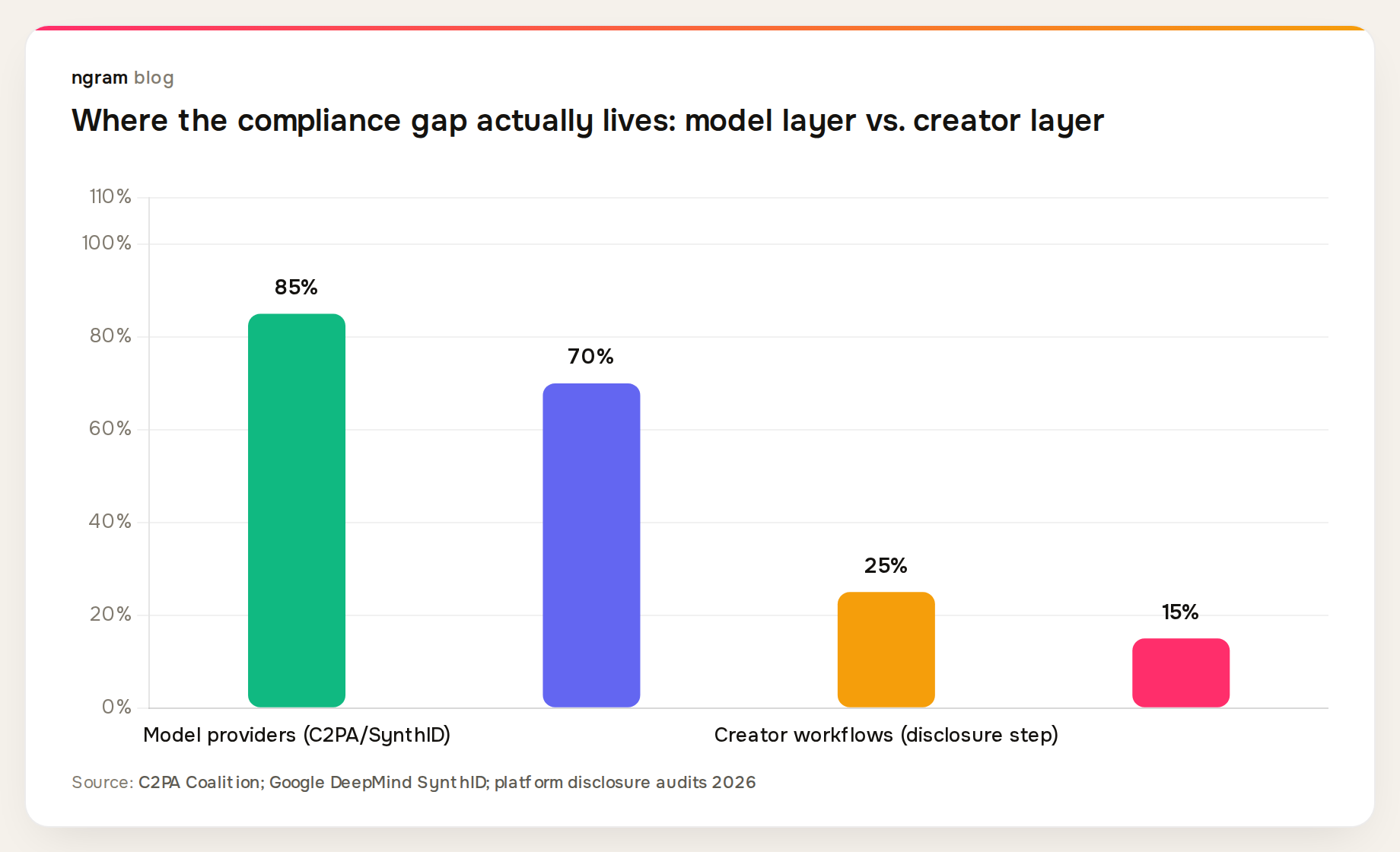
The laws' "actual knowledge" standard in New York and the deployer-level obligations in the EU both put this compliance work on the advertiser. The model provider watermarking is necessary but not sufficient.
54-Day Compliance Checklist: What to Do Before August 2
Both laws create parallel obligations. The practical path to compliance by August 2, 2026 requires action across four areas.
1. Campaign audit: inventory synthetic performers
Pull every active and pending video ad campaign. For each, answer: does this ad contain a human-appearing presenter, spokesperson, or actor who was AI-generated? This includes talking-head AI avatars, protagonists generated from a text prompt, and AI face or body replacements applied to a real source recording. If your team uses an ai marketing video generator that produces synthetic presenters, every output from that tool is in scope.
Include any asset where a vendor or agency used an AI video tool. If you do not have clear records, request a written disclosure from each production vendor confirming what AI tools were used.
2. Add visible disclosure to identified assets
For each asset identified in Step 1, add an on-screen disclosure that is noticeable, legible, and understandable to a reasonable viewer. No specific language is required by either law, but plain text works: "AI-generated video," "Contains AI-generated content," or "Synthetic presenter."
For NY law: this is the immediate obligation, effective today. For EU compliance: this is the visible disclosure requirement that applies from August 2, even for grandfathered systems.
3. Verify C2PA metadata through your pipeline
If your AI video generation tool emits C2PA Content Credentials (check the C2PA Coalition's adopter list), verify that those credentials survive your production workflow. Upload a sample output to the C2PA's public verify tool at verify.contentauthenticity.org to confirm the manifest is intact.
If your pipeline strips the metadata (common in video editing software that does not yet support C2PA passthrough), document this gap. The grandfathering provision gives you until December 2, 2026 for the machine-readable marking step: but only if your system was in market before August 2. New systems need the watermarking from day one.
4. Update vendor contracts and internal workflows
The NY law's "actual knowledge" standard makes contract language important. Add a clause requiring production vendors and agencies to disclose AI tool usage and to confirm whether any AI-generated human likenesses appear in delivered assets. This creates the audit trail needed to establish compliance — or to allocate liability if a dispute arises.
Internally, add a disclosure checkpoint to the creative review process. Before any video ad goes to final approval, one person on the team should be responsible for confirming whether a synthetic performer is present and whether the disclosure is in place.
5. For EU-reaching campaigns: check platform disclosure settings
YouTube, Meta, and TikTok all now have advertiser-facing controls for AI content disclosure labels. For EU-targeted campaigns specifically, confirm these are enabled in your ad manager. Platform auto-detection helps, but it does not substitute for the deployer-level obligation you carry under Article 50.
How the Two Laws Fit Together
The NY and EU frameworks are complementary in scope but differ in technical depth. New York's law is a business-law obligation: a visible disclosure is required, and the penalty structure is civil and dollar-denominated. The EU's Article 50 is a technical specification as much as a legal one: it mandates watermarking infrastructure, not just a label.
For most advertisers running campaigns in both markets, the practical approach is to satisfy the higher standard (EU Article 50) and treat NY compliance as already included: a visible disclosure in a video is a visible disclosure regardless of which law requires it.
The real tension is between what the laws require at the advertiser layer and where the industry's tooling is today. Teams using AI video marketing tools rely on platforms that generate synthetic performers: those platforms need to surface disclosure tooling as part of the generation step itself, not as an afterthought in the export workflow. That is the next evolution in responsible AI video production: moving compliance from a legal checkbox at the end of the pipeline to a built-in step at the point of creation.
What Comes After August 2
August 2 is not the end state. Several dynamics will shape how this plays out through the rest of 2026.
Other US states are watching New York. A first-in-nation law that takes effect without obvious industry disruption typically triggers fast followers. California, Texas, and Illinois have each introduced AI content labeling proposals; New York's enforcement record will be a data point for how those bills are written.
The EU Code of Practice is still being finalized. The second draft (published in May 2026) shows regulators still working through modality-specific labeling standards: how long a video label must persist, whether it must appear in the first frame or throughout. The final Code, expected by late June 2026, will fill in these gaps before the August enforcement date.
Platform enforcement will do more work than regulator enforcement, at least initially. YouTube's automatic labeling, TikTok's C2PA detection, and Meta's AI info panels collectively reach a far larger volume of AI video content than any enforcement agency. Platforms are the practical disclosure layer for consumer-facing content; regulators will focus on the cases that fall through.
And the standards will tighten. Today's requirement is a conspicuous disclosure. Tomorrow's — already visible in the EU Code of Practice drafts — is a persistent, modality-specific label that survives republication. Planning for that standard now is more efficient than retrofitting it later.
Frequently Asked Questions
Does the NY law apply to ads that run nationally, not just in New York?
Yes. The obligation falls on any advertiser whose ad could reach a New York audience. A national digital video campaign almost certainly reaches New York. There is no geographic ring-fencing available in digital advertising at the state level.
Does using a real actor with AI voice or AI eye-contact correction count as a synthetic performer?
No — if the underlying performer is a recognizable, identifiable natural person, the definition of synthetic performer does not apply. The NY law specifically covers AI-generated humans "not recognizable as any identifiable natural performer." AI modifications to a real person's performance (voice cloning, gaze correction) are a different question covered by other provisions of NY law and the EU regulation's deepfake rules.
What is C2PA and do I need to implement it?
The Coalition for Content Provenance and Authenticity (C2PA) is an open technical standard for embedding cryptographically signed metadata into media files, declaring their origin and any AI involvement. For EU Article 50 compliance, C2PA Content Credentials (or equivalent machine-readable marking) are required on AI-generated outputs. You do not need to implement it yourself: your AI generation tool should emit it automatically. Your job is to ensure the credentials survive your pipeline.
What counts as a conspicuous disclosure under NY law?
The statute does not define the term. Legal guidance suggests it means disclosure that is noticeable, legible, and understandable to a reasonable consumer. In video advertising, on-screen text placed early and prominently in the ad — not buried in small print at the end — is the most defensible approach until enforcement cases create precedent.
Does the EU grandfathering provision mean I can skip watermarking for existing campaigns until December?
Partially. The grandfathering window extends until December 2, 2026 only for the machine-readable marking requirement (C2PA/SynthID metadata) on systems already in market before August 2, 2026. The human-visible disclosure obligation applies from August 2, with no grandfathering. New campaigns launched after August 2 using new tool versions need the full stack from day one.
Are there any US federal disclosure requirements?
Not yet — no federal AI video disclosure law has passed as of June 2026. The FTC has issued guidance on deceptive AI practices, but no statute. New York is the first US state to create a specific enforcement mechanism for synthetic performer disclosure in advertising. Federal proposals are active in Congress but have not cleared either chamber.