
The Twitch AI training lawsuit arrived eight days after Twitch publicly surfaced a setting for Amazon generative-AI training. That short interval is the story. The dispute is less about a settings toggle than about what happens before the toggle exists, after a user changes it, and once copied video or audio has entered a model-training pipeline.
Warren Pandiscia filed the proposed class action on August 20, 2026 in the U.S. District Court for the Northern District of California. The 37-page complaint is case 3:26-cv-08721. It alleges that Twitch and Amazon used creator content for commercial generative-AI training without adequate notice, permission, or payment. Those are allegations, not findings. No class has been certified, and the public record reviewed for this article remains at the complaint stage.
The most important question is narrower than the rhetoric around AI copyright lawsuits: can a platform rely on default-on permission for training, then offer a future-only opt-out after material may already have been copied? The Twitch AI training lawsuit does not answer that question yet. It gives courts, creators, platforms, and model builders a concrete system to examine.
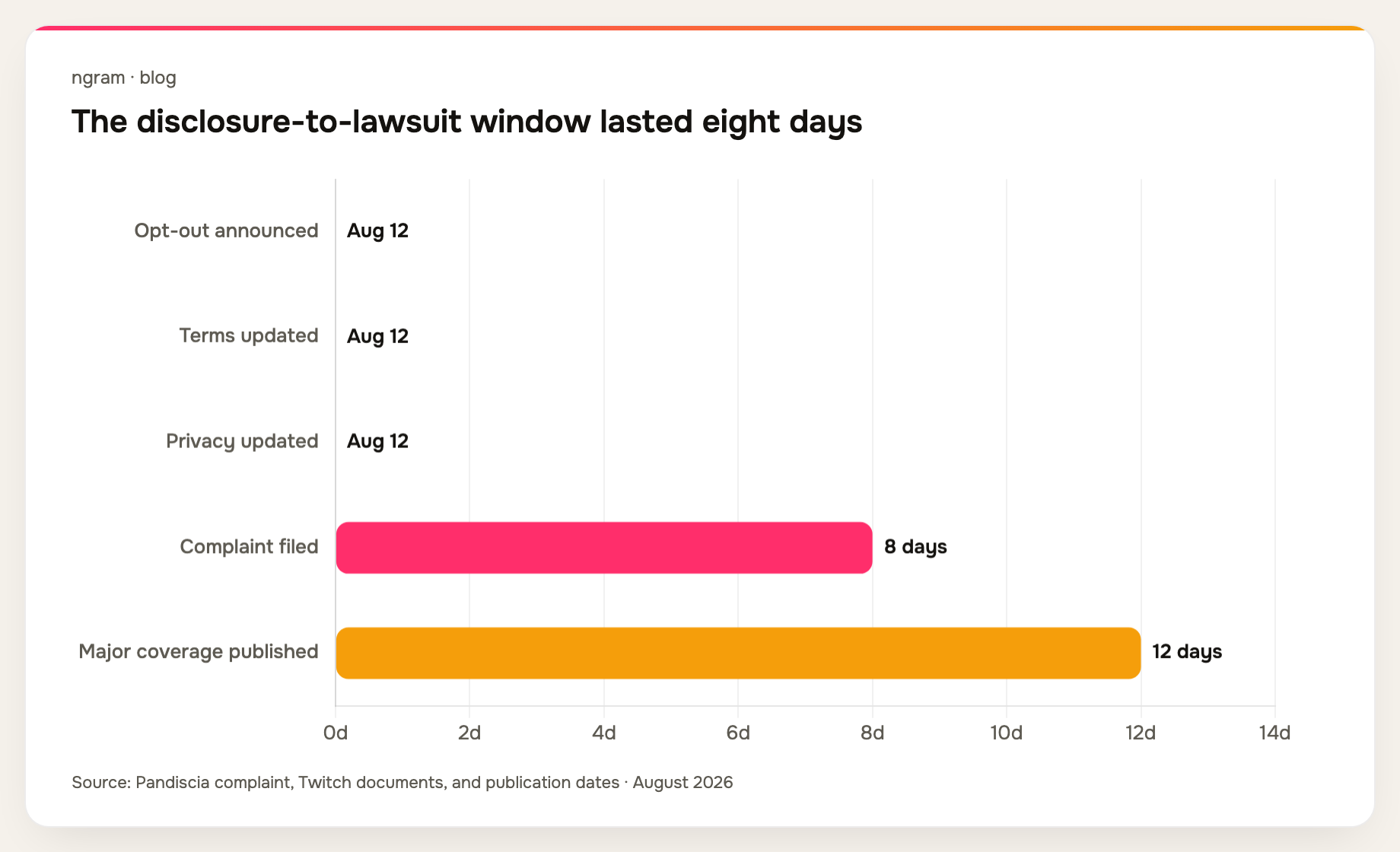
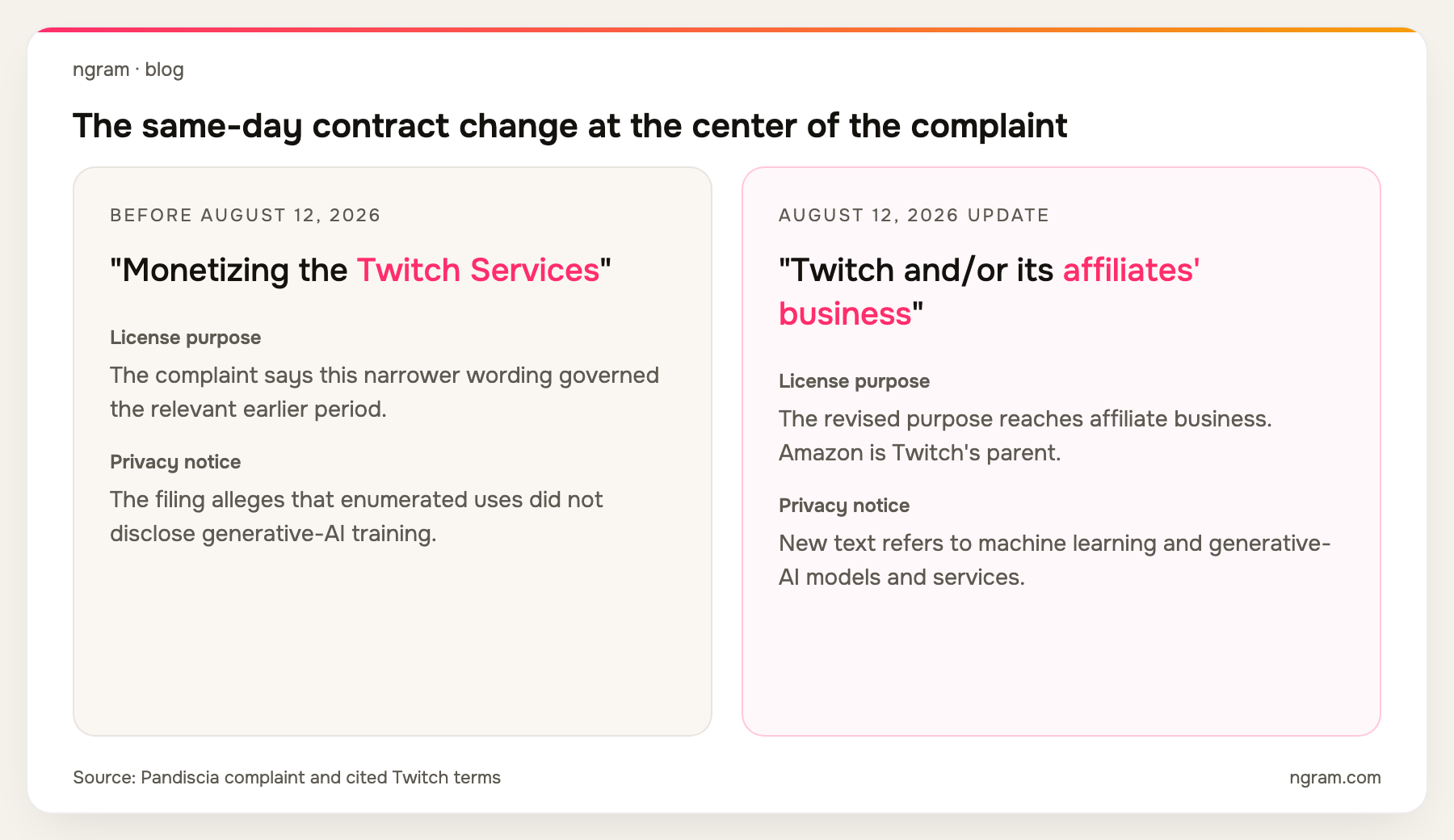
That chronology does not prove wrongdoing. It does explain why consent timing, rather than the existence of a toggle, is likely to dominate the case.
What the Twitch AI training lawsuit actually alleges
The complaint describes Pandiscia as a Connecticut creator who streamed for close to ten years, accumulated more than 900 followers, and produced more than 1,000 hours of content. It alleges that Amazon had used Twitch content in AI work since at least 2024, then says Twitch disclosed the default-on program on August 12, 2026.
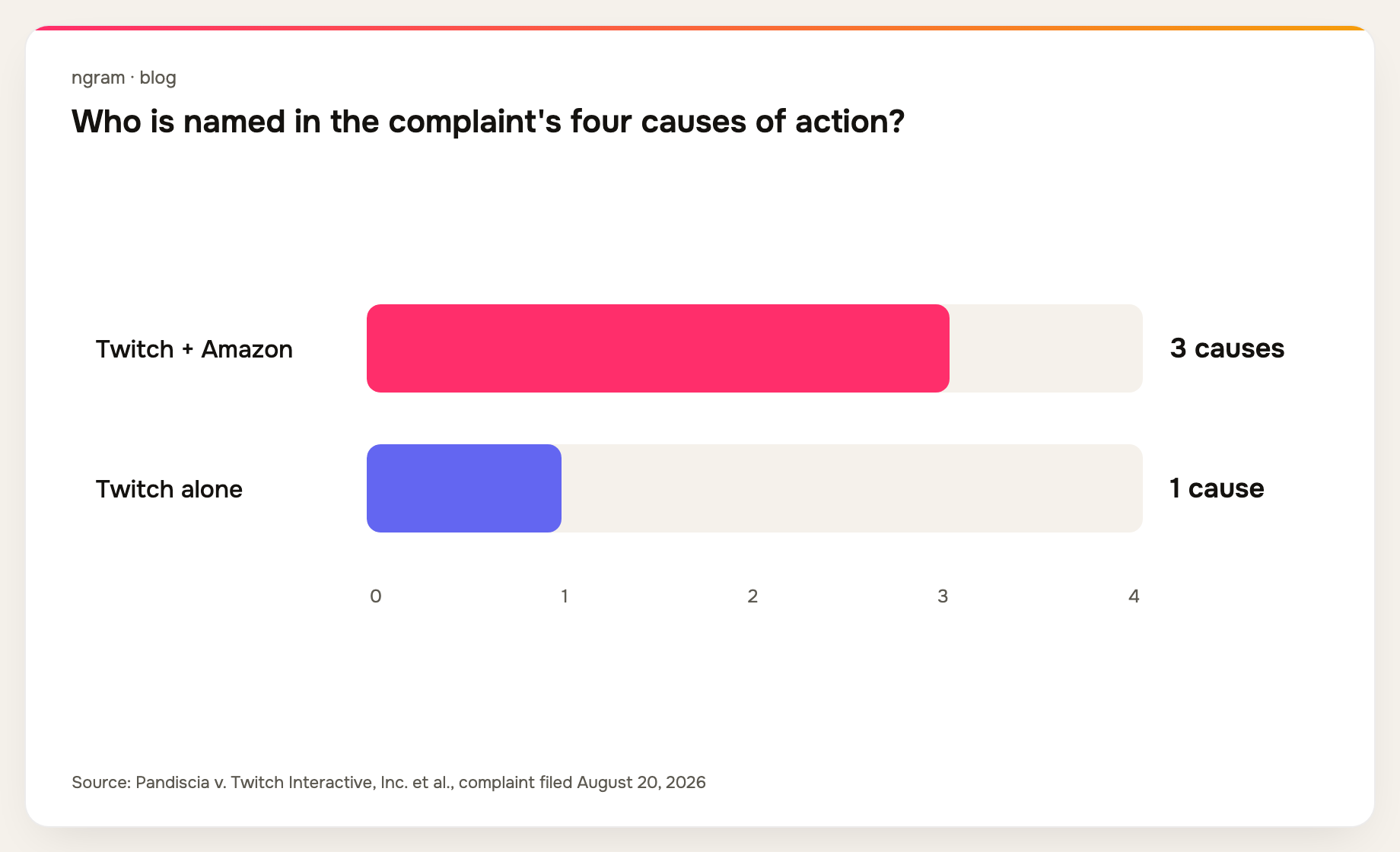
The filing identifies four causes of action: breach of implied contract against Twitch; unjust enrichment against both defendants; breach of express contract against both; and violation of California's Unfair Competition Law against both. It asks for class certification, declaratory and injunctive relief, damages, restitution, disgorgement, interest, costs, and attorneys' fees. It does not name a damages figure. The pleaded amount above $5 million is the Class Action Fairness Act jurisdictional threshold, not a claimed payout.
The case is often described as an AI copyright lawsuit. That is inaccurate. The complaint expressly says the cited streams and videos were not registered with the U.S. Copyright Office, and it pleads no copyright-infringement count. The California Invasion of Privacy Act appears as a predicate for the unfair-competition claim, not as a separate cause of action.
The complaint mentions Amazon Nova Reel and a research corpus derived from YouTube video. It does not allege that Pandiscia's channel, or any other named Twitch stream, trained Nova Reel. It also does not identify an AI output that reproduced his work. Any article making that jump goes beyond the filing.
What Twitch's own AI training setting confirms
Twitch's account settings help page confirms three facts independent of the lawsuit. First, eligible material can include a stream and its chat, VODs, clips, highlights, and text or images on a channel. Second, if a person chats on someone else's stream, the host channel's preference governs whether that chat can be used for training. Third, opting out covers future training of Amazon-developed models intended to generate or synthesize text, audio, images, or video.
The same page draws a boundary around what the toggle does not cover. Turning it off does not disable AI-supported service features such as AutoMod or captions. Twitch says those systems differ because they do not retain content to train models that generate new material. That distinction matters: an account can be opted out of generative-model training while still using machine learning inside the service.
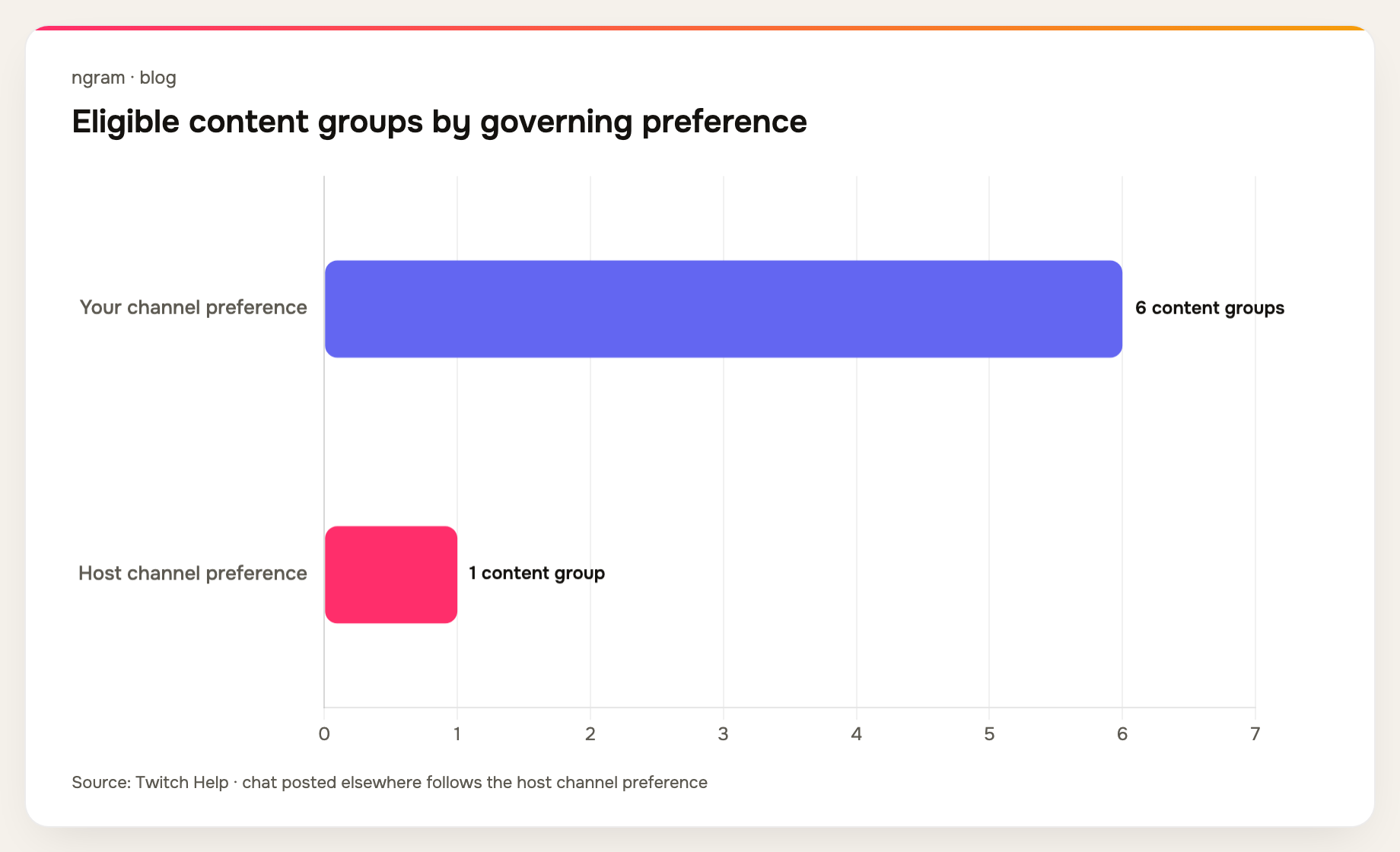
The final row is the consent-design problem in miniature. One person's material can sit inside another person's control surface. A collaborator, guest, moderator, or chat participant may have opted out on their own channel and still lack control over a copy created elsewhere.
Why a future-only opt-out may arrive too late
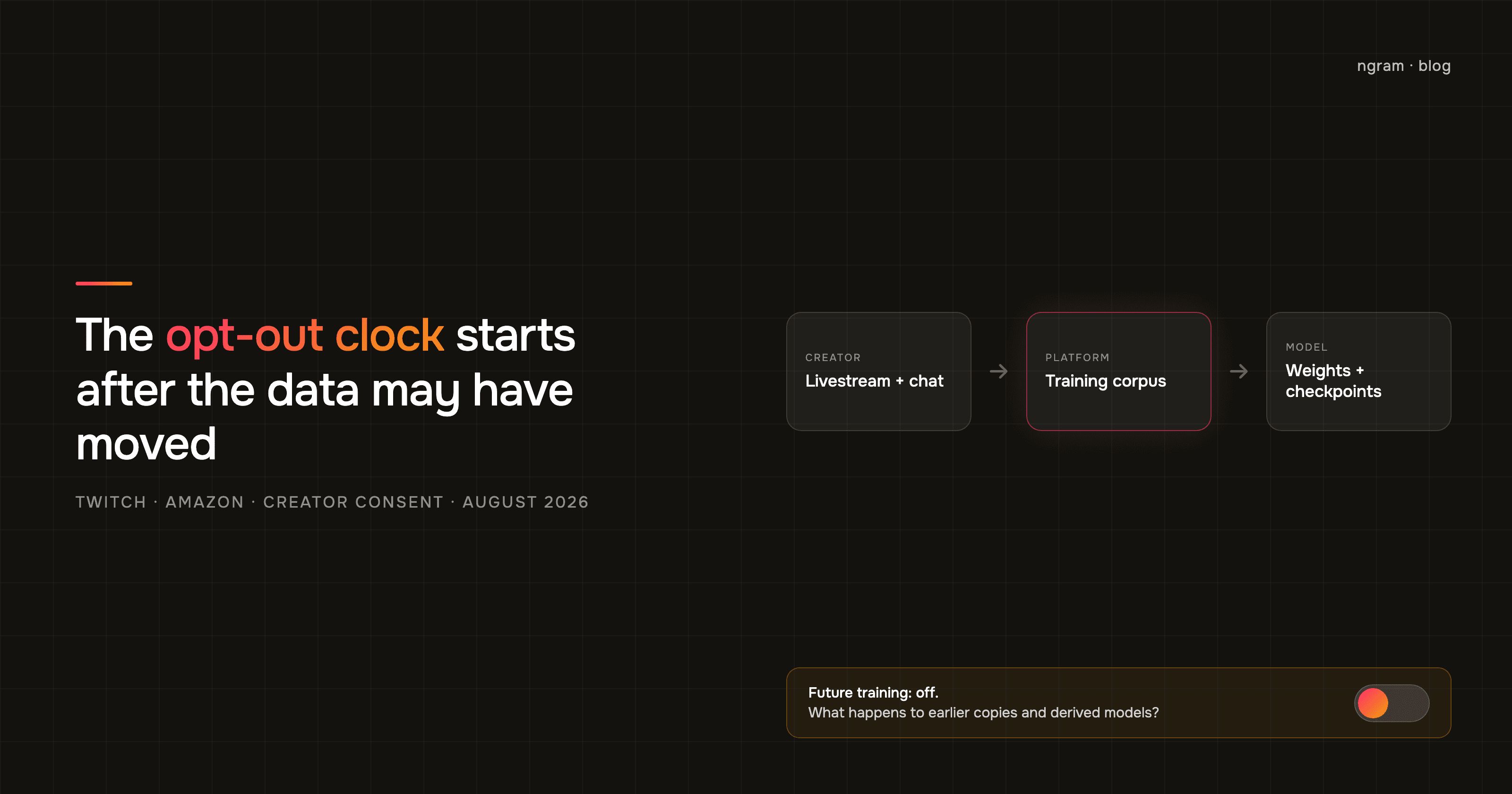
Training data moves through stages. A platform collects source files, creates working copies, cleans or segments them, builds a corpus, runs training, stores checkpoints, evaluates the model, and may reuse the corpus for another run. An opt-out can be effective at one stage and irrelevant at another.
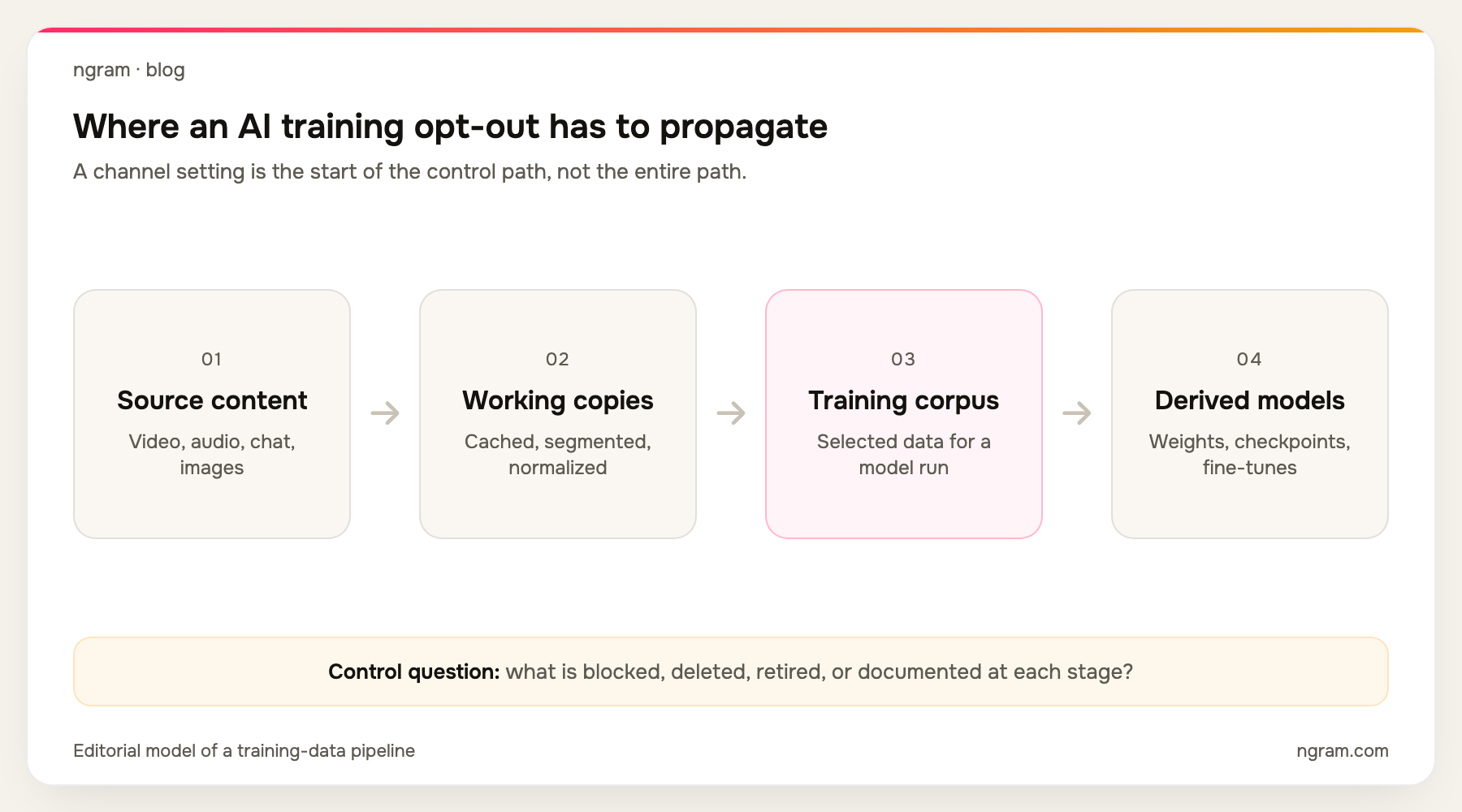
A platform can stop future collection without deleting historical copies. It can delete rows from a corpus without proving that a trained checkpoint changed. It can retire one checkpoint while a derivative model or fine-tune remains. None of those outcomes should be assumed here; the point is that the words "opt out" are incomplete without a pipeline map.
That is why the complaint's requested injunction is operationally specific. It asks for express, informed, person-scoped consent; an effective and durable opt-out; identification, segregation, and deletion of allegedly obtained content; cessation of use of corpora and models to the extent derived from that material; and corrective disclosure. A court has not ordered any of it. The requested remedy shows what plaintiffs believe a meaningful control would have to reach.
The U.S. Copyright Office's 2025 generative-AI training report treats training as a fact-specific copyright question and discusses licensing markets rather than declaring all training categorically lawful or unlawful. In the EU, general-purpose model providers have had training-content summary and copyright-policy obligations since August 2, 2025. The European Commission says its mandatory template has three sections covering model information, data sources, and relevant processing, developed after more than 430 consultation responses plus comments from 111 stakeholders.
Those rules do not decide this California contract case. They show where governance is moving: provenance must be recorded before a dispute, not reconstructed after one.
Creator reaction centered on notice, control, and payment
The early community response is useful because it reveals what a settings page needs to explain. In one r/Twitch discussion, creators wrote that they "wouldn't have even known," that "you have to dig for it," and that Twitch should "at least pay me." Others asked whether turning the setting off would "fully prevent" use and, more directly, "What exactly do they mean by channel content?"
Those five reactions correspond to five product requirements: notice that reaches the user, a control that is easy to find, an explanation of compensation or consideration, a durable record of the user's choice, and a content inventory written in ordinary language. The complaint alleges failures in several of those areas. Whether the evidence supports those allegations comes later.
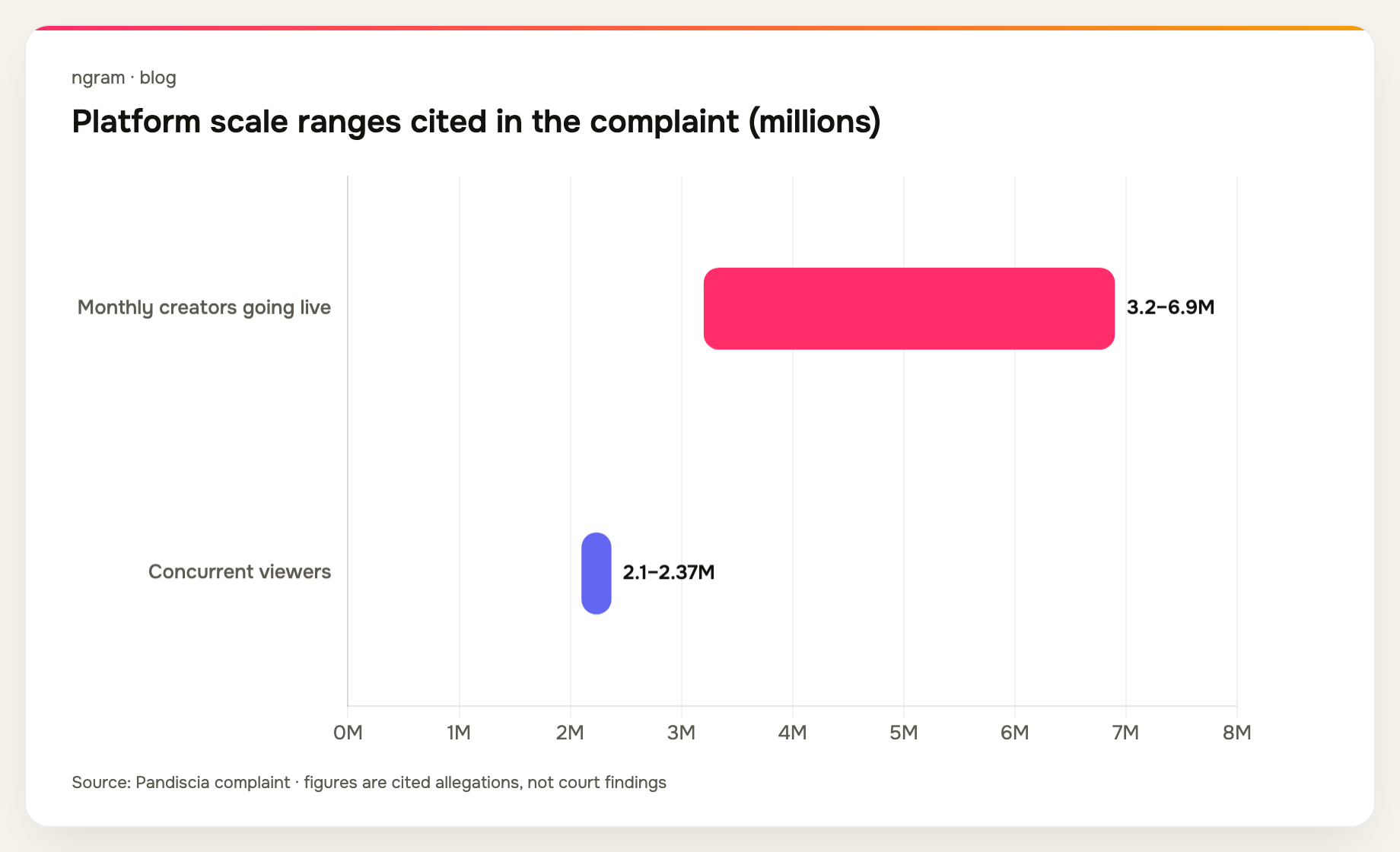
The platform-scale figures explain why the dispute is not a niche settings issue. The complaint cites a range of 3.2 million to 6.9 million creators going live each month and 2.1 million to 2.37 million concurrent viewers. The proposed class is defined as creators whose content was used without consent and is alleged to number in the millions. That class definition still has to survive certification.
Training data is now a priced business asset
The complaint uses Reddit's licensing deals as a comparator for the value of platform content. The filing cites a reported $60 million annual Google agreement and more than $200 million in Reddit AI data-licensing revenue. Those figures are not a valuation of Twitch content, and they do not establish damages. They support a simpler point: access to large stores of human-created material is bought and sold.
Reddit's own SEC filings give a careful public view. Its "other revenue" category, which includes content licensing alongside Reddit Premium and user-economy products, rose from $15.2 million in 2023 to $114.7 million in 2024 and $140.0 million in 2025. The 2025 Form 10-K says content-licensing agreements contributed to the increase, but it does not break out licensing as a standalone amount.
That commercial backdrop makes consent architecture economically material. A default determines access to something with market value; an opt-out affects the supply available for later use; deletion can affect a corpus that supports a model sold downstream. That matters to every AI video generation platform and to the teams buying from them: source rights travel with the data, not the interface.
What the Twitch AI training lawsuit does not prove
The complaint is one side's account. It has no attached exhibits. Public coverage reviewed on August 27 did not show a defendants' answer, a judicial ruling, or a class-certification order. The Law360 docket page confirms the August 20 filing metadata, while The Next Web's document review separates the pleaded claims from what the complaint does not establish.
Keep four limits in view:
- No court has found that Twitch or Amazon breached a contract or privacy duty.
- The proposed class has not been certified, and its membership is not established.
- No named Twitch stream is tied to Nova Reel or another specific Amazon model in the complaint.
- The complaint does not prove that an opt-out cannot affect trained systems; it alleges that the capture and use at issue are permanent and seeks discovery and relief on that basis.
Those limits do not make the case trivial. They make precise language essential. "The complaint alleges" is not timid phrasing here. It is the difference between reporting a filed claim and declaring a result that does not exist.
An operational checklist for platforms and video teams
The Twitch AI training lawsuit suggests a practical audit for any company that hosts creator video, licenses media, builds training corpora, or buys models trained by someone else.
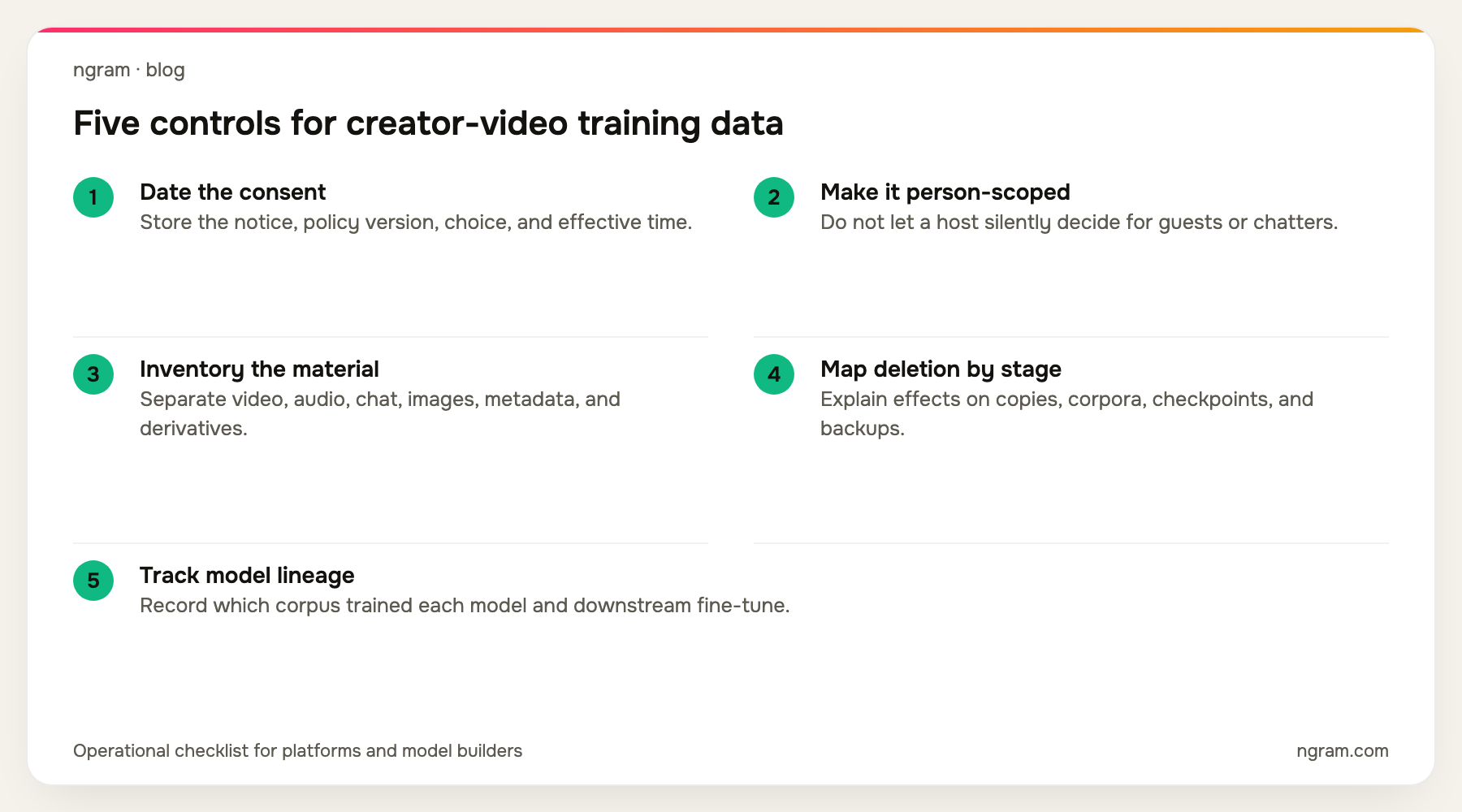
- Date the consent. Record the policy version, the exact choice, the notice shown, and the first collection or training job covered by it.
- Make control person-scoped. A host's setting should not silently substitute for a guest's, collaborator's, or chat participant's choice.
- Inventory the material. Define streams, VODs, clips, chat, audio tracks, images, captions, metadata, and derived segments separately.
- Map deletion by stage. State what happens to source files, staging copies, corpora, checkpoints, fine-tunes, evaluation sets, and backups.
- Track model lineage. Keep a record of which corpus trained which checkpoint and which downstream model inherited it. Without lineage, a deletion promise cannot be tested.
For business teams publishing original video, this is also a source-governance task. ngram accepts screen recordings as source material, keeps scripts and storyboards available for review, and documents account and preference controls. Those workflow facts do not establish a training-data policy. They illustrate the kinds of user control points buyers should distinguish from model-training consent.
What happens next
Twitch and Amazon can answer the complaint, challenge the pleadings, contest the class, or resolve the dispute. Discovery, if the case reaches it, could reveal the chronology and architecture that public settings pages cannot: what was collected, when collection began, what terms applied, which corpora received it, which models used those corpora, and what a later opt-out changed.
That evidence will decide whether the complaint's theory survives. The control problem exists regardless of the outcome. AI training consent has a clock. Platforms need to show when permission began, whose permission controlled each piece of content, and how a later choice propagates through copies and derived models. The same questions apply across AI video creation tools. Buyers should ask which third-party training data a product depends on and what rights follow that data. For AI video, provenance is a product dependency, not a footnote.
The Twitch AI training lawsuit is still a pleading. Its operational test is already clear: if a company cannot answer those questions before litigation, a toggle will not answer them afterward.
Methodology: We reviewed the filed complaint, Twitch's current help documentation, the terms and privacy changes cited in the filing, docket metadata, and primary regulatory and financial sources as of August 27, 2026. Allegations are labeled as allegations, and current platform statements are treated as policy descriptions rather than proof of past use.
Frequently asked questions
What is the Twitch AI training lawsuit?
Pandiscia v. Twitch Interactive, Inc. et al. is a proposed class action filed August 20, 2026 in federal court in San Francisco. It alleges that Twitch and Amazon used creator content for generative-AI training without adequate consent, notice, or compensation. The allegations have not been proven.
Is the Twitch lawsuit a copyright case?
No. The complaint pleads breach of implied contract, unjust enrichment, breach of express contract, and California unfair competition. It pleads no copyright-infringement cause of action and explains that the cited works were not registered with the Copyright Office.
What Twitch content can be used for AI training?
Twitch says eligible channel material may include streams, stream chat, VODs, clips, highlights, and channel text or images. If you chat on someone else's stream, Twitch says that channel's preference controls whether the chat can be used.
Does opting out delete content already used for training?
Twitch's help page says opting out stops the listed material from being used in future training of Amazon generative models. It does not publicly promise, on that page, to remove prior copies from corpora or alter models already trained. The complaint seeks broader identification, segregation, deletion, and model-use remedies, but no court has granted them.
Does the Twitch opt-out disable AutoMod or captions?
No. Twitch says the generative-model training preference does not disable AI-supported service features such as AutoMod or captions. It distinguishes those systems on the basis that they do not retain channel content to train models that create new outputs.
Has a court certified the proposed class?
No. Filing a proposed class action does not create a certified class. The plaintiff must later satisfy the applicable certification requirements, and the defendants can oppose certification.
Did Twitch streams train Amazon Nova Reel?
The complaint names Nova Reel but does not allege that a specific Twitch stream trained it. It says, on information and belief, that Twitch content sits among Amazon's proprietary data. That is not proof tying any named creator to a named model.
Why does person-scoped consent matter for livestream video?
A livestream can contain the host, guests, moderators, callers, music, chat participants, and third-party media. Channel-level permission cannot represent every contributor's choice. Person-scoped records make it possible to honor each contributor's preference and trace where their material moved.