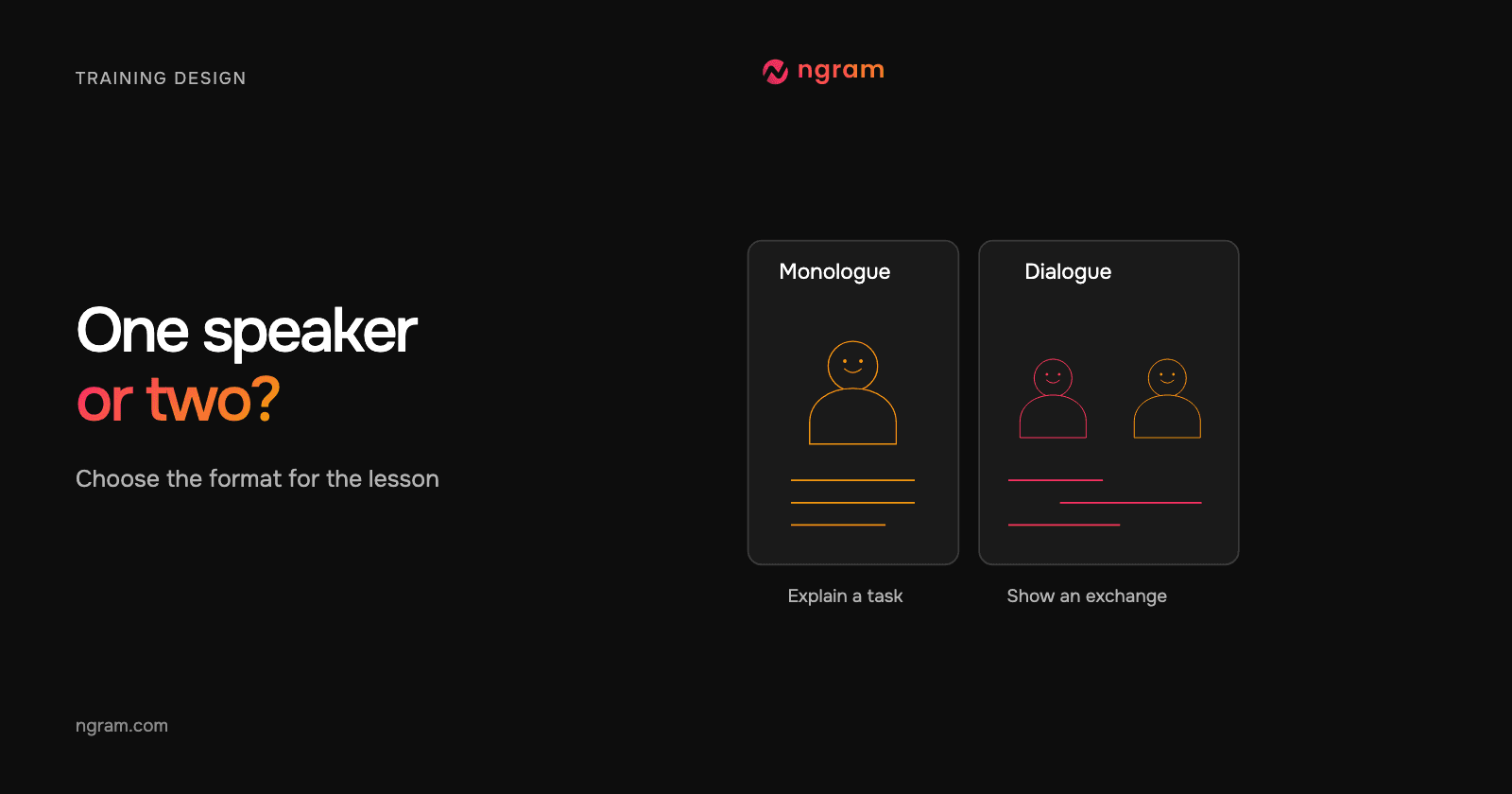

An L&D lead has an approved refund policy and needs a short onboarding lesson. A presenter can explain the rule, or a customer and agent can show how it changes the next reply. Choose between dialogue and monologue by deciding what the learner needs to notice: the policy itself or the response to another person.
Start with the behavior the lesson needs to teach
For a policy overview, a clear single-speaker explanation can cover the condition, authority limit and next action. For an interaction lesson, a second role can supply the information the agent must ask for before answering. That is a concrete reason to use dialogue; adding a second voice by itself does not establish a better lesson.
The examples here use fictional HarborDesk policy: a refund is eligible within 14 days only if the service is unused. Used subscriptions go to a team lead, and the agent cannot promise a refund. Replace that rule with your own approved policy before using the scenario for company training.
One speaker explains the decision rule
In the approximately 29-second monologue, Talia explains what an agent should do when a customer asks for a refund ten days after purchase. She names the usage check, the eligibility boundary and the escalation. A learner can replay the rule without following a customer’s interruptions or changes of tone.
This version is useful as a reference before practice. Ask the learner to identify the fact still missing from the request. If they answer “whether the service was used,” they have found the condition that determines the next step. To test application, give them a new case after the explanation rather than asking them to repeat the narration.
Two speakers show how the answer depends on the customer
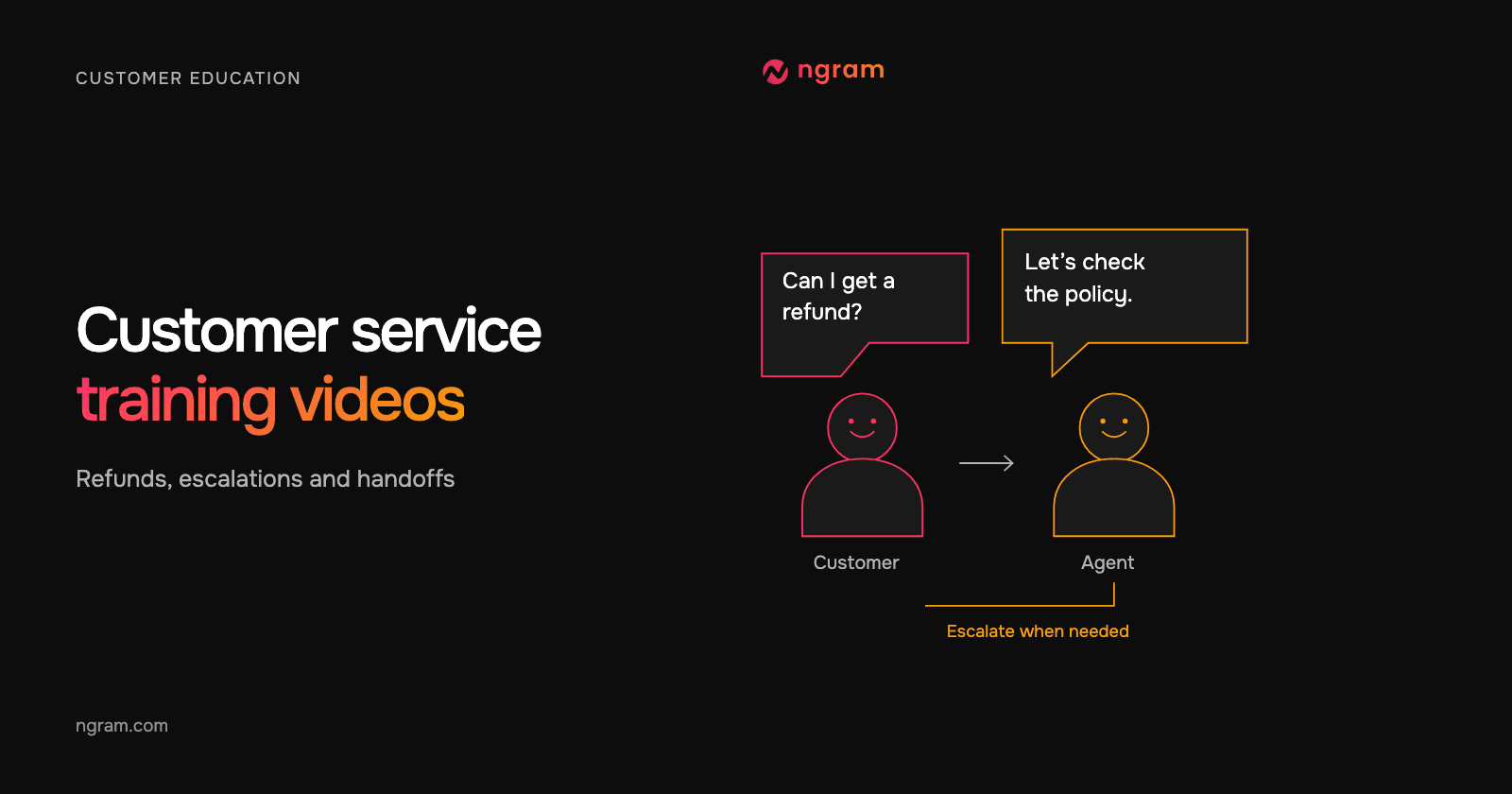
The 31-second dialogue presents Noah’s refund request and Talia’s response. Talia checks usage before explaining the rule. When Noah confirms that the service has been used and pushes back, she offers the team-lead review without promising a refund.
Now the trainer can pause after the customer’s answer and ask what the agent should say next. Listen for the sequence: acknowledge the concern, confirm the relevant fact and state the permitted next step. A learner who knows the policy but promises a refund has not applied the authority limit.
Both videos use the same fictional policy and closing debrief. Their wording, graphics and runtimes differ. They are editorial examples of message structure, not a controlled learner experiment or evidence that either format improves retention.
Choose the format around the moment that matters
| Training need | A useful starting format | What to check |
|---|---|---|
| Explain the rule and its conditions | One presenter | The exception and authority limit are easy to find |
| Model listening before responding | Customer-agent dialogue | The agent’s next turn changes when the customer supplies information |
| Teach a handoff between colleagues | Two-role exchange | The receiving person gets the context needed to continue |
| Teach exact software actions | Actual task recording, with explanation as needed | The screens and steps match the current procedure |
A single presenter can still ask and answer a reasoning question. A dialogue can still become two people reciting paragraphs. Look at what each turn contributes before choosing the cast. If removing the second speaker changes nothing about the explanation, direct narration may be the clearer starting point.
What the research supports
In a CHI 2020 study, Bridjet Lee and Kasia Muldner compared three scripted instructional-video designs with 77 participants: an instructor-visible monologue, an instructor-absent monologue and an instructor-student dialogue. Learning and related outcomes were similar under the study’s conditions. The work concerned introductory programming instruction, not ngram, AI avatars or workplace service role-play. Read the paper.
For this refund lesson, our editorial recommendation follows the task: use the overview when the rule is the message, and the exchange when the learner needs to notice how an answer depends on the customer. Check what learners can do with a new scenario before drawing conclusions about the training program.
Build the debrief before producing the video
Write the question the trainer will ask after playback. “What did you like?” invites a style review. “Which fact must the agent confirm before escalating?” directs attention to the decision. Follow it with a new fictional case and ask the learner to write the response and explain the policy condition behind it.
For a dialogue lesson, the customer-service escalation template contains the reusable scenario brief. Keep the policy check and allowed next step explicit when you customize it. The customer-service training workflow covers how to use that model exchange in an agent-training session.
The Conversation creation guide owns the Studio settings and plan review. Before approving any lesson, read the script against the current policy and check that the debrief tests the intended decision. Keep practice, feedback and completion records in your training environment.
Questions about dialogue and monologue training videos
Is dialogue always better for learning?
No universal advantage follows from having two speakers. The cited study found similar outcomes in its conditions, and these HarborDesk examples do not measure learning. Choose the format for the behavior you need to demonstrate and assess application with a new task.
Can I combine both formats?
Yes. An overview can introduce a policy, followed by a short exchange showing a decision under that policy. Give each part its own purpose so the dialogue adds an application rather than repeating the entire explanation.
How do I judge whether the example worked?
After playback, ask the learner to handle a different request and explain the condition behind the response. Review the observable behavior and the limits of what the agent may promise. A preference for one video’s style is useful feedback, but it is not a learning outcome.