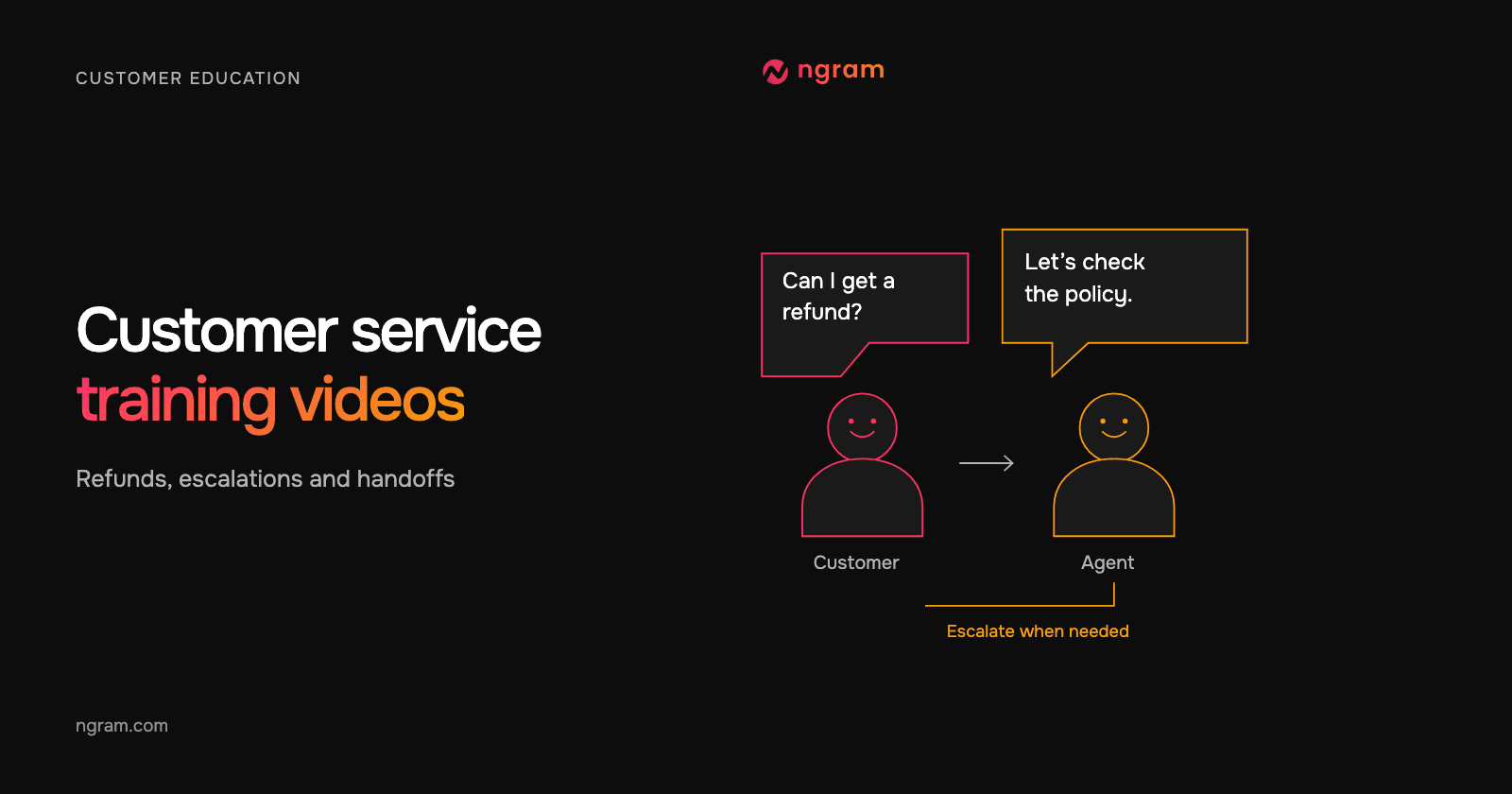

A support lead building an onboarding lesson needs agents to make three different decisions: confirm an eligible refund, escalate a request outside their authority and hand the case to a colleague without losing its context. These customer service training video examples use short fictional conversations to make each decision visible. Each example comes with a behavior to notice and a debrief to use afterward.
The refund and escalation examples use an invented HarborDesk policy: refunds within 14 days require unused service; used subscriptions go to a team lead without a refund promise. The handoff uses a separate fictional shipping case. Replace these conditions with your approved policy and case facts. The presenters are fictional training roles, and the case graphics are illustrations rather than a real support system.
Give each example one decision
| Scenario | Behavior to teach | Debrief question |
|---|---|---|
| Eligible refund | Confirm the conditions before offering the allowed action | Which facts establish eligibility? |
| Used-subscription escalation | Explain the authority limit and offer review | What must the agent avoid promising? |
| Context-preserving handoff | Pass on the known facts and pending decision | What does the receiving colleague need to continue? |
Choose the example that addresses a specific mistake in current work. A policy overview can name the rule, while the conversation shows when the agent needs to ask, respond or pass context. Keep the decision small enough that a trainer can point to the exact line where the response becomes justified.
Example 1. Confirm eligibility before offering a refund
In the 25-second refund example, Noah says he bought HarborDesk ten days ago. Talia acknowledges the request, asks about service use and confirms eligibility only after Noah says he has never used it. The purchase date supplies one part of the fictional rule; unused service supplies the other. She offers to start the request without promising when payment will arrive.
After playback, ask the learner to name the facts that made the request eligible. Then change one condition in a new fictional case and ask them to write the next response. Keep the trainer’s feedback focused on whether the learner checked the condition and stayed within the approved policy.
Example 2. Escalate a used subscription without promising a refund
In the 31-second escalation example, Noah asks for a refund ten days after purchase. Talia checks whether the service was used before explaining that the fictional refund rule requires unused service. When Noah pushes back, she offers team-lead review and keeps the outcome open.
Pause after Noah confirms use and ask the learner to write Talia’s next line. Look for an acknowledgement, the relevant policy boundary and the permitted escalation. An answer that promises a refund goes beyond the scenario’s authority limit; an answer that says nothing can be done misses the offered review path.
The closing question asks what the agent must confirm before escalating. A trainer can follow it with “What can you tell the customer now, and what remains for the team lead to decide?” That separates a helpful next step from an unsupported outcome promise.
Example 3. Hand off the context the next person needs
In the 24-second handoff, Talia passes a shipping case to Andre: the order was due Tuesday, tracking has not changed since Monday and the customer agreed to share the context with the shipping team. Andre repeats those facts and takes ownership of checking shipment status. The exchange leaves the delivery result open.
After playback, ask the learner to write the receiving agent’s case note. Can that person continue without asking the customer to repeat information already established? Identify a missing fact or an unclear owner, then revise the handoff. Do not treat “transferred successfully” as evidence that the context was useful.
Use the videos in a short training session
Salesforce’s customer-service training exercises emphasize listening closely and asking focused questions. In these examples, those actions have a specific purpose: gather the fact that determines the next permitted response. The trainer can listen for that behavior in a new practice case after the model video.
Show one example, pause at its decision point and collect the learner’s proposed response before playing the model answer. Discuss what the response relied on and what the agent was allowed to offer. Conduct the learner’s practice and feedback with a trainer or in your chosen training environment; the generated video is a scripted example to watch.
Use the customer-service training workflow when planning the lesson around the model exchange. If the main task is explaining the policy rather than modeling a response, the dialogue-versus-monologue guide compares both formats using the same fictional rule.
Adapt the scenario without carrying over a fictional policy
Start with the relevant approved policy passage, then name what the agent must confirm, what they may offer and who decides an exception. Keep customer details fictional or anonymized. Review each spoken commitment and any on-screen rule before using the video with new hires.
The escalation role-play template provides the reusable structure behind the second example. The Conversation creation guide covers Studio setup and plan review. When your policy changes, revise the source and check the agent’s answer, captions and case graphics against the new conditions.
Questions about customer service training video examples
Can these examples replace practice with a trainer?
Use them to model and discuss a response, then give learners a new scenario to handle. The finished video does not listen to their answer or provide live coaching. A trainer or your learning environment owns practice, feedback and assessment.
Should I begin with an angry customer?
Begin with the decision you need to teach. Add frustration when it changes the language or sequence the agent needs to practice. An intense performance can distract from a missing eligibility check or an unclear escalation path.
How do I keep a scenario current?
Maintain the policy passage and authority limit with the lesson brief. When either changes, request a revision and review the full exchange before replacing the version used in training. Recheck spoken promises as carefully as the visible rule.