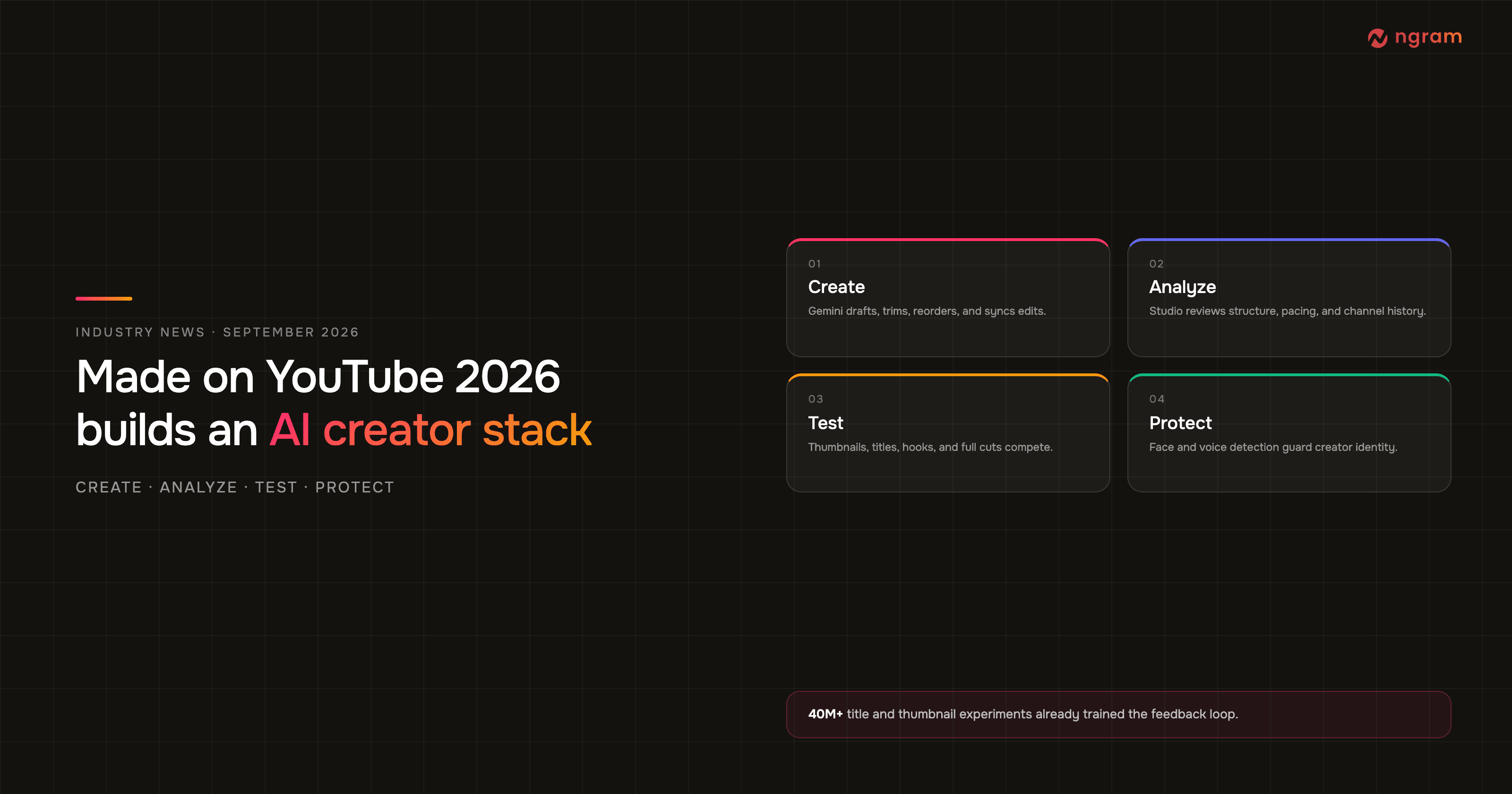

Made on YouTube 2026, announced on September 23, is easy to misread as a bundle of creator features. The bigger story is architectural: YouTube is connecting video research, AI-assisted editing, channel-specific feedback, distribution experiments, and identity protection inside one system.
That is a different move from putting a chatbot in an editor. YouTube already owns the audience signals. Now those signals can guide what gets drafted, how it is packaged, which cut survives, and what a creator makes next.
This Made on YouTube 2026 launch builds on the June rollout covered in our Gemini Omni Flash analysis, but the September launch is materially broader. Gemini Omni is no longer only a generation and remix layer. It is becoming one part of a production-to-distribution feedback loop.
Why Made on YouTube 2026 is a feedback-loop launch
Made on YouTube 2026 links five jobs that creators usually handle in separate tools: research, first-draft editing, packaging, distribution testing, and performance learning. Because YouTube operates the destination as well as the tools, it can use real audience behavior to shape the next production decision. That closed loop is the strategic change.
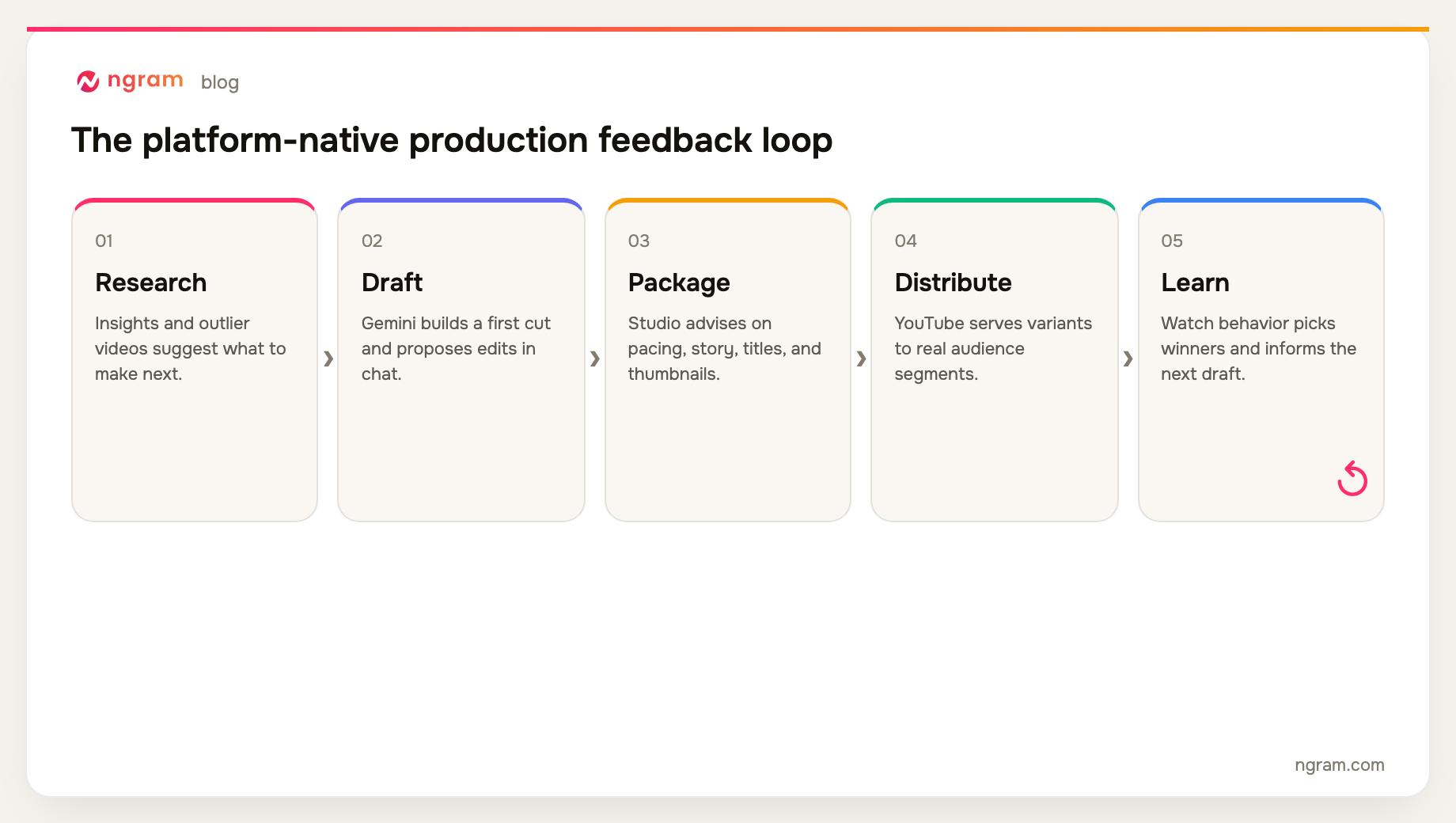
YouTube Studio's new Insights and Research destinations surface past performance and outlier videos. Draft feedback then comments on pacing, structure, and storytelling. Channel-matched thumbnails and dynamic thumbnails change packaging, while video A/B tests move experimentation into the footage itself.
The loop does not stop at the newest upload. YouTube says Ask Studio can review older videos in the background and suggest refreshed thumbnails. A back catalog becomes an active optimization surface rather than an archive.
What Made on YouTube 2026 adds to AI creation
Studio becomes a channel-specific creative reviewer
Generic editing advice is abundant. Channel-specific advice is scarce because it requires access to a creator's history, audience, and outcomes. YouTube Studio has all three.
The announced feedback feature reviews early drafts for pacing, structure, storytelling, and other creative decisions. New Research and Insights destinations connect those recommendations to historical performance and outliers. That makes the system less like a static checklist and more like an editor that has watched the channel's previous work.
The scale behind those recommendations matters. YouTube says more than 20 million videos are uploaded every day. Omdia estimated that YouTube held 29 billion videos by December 2025, with Shorts representing more than 90% of new uploads that year.
Gemini becomes a hybrid editing partner
The new conversational editor spans Shorts and the YouTube Create app. A creator can ask for a first draft, then chat to reorder frames, trim pauses, sync music to the beat, add hooks, and move between conversation and manual timeline editing. It is a video repurposing tool as well as a first-draft editor because the same footage can be rearranged into new cuts.
That combination is more important than either interface alone. Chat is fast when the desired change is easy to describe. A timeline is better when timing and sequence need direct control. The same hybrid pattern also appeared in Google's consumer editing push, which we examined in our Google Photos video remix analysis.
Adoption was already meaningful before this new layer arrived. YouTube reports that hundreds of thousands of channels used Gemini Omni per day in August 2026. Its GenAI trends research found that 72% of US video posters ages 14 to 44 used AI to create or edit video during the previous year.
Earlier in 2026, YouTube also said more than one million channels used its AI creation tools daily in December 2025. These figures measure different tool sets and periods, so they should not be treated as one continuous series. Together, they show that AI-assisted creation is already normal behavior on the platform.
Testing expands from packaging to the video itself
Creators have run more than 40 million title and thumbnail experiments since YouTube officially launched its A/B testing feature in 2024. The next step is testing up to three video cuts to learn which hook holds attention best.
Dynamic thumbnails add another layer. A creator can supply three options and let YouTube recommend different thumbnails to different audience segments. The winning package may no longer be one universal title-image pair. It can vary by viewer context.
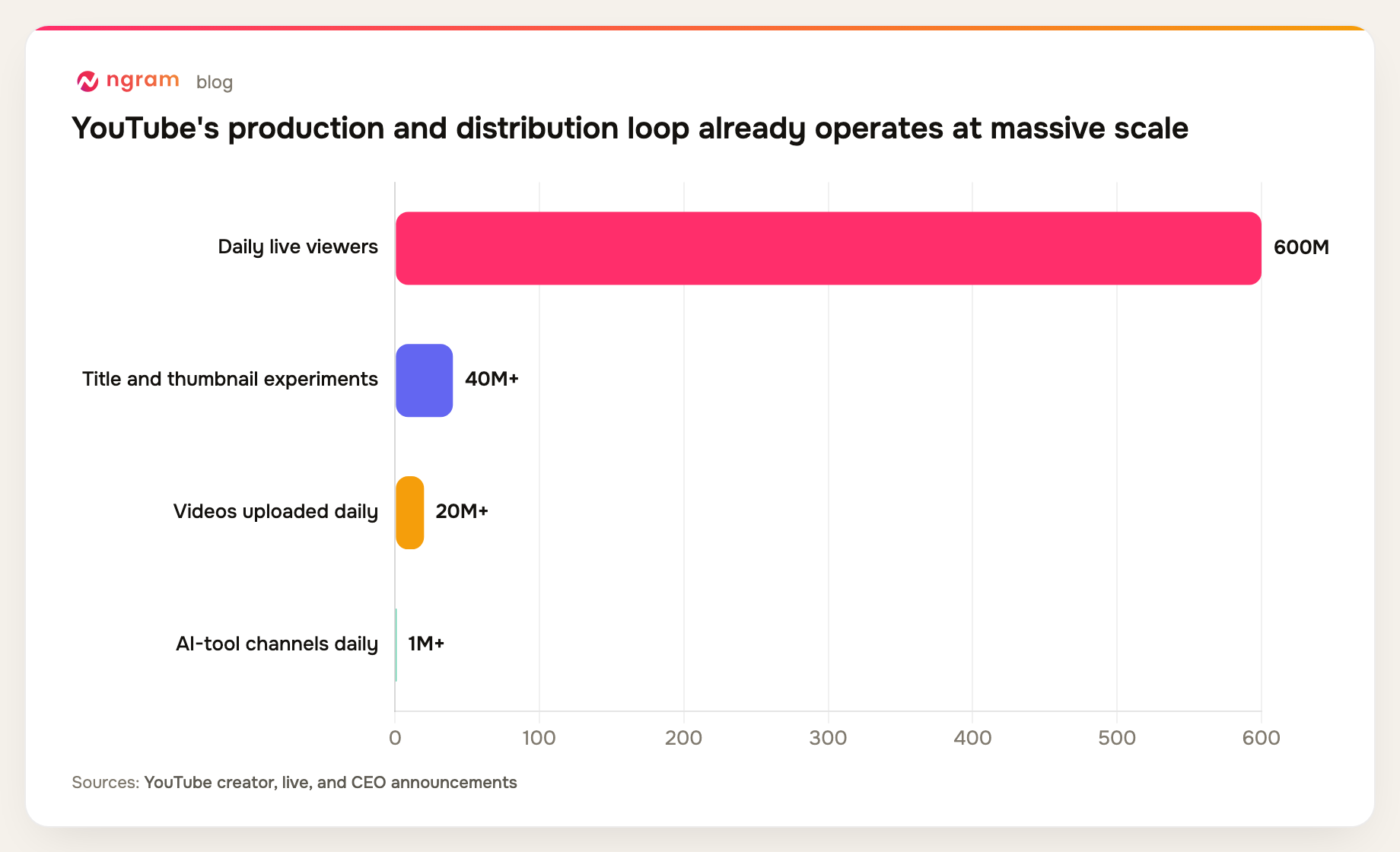
The four measures use different time windows, so the chart is not a performance comparison. It shows why small product changes can reshape creator behavior quickly: the feedback system sits on top of immense volumes of viewing, publishing, and experimentation.
Protection joins the production stack
YouTube says billions of channels are eligible to enroll in automated deepfake detection. The current likeness tool detects enrolled creators' faces in newly uploaded videos. Later in 2026, YouTube plans to combine speaking-voice detection with facial detection and bring enrollment, match review, and actions into the mobile app.
The YouTube Help documentation makes the boundary clear. The feature is experimental, requires consent and identity verification, and can surface genuine footage as well as altered media. A match begins a review process; the creator still decides whether to request removal for a policy violation.
This is an essential companion to easier generation. A platform that lowers the cost of creating or remixing a person also needs tools for that person to discover and contest unauthorized uses. Creation and protection are becoming parts of the same product surface.
Distribution data can now edit the video
The most consequential Made on YouTube 2026 announcement is whole-video A/B testing. Titles and thumbnails test the promise around a video. Different cuts test the product itself.
A creator could compare a cold open with a direct thesis, a 30-second setup with a five-second hook, or two different proof sequences. The winning upload also produces a dataset about which story structure holds attention for that audience.
That changes the production brief in three ways:
- Hooks become testable assets. Teams can plan multiple openings before editing instead of rewriting after a weak launch.
- Versioning moves upstream. Editors need shared footage, clean project structure, and controlled variants so three cuts do not become three disconnected projects.
- Performance becomes creative input. Watch behavior can influence the next script and storyboard as well as the current video's promotion.
Creator reactions show both sides of the shift. In one TravelTubers discussion, posters were excited about testing hooks and serving different thumbnail styles to audience segments. In a YouTube discussion about video A/B testing, commenters immediately raised questions about viewers receiving different footage and how shared comments would make sense across versions.
Those concerns affect the viewing experience. Once a URL can resolve to more than one edit during a test, the idea of a single canonical video becomes temporarily fuzzy. Creators gain better evidence, but they also need stronger version discipline.
Made on YouTube 2026 makes good variants the bottleneck
A/B testing does not eliminate creative work. It creates demand for more deliberate versions. Three near-identical hooks will not teach much, and three unrelated edits will make the result hard to interpret.
Creators already see this problem with thumbnail tests. In a recent PartneredYouTube thread, several posters described near-even results across three options and recommended testing more distinct concepts or running two-way tests. The lesson carries over to video cuts: a useful experiment needs a clear variable.
For teams using video marketing software, that means defining the hypothesis before exporting variants. Change the opening proof, sequence, or framing. Hold the rest steady. Name the intended audience and success signal. Keep a master version that can travel beyond YouTube.
This is where a platform-native AI video generation platform and independent production split. YouTube can optimize for its own audience signals. Business teams still need reusable source material, owned brand rules, and versions for websites, sales, onboarding, paid campaigns, and other channels. In ngram, teams can turn documents, URLs, decks, recordings, and prompts into editable videos, then apply a reusable Brand Kit or start from a creator YouTube content workflow before publishing a channel-specific cut.
That is the practical boundary: use YouTube's loop for last-mile learning, but do not let the destination become the only place where the story, assets, and brand logic exist.
Made on YouTube 2026 still needs reusable production
YouTube is not one format. Omdia's January 2026 analysis estimated that professionally filmed content represented 46% of watch time, music 33%, news 10%, and video podcasts 5%. The same report said the top 1% of videos captured 91% of viewing time, while the other 99% shared 9%.
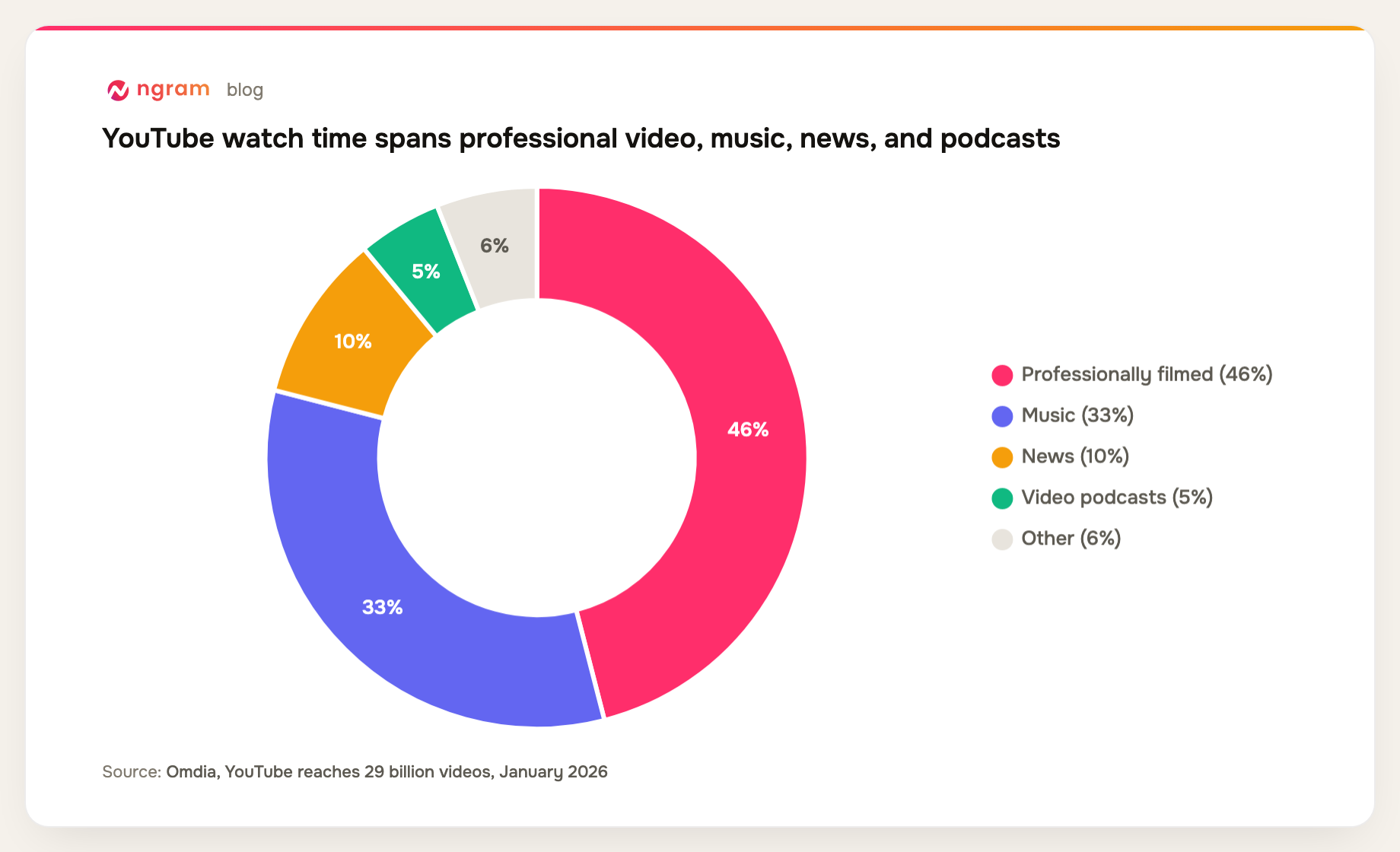
The mix makes one universal production recipe unlikely. A conversational editor can remove friction, but it still needs a clear story model for each format. A Short hook, a product walkthrough, a video podcast, and a live broadcast ask for different pacing and proof.
The concentration statistic also matters. Better tooling may increase supply faster than it increases attention. When more than 20 million videos arrive daily, production speed is not enough. The system rewards creators who can learn, differentiate, and update without losing their voice.
Made on YouTube 2026 makes localization part of production
YouTube's live announcements extend the same logic across languages. The platform says more than 600 million logged-in viewers watched live content each day, including archived streams, in August 2026. More than 40% of live watch time came from outside a creator's home country.
Live auto-dubbing is planned as a pilot for early 2027. It will translate speech in real time so viewers can listen in their preferred language. That video localization feature also feeds back into production: scripts, pacing, on-screen text, and culturally specific references all affect whether a dubbed version lands.
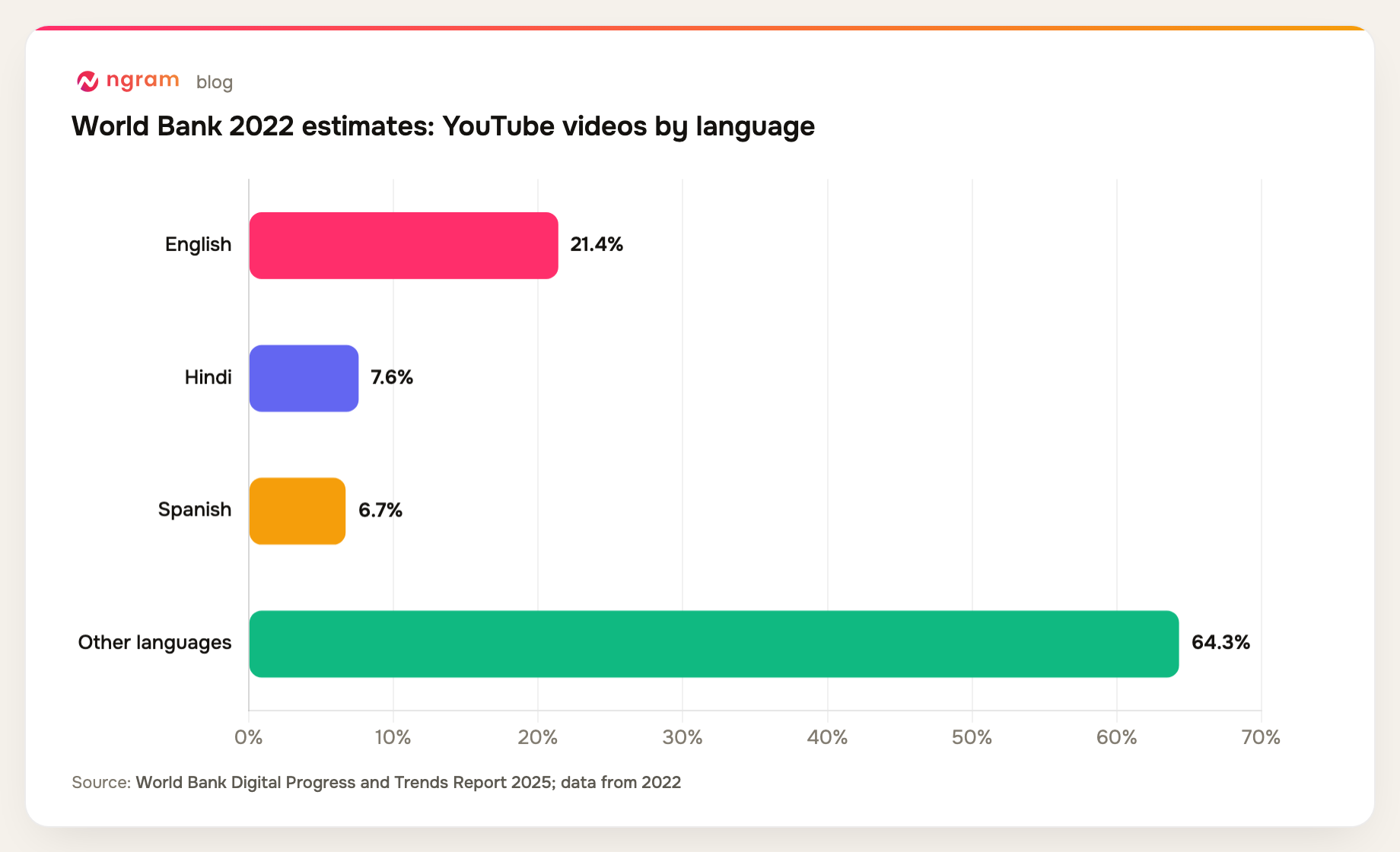
The language distribution of YouTube's inventory shows why this matters. The World Bank's 2025 Digital Progress and Trends Report reports 2022 estimates: 21.4% of YouTube videos were in English, 7.6% in Hindi, and 6.7% in Spanish. The remaining 64.3% spanned other languages.
YouTube said in January that more than six million viewers per day watched at least ten minutes of auto-dubbed content in December 2025. Real-time dubbing pushes that behavior into live production, where creators cannot pause to repair every awkward translation. Preparation becomes more important, not less.
What Made on YouTube 2026 changes for business video teams
The launch is strongest when the destination and feedback metric are clear. A YouTube-first creator can draft, package, test, publish, learn, and refresh without stitching together as many tools. For a business team, the same system is useful but incomplete.
Business video often has more than one destination. The same source may need a YouTube version, a website embed, a sales follow-up, a customer tutorial, a launch cut, and localized edits. An AI video editor for business needs to preserve those channel-specific versions instead of optimizing only for YouTube. The winning YouTube hook may be wrong for an existing customer or a high-intent product page.
A practical operating model is:
- Keep the source of truth outside the platform. Store the approved claims, source footage, brand rules, and master script where the team can reuse them.
- Design variants around hypotheses. Test a shorter setup, a different proof sequence, or a new audience frame, not random edits.
- Use YouTube feedback as one signal. Watch time and retention reflect YouTube viewers in a specific context. Pair them with business outcomes such as qualified visits, signups, adoption, or support deflection.
- Separate the master from the channel cut. Preserve an owned version before YouTube's optimization layer selects a winner.
- Plan protection and disclosure. Keep consent records for faces and voices, disclose realistic AI use, and review likeness matches rather than treating detection as automatic enforcement.
YouTube says an AI disclosure label alone does not change recommendations or monetization eligibility. Its 2026 disclosure update moved labels into more visible positions and added automatic signals for some content. Videos made with YouTube's own AI tools can receive permanent labels.
The result is a more capable platform, but also a clearer responsibility split. YouTube can optimize distribution. The creator or team still owns message quality, consent, claims, brand, and whether a winning test serves the larger communication goal.
Methodology
This analysis covers announcements published by Google and YouTube on September 23, 2026, plus YouTube Help documentation, earlier 2026 YouTube disclosures, the World Bank's 2025 Digital Progress and Trends Report, Omdia's January 2026 platform analysis, and public creator discussions. We verified each launch claim against a primary YouTube or Google source and treated announced or coming-soon features as future availability, not as universally live tools.
Our original contribution is the production-to-distribution loop model: research, draft, package, distribute, and learn. It is an analytical framework built from the announced product surfaces, not a metric supplied by YouTube. Counts with different time windows are labeled and are not presented as directly comparable performance measures.
Frequently asked questions
What was announced at Made on YouTube 2026?
YouTube announced a conversational Gemini editor for Shorts and YouTube Create, new Studio research and draft-feedback tools, channel-matched and dynamic thumbnails, video A/B testing for up to three cuts, expanded face and voice likeness protection, and real-time auto-dubbing for live streams. Availability varies, and several features are described as coming later in 2026 or early 2027.
Is the YouTube AI editor available now?
Gemini Omni was already available in Shorts and YouTube Create before the event, and YouTube said hundreds of thousands of channels used it daily in August 2026. The new conversational editing assistant is an expanded workflow, and YouTube's announcement does not state that every creator receives every new capability immediately.
How does YouTube video A/B testing work?
YouTube says creators will be able to test up to three video cuts to see which hook holds audience attention best. The company has not published complete rollout, winner-selection, or comment-handling details in its main announcement, so teams should avoid assuming the final mechanics until the feature reaches their Studio account.
Does YouTube's dynamic thumbnail feature show everyone the same image?
No. YouTube describes dynamic thumbnails as a system that can recommend the best of three options to different audience segments. That differs from a simple test that eventually selects one permanent thumbnail for every viewer.
Will YouTube detect AI copies of a creator's voice?
YouTube currently documents facial likeness detection for enrolled creators. It says speaking-voice detection will begin integrating with facial detection later in 2026, with broader voice protections developing over time. The system is consent-based and experimental.
Will AI labels hurt YouTube recommendations or monetization?
YouTube says disclosure labels alone do not affect recommendations or monetization eligibility. Discovery still depends on audience signals such as watching, skipping, searching, and interacting, while failure to disclose realistic AI use can lead to penalties.
Does YouTube's creator stack replace independent video production tools?
It can replace several steps for YouTube-first work, especially research, Shorts editing, packaging, and distribution testing. Teams producing branded video for multiple channels still need reusable masters, source control, and brand governance outside the destination. If that is your workflow, try ngram's video workflow and keep YouTube as the feedback layer rather than the only production home.
The platform is becoming part of the edit
The old YouTube workflow ended with upload. The Made on YouTube 2026 workflow can begin and end inside the platform: find an idea, draft it, improve it, package it, test it, and feed the result into the next idea. That makes YouTube a more complete business video maker for teams whose audience already lives there.
That loop will make many creators faster. It may also make platform-specific optimization more demanding because every new testing surface creates another possible variant. The teams that benefit most will not be the ones that generate the most versions. They will be the ones that know what each version is meant to test, preserve a reusable master, and carry the learning into the next story.