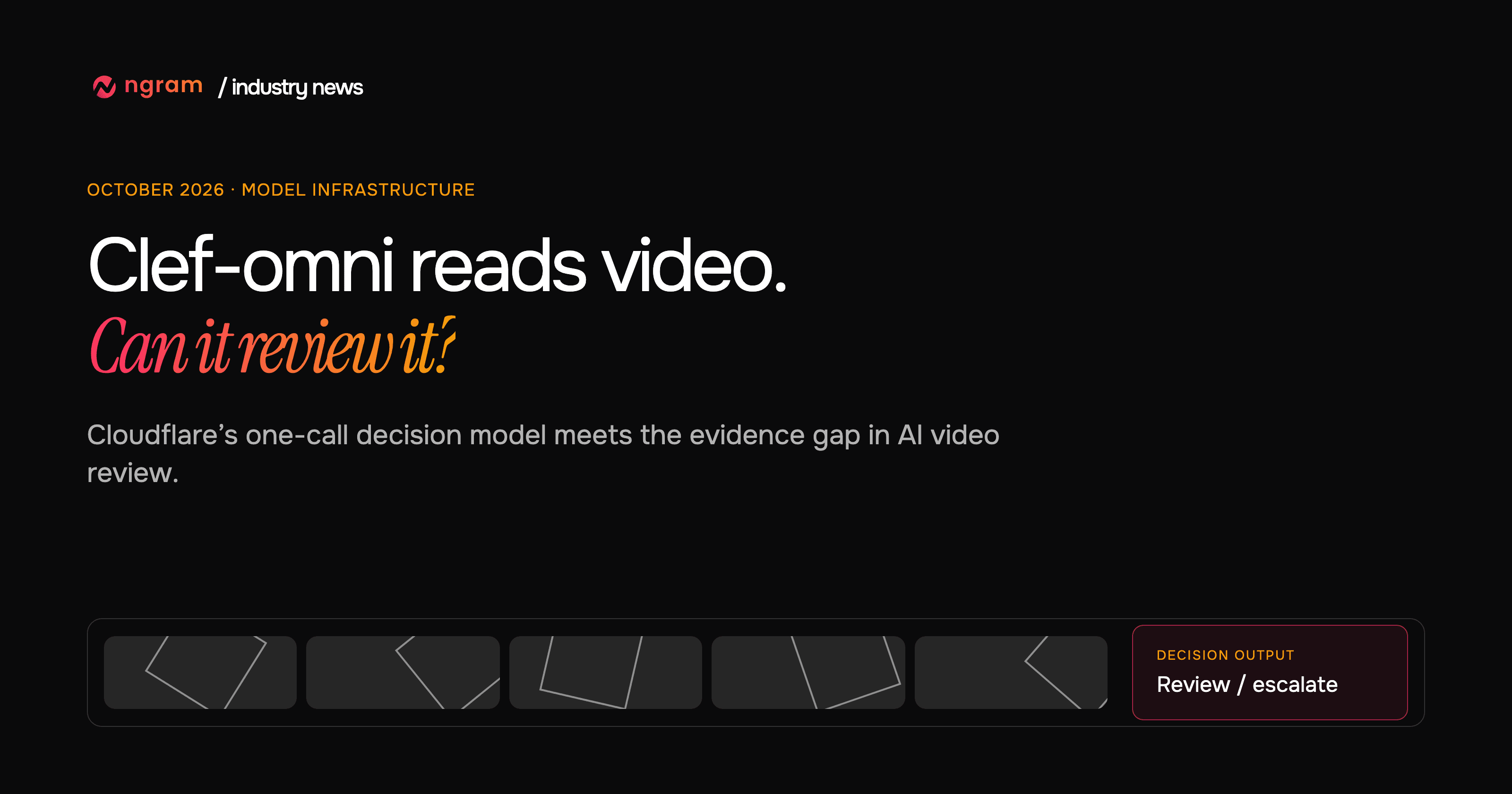

On October 9, 2026, Cloudflare released Clef-omni, an open-weight decision model that reads video with its soundtrack, plus images and text, in one request. It returns probabilities for choices you define instead of drafting a free-form answer. That makes it relevant to a growing problem in AI video production: deciding which finished clips need a closer look before anyone publishes them. Cloudflare’s launch post reports that a 21-second clip with sound was scored in about 1.5 seconds. The company has not published a video-moderation accuracy test.
The distinction matters. A fast second opinion can route an editor to a suspect moment. It cannot yet be treated as a reliable sign-off for copyright, consent, brand rules, or safety. This article separates what Cloudflare measured from what a video team would still have to test on its own footage.
What Clef-omni actually returns
Clef-omni is built on the Qwen3-Omni-30B-A3B-Instruct backbone. Cloudflare adds a joint schema head that scores the allowed options for each typed question. The model card says the backbone has 30 billion total parameters with about 3 billion active in a mixture-of-experts path; the weights are downloadable under Apache 2.0. The model card also says the speech-output components are not used in the decision path.
A request might ask whether a spoken price matches the on-screen price, whether a logo appears, and whether a visible person is speaking. Clef-omni can return option probabilities for those questions in one pass. A probability is a model score for a supplied option, not a forensic finding or an independently verified fact. The question wording, footage, threshold, and review policy still determine whether that score is useful.
The hosted Workers AI endpoint accepts MP4 or WebM video, WAV or MP3 audio, images, and text. Cloudflare says it processes synchronized frames and sound directly, without a separate transcript-and-caption cascade. This reduces orchestration steps for a team already checking multiple signals in each clip. It does not remove the need to keep the original media, inspect the evidence, or log what a human reviewer decided. Cloudflare’s model documentation details the endpoint and limits.
The speed claim is real but narrow
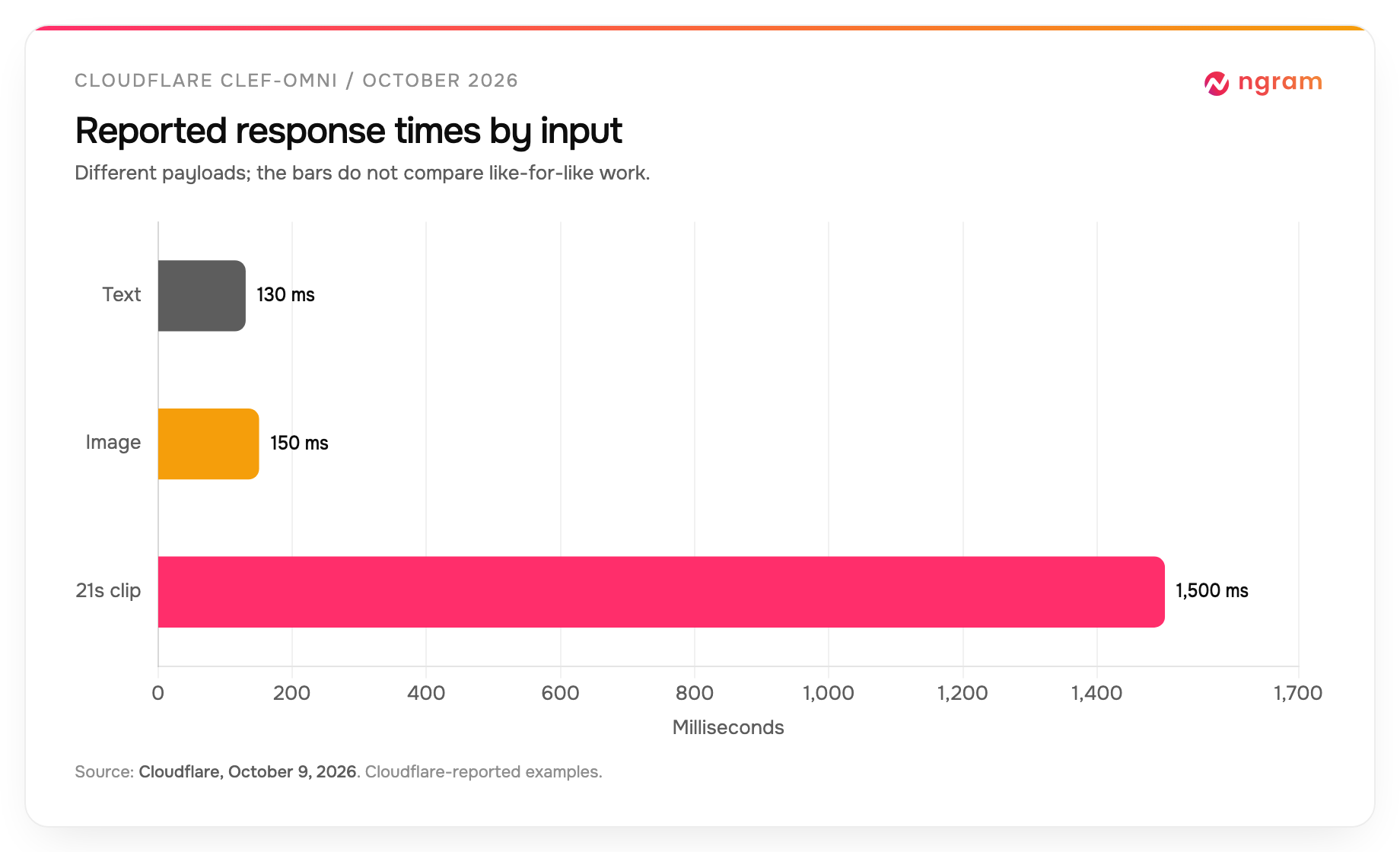
Cloudflare reports roughly 130 ms median for text-only decisions, roughly 150 ms for image inputs, and about 1.5 seconds for a 21-second video with sound. Those are examples from different payload types, not a controlled like-for-like benchmark. The video figure is a useful feasibility signal: review can happen before a person opens a clip. It says little about whether the model identifies a hidden disclosure issue or catches a fleeting visual error.
A 1.5-second service response is not the same as a 1.5-second publication gate. Uploading media, extracting the right clip, retrying failures, bringing a human into the loop, and recording a defensible decision all add time. Teams should measure the end-to-end path on their own queue, then decide whether automated triage improves it.
The published benchmarks do not validate video moderation
Cloudflare publishes scores for decision and business-workflow tasks. The list includes BFCL tool calling, banking classification, retrieval, invoice processing, customer service, and security incidents. There is no published row for detecting unsafe frames, licensing problems, undisclosed synthetic media, accessibility defects, or audiovisual contradictions in a finished ad. A higher decision score on another task is not evidence for any of those uses.
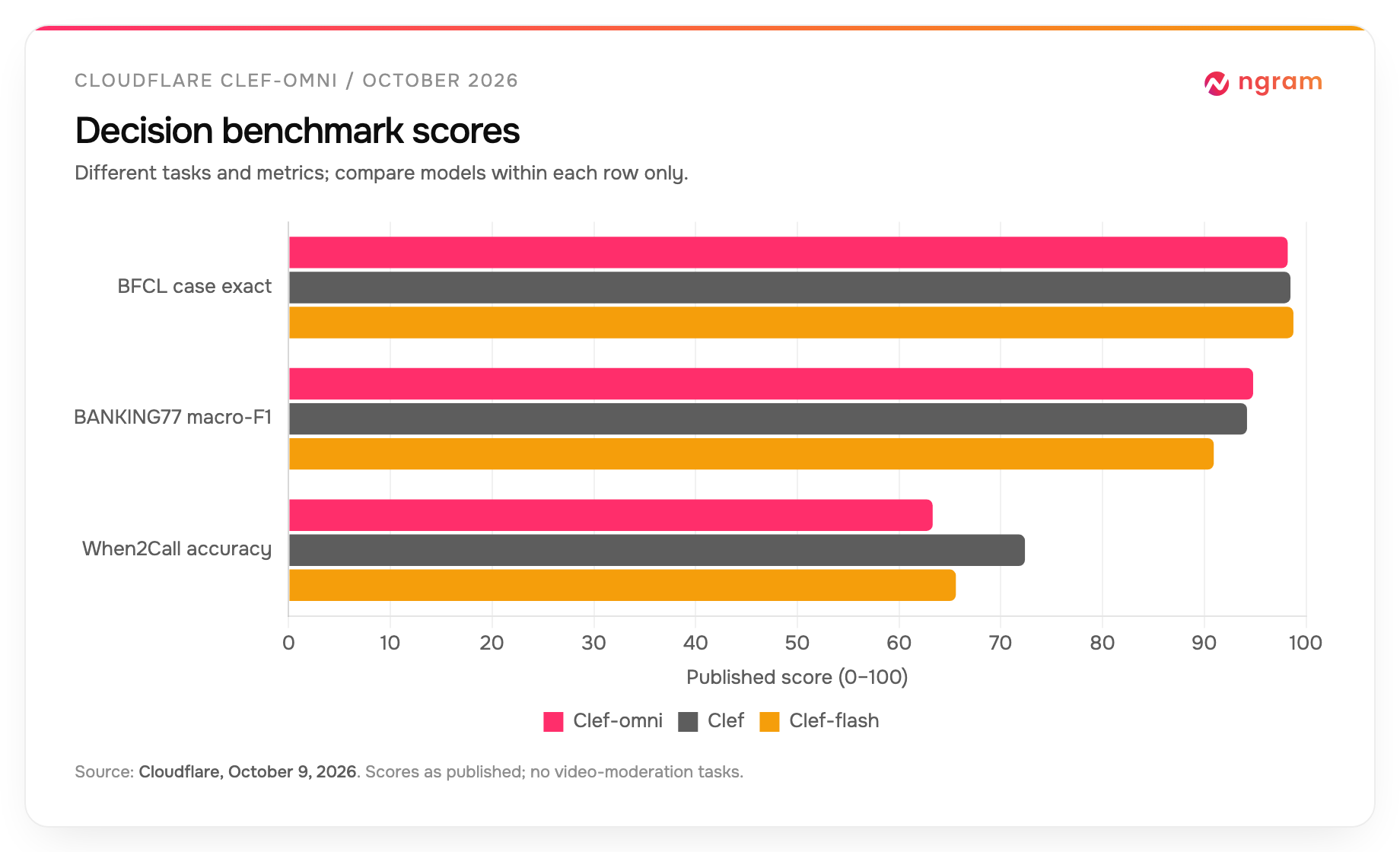
The general benchmark panel is mixed. Clef-omni scores 98.2 on BFCL case exact versus 98.47 for Clef and 98.76 for Clef-flash. It reaches 94.8 macro-F1 on BANKING77 versus 94.20 and 90.93 respectively. On When2Call accuracy, however, Clef-omni scores 63.3 versus Clef’s 72.37 and Jev’s 80.97. These are Cloudflare-reported figures, with different metrics and task populations. Comparing them as one overall “accuracy” number would be misleading. Cloudflare’s benchmark table supplies the values.
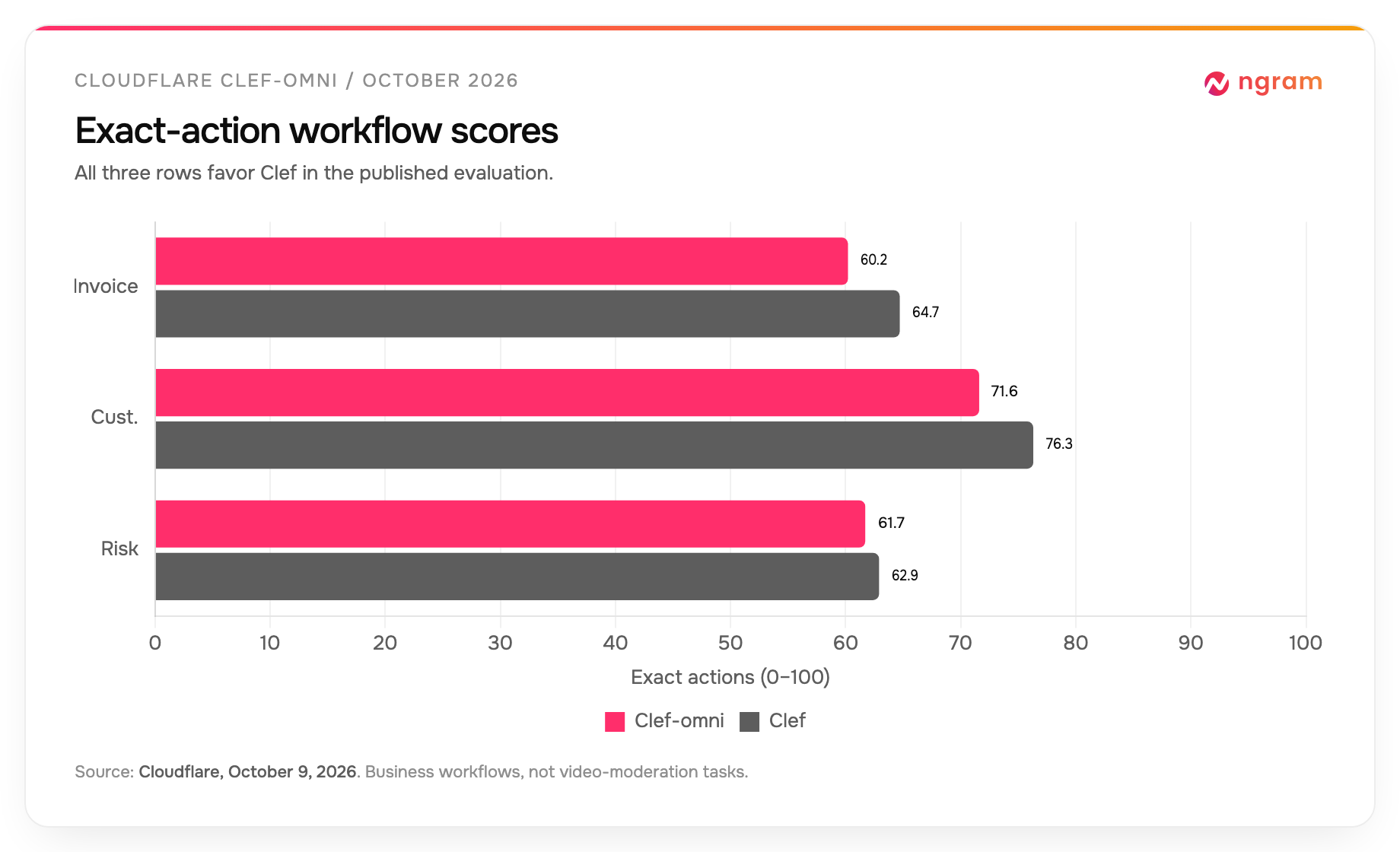
The workflow results sharpen the caution. On invoice processing, Clef-omni gets 60.2 exact actions against 64.7 for Clef. On customer service, 71.6 versus 76.3; on security incidents, 61.7 versus 62.9. Cloudflare does not show an across-the-board performance win. The reason to test Clef-omni is its ability to consider sound and frames together, not a claim that it is generally more accurate than every text- or image-oriented alternative.
A useful evaluation would start with a labeled set of the team’s own clips, including hard negatives. Measure missed violations separately from false alarms. Break results out by language, audio quality, camera cuts, captions, and clip length. Then test whether reviewers find real problems sooner with model suggestions than without them. Until those numbers exist, “video-aware” describes the input path, not the reliability of the review decision.
Hosted limits shape what teams can inspect
The hosted endpoint accepts up to two videos in one request, each at most 60 seconds and 16 MiB. It samples video at two frames per second. Audio and video together have a 16 MiB decoded-media cap, and the request has a 64,000-token context window. Up to four separate audio clips are accepted. These are current Workers AI limits, not a statement about every way the open weights could be run. The documented parameters are the right place to check before designing a review queue.
Two frames per second means the model sees one sampled frame every half-second. An error visible for only a few frames could be missed between samples. A minute-long video can be submitted, but a longer finished video needs a separate segmentation strategy. The 16 MiB shared cap may bind first on high-bitrate media. These are engineering constraints; no published study yet quantifies their effect on moderation recall.
For a production queue, segmenting is only the first step. Keep timestamps, choose overlap between segments where transitions matter, and send failures back for review rather than assuming a clean pass. If the question concerns a spoken claim, preserve the associated visuals and soundtrack in the same unit of review. If the question concerns a one-frame disclosure, two-frame-per-second sampling may be the wrong evidence path entirely.
What the price does and does not tell you
Cloudflare lists Clef-omni at $0.15 per million input tokens on Workers AI, with no output-token charge. Its docs estimate about 780 tokens per minute of audio, roughly 8,600 frame tokens per minute for 480p video, and up to about 15,400 video tokens per minute at maximum resolution. Sound on a video adds roughly 780 tokens per minute. These are tokenization estimates rather than a flat per-video rate. Cloudflare’s billing explanation makes the media conversion explicit.
At those stated rates, a one-minute 480p video with sound would consume about 9,380 media tokens, or about $0.0014 in model input charges before text and other media. At the documented maximum-resolution estimate, video plus sound is about 16,180 tokens, or about $0.0024. Those are calculations from Cloudflare’s published token estimates and price, not a quoted invoice. Retries, storage, segmentation, transport, and human review are outside them.
This is why low model cost alone does not settle the business case. If the model flags every other clip for a specialist, the review queue can still become expensive. If it misses a policy-critical issue, the model fee is immaterial. The worthwhile experiment measures minutes of reviewer attention per true problem found, plus false-negative rates at the threshold your organization can tolerate.
A practical review loop for generated video
A useful first trial is narrow: choose one specific, observable decision, such as whether a required disclaimer is visible and audible in a short product clip. Label a representative sample manually. Ask Clef-omni the same fixed question for every clip, with allowed choices that include an uncertain or escalate path. Log the probability, the source segment, and the human outcome. Do not let a probability silently turn into a publish command.
Expand only after you know what the system misses. A useful escalation rule may send high-confidence clean clips to spot checks, ambiguous clips to a reviewer, and policy-sensitive categories to a specialist regardless of score. The threshold should follow measured error costs. A question about typography or timing may need frame-level inspection; a question about a spoken promise needs audio and visual context. The same decision model need not own both.
This also clarifies the role of generation tools. ngram’s current creation path has a storyboard approval step when required and a video preview with revisions by chat or Make changes. Those human control points let a creator catch issues in the message and scenes before export. A downstream decision model could become another review aid. For teams using an AI-generated business video, the real task is to combine good production judgment with evidence from the final file.
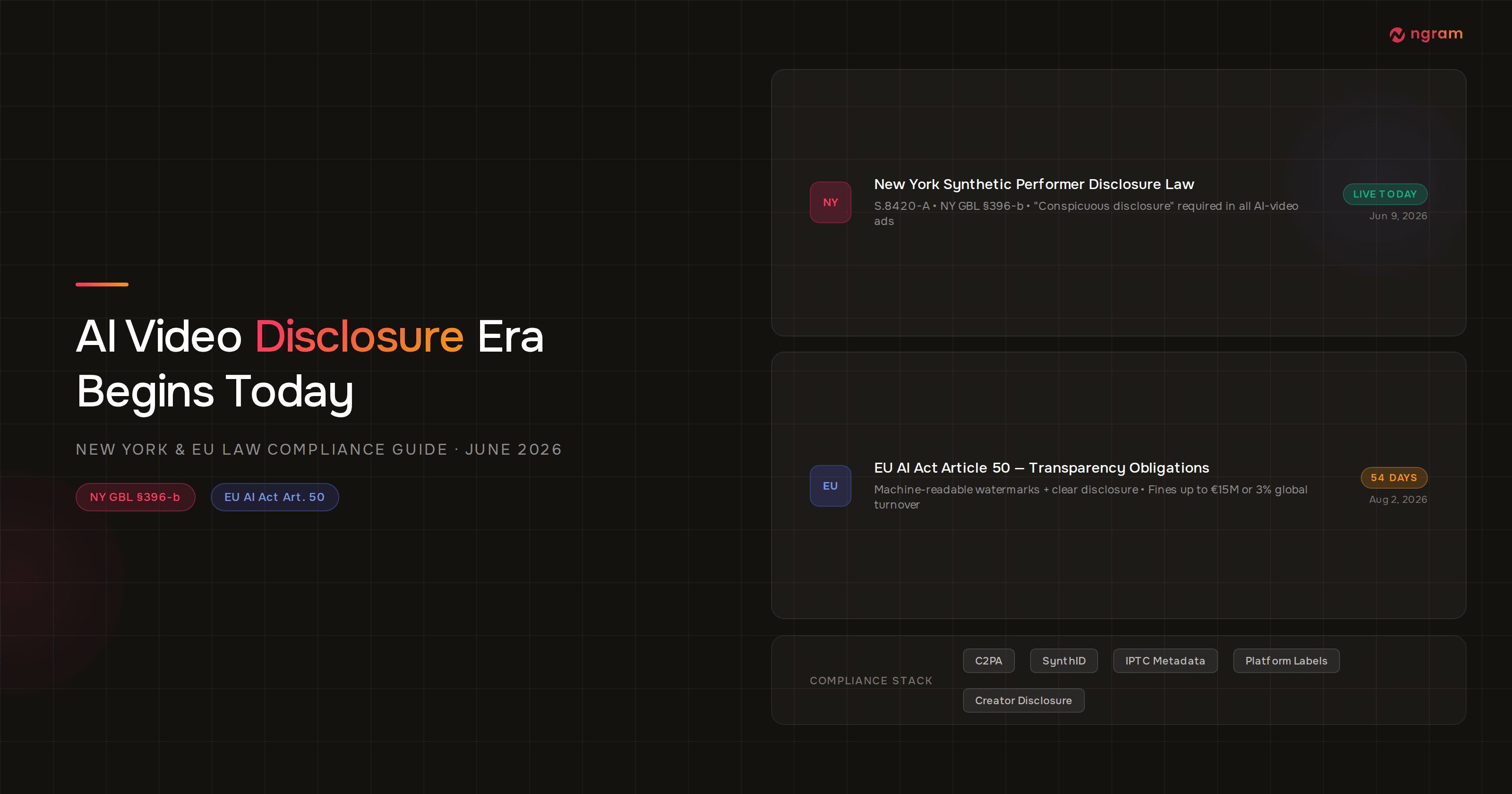
The same distinction appears in other parts of the stack. Our earlier analysis of AI video disclosure rules covers obligations that a model score cannot settle alone. And the Runway moderation infrastructure story shows why model access and operational review are separate decisions. New capabilities make review workflows possible; teams still have to show that those workflows find the failures that matter.
The takeaway for video teams
Clef-omni makes it easier to ask structured questions of short video and synchronized audio in one hosted call, and its open weights give developers another deployment option. The published 1.5-second clip example and $0.15-per-million-token price suggest that the model can be cheap enough to test as triage. Neither figure demonstrates that it can clear a finished video for publication.
The next credible result would be a task-specific evaluation: a labeled set of real clips, a threshold, a measured miss rate, and a record of how much human review the model saved or added. Until then, keep the human reviewer in the decision and use Clef-omni as a way to prioritize attention.