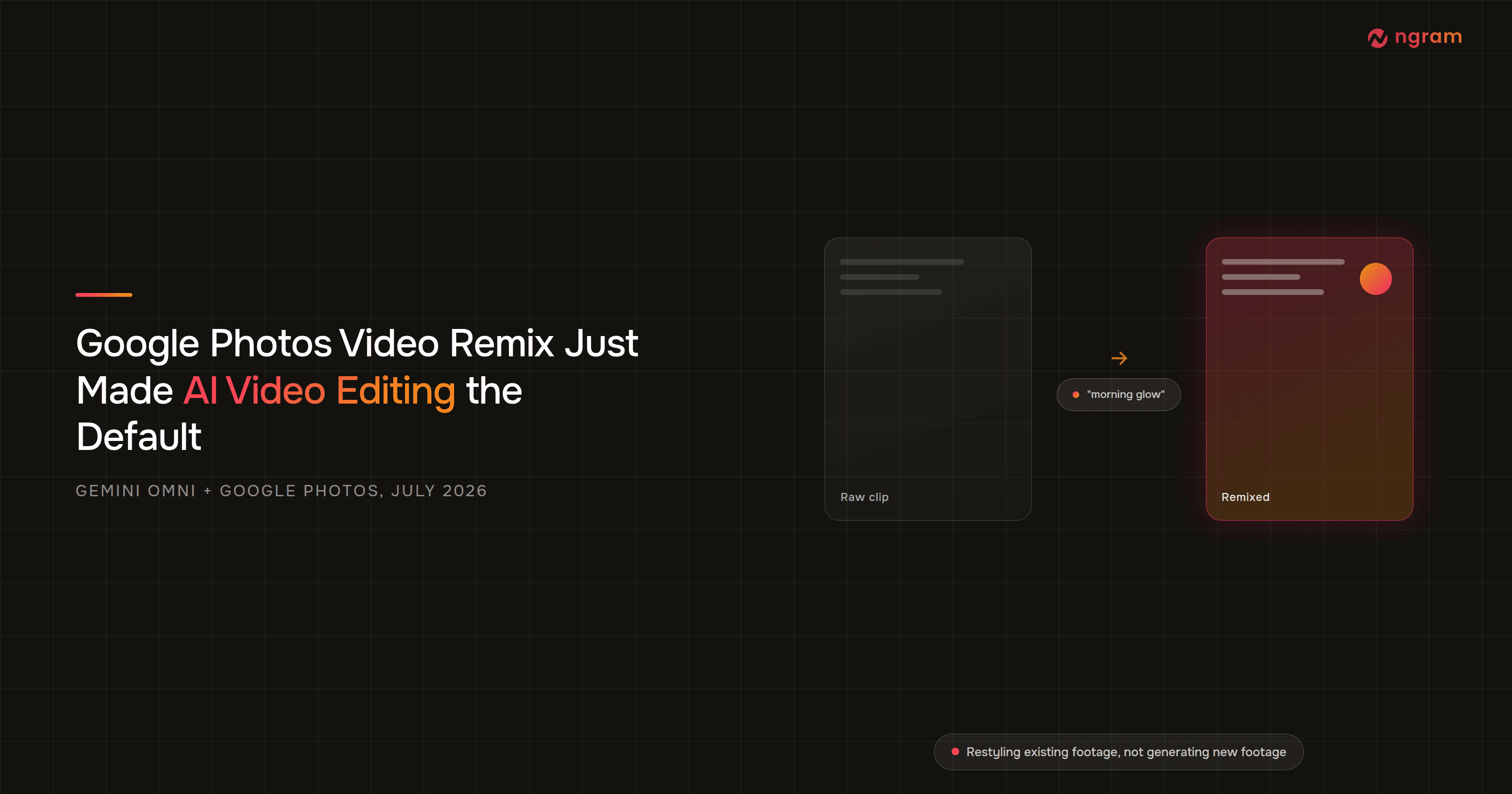

On July 8, 2026, Google Photos started rolling out a feature called Video Remix. Point it at a clip you already shot, describe how you want it to look, and it hands back a restyled version in seconds. No timeline, no export settings, no tutorial.
The obvious read is that Google added a filter pack to Photos. The more useful read is what it reveals about where Google is pointing its AI video effort next. Five weeks earlier, on June 2, the same underlying model gave YouTube Shorts free AI video generation at a scale of 2.7 billion monthly users, a move we covered in detail at the time. Video Remix is the second half of that story: the same Gemini Omni family, applied to editing existing footage instead of generating new footage, landing in the world's largest photo and video library instead of the world's largest video platform.
This piece looks at what Video Remix actually ships, why Google gated it behind a paid subscription when the YouTube move was free, and what it signals about the baseline every video editing tool, including purpose-built ones, now has to clear.
What Google Photos Video Remix Actually Ships
Video Remix lives in the Create tab in Google Photos, next to the app's existing image Remix, Photo to video, and Collages tools, according to 9to5Google's coverage of the rollout. A user picks an existing video, describes the transformation in plain language, and the model applies it directly to the clip. Google says the point is speed: on its own product blog, the company describes results arriving "in seconds," with effects that "instantly apply" to the source footage.
The template library spans four broad categories, pulled from Google's own examples and early hands-on coverage:
- Cinematic relighting: brighten or restyle a dark clip, described in Google's own example as adding "morning glow" to underexposed footage.
- Background replacement: swap a plain or cluttered background for something else entirely; Google's example prompt is literally "set my video in a greenhouse."
- Artistic styles: repaint the clip in watercolor, raw sketchbook, or oil painting treatments.
- Animation-style effects: restyle footage into anime, comic-panel, or 3D-animation looks, per PetaPixel's rundown of the launch.
It rolled out to Google AI Plus, Pro, and Ultra subscribers in 14 countries on day one: the United States, Argentina, Bangladesh, Brazil, Colombia, Egypt, India, Indonesia, Japan, Mexico, Pakistan, the Philippines, South Korea, and Turkey, per PetaPixel and TechCrunch's coverage of the launch. That is a deliberately broad launch list for a first release, not a US-only pilot.
Google's own framing is unambiguous about who it thinks the feature is for and who it thinks it is competing with. "Creating beautiful video clips shouldn't require professional skills or hours of editing," the company said in its announcement, positioning Video Remix directly against the consumer AI editing pushes coming from Apple, OpenAI, and Adobe.
Generation, Then Editing: The Same Model, Five Weeks Apart
Gemini Omni is Google's unified model for turning text, images, audio, and video into video output, unveiled at I/O 2026 on May 19. What it shipped first, on June 2, was generation: Gemini Omni Flash arriving free inside YouTube Shorts, letting anyone with a YouTube account describe a clip into existence at no cost, as we wrote when that rollout landed.
Video Remix is the second move from the same model family, and it inverts almost every variable of the first one. YouTube Shorts generation was free; Photos editing is gated behind a paid subscription. The YouTube move created video from nothing; Video Remix transforms video you already shot. One shipped into the platform with more daily views than almost anything else on the internet; the other shipped into the app that already stores more than 9 trillion photos and videos for over 1.5 billion monthly users, a figure Google confirmed at Google Photos' 10th anniversary in 2025.
The timeline below places both moves alongside what Apple, Adobe, and OpenAI did in the same stretch of 2026. Read together, it looks less like a string of unrelated feature launches and more like every major platform racing to make natural-language editing feel unremarkable before anyone builds a habit around asking for it somewhere else.
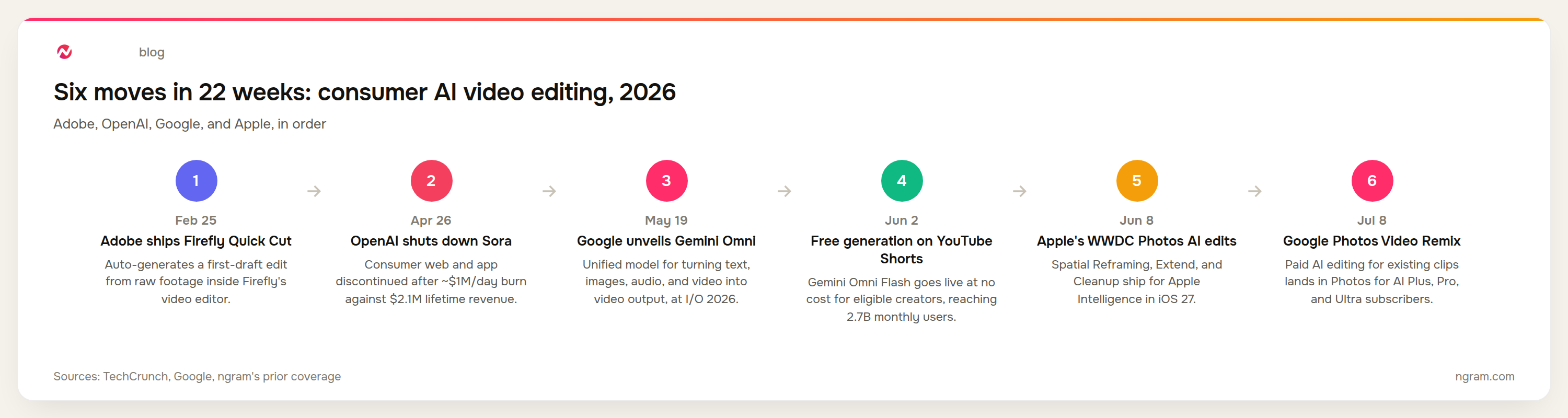
That 36-day gap between free generation on YouTube (June 2) and paid editing in Photos (July 8) is short enough that it reads as sequencing, not coincidence. Google shipped the cheaper, more viral capability first, on the platform built for outbound sharing, then followed with the more utilitarian one, gated behind revenue, on the platform built for personal archives.
The Catch: Editing Costs Money Even Though Generation Was Free
Gemini Omni Flash's YouTube debut cost nothing. Video Remix does not. It requires a Google AI Plus subscription at minimum, currently priced at $7.99 a month, with Pro at $19.99 a month and Ultra starting around $100 a month unlocking higher usage ceilings, per Google's own subscription page and coverage of the 2026 tier restructuring.
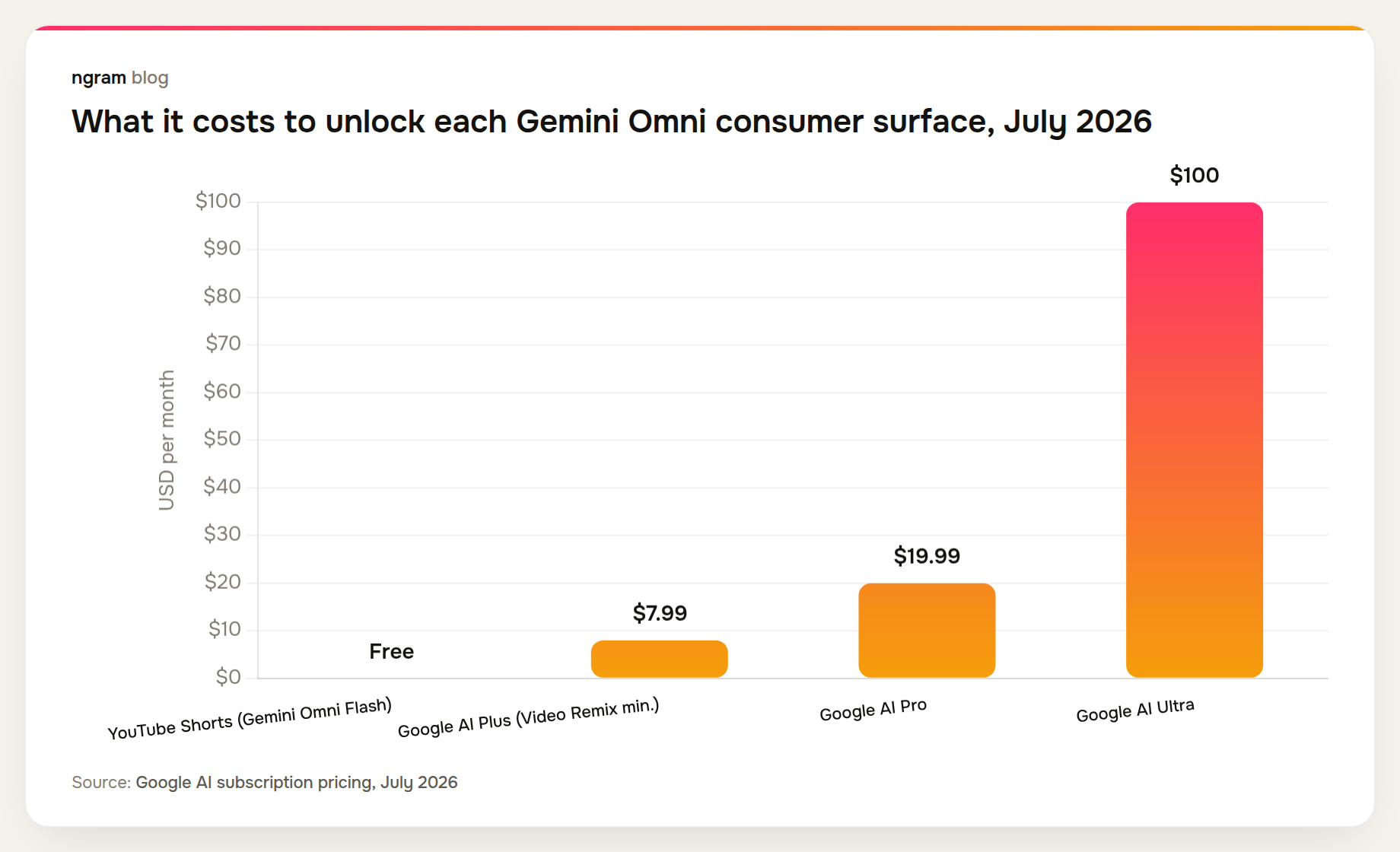
That gap is worth sitting with. Generation is the more expensive capability to run and the one Google gave away. Editing, which is computationally lighter per clip, is the one it charges for. The likely reason is not cost, it is intent: free generation inside Shorts drives content into a feed Google already monetizes with ads, while editing inside Photos serves a private, non-monetized archive, so subscription revenue is the more natural lever to pull.
It also means Video Remix will not reach anywhere near 2.7 billion people the way YouTube Shorts generation can. It reaches whoever is already paying Google $7.99 a month or more for something else, and happens to open Photos instead of, or alongside, a dedicated editor.
Why This Is a Distribution Story, Not a Feature Story
Strip away the subscription gate and the more important number is what Google Photos already is: a default camera roll backup for well over a billion phones. Google's own 10th-anniversary numbers put 4.3 billion photos uploaded daily and 210 million people editing photos in the app every month, before Video Remix existed. Shipping natural-language video editing into that surface does not require anyone to discover a new app, learn a new interface, or decide to try AI video editing as a category. It only requires opening an app that is already the default home for footage people already shot.
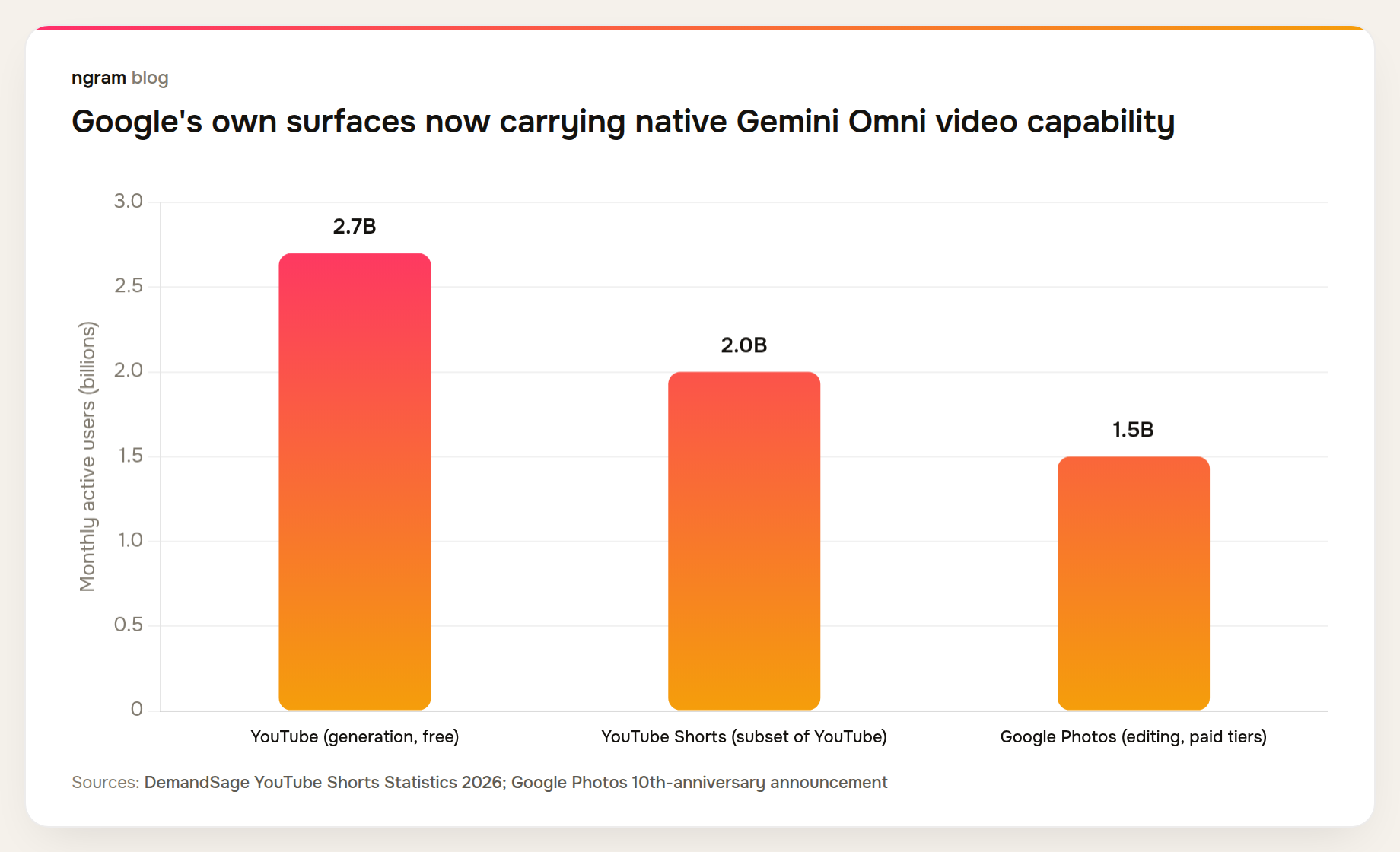
This is the same distribution logic we flagged in the YouTube Shorts piece, now applied a second time: Google is not trying to win video editing on the merits of a standalone product against Adobe or CapCut. It is embedding the capability into surfaces people already open daily for other reasons, whether that person is a marketer, a small business owner, or a content creator polishing a clip for social, so that trying it costs zero discovery effort. A feature that ships into an existing habit spreads faster than a feature that requires forming a new one, regardless of how good the underlying model is.
The Premiere Pro Problem: Pressure on the Traditional Editing Stack
Multiple outlets covering the launch made the same comparison unprompted: Video Remix is designed to save users from, as one write-up put it, sitting through hours of Premiere Pro tutorials. That framing is doing real work. It names the actual alternative Google thinks it is displacing, and it is not another AI startup. It is the decades-old assumption that real video editing requires learning software.
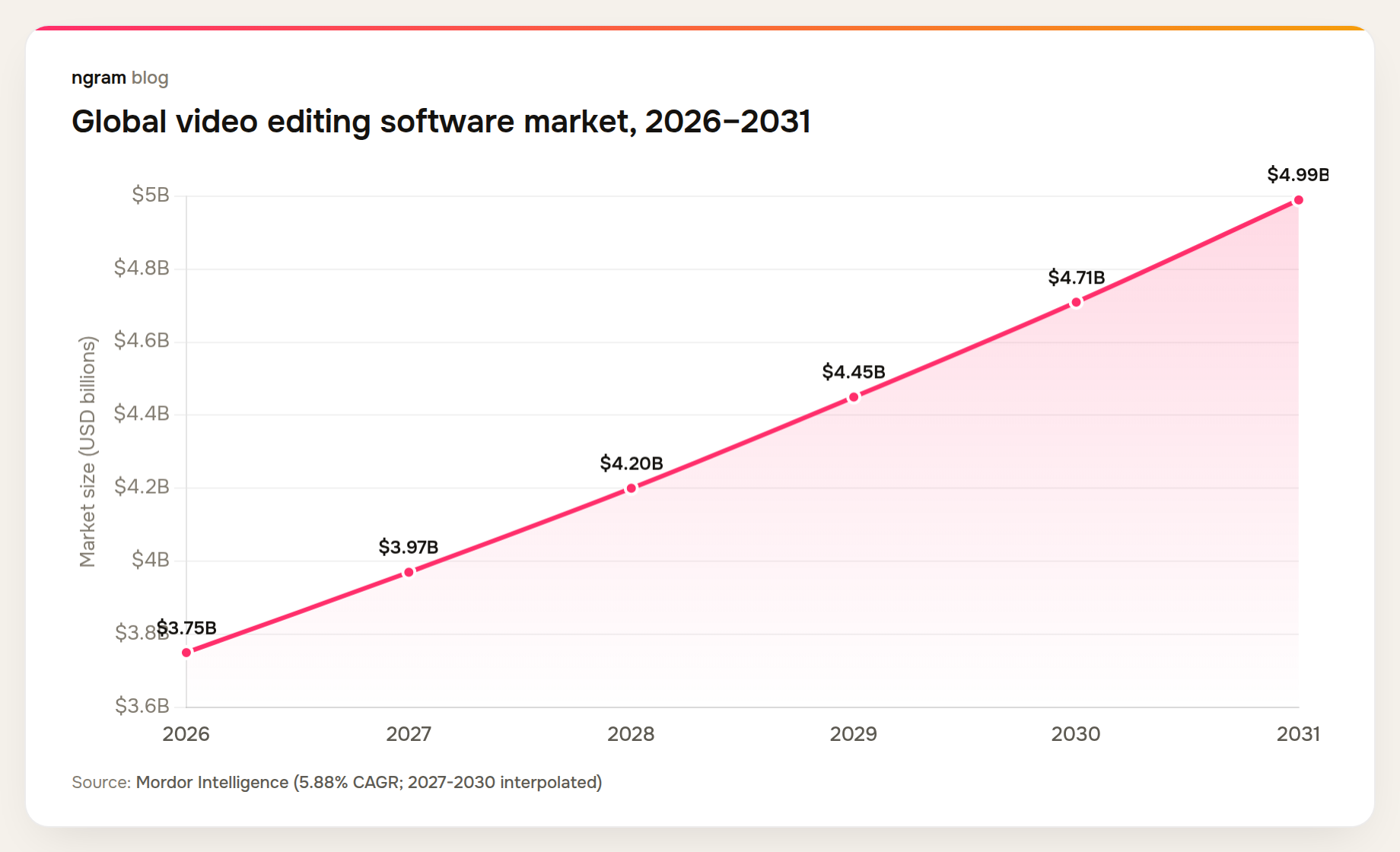
The traditional editing software market is not shrinking, but its center of gravity is shifting. The global video editing software market is projected to grow from $3.75 billion in 2026 to $4.99 billion by 2031, a 5.88% CAGR, according to Mordor Intelligence. Nearly all of that forecast growth is attributed to generative AI editing features, cloud rendering, and mobile-first, prompt-driven workflows, not to more people learning traditional timeline editing from scratch.
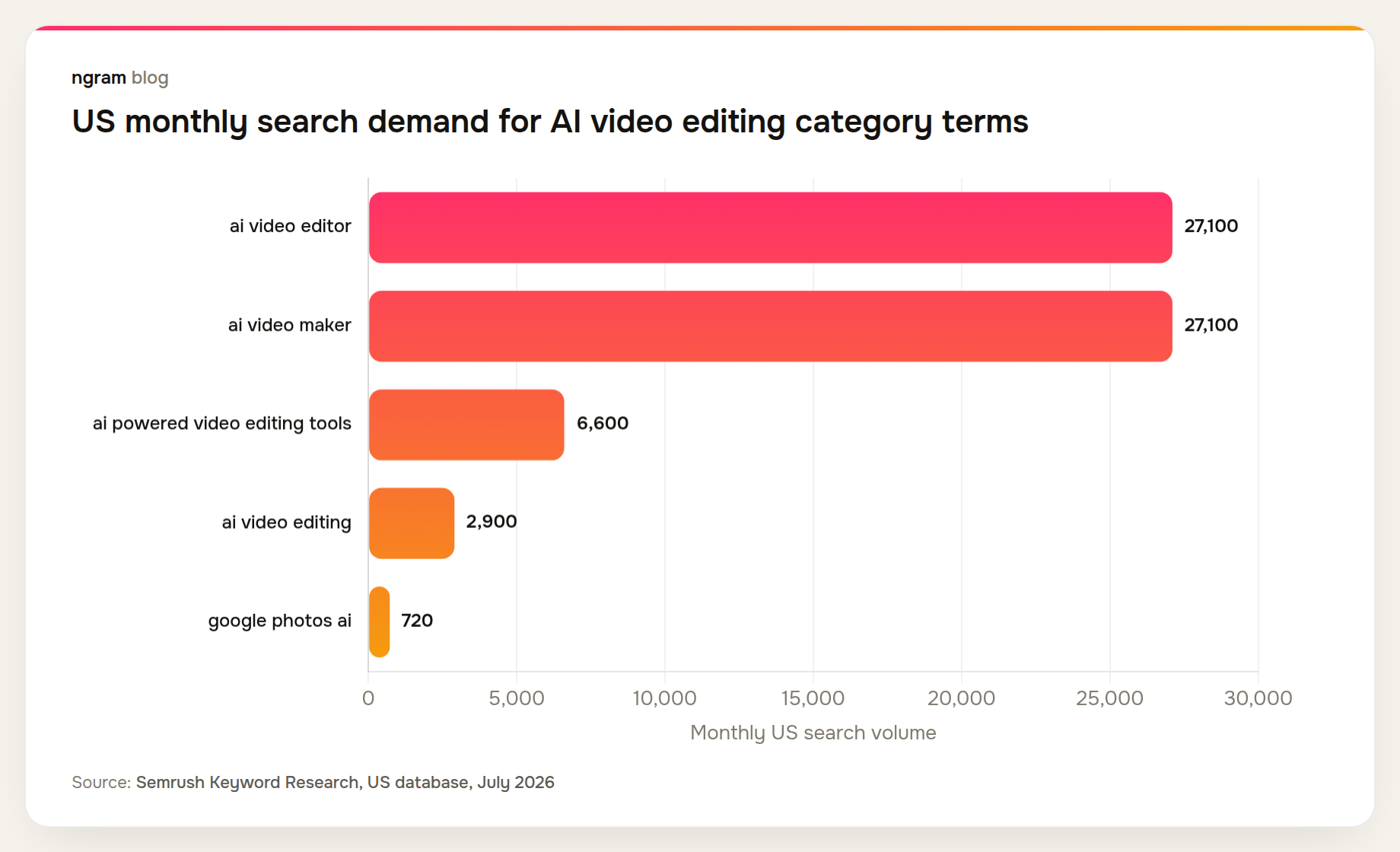
Search demand backs up the shift toward prompt-driven editing over manual timeline work. Category terms centered on AI-assisted editing already pull real monthly search volume in the United States: "ai video editor" and "ai video maker" each draw an estimated 27,100 searches a month, "ai powered video editing tools" draws 6,600, and even the specific "ai video editing" phrase pulls 2,900, per Semrush keyword data for July 2026. "google photos ai" alone draws an estimated 720 searches a month, evidence that people are already actively searching for what Photos' AI capabilities can do, ahead of Video Remix registering any dedicated search volume of its own.
None of this makes Premiere Pro, DaVinci Resolve, or a manual timeline editor obsolete. Frame-level color grading, multi-track audio mixing, and precise cuts are not things a template library replaces. What Video Remix does is take the floor out from under the low end of that market: the quick restyle, the single-clip touch-up, the "just make this look better" job that used to mean opening an editor at all. That job increasingly does not require software with a learning curve, and Google just told 14 countries' worth of paying subscribers so directly.
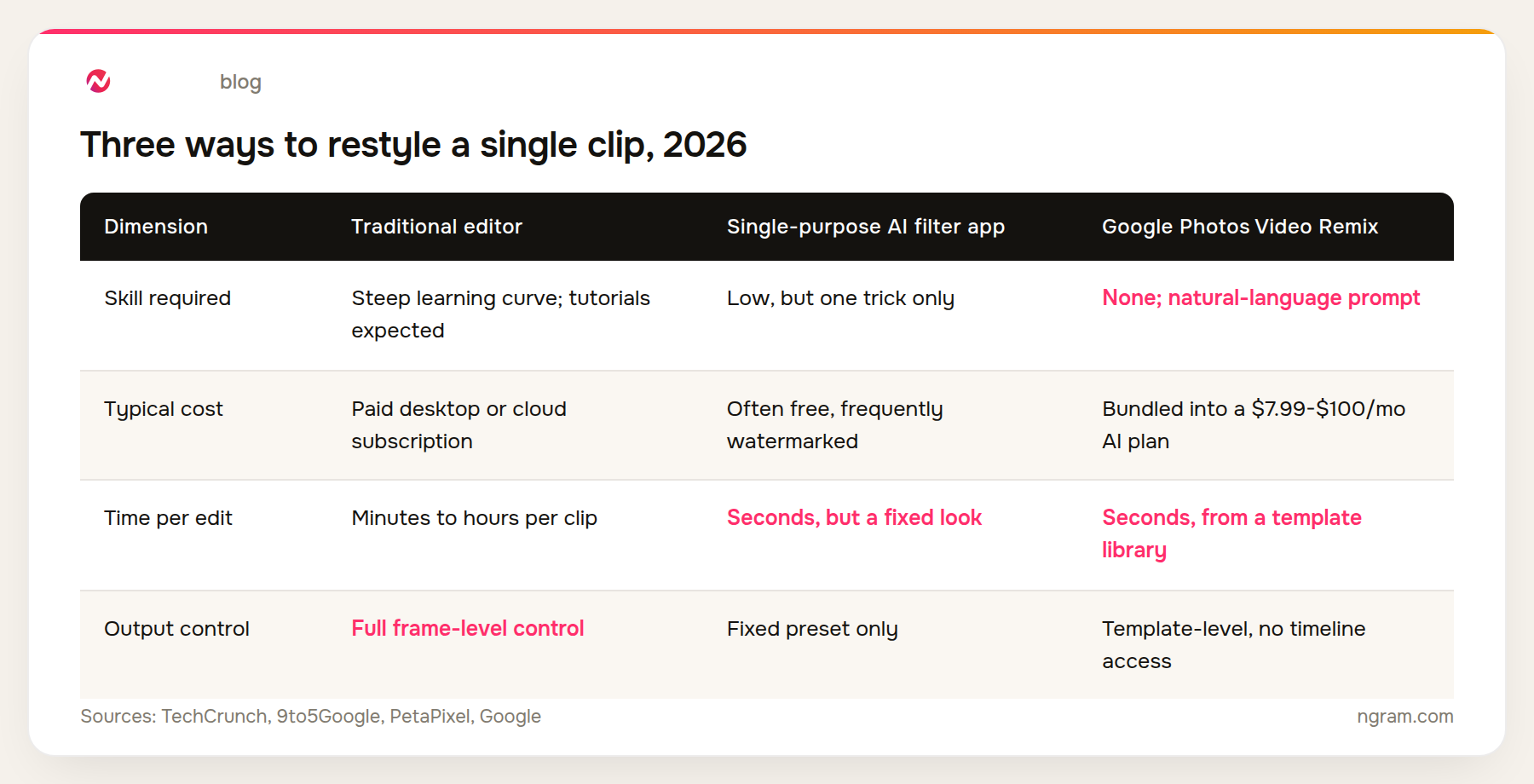
What Apple, OpenAI, and Adobe Are (and Aren't) Doing About It
Google naming Apple, OpenAI, and Adobe as the competitive set is worth taking at face value, because all three moved on consumer AI editing in the same stretch of 2026, with very different outcomes so far.
- Apple announced three AI editing tools for its Photos app at WWDC 2026 on June 8: Spatial Reframing, Extend, and an upgraded Cleanup, all running through Apple Intelligence via Private Cloud Compute, per TechCrunch's coverage. They fix framing and remove distractions from existing shots. None of them are natural-language restyling of full video clips the way Video Remix is.
- Adobe has been shipping the most feature-dense response, adding a Quick Cut tool to Firefly's video editor that auto-generates a first draft from raw footage, prompt-based editing of colors and camera angles, and licensed third-party video models, according to the company's own 2026 product updates. Adobe's edge is depth: a full timeline sits behind the AI layer. Its weakness is that depth is exactly the friction Google's messaging is aimed at removing.
- OpenAI is the cautionary tale in this set rather than an active competitor. Sora's consumer web and app experiences shut down on April 26, 2026, roughly ten weeks before Video Remix launched, a story we covered in detail at the time. Google naming a company whose consumer AI video product no longer exists as part of its competitive framing says something on its own: distribution and an existing user base outlasted a well-funded standalone app that had neither.
The pattern across all three: the AI video editing capability itself is becoming table stakes fast. What differentiates the players is not whether they can restyle a clip from a prompt, most of them now can, but whether they already have the audience in place to make trying it effortless. Google, on that specific axis, is currently ahead of all three.
What This Means for Purpose-Built AI Video Tools
The practical takeaway for anyone building or buying video tools is that "describe the restyle you want, get it back in seconds" is no longer a differentiated pitch on its own. It is what a free camera-roll app and a photo backup service now do by default for hundreds of millions of paying subscribers. Any dedicated AI video editor asking for a sign-up, agency retainer, or per-seat license needs to clear that bar and go further, not just match it.
Where that "further" tends to live is in the difference between restyling one clip and producing a finished piece of content. Video Remix, by design, operates on a single clip at a time, inside a template library, with no timeline. It has no concept of a script, no voiceover, no multi-scene structure, and nothing that turns a raw upload into a repurposed, captioned, on-brand deliverable. That is a narrower job by design, and Google is good at it. It is a different job from planning and assembling a video from source material.
ngram's agentic chat already applies a version of that same restyle-by-description pattern across a fuller pipeline rather than a single clip: raw video upload turns existing footage into a project the agent can transcribe, clip, repurpose, or layer captions and effects on top of; reference video animation lets the agent match a scene to a reference clip, or edit an existing reference-video scene, from a plain-language instruction; and style templates let the agent pick a visual treatment from a direction as simple as "make this more cinematic." It is the same underlying interaction Google just shipped at consumer scale, applied to planning and assembling a video end to end rather than restyling a single 10-second clip.
That is a genuinely different scope than what launched in Google Photos this week, not a claim that either replaces the other. But the two both point at the same underlying shift: natural language, not a timeline, is becoming the default interface for video work, at every layer from a single clip to a full production.
If that fuller pipeline, planning and assembling a video end to end rather than restyling a single clip, is closer to what you actually need, ngram is free to try.
Frequently Asked Questions
What is Google Photos Video Remix?
Video Remix is an AI video editing feature in Google Photos, powered by Google's Gemini Omni model, that restyles an existing video clip based on a natural-language description. It launched July 8, 2026 in the app's Create tab, offering templates for cinematic relighting, background replacement, artistic styles like watercolor and oil painting, and animation-style effects.
How is Video Remix different from Gemini Omni Flash on YouTube Shorts?
Gemini Omni Flash on YouTube Shorts, which launched free on June 2, 2026, generates new video clips from a text prompt. Video Remix, which launched July 8, 2026 and requires a paid Google AI subscription, edits and restyles video footage a user already has. One creates; the other transforms.
Which countries and subscribers get Video Remix?
Video Remix is available to Google AI Plus, Pro, and Ultra subscribers in 14 countries at launch: the United States, Argentina, Bangladesh, Brazil, Colombia, Egypt, India, Indonesia, Japan, Mexico, Pakistan, the Philippines, South Korea, and Turkey.
How much does Video Remix cost?
Video Remix requires at least a Google AI Plus subscription, priced at $7.99 a month as of mid-2026. Google AI Pro runs $19.99 a month, and Google AI Ultra starts around $100 a month with higher usage limits. There is no free tier for the feature.
Does Video Remix replace traditional video editors like Premiere Pro?
No. Video Remix operates on a single clip through a template library, with no timeline, multi-track audio, or frame-level controls. It replaces the quick single-clip restyle job, not frame-accurate professional editing. Traditional editors remain the tool for precise cuts, color grading, and multi-track production.
Why did Google charge for Video Remix after making YouTube video generation free?
Google has not stated a reason publicly, but the difference likely reflects where each feature sits commercially. Free generation inside YouTube Shorts feeds a platform Google already monetizes through ads. Video Remix runs inside Google Photos, a private, non-ad-supported archive, where a subscription is the more direct revenue path.
What does Video Remix mean for other AI video editing tools?
It raises the baseline. Natural-language, template-driven restyling of a video clip is now a feature of a mainstream consumer app with a subscriber base in the hundreds of millions, not a differentiator specific to any single AI video startup. Tools built around video creation and editing now need to offer more than single-clip restyling, such as full production pipelines, scripting, or multi-scene assembly, to stand apart from what ships for free or by subscription inside apps people already use daily.