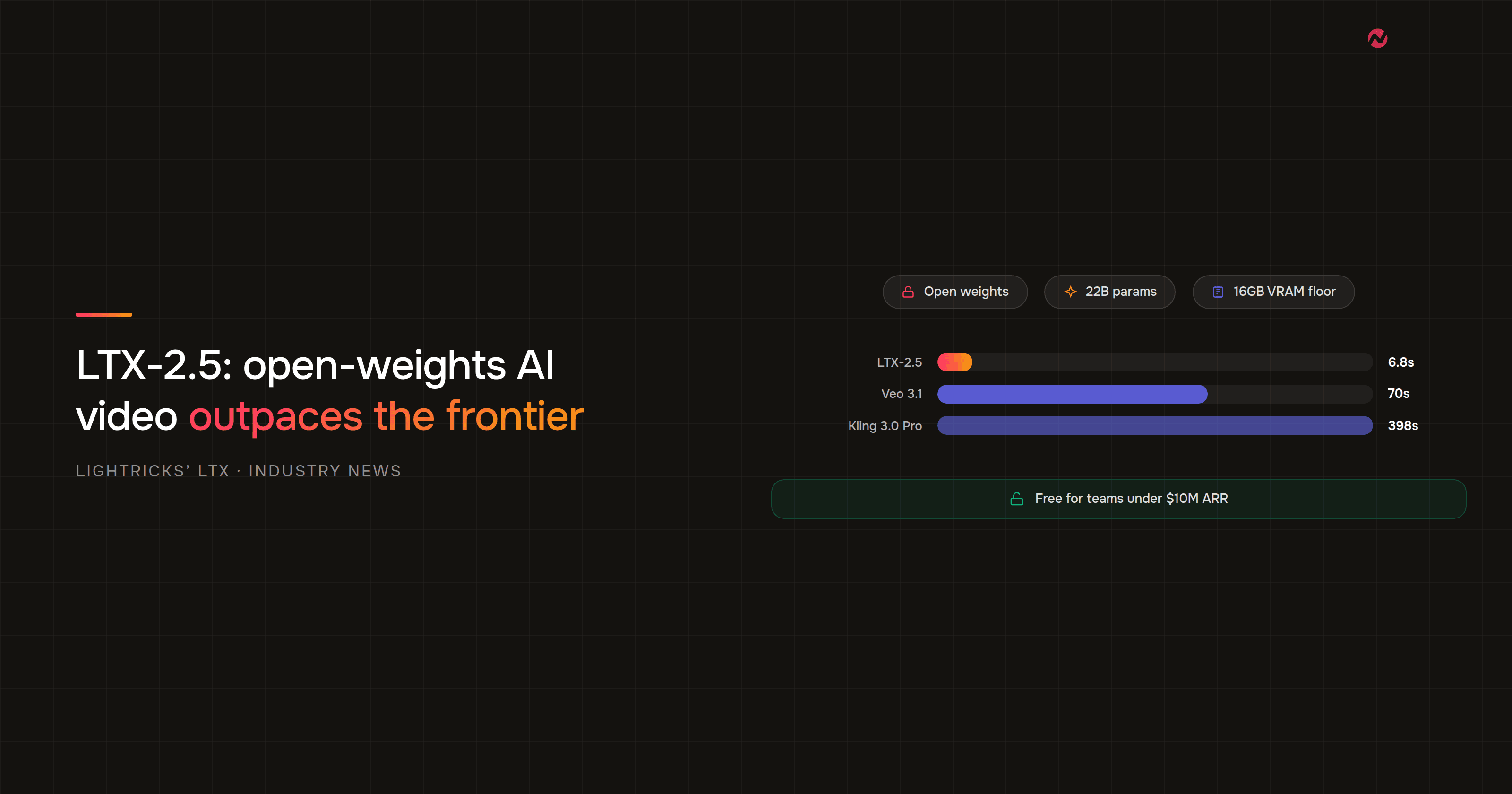

Lightricks’ LTX released LTX-2.5 on August 11, 2026, and the spec sheet reads like two different launches stapled together. One half is a routine version bump: better multi-shot continuity, a faster decoder, a more capable distilled model. The other half is the part worth stopping on: a 22-billion-parameter model that generates synchronized video and audio, ships with its weights fully public, and outruns several closed frontier APIs on raw speed.
That combination, according to VentureBeat's coverage of the launch, is what makes LTX-2.5 more than a routine model update. It generates a 10-second clip from an image in 6.8 seconds on two NVIDIA GB200 superchips, runs on a minimum of 16GB of VRAM, and is free to use commercially for any company under $10 million in annual revenue.
Here is what actually shipped, how the speed and licensing numbers hold up, and why an open-weights model catching up to closed frontier speed changes the build-versus-buy math for anyone generating video at volume.
What LTX-2.5 Actually Is
LTX-2.5 is a 22-billion-parameter asymmetric dual-stream diffusion transformer, paired with a custom fine-tuned Gemma 4 12B text encoder, according to comfyui-wiki's technical breakdown of the release. Video and audio generate jointly through bidirectional cross-attention with modality-aware classifier-free guidance, meaning the model produces motion and sound in the same pass rather than rendering silent frames first and dubbing audio on afterward.
The feature list is long, but three additions carry most of the weight:
- Native multi-shot generation: one prompt produces multiple connected shots (wide, medium, close-up) that hold the same character, environment, lighting, and voice across cuts, instead of one isolated clip per generation.
- Diffusion Fidelity Rendering (DFR): a rendering path aimed at cinema-grade EXR output, alongside native 4K HDR generation.
- Five generation modes in one model: text-to-video, image-to-video, video-to-video, text-to-audio, and audio-to-video, covering most of what a text to video ai workflow needs from a single checkpoint.
LTX shipped both a full "dev" checkpoint and a faster distilled variant, plus int8 and NVFP4 quantized versions and official ComfyUI workflow templates, all on day one. That is a meaningfully more complete release than most frontier launches, which tend to gate the heavier variants behind a waitlist for months.
The Speed Number Everyone Is Repeating
The headline benchmark: LTX-2.5 generates a 10-second, 720p clip from an image in 6.8 seconds, self-hosted on two NVIDIA GB200 superchips. Through LTX's own managed API at 1080p, the same job takes 23.7 seconds, per VentureBeat.
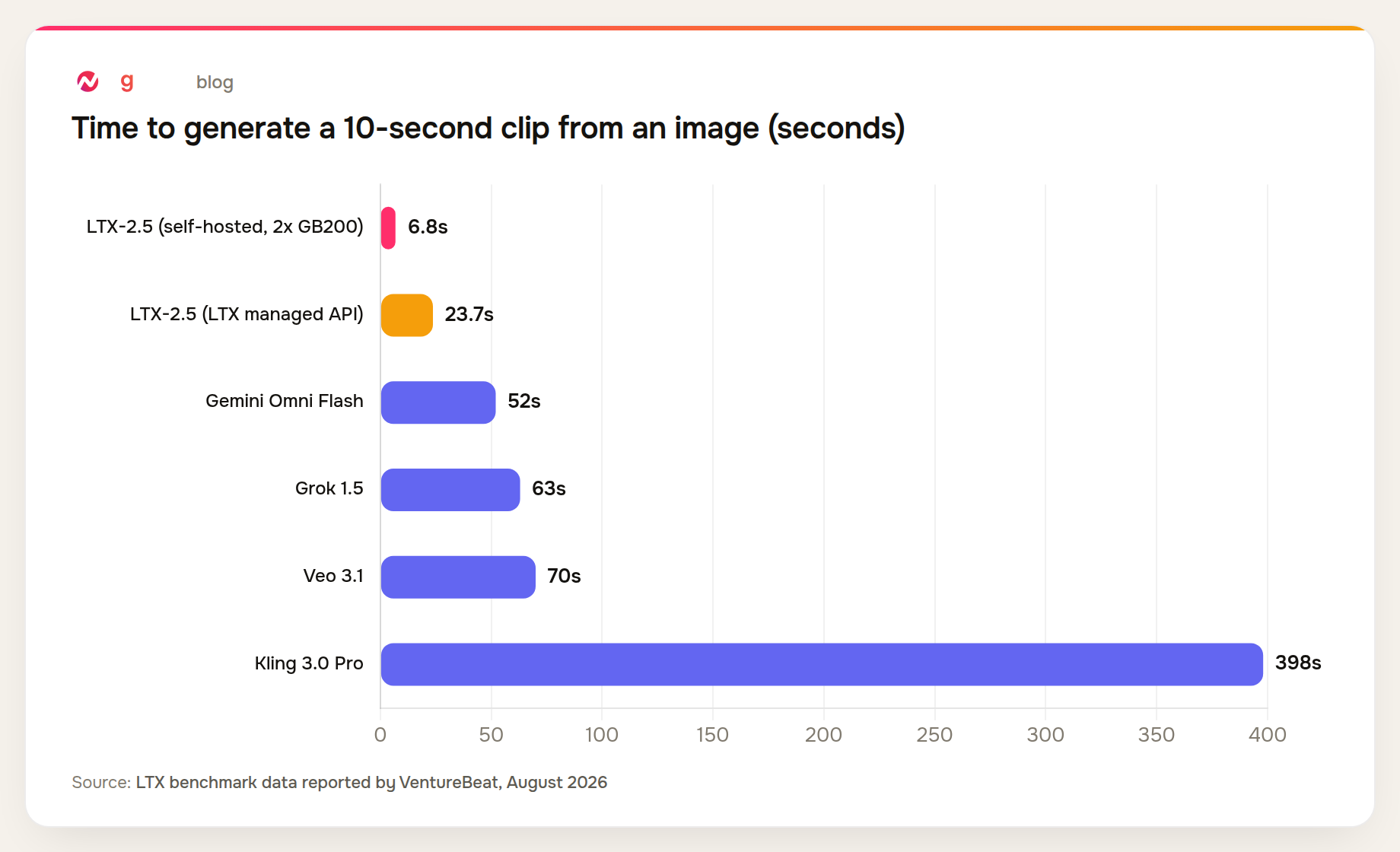
Two caveats worth stating plainly. First, the 6.8-second figure is LTX's own benchmark on hardware most teams do not own; the 23.7-second managed-API figure is the more realistic number for anyone not racking their own GB200s. Second, the comparison numbers for rival models are vendor-reported and not run by an independent lab, and Veo 3.1's cited figure is for an 8-second clip rather than a full 10-second one, so treat the exact ratios as directional rather than exact.
Even accounting for that, the gap is large enough to matter. An open-weights model beating Google's and Kuaishou's closed APIs on latency, even by a wide margin of methodology error, is not something the video model market has seen before.
Free (Mostly): The Licensing Math
LTX-2.5 ships under the LTX-2.x Community License: free for commercial use if your company brings in under $10 million in annual recurring revenue, with a negotiated license required above that threshold, according to Techzine's coverage. Weights, inference code, and training code are all public on Hugging Face.
For teams that would rather not manage their own GPU cluster, LTX also runs a managed API, billed per second of output and scaled by resolution.
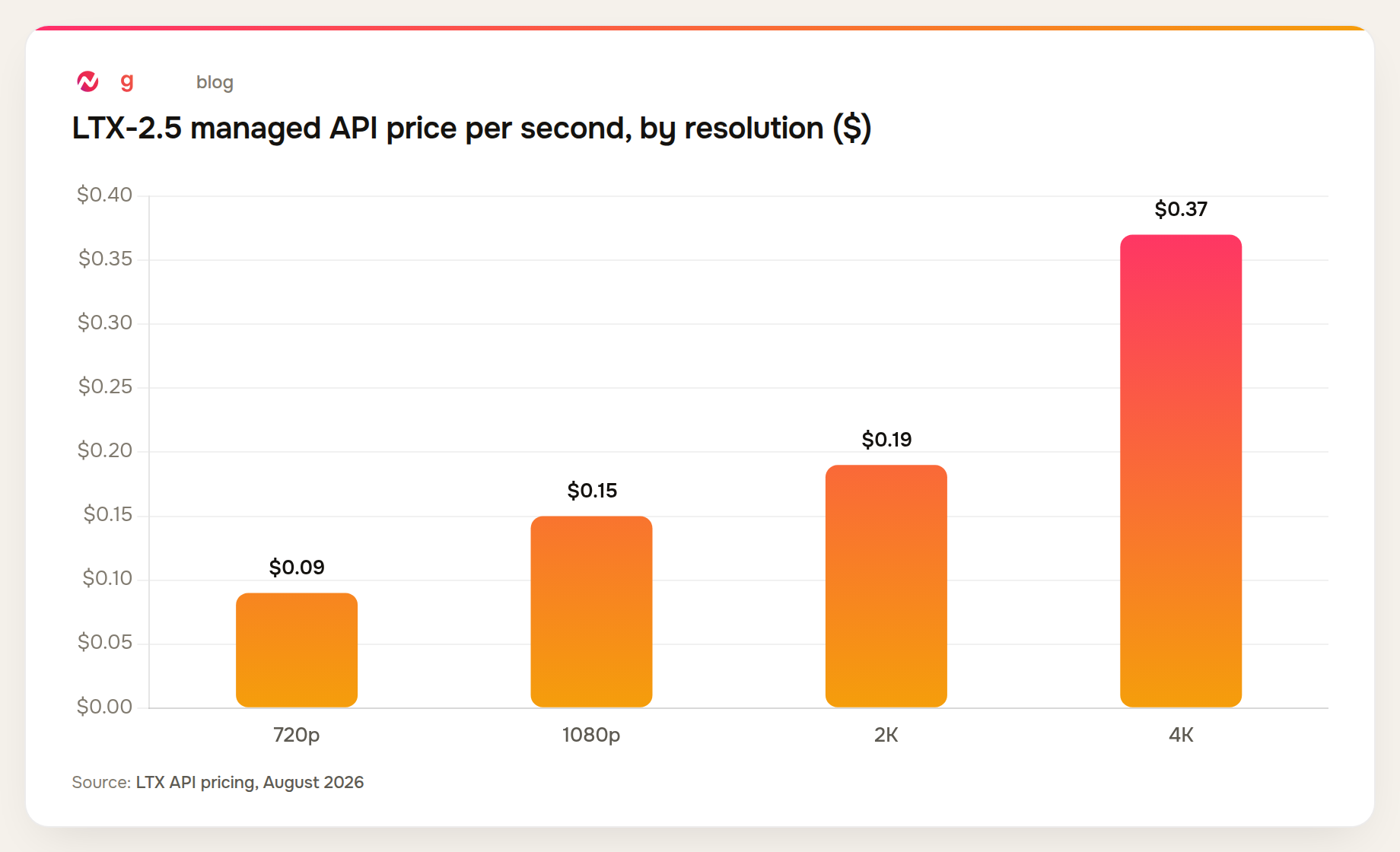
That pricing structure is the real story behind the open-weights angle. A metered API charges the same marginal rate for clip 10 and clip 10,000. Self-hosted, open-weights generation inverts that curve: the GPU cost is fixed once you own or rent the hardware, so the marginal cost of one more clip trends toward the cost of electricity and depreciation, not a per-second line item.
For a team doing occasional generation, the managed API's $0.09 to $0.37 per second is a rounding error. For a team generating thousands of clips a month, the two models produce very different unit economics. That gap is exactly what the free-under-$10M license is designed to let smaller teams exploit before they hit real infrastructure cost.
What Native Multi-Shot and Native Audio Do to a Pipeline
Most AI video generation today works clip by clip. A team generates a short segment, drops it into an editor, generates the next segment separately, stitches the two together, and then runs a separate dubbing or lip-sync pass to make the audio match. Each of those handoffs is a place where a character's face, lighting, or voice can drift between shots.
Native multi-shot generation collapses several of those handoffs into the generation step itself. One prompt produces a wide shot, a medium shot, and a close-up that share the same character, environment, lighting, and voice, because the model generates them together rather than independently. Native audio removes the separate dubbing pass for a similar reason: dialogue, ambient sound, and music generate alongside the motion in the same pass, which keeps lip-sync tighter than adding sound to finished frames after the fact.
That does not eliminate editing. It removes a specific category of manual continuity work, stitching clips and re-syncing audio, that has been a fixed cost of AI-generated video regardless of which model produced the raw footage.
Who Can Actually Run This: The 16GB Floor
LTX-2.5's minimum requirement is 16GB of VRAM for the distilled variant, according to reporting on the release. That number matters more than it sounds, because most closed frontier video models have no local option at any price: Veo, Kling, and Gemini Omni Flash are cloud-API-only, full stop.
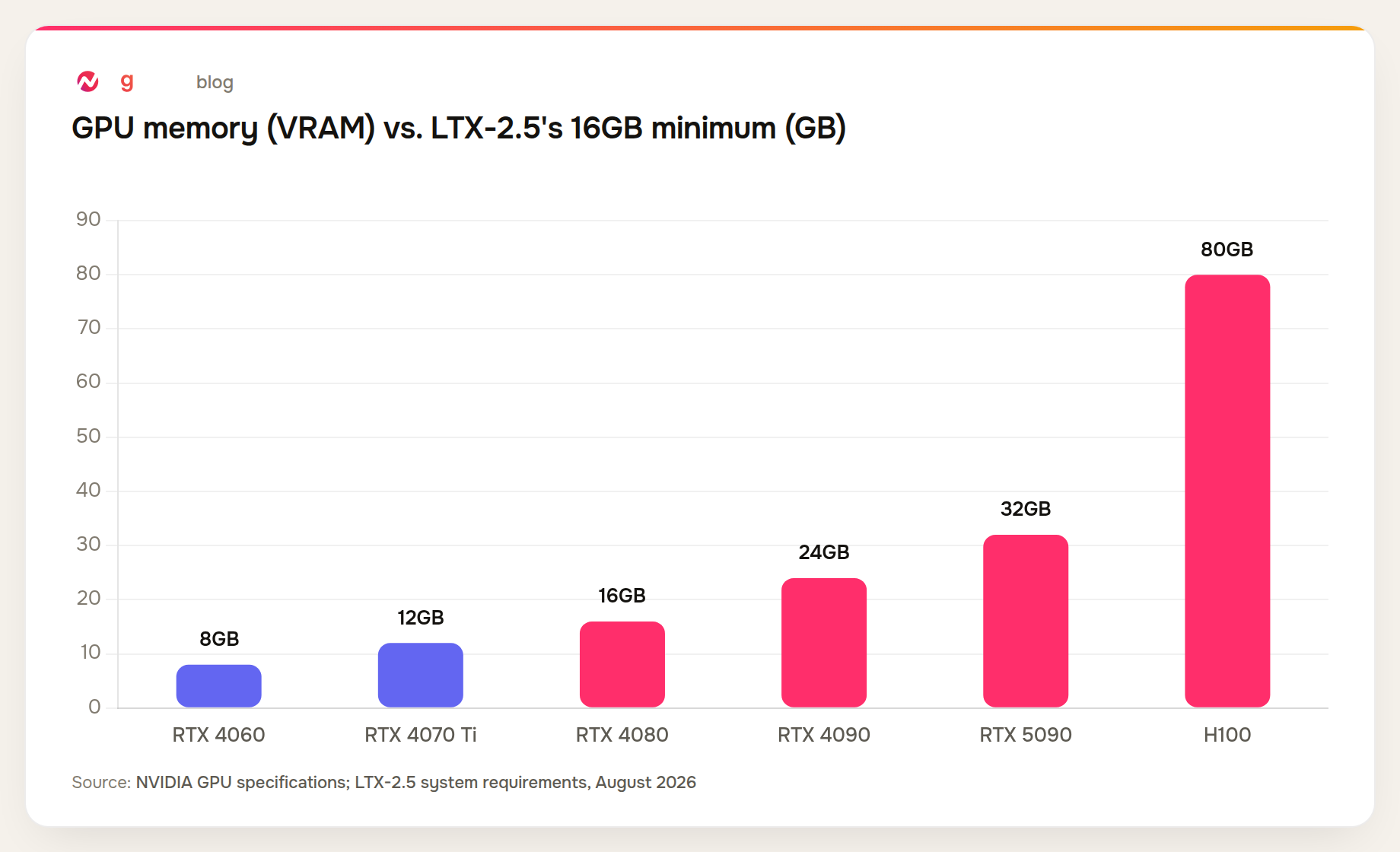
A 16GB floor puts the distilled model within reach of a single high-end consumer GPU, an on-prem workstation, or an edge machine, not just a data center account. That is the accessibility argument in practice: frontier-adjacent video generation, not the absolute state of the art but close enough to matter, no longer requires a cloud contract to try.
Lightricks Split LTX Off, and the Split Explains the Strategy
LTX is not simply a product line inside Lightricks anymore. Lightricks, the Jerusalem company best known for consumer apps like Facetune and Videoleap, spun LTX off as an independent company focused entirely on open world models, with co-founder Zeev Farbman as CEO, according to Calcalist's reporting on the split. Lightricks has invested roughly $150 million in the AI business to date.
That structure matters for reading this story correctly. LTX Studio, Lightricks' consumer creation app, is a separate product from LTX the model company. LTX-2.5 is a model release, not a rebrand of a creative tool, and Farbman's stated focus is the model and infrastructure layer, not a video editor.
World models face challenges that LLMs never had to solve, like holding motion, space and sound consistent across time, which is why efficiency and control matter so much.
That is Farbman, quoted by Techzine, framing why LTX is betting on open, efficient models rather than a single giant closed one.
It is the same "world model, not just a video generator" framing NVIDIA used when it made a similar case for its own Cosmos models, a sign this vocabulary shift is becoming the industry's shared way of describing what these models are for. LTX-2.5 is not a first release either. LTX-2 launched in October 2025, its weights went fully open in January 2026, and LTX-2.3 added a desktop editor for local deployment in March 2026, per Wikipedia's release history, which also notes LTX-2 ranked third for image-to-video and seventh for text-to-video generation at its original launch, the highest of any open-source model at the time. LTX-2.5 is the next point release in that same lineage, not a reset.
How LTX-2.5 Stacks Up on Quality, Not Just Speed
Speed and price do not matter if the output looks worse. LTX ran its own blind human-preference tests, where evaluators vote on side-by-side clips from the same prompt without knowing which model made which, and reported LTX-2.5 winning 67% of comparisons.
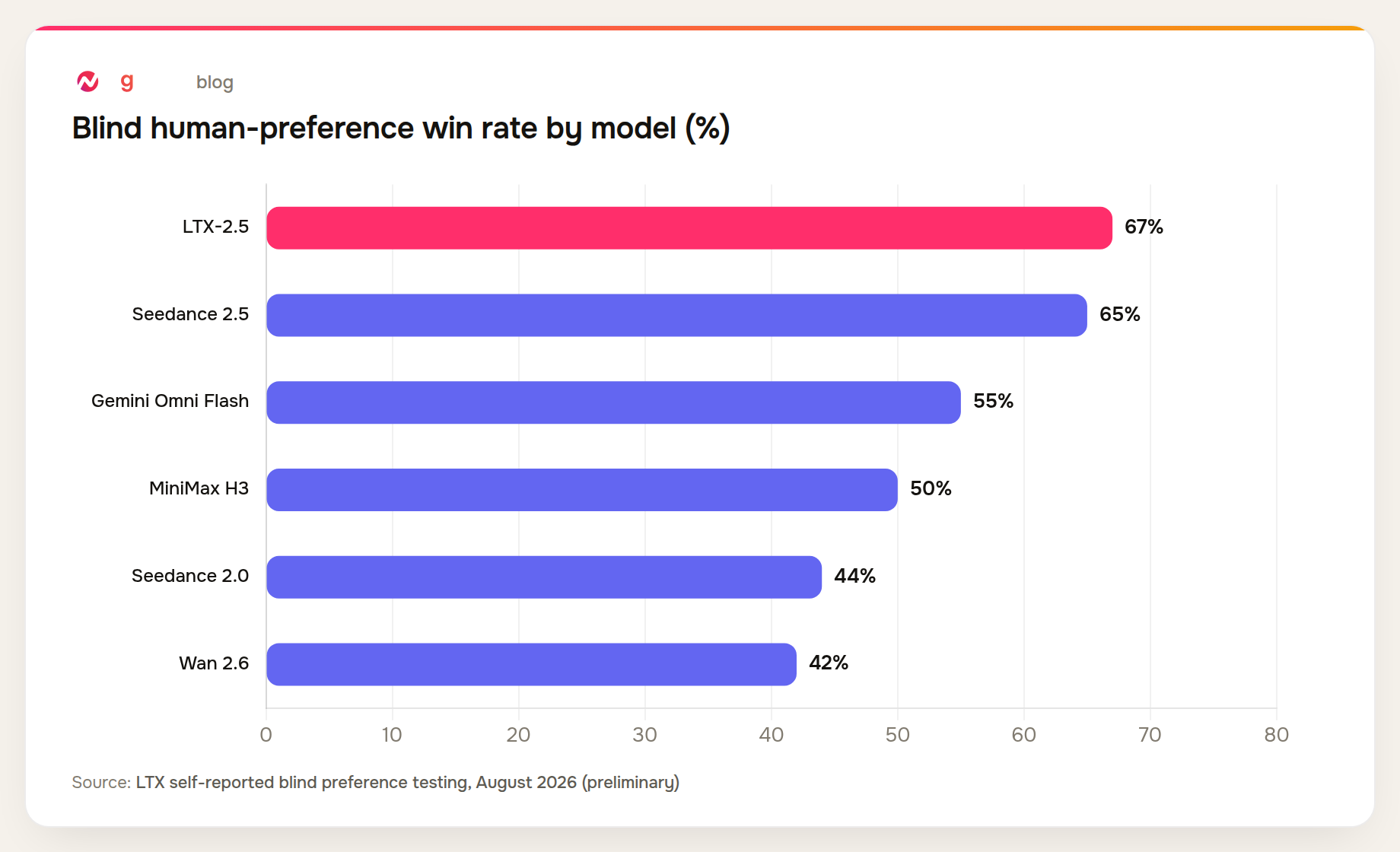
LTX labels those results preliminary, and no outside lab has reproduced them. Treat a 67% win rate the same way to treat any vendor's own benchmark: a real signal worth watching, not a settled ranking.
Benchmarks like this rely on structured, consistent labeling under the hood, which is exactly the kind of work a data annotation service is built to standardize at scale. What is notable is the shape of the result, not the exact number. An open-weights model landing at the top of a blind preference test, ahead of several closed competitors, is a different claim than "open-weights models are catching up eventually." It is closer to "open-weights models are already competitive on the metric that matters most to viewers."
What This Means If You're Choosing Build vs Buy
For a team evaluating an ai video generator or comparing options for volume production, the choice used to have a clear tradeoff: closed APIs bought you convenience and, usually, a real quality edge; open-weights models bought you cost control and no per-clip metering, at the price of running your own inference. LTX-2.5 narrows that tradeoff on both axes at once, matching or beating closed-model speed while claiming to compete on quality, without giving up the free-under-$10M licensing or the 16GB hardware floor.
That does not make open weights the automatic answer. Running your own GPUs is real operational work, and a self-reported 67% win rate is not the same as production-proven reliability across thousands of brand-specific videos. But it does mean the model layer keeps getting cheaper and faster to run well, which is a genuine tailwind for any ai video generation platform built on top of it rather than inside it.
ngram's approach has always been to sit above that layer: turn a prompt, script, URL, document, or deck into a finished video, the way other infrastructure plays in this space are also betting on staying model-agnostic rather than locking into one vendor's roadmap. A faster, cheaper, more capable script to video ai layer underneath compounds into a faster, cheaper finished video for the person actually making it, without ngram needing to operate its own model infrastructure to capture that gain. If that is the kind of workflow you want, you can try ngram directly.
What LTX-2.5 Doesn't Prove Yet
A few things this launch does not settle. The blind preference numbers are self-reported and unaudited, same caveat as every vendor benchmark in this space. The 6.8-second figure runs on hardware, two GB200 superchips, that almost no team outside a well-funded lab actually owns; the 23.7-second managed-API number or a single consumer GPU's real-world throughput are the figures that apply to most people.
Open weights do not automatically mean production-ready. Brand consistency, reliable structured direction from a storyboard rather than a loose prompt, and the ability to revise one shot without regenerating a whole multi-shot sequence are the questions that separate a strong benchmark from a tool a marketing team can rely on every week.
Those are the same three questions worth asking of any video model, open or closed: does it hold visual and audio consistency across a full sequence, can it take structured direction, and can it revise a part without redoing the whole. LTX-2.5 answers the speed and licensing half of that convincingly. The production-reliability half will take longer than one launch week to prove.
Frequently Asked Questions
What is LTX-2.5?
LTX-2.5 is an open-weights AI video model released by LTX, the open world-model company spun out of Lightricks, on August 11, 2026. It is a 22-billion-parameter model that generates synchronized video and audio in a single pass, including native multi-shot scenes, and is available as free weights on Hugging Face plus a managed API.
Is LTX-2.5 free to use?
Yes, for most teams. LTX-2.5 ships under the LTX-2.x Community License, which is free for commercial use for any company with under $10 million in annual recurring revenue. Companies above that threshold need a separate negotiated license.
How much VRAM do I need to run LTX-2.5?
LTX-2.5's distilled variant needs a minimum of 16GB of VRAM, which is already available on consumer GPUs like the RTX 4080 and RTX 4090, not just data center hardware.
How fast is LTX-2.5 compared to Veo 3.1 and Kling?
LTX reports generating a 10-second clip from an image in 6.8 seconds self-hosted on two NVIDIA GB200 superchips, or 23.7 seconds through its own managed API. By comparison, LTX's own benchmark cites roughly 52 seconds for Gemini Omni Flash, 70 seconds for Veo 3.1, and 398 seconds for Kling 3.0 Pro on a comparable clip. These are vendor-reported figures, not an independently audited test.
What is LTX, and how is it related to Lightricks?
LTX is an independent company spun out of Lightricks, the Jerusalem-based maker of consumer apps like Facetune and Videoleap. LTX, led by co-founder and CEO Zeev Farbman, focuses entirely on open world models for video, while Lightricks continues to run its consumer creative apps, including the separate LTX Studio product.
What is native multi-shot generation?
Native multi-shot generation means a single prompt produces multiple connected shots, such as a wide shot, medium shot, and close-up, that share the same character, environment, lighting, and voice, because the model generates them together instead of as separate, independent clips that need to be stitched afterward.
Can I use LTX-2.5 for commercial projects?
Yes, if your company's annual recurring revenue is under $10 million. Above that threshold, LTX-2.x Community License terms require a separate commercial agreement with LTX.