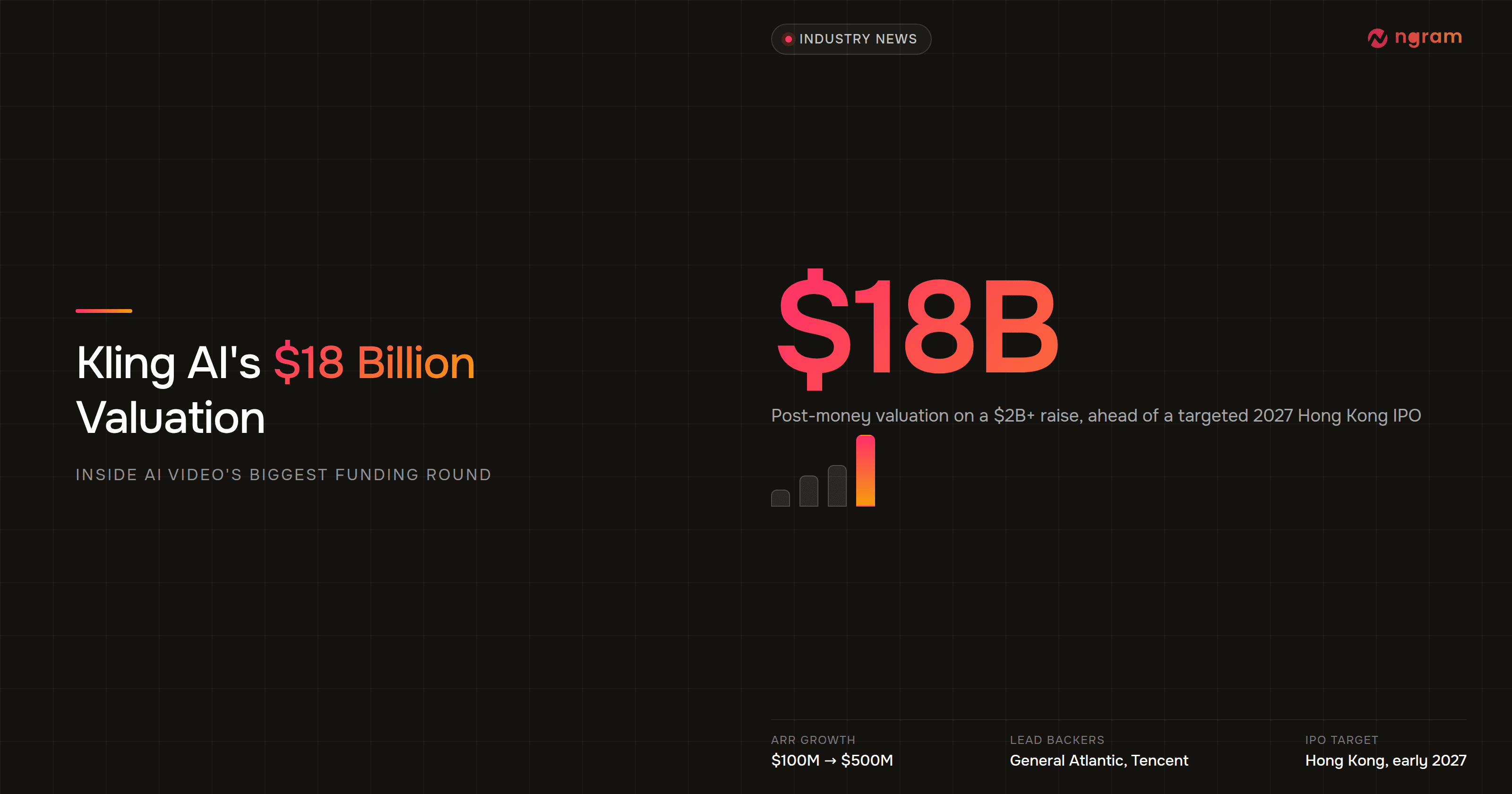

Kuaishou's Kling AI just closed the largest funding round in AI video generation's short history. On July 2, 2026, the company confirmed it had raised more than $2 billion, with room to grow toward $3 billion as additional investors sign on, at a post-money valuation of roughly $18 billion, per Bloomberg. This Kling AI funding round is not a typical growth round. It is a spin-off financing from Kuaishou Technology, structured as a pre-IPO round ahead of a targeted early-2027 Hong Kong listing, and the biggest single bet institutional capital has placed on an AI video model company to date.
The headline number is the valuation. The more useful number is what justifies it: Kling's annualized revenue run rate climbed from $100 million in March 2025 to $500 million by March 2026, a five-fold jump in twelve months. That growth curve, more than the round's size, is what talked General Atlantic and Tencent into the room.
This is not another funding recap. It is about what an $18 billion valuation on a single video-generation model vendor says about the economics of the whole AI video stack: what growth actually justifies that multiple, why institutional capital is suddenly comfortable underwriting the AI video platforms building the model layer, what it signals about consolidation among Kling, Veo, Runway, and Seedance now that Sora is gone, and what it means for teams building products on top of these models rather than inside them.
Inside the Kling AI funding round: what Kuaishou actually raised
Kling AI is Kuaishou's text-to-video and image-to-video generation model, launched in June 2024. It now serves more than 100 million users worldwide who have generated over 600 million videos, with more than 30,000 enterprise and API clients running on its infrastructure, per the company's own investor relations disclosures.
The fundraising story moved fast. Kuaishou confirmed on May 12, 2026 that it was assessing a proposal to restructure Kling AI with outside investors. On June 17, Bloomberg reported the company was seeking more than $2 billion at an $18 billion valuation, with General Atlantic in talks to lead, a target trimmed down from an earlier $20 billion ask to match investor appetite. By July 2, Kling confirmed it had raised the $2 billion, with capacity to expand to roughly $3 billion, that Tencent Holdings had joined as an investor, and that Kuaishou's own stake would dilute to about 68% once the round closes.
Alibaba and Sequoia Capital have also been reported as potential participants, though as of this writing the full investor list and final terms are not confirmed. Deals at this stage in China's AI sector tend to move through the press before they are legally final, and this one is no exception.
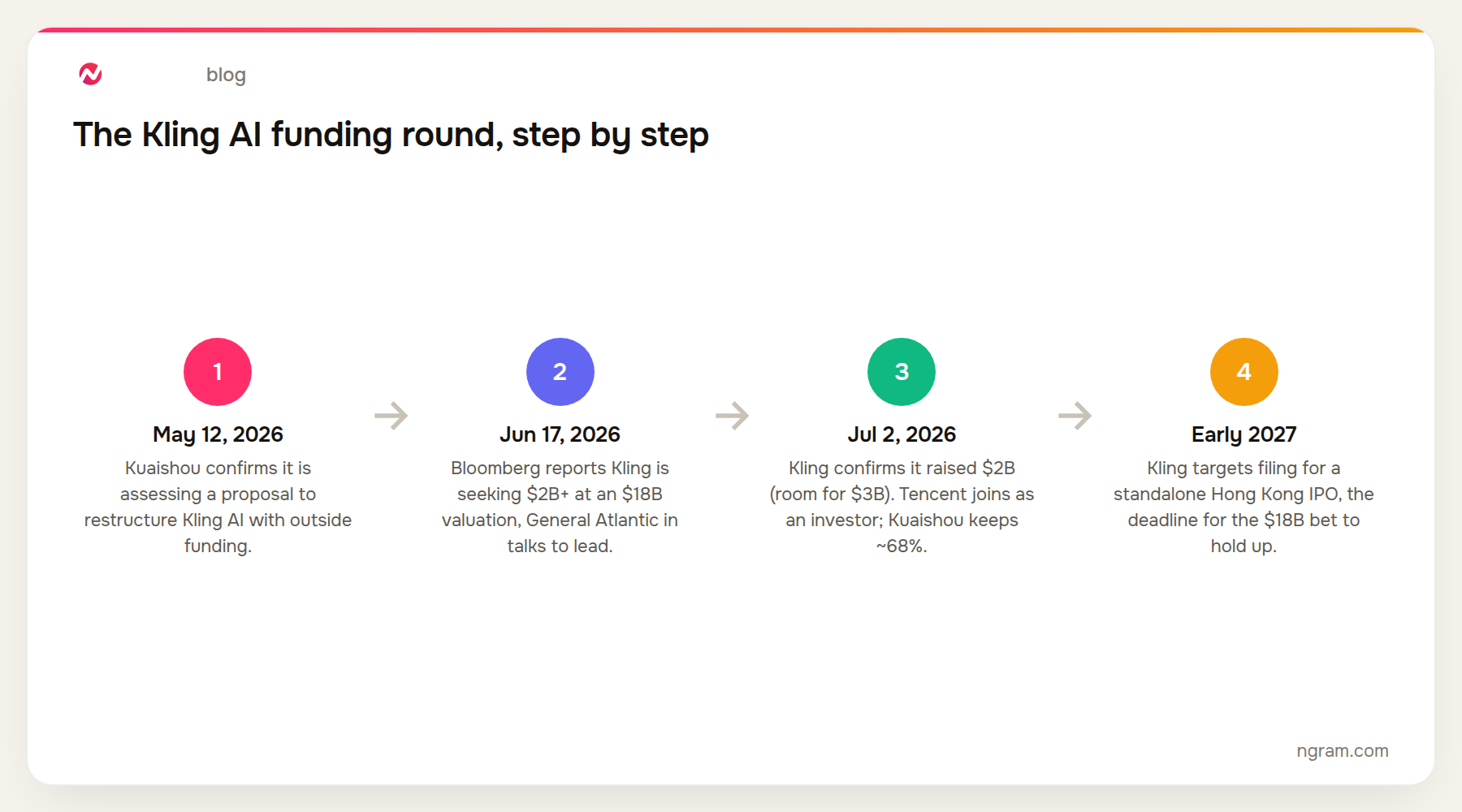
The financing is explicitly structured as a pre-IPO round. Kling is targeting a Hong Kong listing application in early 2027, which puts the entire $18 billion bet on an unusually short public clock: about eighteen months from the round's confirmation to the moment public markets get to reprice it.
The revenue growth that talked investors into the room
Capital doesn't chase valuations. It chases growth curves, and Kling's is the steepest in the sector right now.
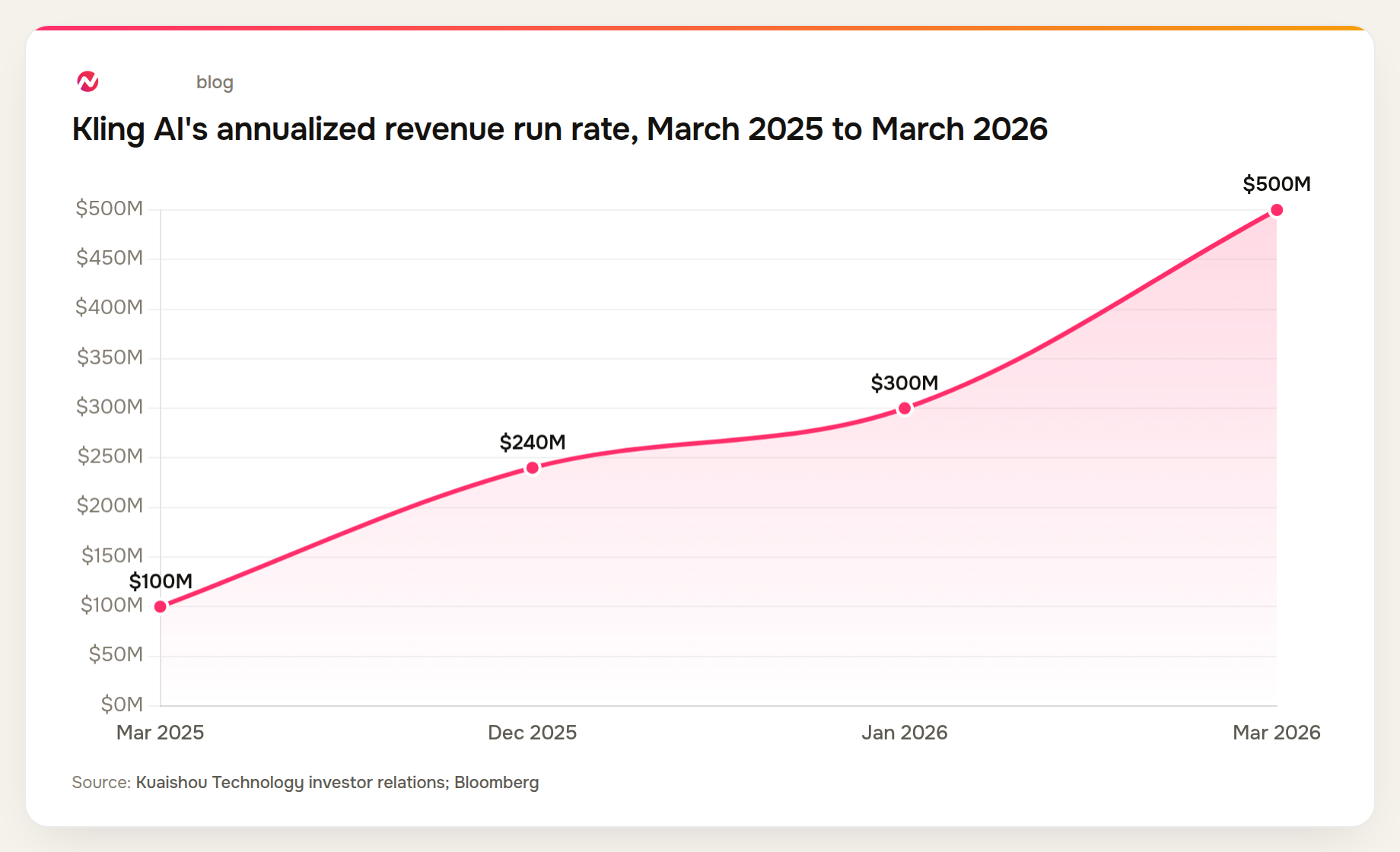
The company crossed $100 million in annualized revenue run rate in March 2025, ten months after launch, according to Kuaishou's investor relations release. By December 2025, that figure had grown to $240 million, the company confirmed. It reached $300 million in January 2026, and by March 2026 it stood at $500 million, up roughly five times in a single year. Kuaishou reported Q1 2026 revenue of more than 650 million yuan (about $96 million), up more than 300% year-over-year.
Kling 3.0, which launched in February 2026 with native 4K output, up to 15-second multi-shot clips, and multilingual lip-synced audio across five languages, is the release most credited with the acceleration. About 75% of Kling's revenue now comes from overseas markets, and the company's own disclosed enterprise client list includes names like Higgsfield, ComfyUI, Freepik, and FAL.ai, a detail worth remembering later in this piece.
How Kling's $18 billion valuation stacks up against its AI video peers
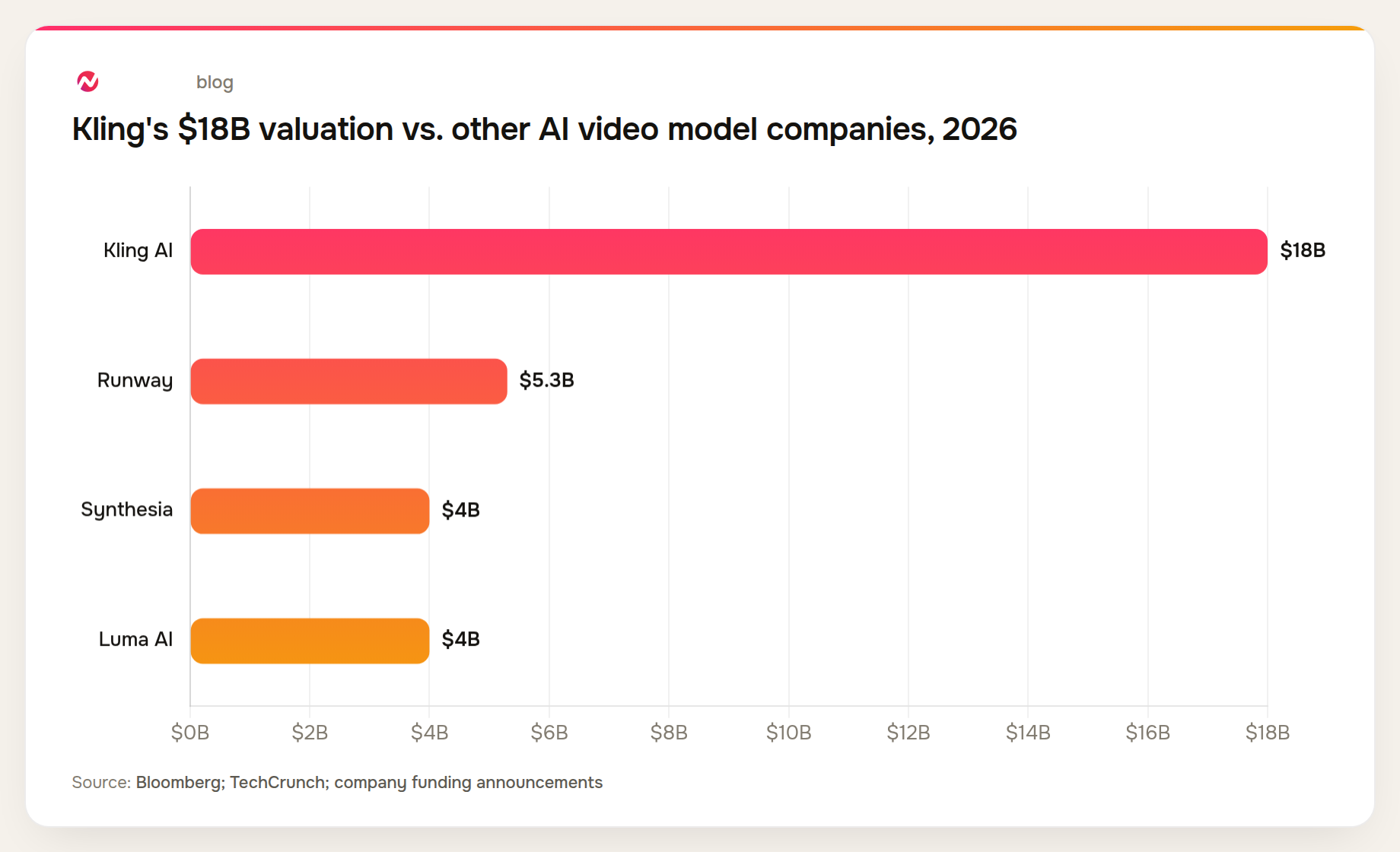
Line up Kling's valuation against the rest of the model layer and the gap is stark. Runway, which builds video and "world models" and closed a $315 million Series E in February 2026, is valued at $5.3 billion, per TechCrunch. Synthesia, the enterprise avatar-video company, hit $4 billion in a $200 million round the month before. Luma AI, backed by Saudi Arabia's Humain, raised $900 million at a $4 billion valuation in November 2025. Kling, at $18 billion, is valued at roughly 3.5x to 4.5x any of them.
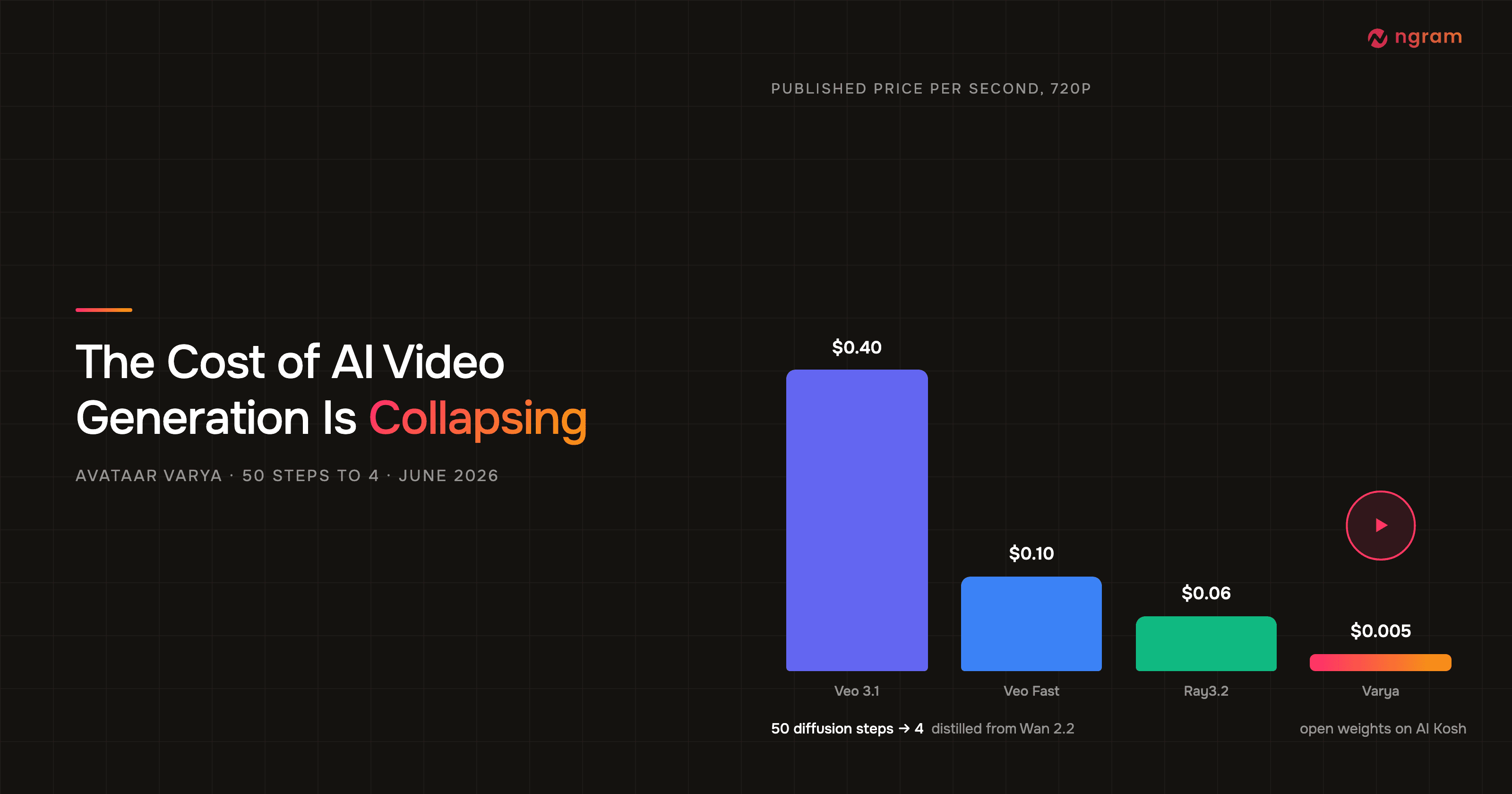
That gap gets more interesting once generation costs enter the picture. Even as raw video generation gets cheaper, our own reporting on Avataar's Varya model and collapsing generation costs found hosted generation prices falling toward half a cent per second by mid-2026. Cheap generation and expensive model companies are not a contradiction. They describe two different layers of the same stack: the companies that own distribution-scale models with real enterprise revenue are pulling away in value even as the price of a raw generated second keeps falling.
The multiple investors actually have to underwrite
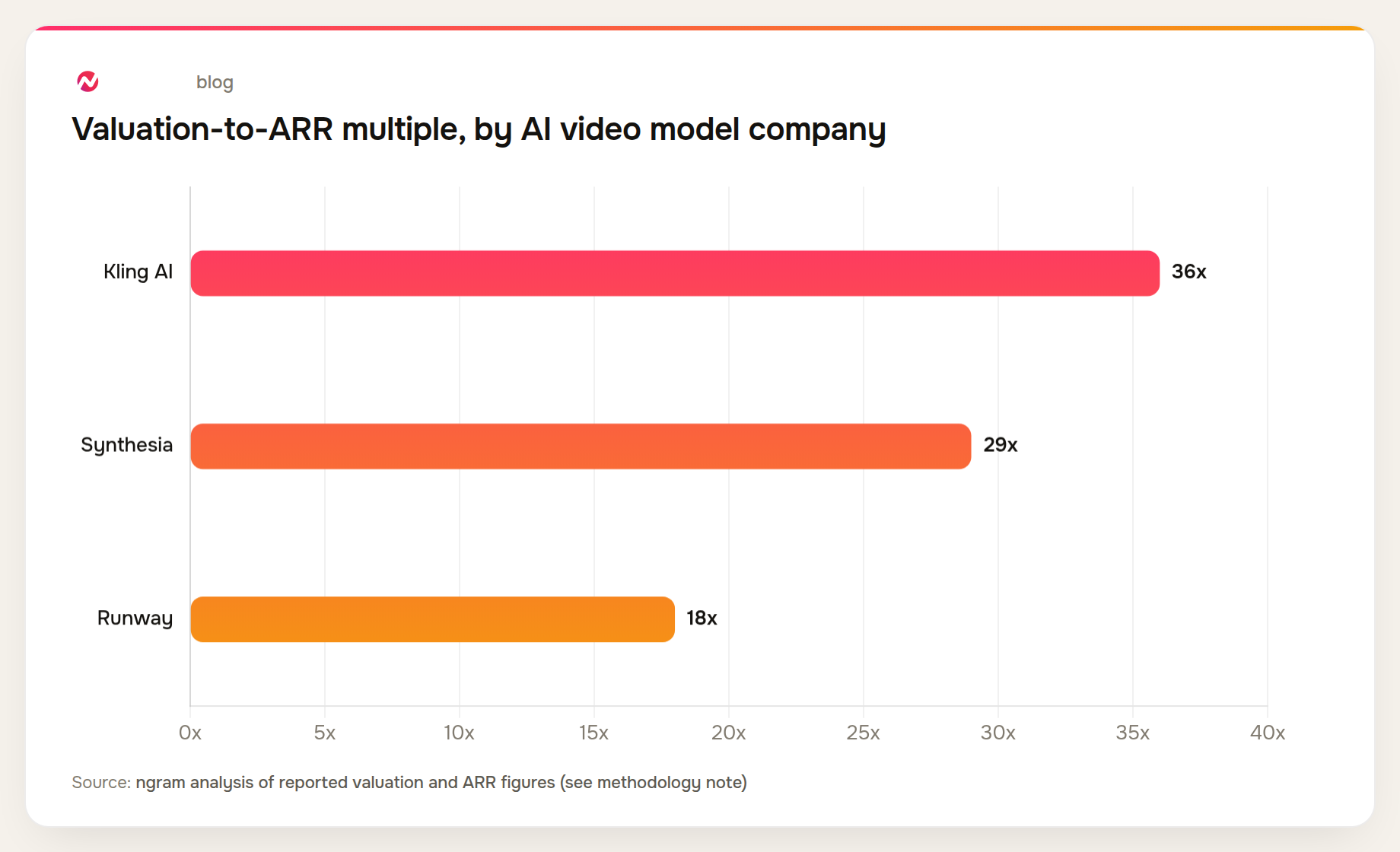
A valuation only means something next to the revenue behind it. Kling's $18 billion valuation against its $500 million ARR works out to roughly 36 times revenue. Synthesia's $4 billion valuation against its reported ~$140 million ARR works out to about 29 times. Runway's $5.3 billion against ARR reported as "well past $300 million" at the end of 2025 works out to roughly 18 times, using the more conservative end of that range.
Methodology note: these are back-of-envelope figures, not audited comparables. Each company reports ARR on a different snapshot date and by its own methodology, and a fair multiple compresses or expands with growth rate, not just size. But directionally, investors are underwriting Kling at the richest multiple of the three, a bet that its growth rate, not just its current revenue, keeps compounding. A 36x multiple assumes Kling's revenue roughly doubles again before the market reprices it at IPO. Kuaishou CEO Cheng Yixiao told investors on a March 2026 earnings call he had "strong confidence" the business would more than double in 2026, per the South China Morning Post, which is exactly the growth rate the multiple requires.
The nearest cautionary tale sits one line item down the same balance sheet.
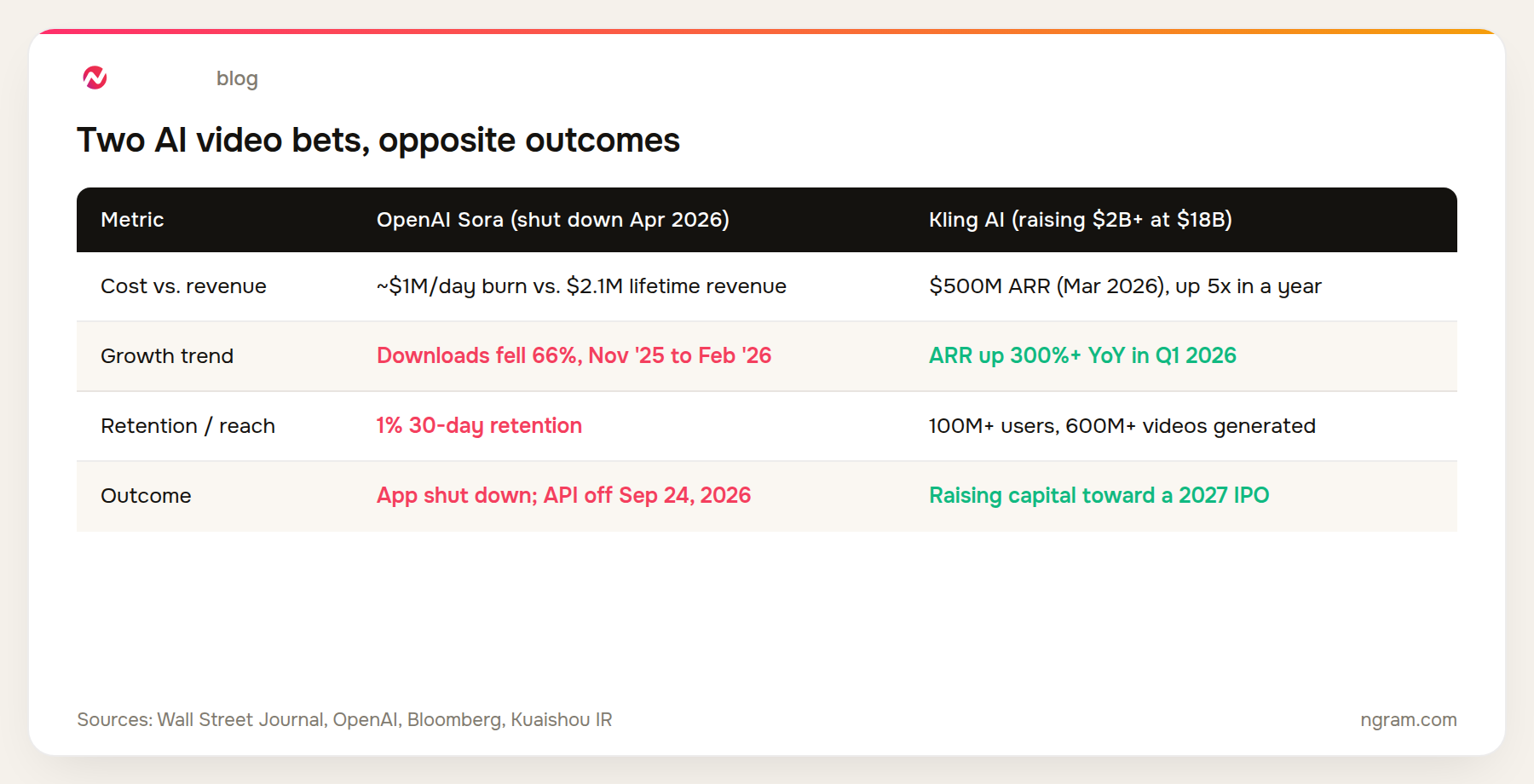
OpenAI shut down the consumer Sora app in April 2026 after it burned roughly $1 million a day in infrastructure cost against $2.1 million in total lifetime revenue, with 30-day user retention around 1%. Kling is a different kind of business: enterprise and creator subscriptions rather than a viral consumer app, with retention proven out over 100 million users and two years of compounding revenue. But the juxtaposition is exactly why this round is being watched so closely. Consumer AI video burned an enormous amount of capital and produced almost nothing. Kling is the live test of whether the same underlying technology, aimed at paying creators and enterprises instead of novelty seekers, actually clears the bar that Sora couldn't.
Why institutional capital is suddenly comfortable funding AI video models
General Atlantic's involvement, if it closes, would not be its first bet on an AI video model company at a rich multiple. The same firm led Runway's $315 million round at $5.3 billion in February 2026. A US growth-equity firm reportedly underwriting the two largest independent video-model companies in the world within five months of each other is a real signal: institutional capital has stopped treating AI-video model vendors as experimental labs and started treating them as scaled, IPO-track businesses.
Tencent's participation reads differently and matters for a separate reason. It is a strategic bet from China's other consumer-internet giant on a Kuaishou-controlled asset, and it would plug Kling into a second major distribution and cloud relationship the way Alibaba's reported interest would plug it into Alibaba Cloud's enterprise channel.
The politics around this round are real and worth stating plainly. China has instructed its leading AI firms to refuse foreign capital without prior government clearance and placed travel restrictions on top AI researchers, according to reporting on the Kling round specifically. A US private equity firm buying a stake in a Chinese AI champion runs directly into that policy, and whether Beijing actually clears General Atlantic's involvement is an open question the round's final terms will answer.
Zoom out and the round fits a broader pattern. AI-video-sector funding has already crossed roughly $5.6 billion in 2026, up more than 43% from 2025's full-year total, according to PitchBook data reported by Yahoo Finance. Most of that capital has converged on a small set of well-funded companies rather than spreading across a long tail of startups. Kling, Runway, Veo, Luma, and ByteDance's Seedance now account for the bulk of dollars raised in the category. We covered the Seedance side of that race separately, and the pattern holds: capital in AI video's model layer is concentrating, not diversifying.
The Hong Kong IPO clock
An early-2027 listing target gives Kling's backers roughly eighteen months from the round's July 2026 confirmation to the moment public markets get to weigh in on the $18 billion price. That is a short runway for a business two years removed from launch. Two comparable Chinese AI companies, Zhipu AI and MiniMax, already completed Hong Kong listings earlier in 2026, giving public investors a fresh reference point for how AI model companies actually trade once private-market enthusiasm meets a public order book.
If Kling's revenue keeps compounding at anything close to its 2025-2026 pace, the IPO becomes a straightforward proof point for the private round's price. If growth decelerates the way Sora's user engagement did, or the way most consumer software growth curves eventually do, the $18 billion mark becomes the ceiling investors have to defend rather than the floor they priced in.
What a better-funded model layer means for teams building on top of it
Step back from Kling specifically and the funding round says something about the model layer of AI video as a whole: it is getting more durable, not less. A model vendor that just raised $2 billion or more toward an IPO is not a vendor likely to shut down, quietly deprecate its API, or run out of runway mid-contract, the way OpenAI did with Sora.
That cuts differently depending on where a company sits in the stack. For teams training their own video models, Kling's valuation is a signal of how much capital it now takes to compete at the frontier. For teams building products on top of third-party video and image models rather than training their own, it reads more like a tailwind: a healthier, better-capitalized model layer is more likely to keep improving and staying online, not less.
ngram's own video generation runs on exactly that kind of vendor layer, FAL.ai as the primary provider and Replicate as a fallback, aggregating multiple third-party models rather than depending on any single one. Kling's own disclosed enterprise client list, notably, includes FAL.ai itself, which is one concrete sign of how deeply Kling has already threaded into the infrastructure other AI video products are built on. For an honest look at what actually differs between generating a raw clip in a model like Kling and producing a finished, on-brand business video end to end, see our ngram vs. Kling AI comparison, or see what an AI video generator built for that exact workflow looks like. If you just want to try it, ngram is free to start.
What to watch next
- Whether General Atlantic's investment actually clears Beijing's new capital-control rules, or whether the round closes with only Tencent, Alibaba, and Sequoia as investors.
- The final round size: confirmed at $2 billion, with reported room to grow to $3 billion as more investors commit.
- Kling's Q2 and Q3 2026 ARR prints. Anything short of continued triple-digit growth reopens the question of whether the 36x multiple is justified.
- The Hong Kong IPO filing itself, expected in early 2027, and how public markets price it against Zhipu AI's and MiniMax's already-trading multiples.
- Whether Seedance, Veo, or Runway respond with funding rounds of their own. Capital concentration in AI video's model layer has tended to move in clusters, not single events.
Frequently Asked Questions
How much did Kling AI raise?
Kling AI confirmed on July 2, 2026 that it had raised more than $2 billion, with reported room to expand to roughly $3 billion as additional investors sign on, at a post-money valuation of about $18 billion. The target had been trimmed down from an earlier $20 billion ask to match investor appetite.
Who owns Kling AI?
Kuaishou Technology remains the majority owner. Kling AI is being spun off into a more independent entity ahead of a planned Hong Kong IPO, and Kuaishou's stake is expected to dilute to roughly 68% once the current funding round closes.
Who is investing in Kling AI's funding round?
Tencent Holdings has been confirmed as an investor. General Atlantic is reported to be in talks to lead the round, and Alibaba and Sequoia Capital have also been reported as potential participants. As of this writing, the final investor list and terms are not fully confirmed, and China's rules requiring government clearance for foreign AI investment add real uncertainty to General Atlantic's piece of the deal.
When is Kling AI's IPO?
Kling AI is targeting a Hong Kong IPO filing in early 2027, roughly eighteen months after this funding round's July 2026 confirmation. The current $2 billion-plus raise is structured explicitly as pre-IPO financing.
How much revenue does Kling AI make?
Kling AI's annualized revenue run rate reached $500 million by March 2026, up from $100 million in March 2025 and $240 million in December 2025. Q1 2026 revenue exceeded 650 million yuan (about $96 million), up more than 300% year-over-year, driven largely by the February 2026 launch of Kling 3.0.
Is Kling AI's $18 billion valuation justified?
That depends almost entirely on whether the growth rate holds. At $18 billion against $500 million in ARR, Kling trades at roughly 36 times revenue, a richer multiple than Runway (about 18x) or Synthesia (about 29x) using each company's latest reported figures. That multiple only holds up if Kling's revenue keeps compounding at close to its 2025-2026 pace through the targeted 2027 IPO. If growth decelerates the way it did for OpenAI's Sora, the valuation becomes harder to defend.
Does ngram use Kling AI's models?
ngram's AI video and image generation runs primarily on FAL.ai, with Replicate as a fallback vendor, aggregating multiple third-party models rather than any single provider. This funding round doesn't change what ngram ships today, but a better-capitalized, more durable model layer generally, Kling included, is a structural benefit for products built on top of it rather than a threat.