
Runway spent four years being known for one thing: a video model you could point a browser at. On July 23, 2026, it shipped something that has nothing to do with which model is best. It shipped a system for not having to know.
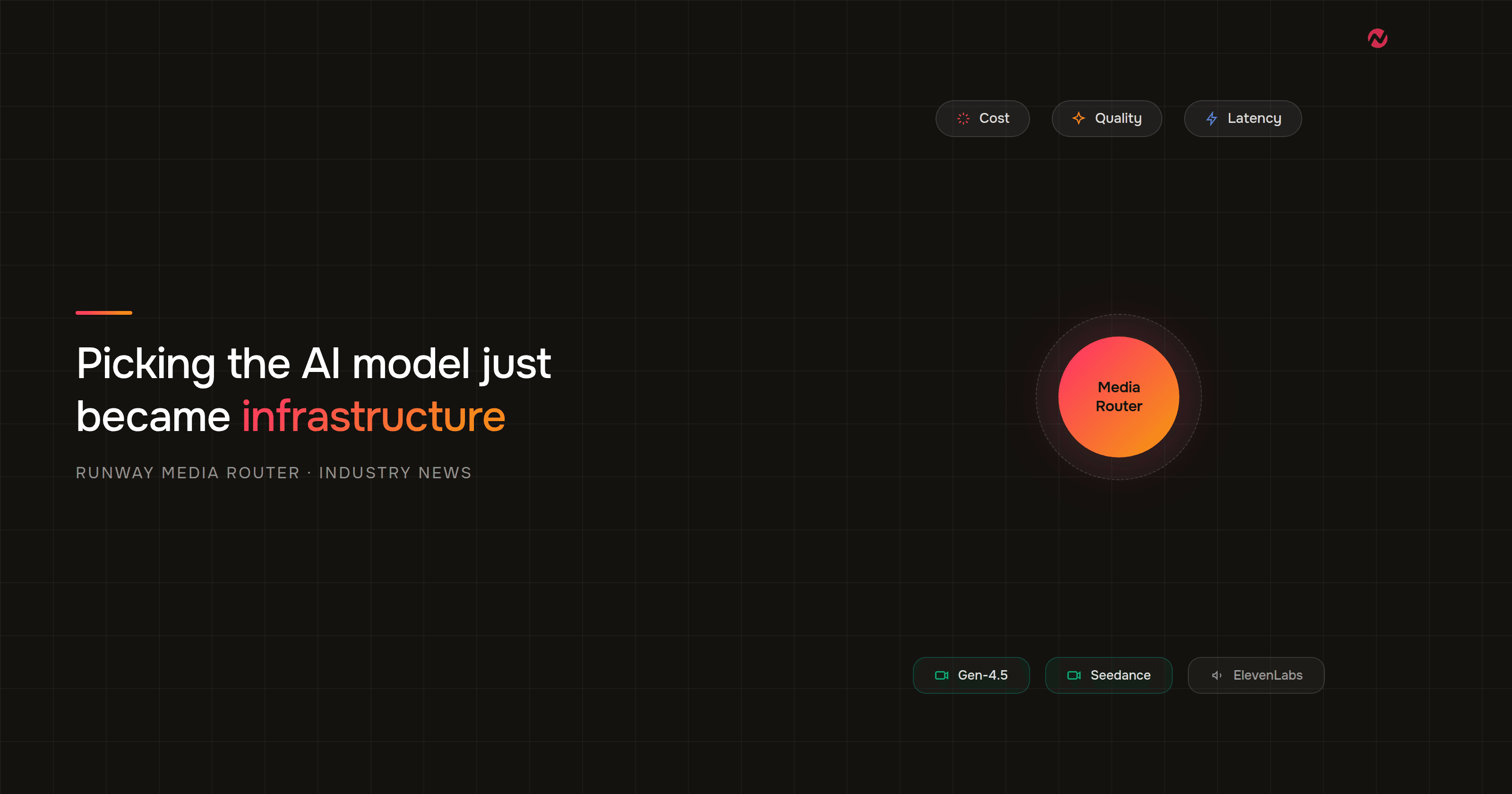
Media Router, built into the Runway Dev developer platform, takes in a generation request, a budget, and a preference for cost, speed, or quality, and picks the model behind the scenes, sometimes one of Runway's own, sometimes not. Per Runway's own announcement, it is the first router built specifically for generative media, modeled on the routing layer that already exists for text models but never quite existed for video, image, and audio.
That framing matters more than the feature list. A company that spent its history selling a model is now selling the layer that decides whether to use its model at all.
What Runway Media Router Actually Does
Media Router sits inside Runway Dev, the API platform Runway launched on July 8, 2026 for teams building generative media directly into their own products rather than sending users to Runway's own app. Media Router is the piece of Runway Dev that decides, per request, which underlying model actually does the work.
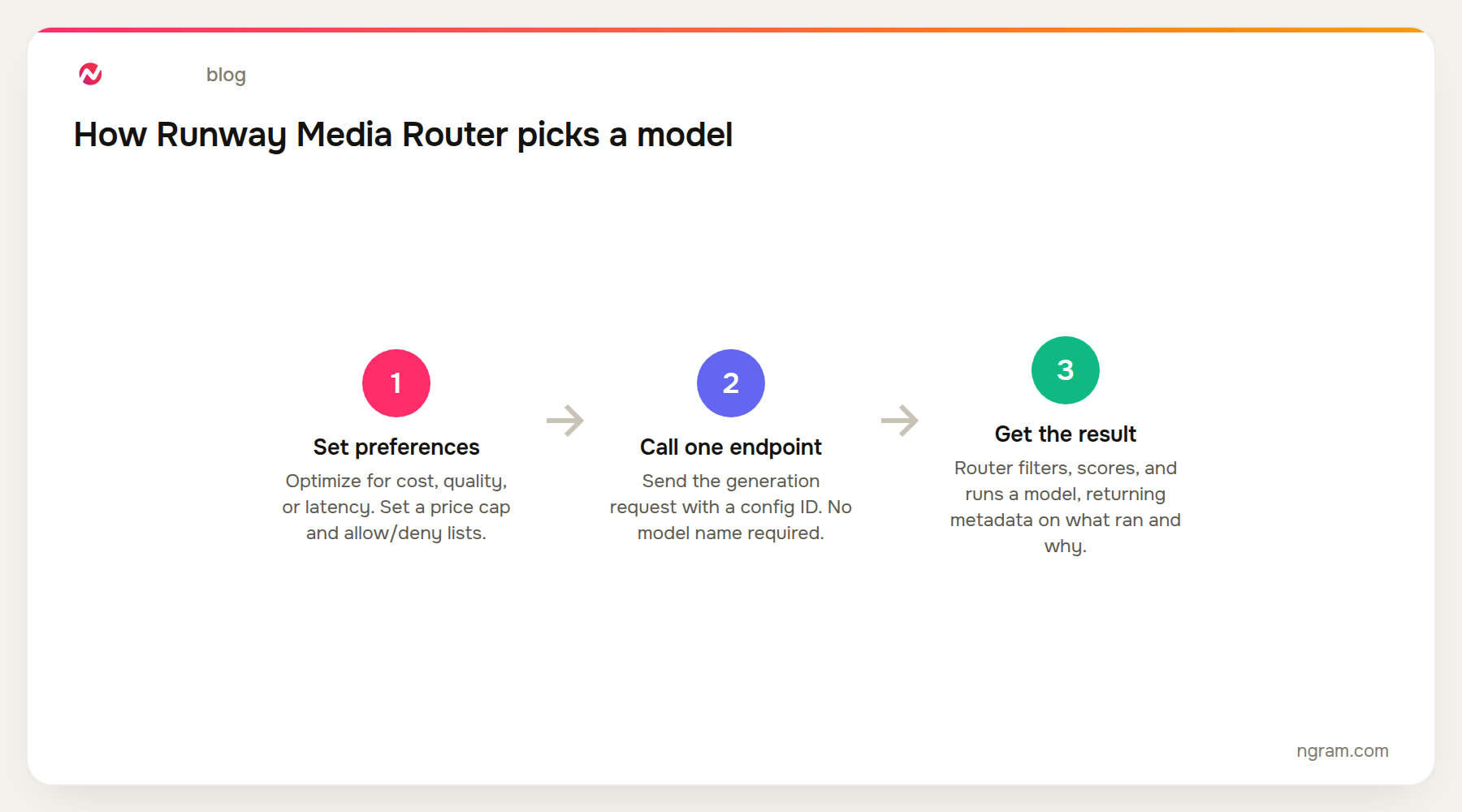
The flow, according to Runway's launch post, has three steps. A developer sets preferences in the Runway Dev portal: an optimization priority (cost, quality, or latency), a hard price cap per generation, and an allow or deny list at the provider or model level. The app then calls a single Media Router endpoint with a config ID, no model name required. The router filters the available models against those constraints, scores what is left, and returns a result along with metadata on exactly which model ran and why, including the realized cost in credits. A dry-run mode checks whether a config is even satisfiable before anything renders, so a team can validate a configuration change without paying for a wasted generation.
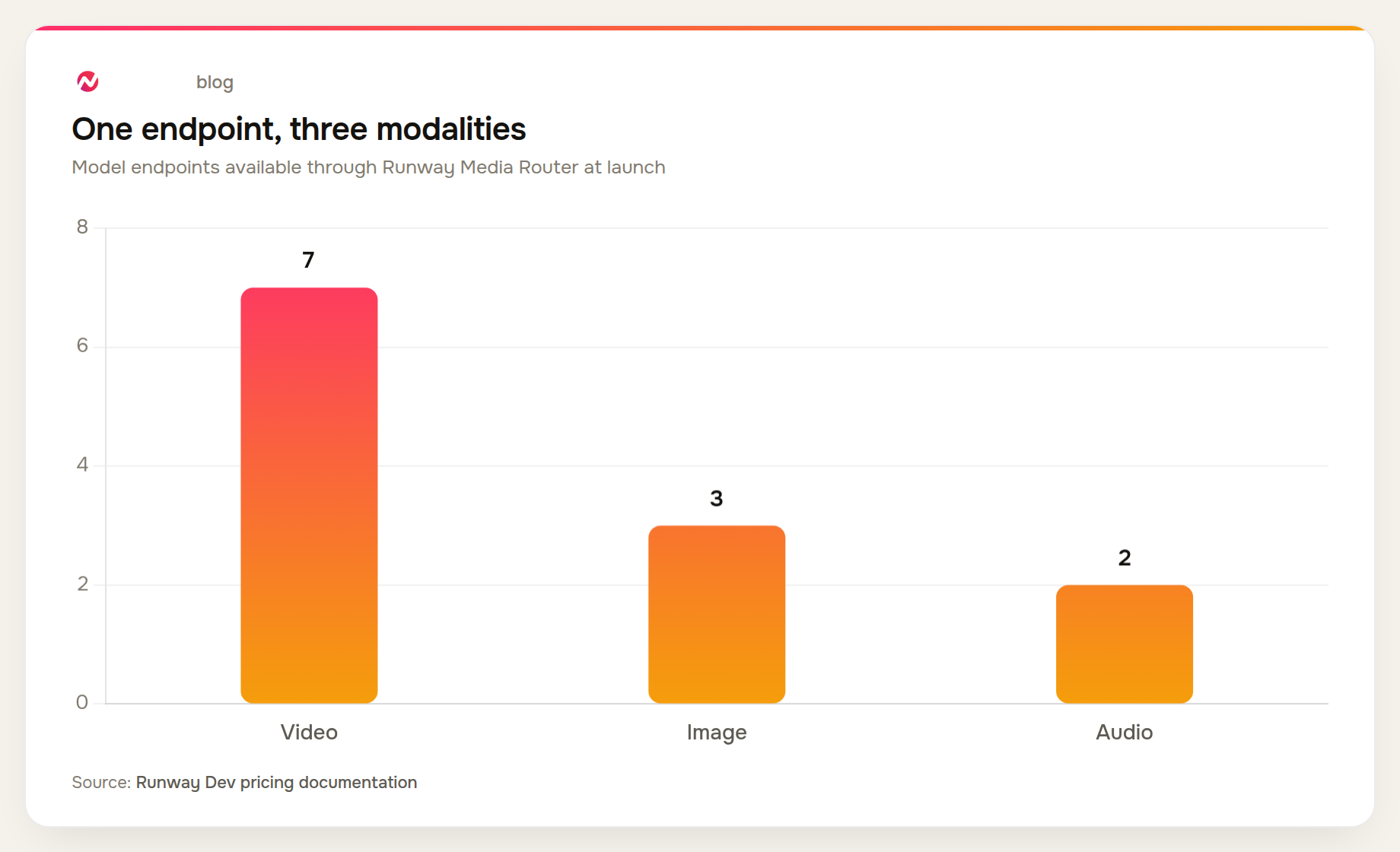
The catalog behind that single endpoint already spans three modalities. On the video side it includes Runway's own text-to-video models Gen-4.5, Aleph 2.0, and Act-Two, plus third-party video models including ByteDance's Seedance and Google's Gemini Omni Flash. On images it routes to Runway's own Gen-4 Image and Gen-4 Image Turbo alongside OpenAI's GPT Image 2. On audio it routes to ElevenLabs. That is 12 named model endpoints across three modalities, live on day one, according to Runway's own developer pricing docs.
Runway Dev already has named customers building on top of that catalog: Adobe, Cloudflare, ElevenLabs, Expedia, Shutterstock, and Quora, according to TechCrunch's coverage of the launch. Runway's own announcement of Runway Dev two weeks earlier separately named Adobe, ElevenLabs, Shutterstock, Figma Weave, Gamma, and Silverside as platform customers, with use cases ranging from a broadcaster producing 800 to 1,000 ads a year across 50-plus labels to a retailer generating over 1,000 product shots a month.
Why Now: Model Proliferation Made Picking One Model a Full-Time Job
Runway did not build Media Router because routing is a novel idea. It built it because the number of generative media models worth considering for any given job has outgrown what one developer can reasonably track. Runway chief product officer Anthony Maggio put the underlying problem plainly:
Most developers are not spending the time to really understand the capabilities of each of these models.
That is not a knock on developers. It is an honest description of what happens when a category goes from having two or three credible players to having a new frontier release most months. A team shipping a product feature on top of generative video has to track motion quality, prompt adherence, resolution ceilings, output length limits, and pricing across every model that might beat what they are using today, on top of actually building the product. That is the same pressure showing up across every ai video generation platform right now, not just Runway's. Runway's own leaderboard position is the case in point: Gen-4.5 led rankings when it shipped in December 2025, and within months, per TechCrunch's reporting, rankings had shifted to feature models from Google, ByteDance, and Alibaba. A model that leads today is not guaranteed to lead by the time a team's next release ships.
Runway co-founder Anastasis Germanidis framed the company's response to that instability directly:
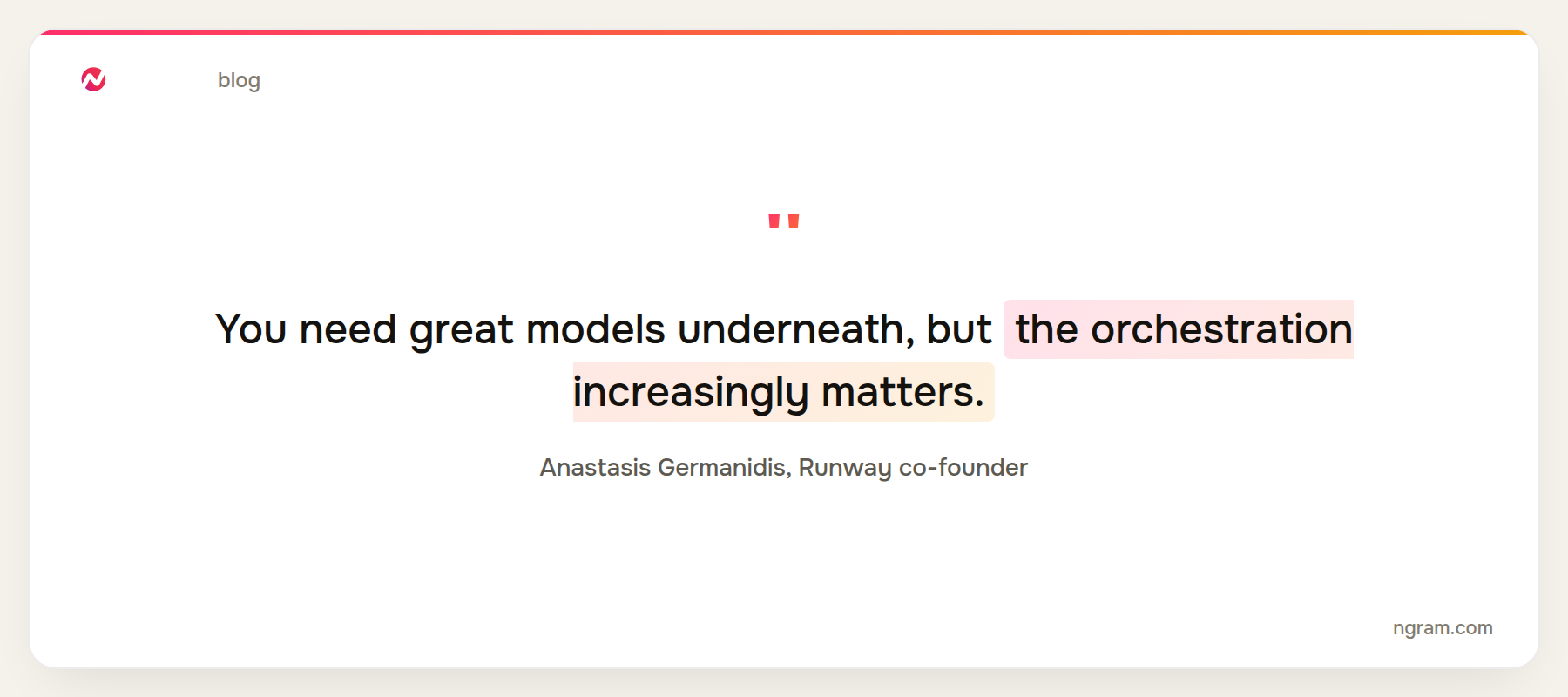
That is a striking thing for a model company to say about its own category. It means Runway is betting that being the best single model is a weaker position than being the layer a developer trusts to pick whichever model is currently best, including a competitor's.
Runway Media Router Is Generative Media's OpenRouter Moment, Years Late
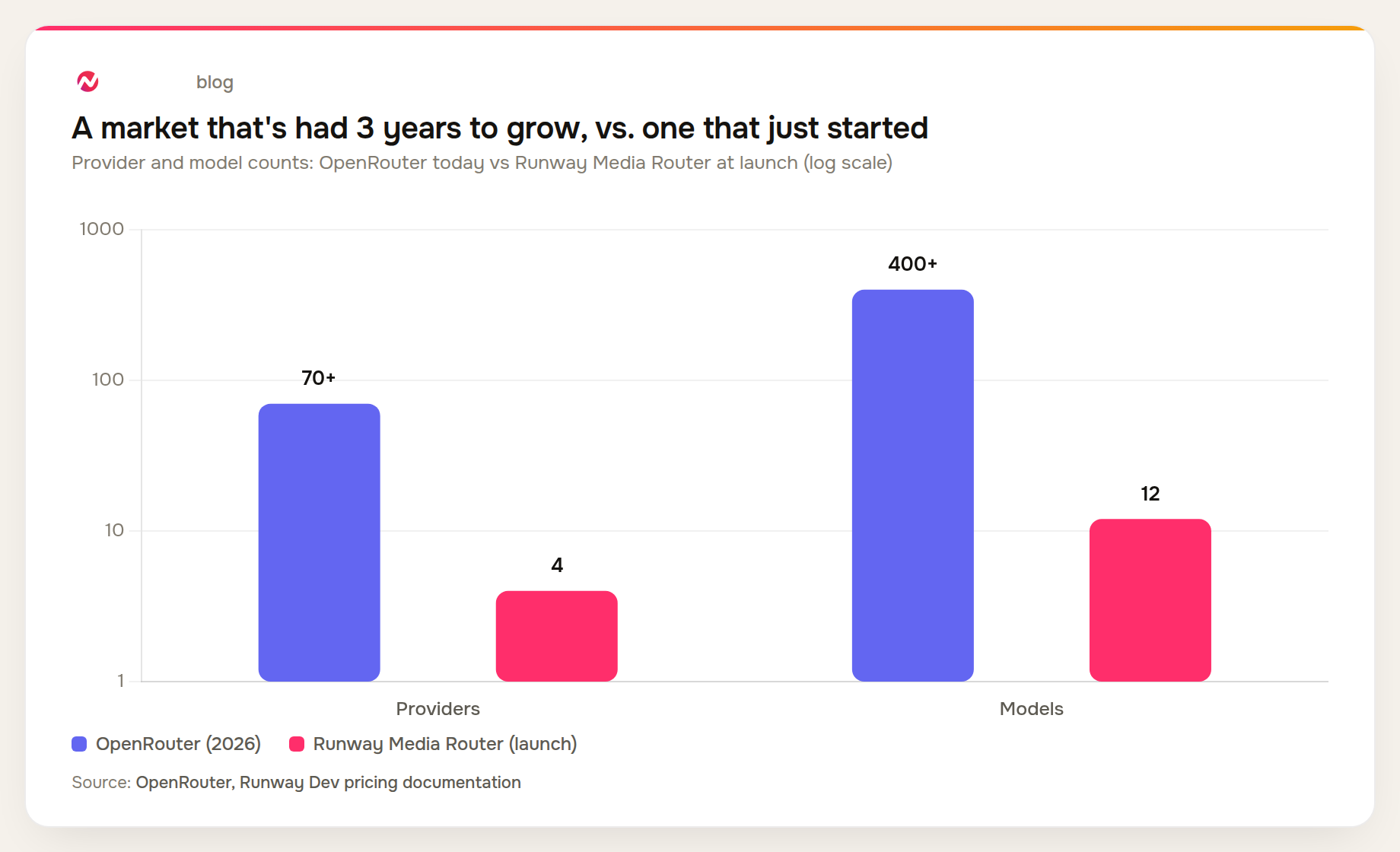
Text had this problem first, and it got solved first. OpenRouter launched in early 2023 as a unified API for large language models: pick a preference, hit one endpoint, let the router pick from whichever provider fits. It now aggregates more than 400 models from over 70 providers, processes more than 200 trillion tokens a month for over 10 million developers, and raised a $113 million round led by Alphabet's CapitalG this past May.
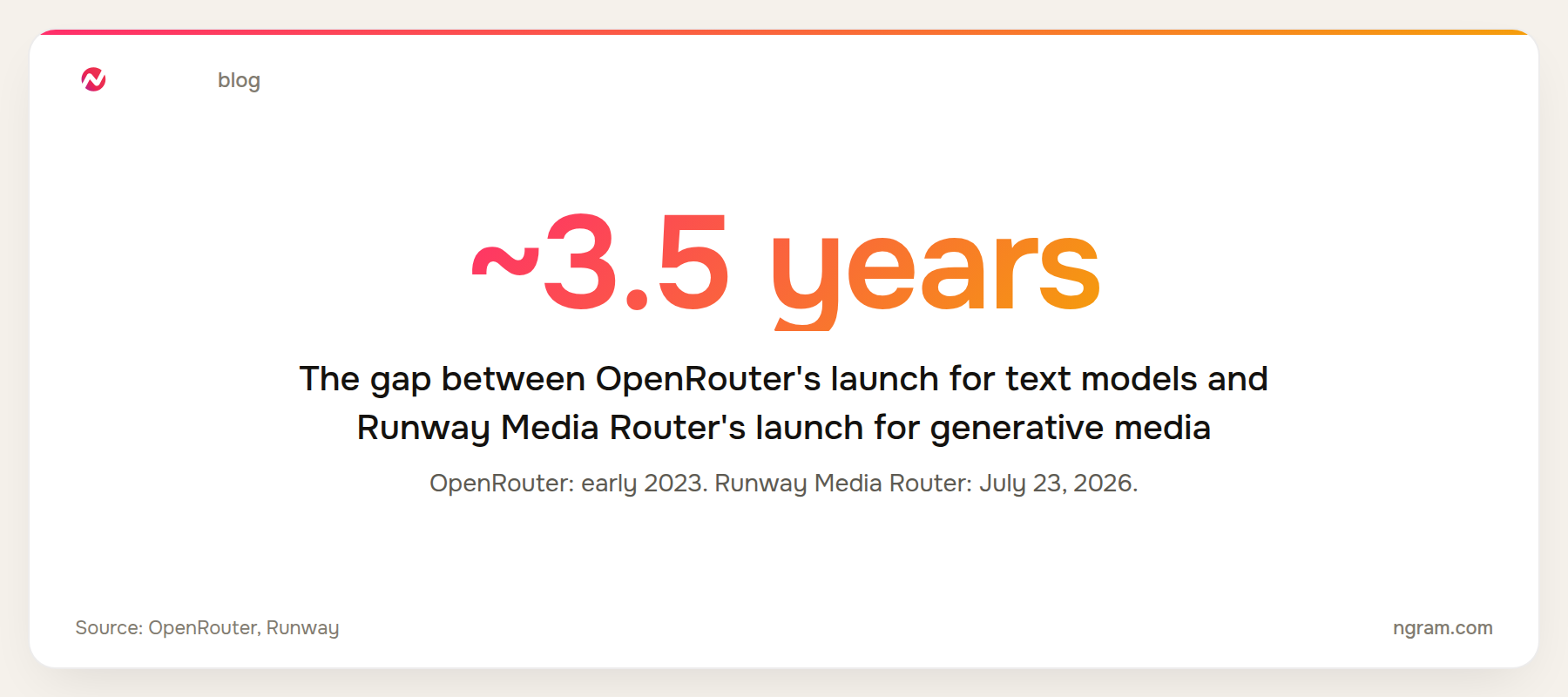
Runway's Media Router arrives roughly three and a half years after that idea took hold for text, and by Runway's own account it is the first router purpose-built for generative media rather than an LLM router extended to also handle video, according to TechCrunch. The scale gap between the two markets right now says as much about the industry's maturity curve as the time gap does.
One detail makes the parallel sharper than a simple time lag. Quora is one of Media Router's named early customers, and Quora already runs its own consumer-facing multi-model product, Poe, which lets people switch between different AI chat models inside one app. A company that already internalized "do not make the user pick a model" for text is now a customer of a company applying the same idea to video, image, and audio. The pattern is not new anymore. It is just arriving in a new medium.
What Cost, Quality, and Latency Really Mean When a Router Is Picking the Model
An LLM router optimizing for cost is usually choosing between a few cents and a fraction of a cent per request. A generative media router optimizing for cost is choosing between a nickel and forty-five dollars for the same job. Runway's own published rates for the models inside Media Router show exactly how wide that spread is within a single catalog: Act-Two runs 5 credits per second of video, Runway's Gemini Omni Flash integration runs 10, Gen-4.5 runs 12, Seedance 2.0 Mini runs 16, Seedance 2.0 Fast runs 29, Aleph 2.0 runs 28, and Seedance 2.0 at full 4K resolution runs 150 credits per second, according to Runway's own developer pricing documentation. At $0.01 per credit, that is a 30-fold range, from 5 cents to a dollar fifty, for one second of output, inside a single router's own catalog.
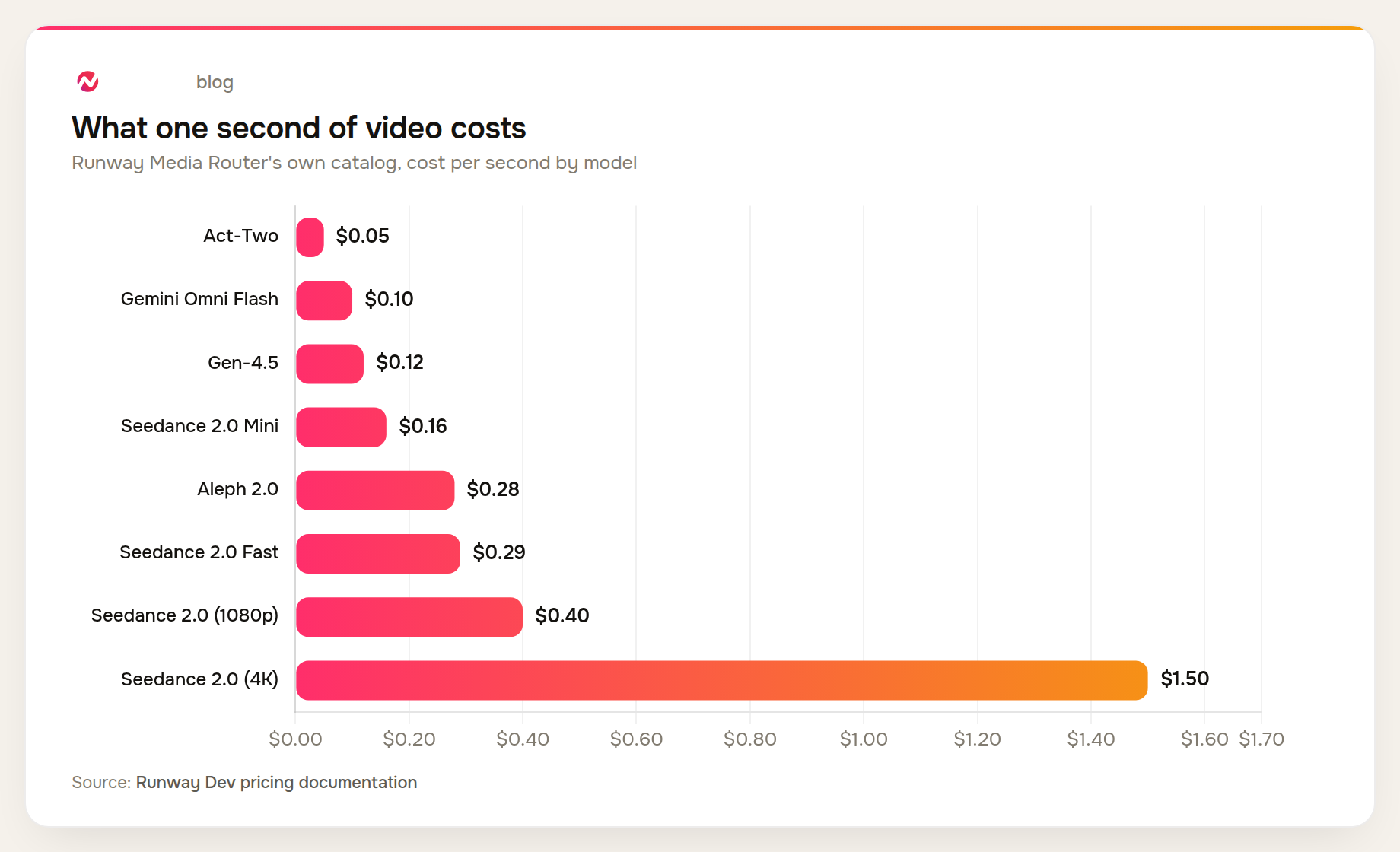
Image generation shows the same shape at a smaller scale: Runway's own Gen-4 Image Turbo costs 2 credits regardless of resolution, while OpenAI's GPT Image 2, one of the ai image generators available through the same router, runs anywhere from 1 to 41 credits depending on quality and resolution. Raw per-unit pricing swings widely for text models too, current flagship-to-budget token pricing spans roughly two orders of magnitude on the highest and lowest tiers, so the multiplier alone is not the real difference.
The real difference is what a bad pick costs in absolute terms and how long it takes to find out. A wrong model choice on a text request usually wastes a fraction of a cent and resolves in under a second. A wrong model choice on a 10-second 4K video can waste real money and several minutes of render time before anyone sees the result, which is exactly why unit economics bite harder in AI video than they do in text generation. That is almost certainly why Runway built a dry-run mode that checks a configuration before it spends anything. An LLM router rarely needs that safety valve because the cost of finding out you were wrong is close to zero. A video router needs it because finding out you were wrong is not.
The Awkward Part: Runway Hosts the Competition It Also Sells Against
Media Router creates a genuine conflict of interest, and Runway built it anyway. Every request that comes in through the router is a request Runway could route to its own Gen-4.5, Aleph 2.0, or Act-Two, and instead sometimes routes to ByteDance's Seedance or OpenAI's GPT Image 2 because a developer's preference says that model is the better fit for the job. Runway is, by design, sometimes handing revenue and usage data to the same labs it competes against on public leaderboards.
ElevenLabs sits on both sides of that arrangement at once. It is named as a Runway Dev customer building products on top of the platform, and its own ai voice generator is simultaneously one of the third-party engines Media Router can route audio requests to. ElevenLabs is, at the same time, a company building on Runway's infrastructure and a vendor whose model Runway resells access to. That is not necessarily a contradiction, plenty of infrastructure companies both host and compete with parts of their own customer base, but it is a genuinely unusual position for a company whose entire origin story was being a single, opinionated model.
The bet only makes sense if Runway believes the router itself, not any one model in it, is where the durable value sits. Owning the decision layer means Runway keeps the relationship and the usage data even in the generations where a competitor's model wins the request. That is a materially different business than selling access to one model and hoping it stays on top of the leaderboard.
What Runway Media Router Means for Builders vs. Creators
Media Router solves a real problem, but it solves it one layer removed from anyone actually trying to make a video. It is aimed at developers who are integrating generative media into their own product and need an API that tracks model quality so they do not have to. It does nothing for someone who just wants a finished video from an ai video generator and has no interest in comparing Seedance to Gen-4.5 to decide which one to call.
That second group is not solving the model-selection problem with configuration, allow lists, and optimization scores. They are solving it by not touching model names at all. ngram's own product works this way at the end-user layer: someone describes the video they want in plain language, and the underlying agent picks whichever tools and models produce it, without the user ever choosing a model by name. It is the same instinct Runway is now selling to developers, don't make the human pick a model, just applied one layer down, at the point where someone is actually making something rather than integrating an API. ngram's Premium and Ultimate plans already unlock every advanced model in the product on that same bet, that the model layer underneath will keep shifting and a creator should not have to re-shop every time it does. Try ngram if that is the layer you actually need.
The two patterns showing up at once, one for developers integrating an API and one for creators typing a prompt, is the real signal in this launch. Model selection is turning into infrastructure at every layer of the stack where a human used to have to know a model's name to get work done. That is a bigger claim than one company's product announcement, and it is one Runway is making about its own industry, not just about itself.
Frequently Asked Questions
What is Runway Media Router?
Runway Media Router is a routing system built into the Runway Dev developer platform that automatically picks which AI model handles a video, image, or audio generation request based on a developer's stated preferences for cost, quality, or latency. Runway calls it the first router built specifically for generative media, launched July 23, 2026.
How does Runway Media Router decide which model to use?
A developer sets an optimization preference, a price cap, and allow or deny lists in the Runway Dev portal, then calls one endpoint with a config ID instead of naming a model. The router filters available models against those constraints, scores what is left, and returns the result along with metadata on which model ran and why, including the realized cost in credits.
What models can Runway Media Router route to?
At launch it covers Runway's own Gen-4.5, Aleph 2.0, and Act-Two for video, plus third-party models including ByteDance's Seedance and Google's Gemini Omni Flash. On images it includes Runway's Gen-4 Image and Gen-4 Image Turbo alongside OpenAI's GPT Image 2. On audio it routes to ElevenLabs.
What is OpenRouter, and how is it different from Runway Media Router?
OpenRouter is a unified API launched in early 2023 that routes requests across large language models from more than 70 providers, letting developers pick a model or an optimization preference through one endpoint instead of integrating each provider separately. Runway Media Router applies the same routing idea to generative media instead of text, and Runway describes it as the first router purpose-built for that category rather than a text router extended to video.
Who is already using Runway Dev?
TechCrunch named Adobe, Cloudflare, ElevenLabs, Expedia, Shutterstock, and Quora as early Runway Dev customers using Media Router. Runway's own launch post for the Runway Dev platform two weeks earlier separately named Adobe, ElevenLabs, Shutterstock, Figma Weave, Gamma, and Silverside.
Does Runway's own model win by default in Media Router?
No. The router scores models against whatever preference and constraints a developer sets, and a competitor's model, such as ByteDance's Seedance or OpenAI's GPT Image 2, can be selected over Runway's own Gen-4.5, Aleph 2.0, or Act-Two if it better fits the stated priority.
Why does AI video generation cost vary so much between models?
Because video models differ far more in compute cost, resolution, and specialization than most text models do. Inside Runway's own router catalog, per-second video pricing ranges roughly 30-fold, from 5 cents for Act-Two to a dollar fifty for Seedance 2.0 at 4K resolution, depending on the model and output quality selected.
Is Runway Media Router available to everyone?
It is part of Runway Dev, Runway's developer platform, so it is aimed at teams building generative media into their own products through the API rather than individual users of Runway's consumer app. Developers apply for access through the Runway Dev portal.