
On March 24, 2026, OpenAI announced it was killing Sora. The app closed on April 26. The API enters maintenance-only mode now and shuts down permanently on September 24, 2026. No successor has been named.
This was the most visible AI video product in the world, backed by the most valuable AI company in the world. Its failure is not a footnote. It is the most useful data point the AI video market has produced in two years.
Here is what the numbers say, why they matter, and what they reveal about where AI video infrastructure is actually heading in 2026.
The Sora shutdown: what happened and when
Sora 2 launched in October 2025 as a standalone app and API. The launch was genuinely impressive. The model produced cinematic video from text prompts with a level of visual coherence no previous public model had matched. Downloads crossed one million in the first five days, briefly hitting the top of the App Store free chart.
Five months later, OpenAI killed it.
The official timeline: app and web experience discontinued April 26, 2026. API access in maintenance-only mode until September 24, 2026, when it is permanently switched off. Per the official OpenAI help center documentation, all account data will be permanently deleted after the API shutdown date. There is no stated replacement product in the deprecations page - the replacement column is empty.
The Sora 2 model itself is not gone entirely. It remains accessible inside ChatGPT's paid subscription tiers as a generation option. But the standalone product, the dedicated infrastructure, and the public API are done.
The unit economics that made Sora impossible to keep running
The numbers behind the shutdown are worth sitting with, because they are not edge-case numbers. They are the baseline cost structure of running a consumer AI video generation product at OpenAI's scale.
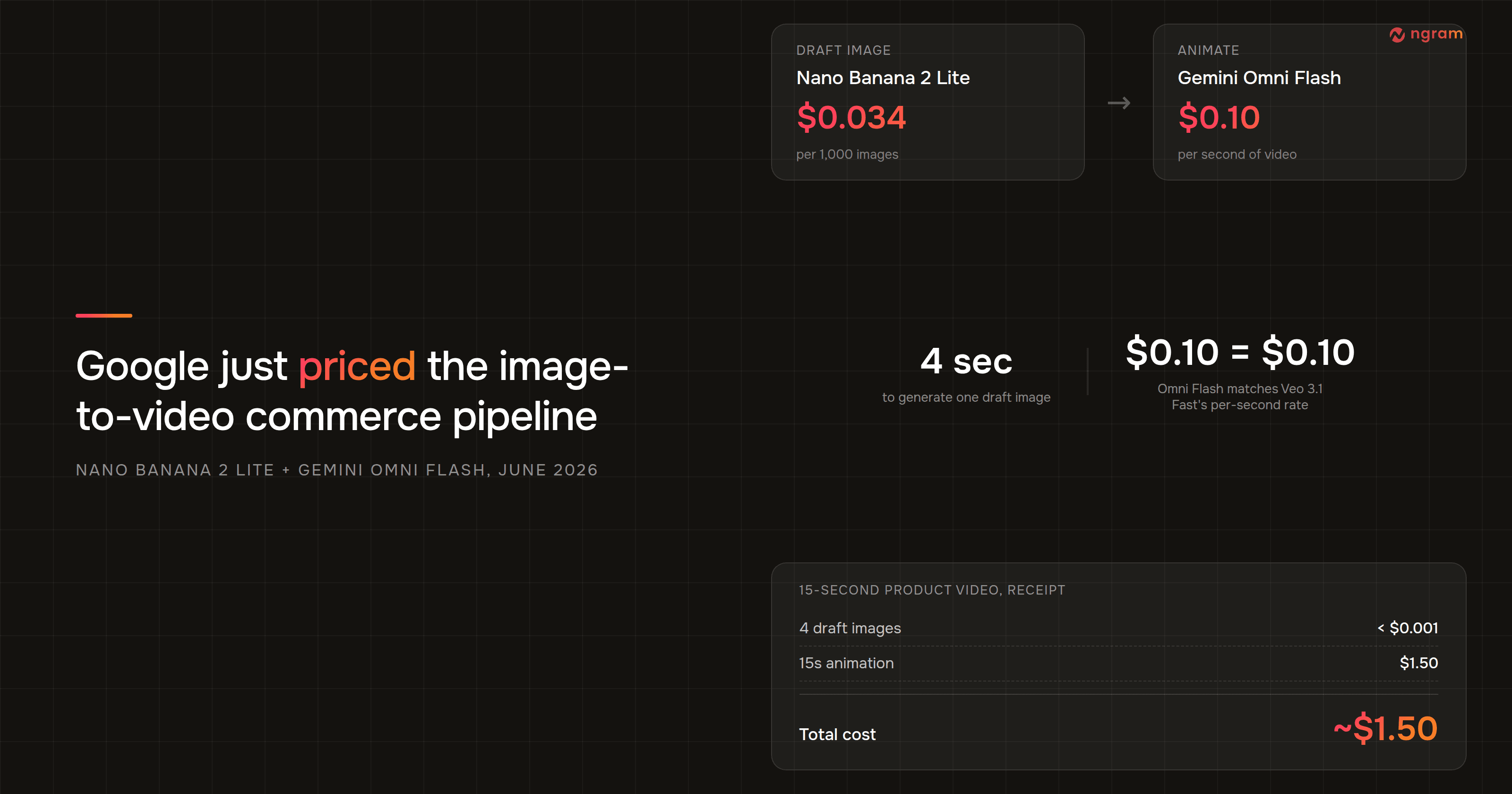
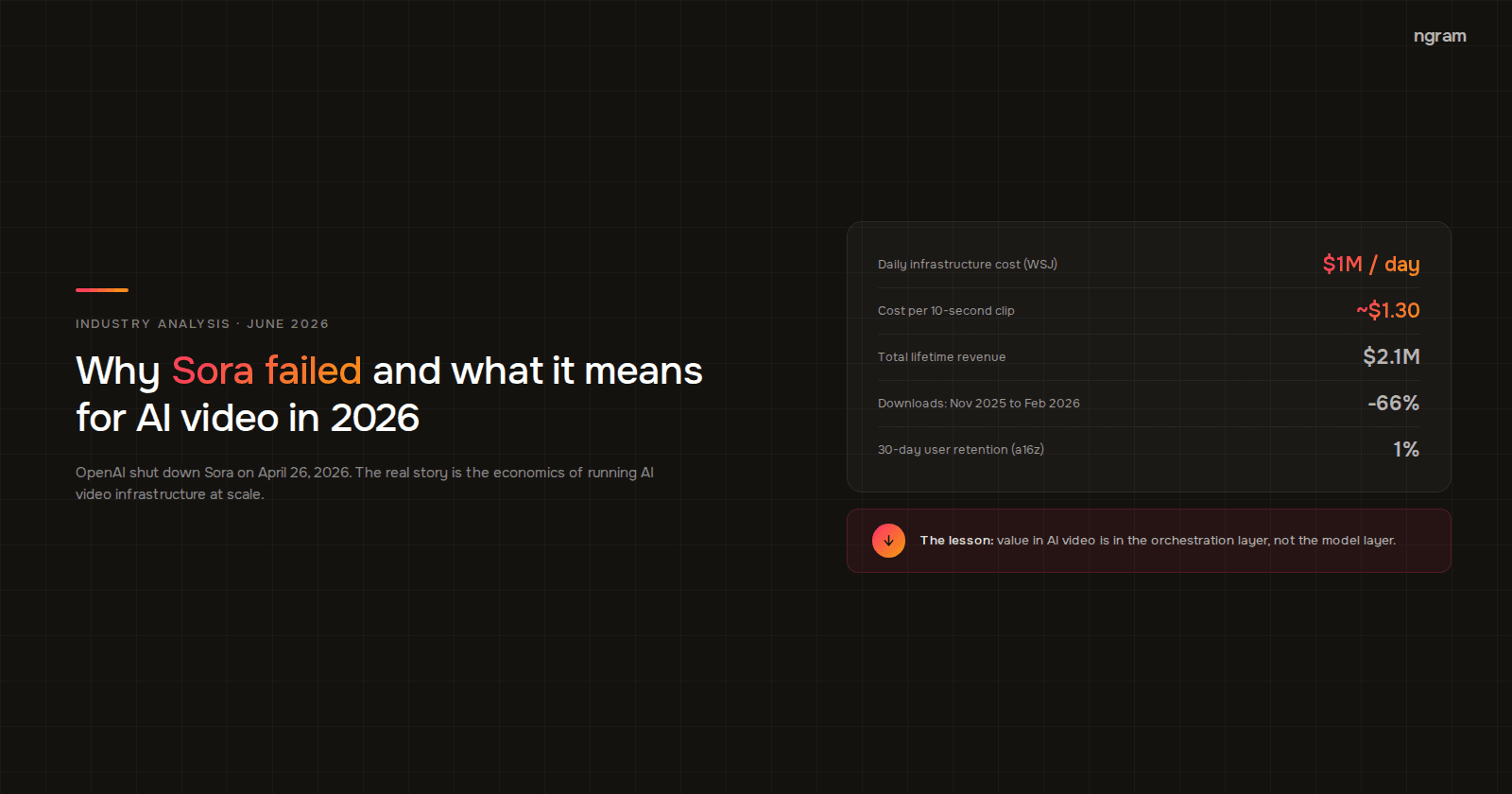
According to reporting from the Wall Street Journal, Sora burned approximately $1 million per day in infrastructure costs. Each 10-second video clip cost OpenAI roughly $1.30 to generate - a figure confirmed across multiple industry analyses. Against that cost structure, the platform generated $2.1 million in total lifetime revenue from in-app purchases.
That ratio - $365 million in annualized costs against $2.1 million ever earned - is not a business problem that better conversion rates fix. It is a structural incompatibility between what video generation requires and what consumer pricing can cover.
The core issue is compute competition. Every GPU running a Sora inference request was unavailable for ChatGPT queries, Codex completions, or enterprise API calls - all of which generate direct, predictable revenue. Sam Altman's decision to shut down Sora was, by internal accounts, framed as dropping a 'side quest' to free compute for what OpenAI calls its core mission: enterprise AI tools, coding infrastructure, and AGI development.
The chart below shows the gap clearly.
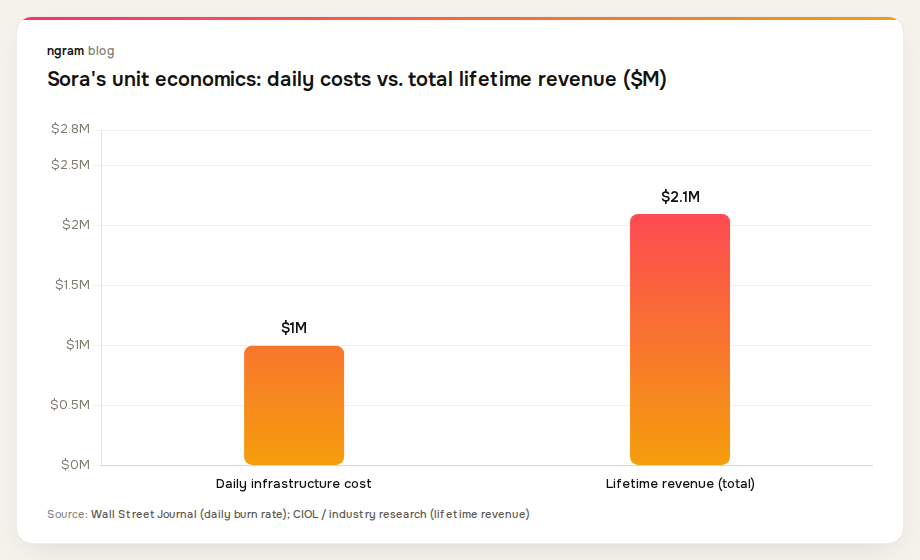
The daily burn rate alone exceeded total lifetime revenue in roughly two days. Over the product's five-month life as a standalone app, the implied compute cost ran more than 85 times what users ever paid.
Retention collapsed faster than any metric predicted
Cost alone does not explain the shutdown timing. Plenty of expensive products survive when user engagement compounds. Sora's did not.
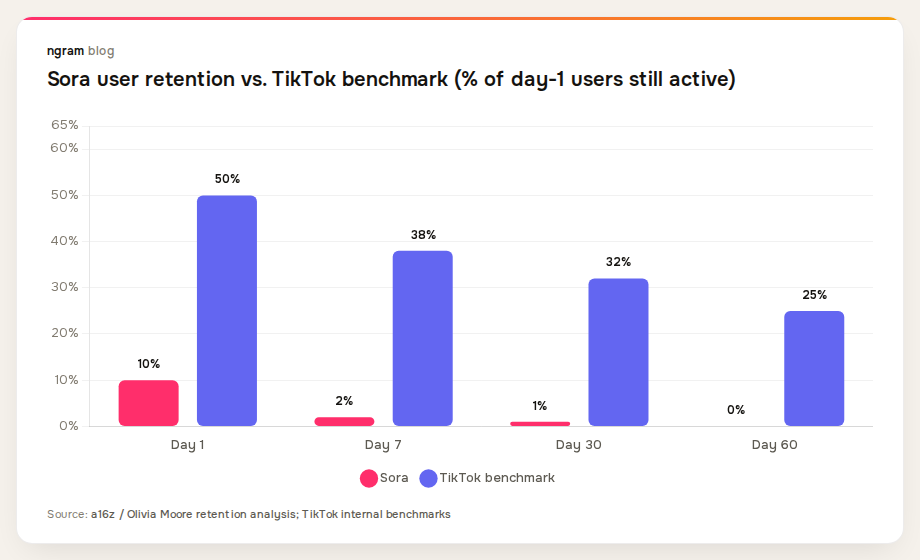
Retention data published by Olivia Moore at venture firm a16z showed Sora's 30-day retention rate sitting at 1%. Day 7 retention was 2%. By day 60, it was effectively 0%. For context, TikTok's 30-day retention benchmark is approximately 32%. Sora users were using the product once or twice, generating a clip to share, and never returning.
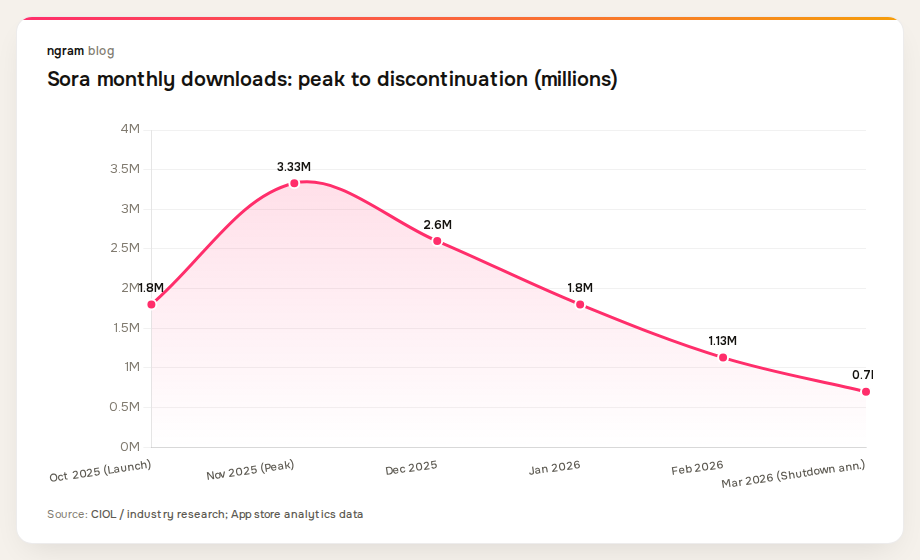
Download data told the same story. Monthly downloads peaked at 3.33 million in November 2025, the month after launch. By February 2026, three months later, downloads had fallen to 1.13 million - a 66% decline. The announcement of the shutdown came one month after that.
The pattern reflects what AI video researchers have termed 'counter-creative bias' in generative models: systems trained to produce familiar, aesthetically safe output end up generating clips that feel technically impressive but creatively flat. Users generate a few videos to see what the model can do, share them as novelties, and then discover they do not need the capability for anything they do regularly.
This was not a marketing problem or a UI problem. It was a product-market fit problem at the consumer layer. The best video generation model in the world had no recurring use case that justified the compute it required.
Why video generation is structurally different from language generation
The Sora failure has a structural explanation that goes beyond this specific product. Video generation does not scale the way language generation does, and that matters for every company building on AI video infrastructure.
Language models benefit from what researchers call favorable token economics: each token is cheap, outputs are short, and the model can be cached and batched aggressively. A 500-word ChatGPT response costs a fraction of a cent to generate. The cost curve bends downward as scale increases.
Video generation does not share this curve. A 10-second clip at Sora's quality requires generating, evaluating, and compositing thousands of frames. Each frame carries spatial complexity that text does not. There is no shortcut analogous to tokenization that reduces the compute footprint. At $1.30 per 10-second clip, even a $20/month subscription covers roughly 15 clips - far below what a weekly active creator would generate.
This is not a problem unique to OpenAI. It is a constraint of the physics of video rendering. The companies that survive in AI video long-term are the ones that work with this constraint - by routing generation across multiple models, optimizing for specific use cases where the cost-per-clip pencils out, and building workflow value that justifies the inference cost.
What OpenAI is building instead
The compute freed by shutting down Sora is going to products where the revenue-to-cost ratio is far more favorable. OpenAI shipped Codex, its agentic coding tool, as a desktop app in February 2026. GPT-5.4 followed in March, targeted at professional work. The company is now building what insiders call 'Atlas,' a desktop superapp combining ChatGPT, Codex, and a web browser with agentic capabilities.
These products serve enterprise customers who pay per seat or per API call, where pricing correlates with value delivered. That is a fundamentally different business than a consumer app where the primary monetization is a $20/month subscription against $1.30-per-clip generation costs.
A 1H 2026 survey by Futurum Research (n=838 enterprise decision-makers) found that 61% of organizations cite OpenAI GPT as their primary generative AI platform, and 67% already run GenAI models in production. Those organizations are paying for language intelligence, not video generation. That is where OpenAI's revenue is, and that is where the freed compute is going.
The market filling the gap: Veo, Kling, Runway, and Luma
Sora's exit did not create a vacuum. The AI video generation market had been developing alternatives throughout 2025 and accelerating into 2026. Several now match or exceed Sora's output quality in specific dimensions.
Google Veo 3.1, released in January 2026, is widely regarded as the current state-of-the-art for video with native audio generation. Kling 3.0 (launched February 5, 2026) added native 4K output and multilingual audio with lip-sync across five languages. Runway Gen-4.5 holds the top position on the Artificial Analysis video generation leaderboard for professional use cases. Luma Ray3 and Ray3.14 lead on natural phenomena - fluid dynamics, lighting, atmospheric effects. ByteDance Seedance 2.0 ranked first on the Artificial Analysis benchmark in February 2026 for raw output quality.
In the open-source tier, LTX-2.3 launched in March 2026 as the first text-to-video model with native 4K output and audio generation under an Apache 2.0 license. It gives developers a zero-cost generation option for workflows that can accept trade-offs on quality.
The pattern that emerged after Sora's shutdown: Kling and Seedance absorbed most of Sora's casual user base because both offer generous free tiers with minimal geographic restrictions. Runway and Veo captured the professional segment, where editing tools and resolution capabilities matter more than novelty.
What Sora's failure reveals about AI video infrastructure in 2026
The most useful way to read the Sora shutdown is not as a video product failure. It is as an infrastructure lesson.
OpenAI built Sora as a vertically integrated product: one model, one product, one cost structure. That integration worked against them. When the economics did not pan out, there was no fallback. The entire product had to go.
The platforms that are surviving and growing in AI video in 2026 are architected differently. They route generation across multiple models - matching the right model to the right task based on quality requirements, cost, latency, and availability. A product that can send a high-fidelity request to Veo 3.1 or Kling 3.0 and fall back to an open-source model for batch jobs is not exposed to the single-point-of-failure risk that sank Sora.
This is not a novel observation - it is what mature cloud infrastructure has always looked like. The value is in the abstraction layer that selects, orchestrates, and quality-controls across providers, not in owning any single provider. The Sora story is the most expensive proof point for that principle the AI video market has produced.
ngram's video pipeline routes generation through FAL.ai (primary) and Replicate (fallback) rather than a single model provider - the same multi-vendor pattern that insulates production workflows from exactly this kind of single-model shutdown. When a model is deprecated, the orchestration layer routes around it.
The Disney deal and the enterprise signal
One more data point worth noting: a reported $1 billion partnership between Disney and OpenAI, tied to Sora and character licensing access, reportedly collapsed in December 2025 before any funds were exchanged. The details remain unconfirmed - OpenAI has not commented publicly and Disney has not confirmed the deal's scope - but the pattern is consistent with what Futurum's enterprise research shows.
According to Futurum's 1H 2026 AI Platforms Decision Maker Survey, enterprise buyers are now prioritizing platform durability and transparent deprecation policies over raw capability. A single-vendor AI dependency - whether for language models or video generation - is now a boardroom-level risk conversation. The Sora shutdown is the case study those conversations will reference.
Where AI video actually works in 2026
The Sora failure is a consumer product failure, not a verdict on AI video itself. The places AI video generation works well in 2026 are the places the economics make sense:
- B-roll and scene fills: generating short clips to fill gaps in produced video, where a $1.30 clip replaces a $400 stock footage license.
- Product marketing video: converting screenshots, URLs, and structured data into polished explainer videos where the alternative is a $3,000 agency engagement.
- Batch personalization: generating variants of the same video for different audiences, channels, or languages at a cost that scales linearly rather than requiring re-production.
- Internal communications: turning changelogs, release notes, and documents into short-form video where production quality is secondary to speed and clarity.
What does not work is raw consumer novelty generation - people using an ai video generator to make clips to share on social media - where there is no workflow value, no recurring job-to-be-done, and no willingness to pay what the inference actually costs.
That is the market Sora targeted. It is not the market that AI video infrastructure is built for.
Frequently Asked Questions
Why did OpenAI shut down Sora?
OpenAI shut down Sora because the platform's infrastructure costs (approximately $1 million per day according to the Wall Street Journal) were not recoverable through consumer subscription pricing. Total lifetime revenue was $2.1 million. Sam Altman redirected the compute toward enterprise AI tools, coding infrastructure, and AGI development, describing Sora as a 'side quest' that could not justify its resource footprint.
Is Sora completely gone?
The standalone Sora app and website shut down on April 26, 2026. The Sora API remains in maintenance-only mode until September 24, 2026, when it is permanently decommissioned. The underlying Sora 2 model is still accessible as a generation option within ChatGPT's paid subscription tiers, but there is no dedicated Sora product.
What are the best Sora alternatives in 2026?
The leading alternatives filling Sora's gap in 2026 are Google Veo 3.1 (best for video with native audio), Kling 3.0 (native 4K and multilingual lip-sync), Runway Gen-4.5 (top Artificial Analysis leaderboard ranking, strong editor workflow), Luma Ray3 (best for natural phenomena and atmospheric effects), and ByteDance Seedance 2.0 (top Artificial Analysis benchmark for raw quality). For open-source use cases, LTX-2.3 launched in March 2026 with native 4K and audio under Apache 2.0 license.
How much did Sora cost per video?
Each 10-second Sora video clip cost OpenAI approximately $1.30 to generate in infrastructure compute. This is a cost-of-goods figure, not a user-facing price. At a $20/month subscription covering roughly 15 clips, the unit economics never closed - especially given that most users generated a handful of clips and stopped returning.
Will OpenAI release a new video product?
As of June 2026, OpenAI has not announced a replacement video product. The company's stated focus is on enterprise AI tools (Codex, GPT-5.4), a desktop 'superapp' combining ChatGPT and Codex, and AGI research. The Sora 2 model remains available inside ChatGPT for paid subscribers, which appears to be the extent of OpenAI's current video generation offering.
What does the Sora shutdown mean for AI video developers?
For developers building on AI video infrastructure, the Sora shutdown is a clear signal to avoid single-model dependency. Products built on one API from one provider carry the risk that the provider changes economics, deprecates the model, or exits the market entirely. The durable architecture routes generation across multiple providers - matching quality, cost, and latency requirements dynamically - so no single shutdown cascades into a product outage. This is how text-based AI video generation tools can build something resilient without owning their own models.
What was Sora's user retention rate?
According to retention analysis from Olivia Moore at a16z, Sora's 30-day retention rate was approximately 1% - meaning 99 out of 100 users who installed the app had stopped using it within a month. Day 7 retention was 2%. Day 60 was effectively 0%. For comparison, TikTok's 30-day retention benchmark is approximately 32%. The collapse in retention preceded the download decline and likely drove the shutdown decision.