

Search for "Arcads vs Jogg AI" and you find two AI ad generators that both promise creator-style video without a creator. The difference is what they optimize for. Arcads is the realism engine, tuned so its AI actors pass for real people in paid-social testimonials. Jogg AI is the broader, cheaper avatar platform, built to turn a product link into avatar videos and product ads at a fraction of the price. This guide compares Arcads vs Jogg AI across the things that actually decide the purchase: actor realism, product video, inputs and workflow, and pricing. It also shows where a third option, ngram, beats both when your real job is a finished marketing video, not just an ad clip.
Both tools are legitimately good. Arcads wins on top-end believability and a deep actor roster pulled from real human motion. Jogg AI wins on price, language coverage, and product-video features like QuickAds. The honest answer to "which is better" is "for which job," so we pick a winner per dimension instead of crowning one overall.
Arcads vs Jogg AI at a glance
Here is the short version before the deep dive. ngram sits in the table because for many teams comparing these two, the better question is whether you need an ad-clip generator or a system that builds the whole video.
| Tool | Best for | Starting price | Main distinction |
|---|---|---|---|
| ngram | Teams turning prompts, product URLs, PDFs, decks, and recordings into finished branded videos | Free, paid from $29/mo | Plans the whole video, not just an ad clip |
| Arcads | Performance marketers who want the most realistic AI actors for paid social | Paid from around $110/mo, no free tier | Lifelike actors from real human motion data |
| Jogg AI | Founders and e-commerce teams who want affordable avatar and product video | Free, paid from $29/mo | Cheap avatars plus QuickAds product video |
Actor quality and realism
This is the first thing buyers test, and it is where Arcads and Jogg AI split most clearly.
Arcads is built around realism. Its AI actors draw on motion data from real human performers, giving subtle head tilts, micro gestures, and the slightly imperfect timing that reads as human. Lip-sync is reliably tight at normal speed, with reviewers noting it loosens a little on fast cuts. For a testimonial ad whose whole job is to feel like a real creator talking to camera, Arcads is the stronger pick in 2026.
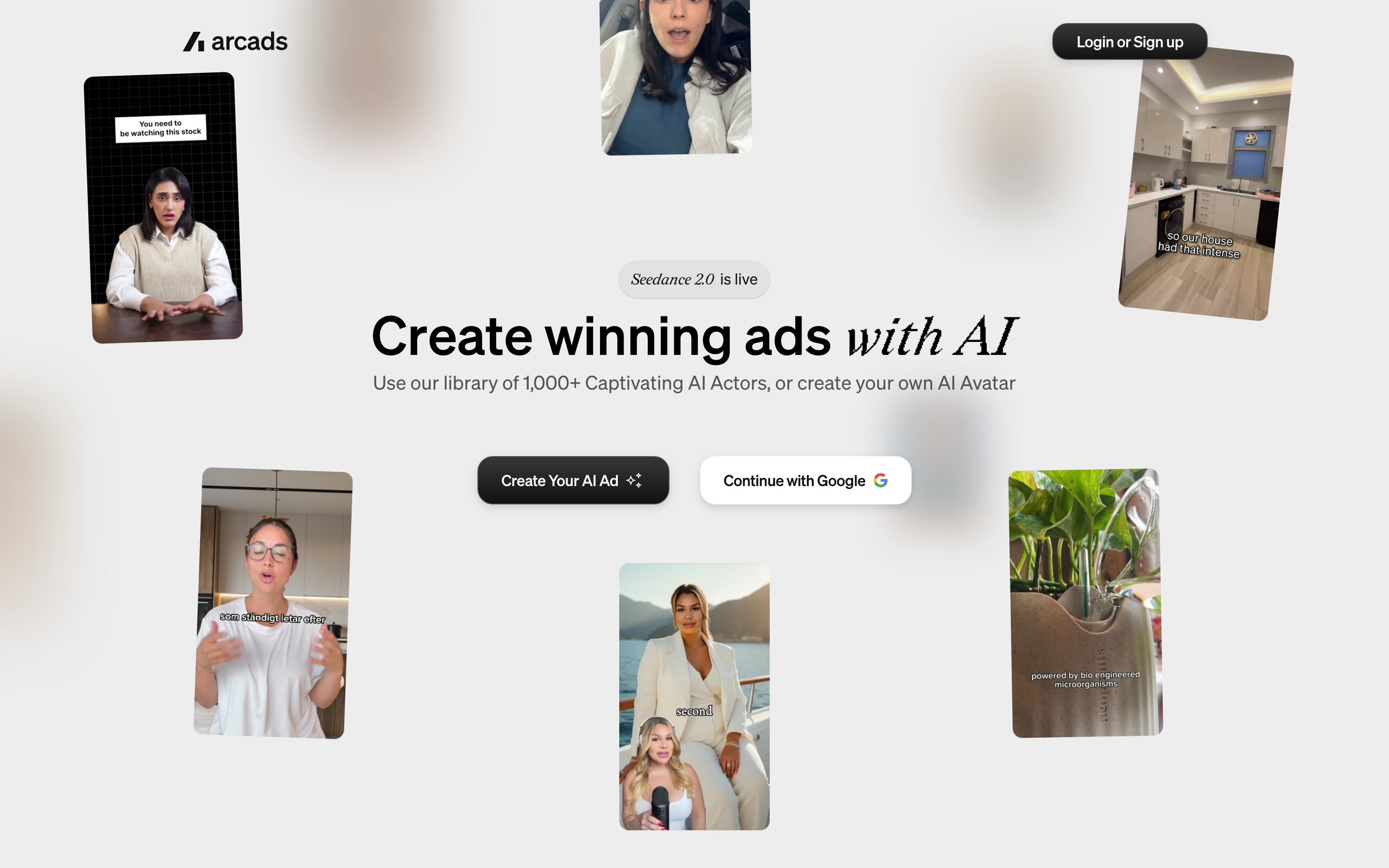
Jogg AI counters with a large, diverse avatar library reported around 450 plus options, with natural expressions, fluid speech, and accurate lip-sync. It also lets you build custom avatars from photos and clone a voice. The faces are good and the variety is wide, but the very top end of believability tends to go to Arcads in head-to-head reviews. For teams who value breadth, custom avatars, and language coverage over the single most lifelike read, Jogg AI holds up well.
Winner: Arcads for top-end actor realism, Jogg AI for library breadth, custom avatars, and language range. Pick based on whether your ad rewards believability or flexibility.
Worth noting for both: a realistic actor is still a person reading a script in front of a simple scene. If the finished ad also needs product callouts, screen recordings, B-roll, captions, and motion graphics assembled together, neither tool is built to do all of that for you. That gap is where ngram comes in, and we cover it below.
Product video and demos
For e-commerce buyers, what each tool does with the product itself matters as much as the actor.
Jogg AI leans into product video. Its QuickAds workflow generates product ads without a model or photoshoot, including AI models showcasing fashion, beauty, or electronics and multi-product scenes built from a link or product materials. For a store that needs the product shown, not just talked about, Jogg AI does more out of the box.
Arcads is built mainly for paid social and talking-head UGC. It can make ads about a physical product, but because actors are synthesized separately from your product, it is weaker when the item needs to be held, demonstrated, or unboxed. Those ads usually require real product B-roll composited in. Arcads is not trying to be a broad avatar or product-video tool; it is focused on producing believable UGC-style ads fast.
Winner: Jogg AI for product-led video and demo scenes, Arcads for talking-head testimonial ads. Match it to whether the hero is the actor or the product.
ngram takes the product angle further. You can start from a Shopify product URL, a product page, a PDF, screenshots, or a screen recording, and its agentic chat plans a script, storyboard, scenes, captions, and call to action that combine an AI presenter with product callouts, B-roll, and motion graphics in one branded video.
Pricing and value
Pricing is where these two feel most different, and it is often the deciding factor.
Jogg AI is the budget-friendly option. A free tier offers a few watermarked avatar videos, Starter is around $29 a month with an annual discount, and the Creator tier runs near $69 a month, frequently discounted on annual billing, for unlimited standard avatar videos plus a pool of credits for advanced features. Team plans add per-seat collaboration. Note that unlimited applies to standard avatar videos, while advanced features draw on credits.
Arcads sits at the premium end with no free trial. The entry plan is reported around $110 a month for roughly 10 videos, the Creator tier near $220 a month for about 20 videos, and custom Pro pricing covers unlimited volume, API access, and actor cloning. That is a high per-video cost, which Arcads frames against the much higher cost of hiring human creators. For a team that needs a handful of very believable ads, the spend can pay off; for high volume or tight budgets, it adds up fast.
Here is how the entry-level paid plans compare on monthly and annual billing:
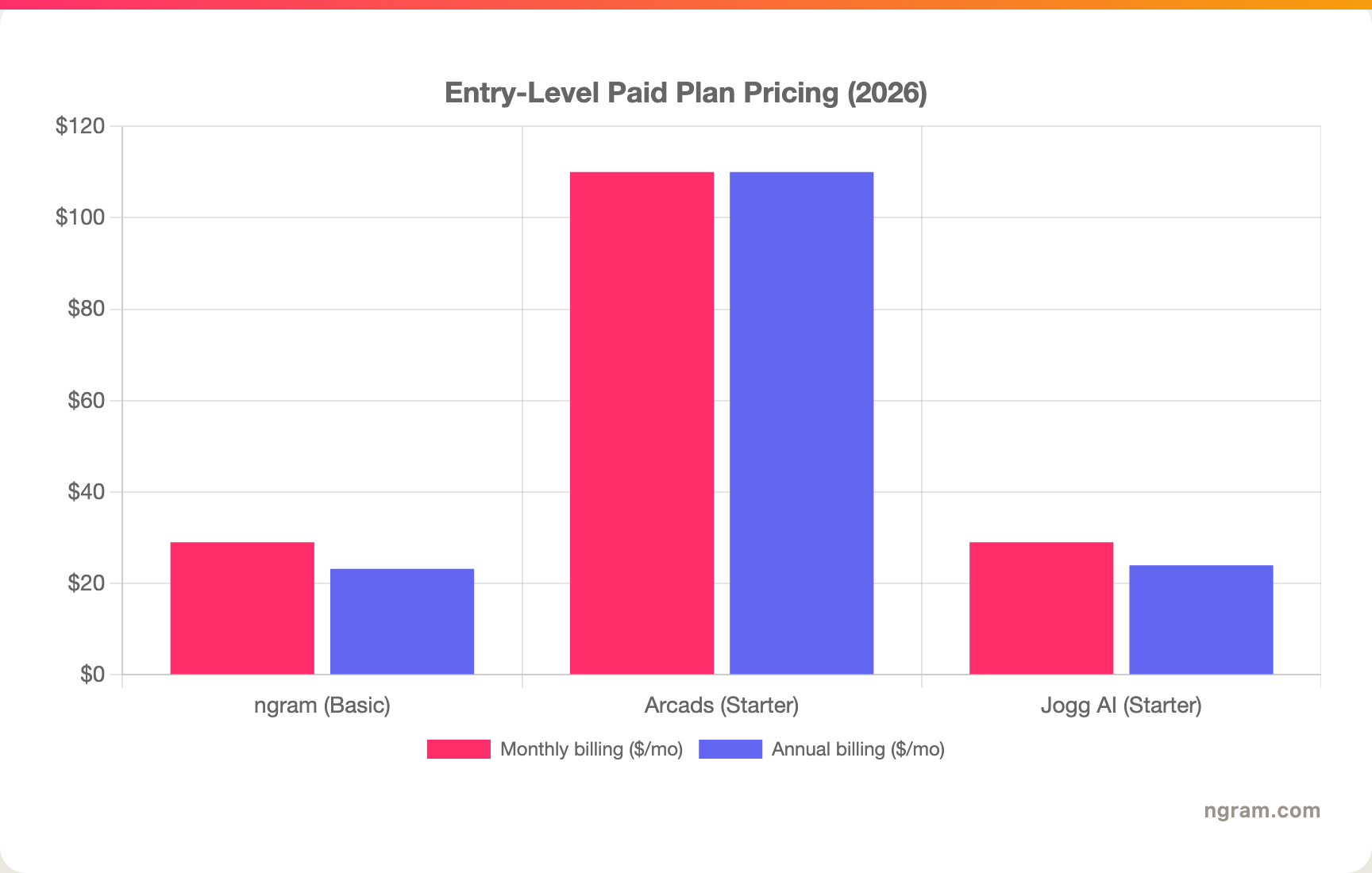
Arcads does not publish a public pricing page, so its numbers move and should be confirmed in-app, and we use its monthly figure for both bars where the annual rate is unclear. Jogg AI discounts annual billing and runs frequent sales, and ngram's Basic plan includes 3,000 credits a month on a credit model shared across video generation, editing, and exports. Match the unit and your real ad cadence before you decide.
Winner: Jogg AI for the cheapest, most flexible entry, ngram for the most generous monthly volume on an entry plan, Arcads for buyers who will pay a premium for top-tier realism.
1. ngram, the better third option for most teams
Watch how ngram turns an idea into a finished video:
ngram does the same core job as Arcads and Jogg AI, generating UGC-style and product video with an AI presenter and voiceover, and then keeps going where they stop. Instead of starting from a script box or a single product link, you can give ngram a prompt, a product page, a Shopify product, a PDF, a deck, screenshots, a screen recording, or raw footage, and its agentic chat plans the script, storyboard, scenes, captions, and call to action for you to review before anything renders.
That plan-first workflow is the difference. Many "Arcads vs Jogg AI" searches come from e-commerce, app, and growth teams whose real need is rarely just a talking-head ad. It is a launch video, a product demo, an explainer, or an ad that needs product callouts, B-roll, branded intros, and MP4 export with separate channel-cut preparation, all on brand and ready for paid social.
What makes ngram different
- Source-aware inputs - Start from a prompt, product URL, Shopify product, PDF, deck, screenshot, screen recording, or raw video, not just a typed script.
- Plan before render - Review the script and storyboard in chat, fix direction early, then generate. No burning credits on the wrong cut.
- Actors plus everything else - Use the avatar library, a custom face, a talking head with lip sync, the UGC Animator, or a generated on-brand presenter, then add screen-recording polish, smart zooms, product callouts, motion graphics, and B-roll in the same video.
- Brand kits - Logos, colors, fonts, approved and blocked phrases applied automatically to every ad.
- Localization built in - Translate script, captions, and on-screen text, generate multilingual voiceover, and re-lip-sync presenters for each language.
- MP4 export - Finished videos export as MP4; separate media tools can derive GIF, WebM, PNG, or JPG from supplied media for every placement.
Where ngram is honest about its limits
ngram provides hosted video pages and embeds but has no generally available owner analytics surface, so analytics-heavy buyers should confirm needs first. Among automation integrations, Zapier and n8n are available, while Make.com is Coming Soon, and API access uses self-service bearer API keys. And if you only ever need a single hyper-real AI actor reading a testimonial with no other scenes, a focused actor tool like Arcads is lighter.
Who ngram is best for
ngram fits e-commerce, app, growth, product marketing, and sales teams that turn product pages and source material into polished video repeatedly, not just one ad format. For current plans and credits, check ngram pricing rather than stale screenshots, and for the direct head-to-heads see the ngram vs Arcads comparison and the ngram vs Jogg AI comparison.
Ready to try ngram? Create your first video from a prompt, product URL, doc, deck, or recording. Start free
2. Arcads
Arcads is best for performance marketers and agencies who want the most realistic AI actors for high-volume creator-style ads. Public details were checked against Arcads and 2026 review sources for this comparison.
Key features
- Lifelike AI actors - Actors built on real human motion data for natural gestures and timing, Arcads's strongest selling point.
- Deep actor library - A large roster across ages, ethnicities, and settings for varied UGC.
- Script-to-actor pipeline - Write or generate a script, then render many actor reads of it fast.
- Actor cloning and API - Available on higher and custom tiers for branded, repeatable presenters.
- Per-video plan model - Plans sized by video count rather than a free testing tier.
What users say
Users praise Arcads for actor realism and for ads that are hard to tell from real creator content, and reviewers consistently rank it at the top for believability. The common cautions are price and access: there is no free trial, the entry plan is steep, and because actors are generated separately from your product, demo-heavy ads still need real product B-roll composited in.
Best for
Choose Arcads when top-tier actor realism and fast volume matter most and budget is not the constraint, especially for paid-social testimonial ads.
3. Jogg AI
Jogg AI is best for founders and e-commerce teams who want affordable avatar and product video from links, scripts, or product materials. Public details were checked against Jogg AI's pricing and product pages for this comparison.
Key features
- Lifelike avatar library - Around 450 avatars plus custom avatars built from photos and voice cloning.
- QuickAds product video - Generate product ads and multi-product scenes without a model or photoshoot.
- URL and material inputs - Turn a product link, images, or audio into avatar video in minutes.
- Broad language coverage - Voices across many languages for localized ads.
- Affordable plans - A free tier plus low-cost paid plans, often with annual discounts.
What users say
Buyers shortlist Jogg AI when they want avatar and product video without the premium price, and reviewers credit its breadth, custom avatars, and cost-effective plans. The trade-offs cited are realism that does not quite reach the top end of Arcads and that unlimited applies to standard avatar videos while advanced features draw on credits.
Best for
Choose Jogg AI for founders and e-commerce teams that want affordable avatar and product video, custom avatars, and broad language support.
How we compared these tools
This is not a star rating. It is a decision-weighting model for buyers choosing between two AI ad tools, with ngram included as the third option many of them actually need.
| Criteria | Weight | What we looked at |
|---|---|---|
| AI capabilities | 30% | Actor realism, voice, product video, and scene generation |
| Features | 30% | Inputs, product workflow, editing, and export options |
| Ease of use | 20% | Time to a first finished ad and learning curve |
| Value | 15% | Public pricing, credit rules, free tier, and per-video cost |
| Support and community | 5% | Collaboration, onboarding, and team controls |
We reviewed official vendor pricing and product pages, current SERP patterns, and 2026 review-site and forum sentiment, and we did not use numerical star ratings because they flatten the real decision: the best tool depends on whether you need top-tier actor realism, affordable product video, or a complete source-to-video system.
Common questions
Is Arcads better than Jogg AI?
Neither is better outright. Arcads wins for top-end AI actor realism and believable testimonial ads, while Jogg AI wins for affordable avatar and product video, custom avatars, and language breadth. Match the tool to the job, and consider ngram if your real need is a finished marketing video built from a product page or source assets rather than a single ad clip.
Is Jogg AI cheaper than Arcads?
Yes, by a wide margin. Jogg AI has a free tier and paid plans from around $29 a month, while Arcads has no free trial and starts near $110 a month. Jogg AI is the budget-friendly way to make avatar and product video, though its unlimited applies to standard avatar videos while advanced features draw on a credit pool.
What is the best Arcads and Jogg AI alternative?
For teams that need more than an ad clip, ngram is the strongest alternative because it plans and builds full videos from prompts, product URLs, PDFs, decks, and recordings, then adds actors, product callouts, B-roll, captions, and branding. Arcads and Jogg AI remain the specialist picks for pure actor realism and affordable avatar plus product video.
Which is better for product ads, Arcads or Jogg AI?
Jogg AI is the stronger pick for product-led ads because its QuickAds workflow builds product video and multi-product scenes without a photoshoot, where Arcads actors are generated separately from your product and often need real B-roll composited in. ngram is the better fit when the ad starts from a product page, screen recording, or deck and needs storyboard planning plus branded, MP4 export.
Which one should you pick?
The Arcads vs Jogg AI decision is really a question about your job, not the avatars. If you want the most believable AI actor for paid-social testimonials and budget is not the constraint, pick Arcads. If you are a founder or e-commerce team that wants affordable avatar and product video with custom avatars and broad languages, pick Jogg AI. If your actual job is turning a product page or source material into finished, branded videos, where the actor is one scene among product callouts, screen recordings, and B-roll, ngram beats both. The mistake is treating every AI ad tool as interchangeable. In 2026, workflow fit matters more than the category label.
---
Try ngram free, your first video in under 5 minutes. Turn a prompt, product URL, deck, or recording into a polished, on-brand ad without rebuilding it from a blank script. Start free