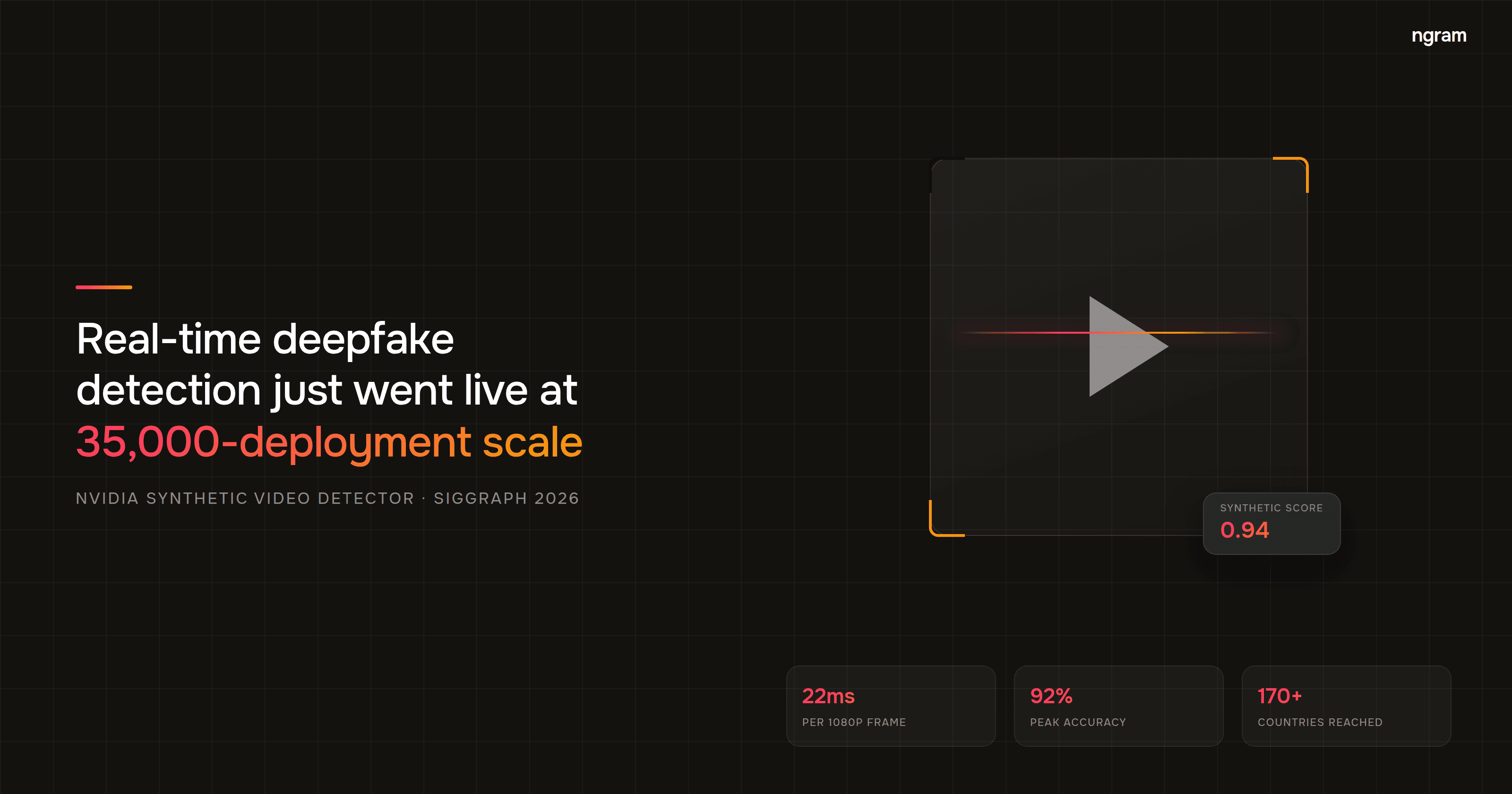

On July 20, 2026, at SIGGRAPH, NVIDIA announced a NIM microservice called Synthetic Video Detector. Within the same announcement window, Wowza confirmed it had already embedded the detector into its Video Intelligence Framework, the software running more than 35,000 livestreaming deployments in over 170 countries.
That is the part worth pausing on. Most AI news is a demo, a benchmark, or a waitlist. This is a detection model that shipped straight into production infrastructure at broadcasters, government agencies, financial institutions, and critical infrastructure operators, on the same day it was announced.
For the last two years, the AI video story has almost entirely been about generation: Sora, Veo, Kling, Seedance, and NVIDIA's own Cosmos models turning text prompts into footage that keeps getting harder to distinguish from a camera. This is the other half of that story catching up. Here's what NVIDIA's own published numbers show about what the detector can catch, where it still struggles, and why the timing lines up with a set of disclosure laws that took effect this year.
What NVIDIA Actually Shipped
Synthetic Video Detector is part of NVIDIA's "AI for Media" platform, packaged as a NIM microservice, NVIDIA's format for a pre-built, deployable AI model that runs as a self-contained service rather than a research checkpoint someone has to wire up themselves.
The model analyzes video frame by frame using DINOv2 and DINOv3 vision-transformer backbones, the same family of visual-representation models used across a lot of current computer vision work. Frame-level scores get averaged into a single video-level score. Critically, that output is a probability, not a label. The detector does not tell an editor "this is fake." It returns a number, a classifier score for how likely a clip is to be synthetic or manipulated, and lets a human decide what to do with that number.
NVIDIA says the model currently ranks at the top of AI GVD Bench, an industry benchmark for synthetic media detection systems. That claim is worth normal skepticism toward any vendor's own benchmark result, but the underlying accuracy figures are specific enough to dig into on their own.
The Numbers That Matter: Accuracy Falls as Compression Rises
NVIDIA published three accuracy figures, and the pattern between them is the most useful data point in the whole announcement.
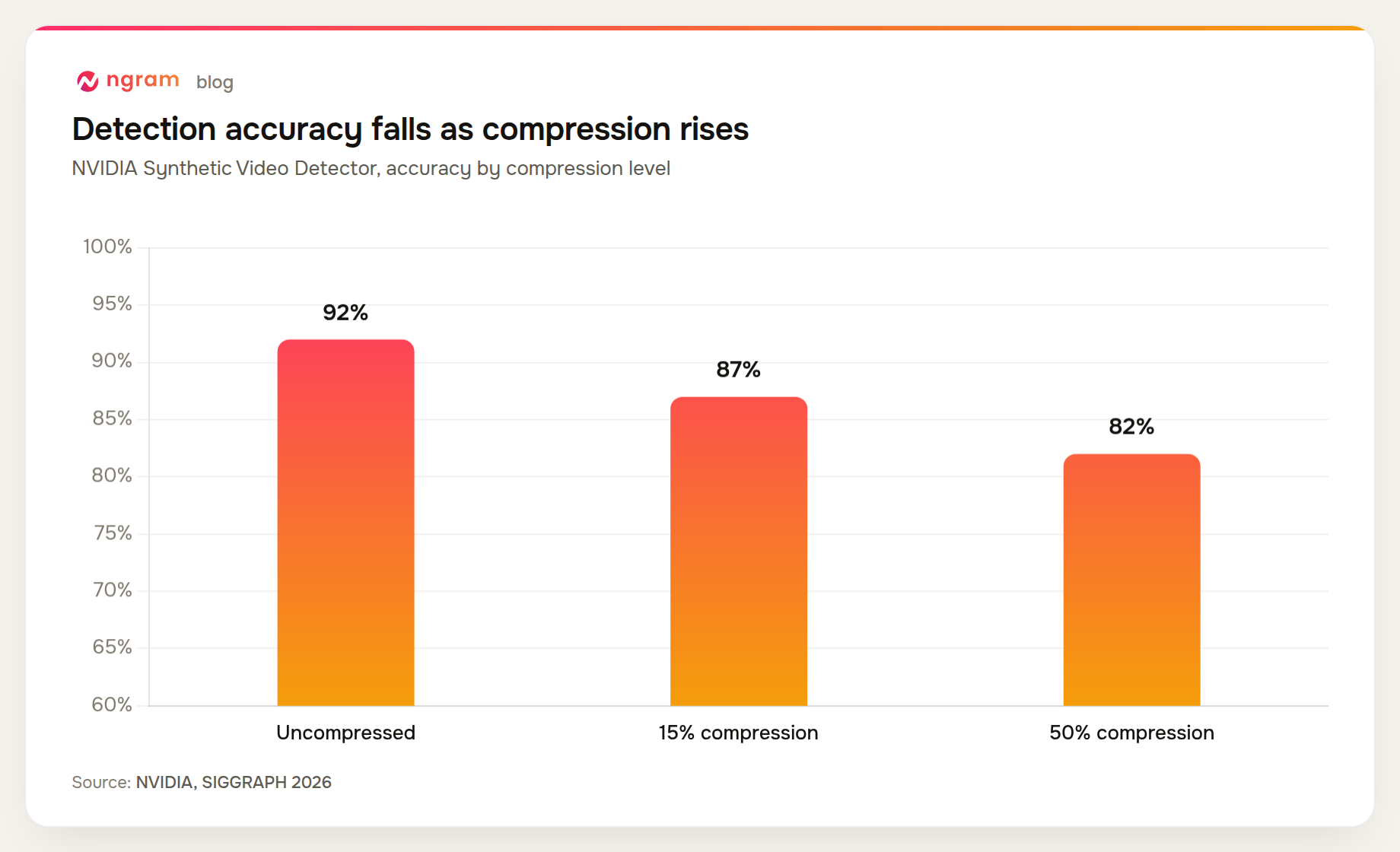
On uncompressed footage, the detector hits 92% accuracy, with an AUC of 0.9614 and 0.9453 accuracy on NVIDIA's internal test set. At 15% compression, that drops to 87%. At 50% compression, a level that is common once video has been through a couple of rounds of social-platform or broadcast re-encoding, accuracy falls to 82%.
Ten points of accuracy is a meaningful gap, and it matters because almost no real-world video that anyone is trying to verify arrives uncompressed. A clip pulled from a livestream, re-uploaded to a social platform, and then downloaded again for review has typically been compressed multiple times over. The 92% headline number describes a lab condition. The 82% number is closer to what a newsroom actually deals with, and even NVIDIA frames the tool as one signal inside a broader verification process, not a standalone answer, which is the honest way to read a detector that loses 10 points of accuracy to something as ordinary as re-encoding.
Real-Time Is the Point
The accuracy numbers alone would be a research result. What makes this a shipping product is speed: NVIDIA reports 22 milliseconds to score one 1080p frame on NVIDIA RTX systems, and roughly 30 milliseconds on NVIDIA L40 GPUs.
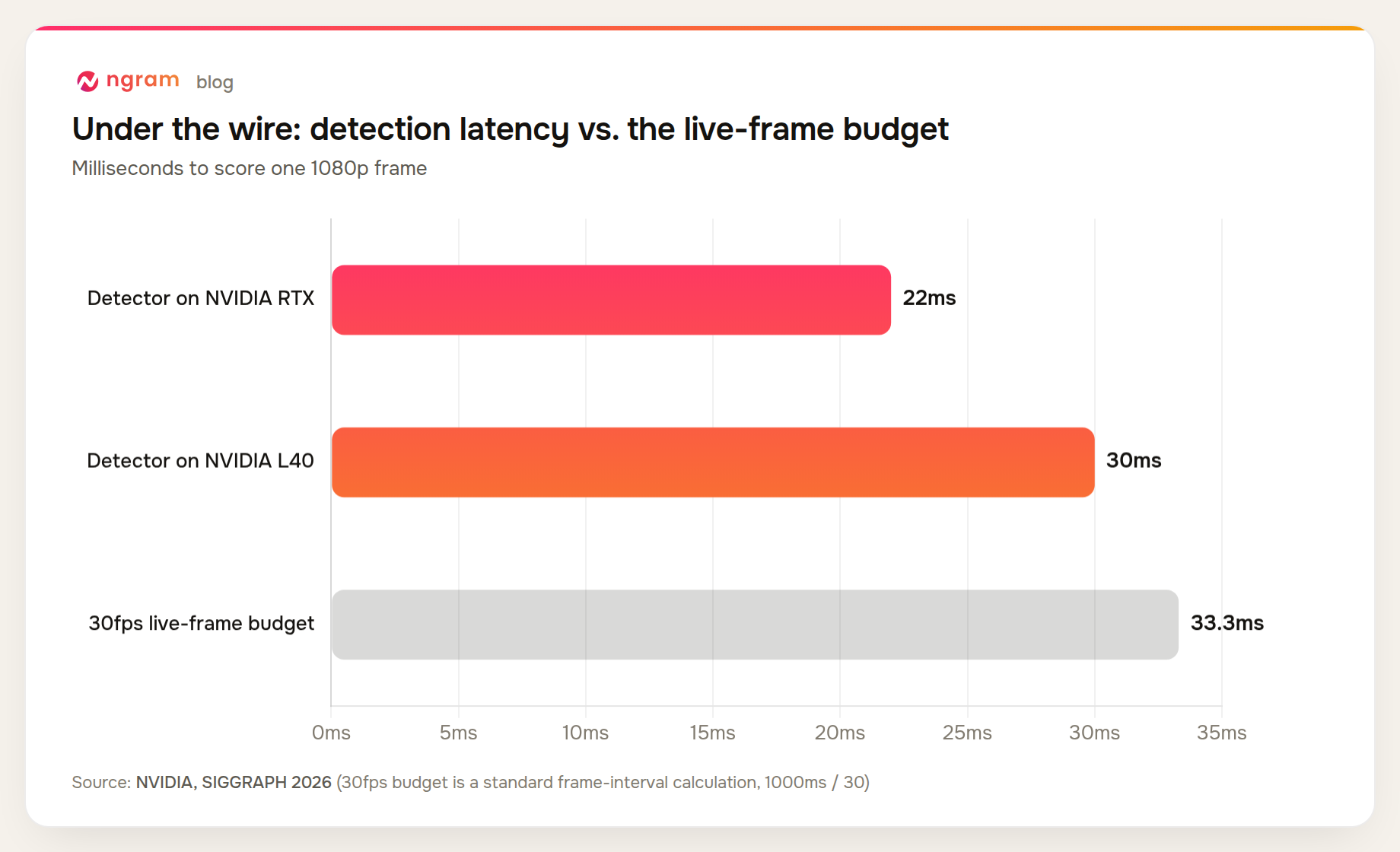
That comparison is the whole argument for calling this real-time. Standard video runs at 30 frames per second, which gives a system 33.3 milliseconds to process each frame before the next one arrives. At 22ms and 30ms, the detector fits inside that window on both hardware tiers, with room to spare on RTX and only a few milliseconds of margin on L40. A detector that took 200 milliseconds per frame could still be accurate, but it would only ever work on recorded footage reviewed after the fact. Fitting inside the live-frame budget is what makes scanning an active broadcast feed possible at all, rather than something you do to a file after the show has aired.
From Research Demo to 35,000 Livestreams in 170 Countries
The deployment number is where this stops being a NVIDIA story and becomes an industry story.
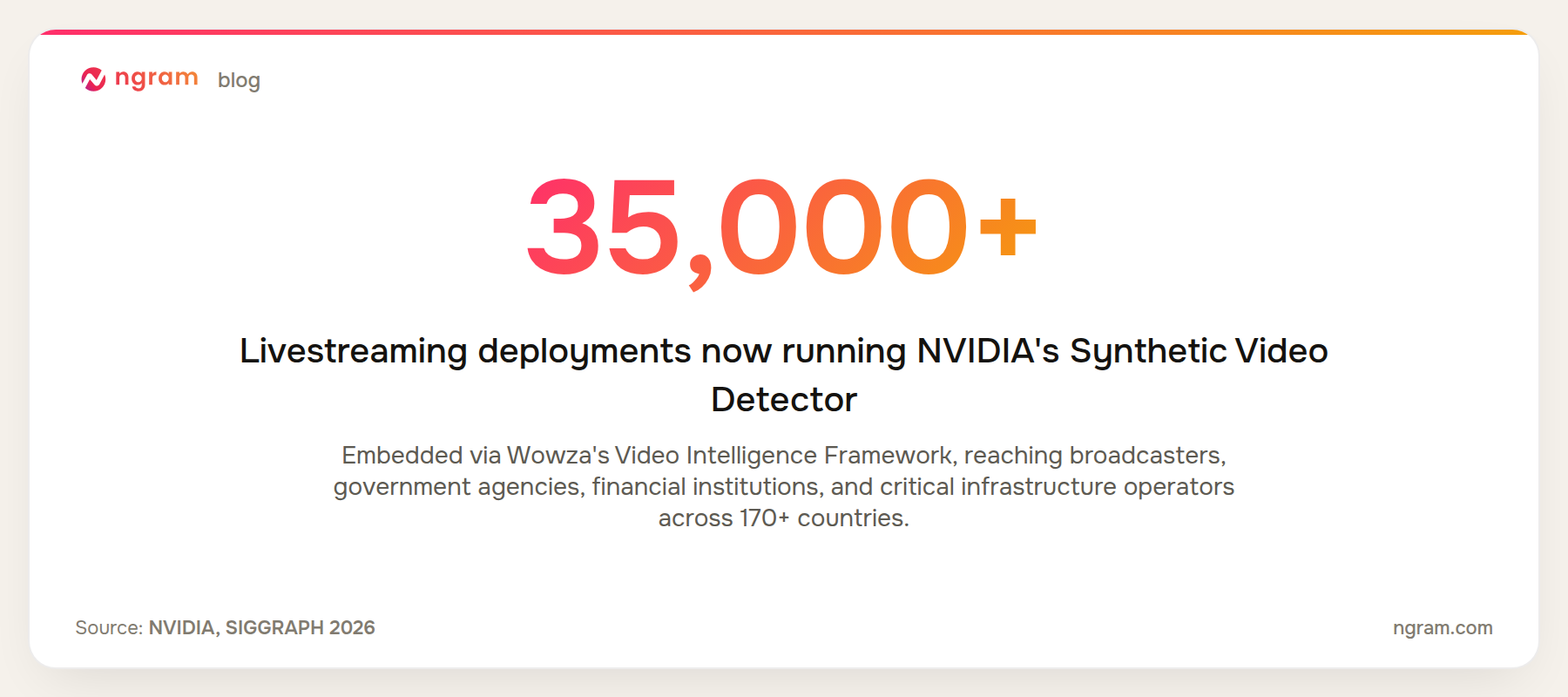
Wowza, whose infrastructure already runs a large share of the world's commercial livestreaming, folded the detector into its Video Intelligence Framework at launch, reaching more than 35,000 deployments across over 170 countries. NVIDIA and Wowza point to broadcasters, government agencies, financial institutions, and critical infrastructure operators as the target sectors, organizations with an obvious reason to want a real-time answer to "is this feed showing something that was actually generated."
The deployment model matters as much as the reach. NVIDIA built the detector to run on-premises, at the edge, in hybrid setups, or in approved air-gapped environments, meaning organizations that cannot send sensitive video to an external cloud API for scanning can still run detection close to where the footage is captured, stored, or distributed. For a government agency or a bank, that is often a harder requirement to satisfy than accuracy.
A Score, Not a Verdict
Every account of how this tool actually works in practice lands on the same caveat: it hands editorial teams a number, not a decision.
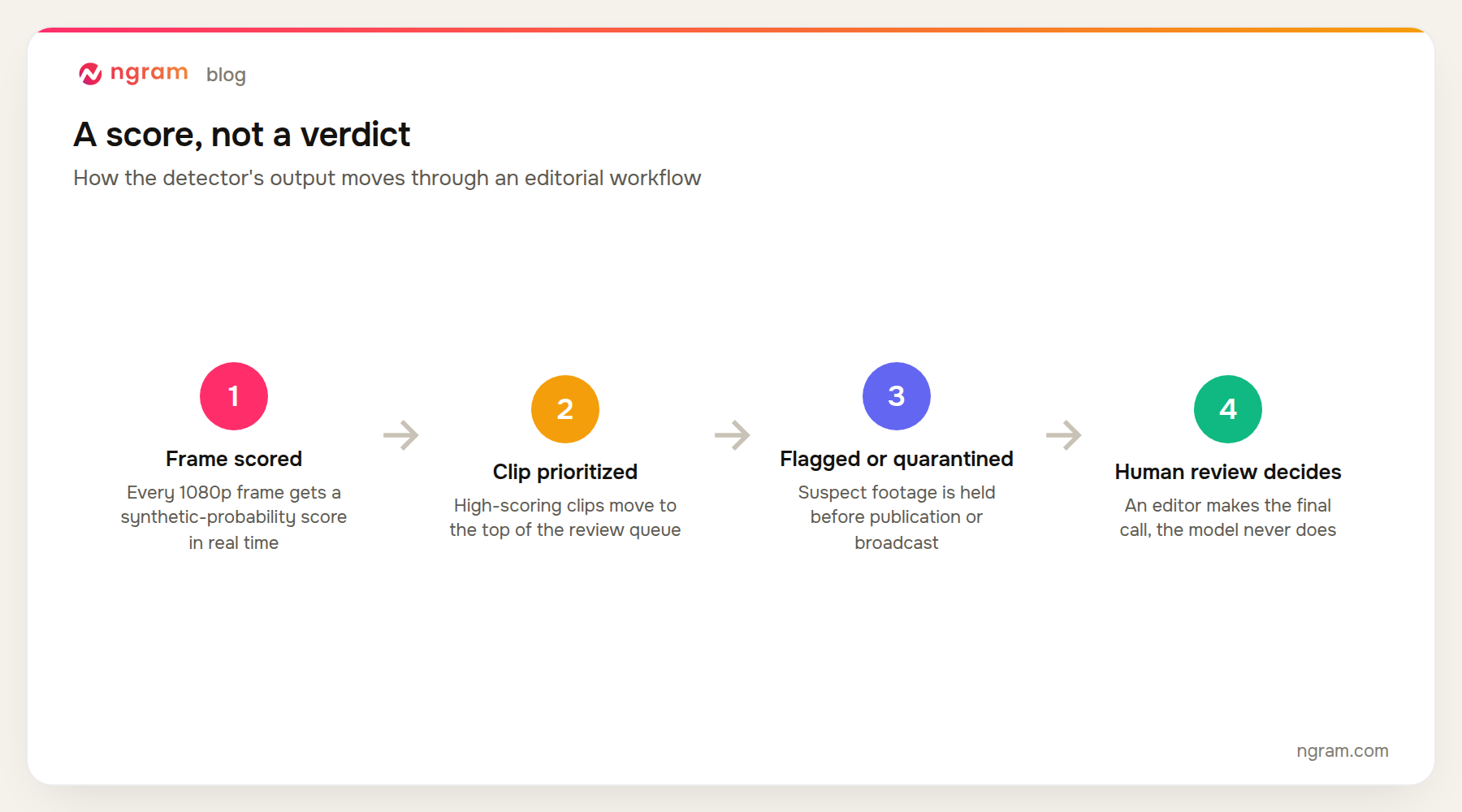
A high score moves a clip up the review queue. It can trigger a hold before publication or broadcast. It never, on its own, gets to declare a video fake. Rev Lebaredian, NVIDIA's VP of physical AI simulation, framed the underlying problem plainly:
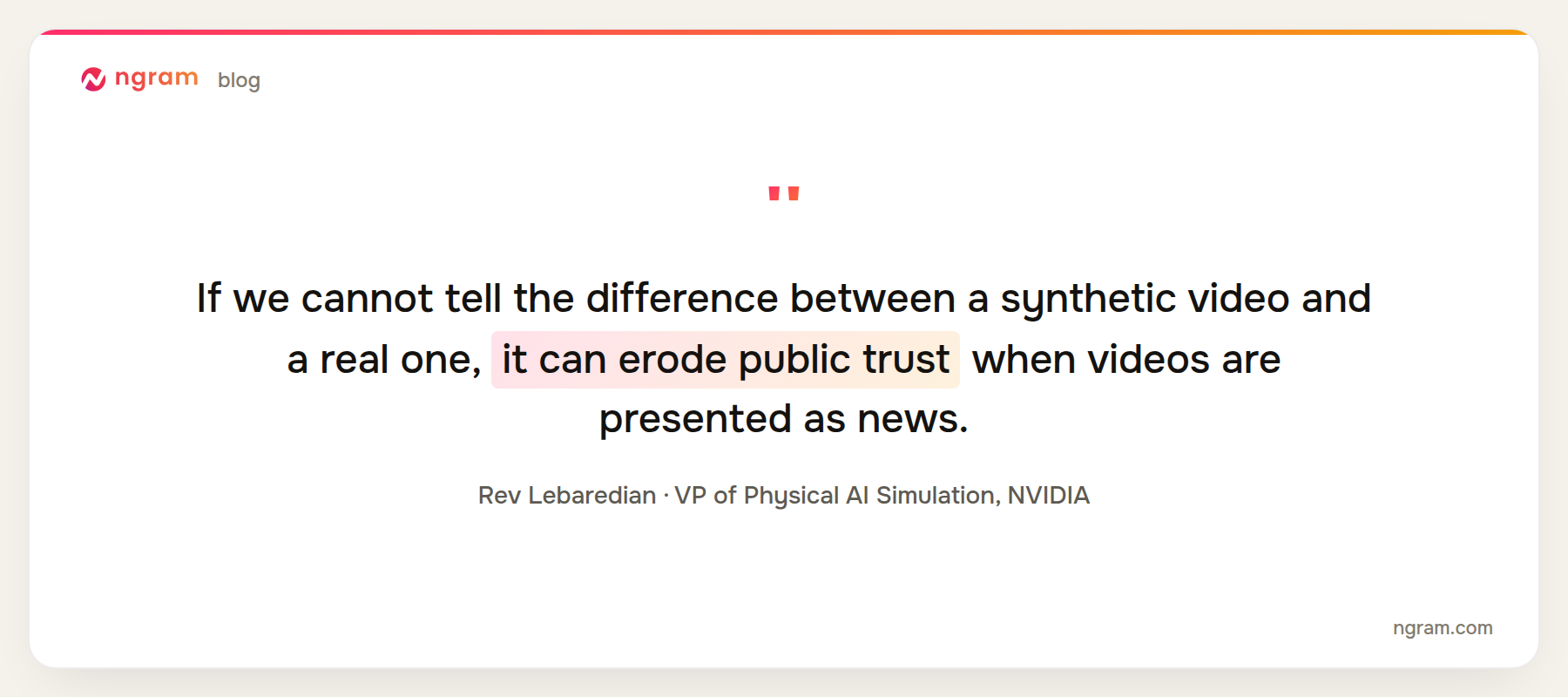
Lebaredian also made the more interesting point directly: the same underlying AI research that produces convincing synthetic video is what makes detecting it possible in the first place. Vision-transformer models trained to understand visual structure can be pointed at either job.
That is also why NVIDIA is careful to say the detector complements, rather than replaces, existing verification work. It is not a substitute for traditional fact-checking or forensic video analysis, and compression will keep cutting into its accuracy no matter how the underlying model improves, because compression is specifically the process of throwing away the subtle visual information detection models rely on.
Why Detection Infrastructure Is Catching Up Now
The timing is not a coincidence. Generation quality exploded well before verification caught up, and the gap between the two is exactly what a tool like this is trying to close.
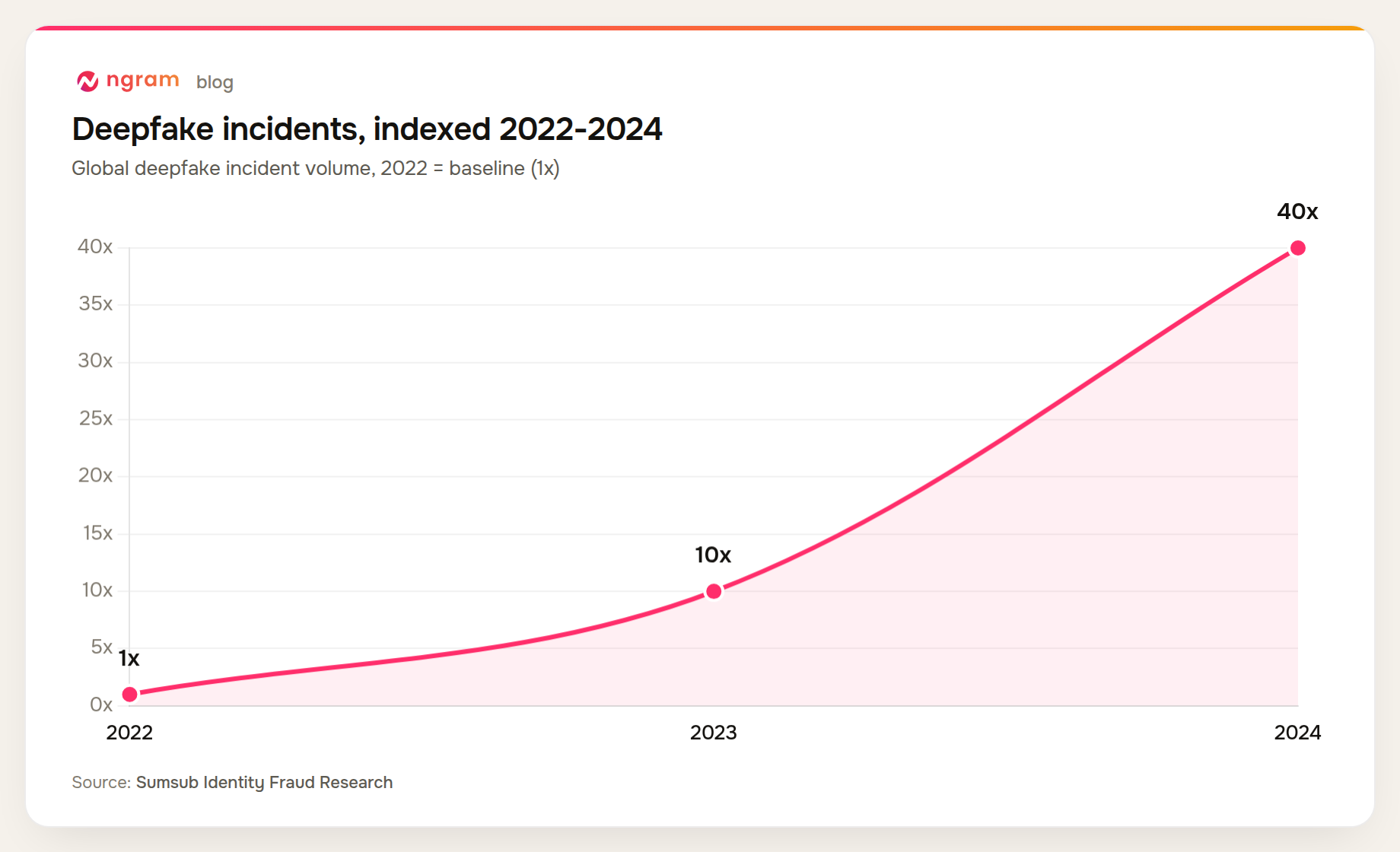
Sumsub's identity fraud research recorded a tenfold increase in global deepfake incidents from 2022 to 2023, and a further fourfold increase from 2023 to 2024, a roughly 40x cumulative jump in two years. That climb tracks almost exactly with the period when text-to-video models went from novelty to production-ready.
NVIDIA's own SIGGRAPH keynote was a reminder of how fast that generation side keeps moving: alongside the detector, the company announced Cosmos 3 Edge, a smaller on-device world model for robotics and infrastructure monitoring, plus MotionBricks, VideoNeuMat, and new MCP-based agentic workflows adopted by Adobe, Blender, Affinity, and Unreal Engine. We covered the base Cosmos 3 world model in more depth in our earlier look at NVIDIA Cosmos 3 and AI video, and the growth in AI-generated video output more broadly is tracked in our 2026 AI video statistics roundup. A detection microservice announced at the same event, in the same keynote, is a fairly direct acknowledgment from NVIDIA that generation and verification now have to ship together.
Detection as the Enforcement Layer for Disclosure Law
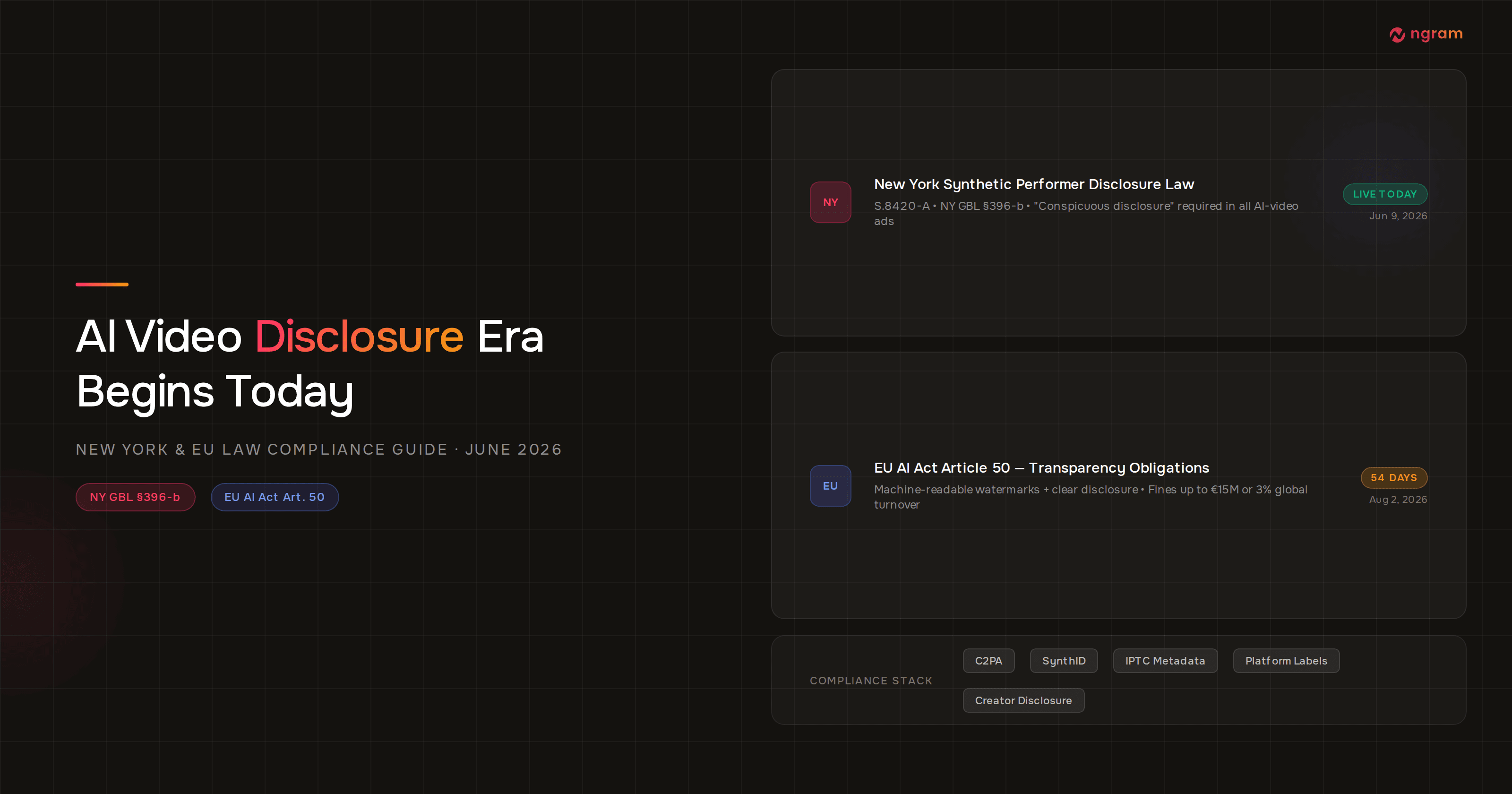
This announcement also lands in the middle of the first real wave of AI video disclosure law. New York's Synthetic Performer Disclosure Law has required a conspicuous disclosure in any ad containing an AI-generated human likeness since June 9, 2026. EU AI Act Article 50 adds machine-readable watermarking requirements starting August 2, 2026. We broke down what both laws actually require, and who is exposed, in our full disclosure-law breakdown.
Neither law says much about how anyone is supposed to check compliance at scale. A disclosure requirement without a practical way to verify it is mostly a promise. Detection infrastructure like NVIDIA's, running inside the same livestreaming and broadcast pipelines the disclosure laws are trying to regulate, is the closest thing either law has to an enforcement mechanism today. A regulator, a platform, or a newsroom with a real-time synthetic-probability score attached to incoming video has something concrete to act on. One without it is relying entirely on advertisers self-reporting.
That is also roughly the gap the EU's draft Code of Practice is trying to close with C2PA Content Credentials and watermarking, and it is why a detection tool and a disclosure law are really two pieces of the same shift: video now has to be able to prove what it is, on the production side through watermarking and disclosure, and on the verification side through tools that can check.
What This Means If You Make Video for a Living
None of this changes what a legitimate business needs to do with AI video: use it, and be straightforward about it. As detection infrastructure gets embedded into more of the pipelines video actually travels through, brands and creators who generate video on-brand and transparently are simply on the right side of an industry that is actively building tools to catch the deceptive use of the same underlying technology. ngram is built around that use case: it's an AI video generator with an agentic chat interface for scripted, storyboarded, on-brand video, and BrandKit lets a team save its fonts, colors, and logos, then select the kit during creation. Create and share a public video on Free, or choose a paid plan to download the MP4. Be transparent about how the video was made when sharing it.
None of that is a claim that ngram does deepfake detection, C2PA provenance, or anything adjacent to what NVIDIA just shipped. It doesn't. But among AI video creation tools, the direction of travel is the same one this whole announcement points toward: video that is upfront about what it is tends to hold up better than video that isn't, and that gets more true, not less, as detection keeps improving. If you want to see how an on-brand video generator actually works in practice, ngram is worth a look.
Frequently Asked Questions
What is NVIDIA's Synthetic Video Detector?
It's a NIM microservice, part of NVIDIA's AI for Media platform, announced at SIGGRAPH on July 20, 2026. It analyzes video frame by frame and returns a probability score for how likely footage is to be AI-generated or manipulated, rather than a simple real-or-fake label.
How accurate is NVIDIA's Synthetic Video Detector?
NVIDIA reports up to 92% accuracy on uncompressed video, with an AUC of 0.9614. Accuracy drops to 87% at 15% compression and 82% at 50% compression, since compression removes some of the subtle visual artifacts the model relies on.
Does video compression really affect deepfake detection accuracy that much?
Yes. NVIDIA's own figures show a 10-point accuracy drop between uncompressed video and 50% compression. That matters in practice because most video circulating online or through broadcast pipelines has already been compressed at least once, so real-world performance sits closer to the 82-87% range than the 92% headline figure.
How fast is the detector?
NVIDIA reports 22 milliseconds to score one 1080p frame on NVIDIA RTX systems and about 30 milliseconds on NVIDIA L40 GPUs. Both fall under the 33.3 millisecond budget needed to keep up with live 30fps video, which is what makes real-time analysis of an active stream possible.
Which companies are actually using it?
Wowza is the first confirmed integration, embedding the detector into its Video Intelligence Framework at launch. That brings it to more than 35,000 livestreaming deployments across over 170 countries, reaching broadcasters, government agencies, financial institutions, and critical infrastructure operators.
Does this replace human fact-checking or forensic video analysis?
No. NVIDIA and Wowza both describe it as one signal inside a broader verification process. It generates a score that helps editorial teams prioritize, flag, or quarantine footage for review, but a human still makes the final call.
How does this connect to AI video disclosure laws like New York's and the EU AI Act?
Disclosure laws such as New York's Synthetic Performer Disclosure Law and EU AI Act Article 50 require telling audiences when video contains AI-generated content, but neither specifies how anyone verifies that at scale. Real-time detection infrastructure embedded in livestreaming and broadcast pipelines is the closest practical mechanism either law has for actually checking compliance.