
On September 9, 2026, NVIDIA used IBC to make a much bigger claim for NVIDIA AI for Media. AI is no longer being pitched only as a way to generate a clip, clean up an archive, or translate a finished program. NVIDIA wants it running inside live broadcast, sports, news, streaming, localization, and creator pipelines while the feed is still moving.
The IBC 2026 expansion combines GPU-accelerated SDKs, NIM microservices, sports playbooks, localization workflows, Holoscan for Media, and the Media Exchange Layer. It covers motion extraction, slow-motion frame generation, super resolution, SDR-to-HDR conversion, synthetic-video scoring, active-speaker detection, lip sync, speech cleanup, and domain-specific sports intelligence.
That breadth is the news. The boundary for real-time AI video is shifting from model quality alone to systems engineering: latency, reliability, interoperability, editorial control, and what happens when the model is uncertain during a live show.
What NVIDIA AI for Media added at IBC 2026
NVIDIA AI for Media is a collection rather than one application or an AI video generation platform. NVIDIA describes it as SDKs, NIM microservices, blueprints, and playbooks for audio, video, augmented-reality effects, media intelligence, and live production. The official IBC event page says the stack is optimized for ultra-low latency and SMPTE ST 2110 workflows, with deployment from local hardware to cloud environments.
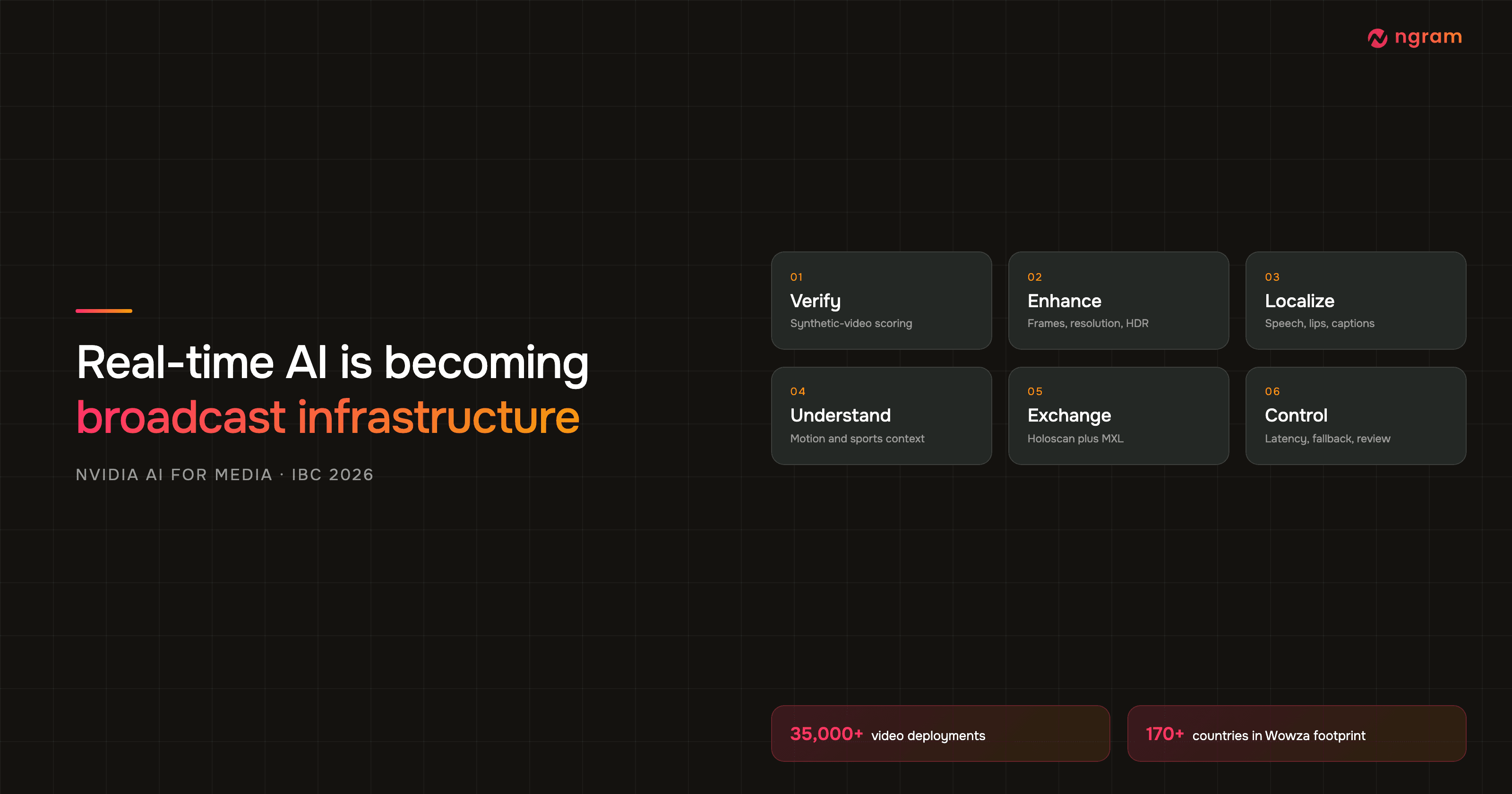
The September release groups the work into six practical jobs: understand motion, verify footage, enhance pictures, localize programming, improve audio, and connect media applications. Named partners include Dalet, TwelveLabs, Wowza, Vizrt, Ross Video, NDI, Machina Sports, AI-Media, CAMB.AI, Chyron, Panjaya, and Beamr. That is a deployment story, not a model-card story.
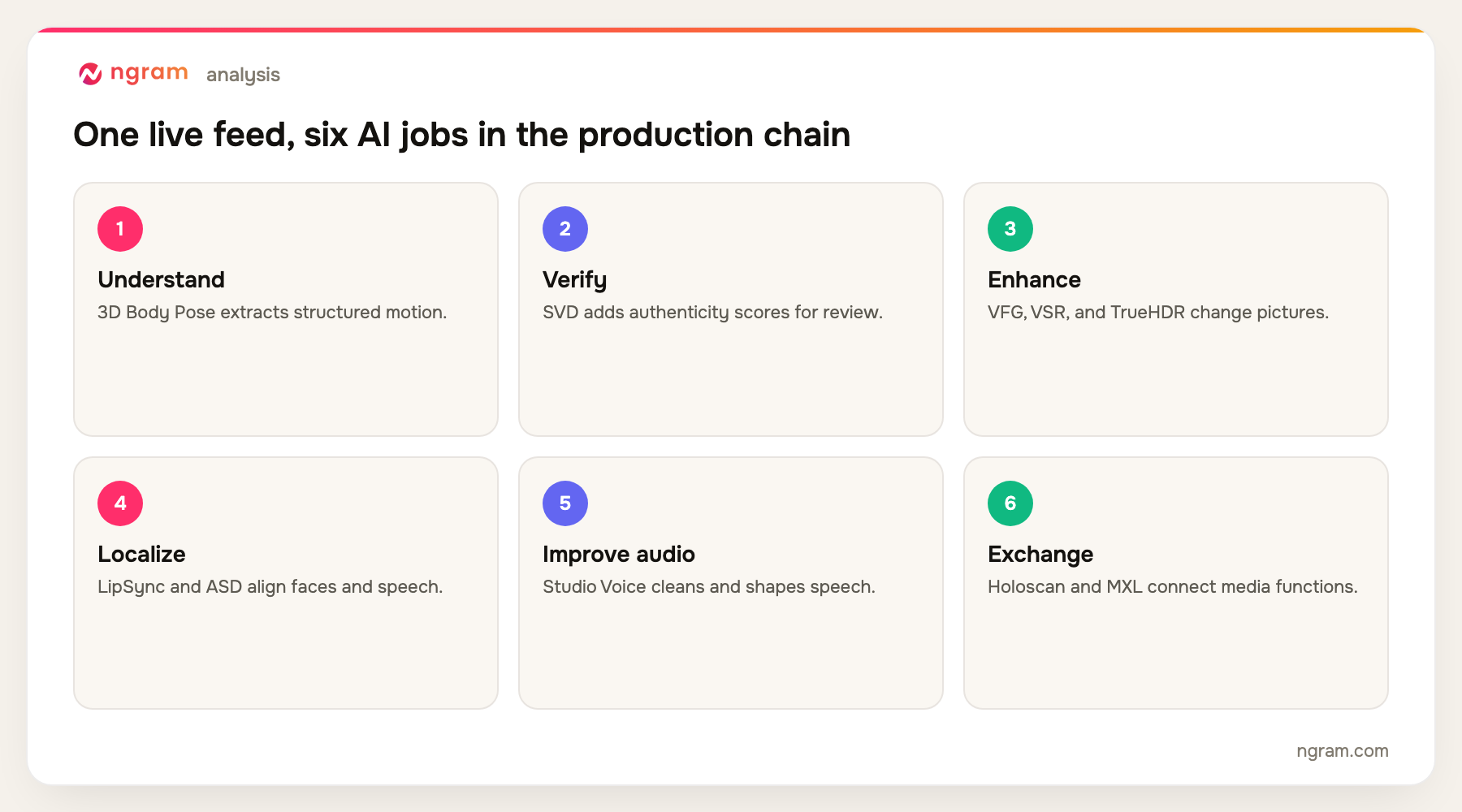
The common thread is continuous processing. Each component has to accept a live feed, return a usable result quickly enough for the next stage, and coexist with switching, graphics, replay, captioning, encoding, and compliance systems that cannot pause for a retry.
Real-time AI video changes the reliability standard
Offline video tools get a forgiving failure mode. A creator can regenerate a shot, compare two versions, correct a caption, or render again. Live television does not have that luxury. If frame generation produces a distorted ball during a replay, a localization model assigns speech to the wrong face, or a detector flags real footage in the middle of breaking news, the error reaches viewers or operators immediately.
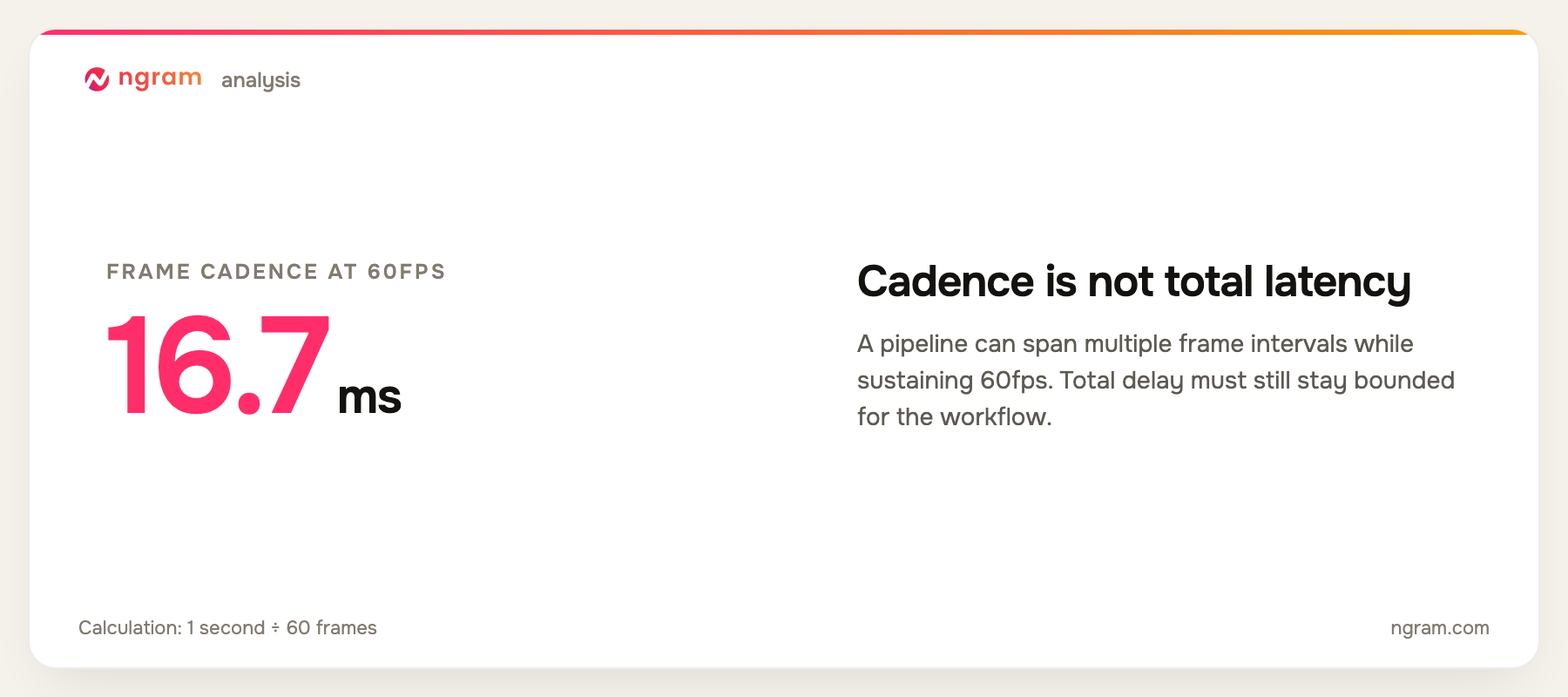
Real-time therefore means more than fast inference. It means bounded latency, predictable throughput, synchronized audio and video, graceful fallback, observable confidence, and a human override that works before the next frame. At 50 frames per second, one frame arrives every 20 milliseconds. At 60fps, the interval is about 16.7ms. That interval sets the required processing cadence, not a universal ceiling for end-to-end delay. A pipelined system can span multiple frame intervals while sustaining 60fps, but its total latency must stay bounded and appropriate to the workflow across capture, transport, AI processing, composition, encoding, and distribution.
NVIDIA's architecture addresses part of the integration problem by placing media and AI workloads on shared accelerated infrastructure. It does not erase production risk. A broadcaster still needs to define when the system can act automatically, when it should surface a recommendation, and when it should fall back to the unmodified feed.
Frame generation, upscaling, and HDR move into the live chain
Video Frame Generation creates intermediate frames between captured frames. NVIDIA says the model can increase frame rates by 2x or 4x while preserving temporal consistency. Ross Video is integrating it into Rio Replay for 6x AI-assisted slow motion, with development underway toward 8x interpolation.
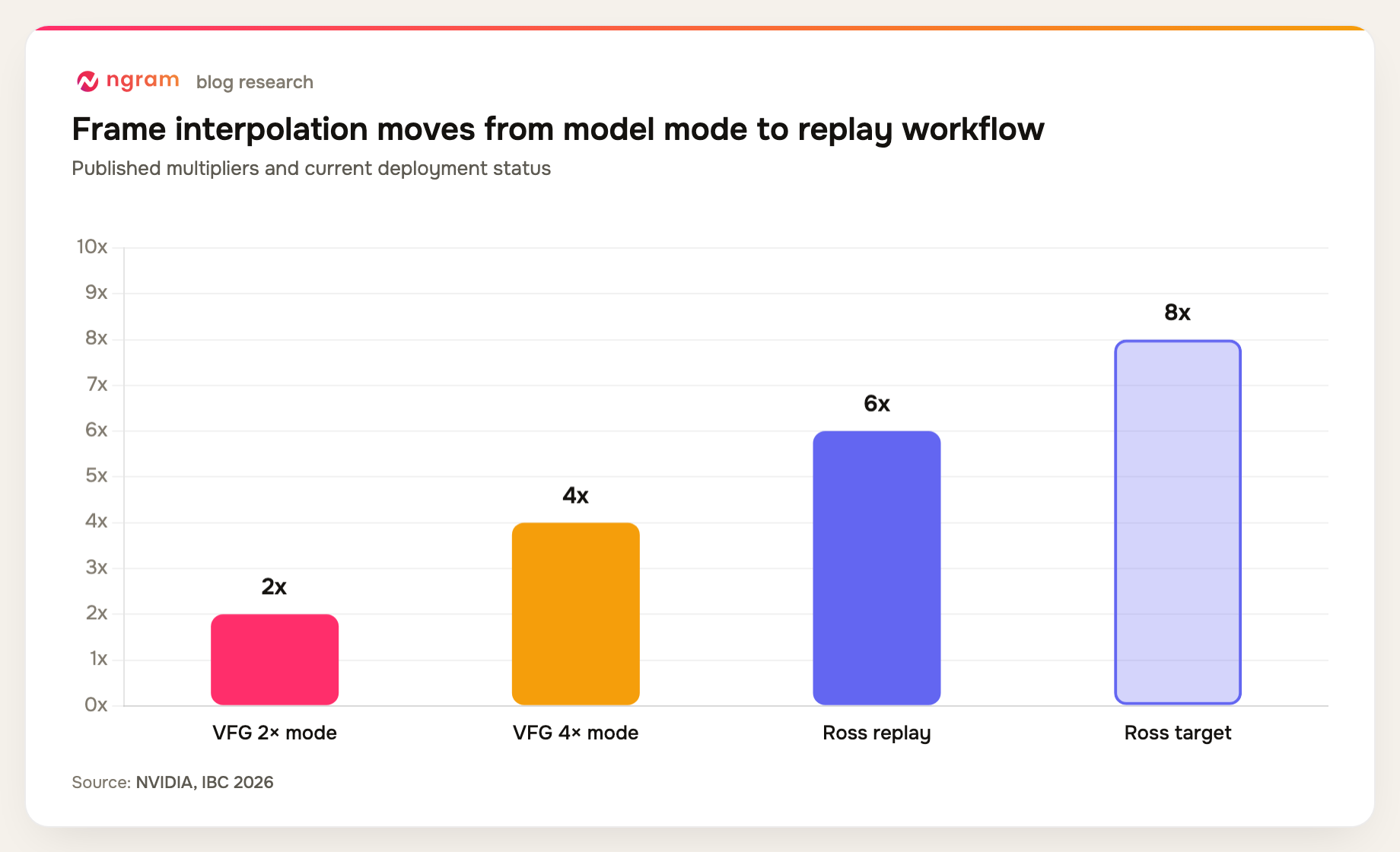
Those multipliers are not interchangeable performance tiers. The first two describe the frame-rate boost supported by NVIDIA's model; 6x describes Ross Video's replay result; 8x is a development target. The distinction matters because a roadmap number should not be read as a production capability.
Video Super Resolution now offers real-time and quality modes, adjustable enhancement controls, 10-bit support, and delivery through both the Video Effects SDK and a NIM microservice. TrueHDR converts standard-dynamic-range video to HDR in real time, reaching approximately 2,000 nits according to NVIDIA. The three tools can be combined in one effects pipeline.
Beamr offers one concrete deployment pattern: pair NVIDIA Video Super Resolution with content-adaptive encoding so an HD source can be enhanced toward 4K without letting delivery cost rise unchecked. In its IBC announcement filed with the SEC, Beamr says its compression can reduce video file size by up to 50% while preserving quality. That is a company claim, but it points to the economic constraint upscaling alone does not solve.
Synthetic video detection becomes an editorial signal
The Synthetic Video Detector is the clearest example of why editorial control matters. NVIDIA now reports 99.3% accuracy for text-to-video content and 97.7% for image-to-video content. Those are vendor-reported results, and the announcement does not provide enough detail to treat them as universal newsroom performance. They should be read as model-evaluation results under NVIDIA's stated test conditions.
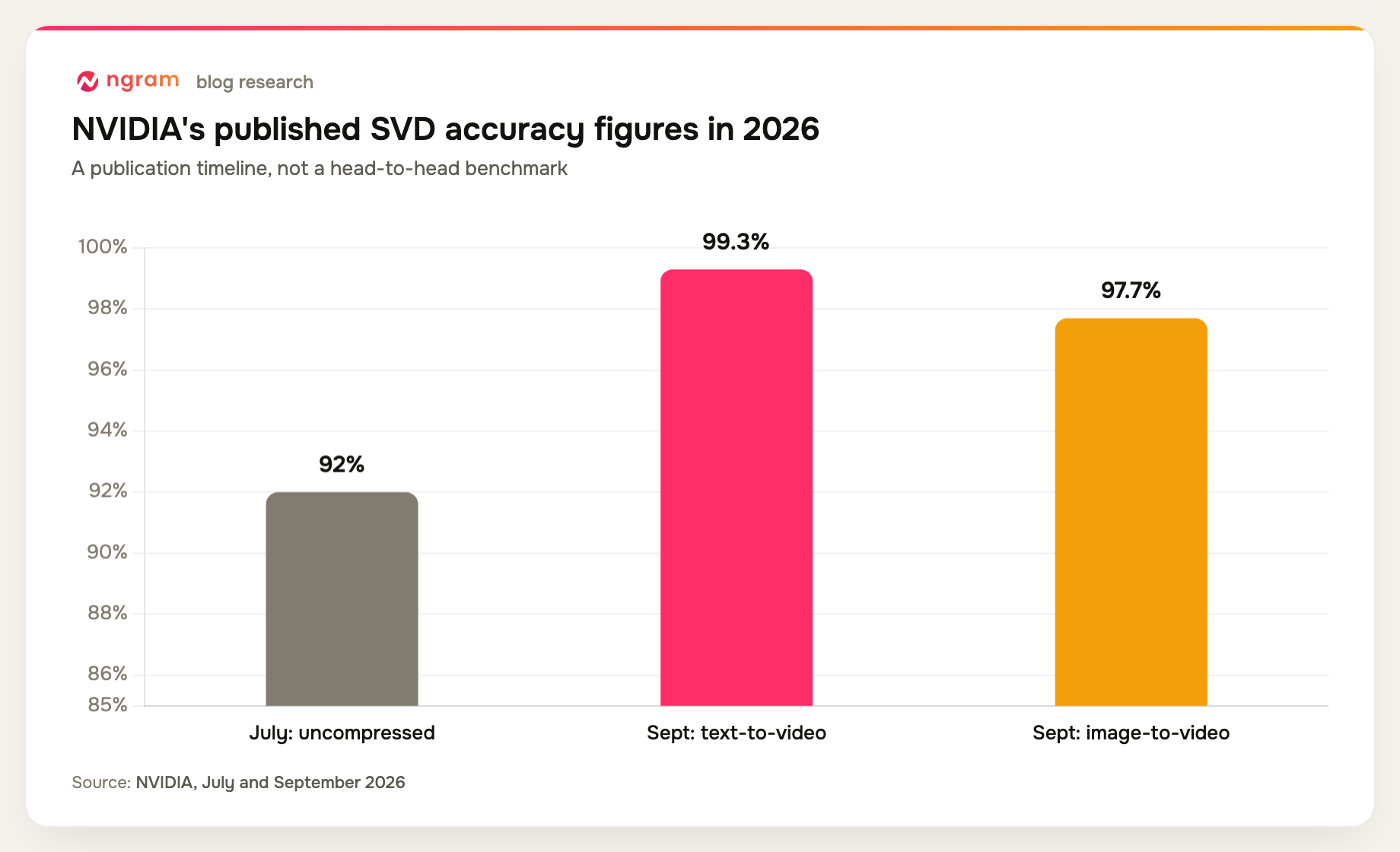
The July and September numbers should not be subtracted to claim a 7.3-point product improvement. July's headline result used uncompressed video, while September splits results by generation modality. A clean improvement claim would require the same evaluation set, compression profile, threshold, and class balance.
The deployment model is more informative. Dalet is integrating SVD into a secure cloud-hosted review workflow. TwelveLabs is adding frame-level authenticity signals to compliance screening. Wowza plans to distribute it through infrastructure used by more than 35,000 video deployments across over 170 countries, with on-premises, edge, cloud, hybrid, and air-gapped options. Our July analysis of the original SVD launch covers the detector's earlier compression and latency results in detail.
For an editorial desk, the output should remain a triage signal. A probability score can decide which clips receive more review, but it cannot establish provenance by itself. False positives can suppress authentic footage, while false negatives can pass synthetic media. Chain of custody, source confirmation, metadata, visual forensics, and human judgment still belong in the workflow.
Real-time video localization has to preserve timing and speaker identity
NVIDIA's localization stack combines LipSync with Active Speaker Detection. LipSync adjusts mouth movement to match a target audio track while preserving head pose, blinking, and body movement. The new version improves facial-occlusion handling and preservation of teeth, lips, and facial texture. Active Speaker Detection adds voice-activity detection, a gRPC interface, broader GPU compatibility, and no longer requires speaker diarization across multiple audio tracks.
NDI is using those components for real-time translation, lip-synced dubbing, and regional-language adaptation from a common media stream. Holoscan's localization reference workflow also brings together captions, translated audio, synchronized video, and localized graphics from AI-Media, CAMB.AI, Chyron, and Panjaya.
This is where the distance between file-based video translation and live localization becomes obvious. A finished video can be reviewed for mistranslation, timing drift, or a bad lip-sync segment before release. A live system needs thresholds for uncertain speech, overlapping speakers, obscured faces, names, numbers, and culturally specific phrasing, plus a path to captions or original audio when confidence drops.
That distinction also keeps the product categories honest. ngram includes an AI video editor for business, video translation, AI voiceover, and a lip-sync video translator for business-video workflows. It does not ship NVIDIA AI for Media or a real-time broadcast stack.
Sports Intelligence shows the promise and the benchmark caveat
The Sports Intelligence Playbooks address a different problem: adapting open models to proprietary sports footage, annotations, rules, players, scoring, and strategy. NVIDIA says the playbooks cover data preparation, fine-tuning, inference, evaluation, optimization, and deployment, using Nemotron, NeMo AutoModel, Megatron Bridge, NIM microservices, and accelerated computing.
In early tests on unseen footage, using question formats similar to training, NVIDIA reports multiple-choice accuracy rising from approximately 53% to 94%. Open-ended evaluation rose from about 5.7% to 66%.
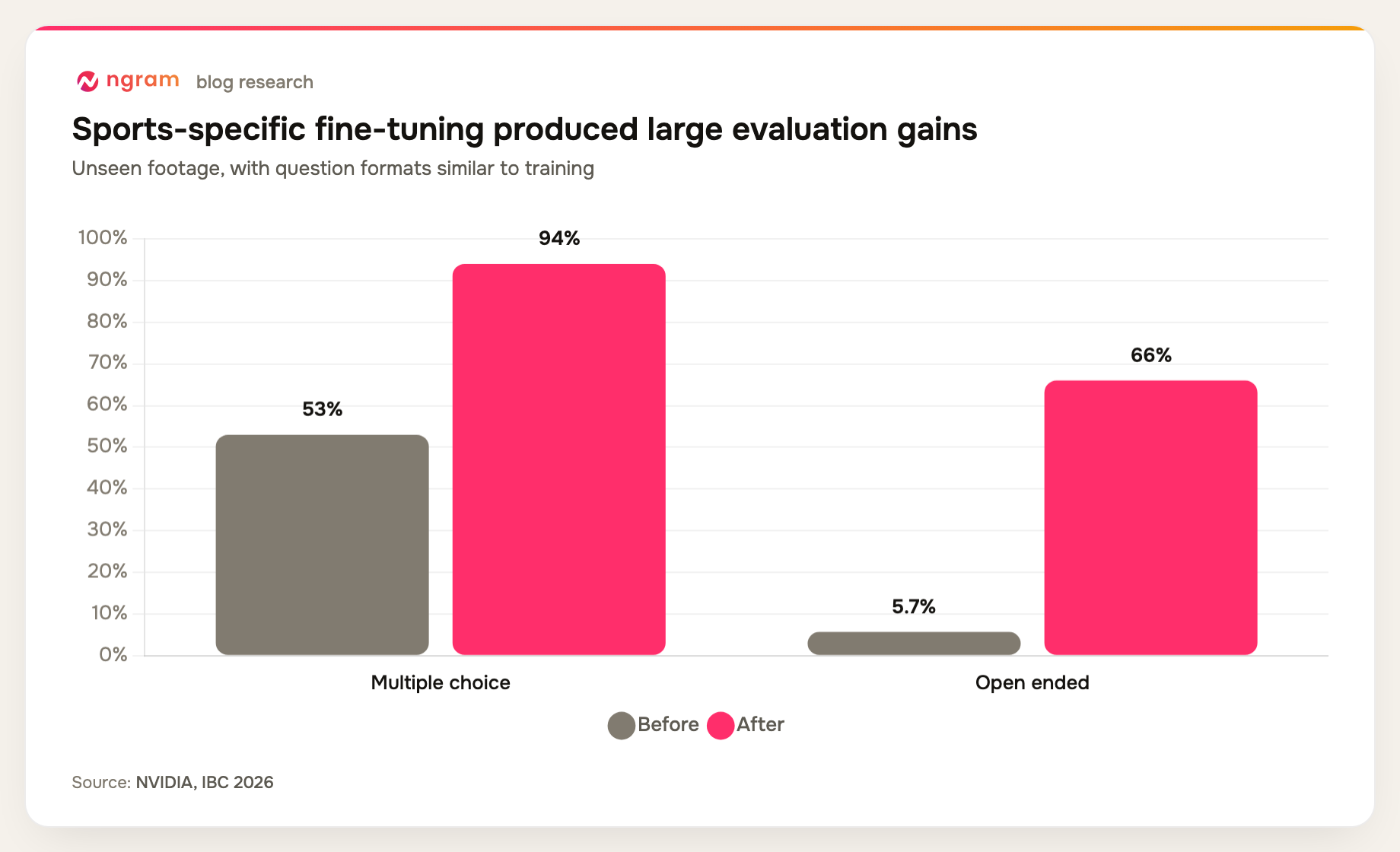
The gains are large, especially for open-ended questions, but the methodology phrase matters. Similar question formats can reward adaptation to the evaluation pattern as well as deeper understanding of the sport. The announcement does not disclose the number of clips, sports represented, annotator agreement, prompt distribution, or error categories. A rights holder should validate the playbook on its own camera angles, leagues, languages, and rare events before using it in live decisions.
NVIDIA AI for Media becomes broadcast infrastructure with Holoscan and MXL
Models become infrastructure when media applications can share live video, audio, data, timing, and compute without a custom bridge for every pair. NVIDIA calls Holoscan for Media an open reference architecture and developer toolkit for software-defined live production. The Media Exchange Layer, or MXL, gives distributed media functions a common way to exchange streams and data.
The open-interface claim deserves two readings at once. A common exchange layer can reduce bespoke integration and let applications evolve independently. At the same time, the broader system spans NVIDIA GPUs, NIM packaging, SDKs, Holoscan orchestration, MXL, and partner software. TechRepublic's independent coverage flags the resulting deployment complexity and potential switching costs.
Open interfaces do not automatically create an exit path. Buyers still need to test whether media functions can move to alternative hardware, whether metadata and state remain portable, which services require NVIDIA-specific acceleration, and how many operational tools become tied to one vendor's lifecycle.
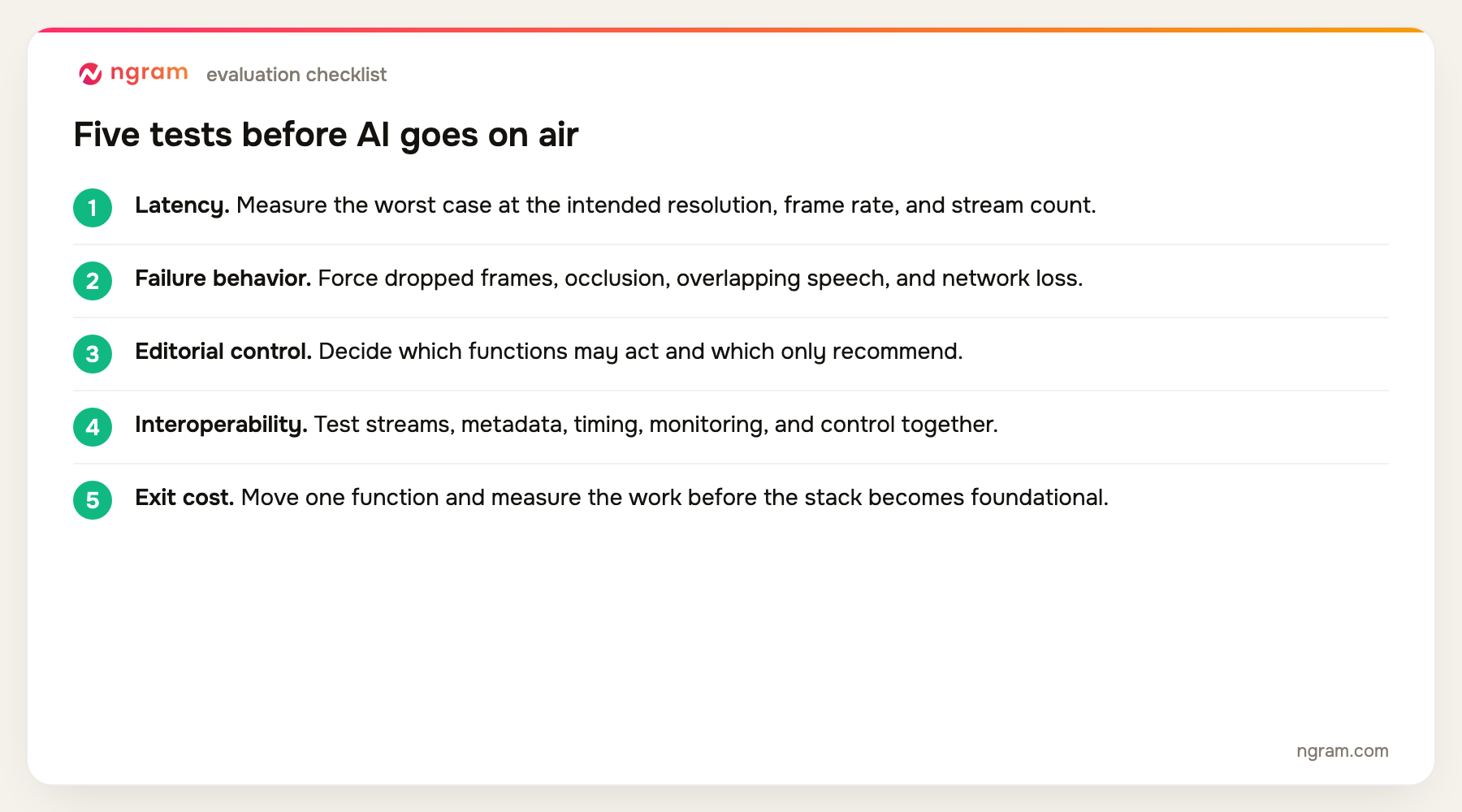
Five tests before AI goes on air
The IBC release suggests a practical acceptance test for broadcast AI. First, measure worst-case latency, not a best-case average. Test the intended resolution, frame rate, codec, number of concurrent streams, and the exact chain of effects. A system that stays fast on one clean 1080p feed can still miss its budget on four 10-bit feeds with graphics and localization running together.
Second, force failure. Drop frames, obscure faces, overlap speech, introduce compression, switch cameras, and remove network connectivity. The key result is not whether the model remains perfect. It is whether the production chain stays synchronized and returns to the original feed cleanly.
Third, separate enhancement from editorial judgment. Upscaling may run automatically when artifacts remain within a technical threshold. Authenticity detection should generally produce evidence for review. Sports intelligence used for highlights carries a different risk from the same system used for officiating. Each function needs its own authority boundary.
Fourth, prove interoperability at the stream, metadata, timing, monitoring, and control layers. A demo that exchanges pictures but cannot expose health, confidence, or trace data to the control room is not operationally integrated.
Fifth, rehearse an exit. Move one function to a different implementation, export its configuration and telemetry, and measure the work required. That exercise puts a price on stack dependence before the system becomes the foundation for replay, compliance, localization, and media intelligence at once.
Methodology: this five-test framework is our original analysis of NVIDIA's September 9 announcement, the IBC program, partner deployment notes, and the independent implementation caveats reported by TechRepublic. It has not been tested inside a broadcaster's control room, so it should be used as an evaluation checklist rather than a certification standard.
What this NVIDIA broadcast AI stack proves
The most important shift at IBC 2026 is not that AI can make another frame. It is that video generation, enhancement, detection, localization, and analysis are being packaged as functions inside the same live-media environment. The partner list shows where those functions land: replay, virtual studios, compliance, streaming infrastructure, dubbing, graphics, and sports intelligence.
It also proves that model accuracy is only the start of the procurement conversation. Broadcast teams need evidence about tail latency, degraded modes, synchronized fallback, evaluation scope, human review, portability, and operational ownership. Those are not caveats around the product. In a live environment, they are the product.
Frequently asked questions
What is NVIDIA AI for Media?
NVIDIA AI for Media is a collection of GPU-accelerated SDKs, NIM microservices, blueprints, and playbooks for live and post-production audio, video, augmented reality, media intelligence, and localization. At IBC 2026, NVIDIA expanded it with new partner workflows and deeper integration with Holoscan for Media.
Which NVIDIA AI tools now run in real-time broadcast workflows?
The announced set includes Synthetic Video Detector, 3D Body Pose, Video Frame Generation, Video Super Resolution, TrueHDR, LipSync, Active Speaker Detection, Studio Voice, Sports Intelligence Playbooks, and content-localization workflows on Holoscan for Media. Their integration and deployment status varies by product and partner.
How accurate is NVIDIA's Synthetic Video Detector?
NVIDIA reports 99.3% accuracy for text-to-video content and 97.7% for image-to-video content in its September 2026 update. Those figures are vendor-reported evaluation results, and an editorial team should validate performance on its own footage, compression profiles, sources, and decision thresholds.
What is NVIDIA Holoscan for Media?
Holoscan for Media is NVIDIA's open reference architecture and developer toolkit for software-defined live production. It lets traditional media functions and AI applications share accelerated infrastructure, while MXL provides a common exchange layer for live video, audio, and data across distributed applications.
Does Media Exchange Layer prevent NVIDIA vendor lock-in?
MXL can reduce point-to-point integration by giving applications a shared way to exchange media and data. It does not by itself guarantee workload portability because the surrounding stack may still depend on NVIDIA GPUs, NIM packaging, SDKs, orchestration, and partner implementations.
What should broadcasters test before putting AI on air?
Test worst-case latency, failure recovery, audio-video synchronization, human override, confidence reporting, interoperability, and exit cost using the actual resolutions, codecs, stream counts, camera changes, languages, and edge cases expected in production. Also define which AI functions can act automatically and which must remain review signals.