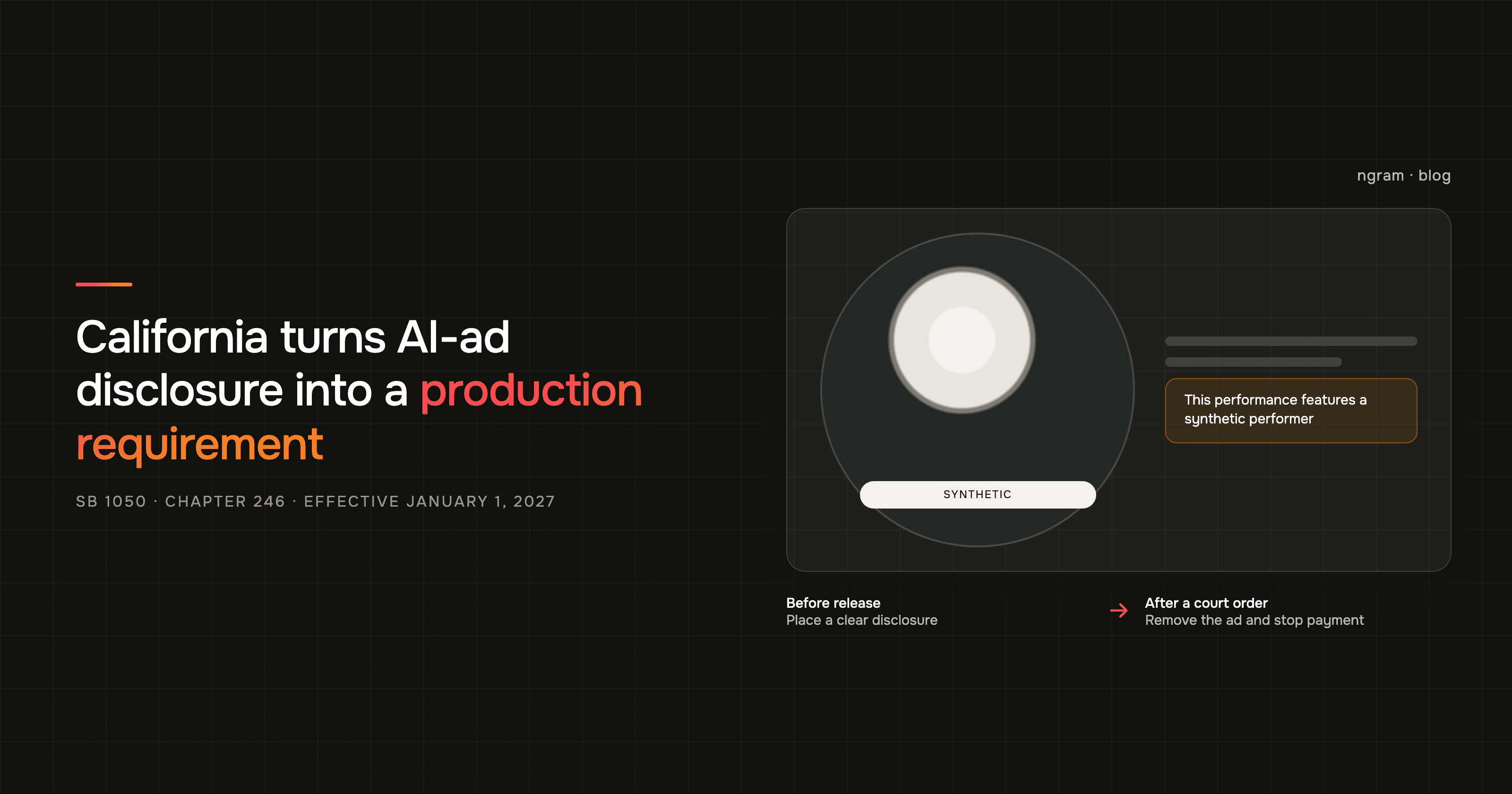

The California AI advertising law now has an operative date and a concrete production rule. Starting January 1, 2027, an ad that prominently includes a realistic synthetic performer needs a disclosure that viewers or listeners can readily notice and understand. SB 1050 reaches audio as well as video, and it creates a post-order removal duty for the companies distributing the ad.
That is the California-specific delta. The question is no longer whether a model added an invisible watermark. It is whether the finished ad carries a human-facing disclosure in its actual placement, format, and context, and whether the distribution chain can act if a court orders the ad down.
What the California AI advertising law changes
SB 1050 adds Section 17610 to California's Business and Professions Code. It creates an unlawful advertising practice when a person creates and causes to be published an advertisement that prominently includes a synthetic performer without a clear and conspicuous disclosure. A violation is also a violation of Section 17500, California's false-advertising statute, and is enforceable through the state's unfair-competition framework in Section 17200.
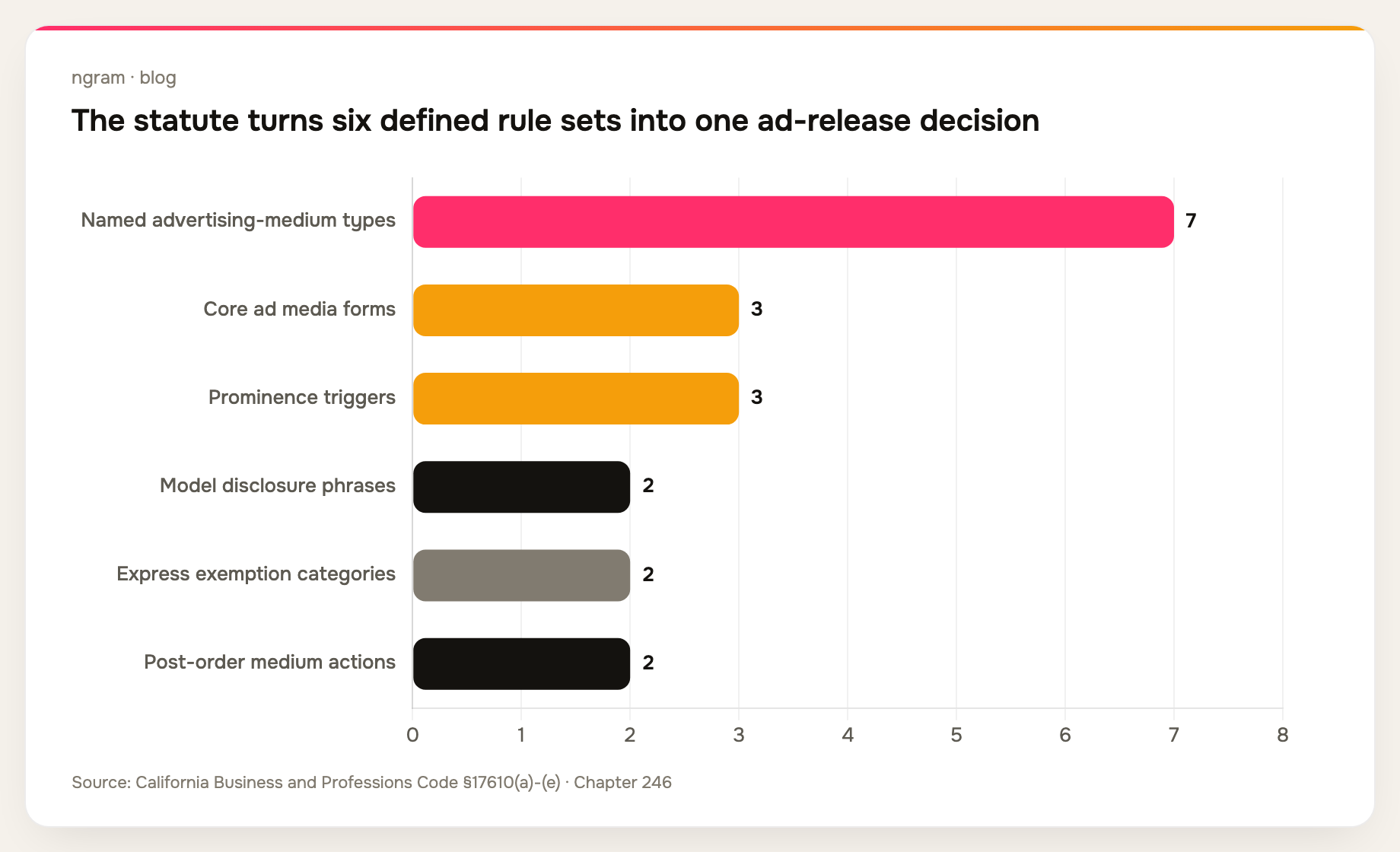
The chaptered bill text is unusually operational. It defines the advertisement, the advertising medium, the disclosure standard, prominence, and the synthetic performer. It also requires wording substantially similar to one of two statutory phrases and tells distributors what happens after service of a court order.
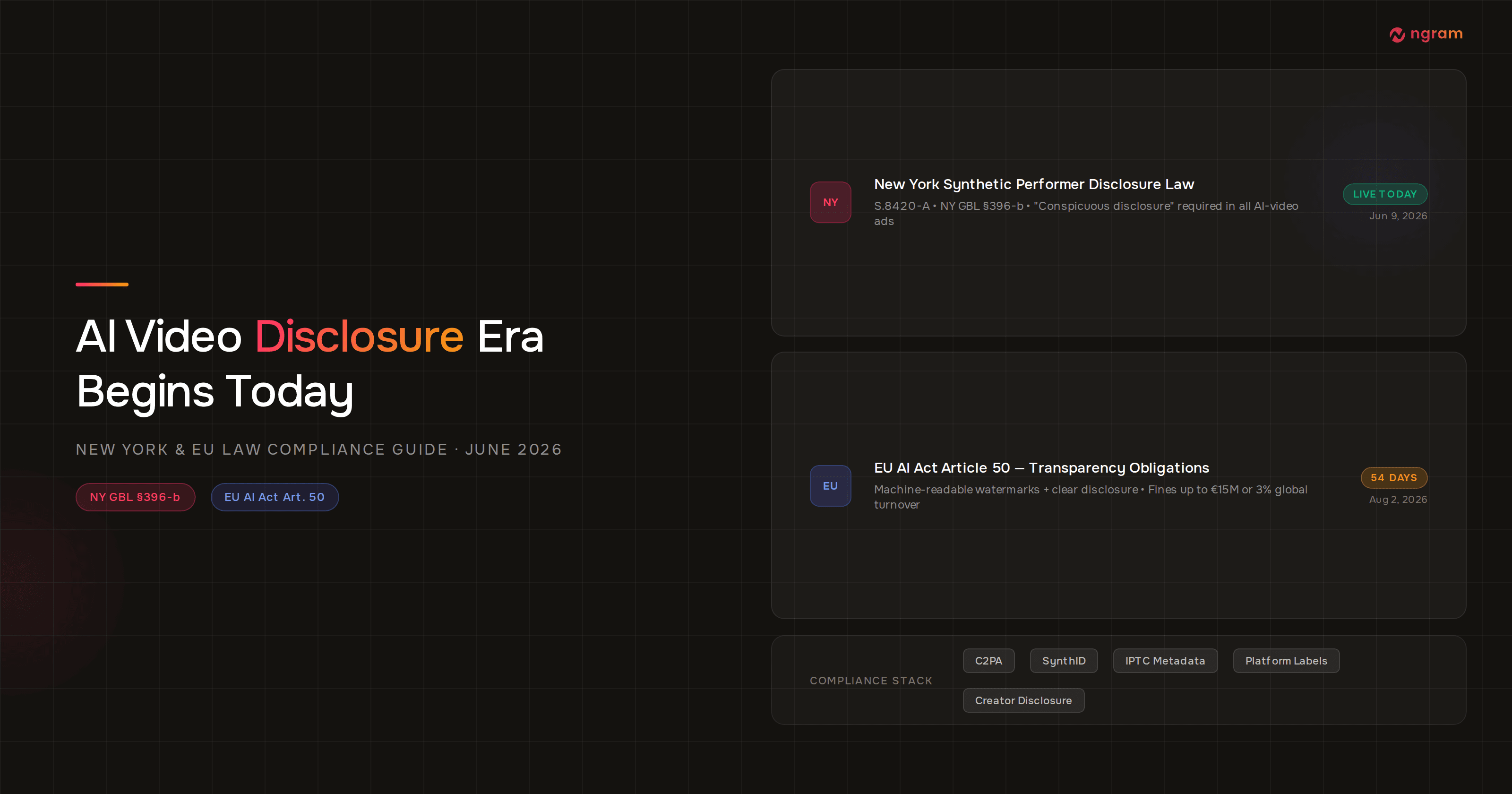
California is not starting from a blank page. Our earlier guide to the New York and EU AI video disclosure rules covers the broader 2026 patchwork. SB 1050 matters because it goes further on audio coverage, disclosure detail, and distributor response.
When the California AI advertising law takes effect
Governor Gavin Newsom approved SB 1050 on September 16, 2026, and the Secretary of State chaptered it that day as Chapter 246. The Legislature's status page identifies it as a non-urgency measure and the text supplies no special operative date. California's Secretary of State says statutes enacted in a regular session generally take effect on January 1 of the following year unless they are urgency measures or specify a later date. Together, those records put SB 1050's effective date at January 1, 2027.
Primary records: California Legislature bill status and the Secretary of State's effective-date rule.
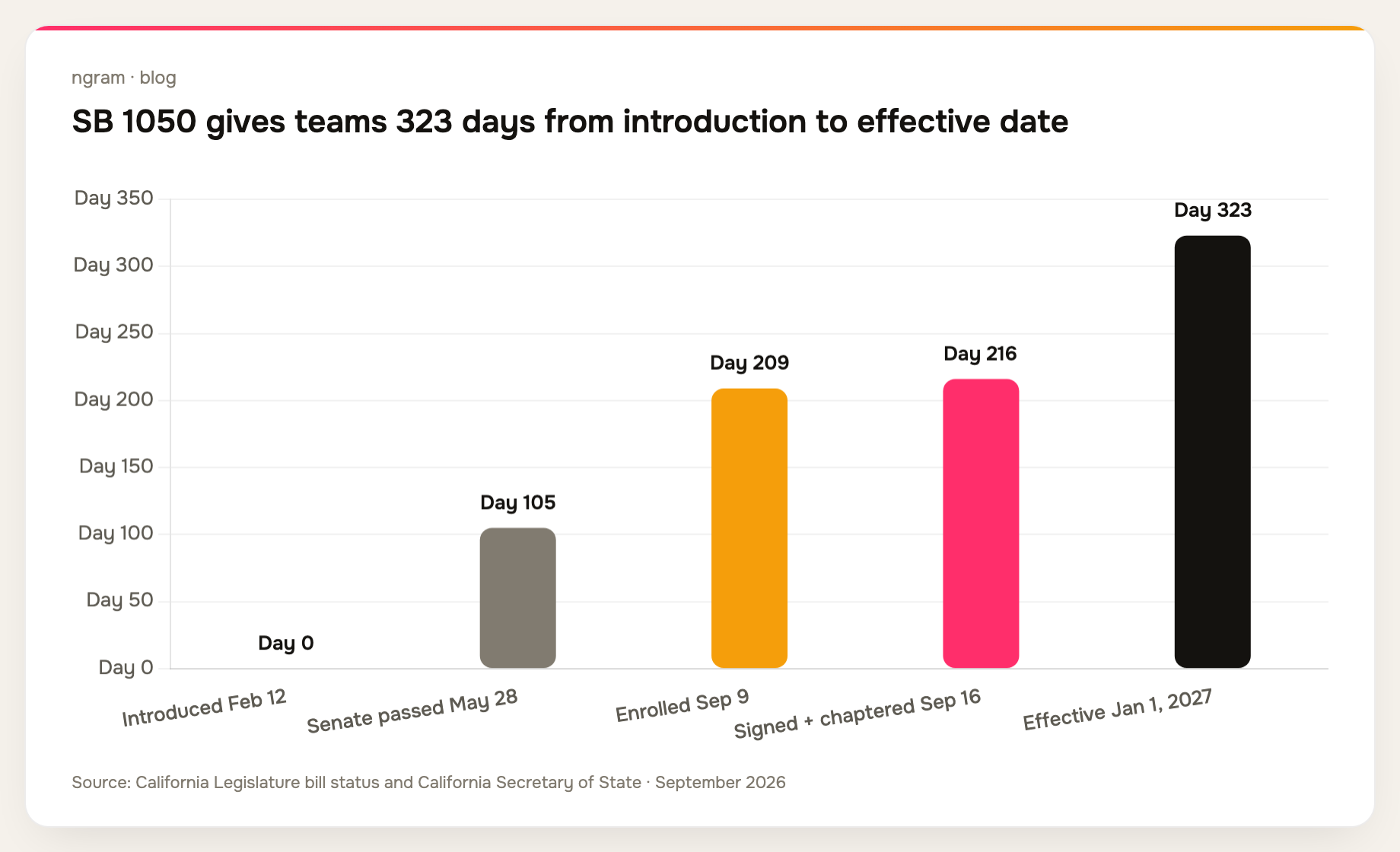
The calendar leaves 107 days between signing and effectiveness. That is enough time to add a release control, but not enough for a brand, agency, publisher, ad network, and streaming partner to invent different definitions after a campaign ships.
Which advertisements the California AI advertising law covers
The statute uses a chain of definitions. All of them need to be satisfied before the disclosure obligation attaches.
An advertisement must be commercial
An advertisement is an audio, video, or audiovisual message, or another digital communication, intended or reasonably expected to induce the purchase of goods or services. This is not a general label rule for every synthetic character on the internet. The communication needs a sales purpose.
The performer must look or sound realistically human
A synthetic performer is a digital figure, voice, or representation created in whole or in part with generative AI. It must realistically appear to be a human performance, while not being recognizable as an identifiable natural person. A stylized mascot that does not realistically appear human is therefore a different case from a photoreal presenter or plausible human voice.
The synthetic performer must be prominent
California defines three prominence triggers. The performer can demonstrate a product in the foreground, deliver narration or another commercial message on or off camera, or illustrate or react to that narration or message. This catches the obvious AI spokesperson, but it also catches a synthetic voiceover and a realistic character reacting to the pitch.
What the disclosure must say and look like
The disclosure must be clear and conspicuous. SB 1050 defines that phrase as difficult to miss and easily understandable by ordinary consumers. The notice also has to be reasonably noticeable, readable, and comprehensible in the medium, format, and context where it appears.
That context language is important. A readable label on a landscape television ad may become illegible in a cropped vertical placement. A visual label cannot disclose a synthetic narrator to someone hearing an audio-only spot. A disclosure hidden in post copy may not be reasonably noticeable inside a streaming ad. The finished placement is what matters, regardless of which AI video generator or AI video generation platform produced it.
The statute requires the disclosure to use wording substantially similar to one of two phrases: "this performance features a synthetic performer" or "no human performer is depicted." Verbatim text is not required, but the disclosure must track one of those formulations. The first fits a mixed production that includes synthetic performance. The second is stronger and should only be used when it is accurate.
The law does not prescribe font size, screen position, spoken duration, or a universal number of seconds. That is not permission to minimize the notice. It is a requirement to test the disclosure in the final delivery context.
Who is responsible before and after publication
The core prohibition applies when a person creates a covered ad and causes it to be published without the required disclosure. That puts the label decision upstream, before the asset enters trafficking or publishing systems.
The California AI advertising law separately defines an advertising medium. Its list includes broadcasters, cable systems, multichannel video programming distributors, online platforms, streaming services, digital advertising networks, and publishers. A business that cannot remove, disable, or otherwise stop an ad is excluded from that definition.
The medium's special response duty is triggered by service of a court order that includes enough information to identify the ad. At that point, the medium must remove, disable, or otherwise cease dissemination as soon as commercially reasonable and technically feasible. It must also stop accepting payment for further dissemination in California.
This is not a general notice-and-takedown rule activated by any complaint. The text ties the duty to a court order and service. Operationally, however, a medium still needs an owner for legal intake, a reliable creative identifier, the ability to find all active placements, and a payment stop that follows the creative stop.
Newsom's signing announcement describes the measure as requiring explicit disclosure for video or audio ads that use AI-generated performers. SAG-AFTRA says it helped craft the legislation, linking the rule to consumer transparency and work performed by human performers.
How California's AI advertising law differs from New York
California is the second state with a synthetic-performer advertising disclosure law, according to SAG-AFTRA's September 17 statement. New York's rule became effective June 9, 2026. The two statutes share a core idea, but they do not create the same production checklist.
The California AI advertising law covers audio-only ads; New York expressly exempts them. California defines clear and conspicuous, requires wording substantially similar to one of two statutory phrases, and imposes a post-order duty on capable distributors. New York instead expressly limits liability to a person or entity with actual knowledge that the ad contains a synthetic performer.
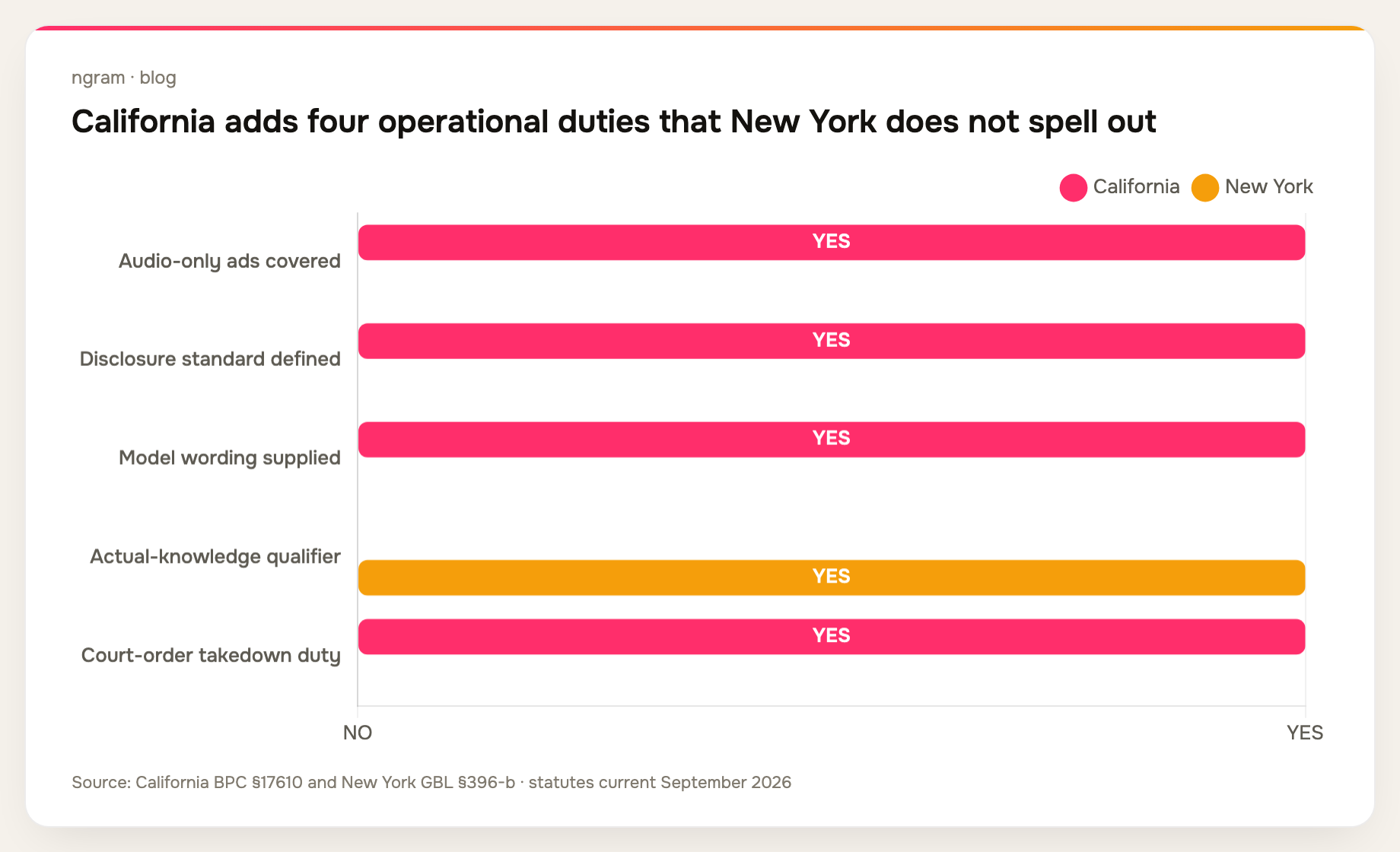
For a national campaign, the safer production design is not to create a California file and a New York file unless the media plan truly supports that split. Build a master disclosure treatment that survives the stricter combination: audio-aware, clearly visible or audible, documented, and removable across placements.
Primary comparison source: New York General Business Law §396-b.
The exemptions that matter
The California AI advertising law has two express exemptions. The first covers an ad for an expressive work when the synthetic performer's use is consistent with that work. A trailer that shows a synthetic character as the character appears in the advertised film is different from using that character as an unrelated product endorser.
The second covers an ad in which generative AI is used solely for language translation of a human performer or other accessibility features. The word "solely" matters. Translation does not automatically exempt an ad when the same workflow also creates a new realistic synthetic spokesperson or materially changes the performance for another purpose.
These are factual tests, not labels a producer can apply at export. The campaign record should state what the AI did, why the exemption is believed to fit, and who approved that conclusion.
A production workflow for California SB 1050
The cleanest response is a gate between final creative approval and export. It should cover every tool in the stack, including any video ad maker or video marketing software used after the first generation step.
- Inventory the human-like elements. Record every realistic digital figure, voice, face, narrator, demonstrator, and reacting character, plus the tool and source asset used to create it.
- Classify the use. Ask whether the communication is commercial, whether the performer is synthetic under the statutory definition, and whether one of the three prominence triggers applies.
- Choose accurate wording. Use wording substantially similar to one of California's two statutory phrases, then check that it describes mixed human and synthetic scenes honestly. Verbatim text is not required.
- Test every placement. Review landscape, vertical, square, connected-TV, muted autoplay, audio-only, translated, captioned, and shortened versions. A disclosure that survives the master file can still fail after cropping or localization.
- Preserve an approval packet. Save the script, final creative, disclosure wording, placement screenshots or audio proof, dates, campaign IDs, media destinations, and named approver.
- Map the response path. Brands and agencies should know who can pause a campaign. Publishers, ad networks, streamers, and platforms should connect a served order to the creative ID, placement list, and payment system.
For teams producing with ngram or another AI-video stack, the relevant checkpoint sits before export. A talking-head or avatar workflow can produce the kind of realistic performance that needs classification, while a brand kit can keep approved visual treatment consistent. Neither feature replaces legal review or automatically determines whether an ad falls within SB 1050.
How we read SB 1050
For this California AI advertising law analysis, we reviewed the official chaptered bill text and status history, California's published rule for effective dates, the governor's signing announcement, SAG-AFTRA's statement, and New York's current statutory text. Counts in the charts are our tabulation of provisions expressly listed in those laws. Dates and statutory comparisons were checked on September 22, 2026.
This article is general information, not legal advice. Application depends on the finished creative, the parties' roles, where the ad runs, and later regulatory or court guidance. Counsel should review edge cases and campaign-specific decisions.
What teams should do before January 1, 2027
Do not start with a universal watermark. Start with the campaign inventory. Find realistic synthetic people and voices, identify which ones carry the commercial message, and decide what a reasonable viewer or listener will encounter in each final placement.
Then make the disclosure part of the creative system: one approved wording library, one placement standard, one QA record, and one owner for takedown coordination. That is the practical meaning of the California AI advertising law. Disclosure moves from policy copy into production operations.
If your team is building the next campaign from a brief, product page, or existing asset, try an AI video ad maker and add the disclosure checkpoint before the final export.
Frequently asked questions about California SB 1050
When does California SB 1050 take effect?
January 1, 2027. The governor signed the non-urgency bill on September 16, 2026, it was chaptered as Chapter 246, and it does not state a different operative date.
Does SB 1050 apply to audio-only ads?
Yes. California's definition of advertisement expressly includes audio messages, and the prominence definition includes on-camera or off-camera narration and other commercial messages.
What is a synthetic performer under California law?
It is a digital figure, voice, or representation created in whole or in part with generative AI that realistically appears to be a human performance but is not recognizable as an identifiable natural person.
What disclosure wording does SB 1050 require?
The disclosure must use wording substantially similar to "this performance features a synthetic performer" or "no human performer is depicted." Verbatim text is not required. The disclosure must also be clear and conspicuous in its actual medium and context.
Are translation and accessibility uses exempt?
Yes, when generative AI is used solely for language translation of a human performer or other accessibility features. If the workflow also creates or changes a synthetic performance for another purpose, the exemption may not fit.
Must a platform remove an ad after receiving a complaint?
SB 1050's specific advertising-medium duty begins after service of a court order with enough information to identify the ad. The medium must then stop dissemination as soon as commercially reasonable and technically feasible, and stop accepting payment for further dissemination in California.