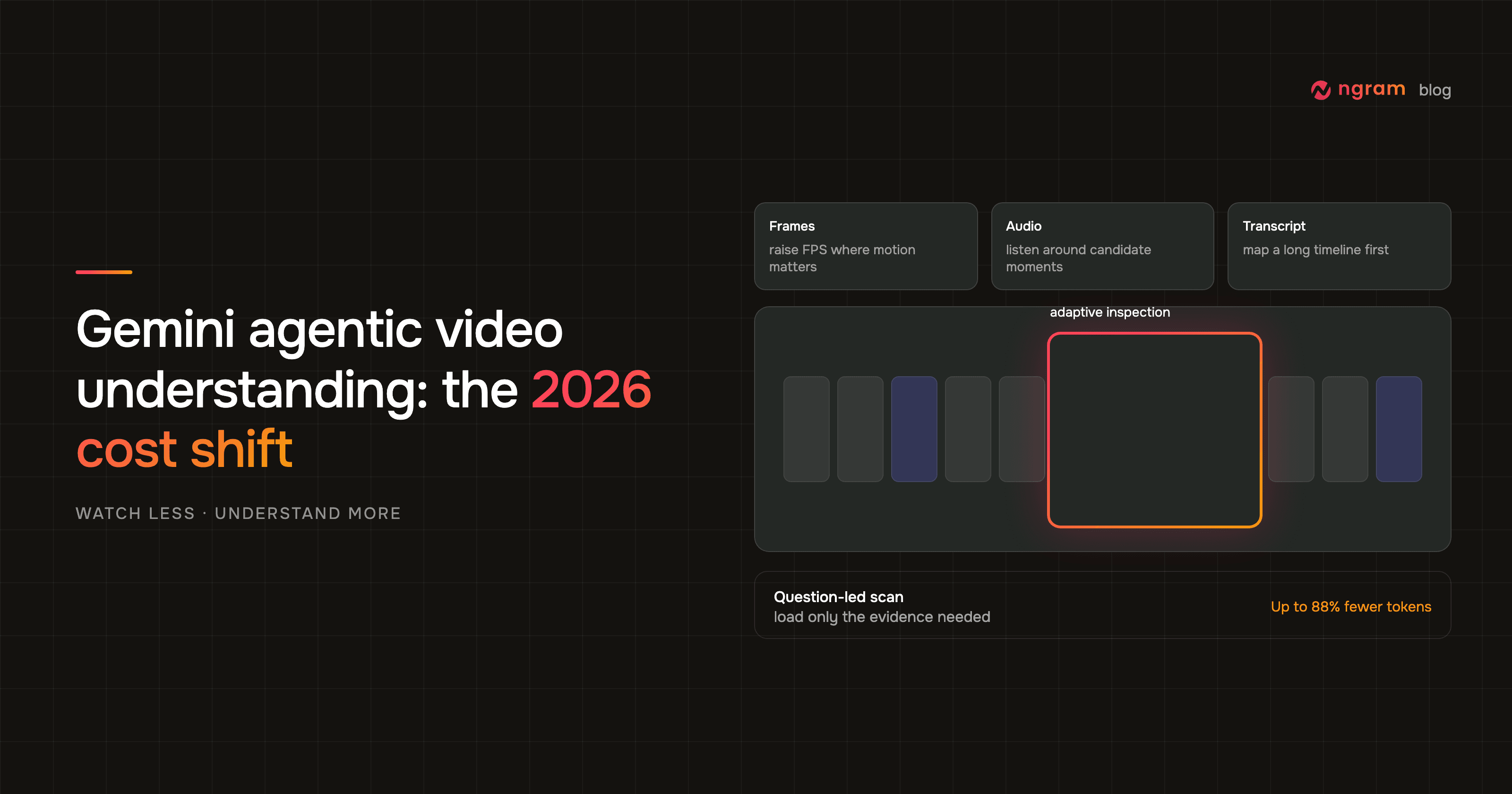

On September 1, 2026, Google gave Gemini agentic video understanding a very literal job: decide what part of a video is worth watching. Instead of pushing a fixed sample of an entire recording into context, Gemini can search the timeline, inspect selected frames, listen to audio, read transcript passages, and return for a closer look when the question demands it.
Google's headline numbers are large: up to 88% lower token use, up to 66% lower analysis cost, and up to 7% higher quality across its tested video-analysis benchmarks. The more consequential change is the control loop underneath those numbers. A model that can choose where to look no longer has to pay the same inspection cost for every second of footage.
That makes "watch less, understand more" a plausible design principle for video search, logging, quality assurance, and editing. It does not make every answer dependable. Google's percentages are best observed results, and independent benchmarks show that agentic video systems still lose important context and fail multi-step production tasks.
What Gemini agentic video understanding changes
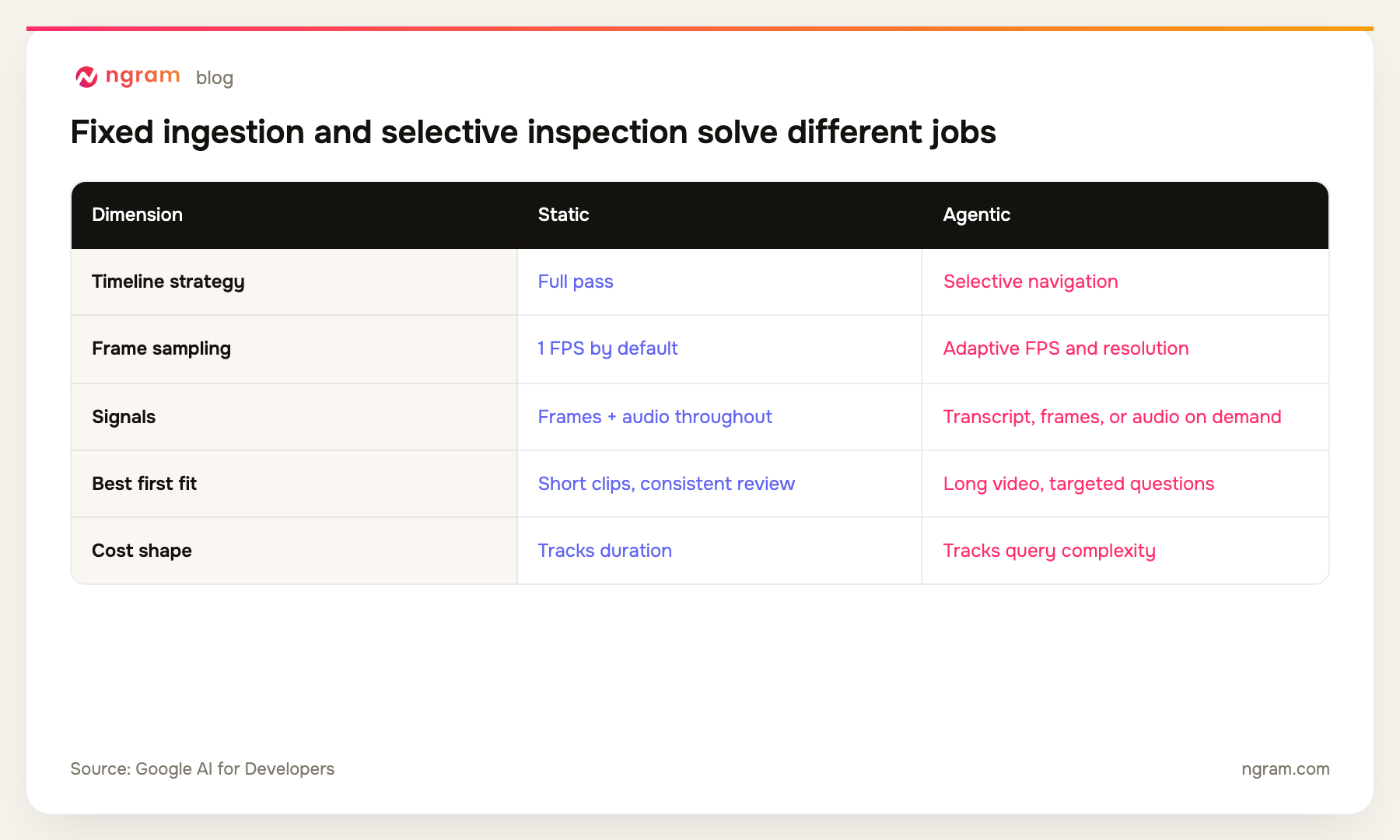
Static video processing is predictable. Gemini's default mode extracts frames at 1 frame per second, places them in context, and processes audio alongside them. Google's video-understanding documentation estimates about 100 tokens per second at low media resolution and about 300 tokens per second at high resolution. Cost grows with duration even when the answer depends on a five-second event near the end.
Agentic processing starts from the question. The model can load a transcript for a broad map, search candidate intervals, increase frame rate or resolution around an interesting moment, listen to the corresponding audio, and inspect again before answering. Google describes sub-second moment retrieval, long-video needle search, anomaly detection, and action or object counting as target use cases in its launch announcement.
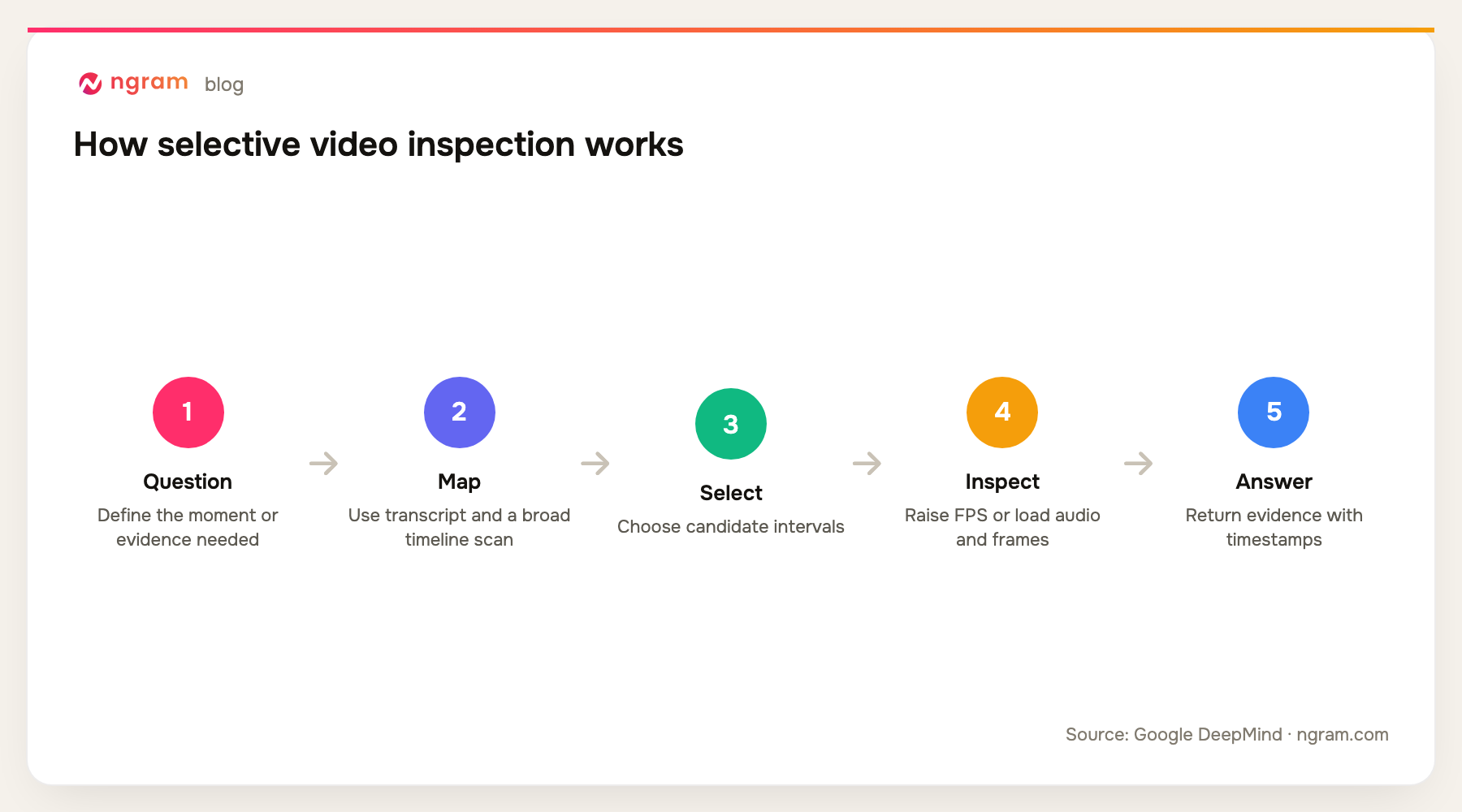
The agentic loop spends inspection on the signals most likely to answer the question. Source: Google DeepMind and Google AI for Developers.
The reported upside is real, but it is a ceiling
Google reports three separate improvements, and they should stay separate. Token consumption fell by as much as 88%. Analysis cost fell by as much as 66%. Quality rose by as much as 7%. None of those figures says every prompt, model, or video will produce the same result.
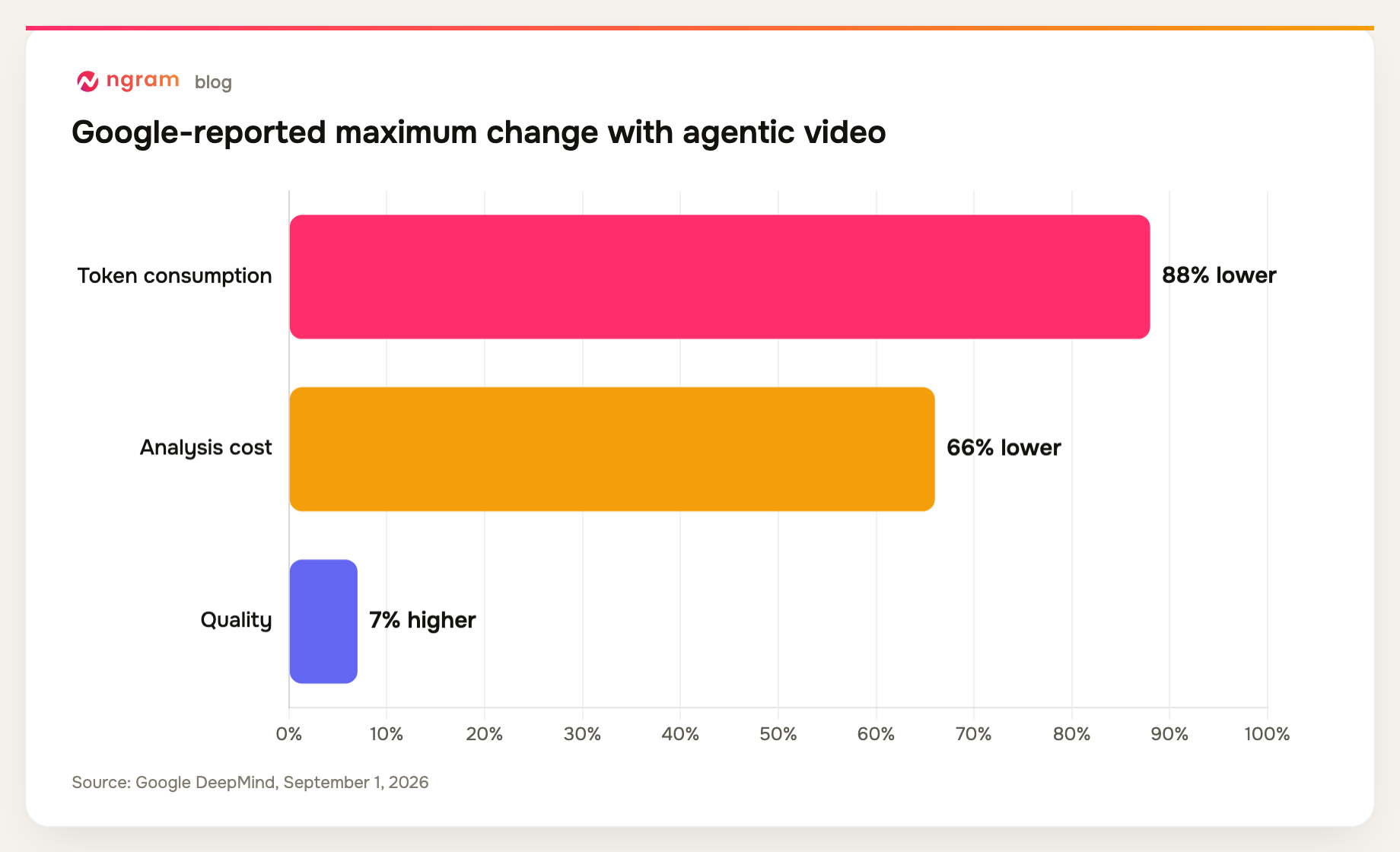
The gap between token savings and cost savings matters. Selective inspection reads less source material, but the model also spends tokens navigating, reasoning, and calling its internal video tools. Google does not publish a per-benchmark bill that lets developers reconstruct the 66% cost figure. Teams should measure usage from real requests instead of multiplying list prices by the 88% headline.
One hour of video shows the new cost shape
Google's token guide estimates that static processing consumes about 100 tokens per second at low resolution and about 300 at high resolution. That puts a one-hour video near 360,000 or 1.08 million input tokens before the answer. The same guide gives an illustrative agentic result of roughly 108,000 tokens for a one-hour lecture, while warning that actual use depends on the prompt and content.
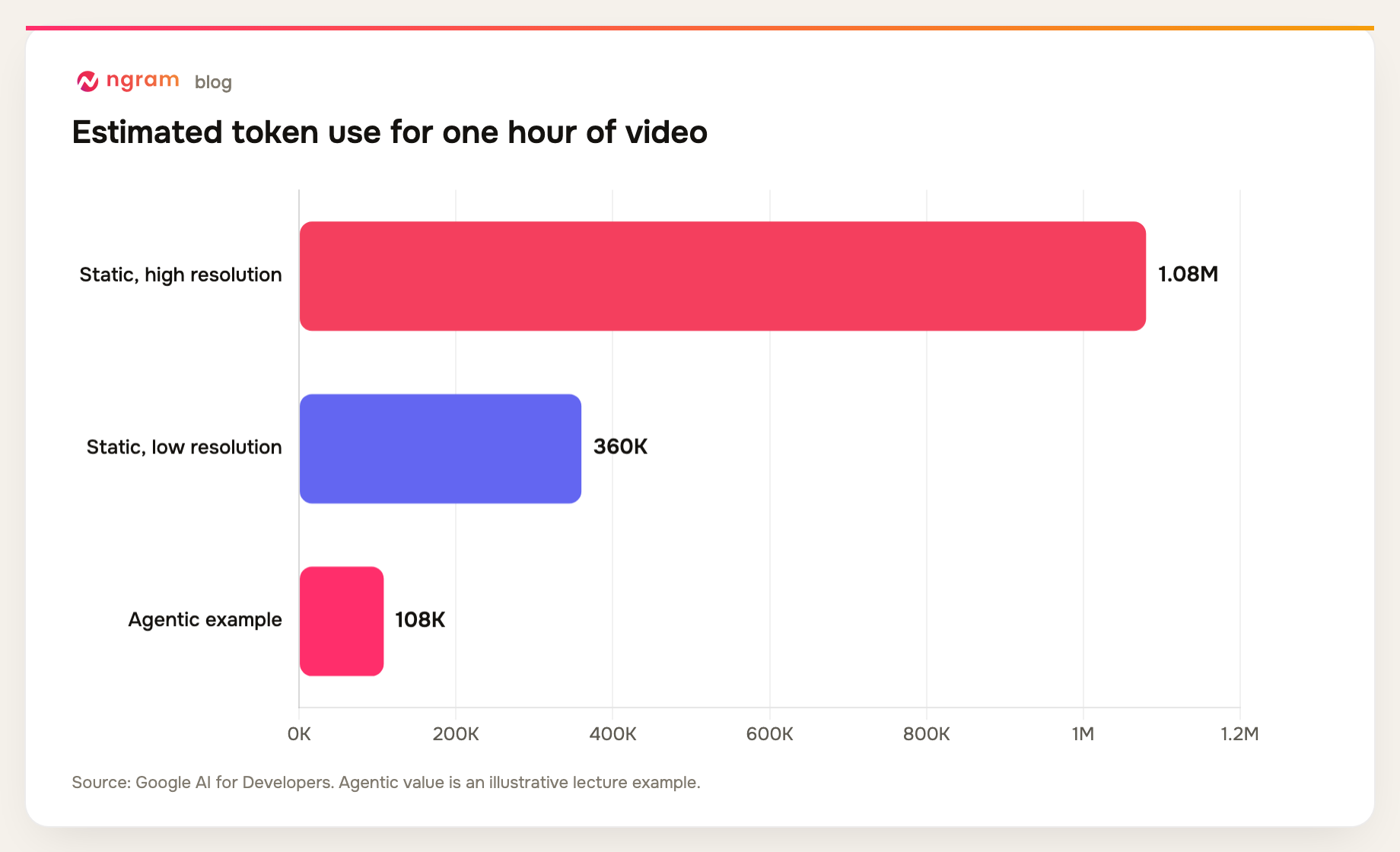
That is why long-form search is the clearest first market. If a query asks for one pricing objection in a 90-minute sales call, processing every sampled frame is mostly waste. If a safety review must inspect every frame for a brief visual defect, selective viewing can become the wrong optimization. Google's own docs recommend static mode for short clips under five minutes when latency or frame-level precision matters.
Video search is the easy win; editing is the hard one
The launch collapses several old preprocessing steps into one model loop. Archive search can ask for the moment a speaker changes a forecast. QA can scan for a missing logo, a visual glitch, or an unexpected action. Logging systems can attach structured events to footage without indexing every frame at maximum resolution.
Editing asks more of the system. Finding a cut boundary is retrieval. Deciding whether the cut preserves the argument, keeps audio continuous, respects a creative brief, and remains reversible is a production decision. Google's sub-second retrieval example makes frame-level tool use more credible, but a good timestamp is not the same thing as a good edit.
This distinction also separates the launch from the broader video-understanding infrastructure layer. Indexing an archive makes footage searchable. Agentic inspection adds a decision loop that can choose a modality and revisit an interval. A production system still needs edit primitives, state, version history, and approval boundaries around that intelligence.
The benchmark score that should not be mixed with the uplift
Google's Gemini 3.7 Flash model card reports 85.4% on LVBench. The same row lists Gemini 3.6 Flash at 84.2%, GPT-5.6 Terra at 78.9%, and Claude Sonnet 5 at 68.5%. That is a useful model-level comparison, but it is not the same experiment as the up-to-7% gain from switching Gemini between static and agentic processing.
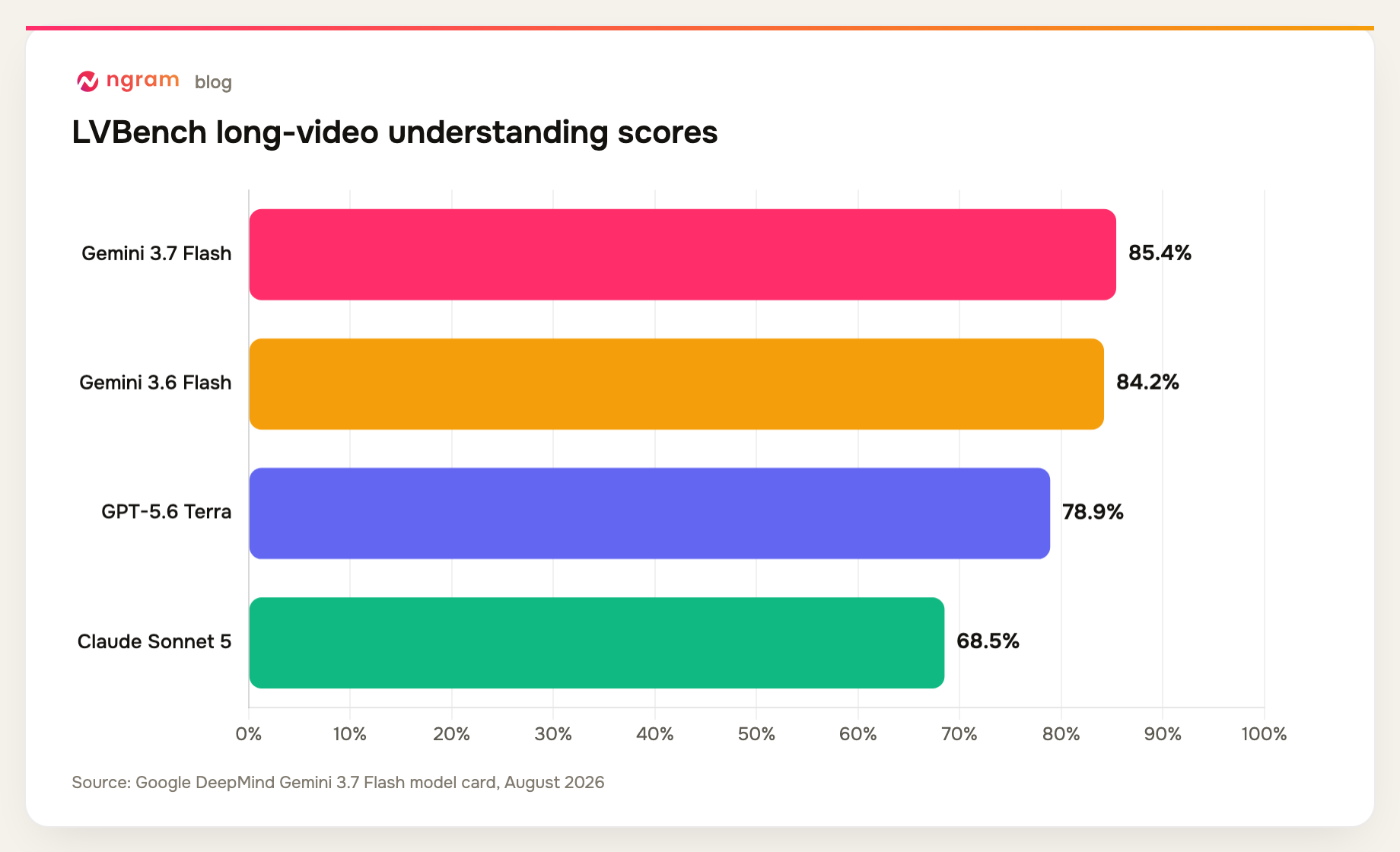
The careful reading is narrower: Gemini 3.7 Flash is strong on the published LVBench setup, and Google saw additional gains from agentic processing in separate tests. Without per-benchmark static and agentic rows, the two claims cannot be merged into a single score or universal improvement.
Where agentic video understanding still fails
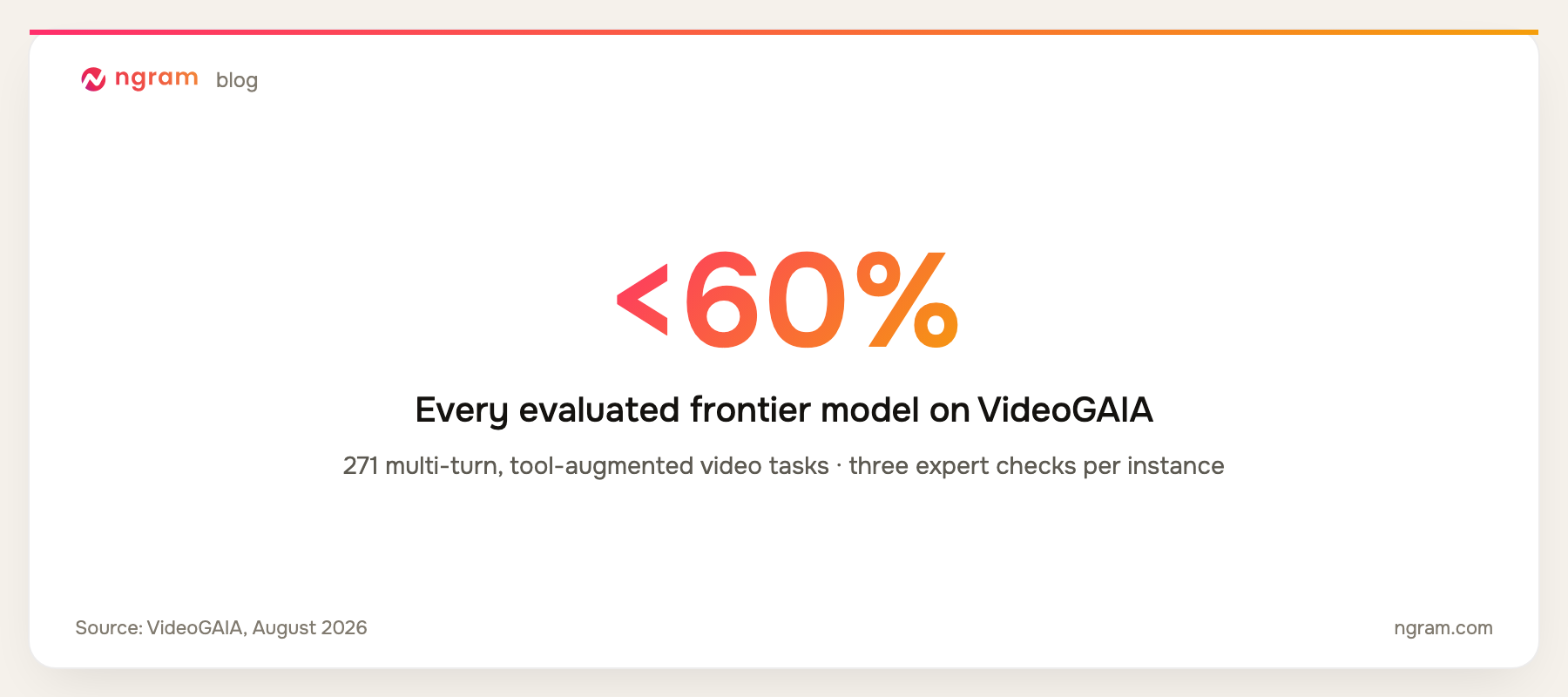
VideoGAIA was published before Google's launch and should not be presented as a direct test of this feature. It is still a useful category warning. The 271-task benchmark evaluates multi-turn, tool-augmented video work, with each instance checked by three human experts. Every evaluated frontier multimodal model scored below 60%.
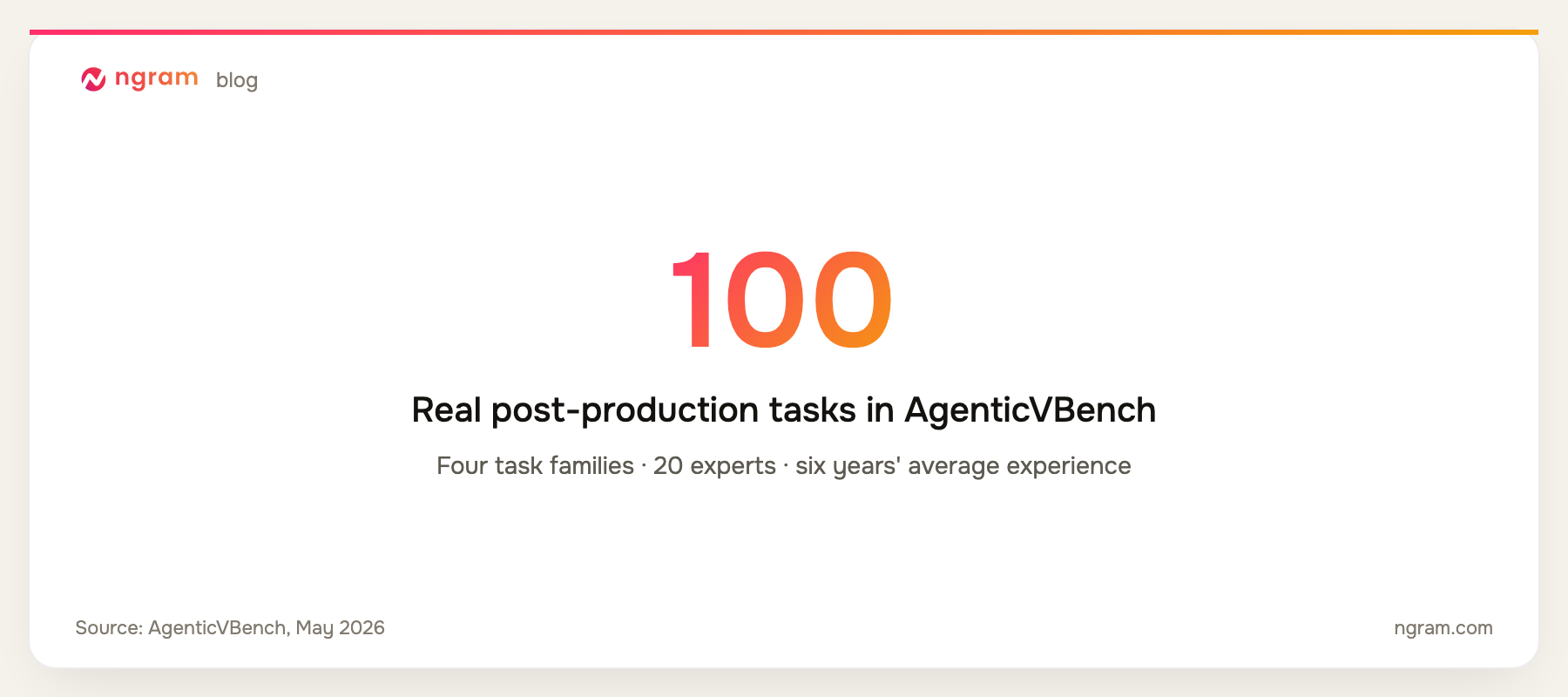
AgenticVBench moves closer to editing. Its 100 post-production tasks span assembly, repair, sequencing, and repurposing. Twenty industry experts with six years of experience on average contributed the workflows. The paper reports that the best evaluated agent stack barely crossed 30%, and that the surrounding harness materially changed behavior and failure modes.
The practical rule is simple: retrieval can propose; production systems should preserve the source, expose the selected interval, record why it was chosen, and let a human undo the action. Confidence scores alone are not enough when a missed frame changes the meaning of a clip.
What this changes for video teams now
For search and logging, the first deployment target should be narrow questions with verifiable timestamps. For QA, route suspicious intervals to a deterministic check or a reviewer. For editing, treat the model's selections as proposed operations rather than final truth.
A useful evaluation compares more than average token use. Teams should record the median and worst-case cost of each query type, the time to first answer, and whether the returned timestamp contains the requested evidence. A selective system can be cheap on routine questions and unexpectedly expensive when it revisits several intervals. It can also return a confident answer after choosing the wrong part of the timeline. Cost and retrieval recall need to be measured together. Publish the test questions and expected moments internally so later model or prompt changes can be compared against the same baseline.
The failure modes differ from fixed sampling. At 1 FPS, a short visual event may fall between sampled frames. With adaptive inspection, the initial map or search step may never select the right interval. Audio can contradict the visible action, and a transcript can omit a sound or speaker cue that changes the interpretation. A production test set should include fast cuts, off-screen speech, repeated scenes, weak transcripts, and long quiet spans, then score both the final answer and the evidence path used to reach it.
That suggests a two-stage operating model. Let agentic video understanding narrow a long recording to a small set of candidate moments, then apply a deterministic frame check, a second model pass, or human review where the consequence of a miss is high. The benefit is not unattended automation. It is moving expensive attention from the whole timeline to the few intervals that deserve confirmation. Search can often stop after the evidence is returned; editing should continue through an explicit approval and rollback step.
At ngram, the relevant boundary is the workflow around the model rather than a claim that we use Google's new mode. ngram already accepts raw video and screen recordings, turns uploaded media into text through its video-to-text workflow, and keeps edits reviewable in a video editor. Better video reasoning infrastructure matters to those workflows, but the launch does not prove any specific product integration.
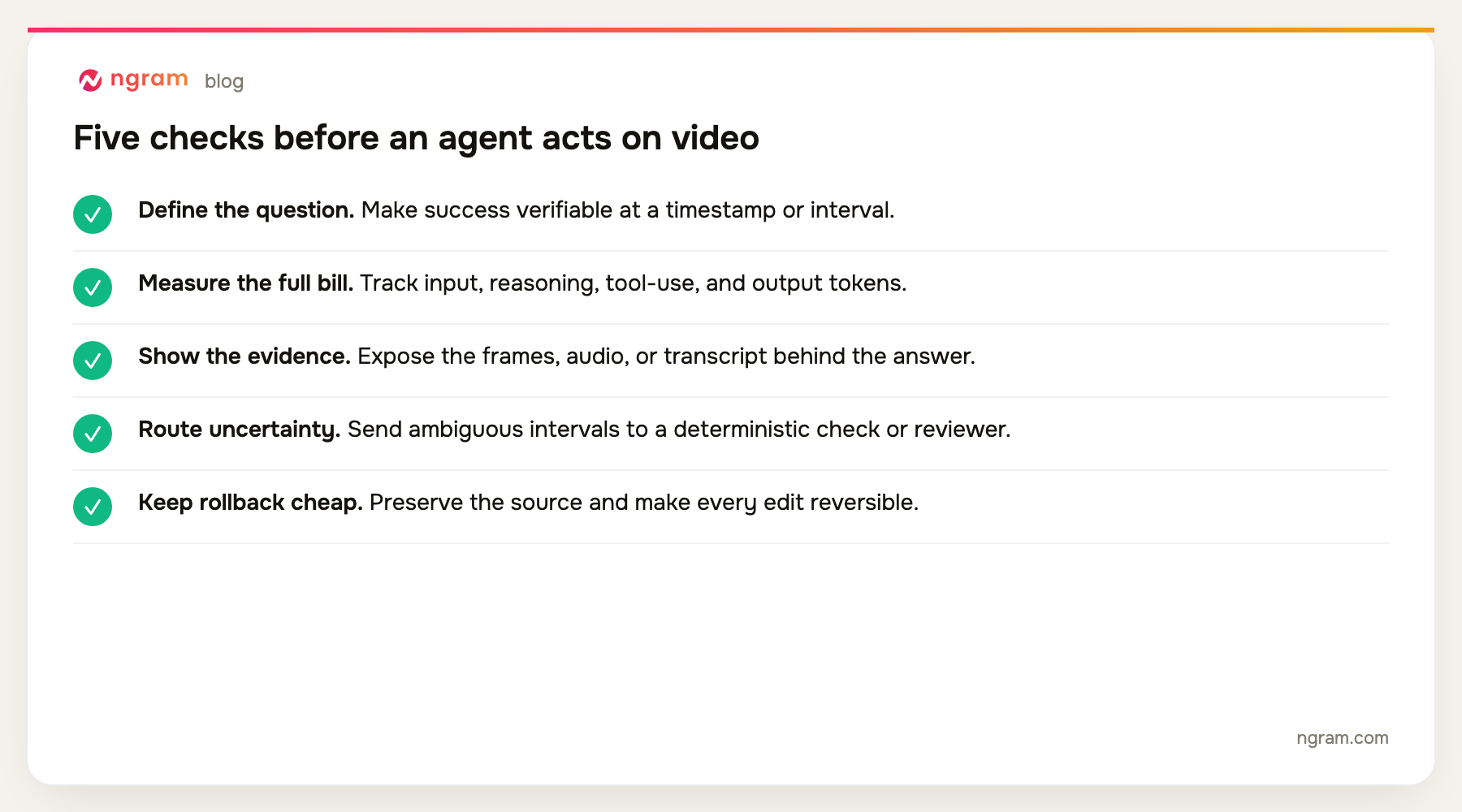
A useful pilot makes cost, evidence, review, and rollback visible before automation expands.
Availability now, Google products later
Agentic video understanding is available now for uploaded videos and YouTube videos through the Gemini API in Google AI Studio and Gemini Enterprise Agent Platform. The supported launch models are Gemini 3.7 Flash, 3.6 Flash, and 3.5 Flash-Lite. Google says the mode uses standard Gemini API token pricing and adds no separate feature fee.
The consumer rollout is future tense. Google says the mode will reach the Gemini app soon and power Ask YouTube in the coming months. Those announcements matter because selective inspection could become a default interaction for billions of viewers, but neither should be described as generally live on September 3, 2026.
Methodology and proof boundary
This analysis was prepared from Google's September 1 launch post, current Gemini API documentation, the August 2026 Gemini 3.7 Flash model card, VideoGAIA, and AgenticVBench. We kept Google's reported maxima labeled as "up to," treated its one-hour token example as illustrative, and did not compare scores across unrelated benchmarks. No generated visual in this post is product proof; each diagram and chart is an editorial rendering of cited source data.
Frequently asked questions
What is agentic video understanding?
Agentic video understanding lets a model choose which parts of a video and which modalities to inspect for a given question. Gemini can search the timeline, load transcript passages, inspect frames, listen to audio, and revisit an interval at a different frame rate or resolution.
Which Gemini models support agentic video understanding?
At launch, Gemini 3.7 Flash, Gemini 3.6 Flash, and Gemini 3.5 Flash-Lite support agentic video understanding. Google exposes the mode through the Gemini API for video uploads and YouTube inputs.
How is agentic video processing different from static processing?
Static processing samples the video at a fixed rate, 1 FPS by default, and loads the resulting stream in one pass. Agentic processing loads selected transcript, frame, or audio evidence on demand, so usage depends on the question and the model's navigation path.
Does agentic video understanding always cut tokens by 88%?
No. Google reports up to 88% fewer tokens on long-form content across its tested setup. Actual usage changes with video complexity, the question, the model, and how many intervals or modalities Gemini decides to inspect.
Is agentic processing better for every video?
No. Google recommends agentic processing for long videos and targeted questions. Static processing remains useful for short clips under five minutes, latency-sensitive work, and reviews where every sampled frame needs consistent treatment.
Can Gemini's agentic mode edit video by itself?
Gemini's launch focuses on video understanding and returns text grounded in selected evidence. Google lists precise moment retrieval as useful for automated editing, but reliable post-production also requires edit tools, project state, validation, and a way to review or reverse each action.