

The Video Marketing Equation Just Changed
Here's the reality every marketing team faces: 89% of marketers now integrate video into their strategy, and 82.5% of all internet traffic is video content. Your audience expects video. Your competitors are shipping video. And if you're still relying on traditional production workflows, you're spending $4,500 per minute of finished content and waiting 13 days for a single 60-second clip.
That's not a content strategy. That's a bottleneck.
The right AI video generator for marketing changes that equation entirely. What used to cost thousands now costs hundreds. What took weeks now takes minutes. And the quality gap between AI-generated and traditionally produced marketing video has nearly closed.
This guide breaks down the data behind the shift, walks through how marketing teams are actually using AI video generators today, and shows you how to start producing professional marketing videos at the speed your campaigns demand - using tools like ngram that are built specifically for marketing workflows.
The AI Video Market is Exploding
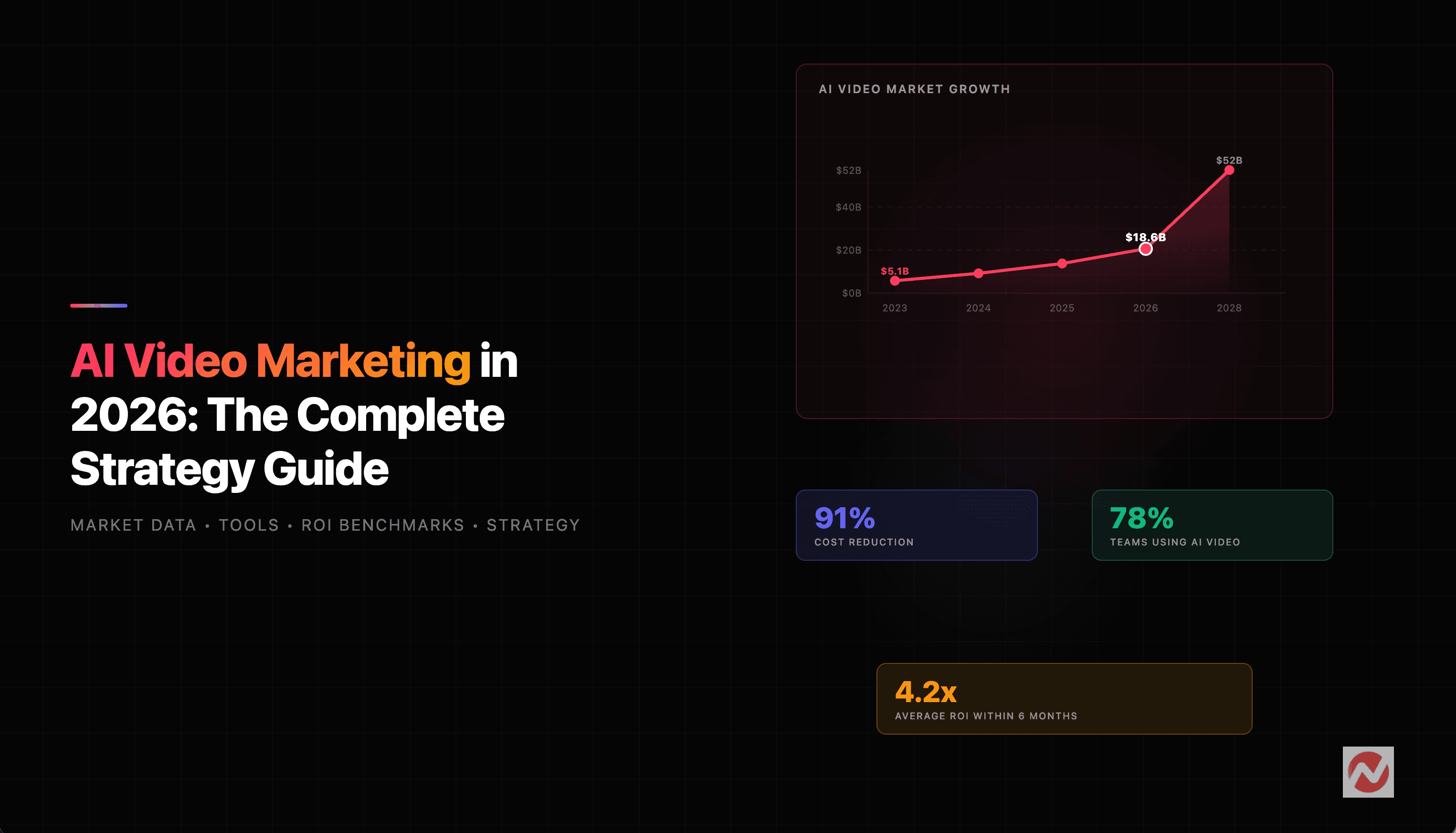
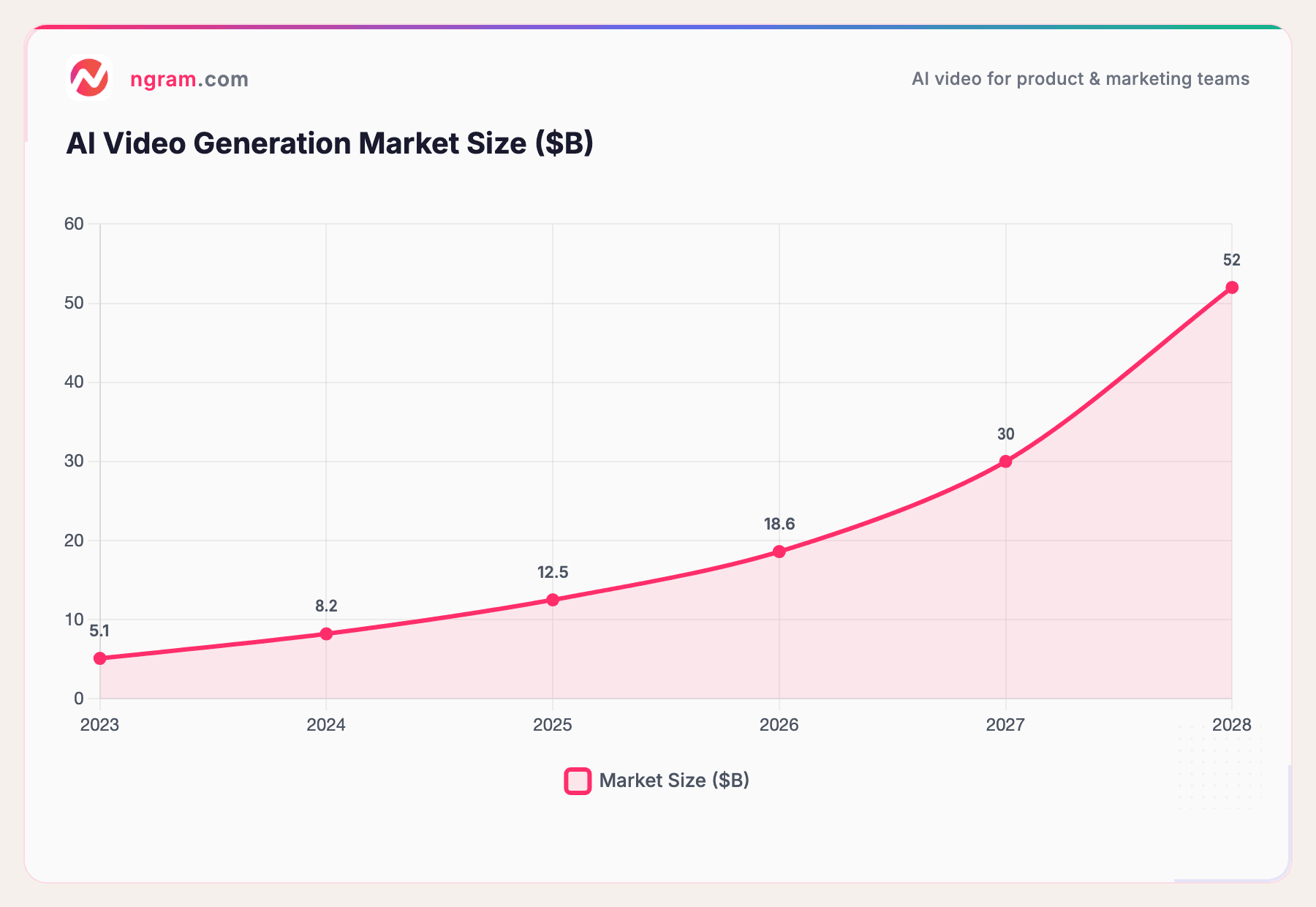
The numbers tell a clear story. According to Fortune Business Insights and market research aggregated by industry sources, the AI video generation market has grown from $5.1 billion in 2023 to a projected $18.6 billion by end of 2026 - a 34.2% compound annual growth rate.
VC investment has followed: $4.7 billion flowed into AI video startups in 2025 alone. Enterprise spending on AI video platforms grew 127% year-over-year, and the total volume of AI-generated video content saw 840% growth between January 2024 and January 2026.
The chart below puts this trajectory in perspective.
Sources: Fortune Business Insights, Meticulous Research
This isn't a niche trend. By 2028, the market is projected to hit $52 billion, and 90% of online video is expected to involve AI in some form by 2030. For marketing teams, the question isn't whether to adopt AI video - it's how fast you can get started.
Why Marketing Teams Are Switching to AI Video
The case for AI video generators in marketing comes down to three numbers: cost, speed, and volume.
The Cost Collapse
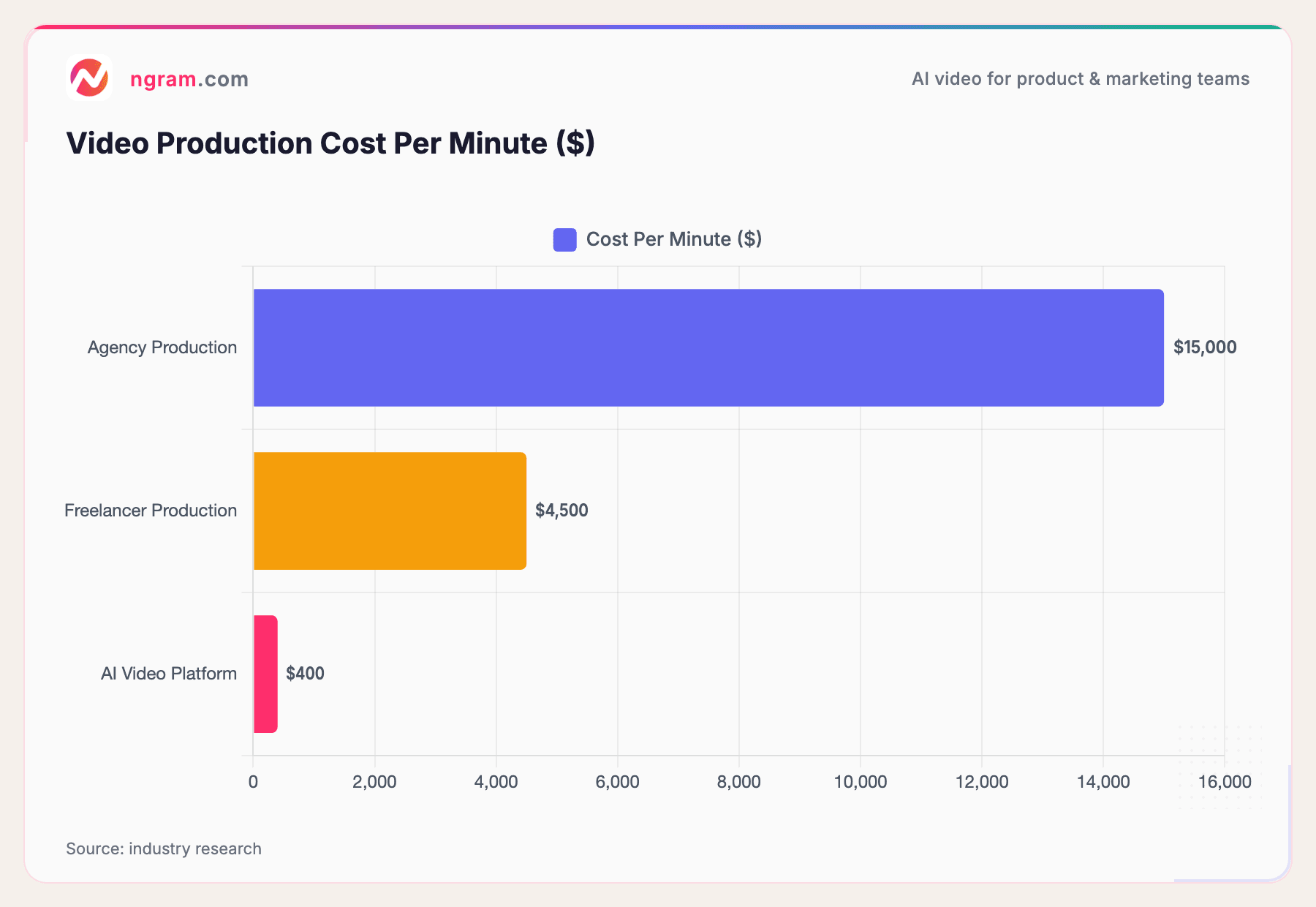
Traditional video production is expensive. Agency production runs $15,000 or more per minute of finished content. Freelancers charge $1,000-$5,000 per minute. An AI video platform like ngram brings that down to roughly $400 per minute - a 91% cost reduction.
Source: industry research
That's not a marginal improvement. It's an order-of-magnitude shift that makes video viable for campaigns that never had the budget for it.
The Speed Advantage
The average time to produce a 60-second marketing video dropped from 13 days to 27 minutes with AI tools. Marketing teams using AI video report 34 hours per week saved on production and editing. That time goes straight back into strategy, testing, and optimization.
The Volume Multiplier
With the same team size, marketing departments using AI video generators create 11x more content per month. A/B testing costs 96% less than traditional methods, which means you can test five hooks, three formats, and two CTAs in the time it used to take to produce a single video.
This is why 78% of marketing teams now use AI-generated video in their campaigns at least quarterly, and 73% of Fortune 500 companies have integrated AI video tools into their workflows.
How Marketing Teams Actually Use AI Video
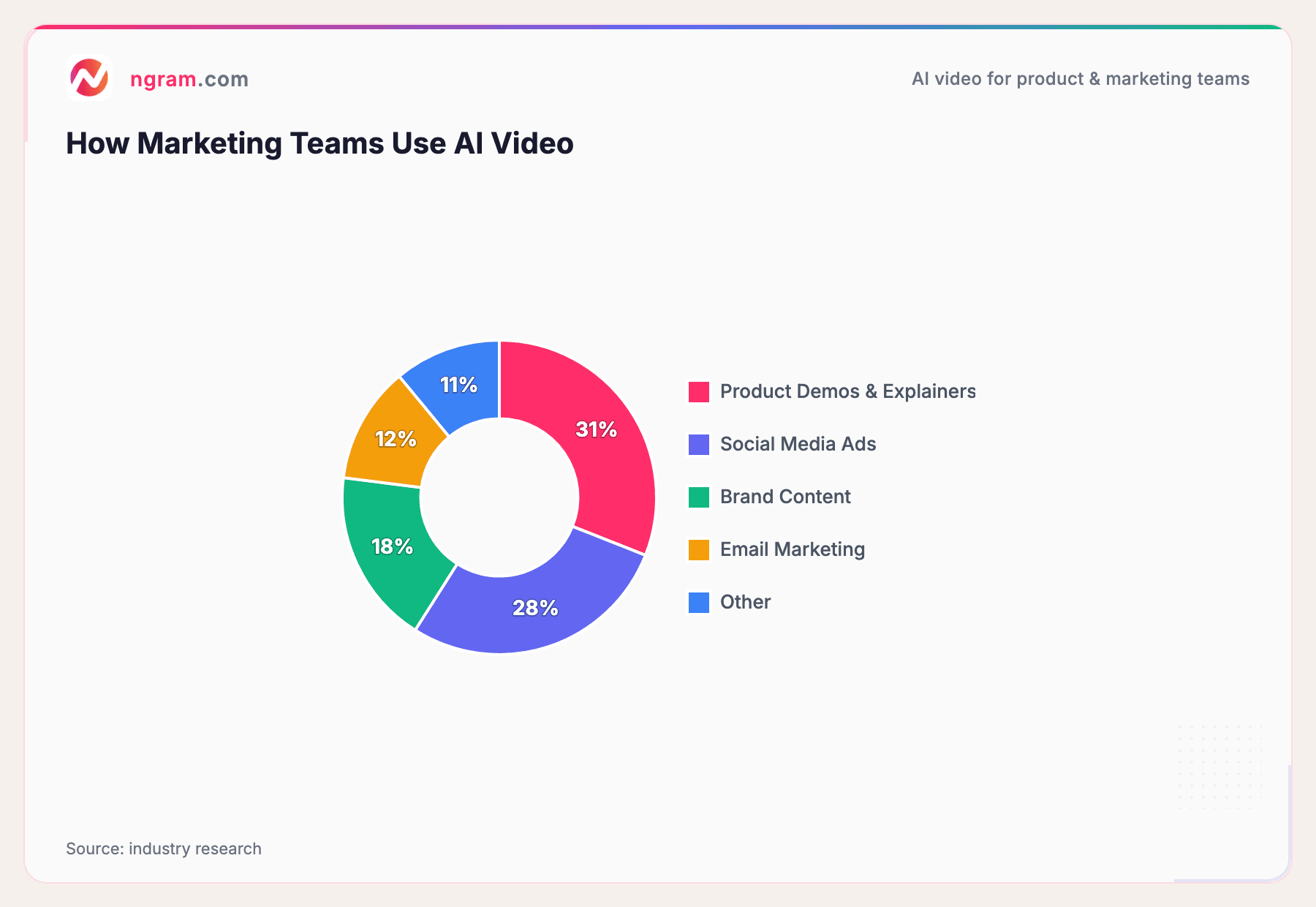
AI video generators aren't a one-trick tool. Marketing teams are deploying them across the entire funnel, from awareness to retention. Here's how the output breaks down.
Source: industry research
Product Demos and Explainers (31%)
The largest use case. Product marketing teams use AI video generators to turn feature documentation, screenshots, and screen recordings into polished demo videos. With ngram, you drop in your raw screen recording and assets, and the platform handles smart cuts, zoom emphasis, callouts, and step labels - turning a rough capture into a walkthrough that looks intentionally produced.
Buyers are 2.3x more likely to purchase after watching a product demo video, and landing pages with explainer videos convert at 34% higher rates.
Social Media Ads (28%)
Short-form video ads are the fastest-growing category. 67% of AI video content is under 60 seconds, and 59% uses vertical 9:16 format - optimized for TikTok, Instagram Reels, and YouTube Shorts.
With ngram, you specify the audience, goal, and destination channel, and the platform adapts structure, length, pacing, and tone for that video. Studio downloads the finished video as MP4. If another system requires MOV, WebM, or MKV, use the separate video converter after export; it changes the file container without reframing the video.
Brand Content (18%)
Announcements, customer stories, case study videos, and thought leadership content. The challenge with brand video has always been consistency - making sure every piece looks and feels on-brand even when different team members create it.
ngram solves this with brand kit capabilities: define your logo, colors, fonts, intro/outro, and lower-thirds once, and every video automatically stays consistent.
Email Marketing (12%)
Personalized video in email campaigns delivers 4.1x higher click-through rates compared to static content. AI video generators make it practical to create personalized clips at scale - something that was completely uneconomical with traditional production.
What Makes an AI Video Generator "Marketing-Ready"
Not every AI video tool is built for marketing workflows. Consumer-focused generators are great for social content and creative experimentation, but marketing teams need specific capabilities.
Here's what to look for:
Context-aware generation. The best marketing video tools don't just accept a prompt - they understand audience, goal, and channel. When you tell ngram you're creating a LinkedIn product launch video for enterprise buyers, it adapts the structure, tone, and pacing accordingly. That's different from a generic "make me a video about X" workflow.
Any-asset-in capability. Marketing teams have existing assets - docs, decks, screenshots, URLs, screen recordings. A marketing-ready AI video generator starts from what you already have, not from a blank page. ngram extracts content from whatever you provide and builds a coherent story from it.
Script and storyboard generation. The hardest part of video isn't the editing - it's deciding what to say and how to structure it. ngram generates a script and scene-by-scene storyboard before rendering, so you can review and adjust the direction before any video is produced. That's where AI script generation saves the most time.
Brand consistency at scale. Every video needs to look like it came from the same team. Brand kits, custom fonts, logo placement, and consistent color schemes should be automatic, not manual.
Team collaboration. Marketing video is rarely a solo effort. Look for shared team workspaces, team invites with role-based access, and a shared asset library so brand kits and footage stay in one place.
Want to see this in action? ngram turns your raw content into polished, on-brand marketing videos in minutes. Try it free
The Real ROI: What Marketing Teams Are Seeing
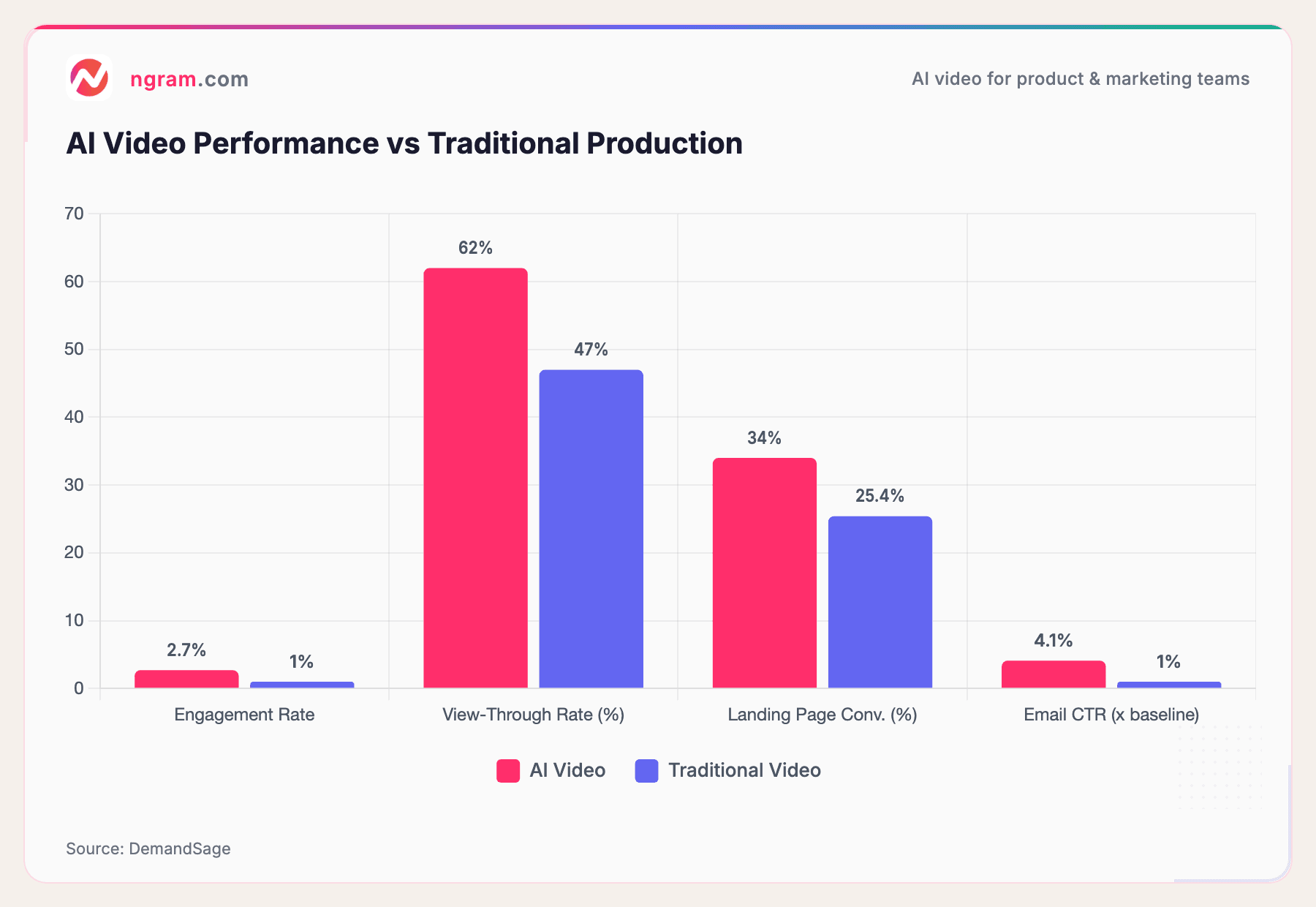
The performance data for AI-generated marketing video is compelling. Across every measured metric, AI video is matching or outperforming traditionally produced content.
Source: DemandSage
Marketing teams report a 4.2x average ROI within the first six months of adopting AI video tools. AI-generated ads see a 62% view-through rate compared to 47% for traditionally produced ads of similar length.
The engagement story is equally strong. AI video content generates 2.7x more engagement than static content, and companies using video grow revenue 49% faster year-over-year compared to those that don't.
These aren't theoretical gains. They're what happens when you can produce more video, test more variants, and publish faster than your competitors.
How to Choose the Right AI Video Generator for Marketing
The right tool depends on your team's primary use case, budget, and existing workflow. Here's a framework for growth marketing teams evaluating their options:
If you need full-funnel marketing video (demos, ads, launches, brand content): ngram is purpose-built for this. It understands marketing context - audience, goal, channel - and plans the video for that situation. You bring your existing assets (docs, screenshots, recordings, URLs), and ngram handles script, storyboard, visuals, and editing. Choose the destination before each edit, then download the finished version as MP4.
If your primary need is avatar-based talking head videos: Platforms like Synthesia and HeyGen specialize in AI avatar presentations, which work well for training, onboarding, and internal communications.
If you're focused exclusively on short-form ad creative: Tools like Creatify and Arcads are built specifically for generating ad variants at scale, with a focus on UGC-style content and performance marketing.
If you need to repurpose existing long-form content: Pictory and similar platforms excel at turning blog posts, webinars, and podcasts into short video clips.
The key differentiator for marketing teams is whether the tool understands marketing intent or just follows generic prompts. ngram's context-aware approach - where you define the audience, goal, and destination before anything is generated - produces videos that feel strategically crafted, not just technically generated.
Getting Started: From Brief to Published Video
Here's the practical workflow for creating marketing videos with an AI video generator like ngram:
- Define your intent. Pick the video type (demo, explainer, announcement, ad), specify your audience, and choose the destination channel. This context shapes everything.
- Add your assets. Drop in whatever you have: a product doc, screenshots, a rough screen recording, a URL, or a slide deck. You don't need polished inputs - ngram extracts what it needs.
- Review the plan. ngram generates a script and scene-by-scene storyboard before rendering. This is the fastest place to iterate - fix direction issues before any video is produced.
- Generate and refine. The platform builds the video using your assets, fills visual gaps with motion graphics and AI-generated visuals, and adds captions, transitions, and pacing. Swap scenes, tweak text, or change style in plain language.
- Export and publish. Download in the right format for your channel, or share it on a brand-styled hosted page and embed it on your site with one line of code. Captions included. Brand kit applied automatically.
The entire process takes minutes, not days. And because the cost per video is a fraction of traditional production, you can create the right video for every message - not just the messages that justify a production budget.
Try ngram free and see how fast your team can produce marketing videos.
Frequently Asked Questions
What is the best AI video generator for marketing?
The best choice depends on your use case. For full-funnel marketing video (product demos, ads, launches, brand content), ngram is built specifically for marketing workflows with context-aware generation that adapts to your audience, goal, and channel. For avatar-based presentations, Synthesia and HeyGen are strong options. For short-form ad creative, Creatify specializes in UGC-style content.
How much does AI video generation cost compared to traditional production?
AI video platforms reduce production costs by roughly 91%. Traditional agency production runs $15,000+ per minute, freelancers charge $1,000-$5,000 per minute, while AI platforms like ngram bring the cost down to approximately $400 per minute. A 10-video social media campaign might cost under $100 with AI versus $100,000+ through a traditional agency.
Can AI-generated marketing videos match the quality of professional production?
For most marketing use cases, yes. AI-generated ads now achieve a 62% view-through rate compared to 47% for traditionally produced ads. The quality gap has narrowed significantly, especially for product demos, social content, and explainer videos. The key advantage is that AI lets you produce 11x more content, which means you can test and optimize far more effectively.
What types of marketing videos can AI generate?
AI video generators handle the full spectrum: product demos and walkthroughs, explainer videos, social media ads (short-form and long-form), brand announcements, customer story videos, email marketing clips, onboarding videos, and ad creative variants. Product demos and explainers account for 31% of AI video output, followed by social media ads at 28%.
How long does it take to create a marketing video with AI?
The average production time for a 60-second marketing video dropped from 13 days (traditional) to 27 minutes with AI tools. With ngram, you can go from raw assets to a polished, on-brand video in under 30 minutes. The script and storyboard generation happens in seconds, and rendering takes just a few minutes.
Is there a free AI video generator for marketing?
Several AI video platforms offer free tiers or trials. ngram offers a free plan that lets you create your first videos without a credit card. Most free tiers have limitations on export quality, video length, or monthly output, but they're enough to evaluate whether the tool fits your workflow before committing to a paid plan.