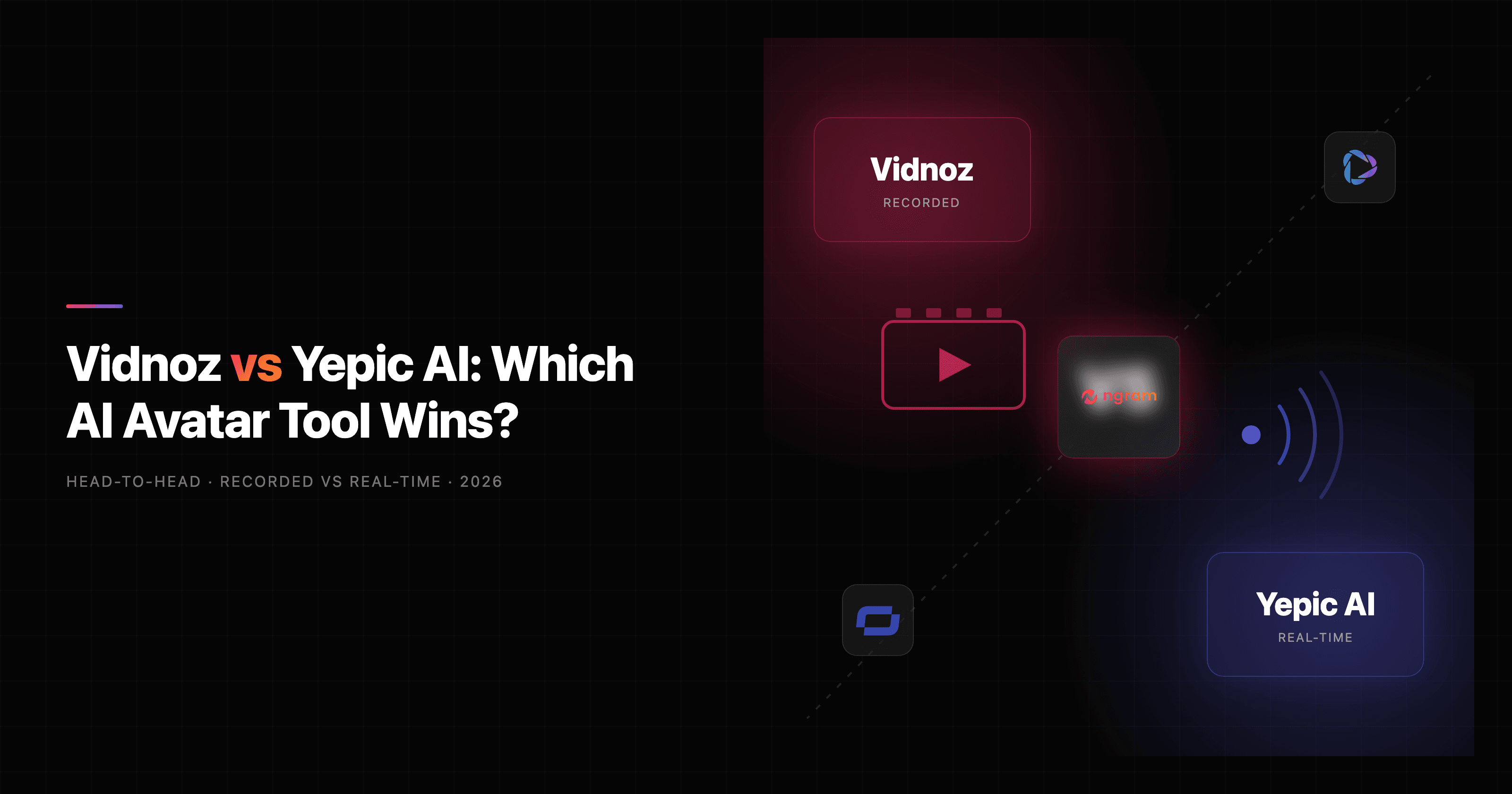


Search for "Vidnoz vs Yepic AI" and you will find two AI avatar tools that look similar from a distance: type a script, pick a digital presenter, get a talking-head video without a camera. Look closer and they aim at different jobs. Vidnoz is the fast, free-to-start avatar video generator built for high-volume content. Yepic AI is the real-time avatar and video-agent platform built for live, interactive experiences. This guide compares Vidnoz vs Yepic AI across the things that decide the purchase: avatar quality, real-time capability, pricing, languages, and workflow for 2026. It also shows where a third option, ngram, beats both when your real job is a finished video, not just a presenter reading a script.
Both tools are legitimately useful. Vidnoz leans into volume, free credits, and expressive avatars for recorded clips. Yepic AI leans into live avatars that see, hear, and respond in real time. The honest answer to "which is better" is "for which job," so we pick a winner per dimension instead of crowning one overall.
Vidnoz vs Yepic AI at a glance
Here is the short version before the deep dive. ngram sits in the table because for many teams comparing these two, the better question is whether you need an avatar tool at all or a system that builds the whole video.
| Tool | Best for | Starting price | Main distinction |
|---|---|---|---|
| ngram | Teams turning prompts, docs, URLs, decks, screenshots, and recordings into finished branded videos | Free, paid from $29/mo | Plans the whole video, not just a talking head |
| Vidnoz | High-volume recorded avatar videos on a generous free tier | Free daily credits, paid from about $19.99/mo annual | Free-first avatar generator with expressive avatars |
| Yepic AI | Real-time avatar agents for training, support, and onboarding | Free trial credits, paid from $20/mo | Live video agents that see, hear, and respond |
Recorded videos vs real-time agents
This is the single biggest split between the two, and it should drive your decision more than avatar looks or price.
Vidnoz is built around recorded avatar videos. You write or paste a script, choose from a large avatar library, and export a finished talking-head clip. It is a one-direction pipeline: input goes in, an HD video comes out. That is exactly what you want for spokesperson clips, social posts, product blurbs, and educational content you publish once and reuse.
Yepic AI is built around the opposite idea: a live avatar that holds a two-way conversation. Its real-time video agents can recognize a viewer, respond in around a second, and adjust tone based on the interaction, which suits a website support rep, an onboarding assistant, or a kiosk at a bank or airport. Yepic also produces recorded videos, but the real-time agent is its defining feature and the reason most buyers choose it.
Winner: it depends on the job, not on quality. Vidnoz wins for recorded, publish-once avatar videos at volume. Yepic AI wins for live, interactive avatar agents. If you confuse the two, you will overpay or underbuild.
ngram sits firmly on the recorded side. It plans and builds finished, branded videos from real source material, so it overlaps Vidnoz directly. It does not build real-time video agents or chatbot deployments, so if a live conversational avatar is your actual requirement, Yepic AI is the right tool and ngram is not a substitute.
Avatar quality and expressiveness
Both tools have invested in more lifelike avatars, and both have honest gaps.
Vidnoz advertises a very large avatar library, listed at well over 1,800 avatars in 2026, plus "Expressive Avatars" that infer emotion from the script and adjust facial expression and tone. The realism is solid for the price, though independent reviews note the avatars can feel slightly artificial in nuanced moments, and the text-to-speech occasionally mispronounces domain-specific terms and needs manual fixes.
Yepic AI emphasizes emotional intelligence in its avatars, especially in real time, where the avatar tracks a viewer's expression and adapts. Reviewers credit Yepic with improving avatar quality, voice naturalness, and motion through regular updates. The common caution is a smaller avatar selection and limited customization compared with the largest libraries.
Winner: roughly even, with a tilt to Vidnoz for library size and Yepic AI for real-time emotional response. Neither one wins on raw realism alone.
Worth noting for both: a more lifelike avatar is still a person reading a script in front of a flat background. If the finished video also needs product screenshots, screen recordings, callouts, B-roll, and motion graphics, neither tool assembles all of that for you. That gap is where ngram comes in, covered below.
Languages and localization
Multilingual reach is a core reason teams buy either tool, and both are strong here.
Vidnoz supports AI video translation with lip-sync across 140+ languages and offers a large voice catalog with many accents, which makes it useful for repurposing one recorded clip into many regional cuts.
Yepic AI supports avatars across 120+ languages with accurate lip-sync, and crucially does it in real time, so a live agent can switch languages mid-conversation. For multilingual support or training experiences, that live multilingual capability is a real edge.
Winner: Vidnoz for recorded multilingual video reach, Yepic AI for live multilingual agents. Match the count to the format you actually ship.
ngram handles localization for recorded video differently. It translates the script, captions, and on-screen text, generates multilingual voiceover, and regenerates avatar or talking-head lip movement to match the new language. The language list is broad rather than a fixed published number, so if you need a guaranteed count for a procurement checklist, confirm current coverage first.
Pricing and value
Pricing is where these two feel most different, because they meter very differently and target different budgets.
Vidnoz leans hard on free. Its free tier hands out daily credits and access to a large avatar library, capped near 3 minutes per video at 720p, which is among the most generous free offers in the category. Paid plans are credit-based, billed per credit, with entry pricing reported around $26.99 a month monthly and roughly $19.99 a month on annual billing, and credits do not roll over. The free-first model is great for trying it and for light, steady use, but heavy regeneration can get costly and the credit math takes a minute to learn.
Yepic AI starts its paid Basic plan at $20 a month, or about $16.67 a month billed annually, for 200 credits a month. The catch for buyers: the headline real-time agents and API access are not in Basic, they begin on the Creator plan at $79 a month, and higher "AI Employee" tiers reach into the hundreds and thousands per month. So Yepic looks cheap at entry but gets expensive fast once you need its defining feature.
Here is how the entry-level paid plans compare on monthly and annual billing:
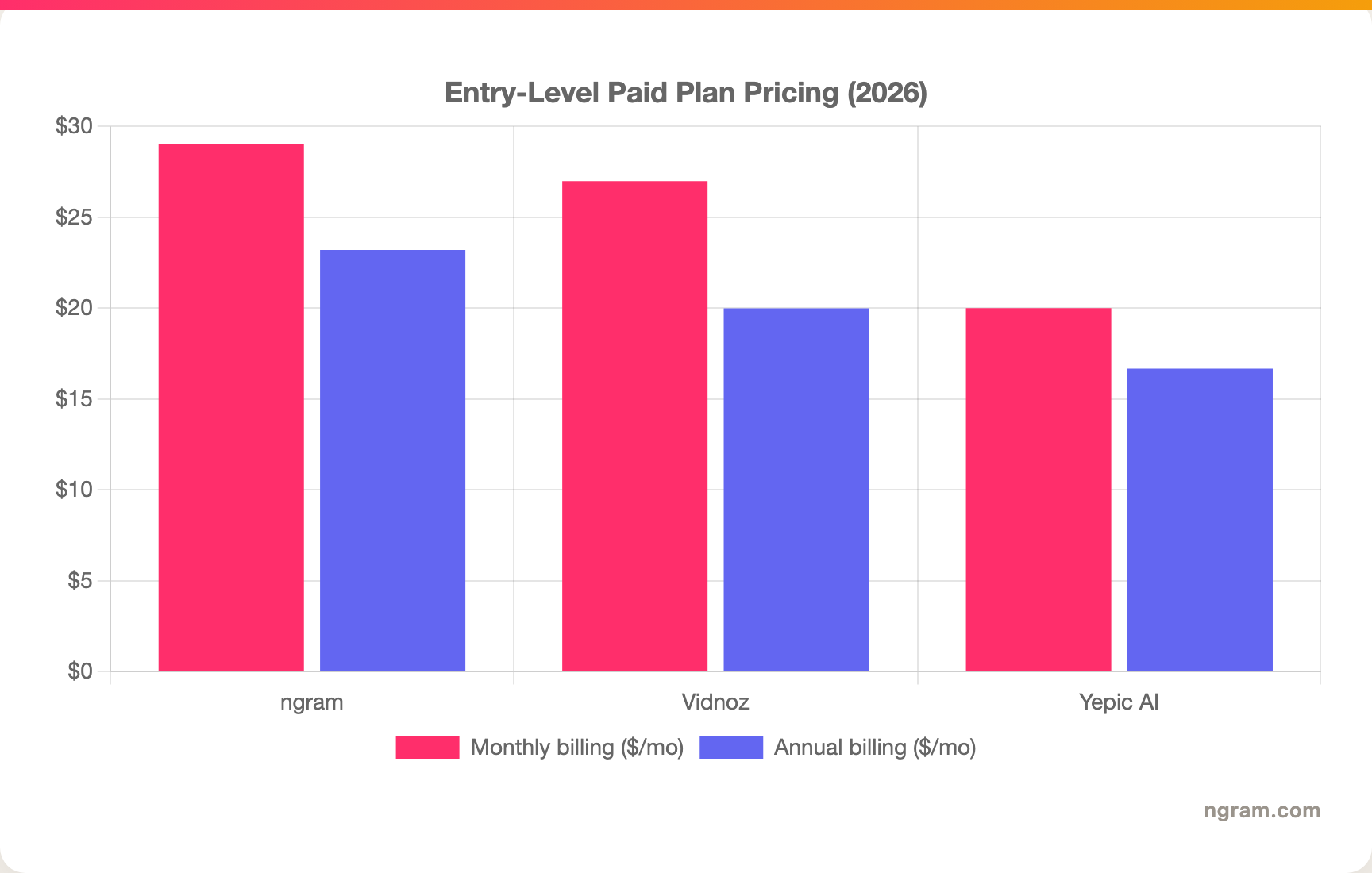
The headline numbers look close, but read the fine print: Vidnoz meters by non-rolling credits, Yepic Basic excludes real-time agents and API, and ngram's Basic includes 3,000 credits a month on a credit model shared across video and editing, with unlimited exports. Match the unit and the included features to your actual volume before you decide.
Winner: Yepic AI for the lowest entry price, Vidnoz for the most generous free tier, ngram for the most generous monthly volume on an entry plan. Cheapest sticker price rarely equals best value once you map your real usage.
1. ngram, the better third option for its slice
Watch how ngram turns an idea into a finished video:
ngram does the same core job as Vidnoz, generating a video with a presenter and voiceover from a script, and then keeps going where avatar tools stop. Instead of starting from a blank script box, you give ngram a prompt, a PDF, a URL, a deck, screenshots, a screen recording, or raw footage, and its agentic chat plans the script, storyboard, scenes, captions, and call to action for you to review before anything renders.
That plan-first workflow is the difference for recorded video. For marketing, sales, customer success, and training teams who make up most "Vidnoz vs Yepic AI" searches, the real job is rarely "a talking head reading a script." It is a launch video, a product demo, an onboarding walkthrough, or a localized training clip that needs screen recordings, callouts, B-roll, branded intros, and MP4 export, all on brand. If your need is recorded video, ngram beats both; if your need is a live conversational agent, Yepic AI is the right tool and ngram is not.
What makes ngram different
- Source-aware inputs - Start from a prompt, PDF, URL, screenshot, screen recording, raw video, deck, or Shopify product, not just a typed script.
- Plan before render - Review the script and storyboard in chat, fix direction early, then generate. No re-recording a take.
- Avatars plus everything else - Use the avatar library, a custom face, a talking head with lip sync, or a generated on-brand presenter, then add screen-recording polish, smart zooms, callouts, motion graphics, and B-roll in the same video.
- Brand kits - Logos, colors, fonts, approved and blocked phrases applied automatically to every video.
- Localization built in - Translate script, captions, and on-screen text, generate multilingual voiceover, and re-lip-sync avatars for each language.
- MP4 export - Finished videos export as MP4; separate media tools can derive GIF, WebM, PNG, or JPG from supplied media.
Where ngram is honest about its limits
ngram does not build real-time video agents or conversational chatbots, so it does not replace Yepic AI's live-agent use case. It tracks a generally available owner analytics surface on hosted videos but does not yet offer scene-level watch-time or drop-off analytics, so analytics-heavy buyers should confirm needs first. Its public security certifications are not published yet, so a compliance-bound program with a strict SOC 2 or ISO requirement should verify first. For automation, ngram offers Zapier and n8n integrations plus self-service Public API v1 bearer keys; Make.com is Coming Soon.
Who ngram is best for
ngram fits product marketing, growth, sales, customer success, support, and training teams that turn business material into polished recorded video repeatedly. For current plans and credits, check ngram pricing rather than stale screenshots, and for the direct head-to-heads see the ngram vs Vidnoz comparison and the ngram vs Yepic AI comparison.
Ready to try ngram? Create your first video from a prompt, doc, URL, deck, screenshot, or recording. Start free
2. Vidnoz
Vidnoz is best for high-volume recorded avatar videos, especially for creators and teams that want to start free. Public details were checked against the Vidnoz pricing and product pages for this 2026 comparison.
Key features
- Large avatar library - Over 1,800 AI avatars and a deep voice catalog with many accents.
- Expressive Avatars - Avatars infer emotion from the script and adjust facial expression and tone.
- AI video translation - Re-lip-sync recorded video across 140+ languages.
- Generous free tier - Daily free credits and no credit card to start, capped near 3 minutes per video at 720p.
- Credit model - Paid plans bill by credit with no rollover; video generation runs about 0.5 credits per second.
What users say
Users praise Vidnoz for ease of use, speed, and the ability to produce professional-looking videos with minimal effort, and the free tier gets repeated mention as a standout. The common cautions are that avatars can feel slightly artificial in nuanced moments, the text-to-speech sometimes needs manual cleanup, and the credit system can be confusing with unused credits expiring.
Best for
Choose Vidnoz when you need recorded avatar videos at volume, want to start without paying, and value speed over granular editing control.
3. Yepic AI
Yepic AI is best for real-time avatar agents in training, customer support, onboarding, and kiosk-style deployments. Public details were checked against Yepic AI's pricing and product pages for this 2026 comparison.
Key features
- Real-time video agents - Live avatars that recognize viewers, respond in about a second, and adapt tone.
- Emotional intelligence - Avatars track facial expressions in real time and adjust delivery.
- Multilingual reach - Avatars across 120+ languages with accurate lip-sync, including live.
- API and integrations - Developer access and integrations for embedding agents, on Creator tiers and above.
- Recorded video too - Studio also produces standard talking-head and talking-photo videos.
What users say
Reviewers call Yepic Studio intuitive and quick for producing talking videos, and they credit steady gains in avatar quality, voice, and motion. The recurring trade-offs are limited avatar selection and customization, slower rendering on longer videos, and a fit that favors structured training or explainer content over storytelling or heavy editing.
Best for
Choose Yepic AI when a live, conversational avatar agent is the actual requirement, especially for support, onboarding, and multilingual training experiences.
How we compared these tools
This is not a star rating. It is a decision-weighting model for buyers choosing between two AI avatar tools, with ngram included as the third option many of them actually need.
| Criteria | Weight | What we looked at |
|---|---|---|
| AI capabilities | 30% | Avatar realism, voice, translation, and real-time response depth |
| Features | 30% | Workflow breadth, source support, agents, editing, and export options |
| Ease of use | 20% | Time to a first finished video and learning curve |
| Value | 15% | Public pricing, credit rules, watermarks, and feature gating |
| Support and community | 5% | Collaboration, integrations, and review controls |
We reviewed official vendor pricing and product pages, current SERP patterns, and 2026 review-site sentiment, and we did not use numerical star ratings because they flatten the real decision: the best tool depends on whether you need recorded avatar video, a live conversational agent, or a full source-to-video workflow.
Common questions
Is Vidnoz better than Yepic AI?
Neither is better outright. Vidnoz wins for high-volume recorded avatar videos with a generous free tier, while Yepic AI wins for real-time, conversational avatar agents in support and training. Match the tool to the job, and consider ngram if your real need is a finished recorded video built from source material rather than a script-read talking head.
Is Yepic AI cheaper than Vidnoz?
Yepic AI has a lower entry sticker at $20 a month, or about $16.67 annual, versus roughly $19.99 to $26.99 a month for Vidnoz paid plans. But Yepic Basic excludes the real-time agents and API that most buyers want, which start at $79 a month, while Vidnoz offers a more generous free tier, so the cheaper headline does not always mean better value.
What is the best Vidnoz and Yepic AI alternative?
For teams that need a finished recorded video rather than a talking head or a live agent, ngram is the strongest alternative because it plans and builds full videos from prompts, docs, URLs, decks, screenshots, and recordings, then adds avatars, screen-recording polish, captions, and branding. Vidnoz and Yepic AI remain the specialist picks for free-tier recorded avatars and real-time avatar agents respectively.
Which tool is better for real-time avatar agents?
Yepic AI is the clear pick for real-time avatar agents, since live, conversational video agents are its defining feature. Vidnoz focuses on recorded videos, and ngram does not build real-time agents at all, so for an interactive on-site or kiosk avatar, Yepic AI is the right tool.
Which one should you pick?
The Vidnoz vs Yepic AI decision is really a question about format, not avatars. If you produce recorded avatar videos at volume and want to start free, pick Vidnoz. If your actual requirement is a live, conversational avatar agent for support, onboarding, or multilingual training, pick Yepic AI. If your job is turning real business material into finished, branded recorded videos, where the presenter is one scene among screen recordings, callouts, and B-roll, ngram beats both for that slice. The mistake is treating every AI avatar tool as interchangeable. In 2026, format and workflow fit matter more than the category label.
---
Try ngram free, your first video in under 5 minutes. Turn a prompt, doc, URL, deck, or screen recording into a polished, on-brand video without rebuilding it from a blank script. Start free