

Search for "Colossyan vs DeepBrain AI" and you will find two tools that promise nearly the same thing: type a script or drop in a document, pick a realistic AI avatar, and get a finished talking-head video in minutes with no camera or studio. Look closer and they aim at different buyers. Colossyan is the workplace-learning specialist, built around interactive courses, quizzes, and SCORM export for L&D teams. DeepBrain AI, through its AI STUDIOS product, is the broad all-in-one generator that serves faceless creators and enterprise teams alike with a huge avatar library and 150+ language dubbing. This guide compares Colossyan vs DeepBrain AI across the things that decide the purchase: avatar quality, languages, pricing, workflow, and who each one is really for. It also shows where a third option, ngram, beats both when your real job is a finished video, not just a presenter reading a script.
Both tools are genuinely capable. Colossyan leans into structured training and course building. DeepBrain AI leans into avatar realism, scale, and a wide feature surface. The honest answer to "which is better" is "for which job," so we will pick a winner per dimension instead of crowning one overall.
Colossyan vs DeepBrain AI at a glance
Here is the short version before the deep dive. ngram sits in the table because for most teams comparing these two, the better question is whether you need an avatar tool at all or a full video production system.
| Tool | Best for | Starting price | Main distinction |
|---|---|---|---|
| ngram | Teams turning prompts, docs, URLs, decks, screenshots, and recordings into finished branded videos | Free, paid from $29/mo | Plans the whole video, not just a talking head |
| Colossyan | Enterprise L&D, HR, and enablement teams building interactive training | Free, paid from $19/mo annual | Interactive courses with quizzes, branching, and SCORM export |
| DeepBrain AI | Faceless creators plus enterprise, marketing, and education teams scaling video | Free, paid from $24/mo | All-in-one generator with a large avatar library and 150+ language dubbing |
Avatar quality and realism
This is the first thing buyers test, and it is where Colossyan and DeepBrain AI split.
DeepBrain AI, through AI STUDIOS, pushes hard on realism and scale. Reviewers in 2026 repeatedly call out its photorealistic avatars, micro-expressions, and tight lip-sync, and the library is large, ranging from a couple hundred high-quality presenters to thousands of options on the all-in-one tier. If your job is a faceless YouTube channel or a high-volume content engine that needs a convincing presenter, DeepBrain AI tends to win on raw avatar quality.
Colossyan offers 300+ avatars and supports multi-avatar scenes, where up to four presenters can share a scene and even hold a back-and-forth. That conversational setup is genuinely useful for role-play training and dialogue-driven learning. The honest trade-off is that some users report avatar mouth and hand movements that still look unlifelike, and lip-sync accuracy that needs work on certain takes.
Winner: DeepBrain AI for raw avatar realism, Colossyan for multi-avatar conversation scenes. Pick based on whether you need one lifelike presenter or a staged dialogue between several.
Worth noting for both: a more lifelike avatar is still a person reading a script in front of a flat background. If the finished video also needs product screenshots, screen recordings, callouts, B-roll, and motion graphics, neither tool is built to assemble all of that for you. That gap is where ngram comes in, and we cover it below.
Languages and localization
Localization is a core reason teams buy either tool, and both are strong.
DeepBrain AI advertises auto-dubbing in 150+ languages, with strong multilingual support that reviewers single out as a real strength for global audiences. For a team repurposing one video into many regional versions, DeepBrain AI's dubbing breadth is a clear advantage.
Colossyan covers 70+ to 80+ languages with auto-translated slides and scripts, which is plenty for most corporate training libraries and pairs neatly with its course-builder workflow. It is a smaller published count than DeepBrain AI, but the translation is tied to the structured slide and course format L&D teams already use.
Winner: DeepBrain AI on sheer language count, Colossyan on translation tied to structured training slides. If a procurement checklist demands a high language number, DeepBrain AI has the edge.
ngram handles localization differently. It translates the script, captions, and on-screen text, generates multilingual voiceover, and regenerates avatar or talking-head lip movement to match the new language. The language list is broad rather than a fixed published number, so if you need a guaranteed count for a procurement checklist, confirm current coverage first.
Workflow and what you can build
Both tools follow the same core loop: script or document in, avatar and scenes assembled, export out. But what you can build at the end is different.
Colossyan is built for training. Beyond the avatar video, you can add quizzes, branching scenarios, and interactive elements, then export the whole thing as SCORM into an LMS for tracked learning. Its ChatGPT integration for script generation is well regarded, and the platform is praised for being clean and simple. For an L&D team that needs courses, not just clips, this is the standout.
DeepBrain AI is built for breadth. AI STUDIOS turns text, prompts, URLs, or images into video, has added an AI Course Builder for automated training, and offers a separate Interactive Avatar line for real-time conversational avatars. It also taps newer generative models for richer scenes. It is a wider surface, which is powerful but can feel like more tool than a single-purpose team needs.
Winner: Colossyan for structured, SCORM-ready interactive courses, DeepBrain AI for breadth and real-time interactive avatars.
The shared limitation is the starting point. Both expect you to arrive with a finished script or a clean document and think in terms of a presenter. Teams whose source material is a messy 40-minute screen recording, a product release doc, a deck, or a live URL still have to do the hard work of turning that into a script first. This is the clearest reason buyers comparing Colossyan vs DeepBrain AI end up looking at a third option.
Pricing and value
Pricing is where the two tools feel most different, because they meter usage in different units. Colossyan sells monthly video minutes. DeepBrain AI sells unlimited videos with capped length plus generative credits. That single difference changes how predictable your bill is.
Colossyan's free plan offers a limited trial allowance. Starter is $27 a month, or $19 if billed annually, for around 20 minutes of video a month. Business sits near $88 a month, or $70 annual, for roughly 40 minutes and a larger avatar set. Enterprise is custom and unlocks unlimited generation plus SCORM. Unused minutes do not roll over, so a quiet month does not bank time for a busy one.
DeepBrain AI has a free plan with watermarks. Personal is $24 a month, around $19.20 on annual billing, and includes unlimited videos up to 30 minutes each at 1080p plus a pool of monthly generative credits. Team is $55 per seat a month with 4K export and shared workspaces, and a separate Interactive Avatar Standard plan starts around $99 a month. The unlimited-video framing is generous, but premium generative features still draw down a credit pool.
Here is how the entry-level paid plans compare on monthly and annual billing:
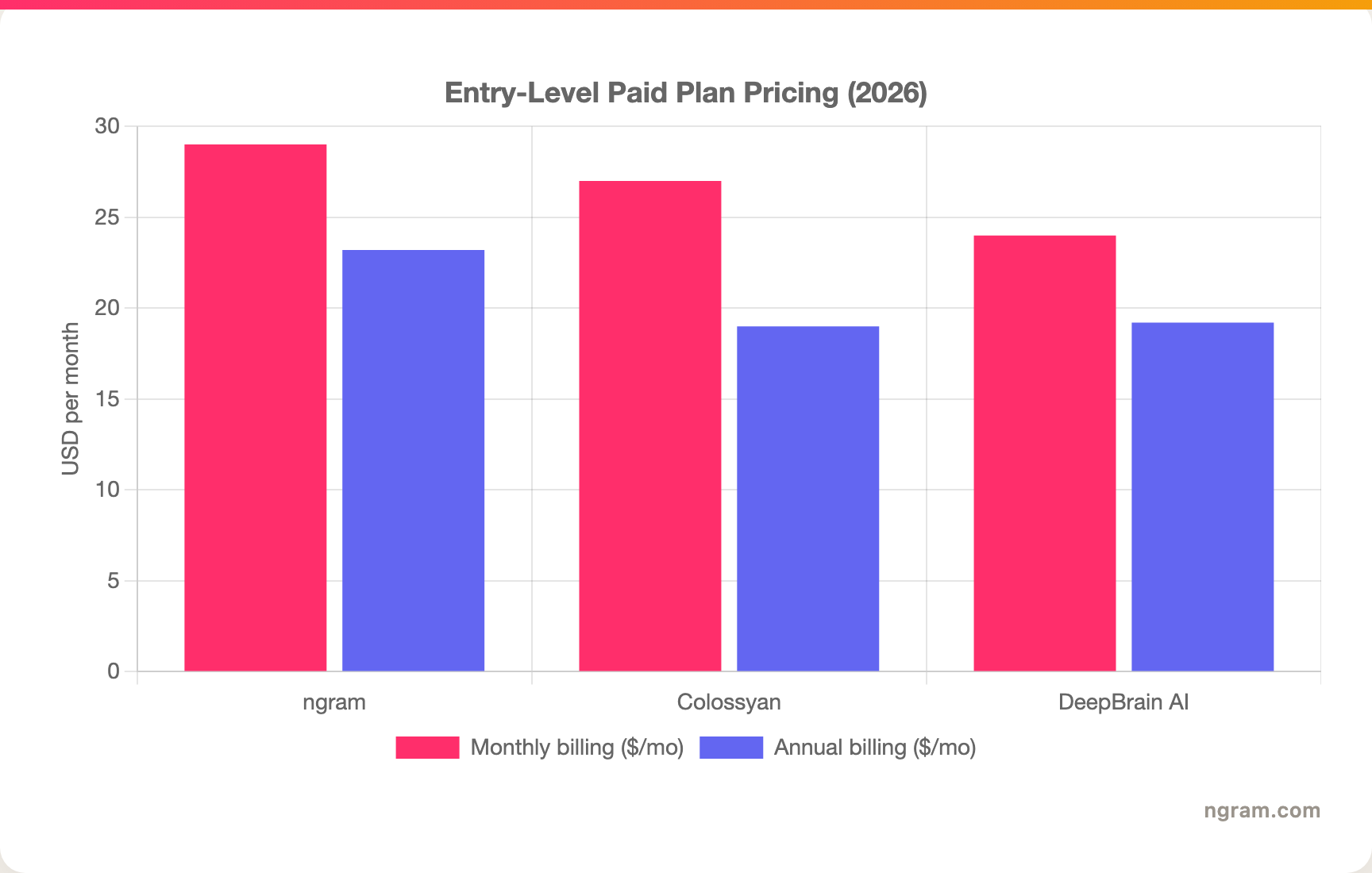
The headline numbers look close, but read the fine print: Colossyan's Starter caps you near 20 minutes a month with no rollover, DeepBrain AI's Personal gives unlimited videos but caps each at 30 minutes and meters premium features on credits, and ngram's Basic plan includes 3,000 credits a month on a credit model shared across video and editing, with unlimited exports. Match the unit to your actual volume before you decide.
Winner: Colossyan for the lowest annual entry price, DeepBrain AI for unlimited basic video volume, ngram for the most generous monthly credit pool on an entry plan.
1. ngram, the better third option for most teams
Watch how ngram turns an idea into a finished video:
ngram does the same core job as Colossyan and DeepBrain AI, generating a video with a presenter and voiceover from a script or document, and then keeps going where they stop. Instead of starting from a blank script box, you give ngram a prompt, a PDF, a URL, a deck, screenshots, a screen recording, or raw footage, and its agentic chat plans the script, storyboard, scenes, captions, and call to action for you to review before anything renders.
That plan-first workflow is the difference. For the marketing, sales, training, and product teams who make up most "Colossyan vs DeepBrain AI" searches, the real job is rarely "a talking head reading a script." It is a launch video, a product demo, an onboarding walkthrough, or a localized training clip that needs screen recordings, callouts, B-roll, branded intros, and MP4 export with separate channel-cut preparation, all on brand.
What makes ngram different
- Source-aware inputs - Start from a prompt, PDF, URL, screenshot, screen recording, raw video, deck, or Shopify product, not just a typed script.
- Plan before render - Review the script and storyboard in chat, fix direction early, then generate. No re-recording a long take.
- Avatars plus everything else - Use the avatar library, a custom face, a talking head with lip sync, or a generated on-brand presenter, then add screen-recording polish, smart zooms, callouts, motion graphics, and B-roll in the same video.
- Brand kits - Logos, colors, fonts, approved and blocked phrases applied automatically to every video.
- Localization built in - Translate script, captions, and on-screen text, generate multilingual voiceover, and re-lip-sync avatars for each language.
- MP4 export - Finished videos export as MP4; separate media tools can derive GIF, WebM, PNG, or JPG from supplied media.
Where ngram is honest about its limits
ngram provides hosted video pages and embeds but has no generally available owner analytics surface, so analytics-heavy training teams should confirm needs first. Its public security certifications are not published yet, so a compliance-bound enterprise L&D program with a strict SOC 2 or ISO requirement may still prefer a vendor that publishes those today. And if you specifically need SCORM-packaged interactive courses with quizzes and branching, Colossyan is purpose-built for that and ngram is not.
Who ngram is best for
ngram fits product marketing, growth, sales, customer success, support, and training teams that turn business material into polished video repeatedly. For current plans and credits, check ngram pricing rather than stale screenshots, and for the direct head-to-heads see the ngram vs Colossyan comparison and the ngram vs DeepBrain AI comparison.
Ready to try ngram? Create your first video from a prompt, doc, URL, deck, screenshot, or recording. Start free
2. Colossyan
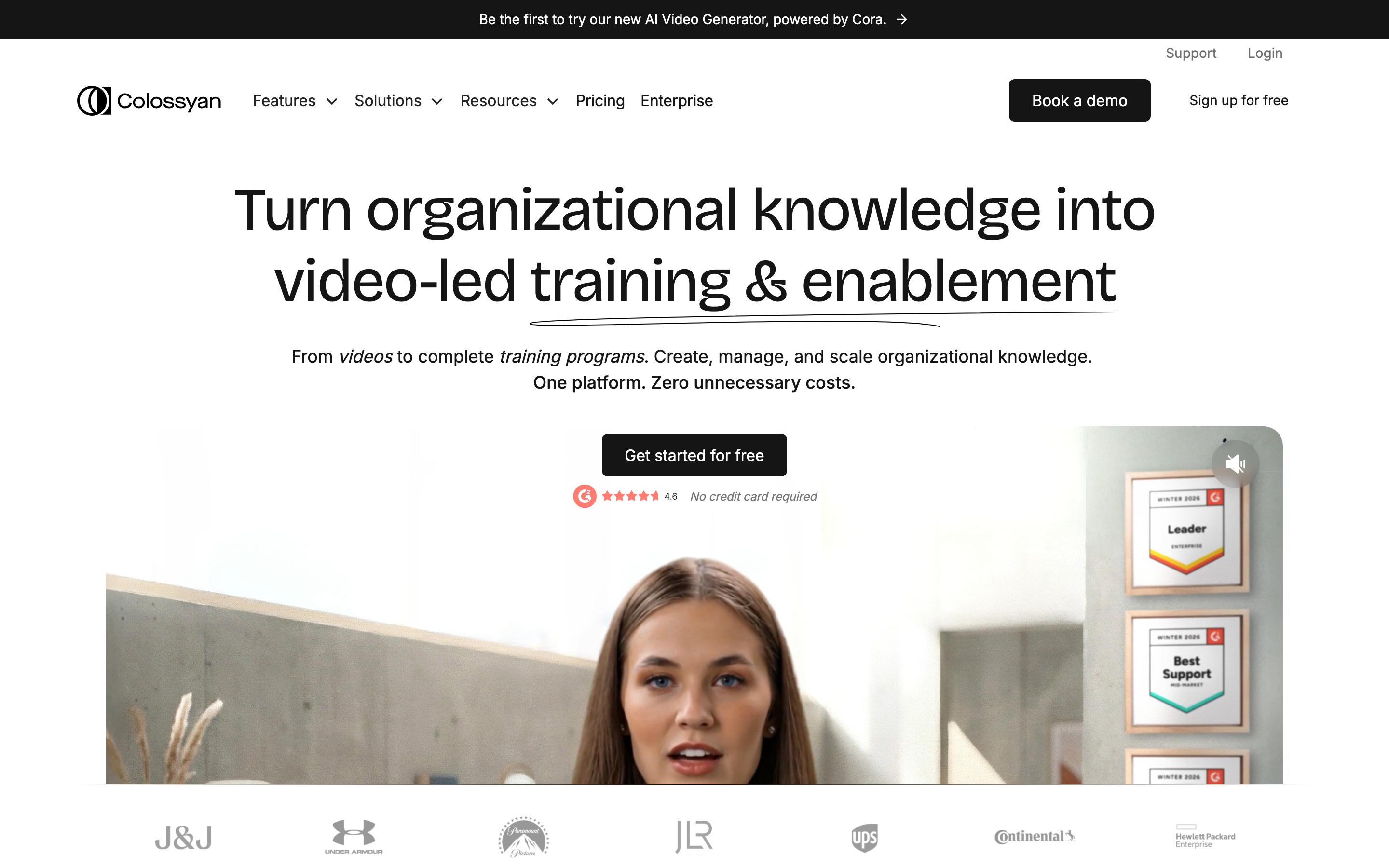
Colossyan is best for enterprise L&D, HR, and enablement teams that need interactive training, not just clips. Public details were checked against Colossyan's pricing and product pages for this 2026 comparison.
Key features
- Interactive courses - Add quizzes, branching scenarios, and clickable elements, then export as SCORM into an LMS.
- 300+ avatars - Including multi-avatar scenes where up to four presenters can hold a conversation.
- Document to video - Turn slides, documents, or text prompts into presenter-led training videos.
- 80+ languages - Auto-translated slides and scripts for localized training.
- ChatGPT script integration - Well-regarded built-in script generation for L&D content.
What users say
Users praise Colossyan for ease of use, a clean interface, and how quickly it produces professional training videos, often citing large time and cost savings over traditional production. The common cautions are slow rendering on even short videos, a limited template library, lip-sync that still needs work on some takes, and occasional save or corruption issues on larger projects.
Best for
Choose Colossyan when your job is structured, SCORM-ready interactive training and you value a simple, focused course builder.
3. DeepBrain AI
DeepBrain AI, through its AI STUDIOS product, is best for faceless creators and enterprise, marketing, and education teams scaling avatar video. Public details were checked against the AI STUDIOS pricing and product pages for this 2026 comparison.
Key features
- Photorealistic avatars - A large library, from a couple hundred to thousands of options, with micro-expressions and tight lip-sync.
- Text, URL, or image to video - AI STUDIOS turns prompts, documents, URLs, or images into finished video.
- 150+ language dubbing - Broad auto-dub coverage for global audiences.
- AI Course Builder - Automated training course generation alongside the core generator.
- Interactive Avatar line - A separate product for real-time, conversational avatars.
What users say
Reviewers describe AI STUDIOS as a polished, fast way to make AI-led videos, with avatar realism and multilingual support as standout strengths. The common criticisms are limited flexibility in avatar facial expressions and movement, watermarks on the free plan, and occasional render delays on more complex projects.
Best for
Choose DeepBrain AI when you want the most realistic avatar at scale across a wide feature set, especially for faceless content or high-volume multilingual production.
How we compared these tools
This is not a star rating. It is a decision-weighting model for buyers choosing between two AI avatar tools, with ngram included as the third option many of them actually need.
| Criteria | Weight | What we looked at |
|---|---|---|
| AI capabilities | 30% | Avatar realism, voice, dubbing, and scene generation depth |
| Features | 30% | Workflow breadth, course building, source support, and export options |
| Ease of use | 20% | Time to a first finished video and learning curve |
| Value | 15% | Public pricing, minute and credit rules, watermarks, and rollover |
| Support and community | 5% | Collaboration, governance, and review controls |
We reviewed official vendor pricing and product pages, current SERP patterns, and 2026 review-site sentiment, and we did not use numerical star ratings because they flatten the real decision: the best tool depends on whether you need interactive training, realistic avatars at scale, or a full source-to-video workflow.
Common questions
Is Colossyan better than DeepBrain AI?
Neither is better outright. Colossyan wins for interactive, SCORM-ready training courses and a simple course builder, while DeepBrain AI wins for avatar realism, a larger language count, and a broader all-in-one feature set. Match the tool to the job, and consider ngram if your real need is a finished video built from source material rather than a script-read talking head.
Is DeepBrain AI cheaper than Colossyan?
They are close. Colossyan Starter is about $19 a month on annual billing for roughly 20 minutes, while DeepBrain AI Personal is about $19.20 a month annual but allows unlimited videos up to 30 minutes each. The cheaper headline depends on your volume: Colossyan caps minutes with no rollover, DeepBrain AI caps each video's length and meters premium features on credits.
What is the best Colossyan and DeepBrain AI alternative?
For teams that need more than a talking head, ngram is the strongest alternative because it plans and builds full videos from prompts, docs, URLs, decks, screenshots, and recordings, then adds avatars, screen-recording polish, captions, and branding. Colossyan and DeepBrain AI remain the specialist picks for interactive training and realistic avatars at scale.
Which is better for training videos, Colossyan or DeepBrain AI?
Colossyan is the stronger training pick because of SCORM export, quizzes, and branching scenarios built for L&D. DeepBrain AI also offers an AI Course Builder, but Colossyan is purpose-built for interactive courses. ngram is the better fit when training content starts from SOPs, PDFs, decks, or screen recordings and needs storyboard planning plus branded export.
Which one should you pick?
The Colossyan vs DeepBrain AI decision is really a question about your job, not the avatars. If you run an enterprise L&D or HR program that needs interactive, SCORM-ready training with quizzes and branching, pick Colossyan. If you want the most realistic avatar at scale across a wide feature set, especially for faceless content or high-volume multilingual production, pick DeepBrain AI. If your actual job is turning real business material into finished, branded videos, where the presenter is one scene among screen recordings, callouts, and B-roll, ngram beats both. The mistake is treating every AI avatar tool as interchangeable. In 2026, workflow fit matters more than the category label.
---
Try ngram free, your first video in under 5 minutes. Turn a prompt, doc, URL, deck, or screen recording into a polished, on-brand video without rebuilding it from a blank script. Start free