

Search for "Opus Clip vs Vizard" and you will find two tools built for the same job: take a long recording and turn it into many short clips for social. They overlap more than most comparison pairs, which is exactly why the differences matter. Opus Clip leans on multimodal AI to find and rank viral moments. Vizard leans on the transcript, letting you pick clips by highlighting text and pricing by hours of upload instead of processing minutes. This guide compares Opus Clip vs Vizard across the things that actually decide the purchase: how each finds clips, the editing experience, pricing, and workflow. It also shows where a third option, ngram, fits when your real job is a finished branded video built from source material, not just a stack of auto-cut clips.
Both tools are legitimately good at repurposing long-form video. Opus Clip is the more famous viral-clip engine; Vizard is the transcript-first workhorse that content teams like for volume. The honest answer to "which is better" depends on how you prefer to find and edit clips and how your usage is measured, so we pick a winner per dimension instead of crowning one overall.
Opus Clip vs Vizard at a glance
Here is the short version before the deep dive. ngram sits in the table because for many teams comparing these two, the better question is whether you need a clipper or a system that builds the whole video and its short-form cuts.
| Tool | Best for | Starting price | Main distinction |
|---|---|---|---|
| ngram | Teams turning prompts, docs, URLs, decks, and recordings into finished branded videos and short-form variants | Free, paid from $29/mo | Plans and builds the whole video, not just clips |
| Opus Clip | Creators and podcasters who want ranked viral clips from long videos | Free, paid from $15/mo | Multimodal ClipAnything with a virality score |
| Vizard | Content teams clipping webinars and podcasts at volume with transcript editing | Free, paid from $19/mo | Transcript-based clipping priced by upload hours |
How each one finds clips
This is the first thing buyers test, and it is the core difference between the two.
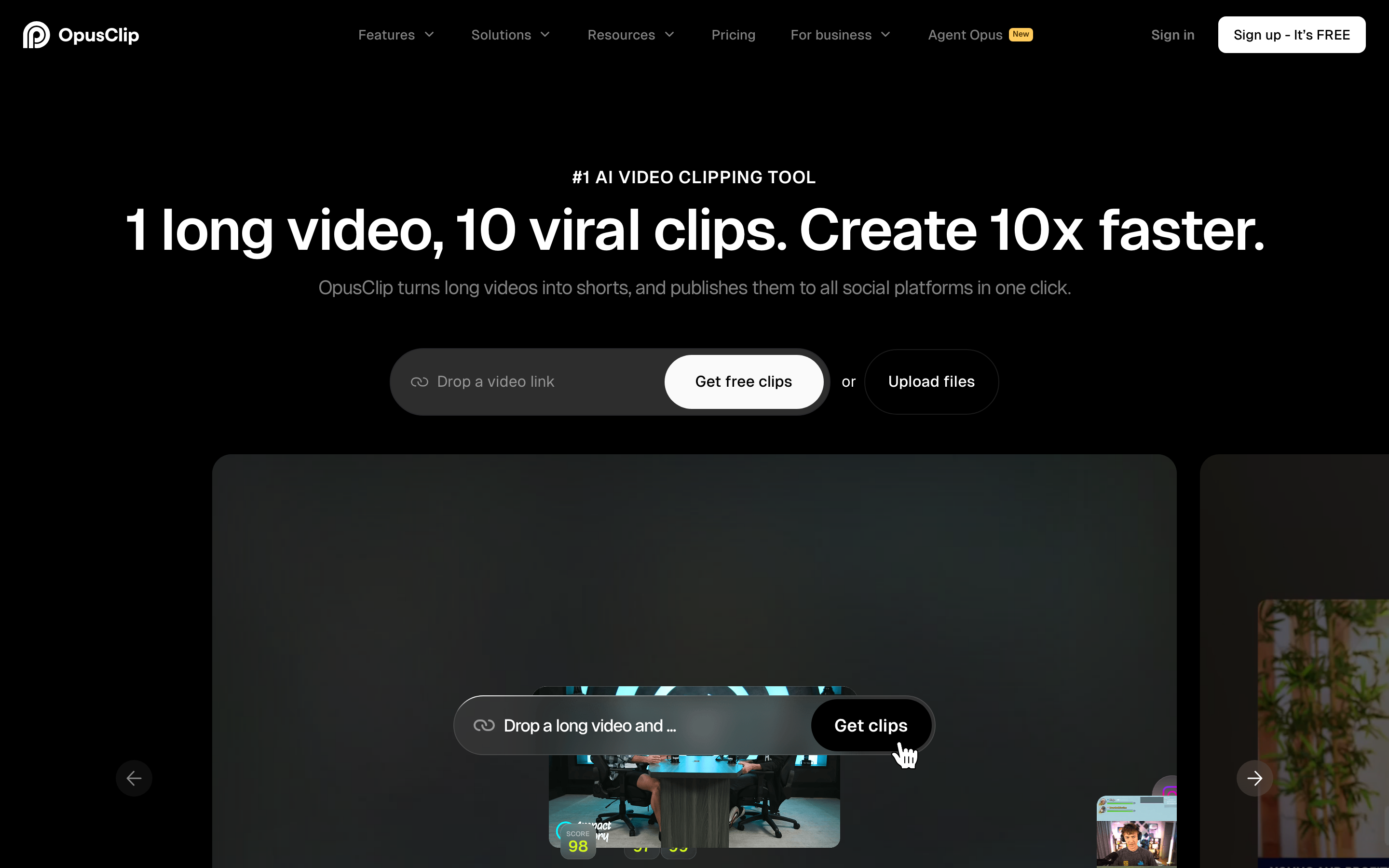
Opus Clip's ClipAnything model reads visual, audio, and sentiment cues to find clip-worthy moments, then assigns each clip a virality score so you know which to post first. It is less dependent on clean speech, so it can surface a strong visual moment even when the transcript alone would not flag it. For a creator who wants the tool to make the editorial call about what is interesting, Opus Clip is the stronger pick.
Vizard's clipping relies mainly on transcript analysis and keyword detection, paired with a transcript-based editor where you select a clip by highlighting the text rather than scrubbing the timeline. That approach is fast and precise for talk-heavy content like webinars, interviews, and podcasts, and editors who think in words rather than frames tend to prefer it. It is less suited to finding purely visual moments where nothing is being said.
Winner: Opus Clip for multimodal moment-finding and ranking, Vizard for transcript-driven precision on talk-heavy footage. Pick based on whether you want the AI to judge what is interesting or you want to choose it yourself from the transcript.
Worth noting for both: a clip is still a slice of an existing recording. If the finished video also needs a written script, branded intros, generated B-roll, and on-screen callouts, neither tool is built to plan that for you. That gap is where ngram comes in, and we cover it below.
Editing and output
Once clips exist, you still have to finish them, and the two tools take different routes.
Opus Clip's editor focuses on reframing, layouts, captions, and a social scheduler on higher tiers, with AI B-roll available on Pro. Its captions are accurate but offer fewer styling options than dedicated caption tools, so brand-conscious creators sometimes do a second pass elsewhere. The strength is speed from raw video to a ready-to-post vertical clip.
Vizard's transcript editor makes trimming and rearranging fast because you edit the words, and it outputs social-ready clips with captions, layouts, and custom branding on paid tiers. For a content team producing many clips a week from recurring webinars, that text-first editing keeps the pipeline moving.
Winner: roughly even, with a tilt to Opus Clip for AI-assisted finishing and Vizard for fast transcript-based trimming.
ngram handles editing differently. After the agent plans and generates a draft, you refine it through agentic chat or a full timeline editor, and you can repurpose a source recording into short-form with branded captions in the same project rather than exporting to a separate finishing tool.
Pricing and value
Pricing is where the two tools feel most different, because they meter usage in different units. Opus Clip sells processing minutes. Vizard sells hours of upload. That single difference changes which one is cheaper for your volume.
Opus Clip's free plan gives 60 processing minutes a month with watermarked exports that expire from storage quickly. Starter is around $15 a month for 150 processing minutes, watermark-free exports, virality scores, and full clipping modes. Pro at $29 a month adds all aspect ratios, a social scheduler, team workspace, AI B-roll, and 1080p export. Business is custom with API access.
Vizard's free plan allows a small number of uploads a month with a watermark and short export caps. Creator is around $19 a month, or roughly $14.50 on annual billing, for about 30 hours of upload with no watermark. Pro or Business runs around $39 to $42 a month for roughly 100 hours of upload, HD, and custom branding. Enterprise is custom. Vizard markets annual billing aggressively, positioning it as several months free.
Here is how the entry-level paid plans compare on monthly and annual billing:
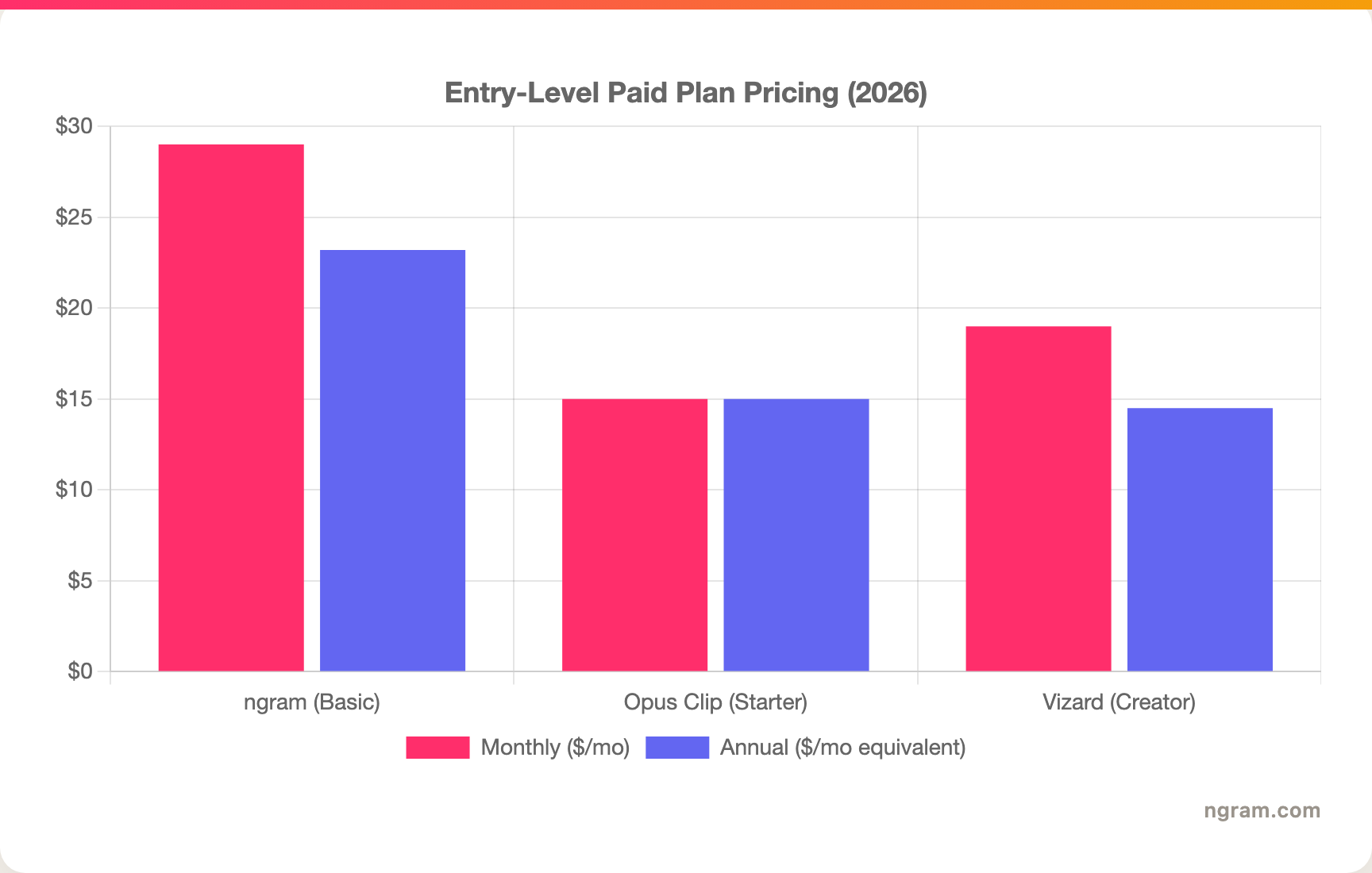
The headline numbers are close, but read the units: Opus Clip's Starter buys you processing minutes, Vizard's Creator buys you hours of source upload, and ngram's Basic plan includes 3,000 credits a month on a credit model shared across generation and editing. A team uploading many long recordings often gets more headroom from Vizard's hours model, while a creator clipping shorter videos may prefer Opus Clip's minutes.
Winner: Opus Clip for the lowest monthly entry price, Vizard for the best annual discount and upload-hour value on long recordings, ngram for the most generous monthly volume on an entry plan.
Workflow and ease of use
Both tools are fast and browser-based, and both follow the same loop: upload a long video, let the AI propose clips, refine, export. Opus Clip feels more hands-off because the virality ranking makes the first editorial pass for you. Vizard feels more hands-on in a good way, because the transcript editor gives you direct control over exactly which words make the cut.
The shared limitation is the starting point. Both need a finished long-form recording to work from. Teams whose source material is a product doc, a deck, a live URL, or an idea with no footage yet still have to record or assemble something before either tool helps.
This is the clearest reason buyers comparing Opus Clip vs Vizard end up looking at a third option.
1. ngram, the better third option when you need the whole video
Watch how ngram turns an idea into a finished video:
ngram overlaps with both tools on the short-form slice: it can take raw video or a screen recording, transcribe it, clip and repurpose it for short-form, and layer on branded captions. Then it keeps going where they stop. Instead of needing a finished recording in hand, you give ngram a prompt, a PDF, a URL, a deck, screenshots, a screen recording, or raw video, and its agentic chat plans the script, storyboard, scenes, captions, and call to action for you to review before anything renders.
That plan-first workflow is the difference. For the marketing, product, and content teams who make up a big share of "Opus Clip vs Vizard" searches, the real job is often not "cut this recording into clips." It is a launch video, a product demo, or a social variant that needs a written script, generated B-roll, branded intros, callouts, and MP4 export with separate channel-cut preparation, all on brand, not just a slice of an existing video.
What makes ngram different
- Source-aware inputs - Start from a prompt, PDF, URL, screenshot, screen recording, raw video, or deck, not just a long recording waiting to be clipped.
- Plan before render - Review the script and storyboard in chat, fix direction early, then generate, instead of re-clipping after the fact.
- Clips plus everything else - Repurpose a recording into short-form, then add generated B-roll, motion graphics, screen-recording polish, branded intros, and voiceover in the same project.
- Brand kits - Logos, colors, fonts, approved and blocked phrases applied automatically, including to caption styling.
- MP4 export - A finished MP4; channel-specific cuts need separate preparation, output as MP4, GIF, WebM, PNG, JPG, or PPTX.
Where ngram is honest about its limits
ngram is not a pure long-to-many clip miner: if your entire job is dropping a weekly two-hour webinar in and getting dozens of ranked clips out at volume, dedicated clippers like Opus Clip and Vizard are purpose-built for that and will feel faster. ngram provides hosted video pages and embeds but has no generally available owner analytics surface, so analytics-heavy buyers should confirm needs first. And ngram does not assign a per-clip virality score the way Opus Clip does, so if predicted-engagement ranking is your must-have, Opus Clip leads there.
Who ngram is best for
ngram fits product marketing, growth, content, and customer teams that turn business material into polished video repeatedly and also need short-form cuts of it. For current plans and credits, check ngram pricing rather than stale screenshots, and for the direct head-to-heads see the ngram vs Opus Clip comparison and the ngram vs Vizard comparison.
Ready to try ngram? Create your first video from a prompt, doc, URL, deck, screenshot, or recording. Start free
2. Opus Clip
Opus Clip is best for creators and podcasters who want the AI to find and rank viral moments inside long videos. Public details were checked against the Opus Clip pricing and product pages for this 2026 comparison.
Key features
- ClipAnything - Multimodal analysis of visual, audio, and sentiment cues to find clip-worthy moments.
- Virality score - Ranks generated clips by predicted engagement.
- AI reframing - Reframes landscape footage to vertical with subject tracking.
- Auto captions and B-roll - Captions in many languages, with AI B-roll on Pro.
- Scheduling - Multi-platform social scheduling on higher tiers.
What users say
Users praise Opus Clip for saving hours of manual clipping and for the virality score that helps prioritize posts. The common cautions are caption styling, where many do a second pass elsewhere, and free-tier clips expiring from storage quickly, so map your styling and storage needs before committing.
Best for
Choose Opus Clip when you want hands-off, ranked clip suggestions from long-form video.
3. Vizard

Vizard is best for content teams clipping webinars, podcasts, and meetings at volume using a transcript-first editor. Public details were checked against Vizard's pricing and product pages for this 2026 comparison.
Key features
- Transcript-based editing - Select and trim clips by highlighting text instead of scrubbing.
- AI clipping - Transcript and keyword analysis to surface highlight moments.
- Captions and layouts - Social-ready captions and vertical layouts.
- Custom branding - Brand colors and logos on paid tiers.
- Upload-hour pricing - Plans metered by hours of source upload rather than output minutes.
What users say
Reviewers like Vizard for fast, precise editing on talk-heavy content and for the generous upload hours on paid plans. The trade-off is that transcript-led clipping is weaker at catching purely visual moments, and it leans toward spoken-word footage rather than highly visual video.
Best for
Choose Vizard when you clip a high volume of talk-heavy recordings and prefer editing by transcript.
How we compared these tools
This is not a star rating. It is a decision-weighting model for buyers choosing between two AI clipping tools, with ngram included as the third option many of them actually need.
| Criteria | Weight | What we looked at |
|---|---|---|
| AI capabilities | 30% | Clip detection method, virality scoring, reframing, and caption generation |
| Features | 30% | Editing model, B-roll, branding, source support, and export options |
| Ease of use | 20% | Time to a first posted clip and learning curve |
| Value | 15% | Public pricing, minute and upload-hour caps, watermarks, and storage |
| Support and community | 5% | Collaboration, scheduling, and team controls |
We reviewed official vendor pricing and product pages, current SERP patterns, and 2026 review-site and creator sentiment, and we did not use numerical star ratings because they flatten the real decision: the best tool depends on whether you want AI-ranked clips, transcript-precise editing, or a full source-to-video workflow.
Common questions
Is Opus Clip better than Vizard?
Neither is better outright. Opus Clip wins when you want the AI to find and rank viral moments with a virality score, while Vizard wins when you prefer transcript-based editing and clip a high volume of talk-heavy recordings. Consider ngram if your real need is a finished branded video built from source material rather than auto-cut clips.
Is Vizard cheaper than Opus Clip?
On annual billing Vizard's Creator can dip to around $14.50 a month, a touch under Opus Clip's $15 Starter, but they meter differently: Vizard sells hours of upload while Opus Clip sells processing minutes. For a team uploading many long recordings, Vizard's upload-hour value often wins; for shorter videos, Opus Clip's minutes can go further.
What is the best Opus Clip and Vizard alternative?
For teams that need more than clipping, ngram is the strongest alternative because it plans and builds full videos from prompts, docs, URLs, decks, and recordings, then adds captions, B-roll, branding, and short-form variants. Opus Clip and Vizard remain the specialist picks for high-volume clip extraction from long videos.
Which is better for podcasts, Opus Clip or Vizard?
Both handle podcasts well. Opus Clip is stronger when you want ranked, ready-to-post viral clips with minimal input, while Vizard is stronger when you want to edit precisely by transcript and process many long episodes on upload-hour pricing. ngram fits when a podcast clip is one output among a planned, branded video built from the same source.
Which one should you pick?
The Opus Clip vs Vizard decision is really about how you like to find and edit clips, and how your usage is measured. If you want the AI to surface and rank viral moments with little input, pick Opus Clip. If you prefer to choose clips by highlighting the transcript and you upload a high volume of long recordings, pick Vizard. If your actual job is turning real business material into finished, branded videos, where the short-form cut is one output among a planned script, B-roll, and callouts, ngram covers more of the work in one place. The mistake is assuming every clipper works the same way. In 2026, workflow fit matters more than the category label.
---
Try ngram free, your first video in under 5 minutes. Turn a prompt, doc, URL, deck, or recording into a polished, on-brand video with short-form cuts, not just auto-extracted clips. Start free