

Search for "Powtoon vs Renderforest" and you find two template-driven video makers that promise the same thing: pick a template, swap your text and brand colors, render a polished video without touching real editing software. Use both for a week and the difference is clear. Powtoon is an animated presentation and explainer studio with a real timeline. Renderforest is an all-in-one branding suite where video sits next to a logo maker, a website builder, and design mockups. This guide compares Powtoon vs Renderforest across the things that decide the purchase: output and focus, AI features, animation depth, pricing, and who each one is for. It also shows where a third option, ngram, beats both when your real job is a finished video built from your own source material rather than a template you fill in.
Both tools are good at their core job. Powtoon wins on animated explainer depth and a friendly timeline. Renderforest wins on price and the breadth of a whole brand toolkit in one subscription. The honest answer to "which is better" is "for which job," so we pick a winner per dimension instead of crowning one overall.
Powtoon vs Renderforest at a glance
Here is the short version before the deep dive. ngram sits in the table because for a lot of teams comparing these two, the better question is whether you need a template at all or a finished video built from your real material.
| Tool | Best for | Starting price | Main distinction |
|---|---|---|---|
| ngram | Teams turning prompts, docs, URLs, decks, and recordings into finished branded videos | Free, paid from $29/mo | Plans the whole video, not just a template fill |
| Powtoon | Educators, marketers, and teams making animated explainers and presentations | Free, paid from about $15/mo annual | Animated explainers with a real timeline and AI credits |
| Renderforest | Entrepreneurs and small businesses building a full brand identity | Free, paid from about $9.99/mo annual | Video plus logos, websites, and mockups in one suite |
Output and focus
This is the first thing buyers test, and it is where Powtoon and Renderforest split most clearly.
Powtoon is built around animated business video. Its sweet spot is the explainer: a script, animated characters and props, a drag-and-drop timeline, and transitions you control frame by frame. Reviewers consistently call it a strong pick for explainer videos, animated presentations, YouTube Shorts, and social clips, and the timeline gives you more hands-on animation control than most template tools. If your output is an animated explainer or a moving presentation, Powtoon has the deeper video toolkit.

Renderforest takes a wider bet. Video is one of several tools in an all-in-one branding platform that also includes an AI logo maker, a website builder, and design mockups, with more than 1,200 templates across all of them. The video maker shines for logo reveals, animated intros, and quick promos where you pick a template, drop in your logo, and render. For someone standing up a brand from scratch who wants the logo, the site, and the intro video in one place, Renderforest covers more ground.
Winner: Powtoon for animated explainer and presentation depth, Renderforest for breadth across video, logo, and website. Pick based on whether you need one strong animated video or a whole brand kit in one tab.
Worth noting for both: the output is still a template you fill in. If your finished video really needs real product screenshots, screen recordings, your actual UI, callouts, and B-roll instead of stock template scenes, neither tool is built to assemble that for you. That gap is where ngram comes in, and we cover it below.
AI features
Both tools have added AI layers, but they point in different directions.
Powtoon meters AI through a credit system. Its AI features include AI anything-to-video, AI image generation, AI clip generation, AI text-to-speech voiceover, and AI avatar lip-sync, with credits allotted per plan: roughly 25 a year on Lite, 80 on Professional, and 350 on Business, where lip-sync characters unlock. The AI speeds up drafting and voiceover, but you are still working inside the animation editor and watching a credit balance.
Renderforest pairs AI video generation with its AI logo maker, which starts from your company name and description and generates logo concepts you can refine. The AI is spread across the suite rather than concentrated on deep video generation, which fits its branding-toolkit identity but means the video AI is lighter than a dedicated generator.
Winner: Powtoon for video-focused AI including avatar lip-sync, Renderforest for AI that spans logo and brand creation.
This is also where ngram is honest competition. ngram starts from a prompt, PDF, URL, deck, screenshot, screen recording, or raw video, and its agentic chat plans the script, storyboard, scenes, captions, and call to action for you to review before anything renders. The difference is the output: a finished branded video with real UI, screen-recording polish, and B-roll, not a template animation you still have to art-direct.
Animation depth and customization
Both tools are approachable, which is the point, but they cap your control in different places.
Powtoon has the more capable timeline and is widely praised for a gentle learning curve, yet reviewers note real limits: many videos end up looking like obvious Powtoon templates, you cannot easily apply brand colors across a whole template at once, imported video clips are capped near 90 seconds, and there is no proper project-library organization. It is flexible enough for a polished explainer but can fight you when you push for a unique look.
Renderforest is even more template-locked. It is fast and beginner-friendly, and you can build a clean logo reveal from your phone, but power users hit a ceiling: limited deep customization, video import limits on lower tiers, and templates that start to feel repetitive across projects. It trades creative control for speed and breadth.
Winner: Powtoon for hands-on animation control, Renderforest for speed when a template is enough.
Pricing and value
Pricing tracks who each tool is built for. Renderforest is the cheaper entry. Powtoon costs more but bundles deeper animation and more AI at the top.
Powtoon offers a free plan with watermarks. Paid tiers, billed yearly, run about $15 a month for Lite (25 AI credits a year, 10-minute videos, limited templates, 5 premium exports a month), about $40 a month for Professional (unlimited exports, 80 AI credits, full templates, 20-minute videos), and about $125 a month for Business (350 AI credits, lip-sync characters, reseller rights, 30-minute videos). There is also an $8-a-month Education plan and custom Enterprise pricing.
Renderforest also has a free, watermarked plan. Lite is about $9.99 a month annual ($14.99 monthly) for 10 HD720 videos a month, Pro is about $19.99 a month annual ($29.99 monthly) for 30 Full HD videos and the full music library, and Business is about $29.99 a month annual ($49.99 monthly) for 60 videos with 4K, reseller licenses, and team features. The catch is monthly video and import caps that can pinch high-volume users.
Here is how the entry-level paid plans compare on monthly and annual billing:
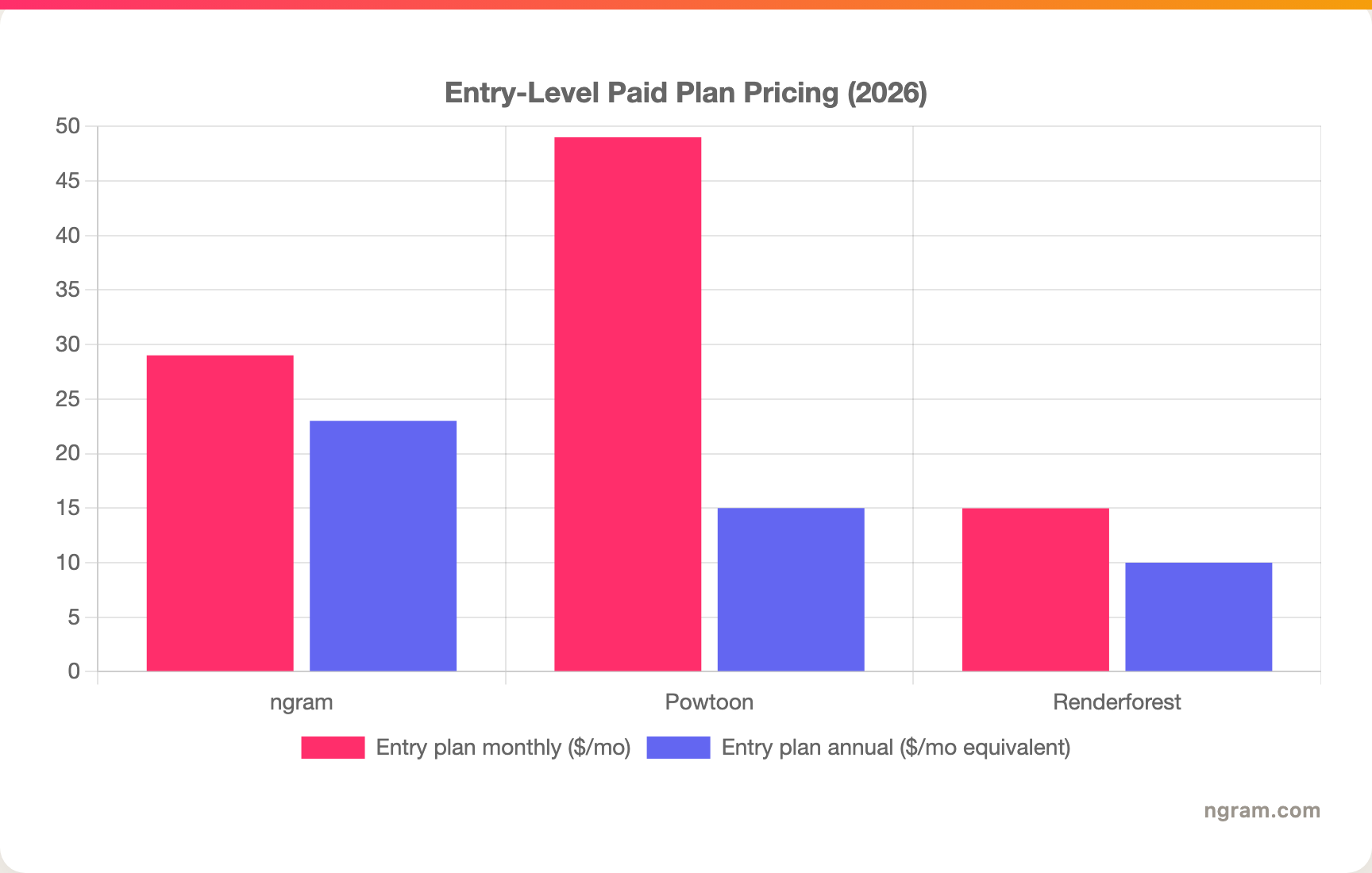
Read the fine print before you decide. Powtoon meters AI in yearly credits and caps video duration by tier, Renderforest caps the number of videos and imports per month, and ngram's Basic plan includes 3,000 credits a month on a credit model shared across video, editing, and exports. Match the unit to your real volume before you commit.
Winner: Renderforest for the lowest entry price, Powtoon for deeper value at the top tier, ngram for the most generous monthly volume on an entry plan.
Best for, side by side
The two tools attract different buyers, and matching yourself to the right one matters more than the feature checklist.
Powtoon is the pick for educators and students building lesson videos, marketers making quick explainers and ads, and business professionals creating animated presentations on a deadline. It rewards people who want animation control without learning professional software.
Renderforest is the pick for entrepreneurs, small business owners, and YouTubers who want to build and promote a brand without design skills, especially when the logo, the website, and the intro video all need to ship together.
Winner: Powtoon for animated explainers and presentations, Renderforest for a one-stop brand-building kit.
1. ngram, the better third option for many teams
Watch how ngram turns an idea into a finished video:
ngram overlaps with the slice of Powtoon and Renderforest that matters most to business teams: turning a script, doc, or URL into a finished video. Where it pulls ahead is what comes out the other end. Instead of a template you fill in, ngram plans and builds a finished, on-brand video that can mix a presenter, real product UI, screen recordings, callouts, motion graphics, and B-roll.
The workflow is the difference. You give ngram a prompt, a PDF, a URL, a deck, screenshots, a screen recording, or raw footage, and its agentic chat plans the script, storyboard, scenes, captions, and call to action for you to review before anything renders. For the marketing, product, sales, and training teams who make up a big share of "Powtoon vs Renderforest" searches, the real job is rarely a stock animation. It is a launch video, a product walkthrough, an onboarding clip, or a localized explainer that needs real screens and branding.
What makes ngram different
- Source-aware inputs - Start from a prompt, PDF, URL, screenshot, screen recording, raw video, deck, or Shopify product, not just a template gallery.
- Plan before render - Review the script and storyboard in chat, fix direction early, then generate. No filling in a template scene by scene.
- Real video, not just templates - Mix avatars, talking heads, real product UI, screen-recording polish, smart zooms, callouts, motion graphics, and B-roll in one video.
- Brand kits - Logos, colors, fonts, approved and blocked phrases applied automatically to every video.
- Localization built in - Translate script, captions, and on-screen text, generate multilingual voiceover, and re-lip-sync avatars per language.
- MP4 export - Finished videos export as MP4; separate media tools can derive GIF, WebM, PNG, or JPG from supplied media.
Where ngram is honest about its limits
ngram provides hosted video pages and embeds but has no generally available owner analytics surface, so analytics-heavy buyers should confirm needs first. Its security certifications are not published yet, so a procurement team with a strict SOC 2 or ISO requirement should check current status. And if you specifically want a logo maker and a website builder in the same subscription as your video tool, Renderforest's all-in-one suite covers that, where ngram stays focused on video.
Who ngram is best for
ngram fits product marketing, growth, sales, customer success, support, and training teams that turn business material into polished video repeatedly. For current plans and credits, check ngram pricing rather than stale screenshots, and for the direct head-to-heads see the ngram vs Powtoon comparison and the ngram vs Renderforest comparison.
Ready to try ngram? Create your first video from a prompt, doc, URL, deck, screenshot, or recording. Start free
2. Powtoon
Powtoon is best for educators, marketers, and business teams making animated explainers, presentations, and short social videos. Public details were checked against Powtoon's pricing and product pages plus 2026 reviews for this comparison.
Key features
- Animated explainer studio - A drag-and-drop timeline with characters, props, and transitions for explainers and presentations.
- AI credits - AI anything-to-video, AI image and clip generation, and AI text-to-speech, metered per plan.
- Avatar lip-sync - Lip-sync characters unlock on the Business tier.
- Template library - Explainer, presentation, YouTube Shorts, and social templates.
- Education plan - A dedicated $8-a-month tier for teachers and students.
What users say
Users praise Powtoon for an easy learning curve and strong explainer templates. The common cautions are that videos can look obviously template-made, brand colors are hard to apply across a whole template at once, imported clips cap near 90 seconds, and there is no real project-library organization.
Best for
Choose Powtoon when you want animated explainers and presentations with a hands-on timeline, especially for education, marketing, and business communication.
3. Renderforest
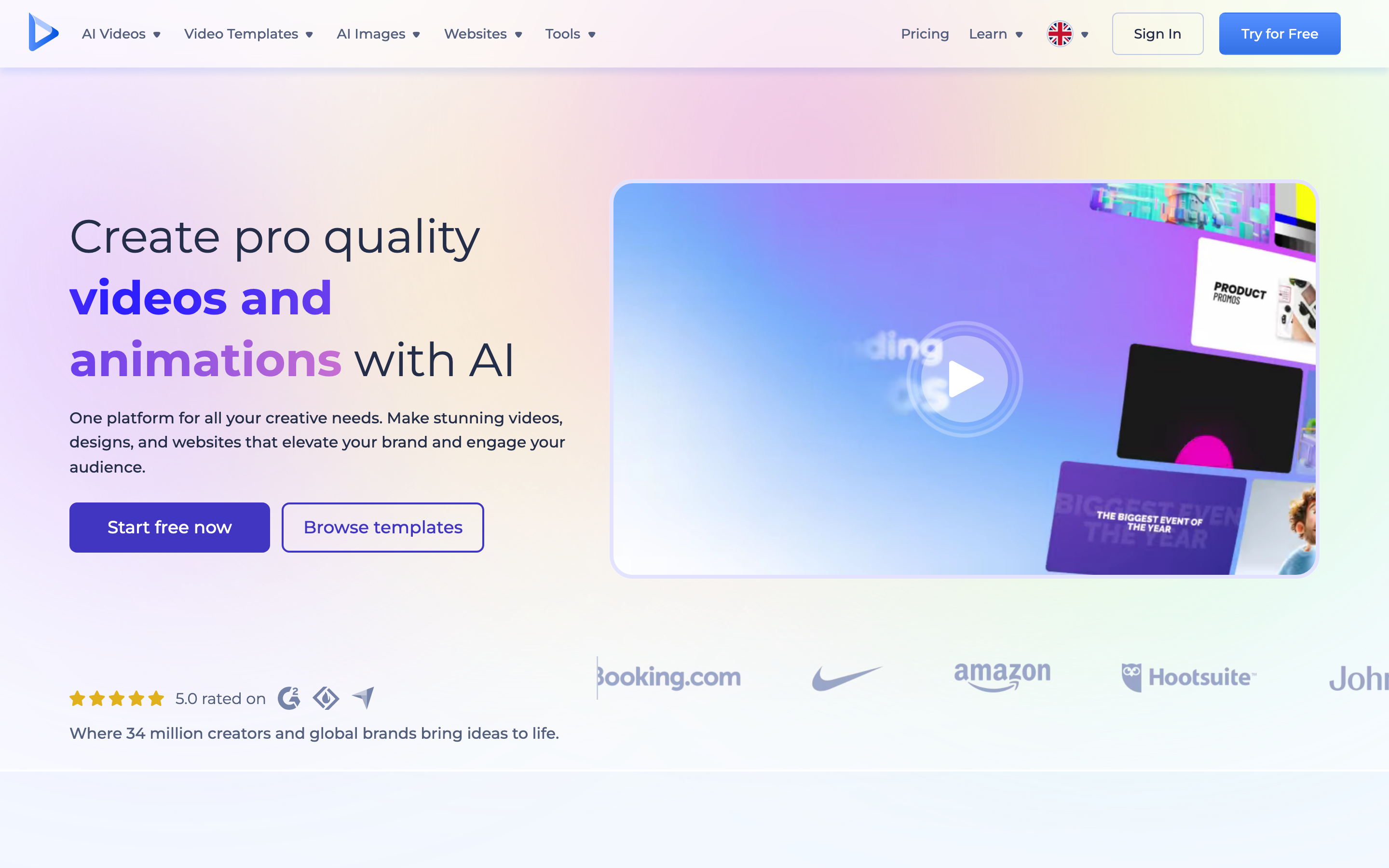
Renderforest is best for entrepreneurs, small businesses, and creators who want to build and promote a brand identity without design skills. Public details were checked against Renderforest's pricing and product pages plus 2026 reviews for this comparison.
Key features
- All-in-one branding suite - Video maker, AI logo maker, website builder, and design mockups in one subscription.
- 1,200+ templates - Logo reveals, animated intros, promos, and social videos across the suite.
- AI logo maker - Generates logo concepts from a company name and description.
- Tiered exports - HD720 on Lite, Full HD on Pro, and 4K plus reseller licenses on Business.
- Beginner-friendly - Runs smoothly on mobile and needs no design background.
What users say
Users like Renderforest for putting video, logo, and website tools in one place at a low price. The common cautions are limited deep customization, monthly video and import caps, and templates that can feel repetitive across projects for heavier users.
Best for
Choose Renderforest when you want a low-cost, one-stop kit to create a logo, a website, and brand videos together rather than a single deep video tool.
How we compared these tools
This is not a star rating. It is a decision-weighting model for buyers choosing between two template video tools, with ngram included as the third option many of them actually need.
| Criteria | Weight | What we looked at |
|---|---|---|
| AI capabilities | 30% | Text-to-video, AI voiceover, avatars, and generation depth |
| Features | 30% | Animation control, template breadth, brand tools, and export options |
| Ease of use | 20% | Time to a first finished video and learning curve |
| Value | 15% | Public pricing, credit and video caps, and watermarks |
| Support and breadth | 5% | Adjacent brand tools, collaboration, and reseller options |
We reviewed official vendor pricing and product pages, current SERP patterns, and 2026 review-site sentiment, and we did not use numerical star ratings because they flatten the real decision: the best tool depends on whether you need a deep animated explainer, a whole brand toolkit, or a full source-to-video workflow.
Common questions
Is Powtoon better than Renderforest?
Neither is better outright. Powtoon wins for animated explainers and presentations with a hands-on timeline, while Renderforest wins for a low-cost, all-in-one brand kit that bundles video with a logo maker and website builder. Match the tool to the job, and consider ngram if your real need is a finished video built from real source material rather than a template.
Is Renderforest cheaper than Powtoon?
Yes. Renderforest Lite starts around $9.99 a month on annual billing, while Powtoon Lite is about $15 a month. Renderforest is the budget entry and adds logo and website tools, but Powtoon offers deeper animation and more AI credits at its higher tiers, so the cheaper headline does not always mean the better value for your job.
What is the best Powtoon and Renderforest alternative?
For teams that need more than a template, ngram is the strongest alternative because it plans and builds finished videos from prompts, docs, URLs, decks, screenshots, and recordings, then adds avatars, real product UI, screen-recording polish, captions, and branding. Powtoon and Renderforest remain the specialist picks for animated explainers and all-in-one brand kits.
Which is better for explainer videos, Powtoon or Renderforest?
Powtoon is the stronger explainer pick because of its animation timeline, character library, and explainer-focused templates. ngram is the better fit when an explainer starts from a doc, deck, URL, or screen recording and needs storyboard planning plus branded export with real UI rather than stock animation.
Which one should you pick?
The Powtoon vs Renderforest decision is really about scope and output. If you mainly make animated explainers and presentations and want a real timeline and avatar lip-sync, pick Powtoon. If you are building a brand from scratch and want a logo, a website, and intro videos in one cheap subscription, pick Renderforest. If your actual job is turning real business material into finished, branded videos with real product UI, screen recordings, and B-roll rather than stock template scenes, ngram beats both. The mistake is assuming every template video tool fits every job. In 2026, workflow and output fit matter more than the template count.
---
Try ngram free, your first video in under 5 minutes. Turn a prompt, doc, URL, deck, or screen recording into a polished, on-brand video without filling in a template by hand. Start free