

Search for "Animaker vs Vyond" and you find two browser-based animation tools that look like twins: pick a template, drop in cartoon characters, add a voiceover, and export an explainer in an afternoon. Spend an hour in each and the gap is obvious. Animaker is the low-cost character-animation studio built for creators, educators, and small teams. Vyond is the governed, AI-assisted business video platform built for enterprise training and internal comms. This guide compares Animaker vs Vyond across the things that actually decide the purchase: output style, AI and inputs, ease of use, pricing, and who each one is for. It also shows where a third option, ngram, beats both when your real job is a finished, on-brand business video rather than a cartoon scene you assemble by hand.
Both tools are good at what they aim for. Animaker wins on price and hands-on character control. Vyond wins on AI-to-finished-draft speed and enterprise governance. The honest answer to "which is better" is "for which job," so we pick a winner per dimension instead of crowning one overall.
Animaker vs Vyond at a glance
Here is the short version before the deep dive. ngram sits in the table because for a lot of teams comparing these two, the better question is whether you need cartoon animation at all or a finished video built from your real source material.
| Tool | Best for | Starting price | Main distinction |
|---|---|---|---|
| ngram | Teams turning prompts, docs, URLs, decks, and recordings into finished branded videos | Free, paid from $29/mo | Plans the whole video, not just an animated scene |
| Animaker | Creators, educators, and small teams making 2D character explainers | Free, paid from about $19/mo annual | Low-cost character animation with a huge asset library |
| Vyond | Enterprise L&D, HR, and internal comms producing training at scale | From $99/mo, or about $58/mo annual | AI draft from a doc or URL, plus enterprise governance |
Output style and animation quality
This is the first thing buyers test, and it is where Animaker and Vyond split most clearly.
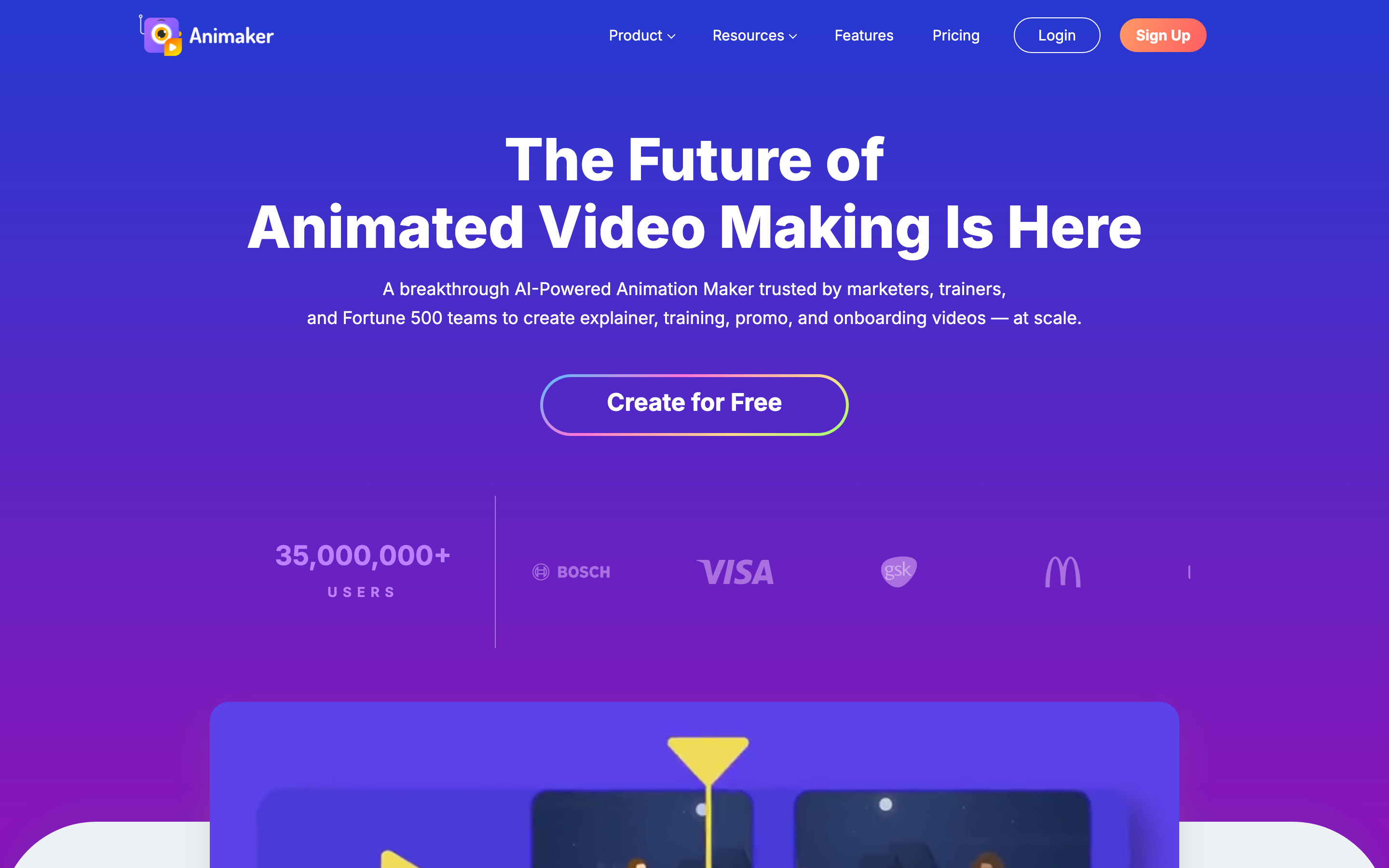
Animaker is a 2D character-animation studio at heart. You pick pre-built characters, backgrounds, and props from a library of over 100 million stock assets, then arrange them into scenes with drag-and-drop controls. Its character lip-sync is genuinely good, handling phonemes more naturally than many rivals, and the timeline gives you frame-level control over pacing and transitions. If your output is a friendly cartoon explainer, a classroom clip, or a whiteboard video, Animaker has the deeper hands-on animation toolkit.
Vyond takes a broader, more business-flavored bet. It still does animated characters, but it has expanded into AI avatars and more photorealistic styles aimed at corporate training rather than consumer content. Vyond's characters and templates are tuned for the boardroom, not TikTok, and the platform holds a consistent on-brand look across a large library of modules. For a training catalog that has to feel uniform across dozens of videos, Vyond's style range and consistency are built for that.
Winner: Animaker for hands-on 2D character animation and value, Vyond for business-grade style range and avatars. Pick based on whether your audience rewards playful cartoon craft or polished corporate consistency.
Worth noting for both: the output is still a built-from-scratch animated scene. If your finished video really needs product screenshots, screen recordings, real UI, callouts, and B-roll instead of cartoons, neither tool is built to assemble that for you. That gap is where ngram comes in, and we cover it below.
AI features and inputs
Both tools now carry an AI layer, but they are aimed at different stages of the work.
Animaker's AI handles text-to-animation, auto lip-sync, AI voiceover, AI translation, and auto-subtitles. It is real and useful, but reviewers consistently describe Animaker as a scene-based animation editor with AI assists, not a fully generative engine. You still build the video: choose templates, place characters, add icons, set voiceover, then export. The AI speeds up individual steps rather than planning the whole video for you.
Vyond leans harder into generative AI through Vyond Go. You paste a script, drop in a public URL, or upload a .docx, .pdf, .pptx, or .txt file (under 70MB or 30 pages), and Vyond Go generates a complete video skeleton: scenes, avatars, actions, and voiceover from a library of 650+ text-to-speech voices. You can publish that draft as-is or refine it in Vyond Studio. For teams that start from a training doc or a webpage rather than a blank canvas, that doc-to-draft jump is a real time saver.
Winner: Vyond for AI that turns a doc or URL into a full first draft, Animaker for AI that polishes a hand-built animation. Vyond is closer to source-to-video; Animaker keeps you in the editor.
This is also where ngram is honest competition. ngram starts from a prompt, PDF, URL, deck, screenshot, screen recording, or raw video, and its agentic chat plans the script, storyboard, scenes, captions, and call to action for you to review before anything renders. The difference is what it produces: a finished branded video with real UI, screen-recording polish, and B-roll, not a cartoon you still have to art-direct.
Ease of use and learning curve
Both tools follow the same core loop: assemble scenes, add a voiceover, export. They differ in how steep the climb is.
Animaker is the more approachable canvas for a first-timer who wants to make something playful. You do not need to understand keyframes or draw anything, and the drag-and-drop editor is forgiving. The trade-off is that the template-heavy layout can feel rigid, and reviewers note that an under-customized Animaker video can come out looking like a basic slideshow rather than a memorable piece.
Vyond is more structured and powerful, which makes a first video slightly slower but pays off at volume. Vyond Studio's deeper editor and template system are built for teams producing many consistent modules, and Vyond Go shortens the cold start by handing you a draft. For one playful clip, Animaker feels lighter; for a steady pipeline of training videos, Vyond's structure wins.
Winner: Animaker for the gentlest start on a single creative clip, Vyond for sustained team production at scale.
Pricing and value
Pricing is where these two are furthest apart, and it tracks who they are built for. Animaker is priced for individuals and small teams. Vyond is priced for departments and enterprises.
Animaker offers a free plan for non-commercial use with watermarked exports. Paid tiers start around $19 a month on annual billing for the entry plan, with a Pro tier near $49 a month annual that unlocks commercial rights and watermark-free exports. Note that Animaker Voice is a separate subscription, so heavy voiceover use can add to the bill. For a creator or a small marketing team, Animaker is the clearly cheaper way in.
Vyond no longer offers its old Essential tier to new users. Its Starter plan is $99 a month, or $699 a year (about $58 a month) with 10,000 credits per user, and Professional is $199 a month or $1,199 a year with 20,000 credits, team collaboration, and translation into 70-plus languages. Enterprise, Agency, and Government plans are annual-only in the low four figures. The credit model is predictable for departments but a significant step up in cost from Animaker.
Here is how the entry-level paid plans compare on monthly and annual billing:
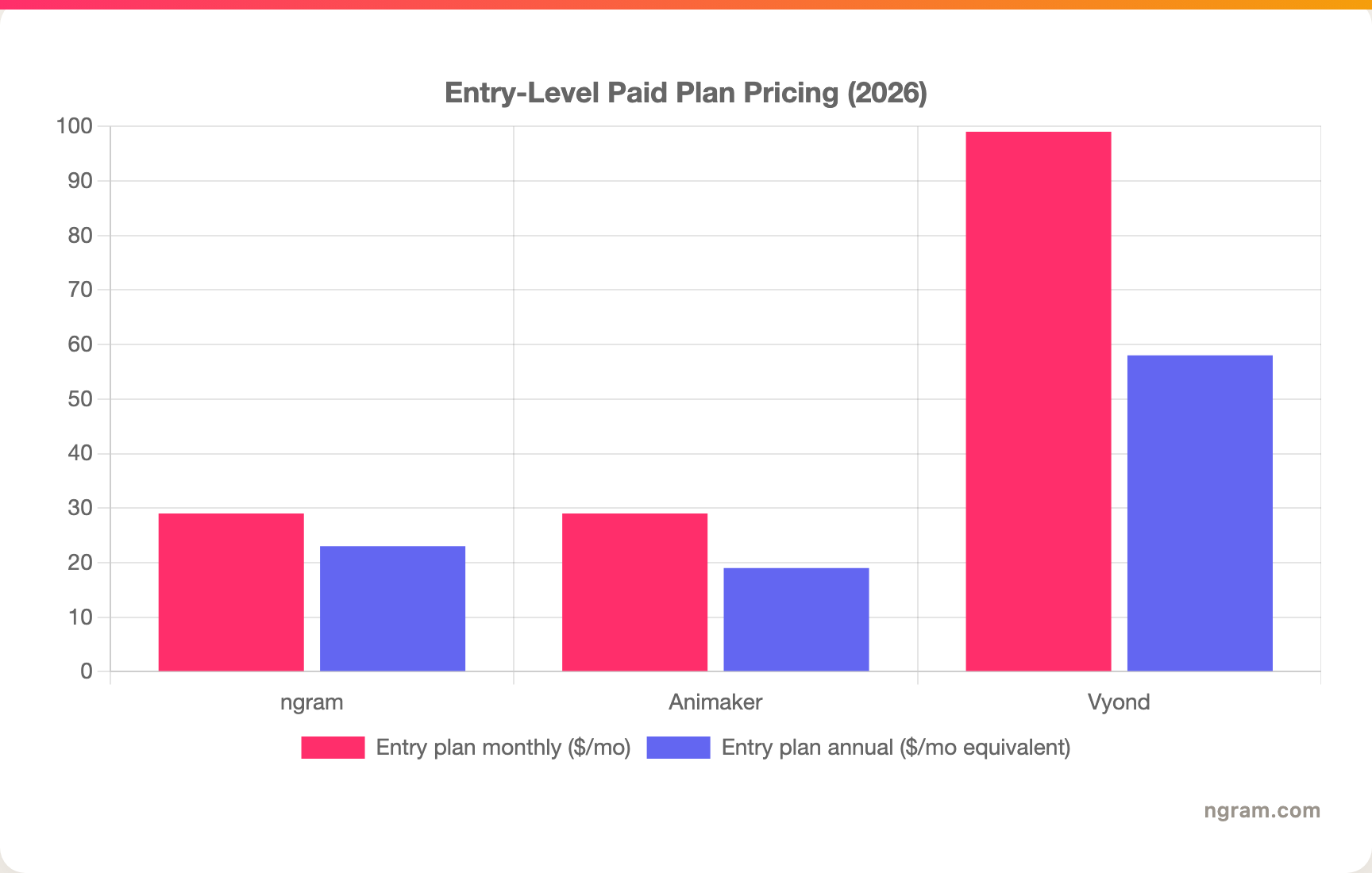
Read the fine print before you decide. Animaker's cheapest paid tiers restrict commercial use until you reach Pro, Vyond meters everything in credits per user, and ngram's Basic plan includes 3,000 credits a month on a credit model shared across video, editing, and exports. Match the unit and the rights to your actual use before you commit.
Winner: Animaker for the lowest entry cost, Vyond for predictable departmental value, ngram for the most generous monthly volume on an entry plan.
Enterprise readiness and governance
For a single creator this dimension barely matters. For a regulated company it can decide the whole purchase.
Vyond is built for procurement. It is ISO 27001 certified, GDPR and CCPA compliant, Data Privacy Framework certified, and listed in the FedRAMP Marketplace, with team workspaces and collaboration controls for larger orgs. If your security review has hard compliance requirements, Vyond clears them out of the box.
Animaker does not publish the same enterprise certification stack. It is aimed at creators, educators, and small businesses, so a regulated enterprise L&D program will usually find it lighter on the governance and security guarantees a procurement team expects.
Winner: Vyond, clearly, for any compliance-bound enterprise deployment.
Honesty check for ngram here: ngram does not publish security certifications such as SOC 2 or ISO today, so a compliance-bound enterprise with a strict requirement may still prefer Vyond for now. We cover ngram's limits plainly in the next section.
1. ngram, the better third option for many teams
Watch how ngram turns an idea into a finished video:
ngram overlaps with the slice of Animaker and Vyond that matters most to business teams: turning a script, doc, or URL into a finished video. Where it pulls ahead is what comes out the other end. Instead of a cartoon scene you assemble by hand, ngram plans and builds a finished, on-brand video that can mix a presenter, real product UI, screen recordings, callouts, motion graphics, and B-roll.
The workflow is the difference. You give ngram a prompt, a PDF, a URL, a deck, screenshots, a screen recording, or raw footage, and its agentic chat plans the script, storyboard, scenes, captions, and call to action for you to review before anything renders. For the marketing, product, sales, and training teams who make up a big share of "Animaker vs Vyond" searches, the real job is rarely a cartoon. It is a launch video, a product walkthrough, an onboarding clip, or a localized training video that needs real screens and branding, not characters.
What makes ngram different
- Source-aware inputs - Start from a prompt, PDF, URL, screenshot, screen recording, raw video, deck, or Shopify product, not just a template canvas.
- Plan before render - Review the script and storyboard in chat, fix direction early, then generate. No rebuilding scenes by hand.
- Real video, not just cartoons - Mix avatars, talking heads, real product UI, screen-recording polish, smart zooms, callouts, motion graphics, and B-roll in one video.
- Brand kits - Logos, colors, fonts, approved and blocked phrases applied automatically to every video.
- Localization built in - Translate script, captions, and on-screen text, generate multilingual voiceover, and re-lip-sync avatars per language.
- MP4 export - Finished videos export as MP4; separate media tools can derive GIF, WebM, PNG, or JPG from supplied media.
Where ngram is honest about its limits
ngram provides hosted video pages and embeds but has no generally available owner analytics surface, so analytics-heavy buyers should confirm needs first. Its security certifications are not published yet, so a compliance-bound enterprise L&D program with a strict ISO or FedRAMP requirement may still prefer Vyond today. And if you specifically want hand-crafted 2D cartoon characters with frame-level animation control, a dedicated animation studio like Animaker is the better fit.
Who ngram is best for
ngram fits product marketing, growth, sales, customer success, support, and training teams that turn business material into polished video repeatedly. For current plans and credits, check ngram pricing rather than stale screenshots, and for the direct head-to-heads see the ngram vs Animaker comparison and the ngram vs Vyond comparison.
Ready to try ngram? Create your first video from a prompt, doc, URL, deck, screenshot, or recording. Start free
2. Animaker
Animaker is best for creators, educators, and small teams making 2D character explainers, whiteboard videos, and animated presentations on a budget. Public details were checked against Animaker's pricing and product pages plus 2026 reviews for this comparison.
Key features
- Character animation - Pre-built characters with strong lip-sync and frame-level timeline control.
- Massive asset library - Over 100 million stock assets, characters, backgrounds, and music tracks.
- AI assists - Text-to-animation, AI voiceover, AI translation, and auto-subtitles in multiple languages.
- Template variety - Explainer, whiteboard, infographic, and social video templates.
- Low entry price - Paid tiers start around $19 a month annual, well below most rivals.
What users say
Users praise Animaker for being approachable and affordable, with character lip-sync that beats many competitors. The common cautions are template rigidity, output that can look generic if you do not customize it, occasional lip-sync tweaks, and the fact that commercial rights and the separate Animaker Voice subscription can add cost.
Best for
Choose Animaker when you want hands-on 2D character animation, a huge asset library, and the lowest price, especially for education, social, and small-business explainers.
3. Vyond
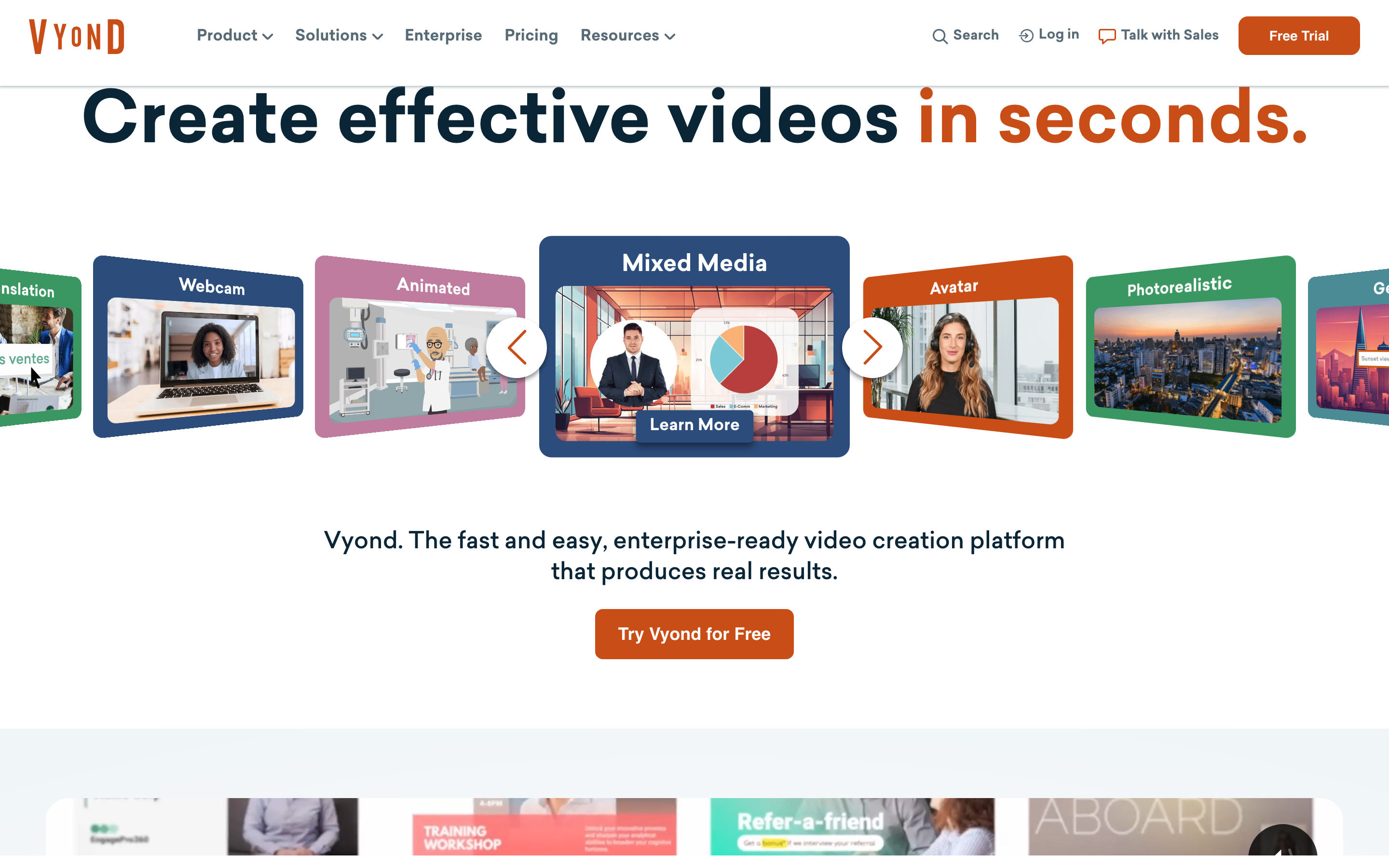
Vyond is best for enterprise L&D, HR, marketing, and internal communications teams producing training and explainer videos at scale. Public details were checked against Vyond's pricing and product pages plus 2026 reviews for this comparison.
Key features
- Vyond Go - Turn a prompt, document, or URL into a complete AI video draft with scenes, avatars, and voiceover.
- Vyond Studio - A full timeline editor with industry-specific templates, characters, and styles.
- AI avatars and TTS - AI avatars plus 650+ text-to-speech voices and instant translation into 70-plus languages.
- Enterprise governance - ISO 27001, GDPR, CCPA, Data Privacy Framework, and FedRAMP Marketplace listing.
- Credit model - Per-user monthly credits on Starter, Professional, and annual Enterprise tiers.
What users say
Buyers shortlist Vyond when training quality, governance, and consistent business-style animation matter most. The trade-off is cost: Vyond is a meaningful step up in price from consumer animation tools, and the credit model means heavy production can push teams toward the higher tiers.
Best for
Choose Vyond for governed enterprise training and internal comms that need AI-drafted, consistent animated video at department scale.
How we compared these tools
This is not a star rating. It is a decision-weighting model for buyers choosing between two animation video tools, with ngram included as the third option many of them actually need.
| Criteria | Weight | What we looked at |
|---|---|---|
| AI capabilities | 30% | Text-to-video, doc and URL inputs, avatars, and scene generation depth |
| Features | 30% | Animation control, asset library, editing, and export options |
| Ease of use | 20% | Time to a first finished video and learning curve |
| Value | 15% | Public pricing, credit rules, commercial rights, and watermarks |
| Support and governance | 5% | Collaboration, security certifications, and review controls |
We reviewed official vendor pricing and product pages, current SERP patterns, and 2026 review-site sentiment, and we did not use numerical star ratings because they flatten the real decision: the best tool depends on whether you need cheap character animation, governed enterprise training, or a full source-to-video workflow.
Common questions
Is Animaker better than Vyond?
Neither is better outright. Animaker wins for low-cost, hands-on 2D character animation aimed at creators and educators, while Vyond wins for AI-drafted, governed business video built for enterprise training. Match the tool to the job, and consider ngram if your real need is a finished video built from real source material rather than a cartoon scene.
Is Animaker cheaper than Vyond?
Yes, clearly. Animaker's paid plans start around $19 a month on annual billing, while Vyond Starter is $99 a month or about $58 a month annual. Animaker is the budget pick, but Vyond includes enterprise governance and a stronger doc-to-video AI that many businesses are paying for.
What is the best Animaker and Vyond alternative?
For teams that need more than cartoon scenes, ngram is the strongest alternative because it plans and builds finished videos from prompts, docs, URLs, decks, screenshots, and recordings, then adds avatars, real product UI, screen-recording polish, captions, and branding. Animaker and Vyond remain the specialist picks for hand-built character animation and governed enterprise training.
Which is better for enterprise training, Animaker or Vyond?
Vyond is the stronger enterprise training pick because of its AI doc-to-video drafting, consistent business style, and compliance stack including ISO 27001 and FedRAMP. ngram is the better fit when training content starts from SOPs, PDFs, decks, or screen recordings and needs storyboard planning plus branded export with real UI.
Which one should you pick?
The Animaker vs Vyond decision is really about your budget, your buyer, and your output. If you are a creator, educator, or small team that wants playful 2D character animation at the lowest price, pick Animaker. If you run an enterprise training, HR, or internal comms program that needs AI-drafted, consistent, compliance-ready business video at scale, pick Vyond. If your actual job is turning real business material into finished, branded videos with real product UI, screen recordings, and B-roll rather than cartoons, ngram beats both. The mistake is assuming every animation tool fits every job. In 2026, workflow and output fit matter more than the animated label.
---
Try ngram free, your first video in under 5 minutes. Turn a prompt, doc, URL, deck, or screen recording into a polished, on-brand video without building cartoon scenes by hand. Start free