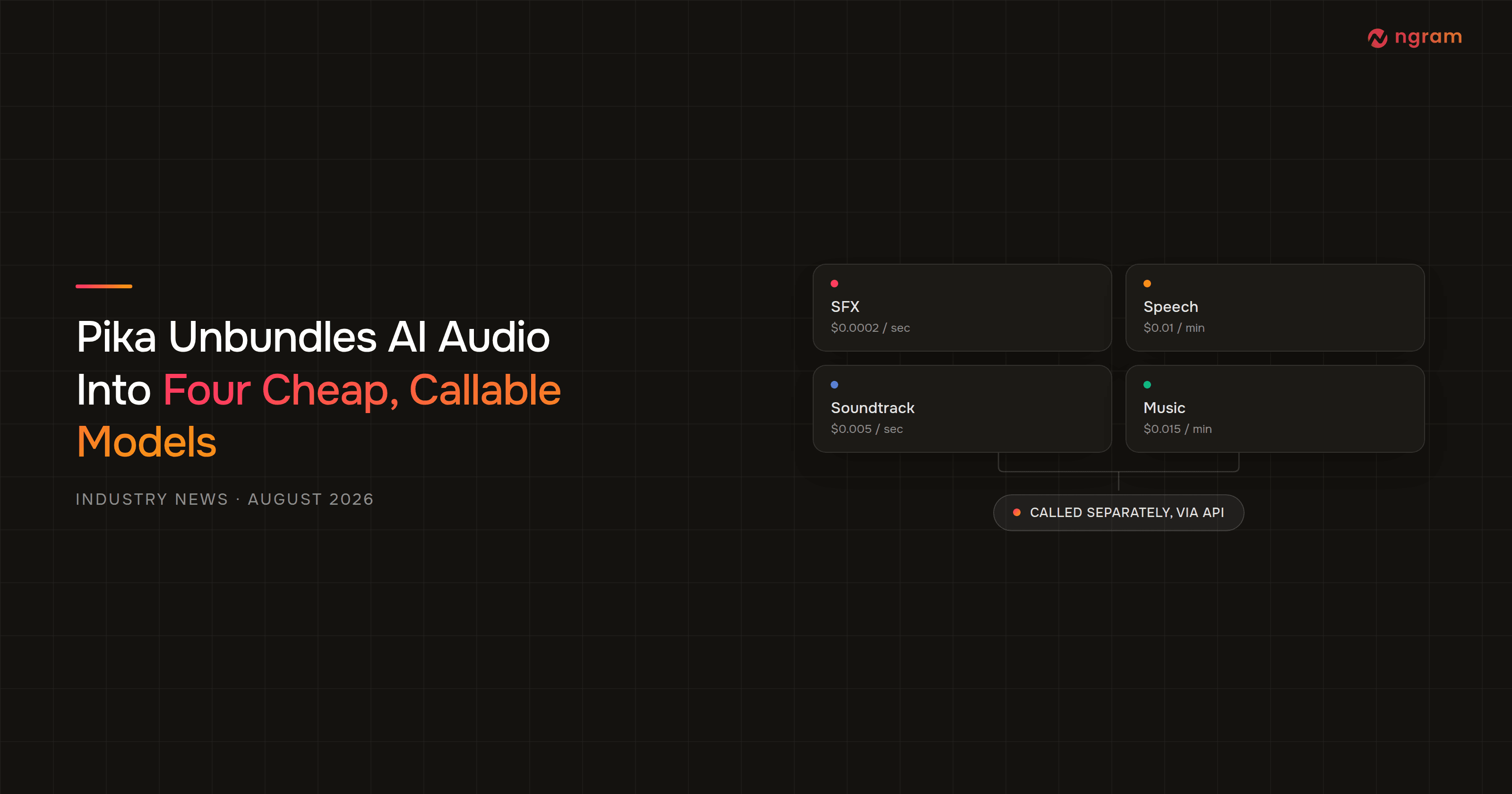

On August 14, 2026, Pika quietly did something more interesting than shipping another video model. It shipped audio, on its own, as four separately priced, separately callable models: SFX, Speech, Soundtrack, and Music. No video required. According to Pika's own announcement, the four models are available exclusively through the paid Pika API Club, and Pika's published rate card undercuts ElevenLabs and Tencent's Hunyuan Foley by wide margins, on paper.
That framing matters. In our last piece on this topic, we covered MiniMax H3 and the rise of native-audio AI video generation, the trend of video models generating dialogue, ambience, and sound effects jointly with the picture, in one inference pass. Kling 3.0 Omni, Gemini Omni Flash, and MiniMax H3 all do that. Pika's move is a different, arguably more disruptive stage of the same collapse: audio unbundled entirely from video, sold as its own commodity API a developer can call whether or not they ever touch Pika's video models. That is a direct shot at companies whose entire business is selling audio generation on its own, ElevenLabs foremost among them.
What Pika Actually Shipped on August 14
The four Pika Audio models each do something different, and each is priced and benchmarked separately, per Pika's launch post and its developer pricing page:
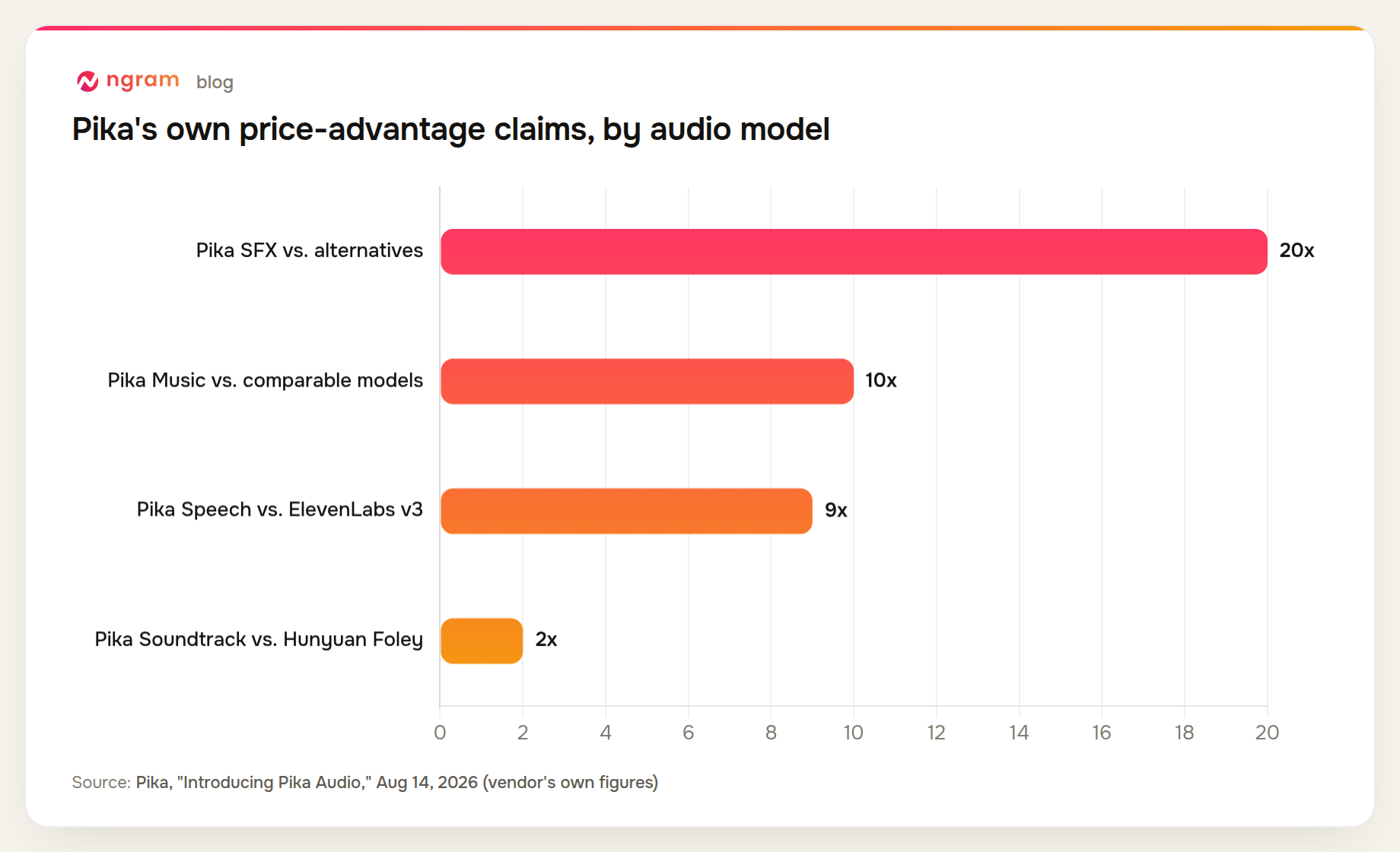
- Pika SFX turns a written description into up to 20 seconds of 44.1kHz stereo sound effects. Priced at $0.0002 per second, generation averages 0.847 seconds. Pika claims it is up to 20x cheaper than alternatives.
- Pika Speech is text-to-speech with expressive delivery control and voice cloning from a short reference clip, up to 5 minutes at 48kHz. Priced at $0.01 per minute, with a claimed real-time factor of 0.02 (a one-minute clip generates in about a second). Pika says it is 9x cheaper than ElevenLabs v3, 4.5x cheaper than Cartesia and ElevenLabs Turbo, and 2x cheaper than Fish Audio.
- Pika Soundtrack converts an existing video into synchronized music, speech, ambience, and motion-aware sound effects. Priced at $0.005 per second, at roughly 0.617 seconds of processing per second of output. Pika claims it is 2x more cost-efficient than Tencent's Hunyuan Foley, the open video-to-sound-effects model it names directly as a comparison point.
- Pika Music generates full tracks up to 6 minutes long from text prompts, lyrics, vocal references, and music references. Priced at $0.015 per minute, with a claimed 90-second song generated in about 6.2 seconds. Pika says it is up to 10x more cost-efficient than comparable models.
All four launched inside the Pika API Club, a $10-a-month membership Pika opened earlier in August 2026 that bundles access to more than 100 video, image, audio, and language models from multiple vendors, including ElevenLabs, MiniMax Music, ByteDance's Seed Audio, and Google's Lyria 2, through one API and one bill.
Pika's pitch for the Club itself is blunt: it says competing API aggregators mark prices up as much as 3x, and that Club members pay rates up to 88% lower by comparison. New members get a $10 usage credit in month one, which covers the membership fee outright. The Pika Audio family is Pika's own first-party contribution to that catalog, not a licensed pass-through of someone else's model.
Worth separating out: Pika also teased a related but distinct product, an audio-driven "performance" model for lip-sync and facial expression, rolling out in the Pika social app. According to Pika's own account, that model animates a static image into expressive, talking video from an audio track, and Pika claims it is roughly 20x faster and cheaper than prior approaches, with HD output in 6 seconds or less. That model, sometimes referred to as Pikaformance, is a facial-animation layer built on top of an audio input.
It is not part of the SFX, Speech, Soundtrack, and Music family this piece is about, and the two shouldn't be conflated even though both trade on the same "20x" language.
How Real Are the Price Claims?
For this piece, we pulled Pika's per-model pricing directly from its developer platform rather than repeating the multipliers secondhand, and cross-checked the comparison points where public rate cards exist. The multipliers below are Pika's own claims, stated in its own launch post, not an independent benchmark ngram ran. Treat them the way you'd treat any vendor's own "Nx cheaper" number: directionally informative, not gospel.
A methodology note, since this is the closest thing to a primary-research hook this piece has: we fetched Pika's pricing page directly (dev.pika.art) rather than trusting secondhand summaries, and we independently pulled ElevenLabs' own published API rate card for comparison. ElevenLabs prices its Multilingual v2 and v3 tiers at $0.10 per 1,000 characters through the API, with Flash and Turbo tiers at $0.05 per 1,000 characters.
Converting that into a per-minute figure depends heavily on speaking rate and isn't apples-to-apples with Pika's flat $0.01-per-minute rate. That is why we're presenting Pika's multiplier as a vendor claim rather than recomputing our own. The units genuinely differ model to model: per-second SFX, per-minute Speech and Music, and per-second-of-output Soundtrack. That is normal for the audio API market, but makes a single clean "X times cheaper across the board" headline harder to defend than it sounds.
What a Minute of AI Narration Actually Costs Now
The more useful way to read Pika's pricing isn't against ElevenLabs specifically. It's against what voicing a video used to cost at all. A year ago, a production team with a script to narrate had two real options: book a professional voice actor, or generate the voiceover with an AI model that itself carried a meaningful per-minute cost. Both of those numbers just moved.
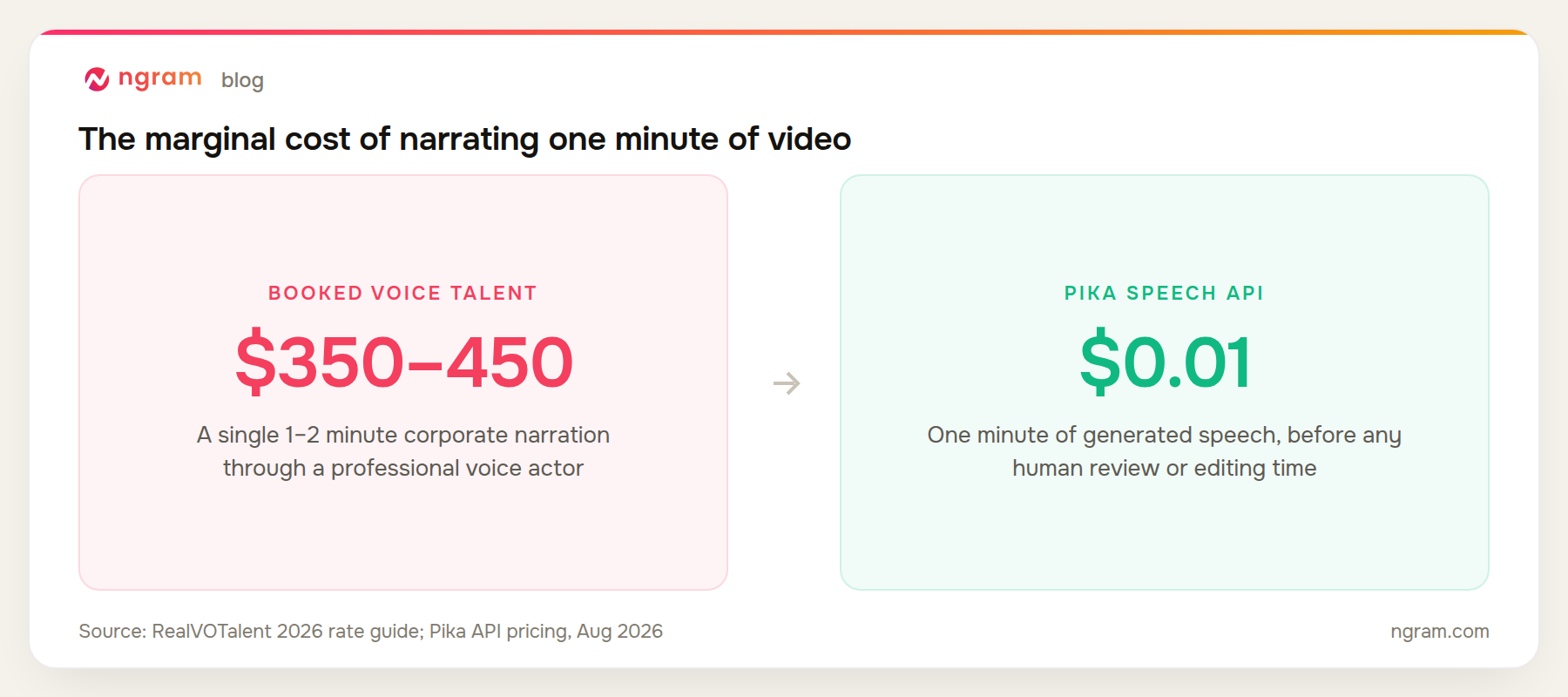
According to RealVOTalent's 2026 voiceover rate guide, a professional voice actor charges $350 to $450 for a single 1-2 minute corporate narration, and $15 to $55 per finished minute for e-learning work. Those figures cover a human's time, direction, and usage rights, not just raw audio generation, so they aren't a clean apples-to-apples comparison with an API call. But the gap is the point. Pika Speech's published rate of $0.01 per minute is, before any human review or editing time, close enough to zero that the marginal cost of generating a minute of narration has effectively stopped being a line item.
That comparison flatters Pika somewhat, since it strips out casting, direction, and quality control on both sides. But even a more conservative comparison, against another AI voice model rather than a human, tells the same story: audio generation costs across the whole stack, speech, music, and sound effects, have moved from a real budget line to a rounding error inside a single quarter.
This Is the Next Stage of a Trend We Already Called
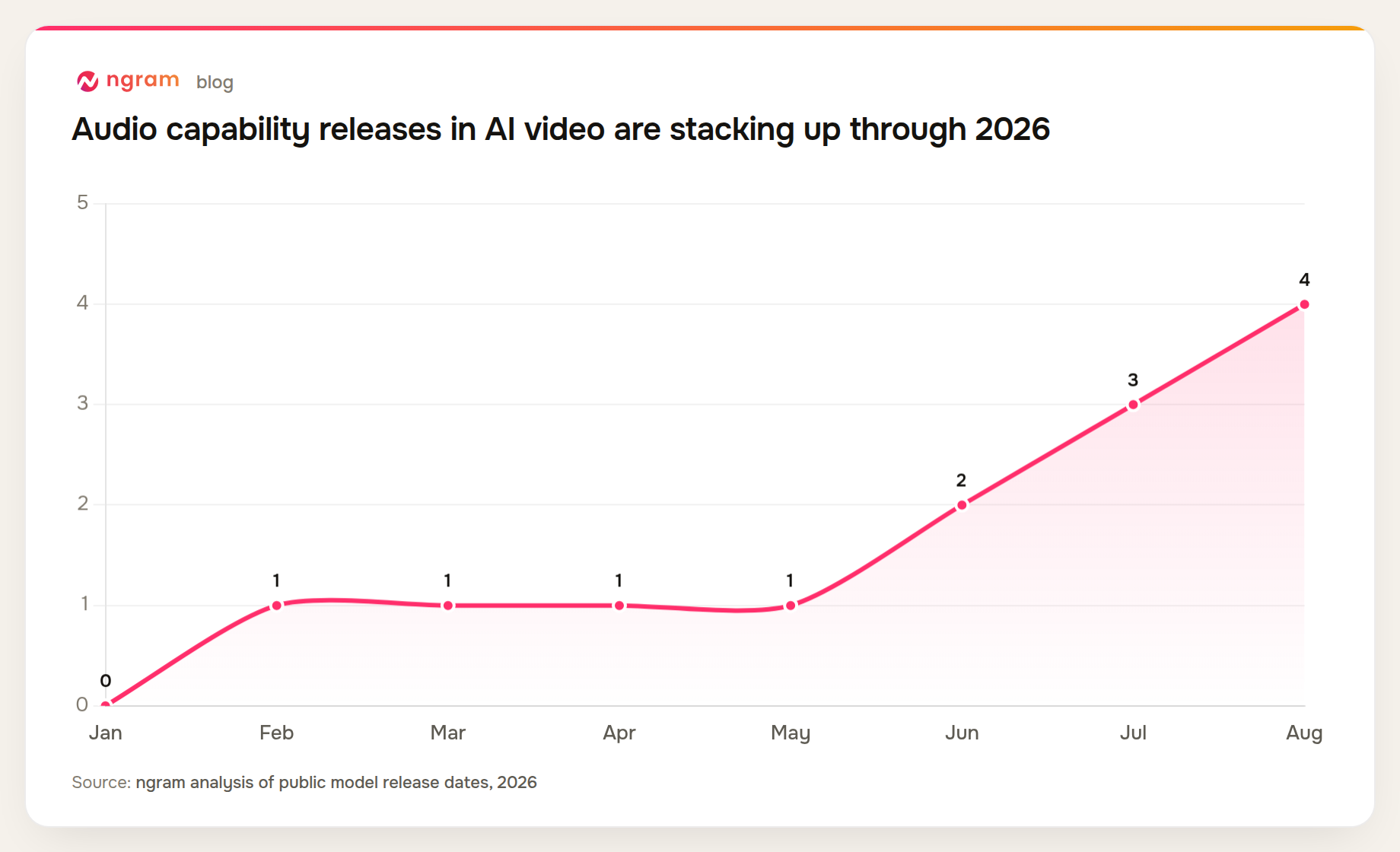
2026 has moved fast on audio in AI video, but almost all of that speed, until now, was about baking audio into the video model itself. Kling 3.0 Omni shipped native lip-synced dialogue in February 2026. Gemini Omni Flash brought native, multi-input audio-video generation to a platform with billions of monthly users on June 2. MiniMax H3 followed on July 31 with 2K video and synchronized stereo audio generated in the same inference pass, with no separate voiceover or lip-sync step required.
Pika's audio family is a related but genuinely different move. It doesn't bake audio into video generation at all. It unbundles audio into its own product line that a developer calls whether or not video is involved. Four releases, four different labs, in seven months, and the direction of travel keeps pointing the same way: audio generation in the AI-video stack is getting cheap fast, whether it arrives fused to a video model or sold on its own.
What This Means for Dedicated Voice AI Vendors
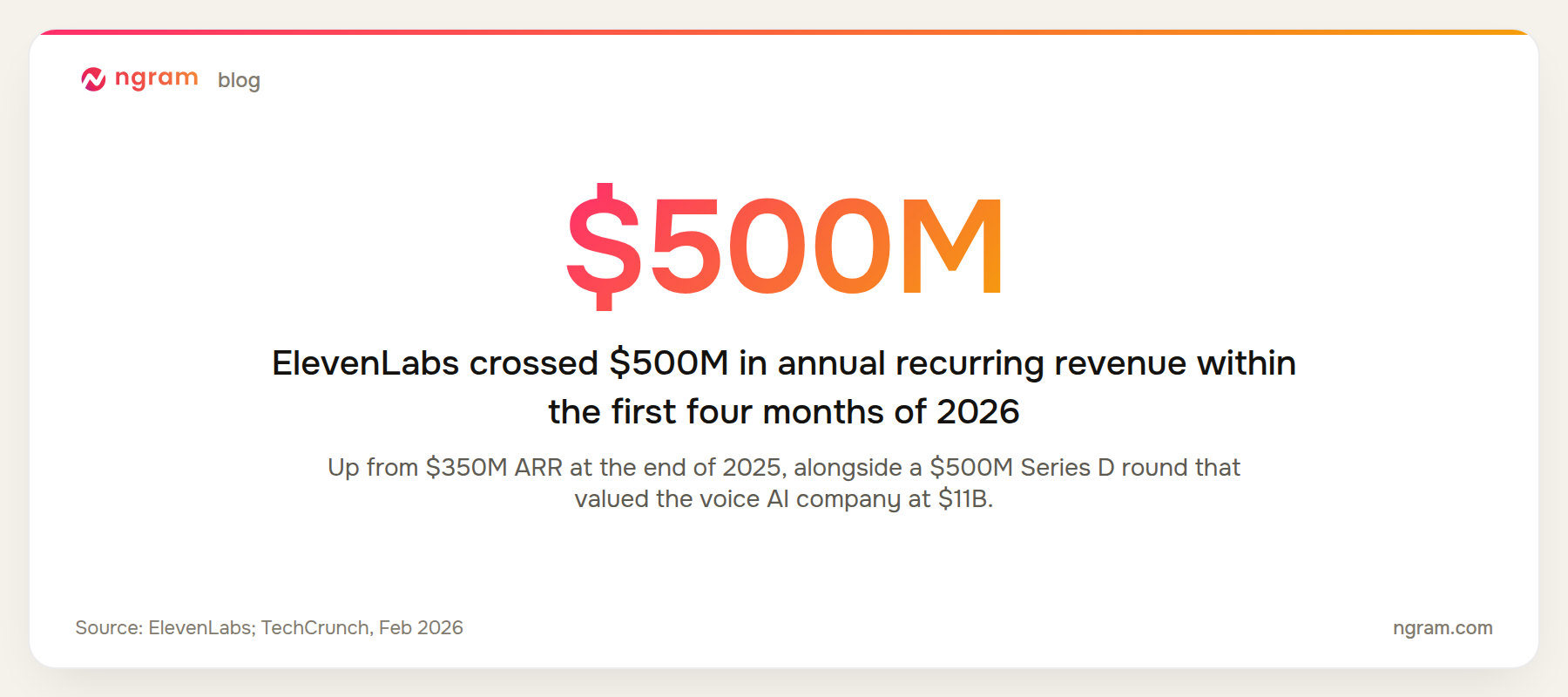
The company with the most to watch here is ElevenLabs, the closest thing the voice AI market has to a category leader. ElevenLabs ended 2025 at roughly $350M in annual recurring revenue and, per the company's own announcement, crossed $500M ARR within the first four months of 2026. That growth came alongside a $500M Series D round that, per TechCrunch's reporting, valued the company at $11 billion, led by Sequoia, with a later close in the round adding BlackRock, NVIDIA, Salesforce, and Deutsche Telekom as strategic backers.
This is not a struggling incumbent. It's a fast-growing, well-capitalized one, which is exactly what makes a video-model company shipping voice generation at a fraction of the price such a pointed signal. The pressure isn't coming from a weaker competitor undercutting a weak leader. It's coming from an adjacent layer of the stack deciding audio is cheap enough to give away as a side product.
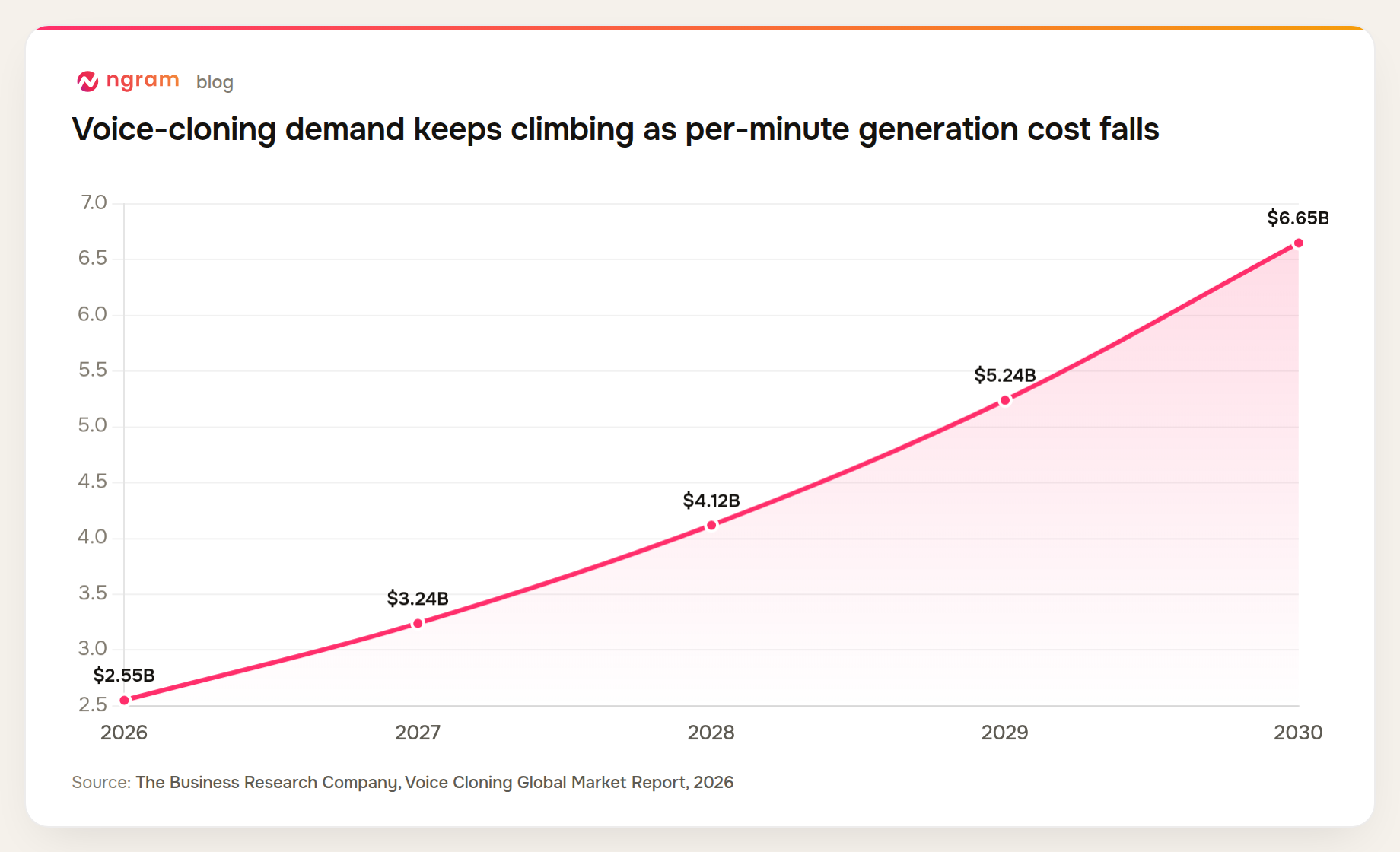
It would be too simple to read this as ElevenLabs' moat disappearing overnight. The standalone voice-cloning market itself keeps growing, not shrinking, even as per-unit generation costs fall. The Business Research Company puts the voice cloning market at $2.55 billion in 2026, growing to $6.65 billion by 2030 at a 27.1% CAGR.
That's the same pattern the image and video generation markets showed through 2024 and 2025: falling per-generation prices didn't shrink the market, they expanded who could afford to use it, and total spend kept climbing because usage grew faster than price fell. Cheaper audio is likely to play out the same way. More video gets voiced, scored, and sound-designed by AI, not less, even as the price per clip keeps dropping.
What Cheap Audio APIs Still Don't Solve
A cheap, fast, separately callable audio model is not the same thing as a finished, brand-consistent, fully produced soundtrack. Three gaps show up quickly for anyone trying to use Pika Audio, or any similarly priced model, for real production work rather than a one-off clip:
- Brand voice consistency across many videos. A cheap TTS call generates a plausible voice for one script. Keeping that exact voice, tone, and pacing consistent across dozens of videos over months is a workflow and asset-management problem a raw API call doesn't solve on its own.
- Orchestration across providers. No single audio model is the best fit for every language, style, and use case at once, which is exactly why aggregators like the Pika API Club exist in the first place: even Pika's own bundle leans on ElevenLabs and other outside models alongside its first-party ones, rather than betting everything on one voice engine.
- Independent control after generation. Voice, music, and sound effects generated separately still need to be mixed, balanced, and made independently adjustable in the finished video, muting a music bed without losing the voiceover, swapping a track without re-rendering everything else.
That last point is where a production platform earns its keep rather than a bare API call. ngram, for instance, already generates voiceover by routing across multiple TTS providers, ElevenLabs and MiniMax TTS, with OpenAI TTS configured as an additional fallback. It treats background music, sound effects, and voiceover as independently mutable tracks in the finished-video editor rather than one baked-in mix.
A cheaper, faster audio layer across the industry doesn't replace that kind of orchestration. It lowers the cost of the raw ingredients a platform like that is already built to combine, mix, and keep swappable, without a user needing to shop between five separate audio APIs themselves.
For localized versions of the same video, the same logic applies to dubbing. ngram's video translator with lip-sync already handles multilingual voiceover and mouth-movement matching as its own dedicated workflow, the kind of task a single cheap generation call doesn't replace even as the underlying speech model gets ten times cheaper. Cheaper audio compute is a genuine tailwind for tools built to route around any one vendor. It is not, on its own, a finished production pipeline.
What a Fully-Voiced, Scored Video Costs Today vs. a Year Ago
Put the pieces together and the shift for a production team's budget is real, even accounting for the vendor-claim caveats above. A year ago, adding professional-sounding voiceover, background music, and sound design to a video meant either paying human talent per project, or paying a per-minute rate to a dedicated AI voice vendor that itself carried a meaningful markup. Today, on Pika's published numbers alone, a minute of speech costs a cent, twenty seconds of sound effects costs less than half a cent, and a full musical track costs a few cents a minute, all sold through a $10-a-month membership rather than a bespoke enterprise contract.
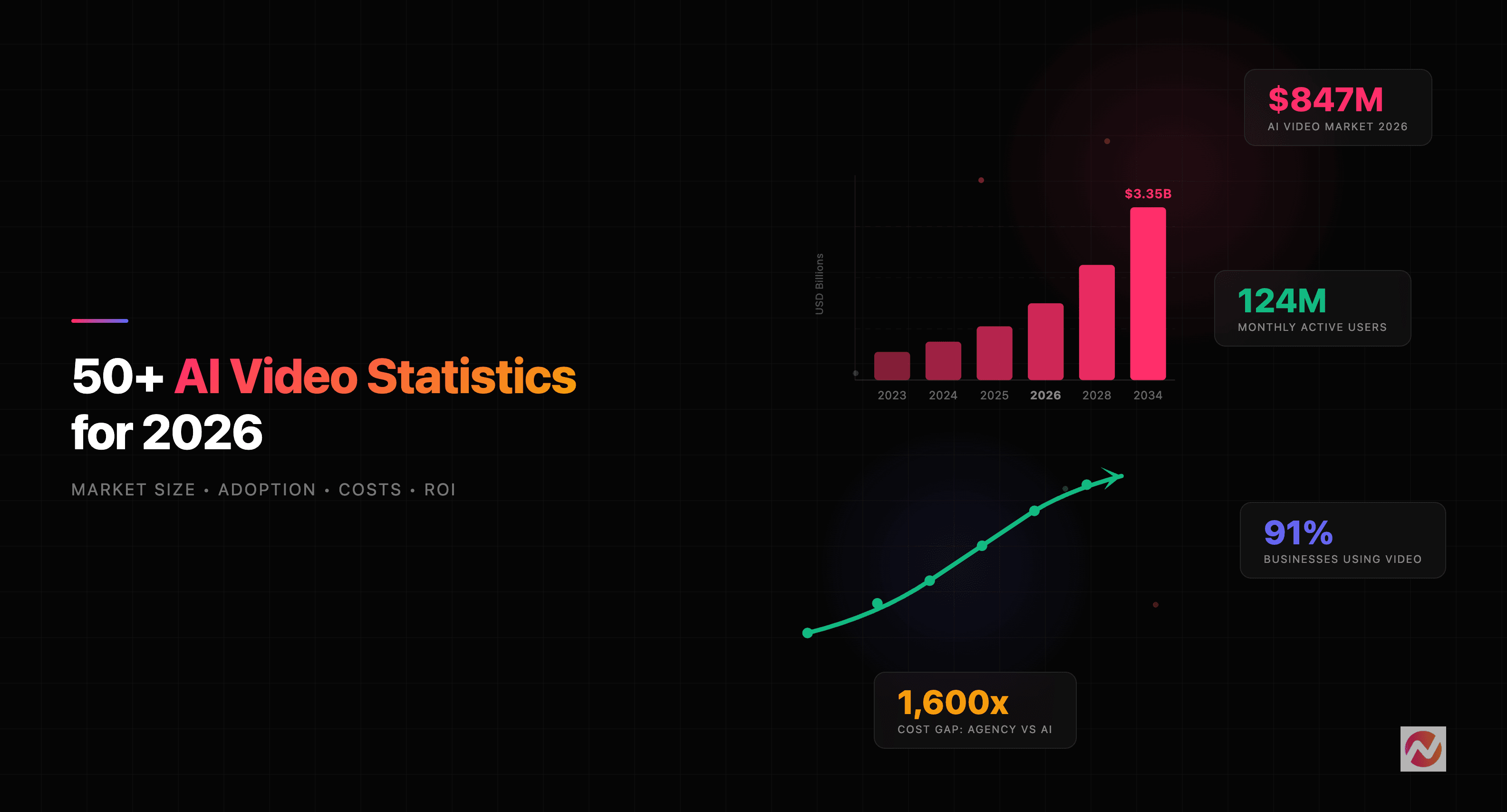
The AI video market itself is still growing into this shift. It's worth an estimated $847 million in 2026, on track for roughly $3.35 billion by 2034, an 18.8% CAGR, per Fortune Business Insights. We tracked a wider set of adoption and spending figures for that market in our 2026 AI video statistics roundup.
A market growing that fast, layered with a cost curve for its audio component that's dropping this quickly, is exactly the environment where a supplier ships a cheap side product and reshapes an adjacent category's economics almost by accident. Image generation went through this in 2024. Video generation went through it in 2025. Audio, judging by four labs shipping cheap or native audio capability in seven months, is going through it right now.
Frequently Asked Questions
What audio models did Pika release?
On August 14, 2026, Pika released four standalone audio models: SFX (text-to-sound-effects), Speech (text-to-speech with voice cloning), Soundtrack (video-to-audio, generating synchronized music, speech, and ambience for an existing video), and Music (text- and lyric-based full track generation up to 6 minutes). All four are available exclusively through the paid Pika API Club.
How much do Pika's audio models cost?
Per Pika's developer pricing page, Pika SFX costs $0.0002 per second, Pika Speech costs $0.01 per minute, Pika Soundtrack costs $0.005 per second, and Pika Music costs $0.015 per minute. Access requires the Pika API Club membership, priced at $10 per month.
Is Pika Speech actually cheaper than ElevenLabs?
Pika claims Speech is 9x cheaper than ElevenLabs v3 and 4.5x cheaper than ElevenLabs Turbo. That figure comes from Pika's own launch post, not an independent benchmark, and the two vendors price on different units (Pika per-minute, ElevenLabs per-character), which makes a single clean multiplier hard to verify precisely. Directionally, Pika's flat per-minute rate is meaningfully lower than ElevenLabs' published API rate card.
What is Pikaformance, and is it the same as Pika Audio?
No. Pikaformance is a separate, audio-driven lip-sync and facial-performance model that animates a static image into expressive talking video from an audio track, rolling out in the Pika social app. Pika claims it is roughly 20x faster and cheaper than prior approaches. It is a distinct product from the SFX, Speech, Soundtrack, and Music audio-generation family, even though both use similar cost-reduction language.
How is this different from native audio in AI video models like MiniMax H3?
Native audio, as shipped by Kling 3.0 Omni, Gemini Omni Flash, and MiniMax H3, generates video and audio jointly in a single inference pass, audio only exists as part of a video generation call. Pika's audio family unbundles audio entirely: SFX, Speech, Soundtrack, and Music are separately callable models a developer can use with or without generating video at all, sold as standalone infrastructure rather than a video-model feature.
Does cheaper AI audio threaten ElevenLabs' business?
It adds real price pressure, but the voice-cloning market is still projected to grow from $2.55 billion in 2026 to $6.65 billion by 2030, the same expand-the-market pattern seen in AI image and video generation as prices fell. ElevenLabs crossed $500M ARR in early 2026 at an $11B valuation, so it enters this price pressure well capitalized, not distressed.
Can production teams fully replace voice actors and sound designers with these models?
For a single short clip, largely yes, on cost. For ongoing branded production, not entirely: brand voice consistency across many videos, orchestration across multiple providers, and independent mixing control after generation are workflow problems a cheap raw API call doesn't solve by itself.
Where can developers access Pika's audio models?
Pika's SFX, Speech, Soundtrack, and Music models are available at dev.pika.art through the Pika API Club, a $10-a-month membership that also bundles access to over 100 other video, image, audio, and language models from multiple vendors.