

Search for "D-ID vs Elai.io" and you find two AI avatar tools that look similar from a distance: type a script or upload a document, pick a digital presenter, and get a lip-synced talking-head video without a camera. Look closer and they have moved in different directions. D-ID has pivoted toward real-time "Visual AI Agents," conversational avatars that answer questions and trigger workflows, with talking-head video as the underlying tech. Elai.io stayed focused on document-to-video for corporate training and is now part of Panopto. This guide compares D-ID vs Elai.io on the things that decide the purchase: avatar quality, inputs and workflow, real-time versus recorded use, and pricing. It also shows where a third option, ngram, fits when your real job is a finished, branded video rather than one presenter reading a script.
Both tools are genuinely good at what they target. D-ID leans into interactive, low-latency avatar agents and developer access. Elai.io leans into turning slides, PDFs, and articles into structured training videos at scale. The honest answer to "which is better" is "for which job," so we pick a winner per dimension instead of crowning one overall.
D-ID vs Elai.io at a glance
Here is the short version before the deep dive. ngram sits in the table because for many teams comparing these two, the better question is whether you need an avatar tool at all or a system that builds the whole video.
| Tool | Best for | Starting price | Main distinction |
|---|---|---|---|
| ngram | Teams turning prompts, docs, URLs, decks, screenshots, and recordings into finished branded videos | Free, paid from $29/mo | Plans and builds the whole video, not just a talking head |
| D-ID | Real-time conversational avatar agents plus recorded talking-head video, with API access | Free trial, paid from $5.90/mo | Real-time "Visual AI Agents" that listen and respond live |
| Elai.io | Corporate training and L&D videos built from slides, PDFs, and URLs | Free, paid from $23/mo annual | Document-to-video for training, now part of Panopto |
Avatar quality and realism
This is the first thing buyers test, and the two tools land in different places.
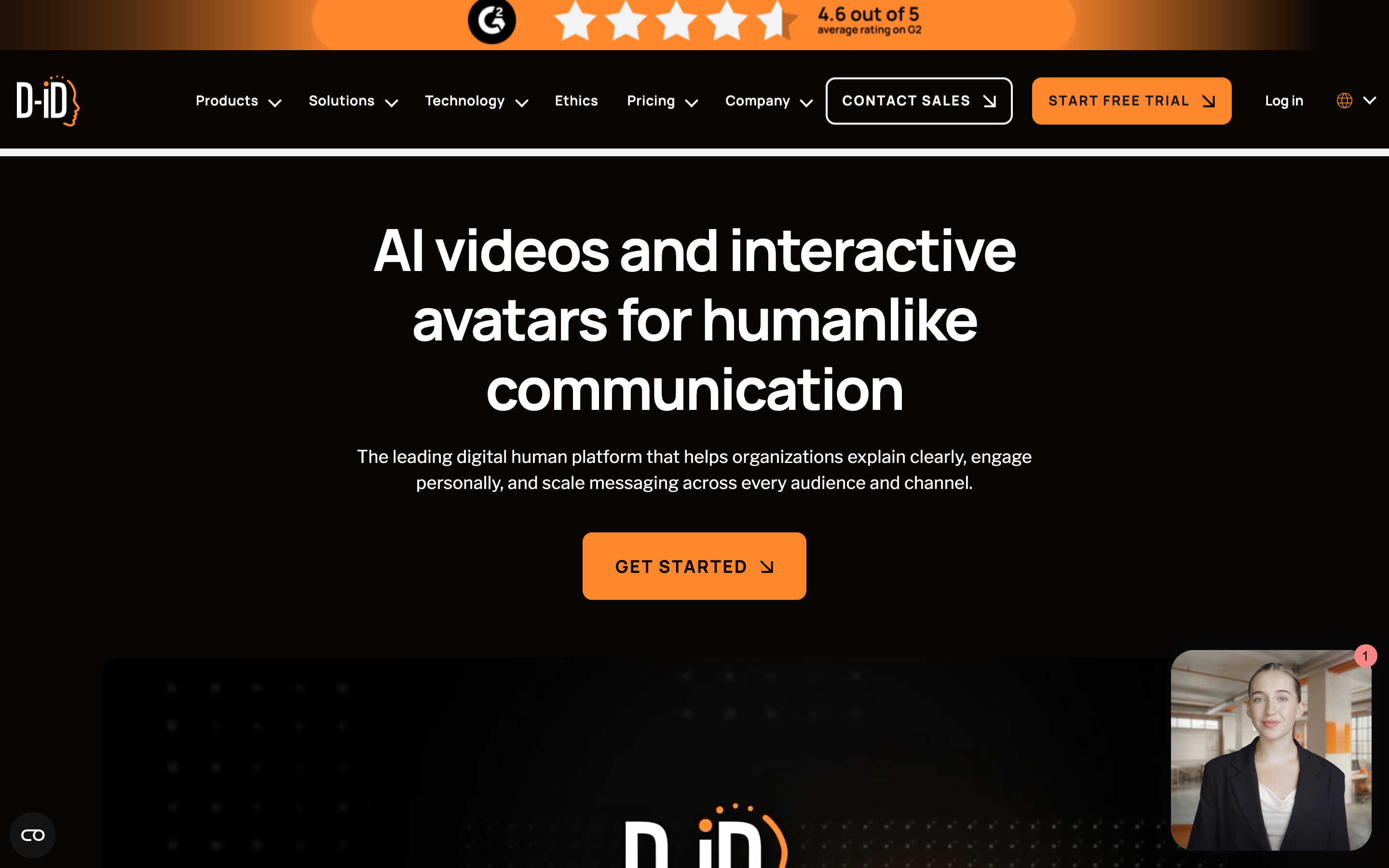
D-ID has invested heavily in its avatar models. Its V4 Expressive avatars adapt facial expression and delivery to the sentiment of the script, and the real-time agents target sub-second response with tight lip-sync at up to 4K. For a single, high-quality talking head or a live agent that needs to feel responsive, D-ID's avatar output is the stronger of the two. Reviewers still note some quality inconsistency between avatars and limited control over gestures and body language.
Elai.io offers roughly 100 avatars and custom avatars from a photo or short clip, but users describe avatar quality as uneven: some presenters look natural, others feel stiff, and lip-sync quality varies by language, with English and common European languages looking best. Elai.io is built for clear information delivery rather than expressive, lifelike performance, and it shows.
Winner: D-ID for raw avatar realism and expression. Elai.io is adequate for training narration, but D-ID's avatars and real-time delivery are more convincing.
Worth noting for both: a more lifelike avatar is still a person reading a script in front of a flat background. If the finished video also needs product screenshots, screen recordings, callouts, B-roll, and motion graphics, neither tool assembles all of that for you. That gap is where ngram comes in, and we cover it below.
Inputs and workflow
How you get from raw material to a finished video matters as much as the avatar, and this is where Elai.io is strongest.
Elai.io is built around document-to-video. Upload a PowerPoint, a PDF, or an article URL, and it builds a structured video with slides and narration automatically, which is a real time-saver for trainers who already have decks. Combine that with SCORM export on higher tiers and PowerPoint conversion, and Elai.io fits L&D teams that produce many similar modules from existing content. The trade-offs are basic editing, a smaller template library, and weak screen-recording support.

D-ID's workflow is split. The Studio side generates talking-head videos from a script, image, or document quickly, while the flagship Visual AI Agent side is about wiring an avatar to a knowledge base and an LLM so it can answer live. That makes D-ID powerful for interactive deployments but heavier for someone who just wants a quick recorded explainer from a deck.
Winner: Elai.io for document-to-video and training workflows. D-ID wins if your workflow is building an interactive agent, not producing slide-based videos.
Real-time agents versus recorded video
This is the dimension where the two tools barely overlap, and it should drive your choice.
D-ID's 2025 to 2026 positioning centers on real-time "Visual AI Agents": embeddable conversational avatars that listen, think, and respond in customer service, sales qualification, and onboarding, with dashboards for interaction analytics. It has also expanded avatar agents into Microsoft Teams. If you want a live, talking digital human that holds a conversation, D-ID is purpose-built for it and Elai.io does not compete here.
Elai.io has no real-time conversational agent. It produces recorded videos, full stop, optimized for training and education that you publish to an LMS or a course. For that recorded, structured use case it is the cleaner fit, and the Panopto acquisition reinforces its lecture-and-training direction.
Winner: D-ID for real-time conversational avatars, Elai.io for recorded training video. These are different products wearing the same avatar label.
This is also the clearest reason buyers comparing D-ID vs Elai.io end up looking at a third option for everything in between, the marketing explainer, the product demo, the launch video that is neither a live agent nor a slide deck.
Pricing and value
Pricing reflects how different these tools are. D-ID meters credits in 15-second blocks across Studio and agent usage. Elai.io meters video minutes per month. That changes how predictable your bill is.
D-ID offers a 14-day free trial, then Lite at $5.90 a month monthly ($4.70 annual) for 40 credits and about 10 minutes of watermarked video. Pro moves up to roughly $16 a month on annual billing with more credits and 1080p premium presenters, and Advanced and Enterprise scale credits and add API and agent access. Real-time agents and serious volume push you toward custom Enterprise pricing quickly.
Elai.io has a free plan with 1 minute of watermarked video and access to its avatars. Creator is $29 a month monthly, or $23 a month billed annually, for one user and about 15 minutes of video at full HD. Higher tiers add 4K, voice cloning, and a Team plan around $100 a month annually for roughly 50 minutes, with SCORM export reserved for Enterprise.
Here is how the entry-level paid plans compare on monthly and annual billing:
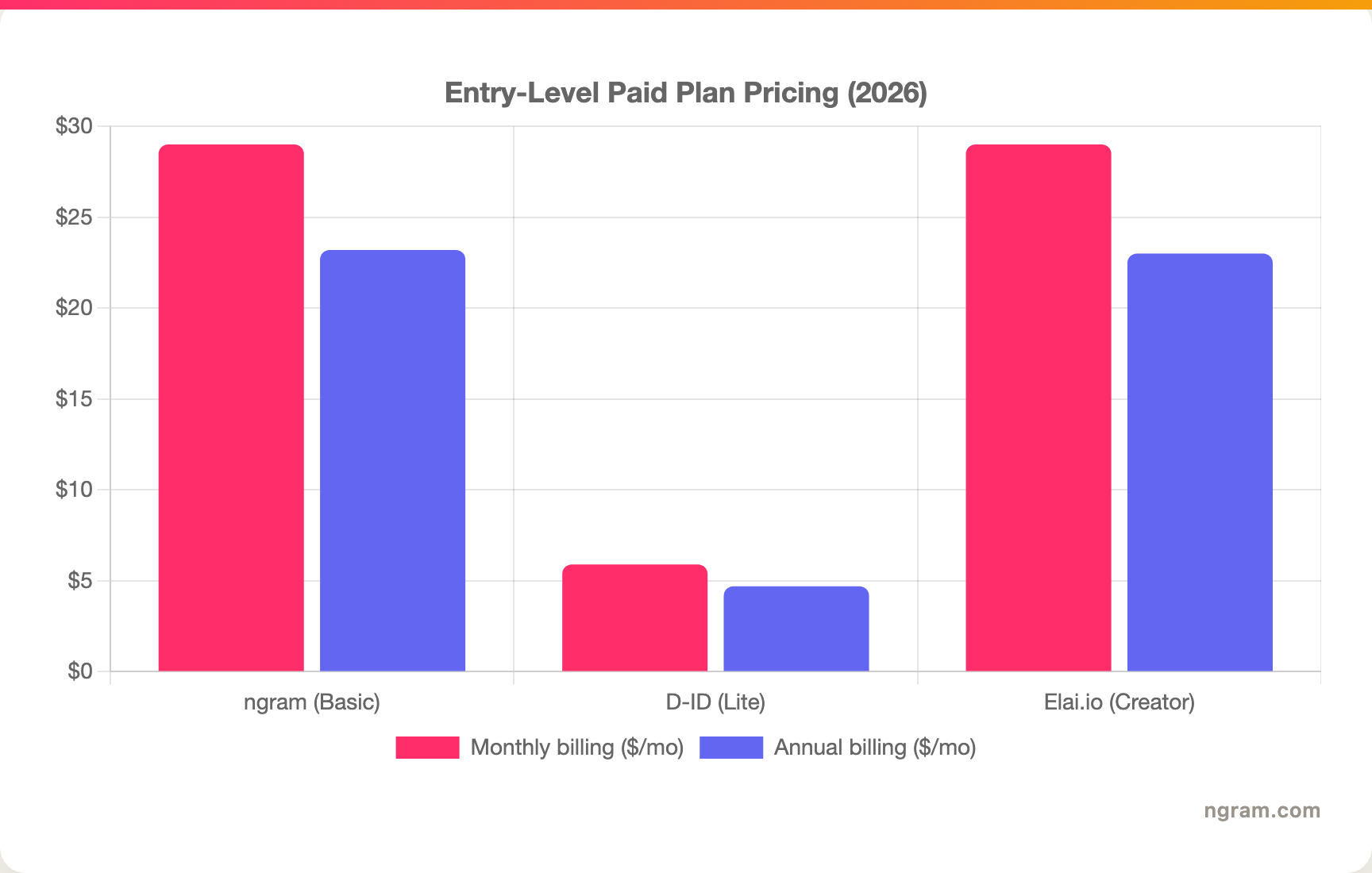
The headline numbers can mislead. D-ID's Lite looks cheapest but caps you near 10 minutes of watermarked video and bills in 15-second blocks, with credits voiding monthly. Elai.io's Creator is around 15 minutes a month, and ngram's Basic includes 3,000 credits a month on a credit model shared across video, editing, and exports. Match the unit to your actual volume before you decide.
Winner: D-ID for the lowest entry price, Elai.io for predictable minute-based training value, ngram for the most generous monthly volume on an entry plan.
1. ngram, the better third option for most teams
Watch how ngram turns an idea into a finished video:
ngram does the same core job as D-ID and Elai.io, generating a video with a presenter and voiceover, and then keeps going where they stop. Instead of starting from a script box or a slide deck, you give ngram a prompt, a PDF, a URL, a deck, screenshots, a screen recording, or raw footage, and its agentic chat plans the script, storyboard, scenes, captions, and call to action for you to review before anything renders.
That plan-first workflow is the difference. For the marketing, sales, customer education, and training teams who make up most "D-ID vs Elai.io" searches, the real job is rarely "a talking head" or "a narrated slide deck." It is a launch video, a product demo, an onboarding walkthrough, or a localized training clip that needs screen recordings, callouts, B-roll, branded intros, and MP4 export, all on brand. Elai.io can narrate your slides and D-ID can voice an avatar, but ngram assembles the whole video.
What makes ngram different
- Source-aware inputs - Start from a prompt, PDF, URL, screenshot, screen recording, raw video, deck, or Shopify product, not just a typed script or a PPT.
- Plan before render - Review the script and storyboard in chat, fix direction early, then generate. No regenerating an avatar take repeatedly to fix one line.
- Avatars plus everything else - Use the avatar library, a custom uploaded face, a talking head with lip sync, or a generated on-brand presenter, then add screen-recording polish, smart zooms, callouts, motion graphics, and B-roll in the same video.
- Brand kits - Logos, colors, fonts, approved and blocked phrases applied automatically to every video.
- Localization built in - Translate script, captions, and on-screen text, generate multilingual voiceover, and re-lip-sync avatars for each language.
- MP4 export - Finished videos export as MP4; separate media tools can derive GIF, WebM, PNG, or JPG from supplied media.
Where ngram is honest about its limits
ngram provides hosted video pages and embeds with basic hosted-video view counts, but has no generally available owner analytics surface, so if you need D-ID-style agent interaction dashboards or detailed engagement reporting, confirm that need first. ngram does not publish security certifications today, so a compliance-bound training program with a strict SOC 2 or ISO requirement may prefer a vendor that does. ngram is also not a real-time conversational avatar: if your job is a live, talking agent embedded on a site or in Teams, D-ID is built for that and ngram is not. Signed-in users can create self-service bearer API credentials for Public API v1. Zapier and n8n are available, while Make.com is Coming Soon.
Who ngram is best for
ngram fits product marketing, growth, sales, customer success, support, and L&D teams that turn business material into polished video repeatedly. For current plans and credits, check ngram pricing rather than stale screenshots, and for the direct head-to-heads see the ngram vs D-ID comparison and the ngram vs Elai.io comparison.
Ready to try ngram? Create your first video from a prompt, doc, URL, deck, screenshot, or recording. Start free
2. D-ID
D-ID is best for real-time conversational avatar agents and recorded talking-head video, especially for teams that also want API access. Public details were checked against D-ID's pricing and product pages for this 2026 comparison.
Key features
- Visual AI Agents - Real-time conversational avatars that answer from a knowledge base, trigger workflows, and integrate with internal systems.
- V4 Expressive avatars - Avatars that adapt expression to sentiment, with tight lip-sync and up to 4K real-time output.
- Talking-head video - Generate lip-synced avatar videos up to about 5 minutes from a script, image, or document.
- Multilingual - Speech in 120+ languages for both recorded video and live agents.
- API and credit model - Developer API access on higher tiers, billed in 15-second credit blocks that void monthly.
What users say
Users praise D-ID for fast, camera-free talking-head generation, responsive support, and the strength of its real-time agent technology. The common cautions are uneven avatar quality between presenters, limited gesture and body-language control, and short maximum video lengths, so it is better for explainers and agents than for long-form or cinematic content.
Best for
Choose D-ID when you need a live conversational avatar agent or a quick recorded talking head, and you value avatar realism and API access over full-video assembly.
3. Elai.io
Elai.io is best for corporate training and L&D videos built from slides, PDFs, and URLs, and it is now part of Panopto. Public details were checked against Elai.io's pricing and product pages for this 2026 comparison.
Key features
- Document-to-video - Turn a PowerPoint, PDF, or article URL into a structured narrated video automatically.
- Avatars and custom avatars - Roughly 100 AI presenters plus custom avatars from a photo or short clip.
- Languages and voice cloning - Text-to-speech in 75+ languages, with voice cloning available in a subset of languages.
- SCORM and LMS fit - SCORM export on Enterprise plans for tracked training, reinforced by the Panopto acquisition.
- Minute-based pricing - Predictable per-minute plans starting around $23 a month annual.
What users say
Users like Elai.io for ease of use, fast PowerPoint-to-video conversion, multilingual support for international training, and reasonable pricing. The recurring complaints are inconsistent avatar quality, basic editing with limited transitions, a small template library, and lip-sync that varies by language, so it suits clear information delivery more than expressive storytelling.
Best for
Choose Elai.io when your job is turning existing decks and documents into training and education videos at scale, especially if you need SCORM export and LMS delivery.
How we compared these tools
This is not a star rating. It is a decision-weighting model for buyers choosing between two AI avatar tools, with ngram included as the third option many of them actually need.
| Criteria | Weight | What we looked at |
|---|---|---|
| AI capabilities | 30% | Avatar realism, real-time agents, voice, translation, and scene depth |
| Features | 30% | Workflow breadth, source support, editing, SCORM, and export options |
| Ease of use | 20% | Time to a first finished video and learning curve |
| Value | 15% | Public pricing, credit and minute rules, watermarks, and rollover |
| Support and community | 5% | Collaboration, governance, and review controls |
We reviewed official vendor pricing and product pages, current SERP patterns, and 2026 review-site and Reddit sentiment, and we did not use numerical star ratings because they flatten the real decision: the best tool depends on whether you need a real-time avatar agent, document-to-training video, or a full source-to-video workflow.
Common questions
Is D-ID better than Elai.io?
Neither is better outright. D-ID wins for avatar realism and real-time conversational agents, while Elai.io wins for turning slides and documents into structured training videos. Match the tool to the job, and consider ngram if your real need is a finished, branded video built from source material rather than a single avatar.
Is Elai.io cheaper than D-ID?
Not on the entry plan. D-ID's Lite plan starts at $5.90 a month (or $4.70 annual), below Elai.io's Creator plan at $29 a month ($23 annual). But D-ID Lite caps you near 10 minutes of watermarked video billed in 15-second blocks, while Elai.io Creator gives about 15 minutes of full HD video, so the cheaper headline does not always mean better value for your volume.
What is the best D-ID and Elai.io alternative?
For teams that need more than a talking head or a narrated slide deck, ngram is the strongest alternative because it plans and builds full videos from prompts, docs, URLs, decks, screenshots, and recordings, then adds avatars, screen-recording polish, captions, and branding. D-ID remains the specialist pick for real-time avatar agents, and Elai.io for SCORM-ready training video.
Which is better for training videos, D-ID or Elai.io?
Elai.io is the stronger training pick because of document-to-video, SCORM export, and its Panopto-backed L&D focus. ngram is the better fit when training content starts from SOPs, PDFs, decks, or screen recordings and needs storyboard planning plus branded, MP4 export.
Which one should you pick?
The D-ID vs Elai.io decision is really a question about your job, not the avatars. If you need a live, conversational avatar agent that answers customers in real time, or a quick recorded talking head with strong avatar realism and API access, pick D-ID. If you build training and education videos from existing slides, PDFs, and URLs and need SCORM export for an LMS, pick Elai.io. If your actual job is turning real business material into finished, branded videos, where the presenter is one scene among screen recordings, callouts, and B-roll, ngram is the stronger fit for that slice and beats both. The mistake is treating every AI avatar tool as interchangeable. In 2026, workflow fit matters more than the category label.
---
Try ngram free, your first video in under 5 minutes. Turn a prompt, doc, URL, deck, or screen recording into a polished, on-brand video without rebuilding it from a blank script. Start free