

Whether you search for Colossyan vs Synthesia or Synthesia vs Colossyan, the decision comes down to the job. Colossyan is strongest for interactive workplace learning with branching, quizzes, and SCORM workflows. Synthesia is stronger for governed multilingual avatar video with published security certifications. This comparison covers interactivity, avatar quality, languages, pricing, and workflow, then explains where ngram fits when the deliverable is a finished video rather than only a presenter reading a script.
Both tools are genuinely strong. Colossyan leans into the full learning lifecycle, where a video is part of a tracked course. Synthesia leans into realism, language breadth, and compliance that satisfies a procurement review. The honest answer to "which is better" is "for which job," so we pick a winner per dimension instead of crowning one overall.
Colossyan vs Synthesia at a glance
Here is the short version before the deep dive. ngram sits in the table because for most teams comparing these two, the better question is whether you need an avatar tool at all or a full video production system.
| Tool | Best for | Starting price | Main distinction |
|---|---|---|---|
| ngram | Teams turning prompts, docs, URLs, decks, screenshots, and recordings into finished branded videos | View pricing | Plans the whole video, not just a talking head |
| Colossyan | L&D and enablement teams building interactive, SCORM-ready training | Starter $27/mo; Professional from $59/mo | Branching, quizzes, and SCORM options |
| Synthesia | Enterprise training and compliance video at scale | Basic $0; Starter from $18/mo annual | Broad languages plus SOC 2 and ISO 42001 |
Interactivity and the learning lifecycle
This is the clearest split between the two tools, and it is the reason most L&D buyers shortlist Colossyan in the first place.
Colossyan is built around interactive training, not just video playback. You can add multiple-choice quizzes and branching scenarios where a learner picks a response and the video follows a different path to a different outcome. That decision-tree approach turns a passive clip into something closer to a simulation, which is exactly what onboarding, compliance, and sales-enablement teams want. Colossyan also lets you edit a script line, swap an avatar, or update one scene while existing translations, course structure, and SCORM packaging stay intact.
Synthesia matches Colossyan on the basics here, with LMS integration and SCORM export, but it gates SCORM export behind the Enterprise plan. Synthesia added an Interactivity feature in its 2025 and 2026 cycle, so the gap is narrowing, but for teams that want branching and quizzes on a self-serve tier, Colossyan is further along and cheaper to reach.
Winner: Colossyan for interactive, course-style training, especially on lower tiers. If your video is one node in a tracked learning path, Colossyan was designed for that job.
Worth noting for both: interactivity and SCORM still assume the underlying unit is an avatar reading a script. If the finished training also needs screen recordings, product callouts, B-roll, and motion graphics stitched together, neither tool assembles all of that for you. That gap is where ngram comes in, covered below.
Avatar quality and realism
Buyers test this early, and it is where Synthesia has invested heavily.
Synthesia's Express-2 model, released in late 2025, closed much of the realism gap with full-body movement, natural co-speech gestures, and micro-expressions. Independent 2026 reviews still note the avatars can look slightly stiff on emotionally complex or fast speech, and reviewers are candid that they do not fully clear the uncanny valley, but in a training or boardroom context the top-tier avatars pass casual scrutiny with solid lip-sync and eye movement.
Colossyan counters with expressive control rather than raw photorealism. Its avatars can be aged up or down and set to specific emotions like happy, serious, or neutral, which several reviewers describe as more natural-feeling than Synthesia's basic gestures. The trade-off is library size and language reach: Colossyan's stock avatar selection and language coverage are smaller than Synthesia's.
Winner: roughly even, with a tilt to Synthesia for raw realism and Colossyan for expressive, emotion-tunable presenters. Pick based on whether you value polish at scale or fine-grained presenter control.
Languages and localization
Localization is a core reason teams buy either tool, and the two are not evenly matched.
Synthesia is the stronger localizer on paper, with official product pages advertising more than 140 languages plus project translation and AI dubbing. Exact language and avatar counts vary across its current product surfaces, so confirm the required language and voice on the live catalog before buying.
Colossyan covers 80-plus languages for text-to-speech with automatic translation, though auto-translation volume is capped on lower tiers and unlimited only higher up. Reviewers consistently flag that Colossyan does not match Synthesia's language count, so if your rollout touches many less-common languages, that gap matters.
Winner: Synthesia for language breadth and translation scale.
ngram handles localization differently. It translates the script, captions, and on-screen text, generates multilingual voiceover, and regenerates avatar or talking-head lip movement to match the new language. The language list is broad rather than a fixed published number, so if you need a guaranteed count for a procurement checklist, confirm current coverage first.
Pricing and value
Pricing is close at the entry level, but the units and limits differ, so read past the headline number.
Colossyan's public comparison pages checked August 5, 2026 list Starter at $27 a month and Professional from $59 a month. Its strongest distinction remains interactive training: branching, quizzes, and SCORM options. Plan names, included minutes, avatar access, and SCORM availability can change, so verify the required feature in the live checkout before committing.
Synthesia's pricing checked August 5, 2026 lists a no-cost Basic tier, Starter from $18 a month when billed annually with 120 minutes per year, and Creator from $64 a month annually with 360 minutes per year. Enterprise is custom-priced and carries the deeper governance and SCORM controls. Confirm monthly billing, avatar access, and usage limits on the live pricing page.
The headline prices do not use the same unit. Synthesia publishes annual minute allowances, Colossyan packages minutes and interactive features by plan, and ngram uses credits across creation and editing with unlimited exports. Model a real month of work and check the live plan pages instead of comparing one entry price.
Winner: Synthesia for the lowest annual headline price, Colossyan for the most generous entry minutes, ngram for volume across a full production workflow.
Workflow and ease of use
Both tools follow the same loop: source in, avatar and scenes assembled, export out. Colossyan is praised for turning static PDFs and PowerPoints into localized training modules quickly, and reviewers single out its onboarding and dedicated support as a real strength for teams new to video. Synthesia feels more template-driven and polished, which suits large teams producing hundreds of consistent modules, though some reviewers note Colossyan renders a touch slower.
The shared limitation is the starting point. Both expect you to arrive with a script or a clean document and think in terms of a presenter. Teams whose source material is a messy 40-minute screen recording, a product release doc, a live URL, or a deck have to turn that into a script before either tool helps.
This is the clearest reason buyers comparing Colossyan vs Synthesia end up looking at a third option.
1. ngram, the better third option for most teams
Watch how ngram turns an idea into a finished video:
ngram does the same core job as Colossyan and Synthesia, generating a video with a presenter and voiceover from a script, and then keeps going where they stop. Instead of starting from a blank script box, you give ngram a prompt, a PDF, a URL, a deck, screenshots, a screen recording, or raw footage, and its agentic chat plans the script, storyboard, scenes, captions, and call to action for you to review before anything renders.
That plan-first workflow is the difference. For the marketing, sales, training, and product teams who make up most "Colossyan vs Synthesia" searches, the real job is rarely "a talking head reading a script." It is a launch video, a product demo, an onboarding walkthrough, or a localized training clip that needs screen recordings, callouts, B-roll, branded intros, and MP4 export with separate channel-cut preparation, all on brand.
What makes ngram different
- Source-aware inputs - Start from a prompt, PDF, URL, screenshot, screen recording, raw video, deck, or Shopify product, not just a typed script.
- Plan before render - Review the script and storyboard in chat, fix direction early, then generate. No re-recording a 20-minute take.
- Avatars plus everything else - Use the avatar library, a custom face, a talking head with lip sync, or a generated on-brand presenter, then add screen-recording polish, smart zooms, callouts, motion graphics, and B-roll in the same video.
- Brand kits - Logos, colors, fonts, approved and blocked phrases applied automatically to every video.
- Localization built in - Translate script, captions, and on-screen text, generate multilingual voiceover, and re-lip-sync avatars for each language.
- MP4 export - Finished videos export as MP4; separate media tools can derive GIF, WebM, PNG, or JPG from supplied media.
Where ngram is honest about its limits
ngram provides hosted video pages and embeds but has no generally available owner analytics surface, so analytics-heavy buyers should confirm needs first. Its public security certifications are not published yet, and it does not build SCORM-packaged courses with branching quizzes. Zapier and n8n are live automation paths; Make remains coming soon. Choose Synthesia for published enterprise governance or Colossyan when the tracked interactive course itself is the deliverable.
Who ngram is best for
ngram fits product marketing, growth, sales, customer success, support, and training teams that turn business material into polished video repeatedly. For current plans and credits, check ngram pricing rather than stale screenshots, and for the direct head-to-heads see the ngram vs Colossyan comparison and the ngram vs Synthesia comparison.
Ready to try ngram? Create your first video from a prompt, doc, URL, deck, screenshot, or recording. Start with ngram
2. Colossyan
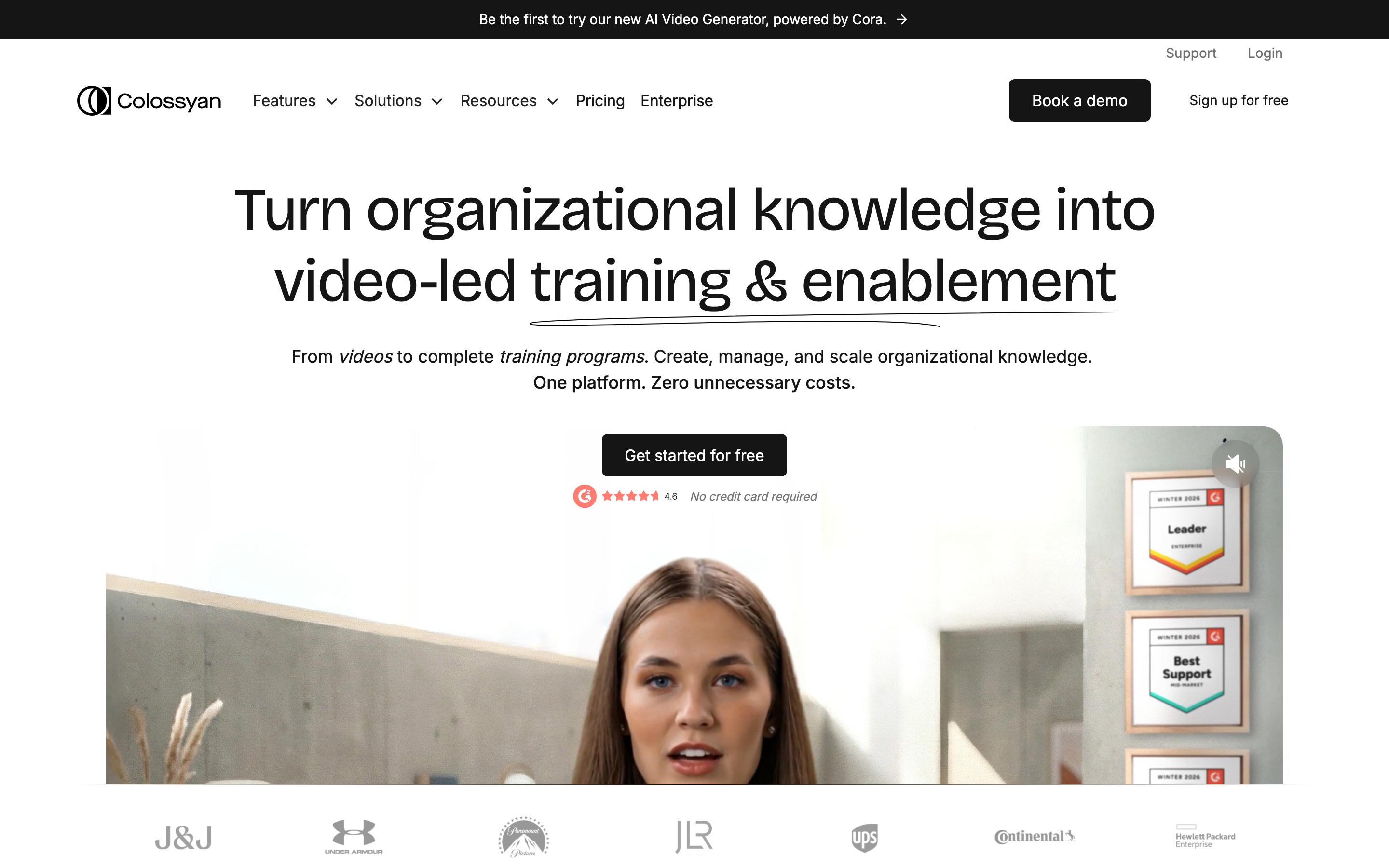
Colossyan is best for L&D, HR, and enablement teams building interactive, SCORM-ready training from documents and slides. Public details were checked against Colossyan's pricing and product pages for this 2026 comparison.
Key features
- Interactive videos - Branching scenarios and multiple-choice quizzes that turn a clip into a decision-based learning path.
- Document to video - Turn PDFs, PowerPoint slides, or text prompts into presenter-led training modules.
- SCORM, brand kits, and SSO - Export courses to an LMS, with brand kits and SSO available on the paid Business and Enterprise tiers.
- Expressive avatars - 170-plus avatars with emotion settings and the ability to age a presenter up or down.
- Localization - 80-plus languages with automatic translation, capped by tier.
What users say
Reviewers praise Colossyan for the speed of converting static documents into localized training and for hands-on onboarding and support that feels like an extension of the team. The common cautions are a smaller avatar library and language list than Synthesia, and slightly slower rendering. Buyers also note it lacks the published SOC 2 certification that some procurement teams require.
Best for
Choose Colossyan when interactive, SCORM-ready training is the priority, especially for onboarding, compliance, and enablement programs, with branching and quizzes reachable on self-serve tiers and SCORM export on the higher paid tiers.
3. Synthesia
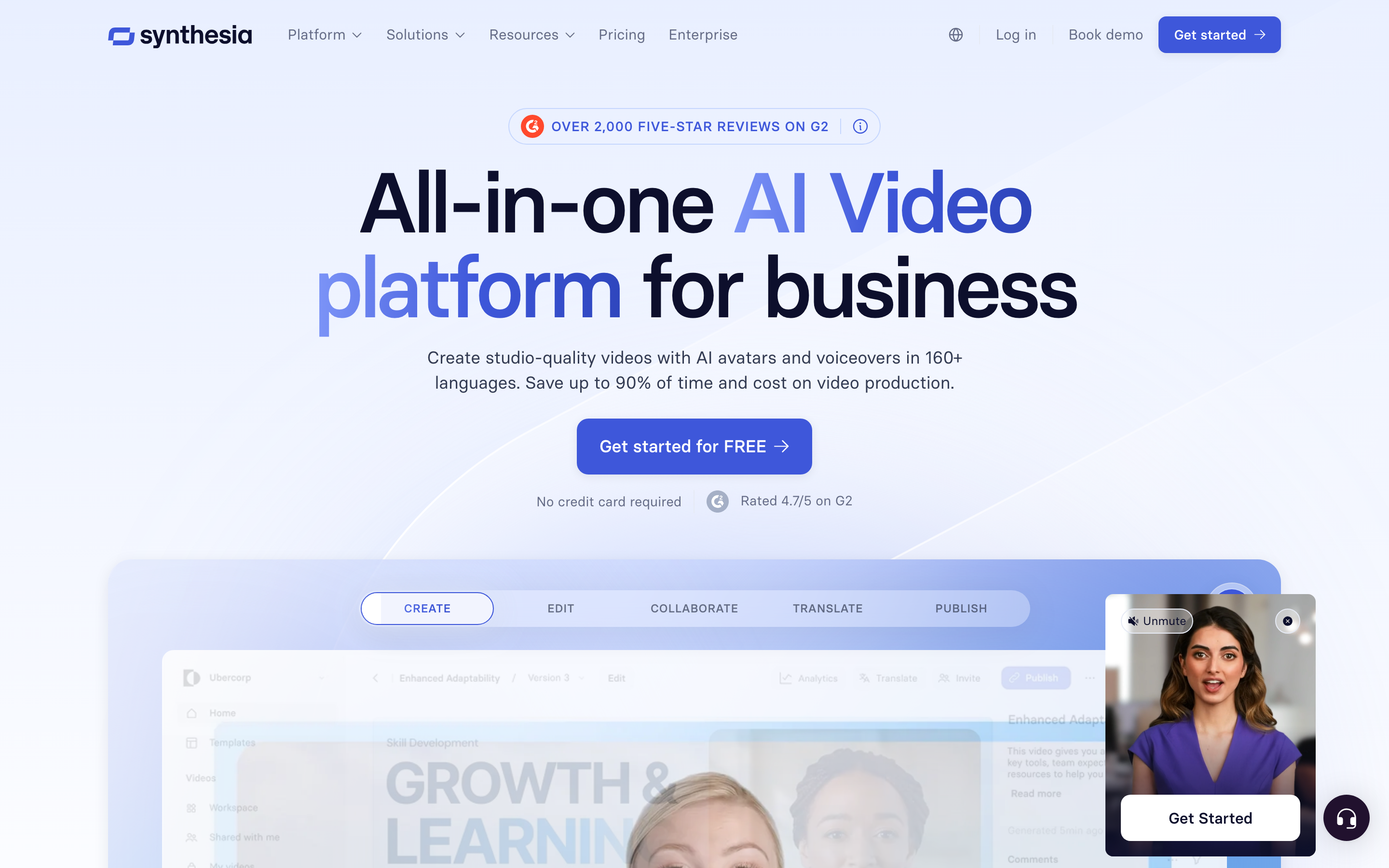
Synthesia is best for enterprise training, enablement, and compliance video produced at scale across many languages. Public details were checked against Synthesia's pricing and product pages for this 2026 comparison.
Key features
- Express-2 avatars - Late-2025 model with full-body movement, co-speech gestures, and micro-expressions for stronger realism.
- Broadest languages - More than 140 languages advertised across current official product pages, with project translation and AI dubbing.
- Governance and compliance - SOC 2 Type II, ISO 27001, ISO 42001, and GDPR, with documented consent for custom avatars.
- Enterprise SCORM and SSO - LMS export and SAML SSO on the Enterprise tier.
- Minute model - Predictable per-minute pricing on self-serve tiers.
What users say
Buyers shortlist Synthesia when avatar realism, language breadth, governance, and enterprise review matter most, and Reddit users generally praise its ease of use and output quality. The trade-offs reviewers raise are steep per-minute cost, key features locked behind Enterprise including SCORM, and avatars that still do not fully clear the uncanny valley on emotionally complex content.
Best for
Choose Synthesia for governed, multilingual training and compliance programs that need consistent avatar video at scale with published security certifications.
How we compared these tools
This is not a star rating. It is a decision-weighting model for buyers choosing between two AI avatar tools, with ngram included as the third option many of them actually need.
| Criteria | Weight | What we looked at |
|---|---|---|
| AI capabilities | 30% | Avatar realism, voice, translation, and interactive depth |
| Features | 30% | Workflow breadth, source support, SCORM, and export options |
| Ease of use | 20% | Time to a first finished video and learning curve |
| Value | 15% | Public pricing, minute and credit rules, watermarks, and tier gating |
| Support and governance | 5% | Onboarding, collaboration, review, and compliance controls |
We reviewed official vendor pricing and product pages, current SERP patterns, and 2026 review-site and Reddit sentiment, and we did not use numerical star ratings because they flatten the real decision: the best tool depends on whether you need interactive training, governed multilingual video, or a full source-to-video workflow.
Common questions
Is Colossyan better than Synthesia?
Neither is better outright. Colossyan wins for interactive, SCORM-ready training, with branching and quizzes reachable on self-serve tiers, and for expressive avatar control, while Synthesia wins for language breadth, raw avatar realism, and published compliance certifications. Match the tool to the job, and consider ngram if your real need is a finished video built from source material rather than a script-read talking head.
Is Synthesia cheaper than Colossyan?
Synthesia currently publishes a lower annualized entry price at $18 a month for Starter, while Colossyan's public comparison page lists Starter at $27 a month. Those plans use different minute and feature allowances, so compare the live checkout against your expected volume and SCORM requirements rather than choosing on the headline price alone.
What is the best Colossyan and Synthesia alternative?
For teams that need more than a talking head, ngram is the strongest alternative because it plans and builds full videos from prompts, docs, URLs, decks, screenshots, and recordings, then adds avatars, screen-recording polish, captions, and branding. Colossyan and Synthesia remain the specialist picks for interactive training and governed enterprise avatar video.
Which is better for interactive training, Colossyan or Synthesia?
Colossyan is the stronger interactive-training pick because branching scenarios and quizzes are available on lower, self-serve tiers, while both tools place SCORM export on their higher paid tiers and Synthesia gates it behind Enterprise. ngram is the better fit when training content starts from SOPs, PDFs, decks, or screen recordings and needs storyboard planning plus branded export, though it does not build SCORM courses.
Which one should you pick?
The Colossyan vs Synthesia decision is really a question about your job, not the avatars. If you build interactive, SCORM-ready training and want branching and quizzes without paying for Enterprise, pick Colossyan. If you run a multilingual enterprise training or compliance program that needs the broadest language list, the most realistic avatars, and published SOC 2 and ISO certifications, pick Synthesia. If your actual job is turning real business material into finished, branded videos, where the presenter is one scene among screen recordings, callouts, and B-roll, ngram beats both. The mistake is treating every AI avatar tool as interchangeable. In 2026, workflow fit matters more than the category label.
---
Start a video with ngram and review the plan before rendering. Turn a prompt, doc, URL, deck, or screen recording into a polished, on-brand video without rebuilding it from a blank script. Start with ngram