
On July 1, 2026, TwelveLabs announced a $100 million Series B, co-led by NEA and NAVER Ventures, with Amazon, Radical Ventures, Korea Investment Partners, Index Ventures, Quadrille Capital, and Red Bull Ventures all participating, per the company's own GlobeNewswire announcement. Amazon did more than write a check. AWS signed a multiyear deal to run TwelveLabs' workloads on its own Trainium chips, with new TwelveLabs models launching on AWS first.
Every other AI video funding headline this year has gone to companies that generate video. Kling AI just confirmed a round worth billions at an $18 billion valuation. Runway raised $315 million at a $5.3 billion valuation in February. TwelveLabs does neither. It doesn't generate a single frame. It builds models that watch video that already exists and turn it into something software can search, query, and reason over.
That distinction is the actual story here. As every major lab races to make it trivially easy to generate more video, a second, quieter race has opened underneath it: making sense of the video that already exists. TwelveLabs' raise, and the AWS chip deal that came with it, is the clearest signal yet that serious infrastructure capital is now backing that second race too.
What TwelveLabs actually raised
TwelveLabs builds foundation models that turn raw video into structured, searchable data instead of generating new footage. Its $100 million Series B was co-led by NEA and NAVER Ventures, with Amazon, Radical Ventures, Korea Investment Partners, Index Ventures, Quadrille Capital, and Red Bull Ventures joining as investors. No valuation was disclosed, which is itself notable next to how loudly generation-layer rounds tend to publish theirs.
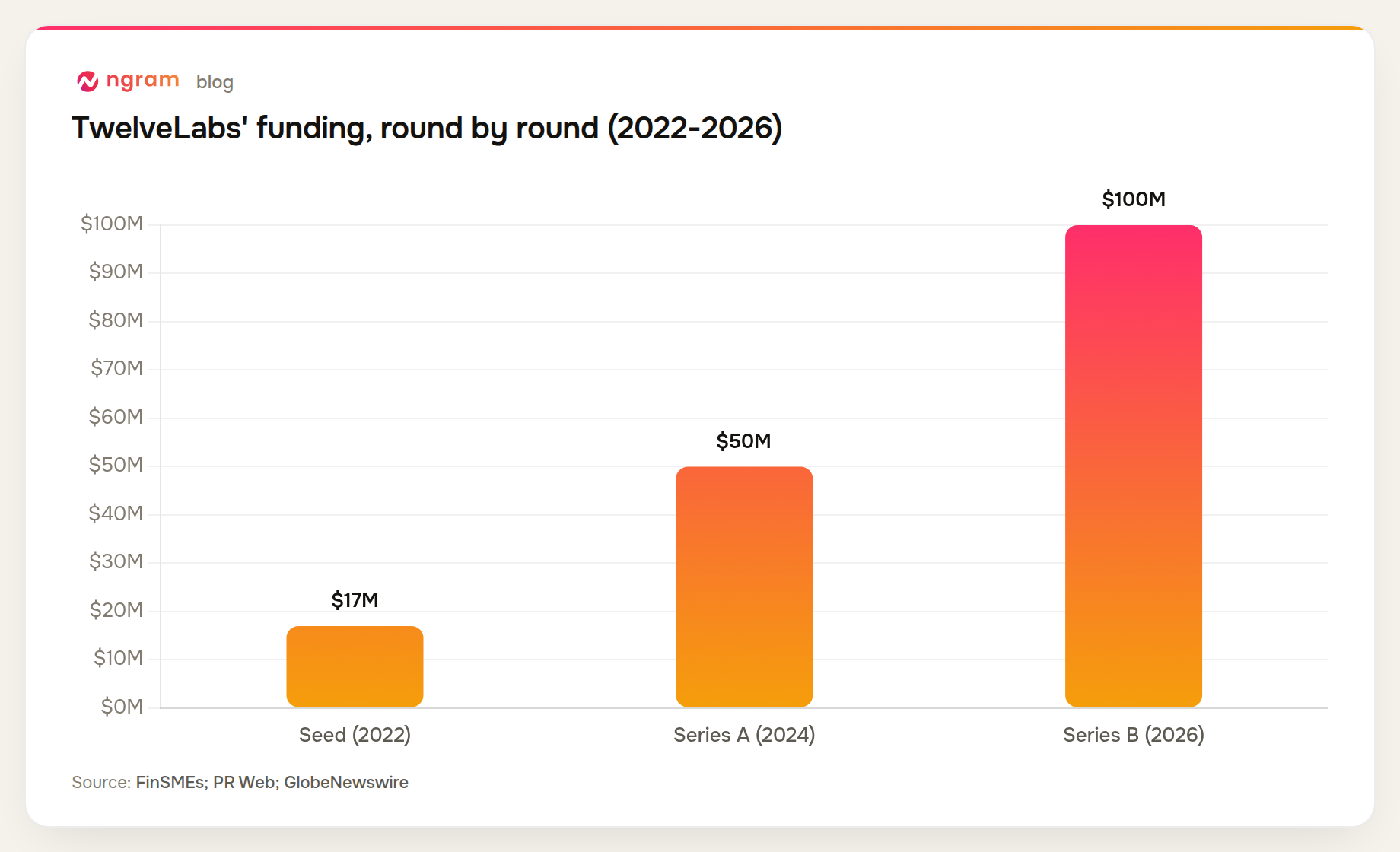
The round brings TwelveLabs' total funding to roughly $167 million across three rounds since its first raise in 2022, according to FinSMEs and TechFundingNews. TwelveLabs raised $5 million in an initial seed round in March 2022, then a $12 million seed extension led by Radical Ventures later that year, bringing seed-stage funding to about $17 million. A $50 million Series A followed in mid-2024, co-led by NEA and NVIDIA's NVentures.
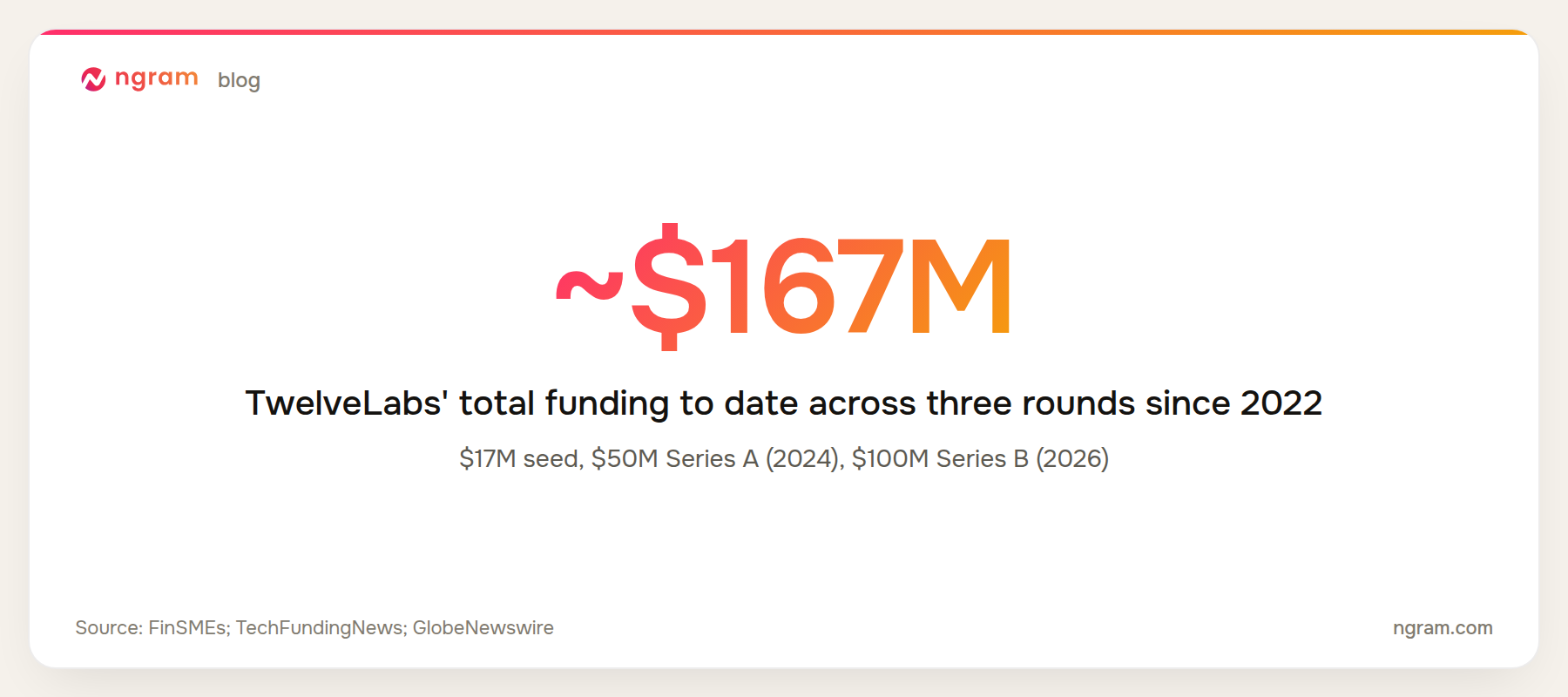
TwelveLabs plans to put the new money into R&D and into opening offices in New York and London, adding to its existing San Francisco and Seoul bases. The company has grown from around 58 employees a year ago to roughly 178 as of June 2026, per TechFundingNews reporting, a headcount curve that tracks the funding curve below.
The real headline is the chip deal, not the check size
A $100 million round is a modest number next to this year's AI video headlines. The part worth paying attention to is what Amazon did alongside it. AWS committed to a multiyear deal to optimize and host TwelveLabs' video inference workloads specifically on its own Trainium chips, and TwelveLabs agreed that its new frontier models will launch on AWS first, according to reporting from Sports Video Group and AI Weekly. TwelveLabs' models have been available on AWS Marketplace since 2025; this deal goes further, tying its compute roadmap to Amazon's own silicon rather than to generic rented GPUs.
That distinction matters more than the dollar figure. Any company can buy cloud compute. Far fewer get a cloud provider to commit its own custom chips to their specific workload and agree to be the first launch surface for that company's future models. It's the kind of commitment a cloud vendor makes when it believes a category is about to matter, not when it's hedging a small bet.
TwelveLabs co-founder and CEO Jae Lee framed the company's whole thesis around that durability. "Video is the data understanding has to answer to," he said in the funding announcement. "Models commoditize. The intelligence layer that composes them does not." NEA partner Tiffany Luck put the investor case in similar terms, saying TwelveLabs' models "are purpose-built to turn millions of hours of footage into intelligence that compounds over time." NAVER Ventures general partner YJ Park added that "video is the modality that matters most, and TwelveLabs is the team building that capability."
What TwelveLabs' models actually do differently
TwelveLabs' pitch rests on a specific technical bet: build native video models instead of retrofitting language models to handle video. Most LLMs still process video by sampling it into a sequence of screenshots, which throws away motion, timing, and continuity. TwelveLabs' Marengo 3.0, released in late 2025, is described as the world's most powerful video embedding model, converting sound, speech, and motion across time into a single machine-readable representation rather than a stack of still frames.
Pegasus 1.5 sits on top of that embedding layer and turns video into structured data: scene boundaries, entities, temporal segments, and semantic context an LLM can reason over directly. TwelveLabs describes Pegasus as functioning like a domain-specific language for video, one that makes raw footage parseable by any intelligent system built on top of it. The company also builds persistent memory into the system, so the more video an organization indexes, the more capable its own archive becomes to query, rather than starting from zero with every new clip.
The use cases follow directly from that architecture. A sports broadcaster can pull every match-winning goal scored in the final minutes out of years of unlabeled game tape. A security team can search surveillance footage by description instead of scrubbing through timestamps by hand. Security, advertising, sports, and automotive are the primary industries TwelveLabs points to today, alongside broader enterprise media libraries that have accumulated more footage than any human team can watch, let alone index.
Two layers, one stack: why 2026's funding map looks lopsided
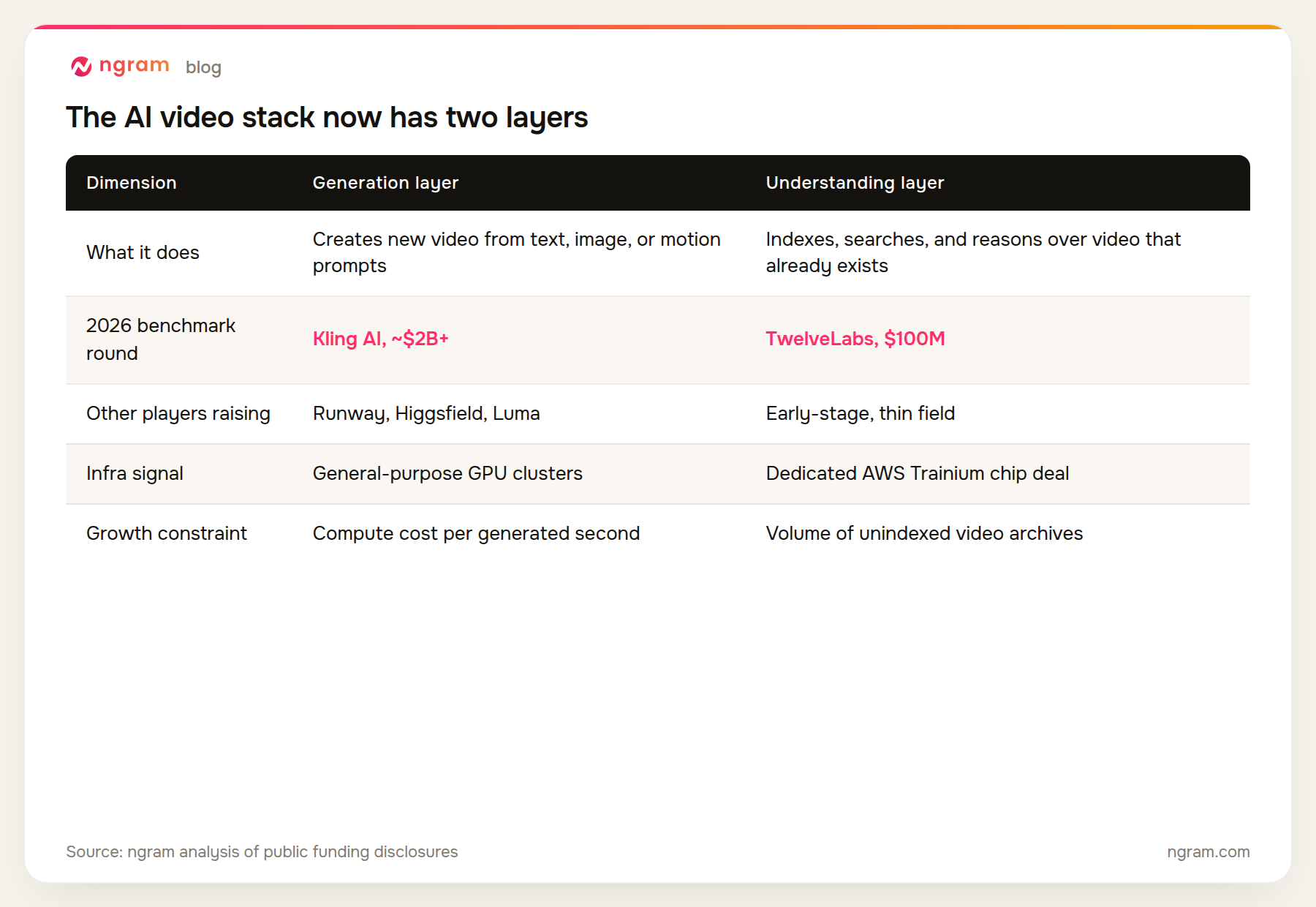
Line TwelveLabs' round up against 2026's other marquee AI video funding events and the gap is stark. Kling AI, Kuaishou's video generation unit, just confirmed a round reported at more than $2 billion at an $18 billion valuation, the largest funding event in AI video generation's history. Runway closed a $315 million Series E at a $5.3 billion valuation back in February. Even Higgsfield, a generation-focused rival, was separately reported this same week to be in talks for a round at a roughly $5 billion valuation on the back of a $500 million revenue run rate. Every one of those dollars is chasing the ability to generate more video, faster and more convincingly.
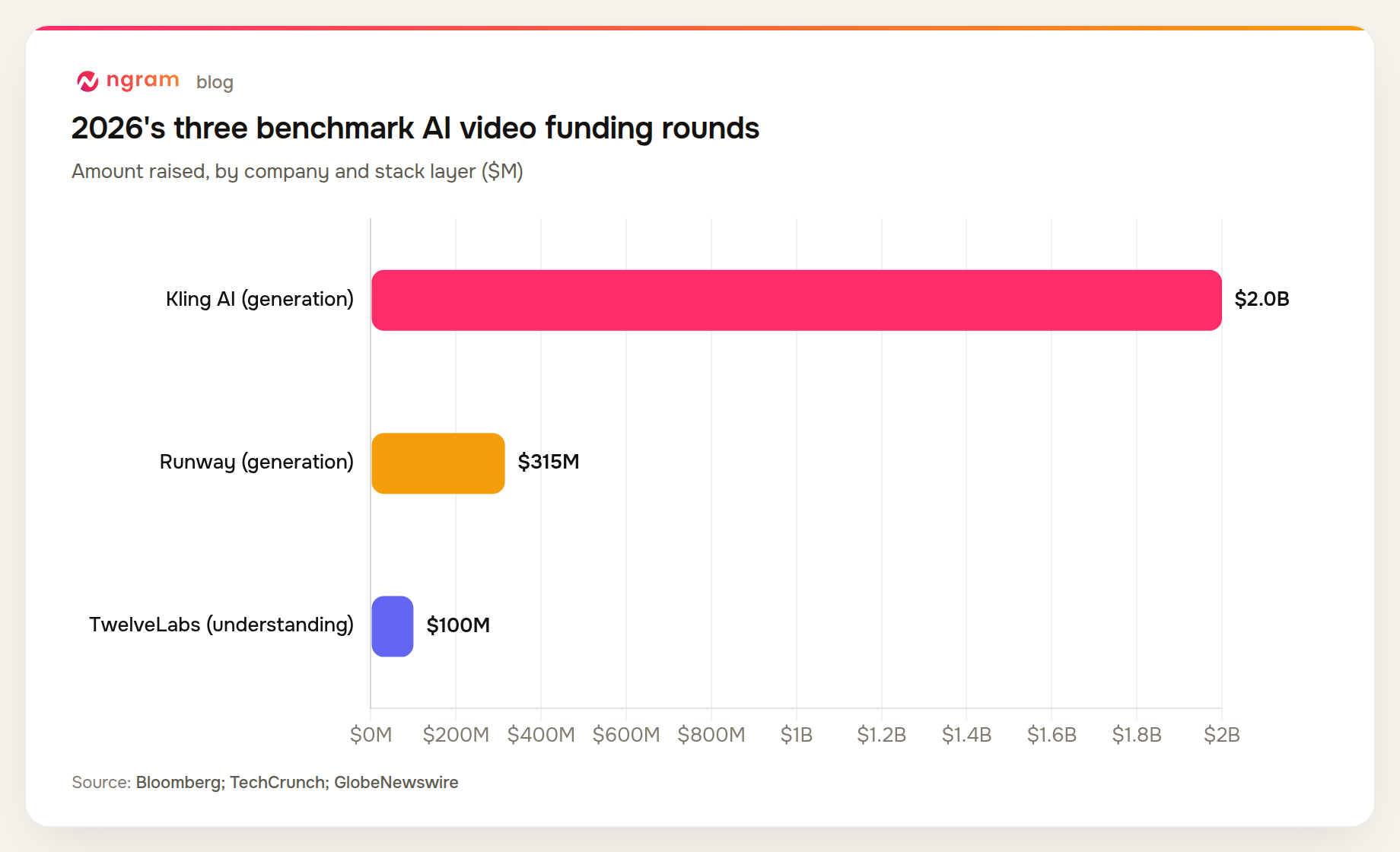
TwelveLabs' $100 million looks like a rounding error next to Kling's round, and that gap is exactly the point. The generation layer has spent 2026 consolidating around a handful of extremely well-funded labs, a pattern we've also traced through OpenAI's decision to shut down Sora earlier this year after the consumer app burned roughly $1 million a day against $2.1 million in lifetime revenue. Generation is getting commoditized fast: cheaper, more capable models are shipping constantly, and the money chasing that layer is now a scale game between a handful of giants. TwelveLabs is the first meaningfully funded bet that the harder, more durable problem sits one layer over, in making all that newly abundant video legible to software in the first place.
Investors are pricing legible video like infrastructure, not a feature
Independent market research backs the direction, even where the exact numbers disagree. Estimates for the video analytics market, the closest existing analyst category to what TwelveLabs sells, range from $33.7 billion by 2030 (Mordor Intelligence) to $65.1 billion by 2034 (Fortune Business Insights), with Grand View Research and MarketsandMarkets landing in between. Different firms scope the category differently, which is why the totals vary this much, but every one of them points to sustained double-digit growth through the early 2030s.
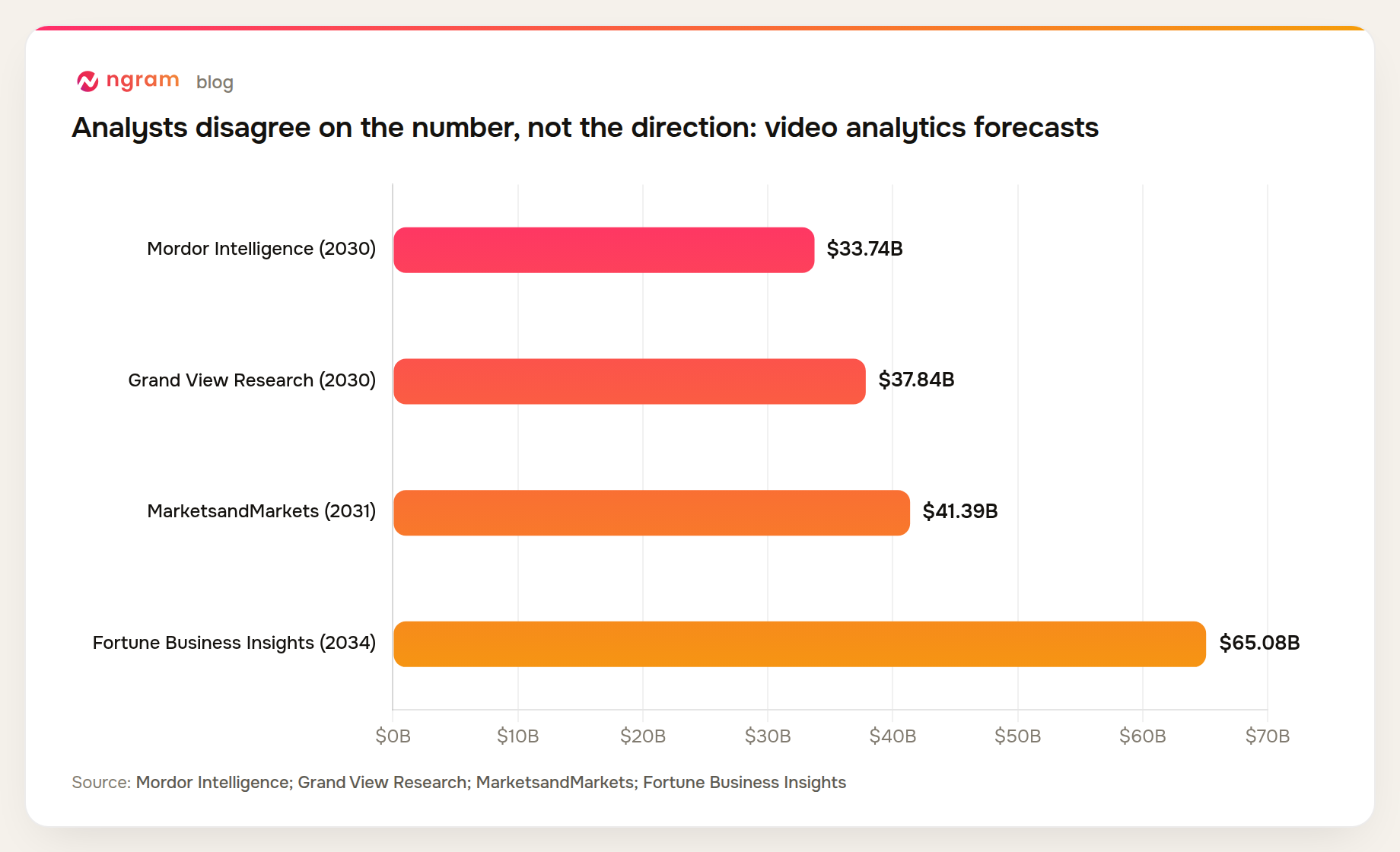
TwelveLabs' bet is that the demand curve for indexing video is about to get steeper than any of those forecasts assume, precisely because the generation layer is now flooding the world with more video than it has ever produced before. Every AI-generated clip, every screen recording, every sports broadcast, every security camera feed adds to a pile of footage that sits unsearchable unless something turns it into structured data first. Generation created the volume problem. TwelveLabs, and whoever else raises money in this layer next, is betting on being paid to solve it.
Every layer of the video stack has to solve this, ngram included
The problem TwelveLabs is solving at the infrastructure layer, turning raw video into something software can actually work with, isn't unique to general-purpose search. It shows up inside video creation tools too, just scoped to whatever that specific pipeline produces or ingests. At ngram, that means auto-generated captions on every render, a screen-recording pipeline that transcribes a raw recording and detects key moments and clicks well enough to turn it into a structured explainer, and a brand kit that governs which assets and styles get selected for a given video automatically. None of that is general-purpose video search across an enterprise archive, and it would be a stretch to call it TwelveLabs-style video understanding. But it's the same underlying problem in miniature: as video volume scales, making that video legible to software, not just generating more of it, is a problem every layer of the stack eventually has to solve.
What to watch next
- Whether other video-understanding startups raise comparable rounds in the next two quarters, which would confirm this is a category shift rather than a one-off AWS strategic bet.
- What TwelveLabs actually ships under the "full-stack agentic intelligence system for video" framing it used in the announcement, and whether that expands beyond search into automated workflows.
- Whether Google, Microsoft, or other hyperscalers respond with their own dedicated video-understanding chip or hosting commitments, the way AWS just did with Trainium.
- Whether generation-layer giants like Kling or Runway start building or acquiring understanding capabilities of their own, which would blur the two-layer split this piece describes.
- TwelveLabs' New York and London office openings, and whether they translate into named enterprise customers beyond the media and sports partners it already works with.
Frequently Asked Questions
What is TwelveLabs?
TwelveLabs is an AI company, founded in 2021, that builds foundation models for video understanding rather than video generation. Its models, Marengo 3.0 and Pegasus 1.5, convert raw video into structured, searchable data so organizations can find, index, and reason over footage they already have, including sports archives, security camera feeds, advertising libraries, and enterprise media collections.
How much funding has TwelveLabs raised?
TwelveLabs has raised roughly $167 million in total since 2022: about $17 million across a seed round and seed extension in 2022, a $50 million Series A in 2024 co-led by NEA and NVIDIA's NVentures, and a $100 million Series B in July 2026 co-led by NEA and NAVER Ventures.
What is the AWS Trainium deal TwelveLabs signed?
Alongside its Series B, TwelveLabs and AWS agreed to a multiyear commitment for AWS to host and optimize TwelveLabs' video inference workloads on its own Trainium chips, with TwelveLabs' new frontier models launching on AWS first. It's a deeper commitment than generic cloud spend: AWS is dedicating its own custom silicon to TwelveLabs' specific workload, not just selling it rented GPU capacity.
What do Marengo and Pegasus actually do?
Marengo 3.0 is a video embedding model that converts a video's sound, speech, and motion across time into a single machine-readable representation, rather than sampling it into a sequence of still screenshots the way many LLMs process video today. Pegasus 1.5 builds on that embedding to output structured data, scene boundaries, entities, timestamps, and semantic context, that an LLM can reason over directly.
How is video understanding AI different from AI video generation?
Video generation models (Kling, Runway, Veo, and similar) create new video from a text, image, or motion prompt. Video understanding models like TwelveLabs' don't create anything; they take video that already exists and turn it into data that software can search, query, and reason over. 2026's biggest AI video funding rounds have overwhelmingly gone to the generation side; TwelveLabs' Series B is the clearest sign yet that serious capital is now flowing to the understanding side too.
Does this affect ngram?
Not directly. ngram is a video creation tool, not a general-purpose video search platform, and it doesn't use TwelveLabs' models. But the underlying problem TwelveLabs solves at industry scale, turning raw video into something software can act on, shows up inside ngram's own pipeline in a narrower form: auto-captions, screen-recording transcription and key-moment detection, and brand-kit-driven asset selection all depend on making video legible enough for the product to act on it.
What's next for TwelveLabs?
TwelveLabs says it will use the new funding to accelerate R&D and expand geographically, opening offices in New York and London alongside its existing San Francisco and Seoul bases. The company has also signaled it's pushing beyond pure video-understanding models toward what it calls a full-stack agentic intelligence system for video, combining perception, knowledge, and reasoning in one architecture. If you want to try ngram's own take on turning raw video and screen recordings into a polished, on-brand video, ngram is free to start.