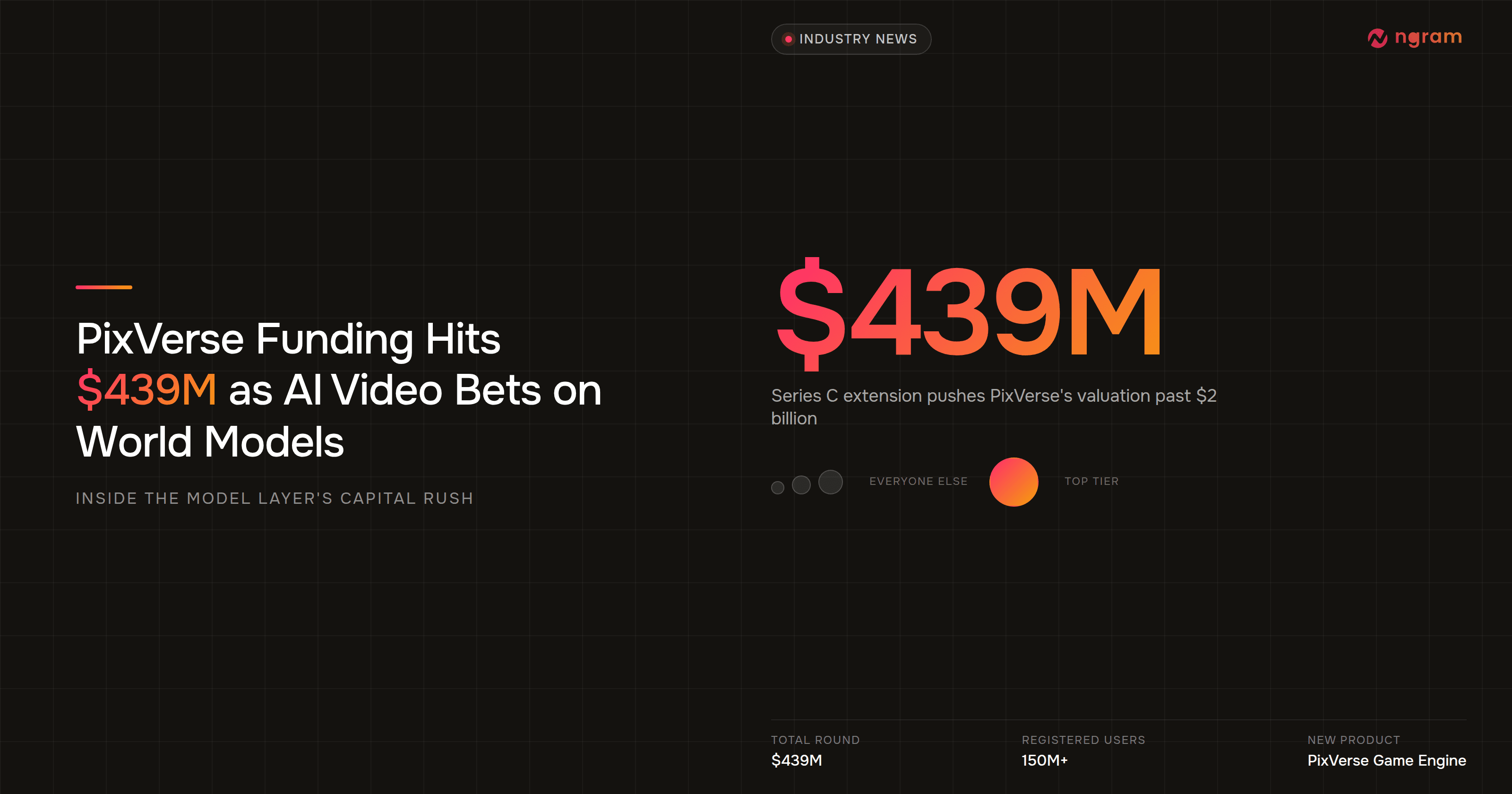

The PixVerse funding story just added a new chapter. On July 13, 2026, the Singapore-based AI video startup closed a Series C extension that brings its total Series C round to $439 million and pushes its valuation past $2 billion, according to TechCrunch and PixVerse's own announcement. The round follows an initial Series C close of roughly $300 million in March 2026, and it did not come from the usual pool of AI-video backers alone: Alibaba, Mirae Asset, and China's BlueFocus joined the extension, alongside returning investors iGlobe Partners and OCBC's Lion X Ventures.
The money is not just fuel for more video generation. PixVerse is using it to push into real-time "world models", interactive, continuously generated environments a person can act inside, rather than a clip that renders once and stops. The company's R1 model now anchors a new PixVerse Game Engine for natural-language-driven interactive worlds, arriving four months after OpenAI shut down Sora and fully exited the consumer AI video market.
This is not just another funding recap. It is a read on where capital in AI video is actually flowing right now: toward a shrinking set of well-capitalized model vendors, toward real-time interactivity as the next frontier past clip generation, and away from the consumer app layer OpenAI just walked away from. We will look at what PixVerse actually raised, how its $2 billion-plus valuation stacks up against Runway, Luma, and Synthesia, what a world model and the new Game Engine actually do, and what a more consolidated model layer means for teams that just want a finished video rather than a raw generated clip.
Inside PixVerse's $439 million funding round
PixVerse's original Series C, led by CDH Investments, closed at roughly $300 million in March 2026. The extension announced July 13 brings the round's total to $439 million and lifts the company's valuation past $2 billion for the first time, per TechCrunch and PixVerse's own release. The extension's new backers, Alibaba, Lollapalooza Capital, Ivy Capital, Grand Mount Capital, Eastern Bell Capital, Mirae Asset, BlueFocus, and CloudAlpha, joined returning investors iGlobe Partners and OCBC's Lion X Ventures.
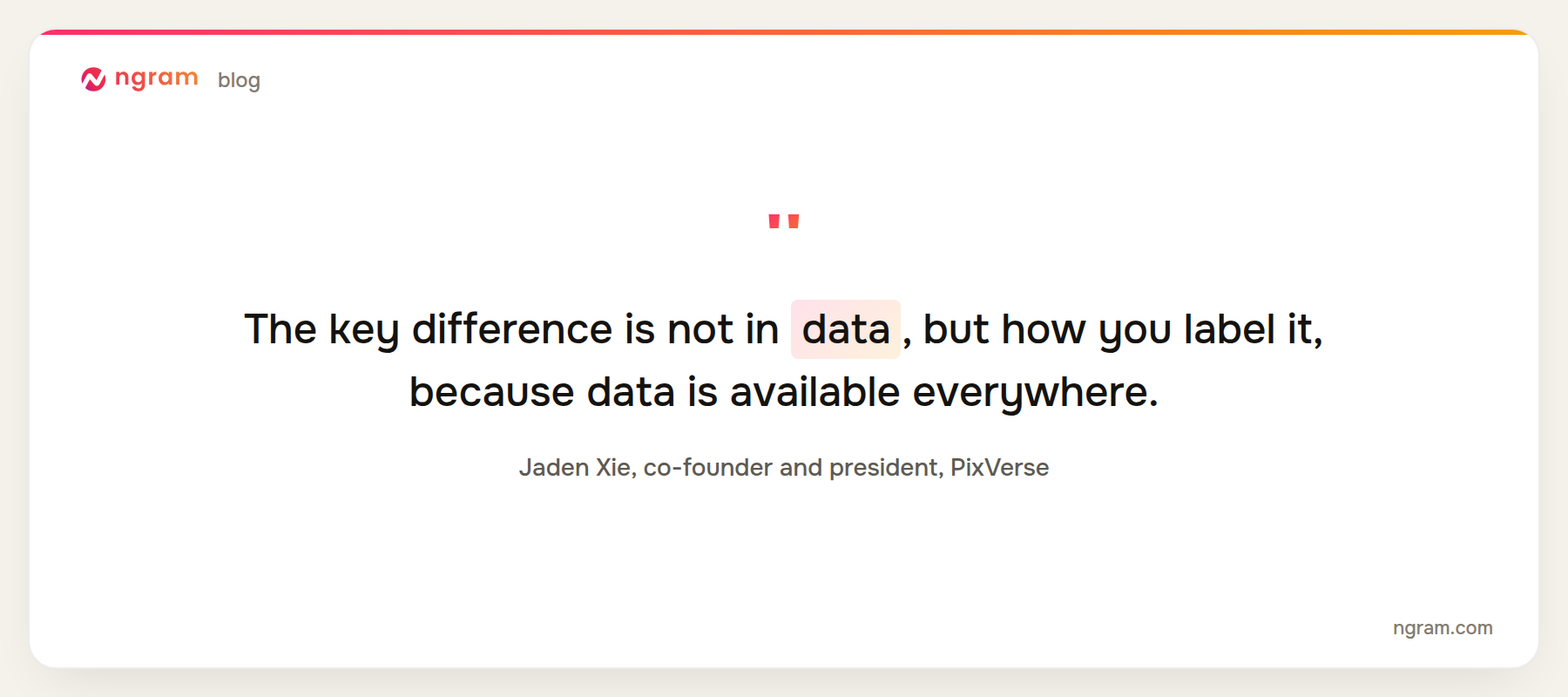
PixVerse co-founder and president Jaden Xie framed the round around a specific competitive claim: that raw model access is no longer the differentiator it once was.
"The key difference is not in data, but how you label it, because data is available everywhere," Xie told TechCrunch, noting that only a handful of companies currently meet the quality bar for competitive video generation. It is a notable thing for a video-generation founder to say out loud: the scarce resource in 2026 is not raw footage or compute, it is the labeling pipeline that turns raw footage into something a model can actually learn from.
PixVerse was founded in 2023 by Wang Changhu, a former ByteDance computer vision researcher, and Jaden Xie, a former Lighthouse Capital executive director. The company is headquartered in Singapore with additional offices in Beijing and Shanghai, and employs around 150 people.
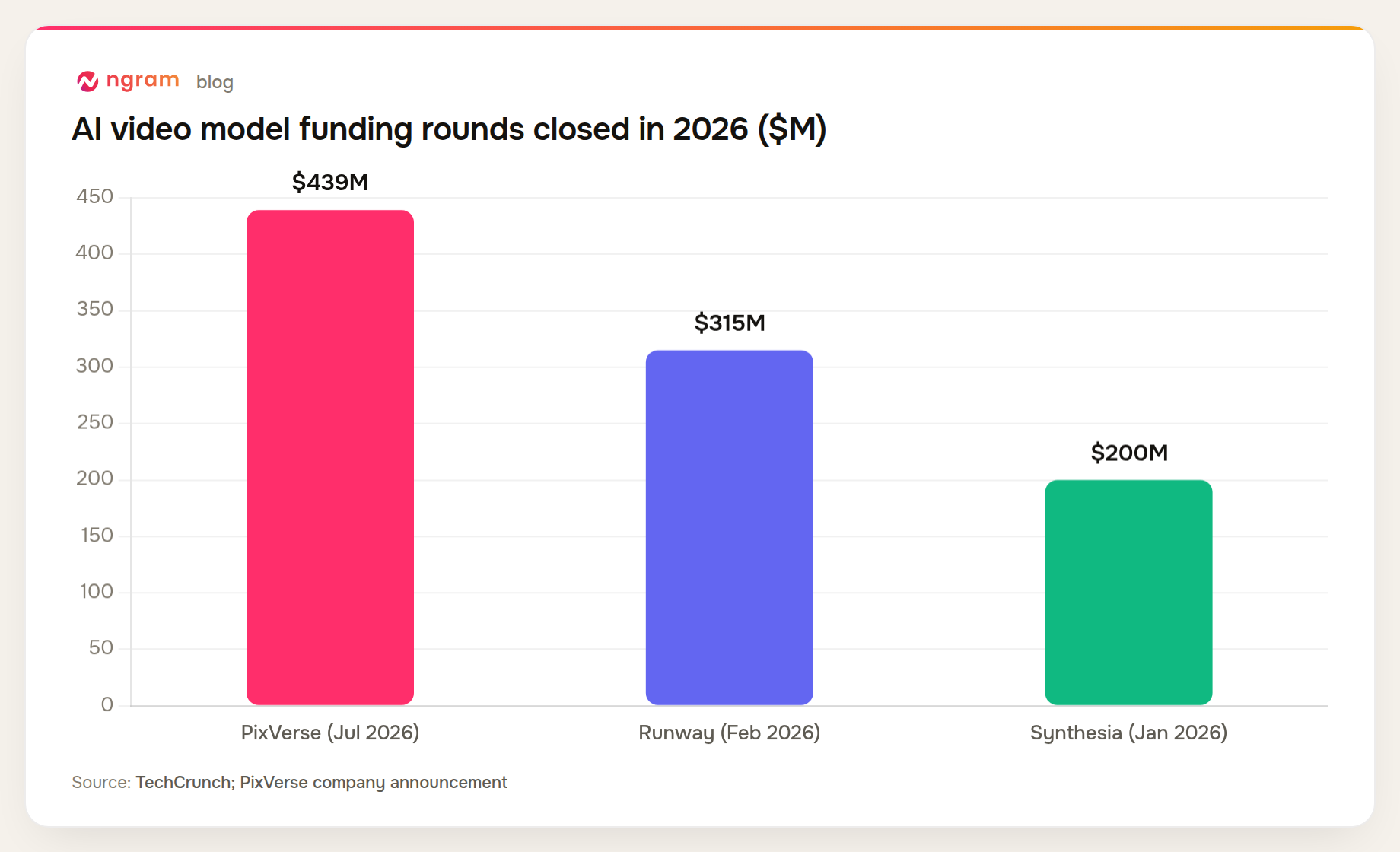
Set next to the rest of 2026's AI video raises, PixVerse's $439 million is the largest single round closed by a pure-play video model company so far this year, ahead of Runway's $315 million Series E in February and Synthesia's $200 million Series E in January.
PixVerse by the numbers: 150 million users betting on more than clips
PixVerse says it now has more than 150 million registered users and 15 million monthly active users across 177 countries, according to TechCrunch and PixVerse's announcement. Pricing for image-to-video generation runs about $4.80 per minute of output.
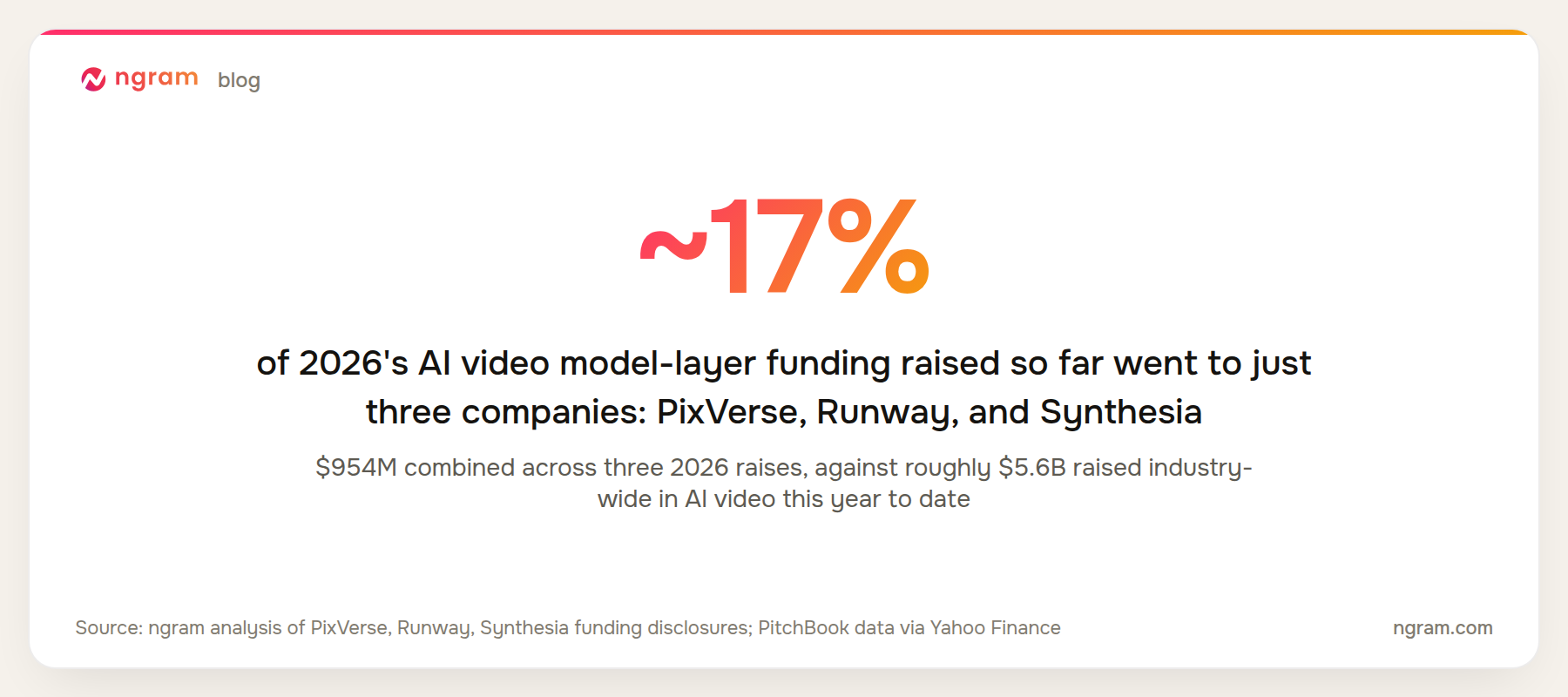
That 17% figure is a back-of-envelope calculation, not an official statistic: it is PixVerse's $439 million, Runway's $315 million, and Synthesia's $200 million (all closed in 2026) added together and divided by the roughly $5.6 billion in AI video funding raised industry-wide so far this year, per PitchBook data reported by Yahoo Finance. Three companies alone account for close to a fifth of everything the sector has raised in 2026. That is the concentration this piece keeps coming back to.
PixVerse's product lineup is built in three tiers. The V-Series is the consumer- and API-facing video generator, with flagship model V6 adding precision camera control, expressive character performance, and cinematic-quality output. The C-Series targets professional film and commercial workflows. The R-Series is where the world-model pivot lives, and it is worth its own section.
From clips to worlds: what R1 and the PixVerse Game Engine actually do
PixVerse launched R1 in January 2026, describing it as the first real-time world model: instead of generating a fixed clip from a prompt, R1 produces a continuous, interactive video stream that responds to user input as it happens. An April 2026 update added shared worlds and personalized avatars, letting more than one person occupy the same generated environment at once.
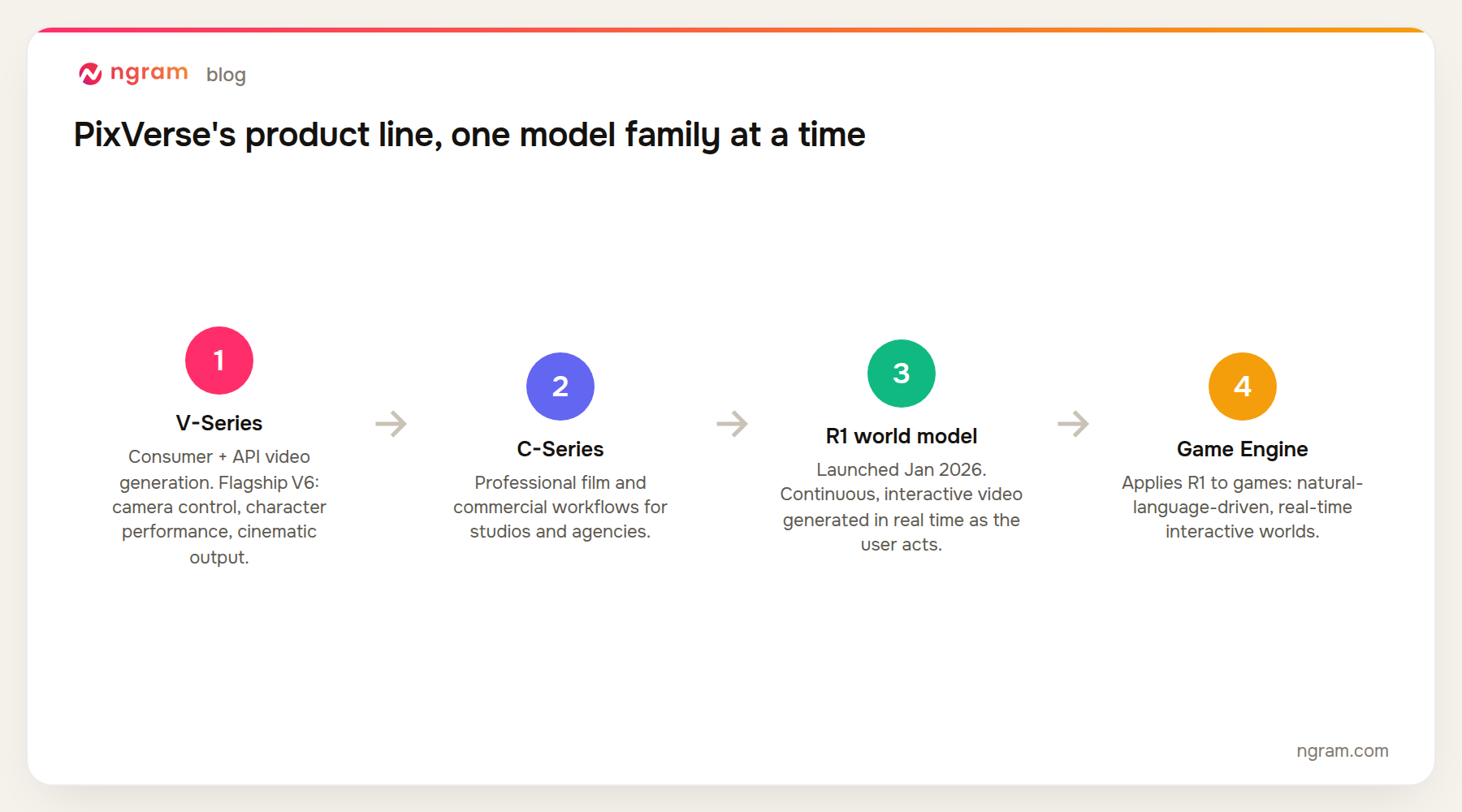
The new PixVerse Game Engine, announced alongside the funding round, extends R1 into game creation. It separates a game's mechanics (rules, physics, objectives) from its visual expression (art style, characters, environments), so a creator can describe a game in natural language and get a playable, real-time-generated world rather than a pre-built level loaded from disk. PixVerse also previewed real-time interactive livestreaming, where AI-generated characters respond live to what viewers say in chat.
Co-founder and CEO Wang Changhu put the underlying idea plainly in PixVerse's own announcement: "The world a player inhabits is not pre-rendered but continuously generated, in real time, in response to what they do." That is the actual pivot buried under the funding headline: PixVerse is betting its next chapter on interactivity, not just higher-fidelity clips.
PixVerse is not alone in that bet. Runway released its own first world model in December 2025 and says the fresh capital from its February round will go toward pre-training "the next generation of world models." Luma AI, which raised $900 million in November 2025, builds multimodal world models of its own and released Ray3, a reasoning video model, in September 2025. Real-time interactivity, not just longer or sharper clips, is emerging as the shared next frontier across the model layer, not just a PixVerse talking point.
AI video funding is concentrating at the model layer, right as OpenAI exits consumer video
PixVerse's raise lands four months after OpenAI shut down the consumer Sora app, the clearest sign yet that raw AI video generation and a profitable consumer product are not the same business. Sora burned roughly $1 million a day against $2.1 million in total lifetime revenue before OpenAI pulled the plug on April 26, 2026 (the API is set to follow on September 24, 2026). PixVerse's timing is not a coincidence: with the biggest lab in the world gone from consumer video, capital that might have chased a Sora competitor is instead flowing toward the handful of vendors already running profitable-enough businesses at scale.
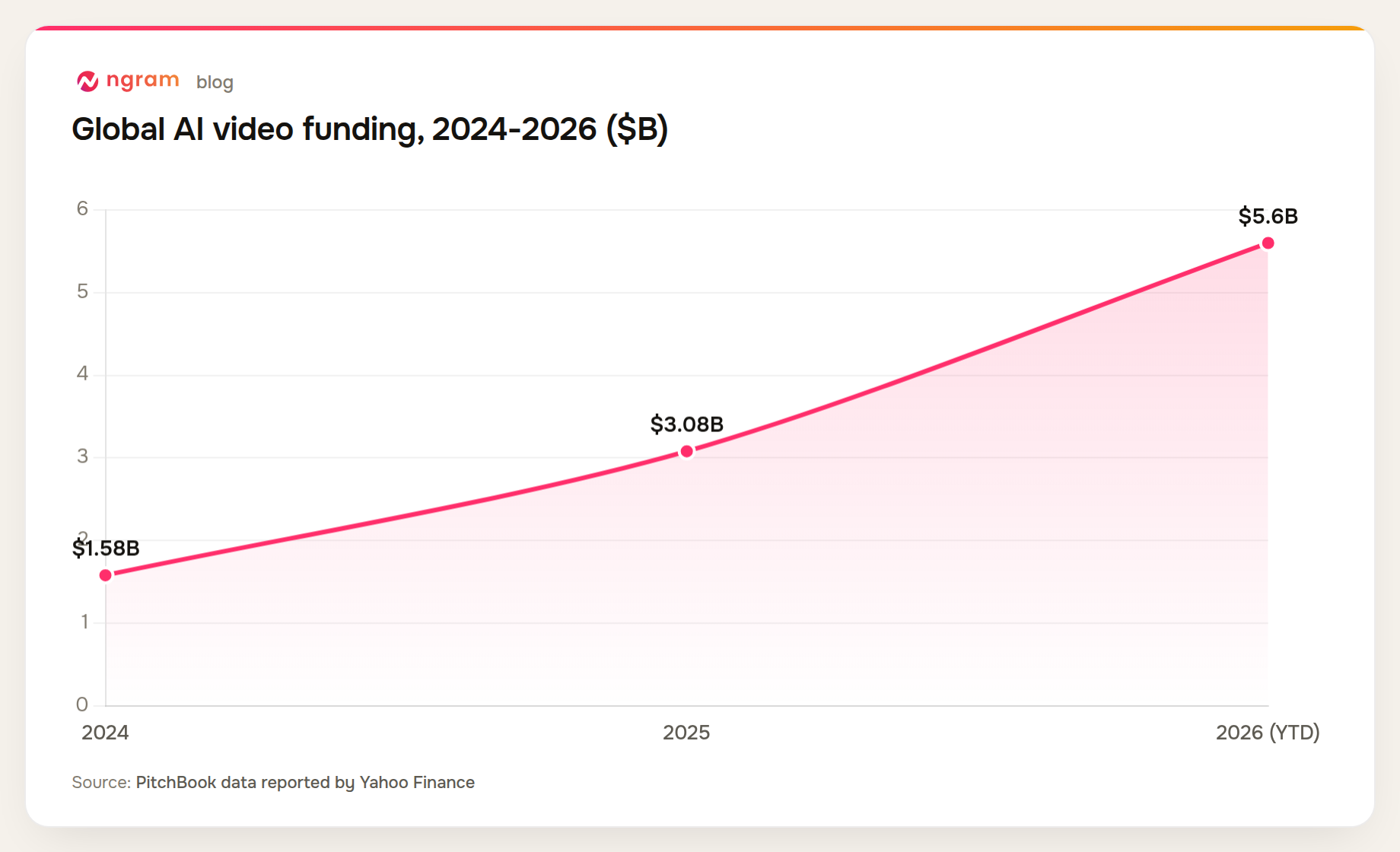
Global AI video funding roughly doubled from $1.58 billion in 2024 to $3.08 billion in 2025, and 2026's year-to-date total has already reached about $5.6 billion, up more than 43% on 2025's full-year figure with months still left on the calendar. But that money is not spreading across a long tail of startups. It is concentrating in a handful of AI video platforms that already have distribution, revenue, and a working product: PixVerse, Runway, Synthesia, Luma, and Kling chief among them.
How PixVerse's valuation stacks up in AI video's two-tier market
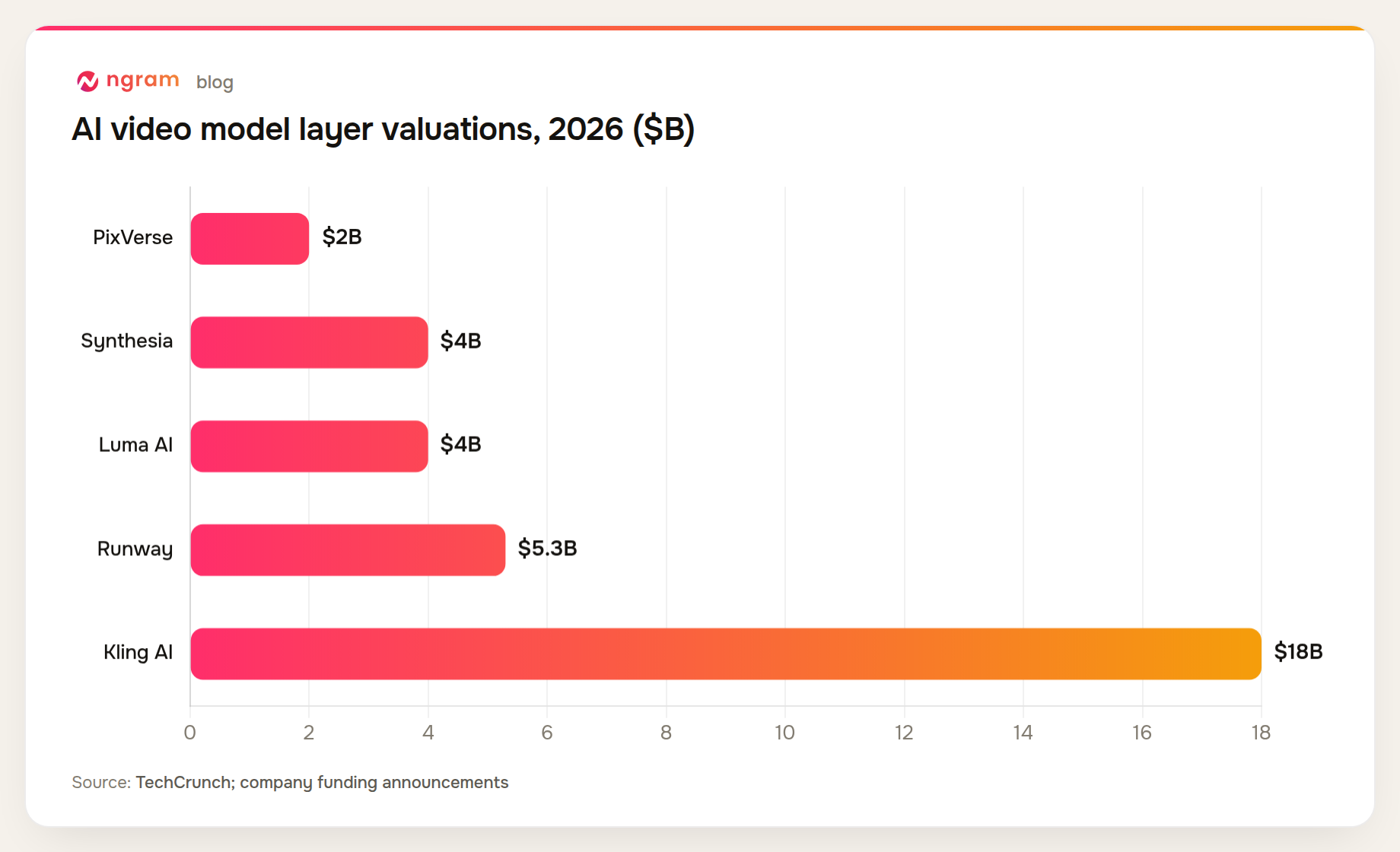
Line PixVerse's fresh valuation up against its closest peers and the picture is not a smooth ladder, it is two distinct clusters. Synthesia and Luma AI both sit around $4 billion, Runway is a step up at $5.3 billion (per its February round, led by General Atlantic), and PixVerse, even after crossing $2 billion for the first time, sits at the bottom of that cluster. Then there is Kling AI, which we covered raising $2 billion-plus at an $18 billion valuation earlier this month, sitting roughly four times higher than everyone else in this chart combined.
That gap is the real story underneath every individual funding headline this year. The AI video model layer is not one market anymore. It is splitting into a small top tier with enterprise revenue, distribution at scale, and pre-IPO ambitions (Kling, and to a lesser extent Runway), and a wider second tier of well-funded but still-catching-up players (PixVerse, Synthesia, Luma) that need to keep raising to stay competitive on compute and talent. We flagged this same power-vacuum dynamic when Alibaba's HappyHorse 1.1 launched into the gap Sora and Seedance left behind: capital in this category rewards whoever already has scale, not whoever raises next.
What a more consolidated, more powerful model layer means for teams that just want a finished video
Zoom out from PixVerse specifically and the pattern across this whole post is consistent: the raw-model layer is getting richer, more capable, and more fragmented all at once. Every well-funded vendor is racing toward its own version of "world models" and real-time interactivity, on its own timeline, with its own prompt syntax, its own strengths, and its own gaps.
That is good news if your job is training or operating one of these models. It is a real headache if your job is just making a finished video someone can watch. Picking the right model for a given shot, writing a prompt that actually gets the result you want, generating enough takes to find a usable one, then stitching those clips together with music, captions, and pacing is a full production workflow on its own, before anyone even opens an editor. The more raw-model options multiply, the more that orchestration work matters, not less.
That is the layer ngram sits in. Instead of asking a user to pick a model, write a prompt for it, and manually edit the output, ngram turns a prompt, script, document, or URL directly into a finished, edited, captioned, voiced video, choosing and orchestrating the underlying generation models on the user's behalf. If you want to see what that looks like without touching a raw model yourself, try an AI video generator built for that workflow.
What to watch next
- Whether the PixVerse Game Engine ships a public beta, and how it compares to what Runway and Luma release from their own world-model programs over the rest of 2026.
- Whether PixVerse's valuation keeps climbing toward the Synthesia/Luma cluster (~$4B) in a future round, or whether it stays the smallest of the named players.
- Whether 2026's full-year AI video funding total clears the roughly $5.6 billion already raised by mid-year, and how much of the rest concentrates in the same handful of companies.
- Whether more consumer-facing AI video labs follow OpenAI's lead and exit the space, further concentrating capital and users around the surviving vendors.
- Whether "world model" becomes a real, differentiated product category in its own right by year-end, or mostly stays a funding-round talking point.
Frequently Asked Questions
How much did PixVerse raise in its Series C funding round?
PixVerse closed a Series C extension on July 13, 2026 that brings its total Series C funding to $439 million. The round follows an initial close of roughly $300 million in March 2026, led by CDH Investments, with the July extension adding Alibaba, Mirae Asset, BlueFocus, and several other new and returning investors.
What is PixVerse's valuation?
PixVerse's valuation crossed $2 billion for the first time with the July 2026 Series C extension, according to TechCrunch. That puts it below peers like Synthesia and Luma AI (both around $4 billion) and Runway ($5.3 billion), and well below Kling AI, which is valued at roughly $18 billion.
What is PixVerse used for?
PixVerse is an AI video generation platform. Its V-Series handles consumer and API text-to-video and image-to-video generation, its C-Series targets professional film and commercial workflows, and its newer R-Series (starting with R1) generates real-time, interactive "world models" rather than fixed clips. PixVerse says it has more than 150 million registered users across 177 countries.
How much does PixVerse cost?
Image-to-video generation on PixVerse runs about $4.80 per minute of output, per TechCrunch's reporting on the funding round. Exact pricing tiers can change, so check PixVerse's own pricing page for current rates.
What is a "world model" in AI video?
A world model generates a continuous, interactive environment in real time, responding to a user's actions as they happen, instead of producing one fixed clip from a prompt and stopping. PixVerse's R1, launched in January 2026, describes itself as the first real-time world model; Runway and Luma AI are pursuing similar real-time, interactive approaches of their own.
What is the PixVerse Game Engine?
The PixVerse Game Engine, announced alongside the July 2026 funding round, applies PixVerse's R1 world model to game creation. It separates a game's mechanics from its visual style so a creator can describe a game in natural language and get a playable, real-time-generated world, rather than assembling one from pre-built assets.
Does ngram use PixVerse's models?
No. ngram's image and video generation is powered primarily by FAL.ai, with Replicate as a fallback and Grok Imagine used selectively, not by PixVerse. This funding round doesn't change what ngram ships today, but it is one more sign that the raw-model layer is getting more powerful and more fragmented, which is exactly why an orchestration layer that picks the right model and finishes the video for you keeps getting more useful, not less.