

InVideo vs Lumen5 is a real 2026 decision for any team that wants software to turn words into video, but the two tools answer that brief in opposite ways. InVideo is a generative AI engine that builds a finished video from a single prompt. Lumen5 is a browser editor that storyboards your existing written content into scenes of licensed stock footage. One starts from an idea, the other starts from a document, and that single difference decides which one fits you.
This guide compares them across the dimensions that actually decide the purchase: what each one produces, how you get from start to finished video, editing and brand control, pricing, and who each one wins for. We also weave in ngram, a third option that plans and brands a finished video from whatever source you already have, because for a lot of teams the honest answer is neither InVideo nor Lumen5.
InVideo vs Lumen5 at a glance
| Tool | Best for | Starting price | Main distinction |
|---|---|---|---|
| ngram | Teams turning prompts, PDFs, URLs, screenshots, recordings, decks, and product URLs into finished branded videos | Free, paid from $29/mo ($23.20/mo billed annually) | Agentic planning, storyboard review, captions, voiceover, brand kits, localization, and timeline editing |
| InVideo | Creators and teams generating finished video, including long-form, from a single prompt | Free plan, Plus from $25/mo ($20/mo billed annually) | Agent One generates the whole video and orchestrates 200+ third-party AI models |
| Lumen5 | Marketing, communications, and L&D teams turning articles, PDFs, documents, or bullet points into branded videos | Free plan, Basic from $19/mo billed yearly | Auto-storyboards written content into scenes with licensed stock footage, captions, music, voiceover, and brand kits |
Core output and video quality
InVideo produces a fully generated video. Since its 2025 and 2026 pivot to Agent One, the invideo v4 agent can generate up to 30 minutes of video from one prompt, handling shot composition, visual consistency, and styling, and it orchestrates 200+ third-party models including Sora 2, Veo 3.1, Kling 3.0, Seedance, Nano Banana Pro, and ElevenLabs. The output is AI-generated footage, voiceover, and edit, which means it can create scenes that never existed rather than pulling from a library.
Lumen5 produces a finished text-to-video story made of licensed stock footage. It auto-storyboards your written content into scenes, pairs each scene with stock clips, adds text overlays, auto-captions, background music, and optional AI voiceover, and keeps the result on-brand with brand kits. The footage is real-world stock rather than generated, so the video looks like a clean marketing storyboard rather than synthetic AI scenes.
Winner: depends on the look you want. InVideo wins when you want generated scenes, long-form, or footage that does not exist as stock. Lumen5 wins when you want a polished, recognizably professional stock-footage marketing video and you do not want AI to invent visuals that might drift off-message.
ngram sits between the two on output. Like InVideo it generates, including AI images and short AI video b-roll, and like Lumen5 it produces clean on-brand business video, but the unit of control is a storyboard you review before rendering, so the structure is settled before any credits are spent. ngram is strongest when the finished video needs to come from real source material, a doc, URL, deck, screenshot, or recording, rather than from a single imagined prompt.
Inputs and workflow
The practical question is what you start with. InVideo starts from an idea. You write a prompt, the agent generates the script, footage, voiceover, and edit, and you steer it through follow-up prompts and project memory. That is fast when your starting point is a concept rather than assets, and it scales to long-form because the agent keeps context across a project.
Lumen5 starts from words you already have. Text, blog, article, PDF, document, and bullet-point inputs all work, and the tool converts them into a structured storyboard you then refine in a drag-and-drop editor. That matters for teams that do not begin with a finished idea but do have a steady pipeline of written content to repurpose.
Winner: InVideo for idea-to-video from scratch, Lumen5 for content-to-video from existing writing. Neither is universally better, they just optimize for different starting points.
ngram covers both starting points and a few more. You can hand it a prompt like InVideo, or a blog post, PDF, or document like Lumen5, but also a URL, screenshot, screen recording, raw video, deck, or product URL, then let the agent plan a script, storyboard, scenes, captions, and CTA before rendering. If your source is messier than a clean prompt or a tidy article, ngram has the wider front door.
Editing depth, brand control, and collaboration
InVideo leans on the agent for editing. You refine by prompting, the project memory keeps iterations consistent, and it adds real-time multiplayer collaboration, batch editing, and custom agents so teams can standardize a repeatable style. The trade-off is steering: an agent that makes many decisions can drift from your intent, so prompt iteration is part of the workflow rather than a one-shot.
Lumen5 gives teams a more conventional editor and a more repeatable workflow. Automatic storyboarding into scenes, a drag-and-drop timeline, auto-captions, background music, AI voiceover, and brand kits for fonts, colors, and logos make it easy to standardize campaigns and bring more teammates into the process. It is built for marketing, internal communications, and L&D teams that want a system rather than a one-off.
Winner: Lumen5 for predictable, brand-consistent editing that a non-video marketer can drive, InVideo for teams comfortable steering an agent who want generation and editing in one prompt loop.
ngram's editing advantage over both is how you revise after the first draft. You can edit in plain language through agentic chat, click a single scene for visual chat, open the script editor, regenerate one scene without touching the rest, or drop into a full timeline editor for frame-level control. Brand kits carry logos, colors, fonts, tone, and approved and blocked phrases, and the content guardrail checks every generation against them. That mix of agent speed and direct manual control is the gap ngram fills between InVideo's prompt loop and Lumen5's drag-and-drop editor.
Pricing and value
The two tools meter different things, so compare what each dollar buys, not just the headline number. InVideo meters AI generation. Lumen5 meters seats and feature tiers.
InVideo has a free tier with generation limits and a watermark, then three paid plans. Its entry Plus plan is $25 a month billed monthly, or about $20 a month billed annually, with 50 AI minutes a month. The mid Max plan runs about $48 a month annually ($60 monthly) with 200 AI minutes, and the top Generative plan is about $100 a month annually ($120 monthly), the tier that bundles the frontier models like Sora 2 and Veo 3.1. Because the spend is tied to generation, heavy prompt-and-regenerate months burn your allowance faster, so map your real volume first.
Lumen5 also has a free plan with a watermark, then paid tiers. Its Basic plan starts at $19 a month billed annually (higher on monthly billing), with a Starter plan at $59 a month, a Pro plan at $149 a month for heavier business use, and a custom Team plan. The value depends on how often you use the deeper workflow: the entry price pays off if it replaces manual storyboarding, clip selection, captioning, voiceover, and repurposing across many videos.
Here is how the entry paid plans compare side by side on annual billing, the basis each tool publishes for its lowest price.
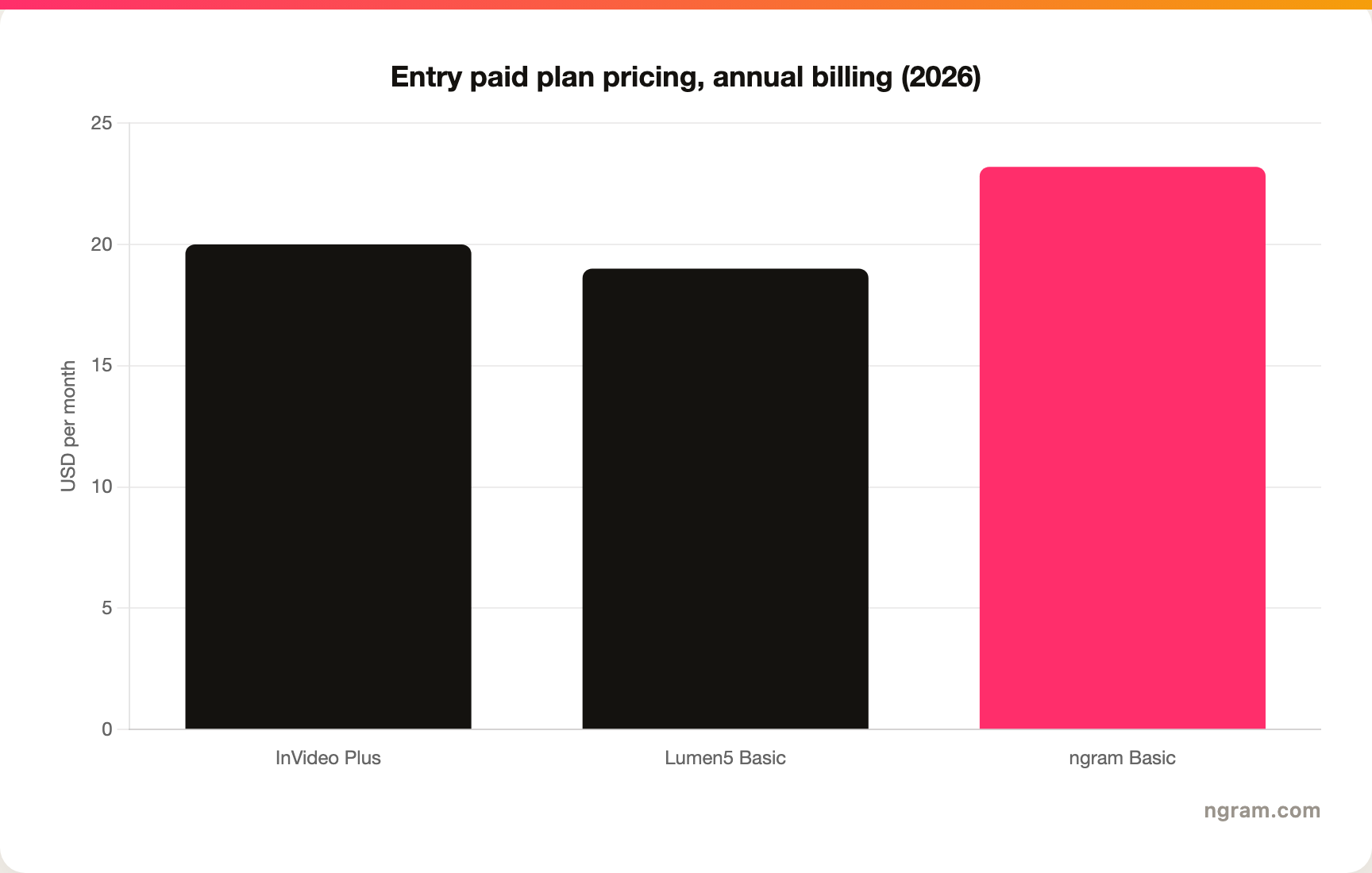
Winner: Lumen5 for a predictable flat monthly cost with no generation meter, InVideo for the most generative capability per dollar if you can manage the minutes. On annual billing Lumen5 Basic is the cheapest at $19 a month, undercutting InVideo Plus at about $20 and ngram Basic at $23, but each unit buys something different, so match it to your real volume before deciding.
ngram uses credits rather than seats or generation minutes. Free includes 600 one-time credits and exports at 720p with a watermark. Basic is $29 a month, or $23.20 a month billed annually, with 3,000 credits a month, and like Free it exports at 720p. Premium ($59 a month) and Ultimate ($299 a month) unlock 1080p and 4K export, with Enterprise custom. Credits are shared across video generation and editing; exports are unlimited and consume no credits. Premium and Ultimate monthly credits roll over one billing cycle, and annual credits roll over until renewal; Basic refreshes monthly without rollover.
Best fit by team and use case
Pick InVideo if your starting point is an idea rather than assets and you want AI to generate the footage, voiceover, and edit, including long-form video, and you are comfortable steering an agent through prompts.
Pick Lumen5 if you are a marketing, communications, or L&D team that turns articles, blogs, PDFs, and internal updates into clean stock-footage videos on a repeatable, brand-consistent workflow, and you want a predictable flat price.
Winner: split decision. InVideo wins for generative, idea-led, long-form video. Lumen5 wins for repeatable content-to-video on stock footage. There is no single winner because they serve different jobs.
Use ngram when neither a single prompt nor a stock-footage storyboard is enough and the video needs to come from real source material with full brand control. If you want an agent to plan, produce, revise, localize, and brand a finished video from whatever you already have, ngram is the stronger path.
1. ngram
Watch how ngram turns an idea into a finished video:
ngram is the best fit when neither InVideo's single prompt nor Lumen5's text box is the natural starting point. You can hand it a prompt, PDF, URL, screenshot, recording, raw video, deck, or product URL, then let the agent plan a script, storyboard, scenes, captions, and CTA before rendering, so the structure is settled before any credits are spent.
It also covers the production layer that InVideo's generation and Lumen5's stock-footage storyboards each leave partly to chance: auto captions, AI voiceover, multilingual voiceover, screen-recording polish, product callouts, motion graphics, branded intros and outros, background music, scene transitions, AI image generation, and short AI video b-roll generated to fit your scene rather than pulled from a shared stock library.
What makes ngram different
- Agentic planning before rendering, so the storyboard is reviewed before credits are spent.
- Source-aware inputs across prompts, documents, URLs, screenshots, recordings, raw video, decks, and product URLs.
- Brand kits for logos, colors, fonts, approved and blocked phrases, tone, and visual style.
- Editing through chat, visual chat, script editor, scene regeneration, and a full timeline.
- Exports to Finished videos export as MP4; separate media tools can derive GIF, WebM, PNG, or JPG from supplied media.
Where ngram is honest about its limits
- ngram provides hosted video pages and embeds; a generally available owner analytics surface is not live.
- Public security certifications are not published, so do not treat it as SOC 2 or ISO certified.
- Public API v1 uses self-service bearer API keys.
- Zapier and n8n are available; Make.com is Coming Soon.
Who ngram is best for
ngram is best for marketing, sales, training, product, and founder-led teams that need finished business video from real source material. If your day-to-day is generating video from a single idea, InVideo stays the more generative buy; if it is turning a steady stream of articles into stock-backed videos, Lumen5 holds up. But if you need an agent to plan, produce, revise, localize, and brand the video from whatever source you have, ngram is the stronger path. It is one of the more flexible options in the broader text to video category for exactly this reason.
Try ngram free, your first video in under 5 minutes. Turn a prompt, doc, URL, deck, or screen recording into a polished, on-brand video without rebuilding it from a blank prompt. Start free
For a direct ngram comparison, see ngram vs InVideo and ngram vs Lumen5.
2. InVideo

InVideo is the generative side of this comparison. Where Lumen5 wants your words and pairs them with stock footage, InVideo wants your idea and generates the footage itself. After its 2025 and 2026 rebrand around Agent One it leans fully into generative AI. Public details were checked against InVideo's pricing and product pages for this 2026 comparison.
Key features
- Agent One: the invideo v4 agent generates a full video, up to 30 minutes, from one prompt, handling shot composition, consistency, and styling.
- 200+ models: orchestrates third-party models including Sora 2, Veo 3.1, Kling 3.0, Seedance, Nano Banana Pro, and ElevenLabs.
- Long-term project memory: the agent retains context across a project so iterations stay consistent.
- Collaboration: real-time multiplayer editing and batch editing for teams producing at volume.
- Custom agents: create your own agents to standardize a repeatable style or workflow.
What users say
Users are impressed by how much finished video InVideo can produce from minimal input, especially since the Agent One pivot, and by the range of models it can tap. The common caution is steering: an agent that makes many decisions can drift from your intent, so prompt iteration and generation allowances are worth planning around.
Best for
InVideo is best for creators and teams whose starting point is an idea rather than assets, who want AI to generate the footage, voiceover, and edit, including long-form video, and who are comfortable steering an agent.
3. Lumen5

Lumen5 is the content-repurposing side of this comparison. It fits teams that have written material and want the tool to convert it into clean, on-brand stock-footage videos on a repeatable workflow.
Key features
- Text, blog, article, PDF, document, and bullet-point inputs.
- Automatic storyboarding into scenes with licensed stock footage and text overlays.
- Auto-captions, background music, and AI voiceover options.
- Brand kits for fonts, colors, logos, and repeatable business styles.
- Enterprise positioning for marketing, internal communications, and training teams.
What users say
Users usually value Lumen5 for turning written content into presentable videos quickly. It fits teams with a steady pipeline of blogs, explainers, and internal updates. More advanced buyers may want more control over scene planning, generated visuals, and agentic editing than a stock-footage storyboard tool provides.
Best for
Lumen5 is best for marketing, communications, and L&D teams that repurpose articles, documents, and internal updates into branded videos at scale on a predictable price. It is less ideal when you need generated footage, long-form AI video, or a wider mix of source inputs.
How we compared these tools
| Criteria | Weight | What we looked at |
|---|---|---|
| AI capabilities | 30 | Source inputs, automatic planning, generation, voiceover, captions, and regeneration |
| Features | 30 | Editing depth, brand controls, collaboration, localization, and export paths |
| Ease of use | 20 | How quickly a non-video user can make a useful first video |
| Value | 15 | Entry price, plan limits, generation or credit constraints, and time saved |
| Support | 5 | Team readiness, enterprise fit, and purchase clarity |
We weighted this as a generative text-to-video versus content-repurposing comparison, not as a single-winner ranking. The strongest signal in the research was that buyers searching InVideo vs Lumen5 are really deciding between generating video from an idea and repurposing existing writing into video, so the dimensions above map to that real decision rather than to a feature checklist.
Common questions
Is InVideo better than Lumen5?
InVideo is better if your starting point is an idea and you want AI to generate the footage, voiceover, and edit, including long-form video. Lumen5 is better if you have written content to repurpose into clean stock-footage videos on a repeatable, brand-consistent workflow. They serve different jobs, so the better tool depends on what you start with.
Is Lumen5 cheaper than InVideo?
On annual billing Lumen5 Basic is $19 a month, slightly under InVideo Plus at about $20 a month, and Lumen5's price is a flat seat cost with no generation meter. InVideo's price buys a pool of AI generation minutes instead, so for heavy generation InVideo can cost more in practice even at a similar headline number. Match the unit to your real volume before deciding.
What is the best InVideo and Lumen5 alternative?
ngram is the strongest alternative when you want InVideo's generation and Lumen5's repeatable, on-brand workflow in one tool, plus a storyboard you review before rendering and a wider set of source inputs. It plans, produces, revises, localizes, and brands a finished video from a prompt, doc, URL, deck, or recording.
Which tool is best for marketing videos in 2026?
For generative, idea-led, or long-form marketing video, InVideo is the stronger pick. For repurposing a steady stream of articles and updates into clean stock-footage marketing videos, Lumen5 holds up well. For finished branded marketing video built from real source material with full brand control, ngram is the better fit.
Which one should you pick?
The InVideo vs Lumen5 decision comes down to what you start with and what you want the software to do. Pick InVideo if you start from an idea and want AI to generate the whole video, including long-form. Pick Lumen5 if you start from existing writing and want a repeatable, brand-consistent way to turn it into stock-footage videos. Pick ngram if neither a single prompt nor a stock-footage storyboard is enough and you need an agent to plan, produce, brand, and localize a finished video from whatever source you already have.
Try ngram free, your first video in under 5 minutes. Turn a prompt, doc, URL, deck, or screen recording into a polished, on-brand video without rebuilding it from a blank prompt. Start free