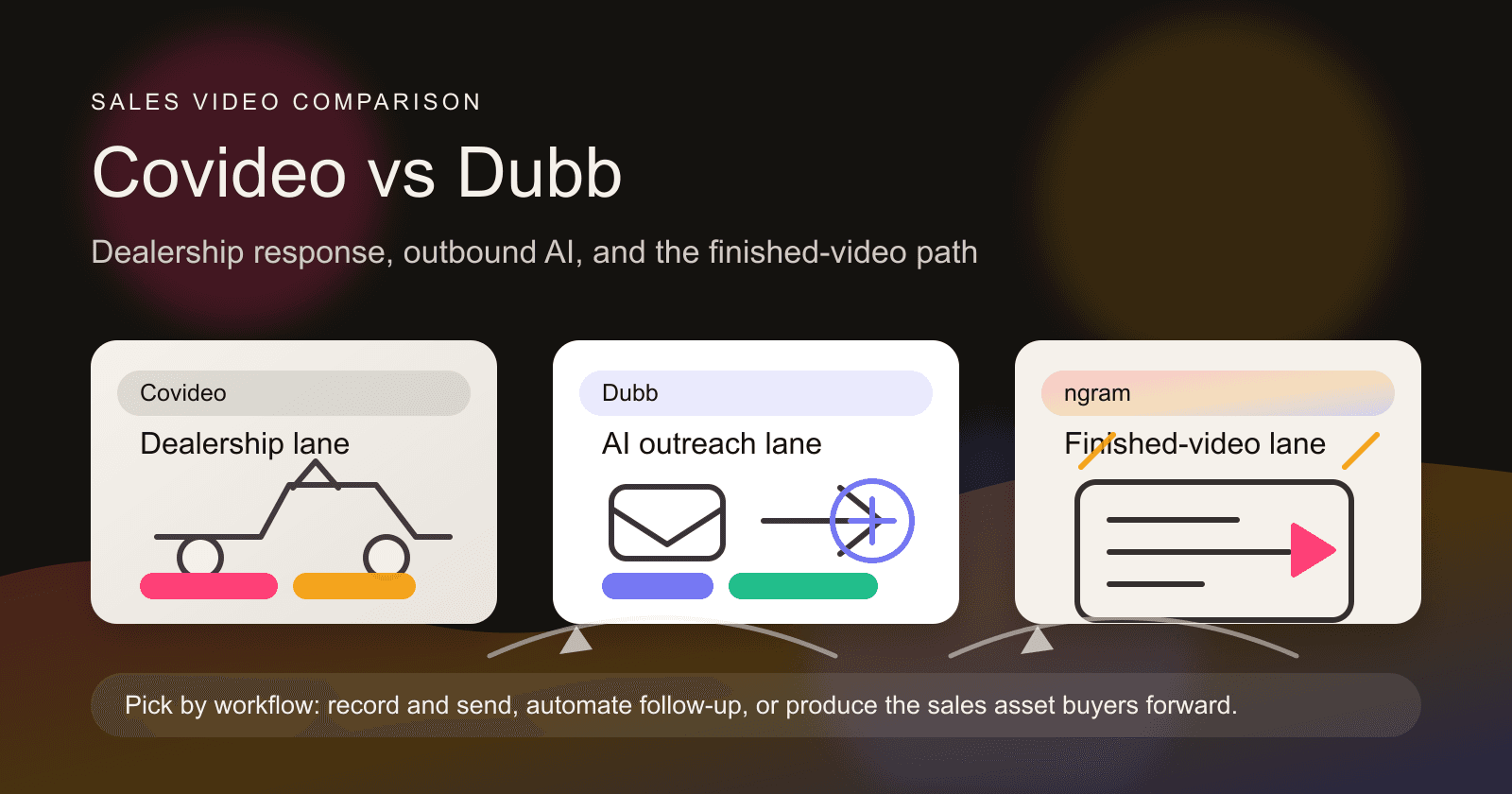


Search "Covideo vs Dubb" and you are already in a narrow buying decision. Both tools promise personalized video for sales teams. Both let a rep record a short message, send it through email or text, and see whether the buyer watched. The split is not whether video works. The split is where your sales motion lives.
Covideo is built around dealership video response. Its own site emphasizes automotive, RV, marine, and powersports workflows, with CRM and inventory-management integrations, live human support, SOC 2 Type 2 security language, and a long history in dealership video. Dubb is broader. Dubb positions itself as a video sales system plus an AI Sales Agent that researches leads, verifies emails, updates CRM activity, sends follow-ups, and books meetings from Slack.
This guide compares Covideo vs Dubb across the things that decide the purchase in 2026: core workflow, AI depth, CRM and integrations, pricing, team adoption, analytics, and where ngram fits as a third option. The short version: pick Covideo for dealership-specific video operations, pick Dubb for broader outbound and AI follow-up, and use ngram when the actual deliverable is a polished sales video, demo recap, proposal walkthrough, or enablement asset rather than a quick one-to-one recording.
Covideo vs Dubb at a glance
| Tool | Best for | Starting paid price | Main distinction |
|---|---|---|---|
| ngram | Teams turning sales docs, decks, URLs, screen recordings, and rough clips into finished branded videos | Free plan, Basic from $29/mo | Plans the script and storyboard, then adds voiceover, captions, callouts, brand treatment, and MP4 export |
| Covideo | Auto, RV, marine, and powersports teams using personal video across sales and service | Quote-first on Covideo, Capterra lists $69/mo | Deep dealership workflow, CRM and inventory fit, live support, service and sales use cases |
| Dubb | B2B sales teams that want video email, SMS, LinkedIn sends, CRM tracking, and AI-driven follow-up | Public sources vary around $40-$42/user/mo for Pro | Broader sales system with video landing pages, campaigns, CRM, 3,000+ integrations, and an AI Sales Agent |
Core output: dealership video response vs sales outreach system
Covideo is strongest when the video is part of a dealership process. Covideo says it works with a dealership's CRM and inventory management system, and its homepage frames the platform around lead response, appointments, and vehicle sales. The sales product page is specific: record videos, send to leads by email or text, track engagement with instant view alerts, and drive next steps with calls-to-action. The use cases are also specific: internet lead response, vehicle walkaround, appointment reminder, and post-appointment follow-up.
Dubb has a wider sales-ops shape. On Dubb's homepage, Sales Studio covers the classic video-message job: record on any device, send by email, text, or LinkedIn, and track views, clicks, and conversions. Then Dubb adds Sales Agent, which researches leads, verifies emails, drafts and sends personalized outreach, logs CRM activity, and books meetings from Slack. Dubb is not only a video messaging app at this point. It is trying to become a sales execution layer around video.
Winner: Covideo for dealership-specific video response, Dubb for broader outbound sales workflows. If your team says "BDC," "walkaround," "appointment show," or "service lane" every day, Covideo fits the language and the process. If your team says "sequence," "CRM activity," "LinkedIn follow-up," and "meeting booked," Dubb is closer to the daily workflow.
Covideo, the dealership-first pick

Covideo has the tighter category focus. The company says it has been in business for more than 20 years, works with 80% of the top dealer groups in the United States, and supports 27,000 dealership users with 40+ dealership-specific integrations on its Why Covideo page. A 2026 Covideo announcement also says the platform is used by 3,500+ dealerships across the United States and Canada.
That focus matters because dealership video is not generic sales video. A rep needs to respond fast to a lead, show the actual vehicle, send a walkaround, remind the buyer before an appointment, follow up after a test drive, and sometimes connect sales and service communication. Covideo's sales page names those jobs directly instead of trying to serve every sales team with the same generic video link.
Covideo has also moved deeper into AI, but the AI is still dealership-shaped. Covideo AI is organized around Create, Accelerate, and Enhance. The Accelerate page describes Quick Video, Script Assist, and Smart Suggestions for lead response. The Enhance page covers AI Music, video stabilization, and noise reduction for recorded dealership videos. In plain English, Covideo is using AI to make dealer videos faster, cleaner, and more consistent, not to become a general-purpose outbound automation product.
Covideo's trade-off is scope. If you are outside automotive-adjacent sales, you may pay for specialization you do not need. If your sales team wants AI lead research, CRM logging, email verification, Slack-based agent work, and broad outbound automation around video, Dubb has more of that system in the box.
Dubb, the broader sales-video system
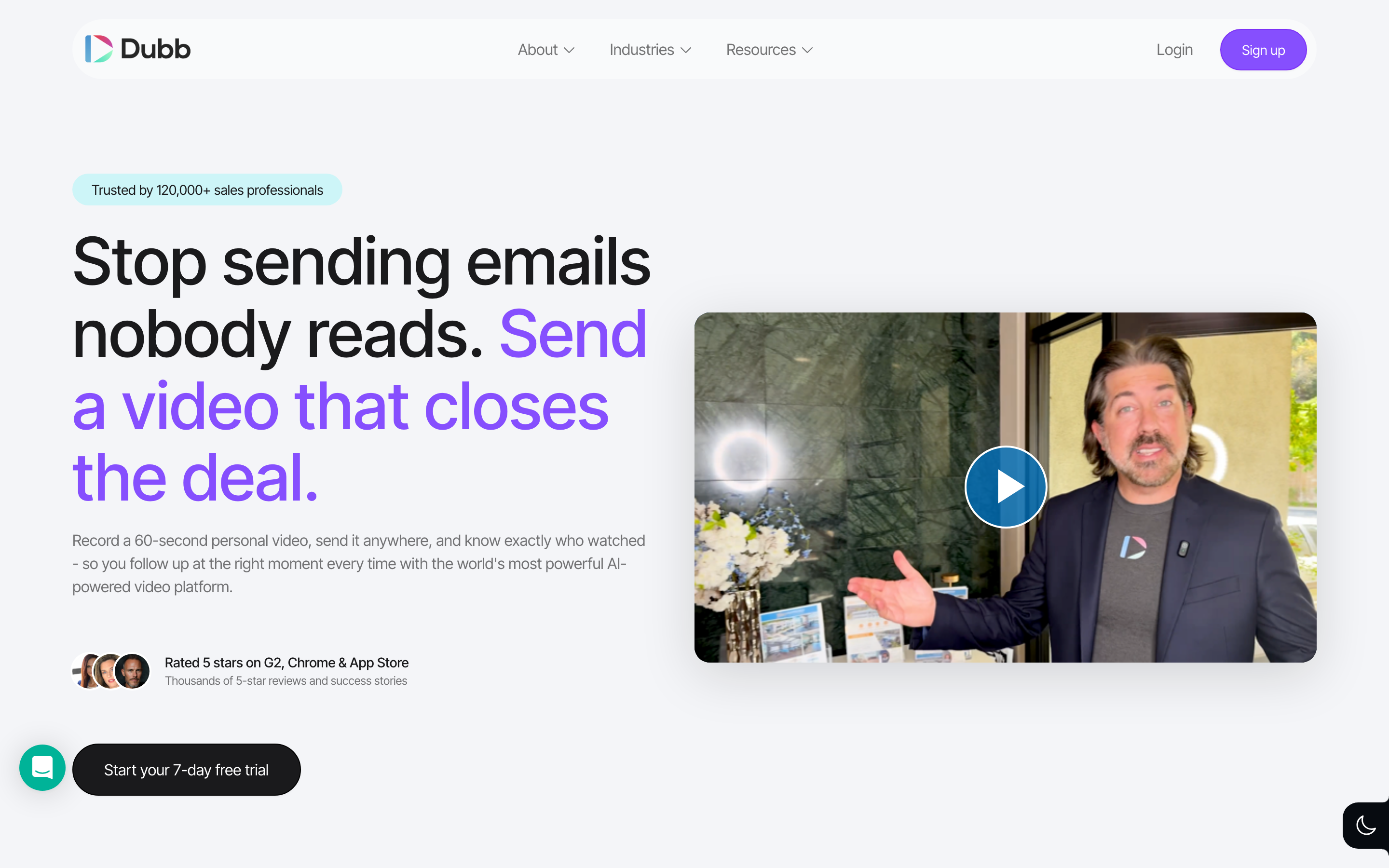
Dubb is the better fit when your team wants video inside a broader revenue workflow. The site says Dubb is trusted by 120,000+ sales professionals and connects with 3,000+ apps and platforms. Its core video workflow is familiar: record a personal video from phone, computer, or browser, send it by email, text, or LinkedIn, then track views, clicks, and conversions.
The newer difference is Dubb Sales Agent. Dubb says the agent researches leads, verifies emails, drafts and sends personalized outreach, updates the CRM, logs activity, and books meetings from Slack. That makes Dubb attractive for founders, coaches, agencies, real estate teams, mortgage teams, SaaS sellers, and other non-dealership sales teams that want video tied to pipeline activity.
The Dubb features page points to the same pattern: screen and webcam recording, video landing pages, email and SMS campaigns, automation, built-in CRM, AI sales assistants, and a broad integration surface. G2 review excerpts repeatedly praise the combination of video hosting, CRM integration, CTAs, and engagement tracking, while also surfacing a common caution: the interface can feel busy and deeper customization or higher-tier features matter for some teams.
Dubb's trade-off is focus. The product has more moving parts than a dealership video-response platform, and teams that only need a fast personal video tool may find the sales-system layer heavier than necessary. For automotive teams, Dubb can send and track video, but Covideo is built around dealership roles, service workflows, and dealership-specific integrations.
AI and automation: different bets
Covideo's AI bet is quality and speed inside a dealer workflow. Script Assist drafts customer outreach. Quick Video surfaces a relevant video without starting from scratch. Smart Suggestions recommends the right video from the library. AI Enhance cleans up recorded video with noise reduction, stabilization, and music. These features make sense when a salesperson is on a lot, in a showroom, or moving between service and sales tasks.
Dubb's AI bet is pipeline labor. Sales Agent is described as researching leads, verifying emails, sending personalized videos and follow-ups, updating the CRM, and booking meetings. Dubb also describes AI assistants that write follow-ups, handle objections, write scripts, generate captions, and guide users inside the dashboard. These features make sense when a rep lives in CRM, Slack, email, LinkedIn, and calendar work all day.
Winner: Covideo for AI that supports dealership video quality, Dubb for AI that supports outbound sales execution. Neither product should be mistaken for a full finished-video generator. Covideo and Dubb improve recorded sales messages and distribution. They do not plan a reusable launch video, sales demo recap, training asset, or proposal walkthrough from a deck or screen recording.
1. ngram, for polished finished sales video
Watch how ngram turns an idea into a finished video:
ngram enters the Covideo vs Dubb decision when the bottleneck is production quality, not message delivery. A sales rep can record a one-to-one video in Covideo or Dubb. ngram is for the moments when the video needs a script, storyboard, product callouts, captions, AI voiceover, branded intro, clean screen-recording polish, and export variants that can be reused by more than one recipient.
That distinction is important. ngram is not a one-to-one video messaging platform, and it should not be sold as a replacement for Covideo's dealership stack or Dubb's CRM-driven outreach system. ngram does not replace per-recipient sales engagement analytics, dealership inventory workflows, or Dubb's Slack-based follow-up agent.
What ngram does replace is the slow production step around sales video. Teams can start from a prompt, PDF, URL, screenshot, deck, screen recording, raw video, or Shopify product page. ngram writes the script, builds the storyboard, plans scenes, adds captions, generates voiceover, applies the brand kit, adds product callouts, smooths cursor movement, trims dead air, and exports a finished MP4. For a sales prospecting video, sales enablement video, demo recap, or proposal walkthrough, that is the higher-value slice.
Use the single-competitor pages if you are comparing directly against ngram: ngram vs Covideo and ngram vs Dubb. This page is the head-to-head between the two sales-video tools.
Pricing and value
Pricing is the messiest part of this comparison because the tools publish pricing differently.
Covideo is quote-first on its own site. The Get a quote page says a Covideo expert will provide straightforward, no-hidden-fees pricing. Third-party directories fill in the public buyer view: Capterra lists Covideo at $69 per month as a flat-rate starting price, while the live Covideo site pushes buyers toward quote and demo flows. Treat Covideo pricing as a sales-assisted purchase, especially for teams.
Dubb publishes more public pricing signals, but the numbers vary by source and timing. Capterra's Dubb pricing page lists a $0 Starter plan, Sales, Marketing, and Comms Pro at $40 per user per month, Pro Plus at $99 per user per month, plus lower-priced internal and support plans. Dubb's live pricing page should be checked directly before procurement because public snippets have changed across plan families. The safe buying advice is to recheck Dubb pricing before procurement and budget in the AI agent separately if that is the feature driving the decision.
ngram uses a credit model. Current ngram pricing in the product facts file lists Free with 600 one-time credits, Basic at $29 per month with 3,000 monthly credits, Premium at $59 per month with 10,000 monthly credits, and Ultimate at $299 per month with 50,000 monthly credits and team access. Credits cover usage-heavy actions such as AI video generation and AI editing, exports are unlimited, and Premium and Ultimate credits roll over one billing cycle.
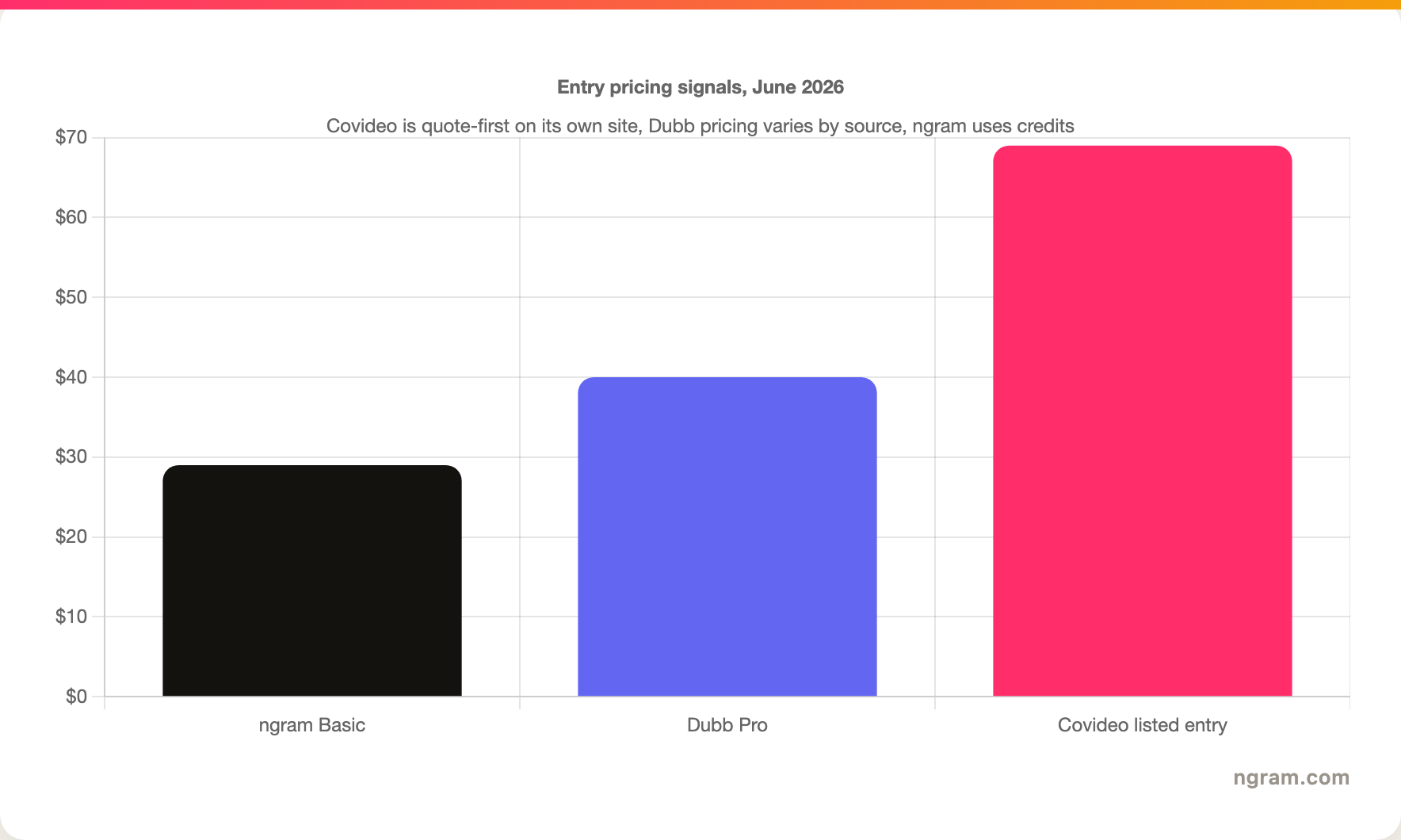
Winner: Dubb for more transparent self-serve entry pricing, Covideo when dealership-specific fit justifies a sales call, ngram when production value matters more than sales-seat delivery. The chart uses public or directory entry points, not enterprise quotes or add-on bundles.
CRM, integrations, and tracking
Covideo is strongest when your workflow is already dealership-shaped. The company highlights CRM and inventory-management integration on its homepage, and the quote page metadata frames the product for auto, marine, and RV dealers. The G2 profile also describes recording, sending, and tracking personalized videos by email, text, CRM, or social media, plus custom video landing pages, CTAs, website overlay, open and click tracking, and campaign analytics.
Dubb has the broader integration story. Dubb advertises 3,000+ integrations and says CRM, email, and calendar tools plug in quickly. The product also leans into sending via email, text, and LinkedIn, plus video landing pages and built-in CRM. If your team works across HubSpot, Salesforce, Gmail, Outlook, LinkedIn, Zapier-style automation, and Slack, Dubb's integration posture is more general-purpose.
ngram has a different publishing surface. It can host rendered videos on shareable watch pages, provide embed codes, and provide hosted pages and embeds. It also has live Zapier and n8n integrations, plus a self-service Public API v1 with webhook subscriptions for `video.completed` and `video.failed`; Make.com is Coming Soon. ngram does not claim detailed scene-level analytics or per-recipient sales engagement tracking today, so do not pick ngram if those metrics are the buying requirement.
Ease of adoption and support
Covideo makes a strong support promise. Its homepage says Covideo acts as an extension of the dealership, with experts who pick up the phone and resolve tickets quickly. The Why Covideo page also talks about strategy calls and onboarding cadence. That matters in dealerships because the tool only works if sales, BDC, service, and managers actually record and send video every day.
Dubb looks more self-serve and system-driven. It offers a 7-day trial, mobile apps, desktop apps, Chrome extension, campaigns, CRM, and AI assistants. For a sales team already comfortable with modern outbound software, that breadth is attractive. For a team that wants fewer moving parts and a high-touch rollout, that breadth may become training work.
G2's head-to-head page says reviewers found Covideo easier to use, set up, and do business with overall, while Dubb has stronger value for teams that want the broader sales-system layer. We do not use numerical review scores here because a rating does not tell you whether your reps need dealership workflows or AI follow-up.
Which should you choose?
Pick Covideo if your sales team works in auto, RV, marine, or powersports and the daily job is fast personal video response. Covideo is the cleaner choice for dealership lead response, vehicle walkarounds, appointment reminders, service communication, and workflows where CRM plus inventory fit matters more than a generic outbound stack.
Pick Dubb if your team sells across broader B2B or service categories and wants video attached to CRM, email, SMS, LinkedIn, campaigns, automations, and AI follow-up. Dubb is the cleaner choice for sales teams that want personal video plus a revenue workflow around it.
Use ngram if your sales video needs to look produced. A one-to-one webcam clip can work for trust. A sales demo recap, proposal walkthrough, product explainer, customer onboarding video, or enablement asset needs structure. ngram can turn the sales deck, rough demo recording, product URL, screen recording, or proposal PDF into a planned video with voiceover, captions, callouts, brand treatment, and export variants.
Methodology
We compared Covideo, Dubb, and ngram across seven buying dimensions: core output, category focus, AI and automation, CRM and integrations, analytics, pricing, and adoption. Official vendor pages were weighted first, including Covideo's homepage, sales page, AI pages, and quote page, plus Dubb's homepage and feature pages. Review directories and comparison pages were used to fill gaps around public pricing, review sentiment, and head-to-head buyer perception.
We avoided numerical ratings because star scores flatten the decision. A buyer choosing between Covideo and Dubb needs to know whether the team needs dealership video response or broader outbound automation. ngram claims are limited to what is live in the product-state and GTM facts files as of September 1, 2026. Self-service bearer API keys for Public API v1 are live; Make.com is Coming Soon, and detailed scene-level analytics are not available.
FAQ
Is Covideo better than Dubb?
Covideo is better than Dubb for dealership-centered video workflows. Covideo's product language, integrations, use cases, support model, and AI suite are built around auto, RV, marine, and powersports teams. Dubb is better for broader sales teams that want video email, SMS, LinkedIn, CRM, campaigns, and AI follow-up in one system.
Is Dubb cheaper than Covideo?
Dubb is usually easier to price from public sources. Capterra lists Dubb Pro at $40 per user per month, while Covideo's own site pushes buyers to a quote flow and Capterra lists Covideo at $69 per month. Dubb's own current pricing signals vary around the low $40s for Pro, so confirm live pricing before purchase.
Does Covideo have AI features?
Yes. Covideo AI includes Create, Accelerate, and Enhance tools. Public pages describe Script Assist, Quick Video, Smart Suggestions, AI Music, video stabilization, and noise reduction. Covideo's AI is aimed at dealership video response and recorded-video polish rather than broad CRM automation.
Does Dubb have AI follow-up?
Yes. Dubb describes Sales Agent as an AI teammate that researches leads, verifies emails, drafts and sends personalized outreach, updates CRM activity, and books meetings from Slack. Dubb also describes AI assistants for scripts, captions, follow-ups, objection handling, and dashboard guidance.
When should I use ngram instead of Covideo or Dubb?
Use ngram when the job is a finished sales video rather than one-to-one video delivery. ngram fits sales prospecting assets, demo recaps, proposal walkthroughs, customer onboarding videos, and enablement videos built from decks, docs, URLs, screen recordings, screenshots, prompts, or raw video. Use Covideo or Dubb when the main job is sending and tracking individual rep videos.
Can ngram replace Covideo or Dubb?
ngram can replace the production step for polished sales assets, but ngram is not a drop-in replacement for Covideo's dealership stack or Dubb's sales engagement system. ngram has hosted pages and embeds, Zapier, and self-service bearer API-key access, but it does not provide per-recipient sales engagement analytics or dealership inventory workflows today.
Final verdict
The Covideo vs Dubb decision is not about which company likes video more. Covideo wins when the sales motion is dealership video response. Dubb wins when the sales motion is broader outbound with video, CRM, campaigns, LinkedIn, SMS, and AI follow-up. ngram wins a different slice: the video needs to become a polished, reusable sales asset instead of a quick personal recording.
That is the practical split for 2026. Use Covideo for dealership trust at the lead and service level. Use Dubb for sales execution around personal video. Use ngram when the buyer, champion, or sales team needs a video that looks planned, branded, and worth forwarding.