
Two Runway releases, eight days apart, deserve more attention than either got in a single news cycle. On June 25, 2026, Runway shipped Agent 2.0, a conversational system that turns a campaign brief into finished, multi-platform assets and keeps refining them against performance data. On July 2, it followed with Agent Skills: slash commands that trigger full production workflows, “build an ad campaign,” “create a commercial,” “localize your ads,” in one line, rolled out to every plan the same day.
Neither release is a new video model. Runway's underlying generator, Gen-4.5, launched in December 2025 at 1,247 Elo on the Artificial Analysis Text-to-Video leaderboard, the top score at the time, and then simply stood still while HappyHorse 1.1, Google Veo 3.1, and even China-only Seedance 2.0 climbed past it, part of a leaderboard that has changed its No. 1 model four times in six months. What shipped on June 25 and July 2 is a different layer entirely: the strategist who writes the brief, the editor who resizes for three platforms, the vendor who localizes for new markets, the social manager who builds next week's calendar. That is the layer Runway is now automating. A foundation video-model company is no longer competing only on generation quality. It is shipping the production department that used to sit above it.
What Runway Actually Shipped, in Three Steps
Runway's agent line didn't arrive in one release. It built up over seven weeks. Runway Agent, the first version, launched May 13, 2026: a conversational creative partner for developing and producing a single finished video through iterative, back-and-forth refinement. It automated the generation step. It did not touch the campaign around it.
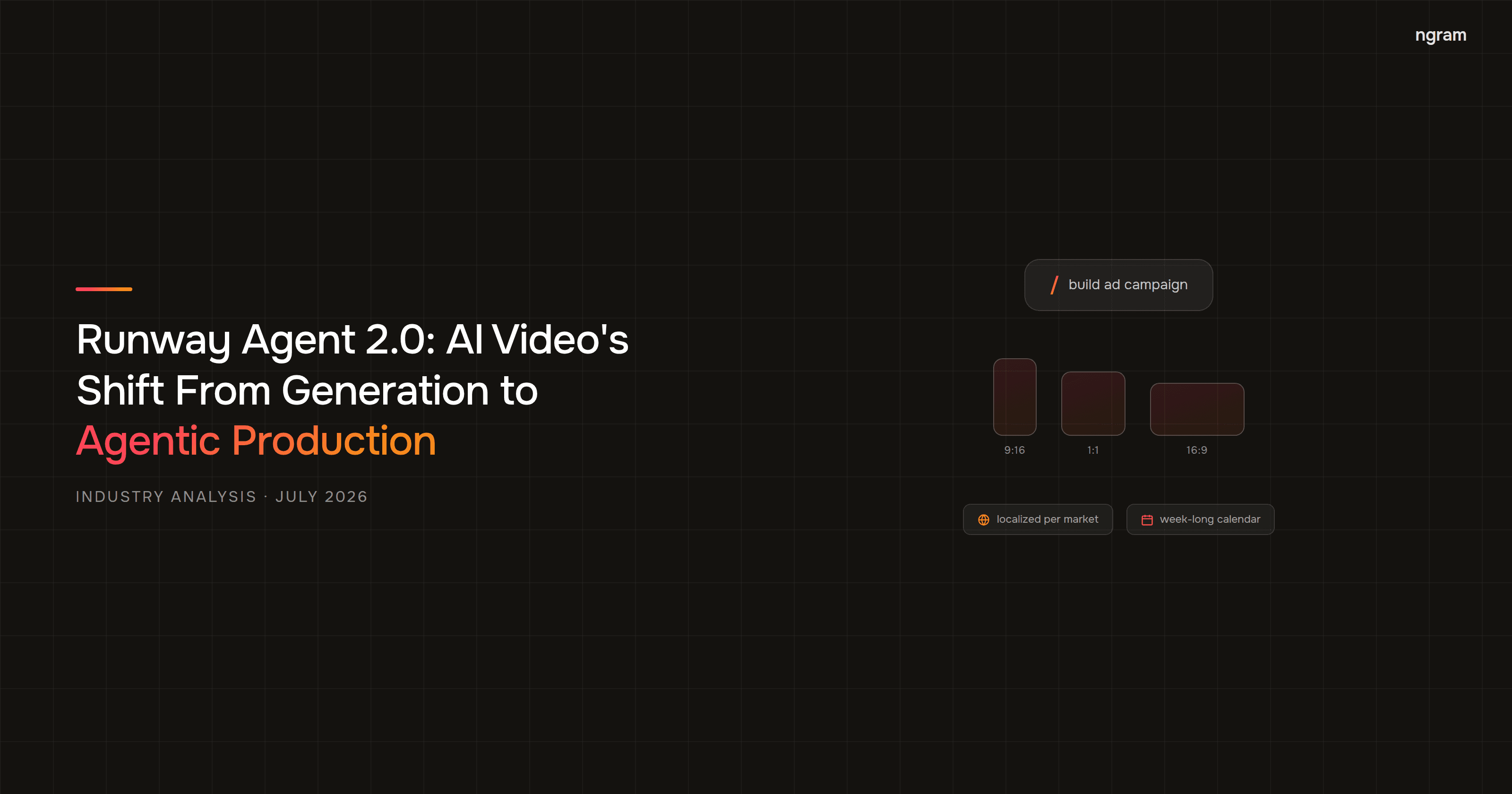
Agent 2.0, released June 25, added the marketing layer. Per Runway's own launch announcement, it analyzes a brand's existing creative performance across Meta, YouTube, TikTok, and Google, generates multiple campaign variations and asset types, auto-formats each one for its destination (9:16 for Reels and Stories, 16:9 for YouTube, 1:1 for feed), adapts copy and visuals for new markets, and builds week-long content calendars straight from engagement data. Four separate flows ship for four buyers: brand marketers developing positioning and seasonal content, performance marketers building ads off Meta, YouTube, TikTok, and Google metrics, social marketers generating on-brand platform variants, and product marketers refining messaging for market testing.
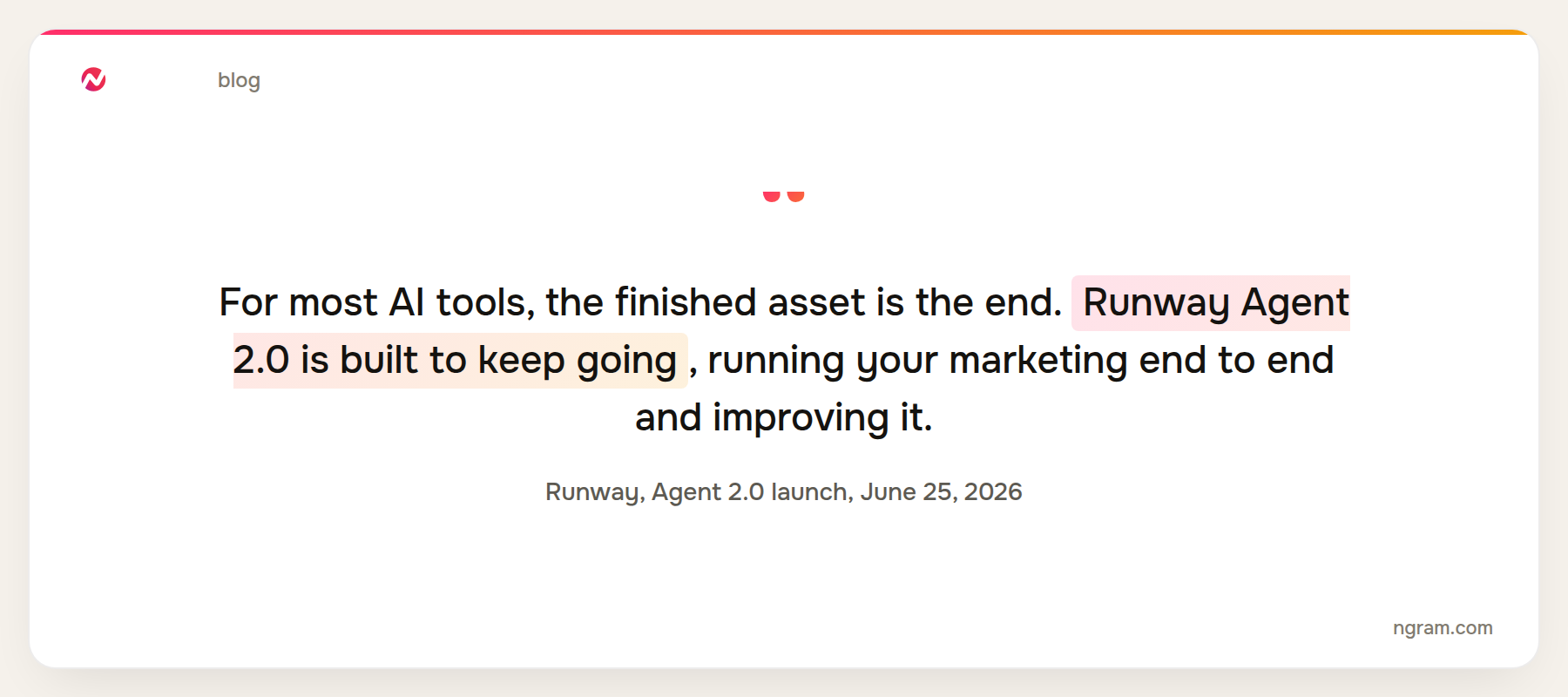
Runway's own framing of the release is unambiguous about what it thinks it's replacing.
Seven days after that, Agent Skills shipped to every plan. Per the July 2 changelog entry, typing “/” inside Agent chat now surfaces pre-built workflows, and picking one runs scripting, generation, editing, and formatting end to end without further prompting, according to AlphaSignal's coverage of the release. “Build an ad campaign, create a commercial, localize your ads and more with a simple command,” is how Runway describes it.
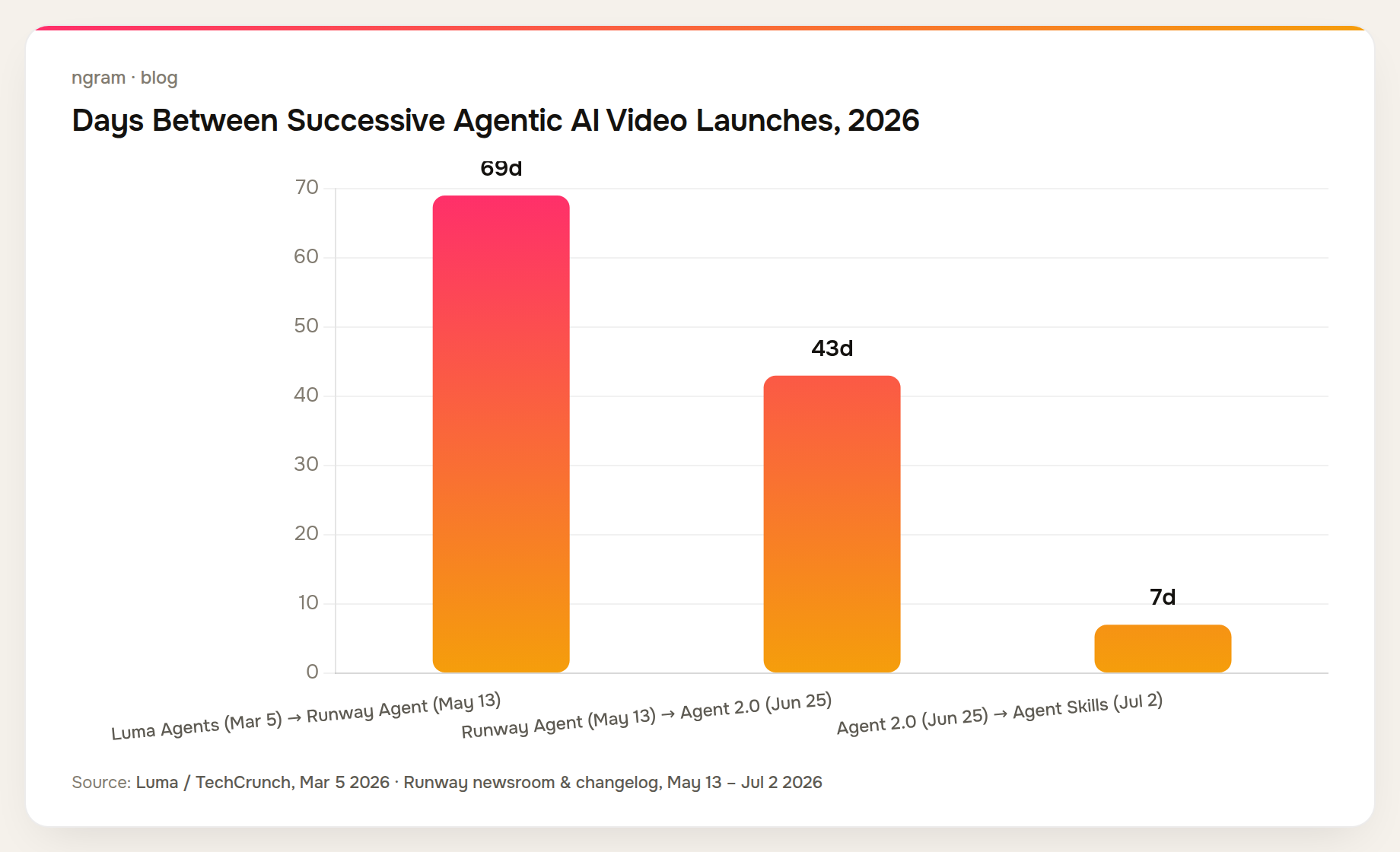
The gap between releases tells its own story. Sixty-nine days separated a comparable move from Luma, agentic multi-step production from a single brief, from Runway's first Agent. Forty-three days separated Runway's first Agent from Agent 2.0. Seven days separated Agent 2.0 from Agent Skills. Whatever this layer is, Runway is not treating it as a feature it ships once and leaves alone.
This Is Not Just a Runway Story
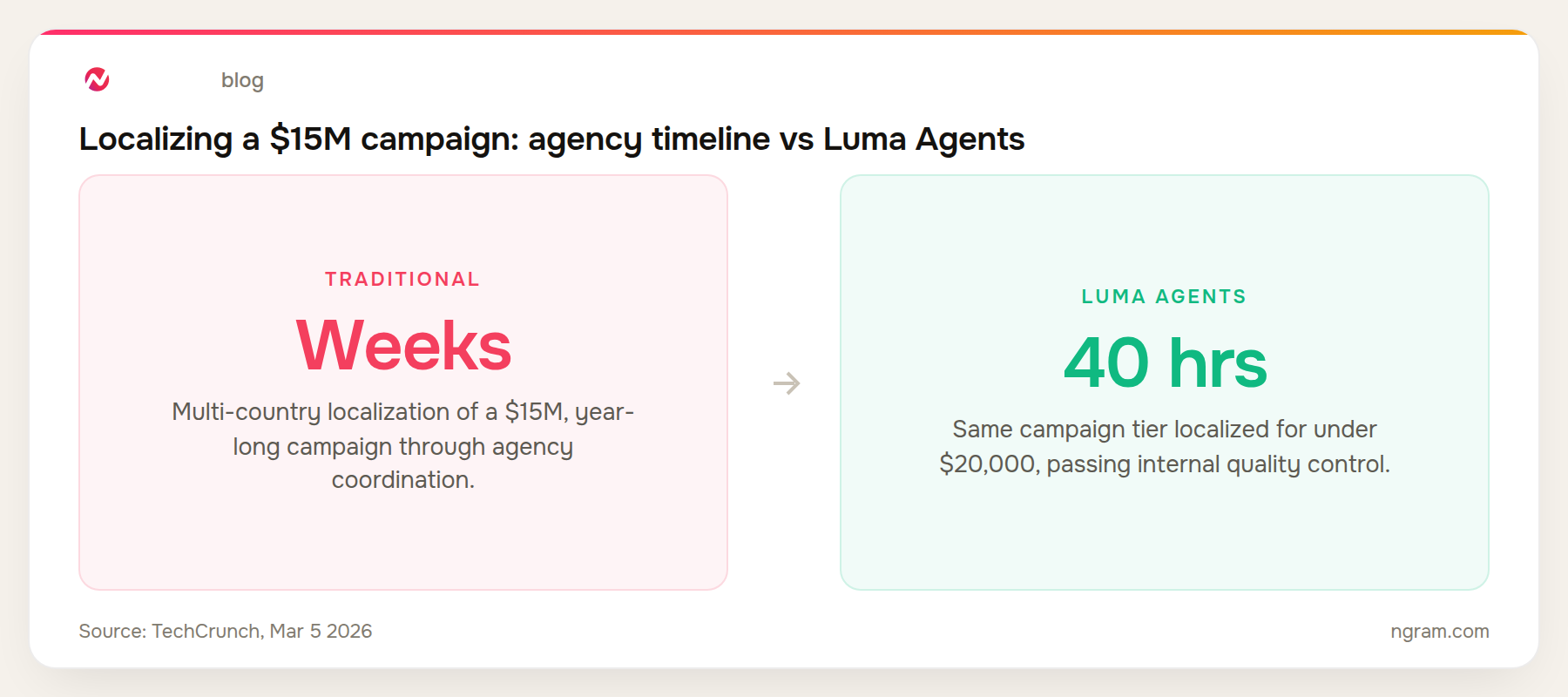
Runway actually shipped second. On March 5, 2026, Luma launched Luma Agents, a multimodal agent platform that plans and generates text, image, video, and audio from a single brief while coordinating outside models, including Google's Veo 3, ByteDance's Seedream, and ElevenLabs' voice engine, according to TechCrunch's report on the launch. The same report documented a concrete result for one early customer: a $15 million, year-long ad campaign localized into multiple countries in 40 hours, for under $20,000, passing the brand's internal quality control.
Publicis Groupe, Serviceplan, Adidas, Mazda, and the Saudi AI company Humain are named early customers in that same reporting. Luma's CEO, Amit Jain, described the shift plainly: “our customers aren't buying the tool; they're redoing how business is done.”
Even the distribution side of the industry is racing toward the same collapse, from a different starting point. At Google Marketing Live on May 20, 2026, Google introduced Ask Advisor, a Gemini-built agent spanning Google Ads, Analytics, Merchant Center, and Google Marketing Platform, plus an upgraded Asset Studio that ingests a full marketing brief, brand guidelines, and reference images to autonomously generate tailored text, image, and video ads. That is the ad-buying platform chasing the same collapse of specialist steps into one instruction, arriving from the media side rather than the generation side.
OpenAI, by contrast, had no agent layer to fall back on. Sora's consumer app shut down April 26, 2026, and its API sunsets September 24, 2026, reportedly because the compute economics of consumer-scale video generation never closed. A company competing purely on generation quality, with no production layer above it, had nothing left to defend once the model itself stopped paying for the compute it burned.
Why the Model Suppliers Are Moving Up the Stack
The workflow Agent Skills collapses into one command used to run through a coordinated handoff between four or more specialists, or vendors, each one a point where timelines slip and briefs get reinterpreted.
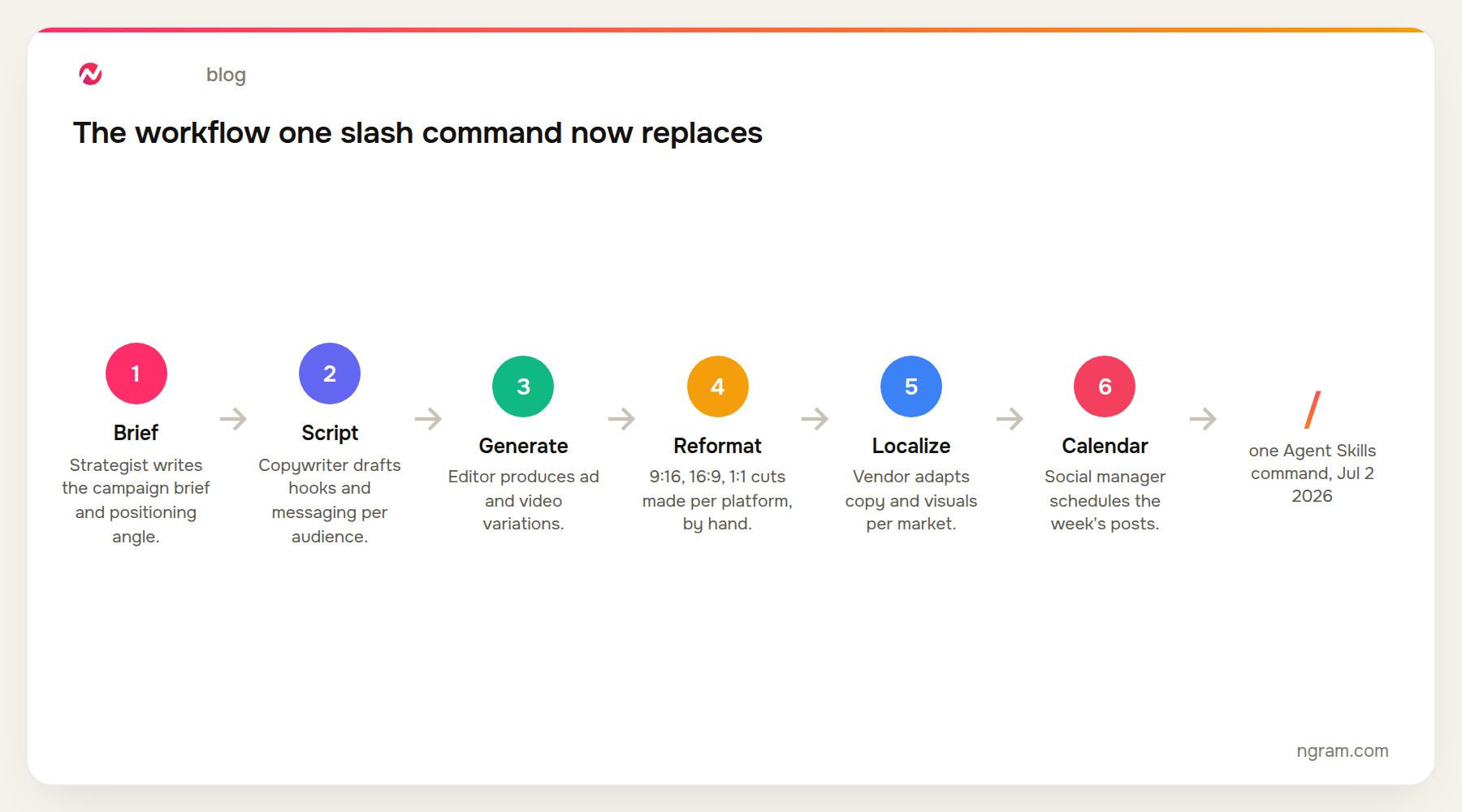
A strategist writes the brief and the positioning angle. A copywriter drafts hooks per audience. An editor produces the ad and video variations. Someone, often by hand, reformats every variation to 9:16, 16:9, and 1:1. A localization vendor adapts copy and visuals per market. A social manager builds and schedules the week's calendar. Six steps, at minimum four different specialists or vendors, each one a handoff.
Traditional agency timelines for that kind of work are not fast to begin with. Industry production benchmarks suggest four to six weeks for a single hero video ad, with one to two weeks added per additional variation. Wyzowl's 2026 video marketing data found that 40% of marketers say video takes too long to produce and 26% report needing two or more hours just for one video, before any reformatting, localization, or scheduling gets counted.
That is why this reads as a category shift and not a version bump. Generation quality was the moat for three straight years: whoever produced the most convincing clip won the news cycle that week. Runway's own model hasn't needed to win that argument since Gen-4.5 peaked in December 2025 and then went quiet while faster-moving rivals climbed past it. The company kept shipping anyway, just one layer up, where the campaign actually gets made.
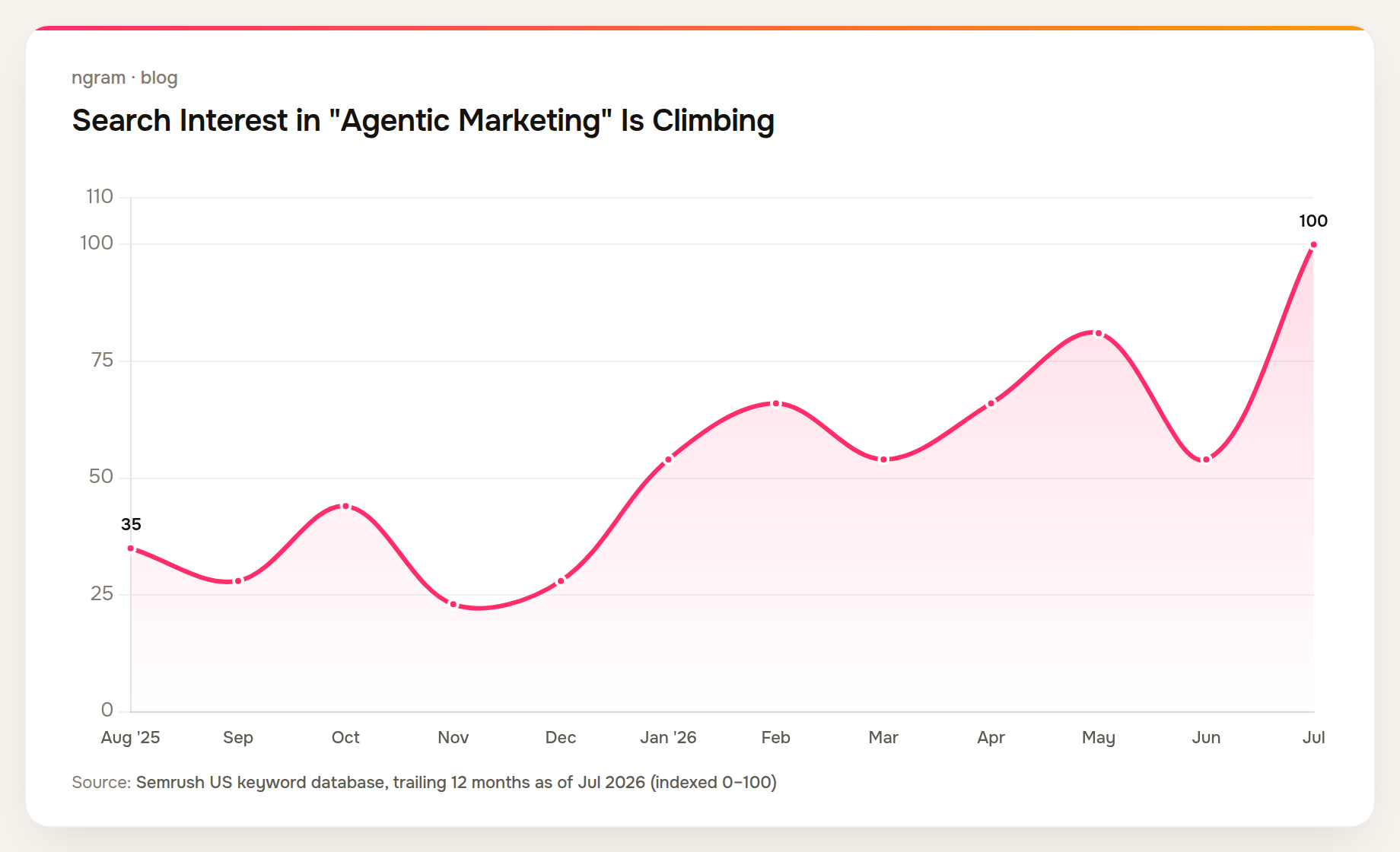
The jump tracks almost exactly with the release calendar above: a rise through the Luma Agents launch in spring, a dip, then a sharper climb through Runway's own Agent 2.0 and Agent Skills releases into July.
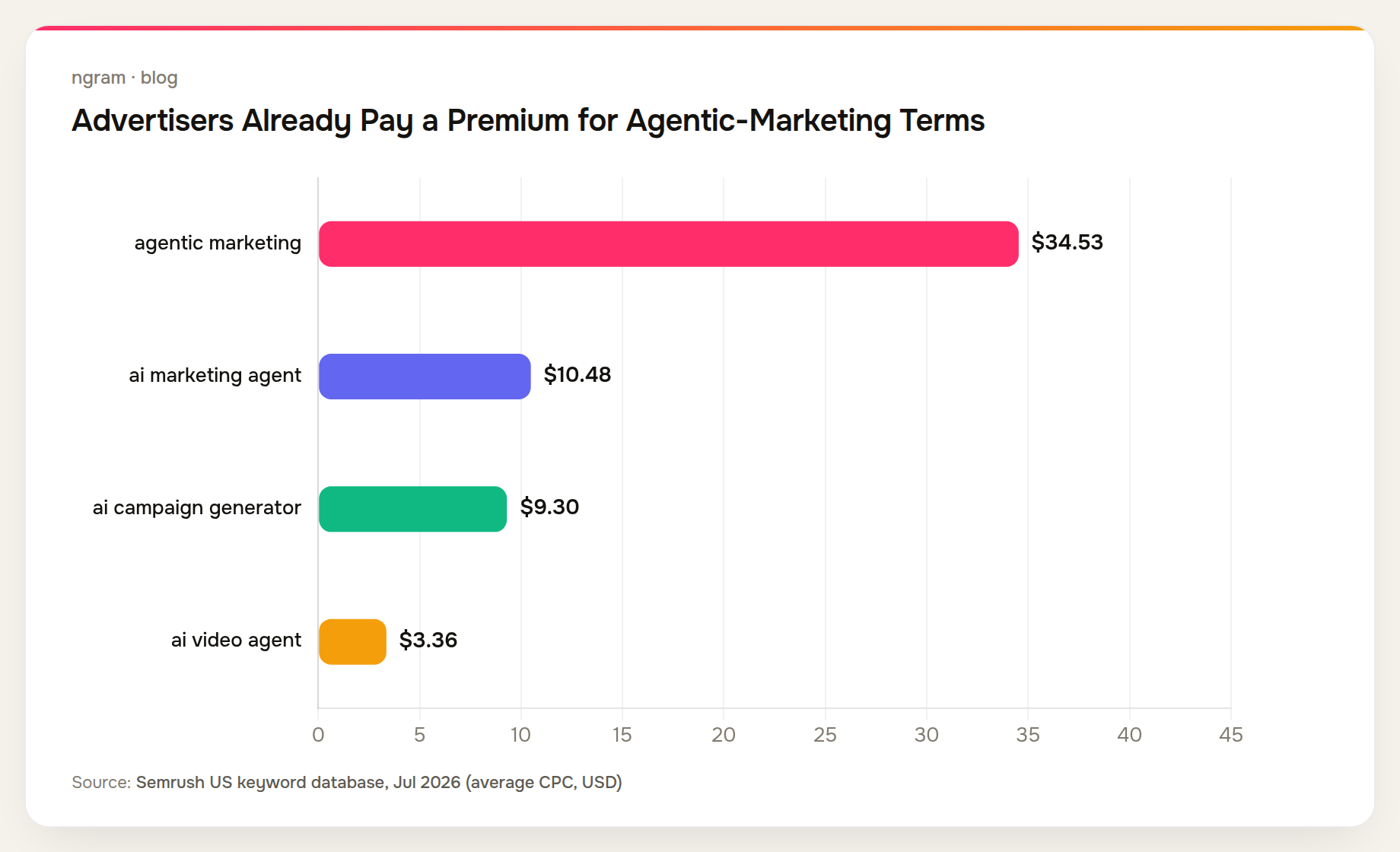
A $34.53 average cost per click on the phrase “agentic marketing”, more than three times the CPC on a plain “ai marketing agent” search, is a commercial signal, not just a content trend. Advertisers pay that much only when they believe the term is attached to real buying intent, not speculative interest.
What This Means for How Marketing and Creative Teams Get Staffed
Collapsing six steps into one command does not remove the need for strategy, brand judgment, or a person who decides whether the output is good enough to ship. It removes the need for a person, or a vendor, dedicated to each individual handoff. Reformatting three aspect ratios by hand stops being a job function. So does purely mechanical localization, and so does building next week's content calendar from a spreadsheet of engagement numbers.
What's left looks like editorial judgment concentrated at the top of a pipeline instead of spread across six roles: someone who can write a sharp brief, someone who reviews what the agent produces before it ships, someone accountable for whether the campaign is actually working. That is a smaller team doing higher-leverage work, not the same team working faster on the same tasks. Growth marketing teams that are still staffed for the six-step version of this workflow are staffed for a version of the job a single slash command now runs.
Where ngram Already Ships This Interaction Model
The interaction model Runway is racing toward for full campaigns—describe what you want in a sentence and get a finished asset back—is one ngram already ships for video creation specifically. In ngram's agentic chat, a user describes the video they want and the agent handles script generation, storyboard, brand-kit-driven visual direction, and a finished MP4. If a downstream system requires MOV, WebM, or MKV, a separate video converter changes the file container after export. It is the same “prompt in, finished asset out” shift Runway is now building toward for campaigns, applied to the production side of video creation rather than the full media-buying and ad-performance-analysis stack Runway Agent reaches into.
Curious what that looks like in practice? ngram runs on the same prompt-in, finished-video-out model for video creation today.
What to Watch Before You Rely on One Command
A few caveats are worth stating plainly. Agent-driven campaign generation is only as good as the performance data and brand guidelines it's fed; Runway's own materials describe Agent 2.0 as analyzing “existing creative performance,” which means a brand with thin or misleading historical data gets thin or misleading variations back.
Quality control at the scale these tools promise, dozens of variations across markets and platforms, is a genuinely different problem than quality control on one hero video, and neither Runway nor Luma has published error or rework rates at that scale. And the walled-garden risk is real: a workflow built entirely inside one supplier's Agent product is a new form of lock-in, not less risk than the six-tool version, just concentrated in a single vendor instead of six.
Frequently Asked Questions
What is Runway Agent 2.0?
Runway Agent 2.0 is a conversational AI system Runway launched on June 25, 2026, that turns a marketing brief into finished campaign assets. It analyzes a brand's existing creative performance across Meta, YouTube, TikTok, and Google, generates multiple ad and video variations, auto-formats them per platform, localizes copy and visuals for new markets, and builds week-long content calendars, all through chat rather than separate tools, per Runway's own launch announcement.
What are Runway Agent Skills?
Agent Skills, which Runway shipped to every plan on July 2, 2026, let a user type “/” inside Agent chat to trigger a pre-built, multi-step production workflow, such as “build an ad campaign” or “localize your ads”, with a single command instead of a chain of separate prompts, per Runway's changelog.
Is Runway's underlying video model still the best available?
No. Runway's Gen-4.5 launched in December 2025 at 1,247 Elo on the Artificial Analysis Text-to-Video leaderboard, the top score at the time, but has not meaningfully improved since. By mid-2026 it had been passed by Grok Imagine 1.5, HappyHorse 1.0, Google Veo 3.1, and even Seedance 2.0's China-only release, as this leaderboard shakeup has played out repeatedly through 2026. Agent 2.0 and Agent Skills both shipped on top of that same, now mid-tier, generation model.
What is Luma Agents, and how does it relate to Runway's move?
Luma Agents is a competing multimodal agent platform that Luma launched on March 5, 2026, roughly ten weeks before Runway's first Agent product. It plans and generates text, image, video, and audio while coordinating outside models, including Google Veo, ByteDance Seedream, and ElevenLabs, from a single brief. A TechCrunch-reported case localized a $15 million campaign across multiple countries in 40 hours for under $20,000, the same category of workflow Runway's Agent Skills now targets.
Does this replace human marketers and creatives?
Not the judgment calls. Brief-writing, review, and accountability for whether a campaign is actually working still need people. What gets removed is the need for a dedicated specialist or vendor at each individual handoff, resizing per platform, mechanical localization, manual calendar-building, which is a real reduction in headcount and vendor spend for teams still staffed for the six-step version of the workflow.
Does ngram do the same thing for ad campaigns?
No, not the ad-buying or performance-analysis side. ngram is a video creation platform, and it does not analyze Meta, TikTok, or YouTube ad metrics the way Runway Agent 2.0 does. What it shares with Runway's shift is the interaction model: describe the video you want in a sentence and get a finished, on-brand MP4 back through agentic chat, which is the production side of the same “prompt in, campaign-ready asset out” idea.