
For the last two years, every AI video generator announcement has come with a demo reel and a waitlist, not a price a finance team could actually model. On June 30, 2026, that changed. Google put a real, published price on the image to video AI workflow that matters most for commerce: turning a static product image into a moving video.
The announcement bundled three things: Nano Banana 2 Lite, a faster and cheaper image generation model; the public preview of Gemini Omni Flash with its own per-second video price; and Omni Product Studio, a demo app that chains the two together to convert static product photos into what Google calls cinematic ecommerce video.
None of that is especially newsworthy on its own. What is newsworthy is that, for the first time, you can actually compute what this costs. Here is the math, why the numbers land the way they do, and what happens to commerce video production when the image-draft-then-animate loop gets this cheap.
What Google actually shipped on June 30
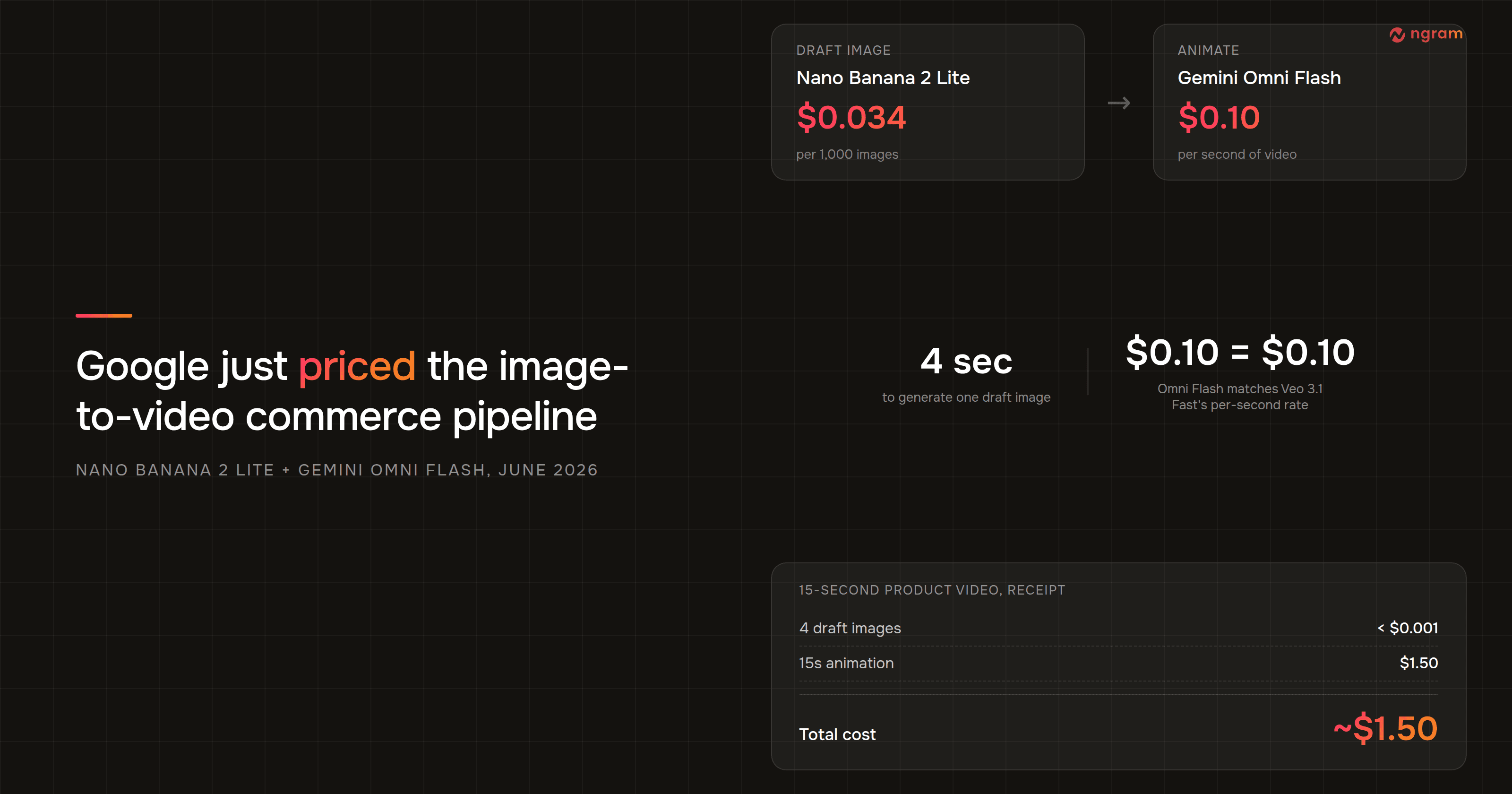
Nano Banana 2 Lite generates a 1K-resolution image in about 4 seconds and costs $0.034 per 1,000 images, according to Google's own announcement. It is positioned as the successor to the original Nano Banana model, built specifically for high-volume workflows rather than one-off hero shots. It is live in Google AI Studio, the Gemini API, the Gemini Enterprise Agent Platform, and is rolling out across consumer surfaces including AI Mode in Search and the Gemini app.
Gemini Omni Flash, the video half of the pair, moved into public preview the same day at $0.10 per second of video output, currently capped at 10-second generations, according to Google Cloud's announcement. This is a different milestone than Omni Flash's first appearance. That happened on May 19, 2026 at Google I/O, when the model rolled out for free inside the Gemini app, YouTube Shorts, and the Flow creative studio, aimed at consumer experimentation. We covered that launch and what it meant for distribution when it happened. This is not that. June 30 is the developer-facing, API-priced, production-oriented expansion, and it comes with two new companion products rather than a wider consumer rollout.
The third piece is Omni Product Studio, one of three sample apps Google built to show the two models working together (the others being a landmark-visualization app called Anywhere and an interior-design tool called Space Lift). Omni Product Studio is effectively an image to video generator built for one specific job: it takes a static product image, drafts variations with Nano Banana 2 Lite, then animates the result into a short cinematic video with Omni Flash. As Google put it in its announcement: "Building with generative media is often about creative iteration. With these two models, developers can build comprehensive, end-to-end multimedia experiences that connect rapid image generation with video creation and editing."
That is a plain description of a workflow ngram's own product already ships in a narrower form. Point ngram's Shopify-product-to-video converter at a product URL and it pulls the product images, copy, and metadata to generate a product video today, no waitlist, no separate draft-then-animate step for the user to manage. It is MVP-level (no full catalog sync yet), but it is the same production category Google is now targeting at the model layer: turn what a merchant already has into a video, not raw footage a crew needs to shoot.
What a 15-second product video actually costs to generate
Do the arithmetic on a realistic commerce use case: a 15-second product video, drafted from four candidate images (a hero angle plus three variants) and animated once the best draft is picked.
Four draft images at $0.034 per 1,000 images works out to $0.000136, effectively a rounding error. Fifteen seconds of animation at $0.10 per second is $1.50. Add them together and the total cost to generate one 15-second product video is about $1.50, and the draft-image step accounts for roughly 0.01% of that bill.
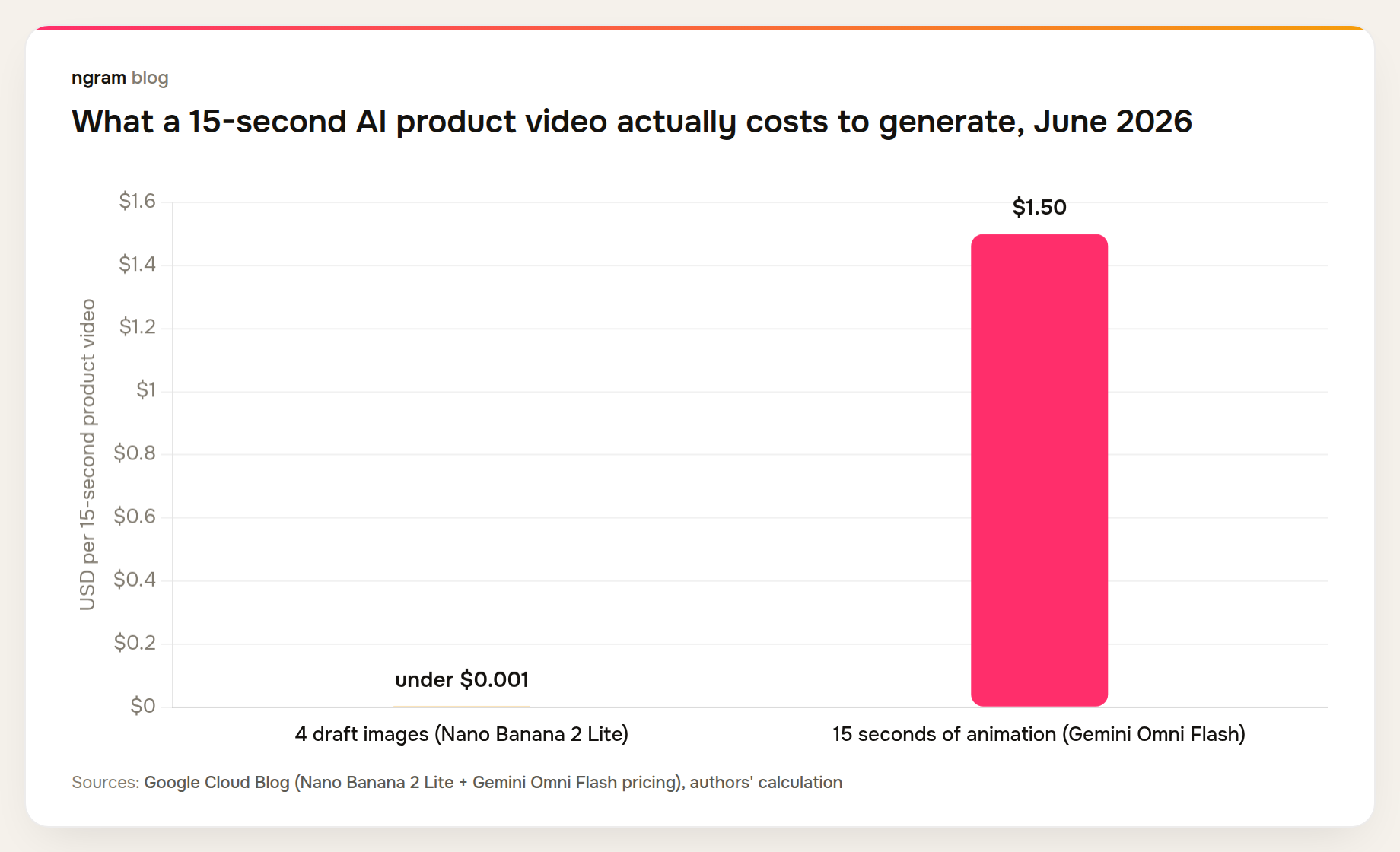
That lopsidedness is the real headline hiding inside this announcement. Google marketed Nano Banana 2 Lite's price cut as the story, but the image-generation cost was already negligible before this release. What actually gates the cost of an AI-generated commerce video is seconds of video output, not images. Nano Banana 2 Lite makes an already-cheap step cheaper. Gemini Omni Flash is where the real spend, and the real pricing decision, lives.
Scale that $1.50 figure and the pattern holds. A batch of 1,000 fifteen-second product videos, drafted and animated this way, runs approximately $1,500 in raw model cost. A 30-second version of the same video, common for a fuller product story, roughly doubles the animation cost to about $3.00 per video, since draft images stay effectively free no matter how many variants get generated.
How that compares to how commerce video gets made today
Traditional ecommerce product video production breaks into a few familiar tiers, according to 2026 industry pricing guides. A budget turntable or white-background showcase runs $1,000 to $3,000. A mid-range shoot with text overlays and comparison visuals runs $1,500 to $3,500. A premium, lifestyle-shot video with talent and studio lighting runs $3,500 to $7,000 or more. On the freelance end, Fiverr-tier editors and videographers typically charge $500 to $2,000 per finished product video, and that is before accounting for the project-management time of briefing, reviewing, and revising with a freelancer.
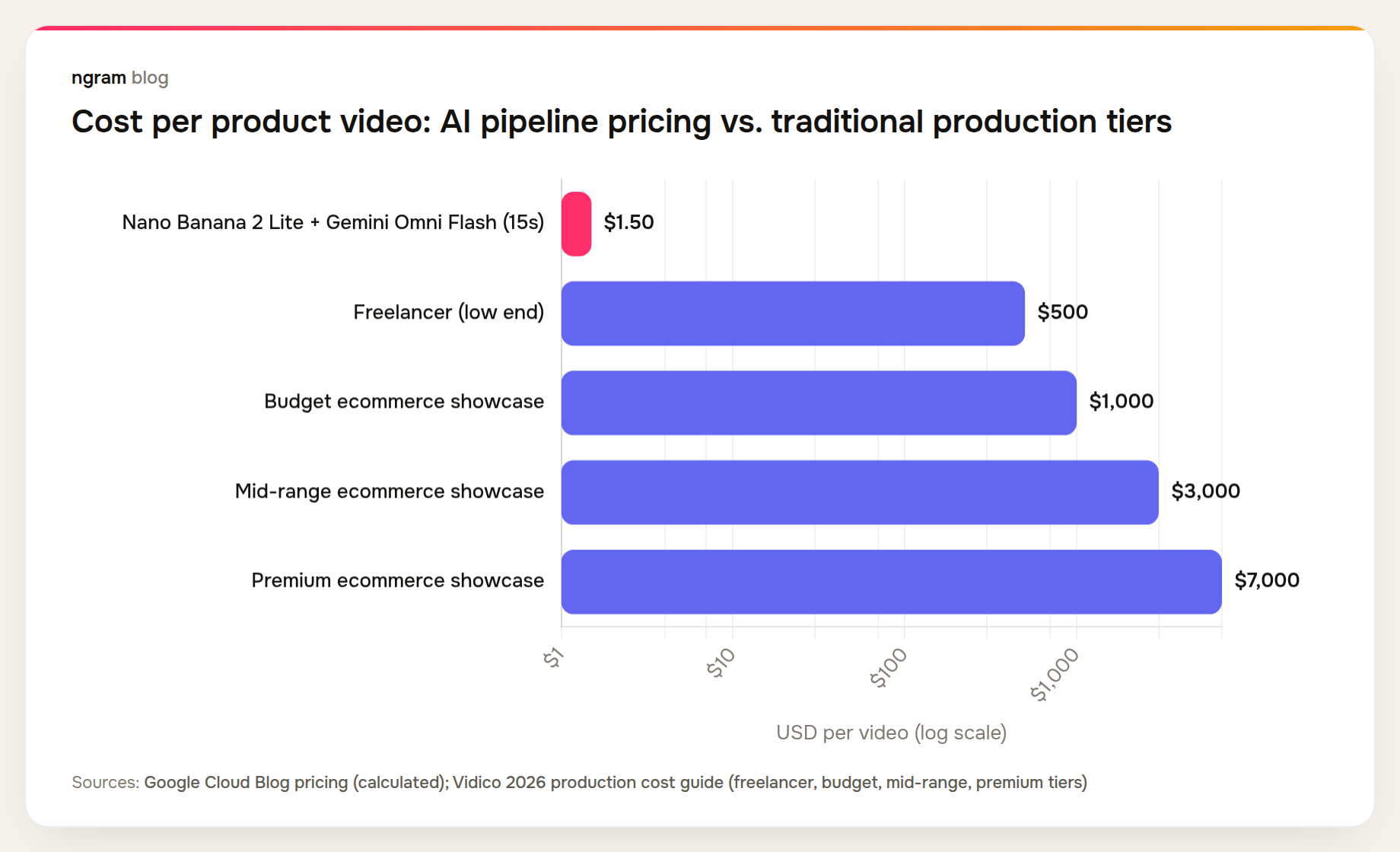
Set the $1.50 AI-generation cost against those tiers and the multiples are stark: roughly 333 times cheaper than a low-end freelancer, 667 times cheaper than a budget agency showcase, and more than 4,600 times cheaper than a premium lifestyle shoot. Even accounting for the fact that raw model cost is not the same as a finished, brand-reviewed video ready to publish, the gap is too large to read as a rounding difference. It is a different cost category entirely.
That gap matters more for timeline than it does for the invoice. A freelancer or agency engagement runs on a schedule measured in days, built around briefs, shot lists, and revision rounds. The AI pipeline runs on a schedule measured in seconds: about 4 seconds to draft one image, and the animation step processes at whatever throughput the API allows. For a merchant who needs a video live before a flash sale ends, that difference is the entire point, not a nice-to-have.
Google is now competing with its own pricing
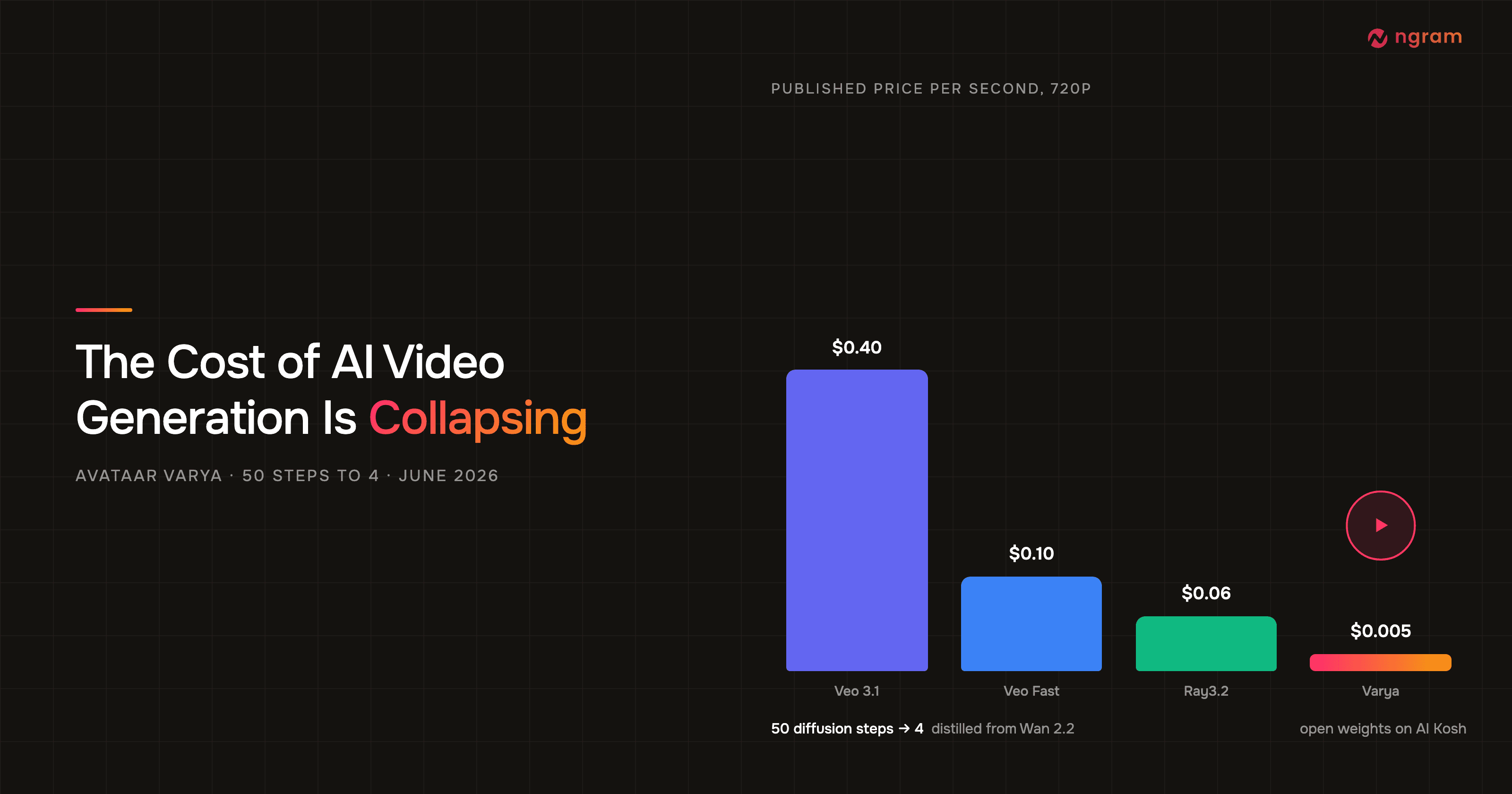
The other detail worth sitting with is what this does to Google's own video lineup. Veo 3.1 Fast, Google's existing low-cost video model, is published at $0.10 per second without audio. Gemini Omni Flash launched into public preview at exactly the same $0.10 per second. That is not a coincidence so much as a statement: Google now has two structurally different video models, from two different model families, priced identically at the entry tier, both undercutting Veo 3.1 Standard's $0.40-per-second rate by a factor of four.
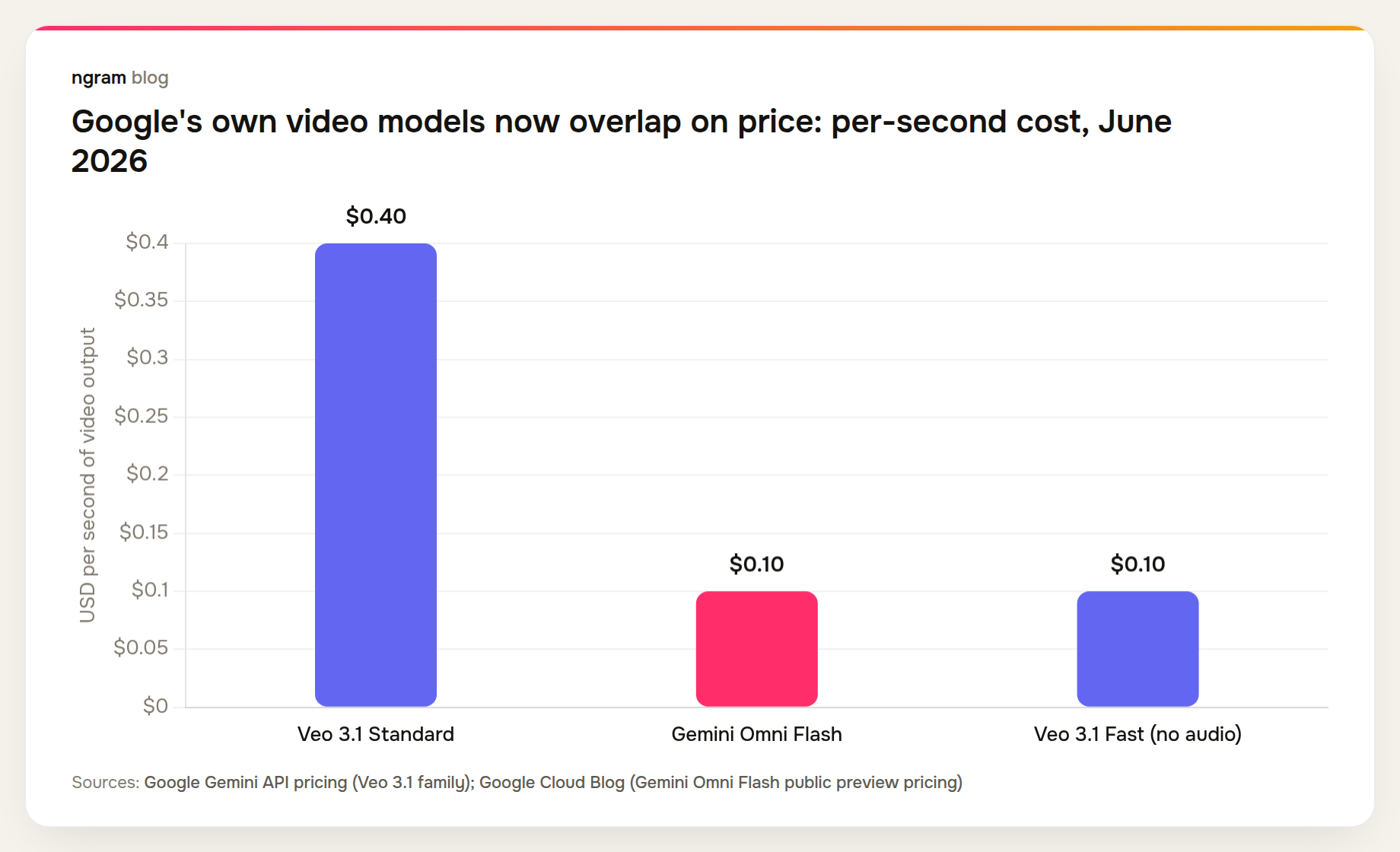
This is the kind of internal overlap that usually signals a company is done treating video generation as a single product line and has started treating it as a shelf of SKUs, each aimed at a different job. Veo is the cinematic, quality-first line. Omni is the conversational, editable, multimodal line built for iteration, matching images, audio, and text into one continuous session rather than a single one-shot prompt. Pricing them the same at the entry tier suggests Google expects developers to pick based on workflow fit, not cost, which is a healthier signal for the market than a race to the bottom on price alone.
Why this is landing now, and why Google is the one doing it
The timing is not incidental. OpenAI discontinued the standalone Sora app and API earlier in 2026 after the unit economics of consumer video generation proved unworkable, and ByteDance shelved the international rollout of Seedance 2.0 following copyright complaints from Hollywood studios. Both of those retreats left a gap at exactly the moment commerce brands are looking for a cheaper way to produce the volume of short-form product video that social and marketplace algorithms now reward.
Google is the supplier stepping into that gap with the most aggressive, most explicitly commerce-shaped bet of the three. Sora was built for open-ended creative generation and consumer novelty. Omni Product Studio is built around a specific, named job: take the product photo a merchant already has, and turn it into video. That is a narrower target than "AI video for everyone," and narrower targets are usually where unit economics actually close, because the model provider is not subsidizing exploratory generation with no clear buyer at the end of it.
It also means Google is now the only major model-layer supplier running a public, aggressively-priced, productized image-to-video pipeline aimed squarely at commerce, at a moment when two of its biggest rivals just retreated from the category. That is a meaningfully different market position than "one more video model launch."
What this means for commerce video production going forward
None of this makes traditional product video production obsolete. A premium lifestyle shoot with a real presenter, real lighting, and a director's eye for pacing is still a different product than a model-generated clip, and for flagship launches or brand campaigns, that difference still justifies the cost. What changes is the floor.
Before this pricing existed, a merchant with 200 SKUs and no video budget simply did not get product video for most of that catalog. The math never worked: even at freelancer rates, 200 videos at $500 each is $100,000, before counting the time to brief and review each one. At roughly $1.50 to $3.00 in raw generation cost per video, video for the long tail of a catalog stops being a budgeting question and starts being a workflow question: does the pipeline plug into a merchant's existing product URLs and image library without someone re-uploading everything by hand.
That is the same gap ngram's Shopify product video workflow already targets for merchants selling on Shopify: pull the images, copy, and metadata straight from the store, so nobody is manually feeding an image model one product at a time. Google's Omni Product Studio proves the same production category out at the raw model layer; the open question for the market is who builds the merchant-facing product around it that removes the manual image-picking and prompt-writing step entirely, since that step, not the per-second price, is what still gates how many merchants actually use this.
For teams evaluating whether to build on this pricing directly, the practical takeaway is to model cost by seconds of finished video, not by which company issued the press release. A $0.10-per-second rate from Google, Veo, or any other supplier converts to the same $1.50 for a 15-second clip regardless of brand name. The differentiator worth paying attention to is workflow: how much manual work sits between a merchant's existing product photo and a finished, on-brand video, because that gap, not the API line-item, is what still separates a demo from a production pipeline most teams will actually use.
If your own product photos are sitting unused while a video budget gets debated, try ngram for free and see what a first draft looks like from a product URL alone.
Frequently Asked Questions
What is Nano Banana 2 Lite?
Nano Banana 2 Lite is Google's faster, cheaper image generation model, announced June 30, 2026. It generates a 1K-resolution image in about 4 seconds and costs $0.034 per 1,000 images. It is available in Google AI Studio, the Gemini API, the Gemini Enterprise Agent Platform, and is rolling out to consumer surfaces including AI Mode in Search and the Gemini app.
How much does Gemini Omni Flash cost?
Gemini Omni Flash, now in public preview as of June 30, 2026, costs $0.10 per second of video output. Generations currently top out at 10 seconds per clip. That per-second rate matches Veo 3.1 Fast's published price without audio, meaning Google now runs two entry-tier video models at the same cost.
How much does an AI-generated product video actually cost?
A 15-second AI-generated product video, drafted with Nano Banana 2 Lite and animated with Gemini Omni Flash, costs approximately $1.50: less than a tenth of a cent for the draft images and $1.50 for 15 seconds of animation at $0.10 per second. A 30-second version costs roughly $3.00, since the animation step scales linearly with duration while image-drafting cost stays negligible.
What is Omni Product Studio?
Omni Product Studio is a demo app Google built to showcase Nano Banana 2 Lite and Gemini Omni Flash working together as an AI product video maker. It converts a static product image into a short cinematic ecommerce video: Nano Banana 2 Lite drafts image variations, and Gemini Omni Flash animates the result. It is one of three sample apps Google released alongside the June 30 pricing announcement.
How does this compare to traditional product video production costs?
Traditional ecommerce product video costs $500 to $2,000 with a freelancer, $1,000 to $3,000 for a budget agency showcase, and $3,500 to $7,000 or more for a premium lifestyle shoot, according to 2026 production cost guides. At roughly $1.50 per video, Google's AI pipeline is 300 to over 4,600 times cheaper in raw generation cost, though it does not replace the creative direction, brand review, and polish a human production team provides for flagship campaigns.
Is this the same as the Gemini Omni Flash launch on YouTube in May 2026?
No. Gemini Omni Flash first rolled out for free inside the Gemini app, YouTube Shorts, and the Flow creative studio at Google I/O on May 19, 2026, aimed at consumer experimentation. The June 30, 2026 announcement is a separate, developer-facing milestone: Omni Flash's move to public preview with published API pricing, alongside two new companion products, Nano Banana 2 Lite and Omni Product Studio, aimed at production and commerce use cases rather than casual consumer use.
Why is Google pricing Gemini Omni Flash the same as Veo 3.1 Fast?
Google has not publicly explained the exact reasoning, but the two models serve different jobs at the same entry-level price. Veo is positioned for cinematic, quality-first generation, while Omni is built for conversational, multimodal iteration across images, audio, and text in a single session. Pricing them identically at $0.10 per second suggests Google wants developers choosing between them based on workflow fit rather than cost.