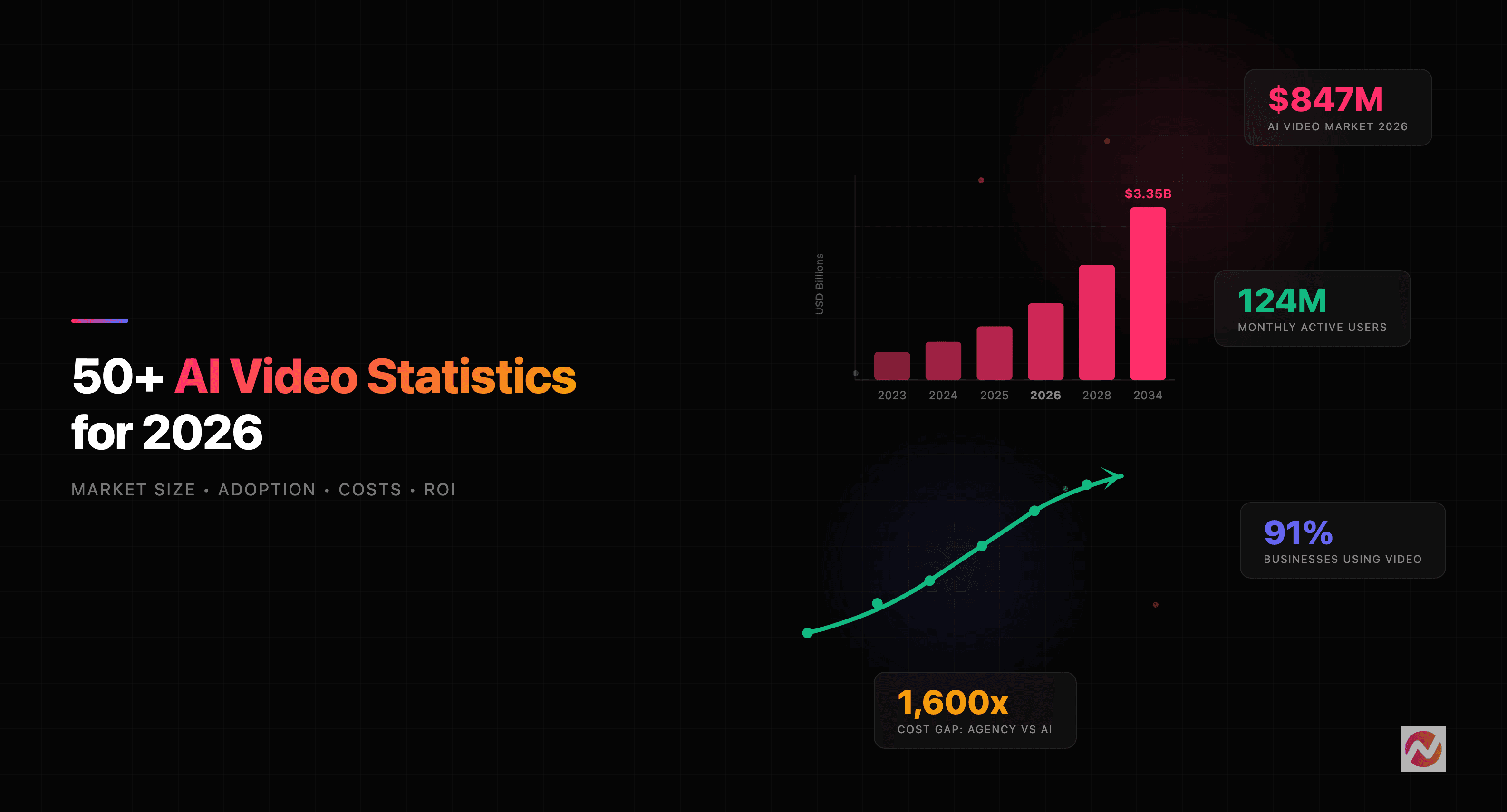

The AI video market crossed $700 million in 2025. Over 124 million people now use AI video platforms every month. And if you are in marketing, product, or sales in 2026, the numbers in this report will shape how you think about video for the rest of the year.
We compiled 50+ AI video statistics for 2026 by cross-referencing market research reports, platform data, enterprise surveys, and freelance marketplace trends. Every data point is sourced. Many are derived by triangulating multiple reports to surface insights you will not find in any single study.
This is not another rehash of the same Wyzowl numbers. This is the data layer underneath the shift.
The Money: AI Video Market Size and Investment
Let's start with what the money is doing, because the money always tells the real story.
Market Size by the Numbers
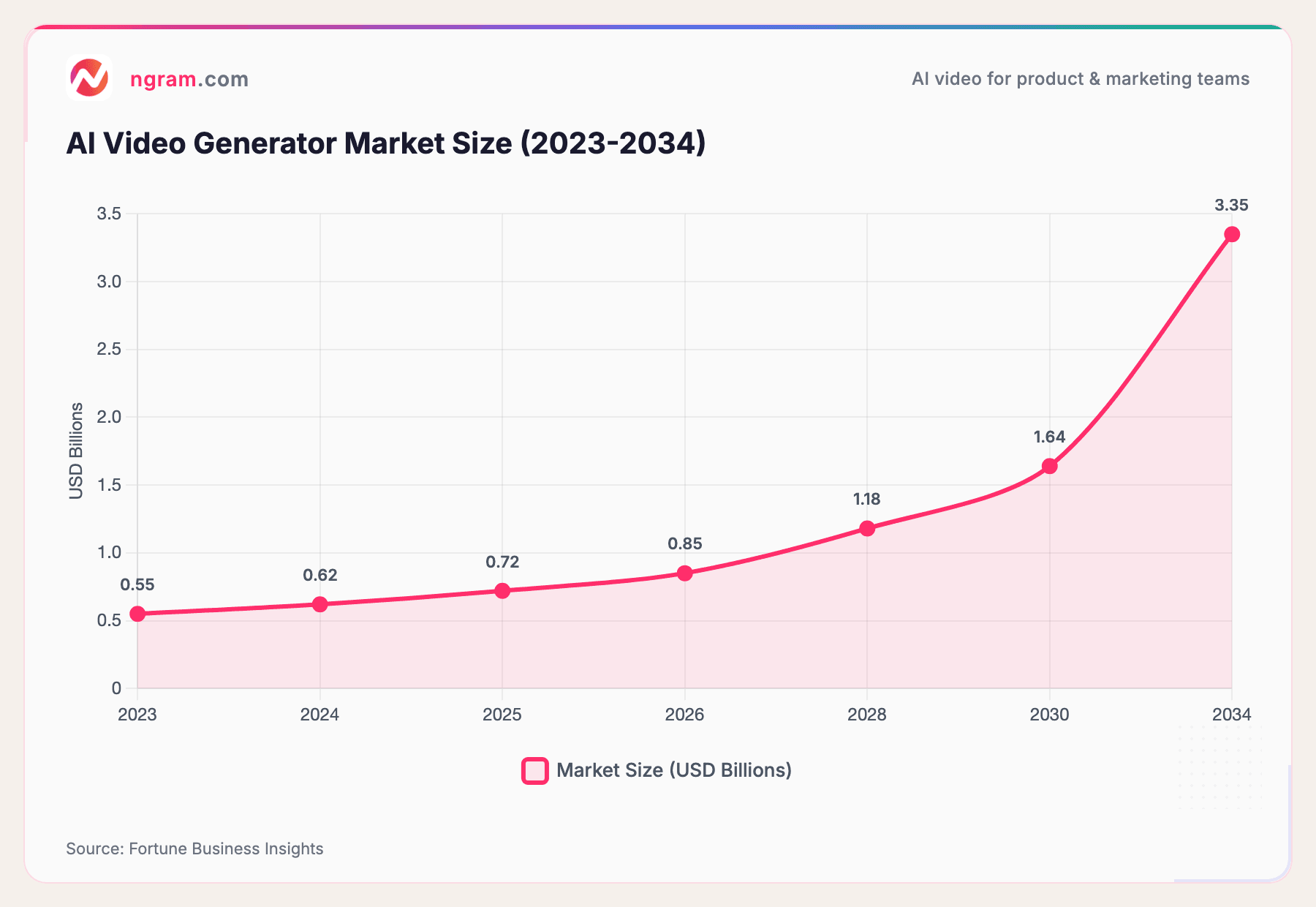
The global AI video generator market was valued at $716.8 million in 2025 and is projected to reach $847 million in 2026, growing at an 18.8% CAGR through 2034, when it's expected to hit $3.35 billion. (Fortune Business Insights)
To put that in context: the broader video editing software market is valued at $2.43 billion in 2025 and growing at just 5.2% CAGR. (Straits Research)
That means AI video is growing 3.6x faster than the overall video editing software market. The category is eating the category.
The chart below shows the AI video generator market's projected growth trajectory from 2023 to 2034.
Source: Fortune Business Insights
The growth curve accelerates sharply after 2026 as enterprise adoption moves from pilot programs into production workflows.
Where the Market Breaks Down
By source type: Text-to-video accounts for 46.3% of AI video generation, making it the dominant creation method. PowerPoint-to-video is the fastest-growing segment at 21.8% CAGR. (Fortune Business Insights)
By enterprise size: Large enterprises hold 50.9% of the market, but SMEs are growing faster at 21.1% CAGR. Small businesses with under 50 employees represent 46% of all AI video platform sign-ups. (Fortune Business Insights)
By region: North America leads with 41% market share ($293.8M in 2025), followed by Europe at 23.1% and Asia-Pacific at 20.9%. Asia-Pacific is the fastest-growing region. (Fortune Business Insights)
The Venture Capital Signal
The VC market has placed enormous bets on AI video in the last 18 months:
- Synthesia raised a $200M Series E in January 2026 at a $4 billion valuation, nearly doubling from $2.1B just one year earlier. Their ARR grew from $88M to $146M in 2025 - a 66% increase. (TechFundingNews, Sacra)
- Runway raised $308M in April 2025 at a $3 billion valuation, with total funding exceeding $540M. (General Atlantic)
- HeyGen reached an estimated $95M ARR by September 2025, up from roughly $35M in 2024 and $1M in early 2023. (Sacra, Getlatka)
Overall, AI startups captured close to 50% of all global VC funding in 2025 ($202.3B total), up from 34% in 2024. In AI specifically, 58% of funding went to megarounds of $500M or more. (Crunchbase)
The Adoption Curve: Who Is Using AI Video and How Fast
The adoption data tells a story of acceleration across every segment.
Enterprise and Marketer Adoption
- 91% of businesses use video as a marketing tool in 2026, returning to joint all-time highs. (Wyzowl)
- 63% of video marketers have used AI tools to help create or edit marketing videos, up notably from prior years. (Wyzowl)
- 78% of marketing teams now use AI-generated video in at least one campaign per quarter. (Industry surveys; sources vary)
- 80%+ of enterprises will have used generative AI APIs or deployed GenAI-enabled applications by 2026. (Gartner)
- 71% of firms reported using generative AI in one or more business functions in 2025, up from 55% in 2024. (Deloitte)
Platform and User Growth
Monthly active users across AI video platforms surpassed 124 million in January 2026. To put that in perspective, if AI video platform users were a country, they would be the 12th largest in the world by population.
On the freelance side, the data is just as telling. Fiverr's Fall 2025 Business Trends Index showed demand for AI video creators surged 66% in six months. Searches for "faceless YouTube video creator" spiked 488%, AI automation rose 136%, and prompt engineering jumped 76%. (Fiverr Investor Relations)
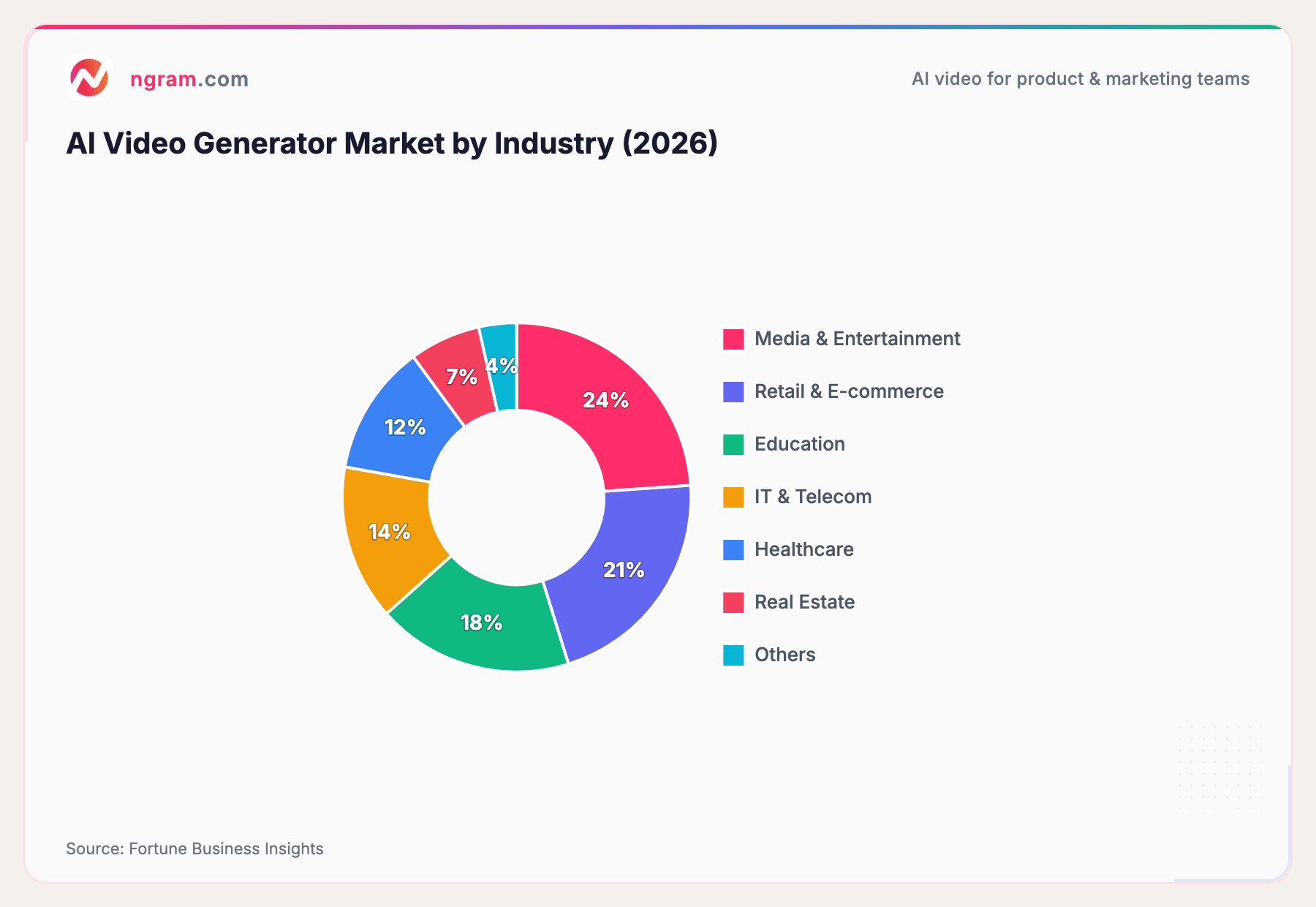
Here is how AI video adoption breaks down by industry.
Source: Fortune Business Insights
Media and entertainment leads, but the real story is how distributed adoption has become. Education, healthcare, and real estate are all meaningful segments now. This is not a marketing-only tool anymore.
The Cost Equation: What Changed in Production Economics
This section is where the data gets uncomfortable for traditional production shops.
The Price Collapse
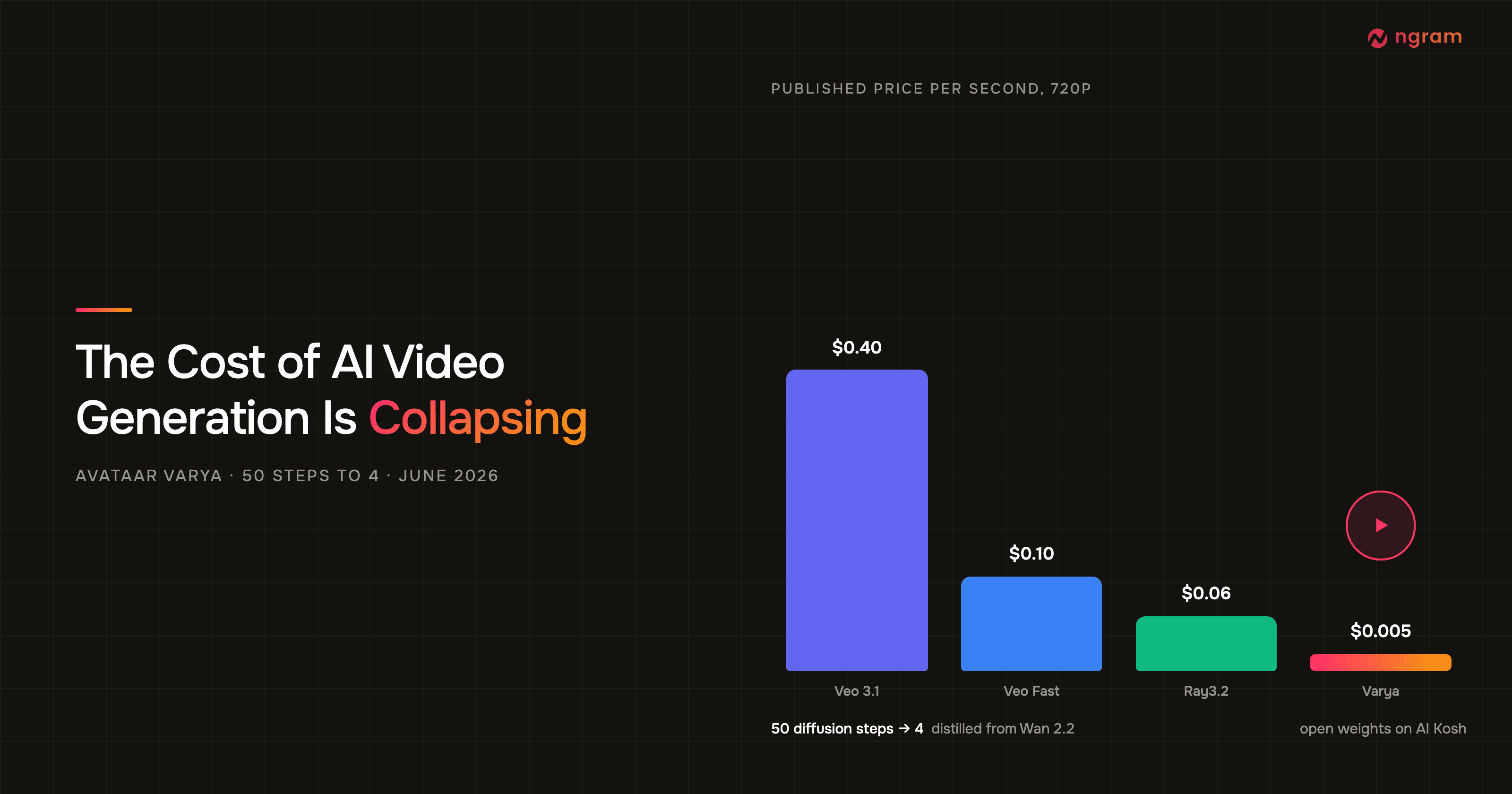
Traditional video production costs between $1,000 and $50,000 per finished minute, depending on complexity and whether you're working with freelancers or agencies. AI video tools bring that down to $2-30 per minute on subscription plans. (Industry benchmarks, Fortune Business Insights)
Here is the cost comparison across production methods.
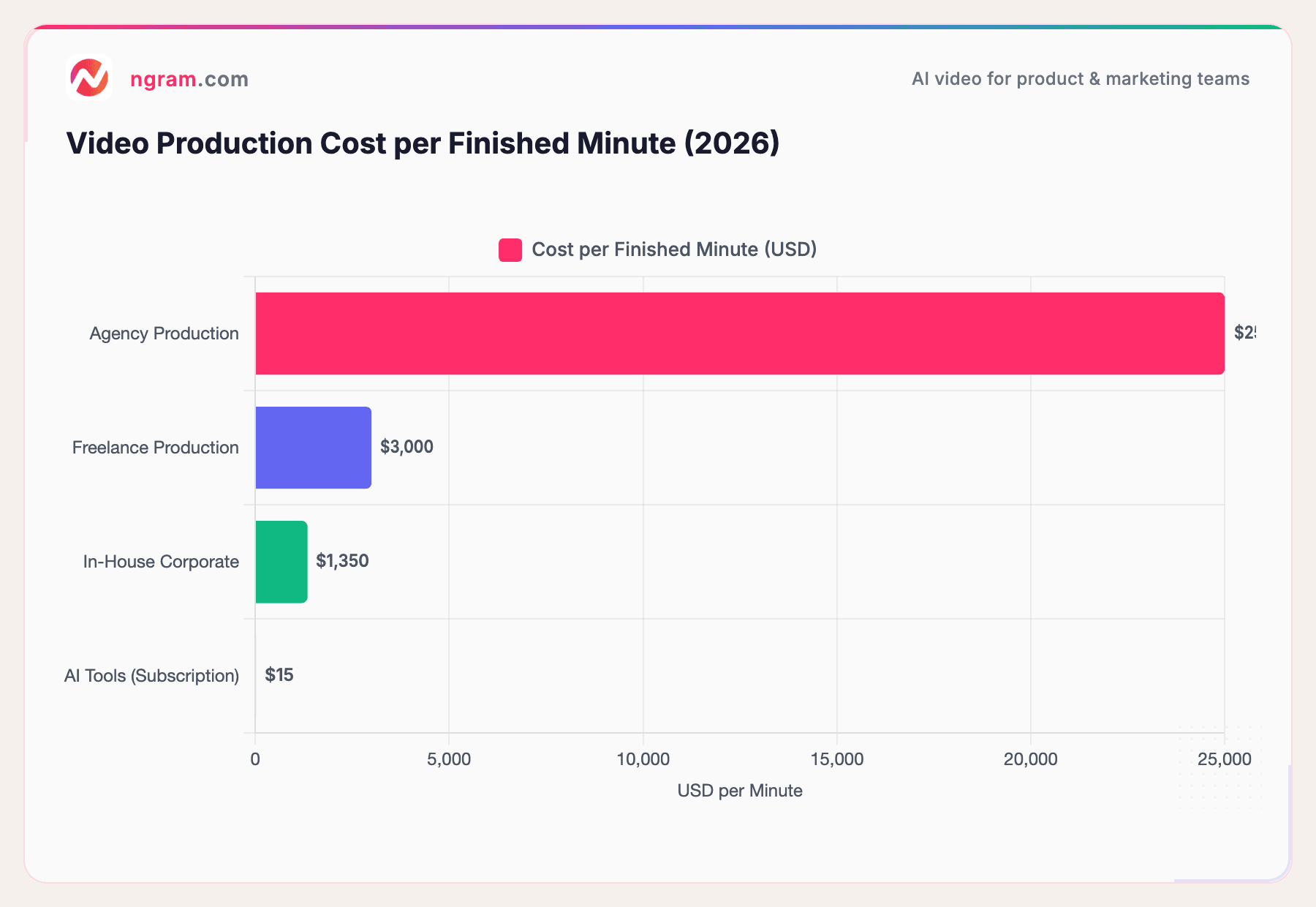
Sources: Industry benchmarks, Fortune Business Insights
The gap between agency production and AI tools is not 2x or 5x. It is closer to 1,600x at the median. That is not a marginal efficiency gain. That is a category disruption.
The Time Compression
- Average time to produce a 60-second marketing video dropped from 13 days (traditional) to 27 minutes (AI). (Industry surveys; sources vary)
- AI video tools save the average marketing team 34 hours per week previously spent on production and editing. (Industry surveys; sources vary)
- 68% faster time-to-publish reported by teams using AI video workflows. (Industry surveys; sources vary)
- 71% of creators use AI for first drafts, then manually refine - making AI a starting point, not a replacement for human judgment. (Industry surveys; sources vary)
Budget Reallocation
- 92% of marketers plan to spend the same or more on video in 2026. (Wyzowl)
- Most marketers (46%) allocate a third of their budget or less to video content, while 17% don't even track their video spending. (Wyzowl)
- The recommended benchmark is 15-25% of marketing budget allocated to video. (HubSpot)
Tools like ngram are built for exactly this shift - turning raw content like docs, screen recordings, and URLs into polished videos in minutes, so teams can reallocate production budgets toward distribution and strategy.
What Viewers Actually Do: Consumption and Engagement Data
Creation is only half the equation. Here is what is happening on the viewer side.
The Scale of Video Consumption
- 94.6% of internet users worldwide watched online videos monthly in Q2 2025. (Statista)
- YouTube users collectively consume more than 1 billion hours of video every day, with 2.7 billion monthly active users. (YouTube/Alphabet)
- People watch an average of 17 hours of online video per week. (Wyzowl)
- 82.5% of global internet traffic is now video content. (DemandSage)
The Format Shift: Vertical Is Winning
One of the clearest trends in 2026 is the dominance of vertical video:
- 59% of AI-generated videos are now in vertical (9:16) format, up from 31% in 2024. (Industry data)
- 52% of social users gravitate toward short-form video (under 60 seconds). (Sprout Social)
- Short-form videos receive 2.5x more engagement than long-form videos. (Industry benchmarks)
- 85% of AI-generated videos now include auto-generated captions. (Industry data)
This format shift matters because it changes what tools you need. Vertical, captioned, short-form video needs to be planned for its target layout before the edit. A video converter can change the finished file's container afterward, but it does not replace that layout work.
LinkedIn: The Surprising Video Platform
LinkedIn has quietly become one of the most important B2B video platforms:
- LinkedIn video viewership surged 36% in 2024, reaching 154 billion views. (Social Insider)
- Video posting frequency doubled from 2 to 4 posts per month on average. (Social Insider)
- Video posts generate up to 3x more engagement than text or image posts on LinkedIn. (Social Media Today)
- Video posts are shared 20x more than any other content type on the platform. (Social Media Today)
Digital Video Ad Spend
The ad money follows the viewers. Global digital video ad spending continues its upward trajectory.
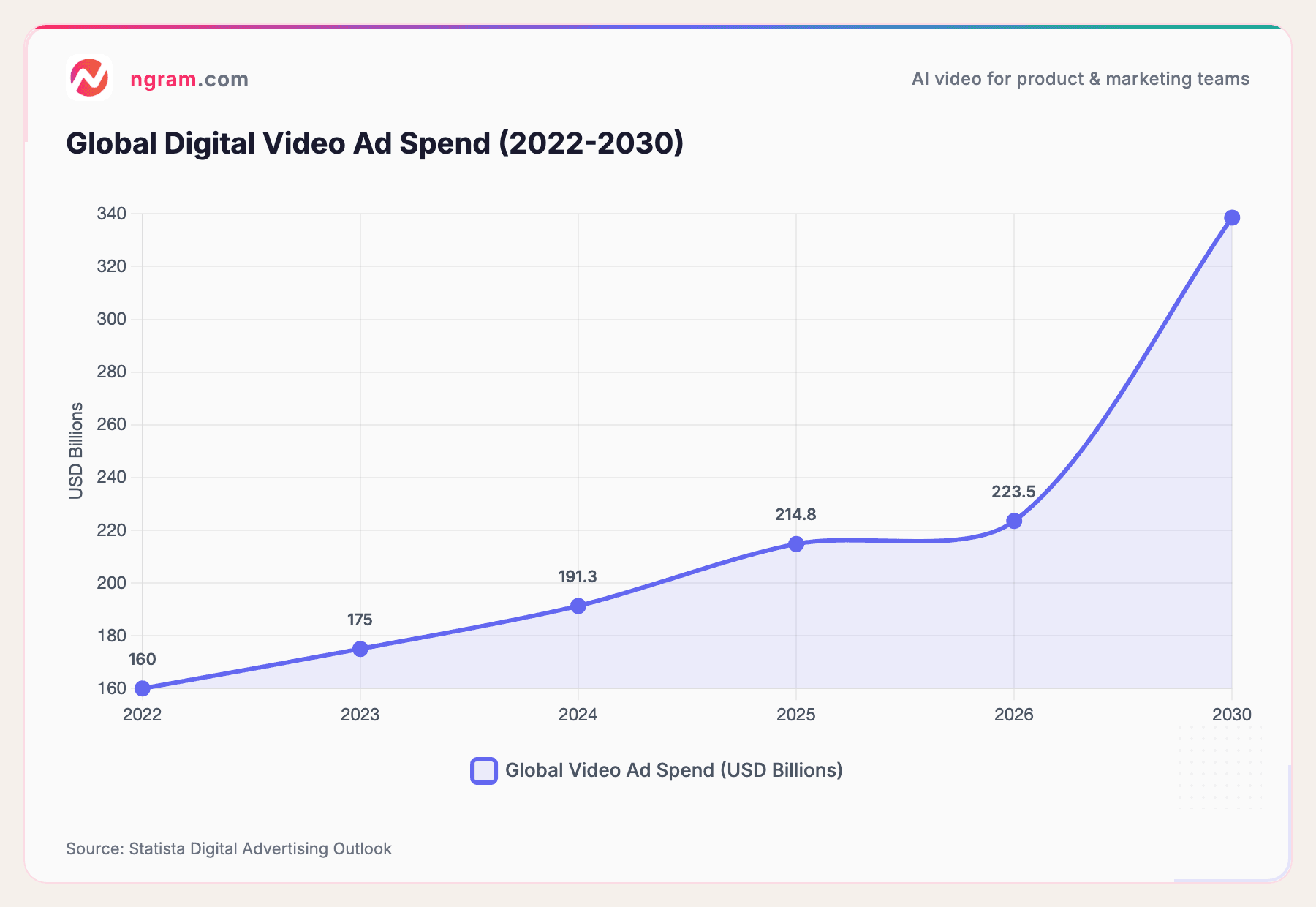
Source: Statista Digital Advertising Outlook
Digital video ad spending is expected to reach $223.5 billion in 2026 and $338.6 billion by 2030, growing at a 9.5% CAGR. The short-form video ad segment alone is projected to hit $219.7 billion by 2030. (Statista)
Here is a derived insight that no other stats page will give you: digital video ad spend ($223.5B) is roughly 264x larger than the AI video generator market ($847M). The tools that create the video are a tiny fraction of the money spent distributing it. This is the "picks and shovels" dynamic - the creation tools market has massive room to grow.
What Is NOT Changing (The Counterpoint Data)
Every stats roundup tells you what is growing. Few tell you what is not moving. The gaps in adoption are just as important as the growth curves.
The 9% Who Still Say "We Don't Need Video"
Despite overwhelming data on video ROI, 9% of businesses still do not use video. And 24% of non-adopters say they simply don't feel video is needed for their business. Another 24% say it is too expensive. (Wyzowl)
But the most telling barrier is this: 37% of marketers who don't create video say they don't know where to start. It is not a budget problem or an ROI problem. It is a knowledge gap.
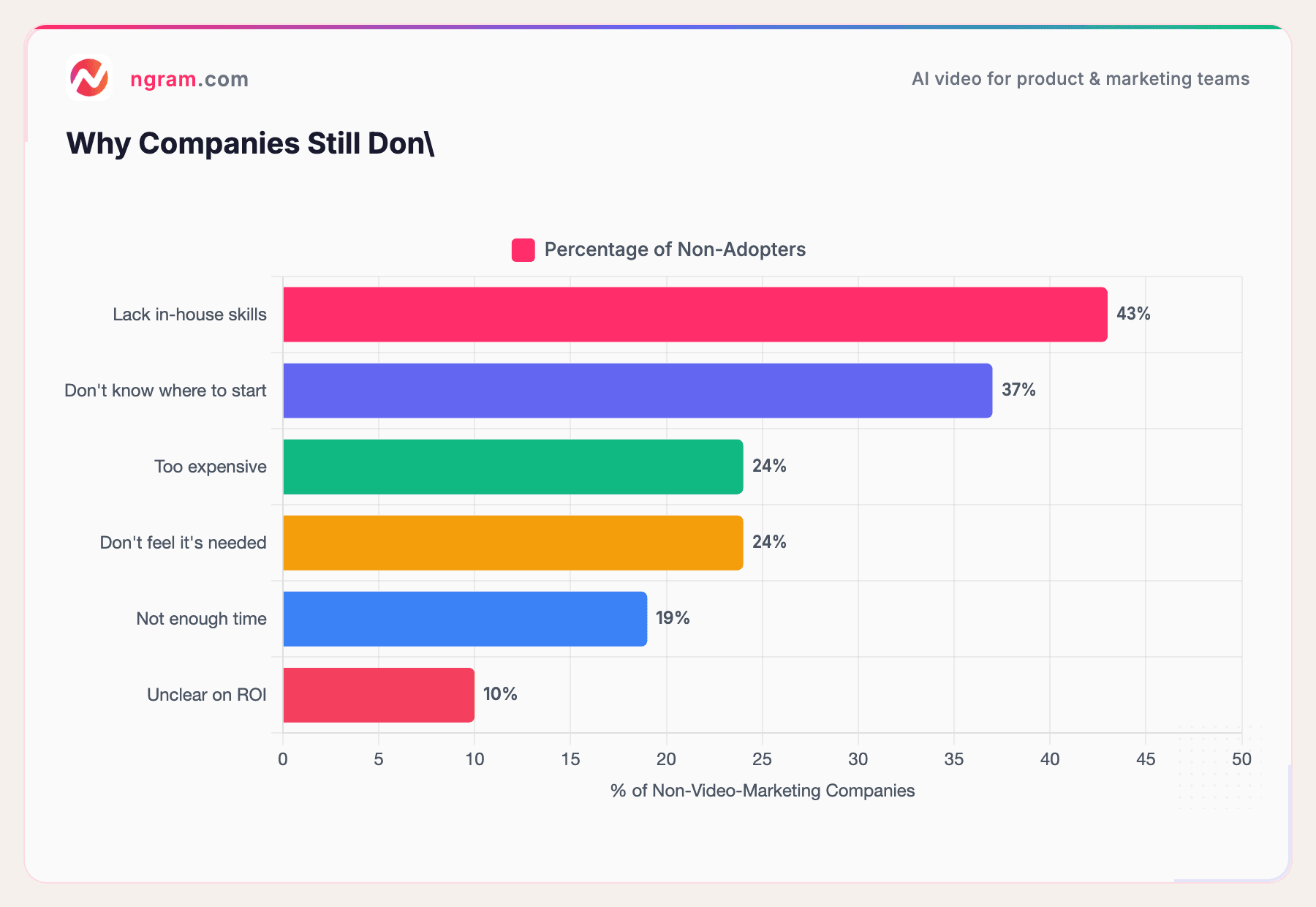
Sources: Wyzowl 2026 State of Video Marketing, industry surveys
The good news: 67% of marketers who currently don't use video say they plan to start in 2026. AI tools are specifically dismantling the top barriers - skills gaps, cost, and complexity.
Traditional Production Is Not Dying
Here is a data point that might surprise you: the traditional video production services market was valued at $222.6 billion in 2025 and is growing, not shrinking. (Business Research Insights)
Corporate video demand grows by 15% yearly. Nearly 700 feature films went into production in 2024, matching pre-strike levels. U.S. theatrical revenue climbed to roughly $8.6 billion. (Business Research Insights)
AI video is not replacing traditional production. It is creating an entirely new category of video that did not exist before - the quick product update, the internal training clip, the personalized sales outreach, the weekly social post. Content that was previously a Google Doc or a Slack message is now a video.
ROI Dipped (Slightly)
Another counterpoint: Wyzowl reports that 82% of marketers say video gives them a good ROI in 2026 - down from last year's all-time high of 93%. (Wyzowl)
Why the dip? More companies are creating video, which means more companies are creating bad video. When the barrier to creation drops, quality variance increases. The ROI gap between intentional, well-structured video and generic AI-generated content is widening.
The GTM Impact: Video in Sales, Marketing, and Product
If you are using video in your go-to-market motion, the data backs you up across every funnel stage.
Top of Funnel: Awareness and Reach
- 93% of video marketers say video increased brand awareness. (Wyzowl)
- 85% of video marketers say video helped generate leads. (Wyzowl)
- 93% of video marketers say video increased user understanding of their product. (Wyzowl)
- 73% of video marketers say explainer videos are their most-used format. (Industry surveys)
Middle of Funnel: Consideration and Conversion
- Landing pages with video convert up to 86% better than those without. (Industry benchmarks)
- 82% of B2B buyers say video influenced a software purchase decision. (Industry surveys)
- Websites using video strategy average a 4.8% conversion rate vs 2.9% without video. (Industry benchmarks)
- Product demo videos have an average 34% conversion rate, outperforming written descriptions by nearly 2x. (Industry benchmarks)
Bottom of Funnel: Sales Enablement
- Follow-up personalized videos sent by sales reps increase response rates by 36% vs 19% for standard email. (Industry surveys)
- Email campaigns with video see 300% higher click-through rates. (Industry benchmarks)
- Emails with embedded video achieve a 9.1% conversion rate vs 5.4% without. (Industry benchmarks)
- Customer testimonial videos have a 44% higher conversion rate vs videos without testimonials (44% vs 21%). (Industry surveys)
For product marketing teams, this data makes the case clear: video is not optional at any stage of the funnel.
Want to start creating these videos without a production team? ngram turns your docs, screenshots, and screen recordings into polished, on-brand videos in minutes. Try it free
Where the Money Is Going Next: 2026-2030 Projections
The trajectory data paints a picture of a market still in early innings.
Market Projections
- The AI video generator market is projected to reach $3.35 billion by 2034, a 4.7x increase from 2025. (Fortune Business Insights)
- 90% of online video is expected to involve some form of AI assistance by 2030. (Industry projections)
- Connected TV ad spending is projected to reach $120.6 billion by 2030, growing at 16.6% CAGR. (Statista)
- Short-form video ad spending is projected to reach $219.7 billion by 2030, growing at 13.7% CAGR. (Statista)
Enterprise Adoption Trajectory
- 40% of enterprise applications will feature task-specific AI agents by end of 2026, up from less than 5% in 2025. (Gartner)
- By 2028, more than 95% of enterprises will have deployed generative AI applications. (Gartner)
- Worker access to AI rose by 50% in 2025, and the number of companies with 40%+ AI projects in production is set to double within six months. (Deloitte)
The Workforce Shift
The job market data shows a nuanced picture:
- Demand for AI video creators surged 66% on Fiverr in H2 2025, while traditional "video editor" roles show seasonal fluctuation. (Fiverr)
- Entry-level job postings have declined 15% year-over-year broadly, with creative roles like computer graphic artists down 33% in 2025. (Dallas Fed, Bloomberry)
-
But roles requiring creative direction and strategy are growing. The shift is from execution to orchestration - knowing what video to make and why, not just how to edit it.
This is the distinction that matters: AI is not replacing video professionals. It is replacing the parts of video work that were always tedious. The people who thrive are the ones who use AI-generated visuals as a starting point for human creativity, not a substitute for it.
The Summary: 10 Data Points That Define AI Video in 2026
Frequently Asked Questions
How big is the AI video market in 2026?
The global AI video generator market is projected to reach $847 million in 2026, growing from $716.8 million in 2025. It is expected to hit $3.35 billion by 2034, driven primarily by text-to-video generation (46.3% of the market) and growing SME adoption. (Fortune Business Insights)
What percentage of businesses use video marketing in 2026?
91% of businesses use video as a marketing tool in 2026, returning to joint all-time highs according to Wyzowl's annual survey. Of those, 63% have incorporated AI tools into their video creation workflow.
How much does AI video production cost compared to traditional production?
AI video tools cost between $2 and $30 per finished minute on subscription plans. Traditional production ranges from $1,000-$5,000 per minute (freelance) to $15,000-$50,000 per minute (agency). That represents a cost reduction of 97-99.9% depending on complexity.
Is AI video replacing traditional video production?
No. The traditional video production market ($222.6 billion in 2025) is still growing. AI video creates an adjacent category of content - quick updates, social clips, internal communications, personalized outreach - that previously was not produced as video at all. Think of it as expanding the total volume of video, not replacing the existing supply.
What video format performs best for marketing in 2026?
Short-form vertical video (under 60 seconds, 9:16 format) delivers the highest engagement rates - 2.5x more than long-form content. 52% of social users prefer this format. For B2B specifically, explainer videos under 2 minutes are the most-used format by 73% of video marketers.
How does video impact conversion rates?
Landing pages with video convert up to 86% better than those without. Websites using video strategy average a 4.8% conversion rate vs 2.9% without. Email campaigns with embedded video see 300% higher click-through rates and a 9.1% vs 5.4% conversion rate.
What are the biggest barriers to video marketing adoption?
The top barrier is lack of in-house skills (43%), followed by not knowing where to start (37%), cost concerns (24%), not feeling video is needed (24%), and time constraints (19%). AI tools are specifically designed to address the skills, cost, and time barriers.
How much should companies budget for video marketing?
Industry benchmarks suggest allocating 15-25% of your marketing budget to video. Currently, 46% of marketers allocate a third of their budget or less. With AI tools reducing production costs by 97%+, the question is shifting from "can we afford video?" to "can we afford not to?"