

Search for "Deepdub vs Dubverse" and you will find two AI dubbing tools that sit at opposite ends of the same market. Deepdub is the studio-grade, emotion-aware localization engine that streaming services and media companies use on full catalogs. Dubverse is the fast, affordable, credit-based platform that creators and educators use to push videos into more languages without a sales call. This guide compares Deepdub vs Dubverse across the things that actually decide the purchase: dubbing quality, language coverage, pricing, and workflow. It also shows where a third option, ngram, fits when your real job is creating and localizing a finished business video, not just dubbing an existing file.
Both tools are good at what they target. Deepdub leans into broadcast-quality performance and a managed, partnership-style engagement. Dubverse leans into speed, self-serve access, and a price point that creators can actually afford. The honest answer to "which is better" is "for which job," so we pick a winner per dimension instead of crowning one overall.
Deepdub vs Dubverse at a glance
Here is the short version before the deep dive. ngram sits in the table because for many teams comparing these two, the better question is whether you need a pure dubbing tool or a system that both makes and localizes the video.
| Tool | Best for | Starting price | Main distinction |
|---|---|---|---|
| ngram | Teams creating and localizing finished business videos from prompts, docs, decks, and recordings | Free, paid from $29/mo | Builds the video, then translates it in the same workflow |
| Deepdub | Studios, streaming, and enterprise media localizing produced content | Custom, sales quote only | Broadcast-grade, emotion-aware dubbing at scale |
| Dubverse | Creators, educators, and marketers dubbing and subtitling existing videos | Free trial, paid from about $15/mo | Affordable, self-serve, credit-based dubbing |
Dubbing quality and voice realism
This is the first thing buyers test, and it is where Deepdub and Dubverse split most clearly.
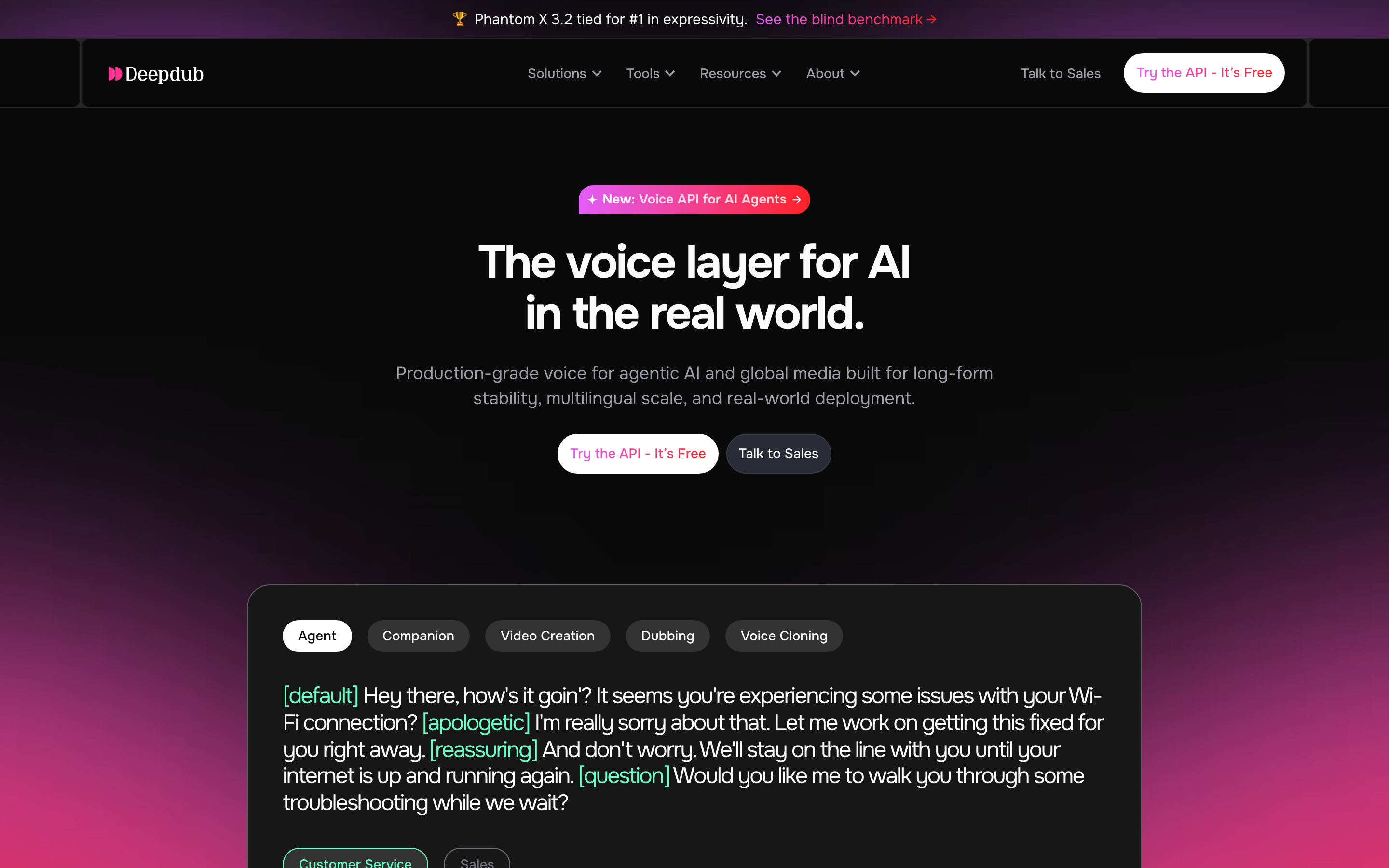
Deepdub is built for high-end media localization. Its engine reads the emotional arc of a scene and adjusts vocal delivery so a character moving from calm to angry sounds like a performance rather than a string of disconnected text-to-speech lines. It handles multiple speakers and holds quality across long-form scripted content, which is why it has been used to localize thousands of titles for streaming and entertainment. If your output is a film, a series, or premium branded media that has to feel acted, Deepdub is the stronger pick.
Dubverse takes a more practical bet. Its synthetic voices are clear and natural enough for talking-head, tutorial, and marketing content, and it syncs dubbed audio to on-screen speech well. It is not chasing cinematic emotional range, and it does not need to: for a YouTube explainer or a course module going into a handful of languages, the output is solid and ships fast. Dubverse is also strong on South Asian languages like Hindi, Tamil, and Telugu, where the voice quality is hard to match elsewhere.
Winner: Deepdub for cinematic, emotion-driven dubbing, Dubverse for fast, good-enough creator and education content. Pick based on whether your audience rewards performance or speed.
Worth noting for both: dubbing only changes the audio of a video that already exists. If the video itself still has to be built, with a script, scenes, captions, and branding, neither tool does that part. That gap is where ngram comes in, and we cover it below.
Languages and coverage
Localization reach is a core reason teams buy either tool, and the two are not close here.
Deepdub covers 100+ languages and accents, and pairs that breadth with human-in-the-loop oversight on its managed service so the output meets broadcast standards. For a studio shipping a catalog across many markets at premium quality, that combination of reach plus quality control is the point.
Dubverse covers roughly 30 languages, a smaller set, with particular depth in Indian and South Asian languages. For a creator or training team localizing into a focused list of markets, 30 languages is usually enough, and the South Asian coverage is a genuine edge. But for a global rollout into dozens of less common languages, Dubverse will run out of options before Deepdub does.
Winner: Deepdub for raw breadth and premium-quality coverage, Dubverse for South Asian language depth at a creator price.
ngram handles localization differently. It translates the script, captions, and on-screen text, generates multilingual voiceover, and re-lip-syncs avatars or talking heads to match the new language, all inside the same project where the video was made. The language list is broad rather than a fixed published number, so if you need a guaranteed count for a procurement checklist, confirm current coverage first.
Pricing and value
Pricing is where the two tools feel most different, because they sell in completely different ways. Deepdub is quote-only. Dubverse is self-serve and credit-based.
Deepdub has no public self-serve plan, no monthly subscription, and no free way to test the tool. Access runs through a sales consultation, and pricing is custom, set per minute based on project scope, language pairs, and quality level. That model fits enterprise media buyers who want a managed partnership, but it rules out anyone who wants to swipe a card and start today.
Dubverse is the opposite. It offers a free trial and paid plans that start around $15 a month on a credit model: dubbing costs roughly 4 credits per minute and subtitles around 1 credit per minute, so you can forecast spend before you commit. Higher tiers unlock studio features, voice cloning, and advanced translation. Billing is available in both USD and INR. For creators and small teams, this is dramatically more accessible than a sales quote.
Here is how the entry-level options compare on monthly and annual billing. Deepdub is omitted because it publishes no self-serve price.
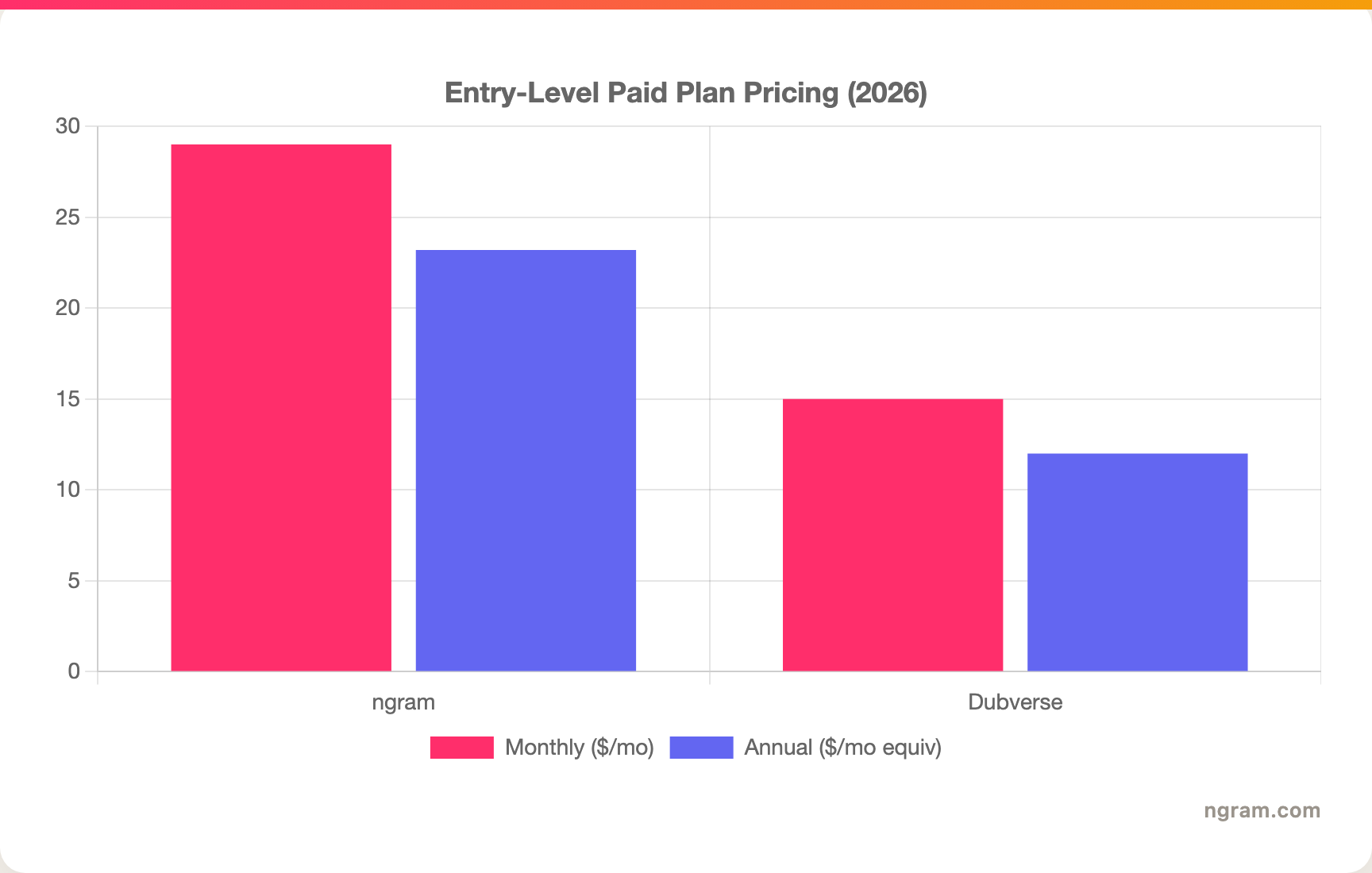
The numbers only tell part of the story. Dubverse meters per credit, so a heavy month of long videos adds up; ngram's Basic plan includes 3,000 credits a month on a credit model shared across video creation, editing, and exports; and Deepdub's true cost only appears after a scoping call. Match the model to your real volume before you decide.
Winner: Dubverse for transparent, low-cost self-serve, ngram for the most generous monthly volume on an entry plan, Deepdub only when budget is a project line item rather than a subscription.
Workflow and who it serves
Both tools assume you arrive with a finished video to localize, but the experience around that is very different.
Deepdub is a partnership. You engage their team, scope the project, and get a managed or SaaS workflow (Deepdub Go) that plugs into a production pipeline. It is built for organizations with localization budgets and timelines, not for someone who needs a dubbed clip this afternoon. Dubverse is built for that afternoon: upload a video, pick languages, review, and export, with no onboarding call required.
The shared limitation is the starting point. Both expect a completed video as the input. Teams whose source material is a product doc, a deck, a script idea, or a raw screen recording still have to produce the video somewhere else first, then bring it to Deepdub or Dubverse to translate. That is the clearest reason buyers comparing these two end up looking at a third option.
1. ngram, the better third option for end-to-end video teams
Watch how ngram turns an idea into a finished video:
ngram overlaps with Deepdub and Dubverse on the localization slice, then keeps going where they stop. Instead of starting from a finished video that needs dubbing, you give ngram a prompt, a PDF, a URL, a deck, screenshots, a screen recording, or raw footage, and its agentic chat plans the script, storyboard, scenes, captions, and call to action for you to review before anything renders. Then it translates that same video: script, captions, on-screen text, multilingual voiceover, and avatar or talking-head re-lip-sync per language.
That single-workflow difference matters most for business teams. For the marketing, product, sales, and training teams who make up a large share of "Deepdub vs Dubverse" searches, the real job is rarely "dub this finished film." It is a launch video, a product demo, an onboarding walkthrough, or a training clip that has to be built first and then shipped in several languages, all on brand.
What makes ngram different
- Source-aware inputs - Start from a prompt, PDF, URL, screenshot, screen recording, raw video, deck, or Shopify product, not just a finished video to dub.
- Plan before render - Review the script and storyboard in chat, fix direction early, then generate, so you are not re-recording a take.
- Create plus localize in one place - Build the video with avatars, voiceover, screen-recording polish, callouts, B-roll, and branding, then translate it without exporting to a separate dubbing tool.
- Localization built in - Translate script, captions, and on-screen text, generate multilingual voiceover, and re-lip-sync avatars for each language.
- Brand kits - Logos, colors, fonts, approved and blocked phrases applied automatically to every video and every localized version.
- MP4 export - Finished videos export as MP4; separate media tools can derive GIF, WebM, PNG, or JPG from supplied media.
Where ngram is honest about its limits
ngram is not a broadcast-grade entertainment dubbing engine. If your job is localizing a feature film or a scripted series where every line has to be acted, Deepdub's emotional range and managed oversight are built for that and ngram is not a drop-in replacement. ngram provides hosted video pages and embeds but has no generally available owner analytics surface, so analytics-heavy buyers should confirm needs first. And ngram does not publish security certifications today, so a compliance-bound program with a strict requirement should verify that separately.
Who ngram is best for
ngram fits product marketing, growth, sales, customer success, and training teams that create business videos and need them in several languages, all in one tool. For current plans and credits, check ngram pricing rather than stale screenshots, and for the direct head-to-heads see the ngram vs Deepdub comparison and the ngram vs Dubverse comparison.
Ready to try ngram? Create your first video from a prompt, doc, URL, deck, screenshot, or recording, then localize it in the same place. Start free
2. Deepdub
Deepdub is best for studios, streaming services, and enterprise media that need broadcast-grade dubbing of produced content. Public details were checked against Deepdub's site and 2026 review coverage for this comparison.
Key features
- Emotion-aware dubbing - Reads a scene's emotional arc and adjusts vocal delivery so dubbed lines feel performed.
- 100+ languages and accents - Broad coverage tuned for premium media localization.
- Multi-speaker handling - Manages multiple characters across long-form scripted content.
- Deepdub Go - A SaaS product that plugs localization into a production pipeline, alongside a managed service.
- Managed oversight - Human-in-the-loop quality control for broadcast standards.
What users say
Buyers shortlist Deepdub when dubbing quality and emotional realism are non-negotiable, and reviewers consistently put it at the top for premium media work. The common caution is access: there is no self-serve plan, no public pricing, and no free trial, so smaller teams and individual creators are effectively priced and gated out.
Best for
Choose Deepdub for film, streaming, and premium branded media that has to sound acted, with a localization budget to match.
3. Dubverse
Dubverse is best for creators, educators, and marketers who want fast, affordable dubbing and subtitling of existing videos. Public details were checked against Dubverse's pricing and product pages for this comparison.
Key features
- Credit-based dubbing - Roughly 4 credits per minute to dub, about 1 credit per minute for subtitles, so spend is predictable.
- 30+ languages - Solid coverage with notable depth in Hindi, Tamil, Telugu, and other South Asian languages.
- Voice cloning - Higher tiers can replicate a creator's voice across languages.
- Subtitle and TTS tools - Dubbing, subtitling, and text-to-speech in one self-serve app.
- USD or INR billing - Monthly or yearly, accessible to creators and small teams.
What users say
Users like Dubverse for its low cost, simple workflow, and quick turnaround, and South Asian creators rate its regional voice quality highly. The trade-off is ceiling: language count and high-end polish trail the premium tools, so projects that need cinematic delivery or very wide language coverage outgrow it.
Best for
Choose Dubverse for affordable, self-serve dubbing of tutorials, courses, and marketing videos, especially into South Asian languages.
How we compared these tools
This is not a star rating. It is a decision-weighting model for buyers choosing between two AI dubbing tools, with ngram included as the third option many of them actually need.
| Criteria | Weight | What we looked at |
|---|---|---|
| Dubbing quality | 30% | Voice realism, emotional range, lip sync, multi-speaker handling |
| Features | 30% | Language coverage, subtitles, voice cloning, workflow breadth |
| Ease of use | 20% | Time to a first dubbed video, self-serve vs sales access |
| Value | 15% | Public pricing, credit rules, free trial availability |
| Support and scale | 5% | Managed service, enterprise readiness, throughput |
We reviewed official vendor pricing and product pages, current SERP patterns, and 2026 review-site and forum sentiment, and we did not use numerical star ratings because they flatten the real decision: the best tool depends on whether you need cinematic dubbing, affordable creator dubbing, or a full create-and-localize workflow.
Common questions
Is Deepdub better than Dubverse?
Neither is better outright. Deepdub wins for broadcast-grade, emotion-driven dubbing of film and premium media, while Dubverse wins for affordable, fast, self-serve dubbing of creator and education content. Match the tool to the job, and consider ngram if your real need is creating the video and then localizing it in one workflow.
Is Dubverse cheaper than Deepdub?
Yes, by a wide margin for self-serve buyers. Dubverse starts around $15 a month on a transparent credit model with a free trial, while Deepdub has no public price at all and is quoted per project through sales. For an individual creator or small team, Dubverse is far more accessible; Deepdub's cost only makes sense as a media-production line item.
What is the best Deepdub and Dubverse alternative?
For teams that need more than dubbing an existing file, ngram is the strongest alternative because it plans and builds full videos from prompts, docs, URLs, decks, and recordings, then translates the script, captions, and voiceover and re-lip-syncs avatars per language. Deepdub and Dubverse remain the specialist picks for pure dubbing at the premium and budget ends.
Which is better for South Asian language dubbing?
Dubverse is the stronger pick for Hindi, Tamil, Telugu, and similar languages, where its voice quality and price are hard to beat. Deepdub can cover those markets too but at premium cost, so it only makes sense when broadcast quality is required.
Which one should you pick?
The Deepdub vs Dubverse decision is really about your output and your budget, not the dubbing alone. If you localize film, streaming, or premium branded media and need dubbing that sounds acted, pick Deepdub and plan for a sales conversation. If you are a creator, educator, or marketer who wants fast, affordable, self-serve dubbing, especially into South Asian languages, pick Dubverse. If your actual job is creating a business video and then shipping it in several languages, where dubbing is one step in a longer workflow, ngram does both in one place. The mistake is treating every localization tool as interchangeable. In 2026, workflow fit matters more than the category label.
---
Try ngram free, your first video in under 5 minutes. Turn a prompt, doc, URL, deck, or recording into a polished, on-brand video, then localize it without rebuilding it elsewhere. Start free