
Search for "D-ID vs Vidnoz" and you will see two tools that promise the same thing: type a script, pick a realistic AI avatar, and get a talking-head video in minutes, no camera or studio required. Look closer and they pull in different directions. D-ID has moved beyond recorded video toward real-time "Visual AI Agents," embeddable conversational avatars that answer questions and trigger workflows. Vidnoz stays focused on fast spokesperson videos and leans hard on a free, daily-credit model. This guide compares D-ID vs Vidnoz on the things that decide the purchase: avatar quality, interactivity, languages, pricing, and value. It also shows where a third option, ngram, beats both when your real job is a finished video, not just a presenter reading a script.
Both tools are legitimately useful. D-ID leads on enterprise interactivity and crisp lip sync from a photo. Vidnoz wins on price and on how much you can do before paying. The honest answer to "which is better" is "for which job," so we pick a winner per dimension instead of crowning one overall.
D-ID vs Vidnoz at a glance
Here is the short version before the deep dive. ngram sits in the table because for most teams comparing these two, the better question is whether you need an avatar tool at all or a full video production system.
| Tool | Best for | Starting price | Main distinction |
|---|---|---|---|
| ngram | Teams turning prompts, docs, URLs, decks, screenshots, and recordings into finished branded videos | Free, paid from $29/mo | Plans and builds the whole video, not just a talking head |
| D-ID | Enterprises and developers who want avatar video plus real-time conversational AI agents | Paid from $5.90/mo (watermark), $29/mo for commercial use | Real-time Visual AI Agents and API-driven avatars |
| Vidnoz | Creators and small teams who want fast, low-cost spokesperson videos | Free daily credits, paid from $14.99/mo | Generous free tier and the lowest paid entry price |
Avatar quality and realism
This is the first thing buyers test, and the two tools split on it.
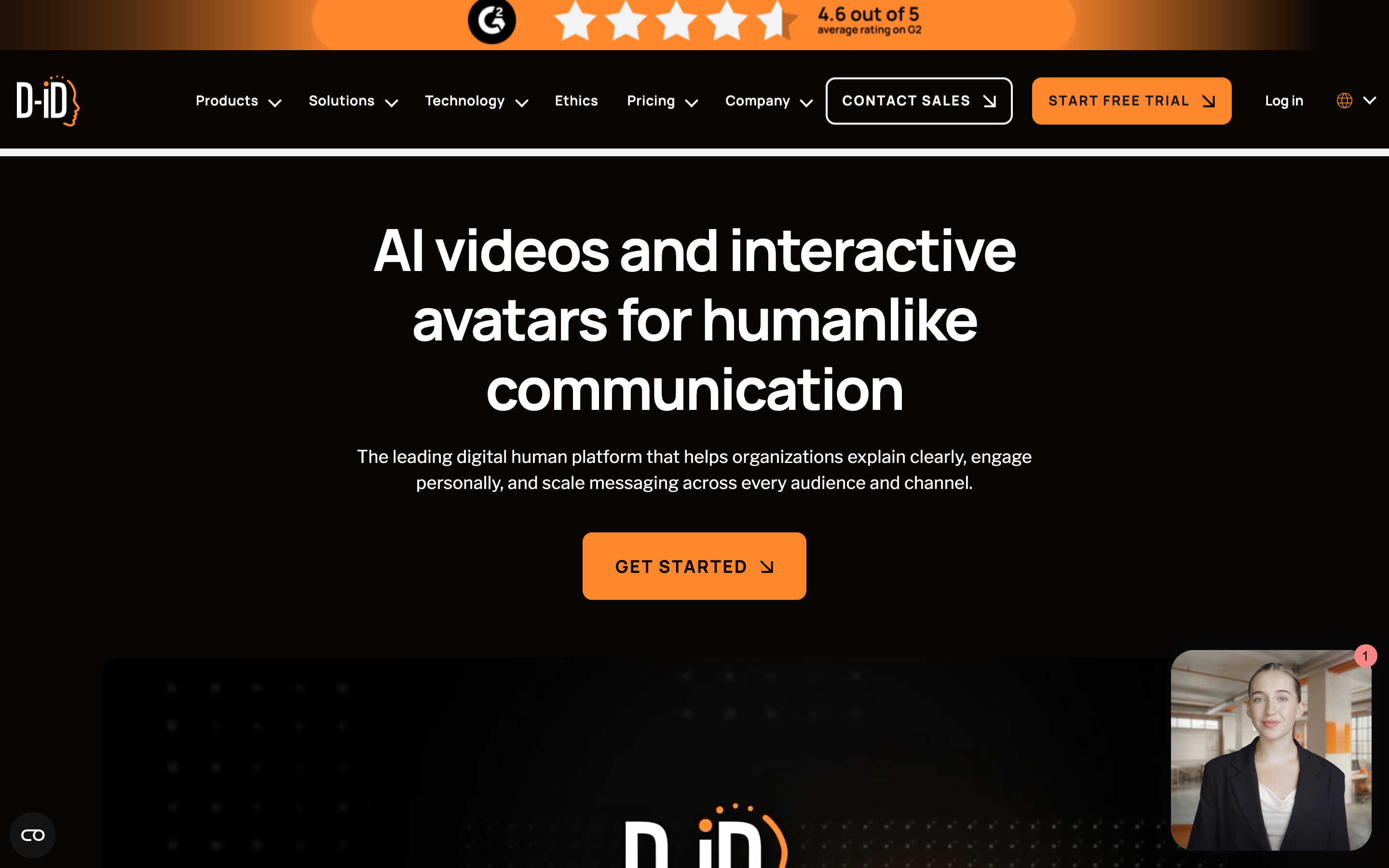
D-ID's strength is lip sync from a single image. Its high-fidelity stock avatars are trained on professional actors, and reviewers in 2026 consistently call out the lip-sync accuracy and natural delivery, now offered at up to 4K through its V4 release. The common criticism is range: D-ID ships a fairly small set of standard avatars, customization of gestures and body language is limited, and quality can vary from one avatar to the next.
Vidnoz takes the opposite bet on volume. It advertises a very large avatar library and has pushed "Expressive Avatars" with emotions, gestures, and body language, plus talking-photo creation from a single image. Users praise the lip sync and multilingual coverage, but reviews are mixed on output consistency: avatar movement and voice realism can vary, and some testers want a broader, more diverse avatar selection.
Winner: D-ID for top-end lip-sync fidelity and 4K output, Vidnoz for avatar variety and expressive range on a budget. Pick based on whether you need one flawless presenter or many quick options.
Worth noting for both: a more realistic avatar is still a person reading a script in front of a flat background. If the finished video also needs product screenshots, screen recordings, callouts, B-roll, and motion graphics, neither tool assembles all of that for you. That gap is where ngram comes in, and we cover it below.
Interactivity and use case fit
This is the clearest fork between the two, and it is mostly about what you are building.
D-ID has repositioned around real-time "Visual AI Agents." These are embeddable avatars that connect to an LLM and your knowledge base, answer questions, carry out tasks, and run with low-latency conversational turns, which the company now frames as its flagship product. For customer service, lead qualification, or an interactive kiosk or website agent, D-ID is built for that, and it backs it with API access and enterprise security options.
Vidnoz stays in the recorded-video lane. It is built to produce a finished spokesperson clip you publish or share: marketing explainers, social content, training intros, and sales outreach videos. It does not pitch a real-time conversational agent, so if your need is an interactive avatar that talks back, Vidnoz is not the tool.
Winner: D-ID for real-time interactive agents, Vidnoz for fast one-off recorded videos. These are almost different product categories that happen to share avatar tech.
ngram lives in the recorded-video world like Vidnoz, but it is honest about the boundary: ngram does not offer a D-ID-style embeddable real-time conversational avatar. If interactive agents are your goal, stay with D-ID. If your job is producing finished business videos, read on.
Languages and localization
Localization is a real reason teams buy either tool, and both are strong here.
D-ID supports lip-synced speech across 120-plus languages, so a single avatar can deliver a script in many regional cuts with accurate mouth movement. Combined with its API, that makes D-ID a fit for teams scaling personalized or localized avatar video programmatically.
Vidnoz advertises AI video translation with lip sync across 140-plus languages, alongside voice cloning and text-to-speech. For a creator repurposing one video into many languages without filming again, Vidnoz's translation workflow is a genuine strength and it sits on a cheaper base plan.
Winner: roughly even, with a slight edge to Vidnoz on raw language count and translation, and to D-ID on programmatic, API-driven localization.
ngram handles localization differently. It translates the script, captions, and on-screen text, generates multilingual voiceover, and re-lip-syncs the avatar or talking head to match the new language. The language list is broad rather than a fixed published number, so if you need a guaranteed count for a procurement checklist, confirm current coverage first.
Pricing and value
Pricing is where the two tools feel most different, because they meter usage and free access in different ways. D-ID gates serious use behind a paid plan. Vidnoz gives away a lot up front.
D-ID offers a no-card trial with a few minutes of video, then a Lite plan around $5.90 a month that still stamps a watermark on exports. The plan most individuals and small teams actually need is Pro at $29 a month, which unlocks commercial licensing, premium voices, one voice clone, and subtitles. Advanced runs about $196 a month for more minutes and agents, and Enterprise is custom. D-ID meters by video minutes, which is predictable but can feel tight on lower tiers.
Vidnoz leads with a free plan: roughly 3 minutes of video a day at 720p with a watermark, plus daily credits and a large avatar library. Starter is $14.99 a month for about 15 minutes of monthly video with no watermark, and Business is $37.49 a month for around 30 minutes. The catch shows up in reviews: the free daily credits run out fast, and some users report billing and support frustration, so treat the free tier as a real trial rather than a long-term plan.
Here is how the entry-level paid plans compare on monthly and annual billing:
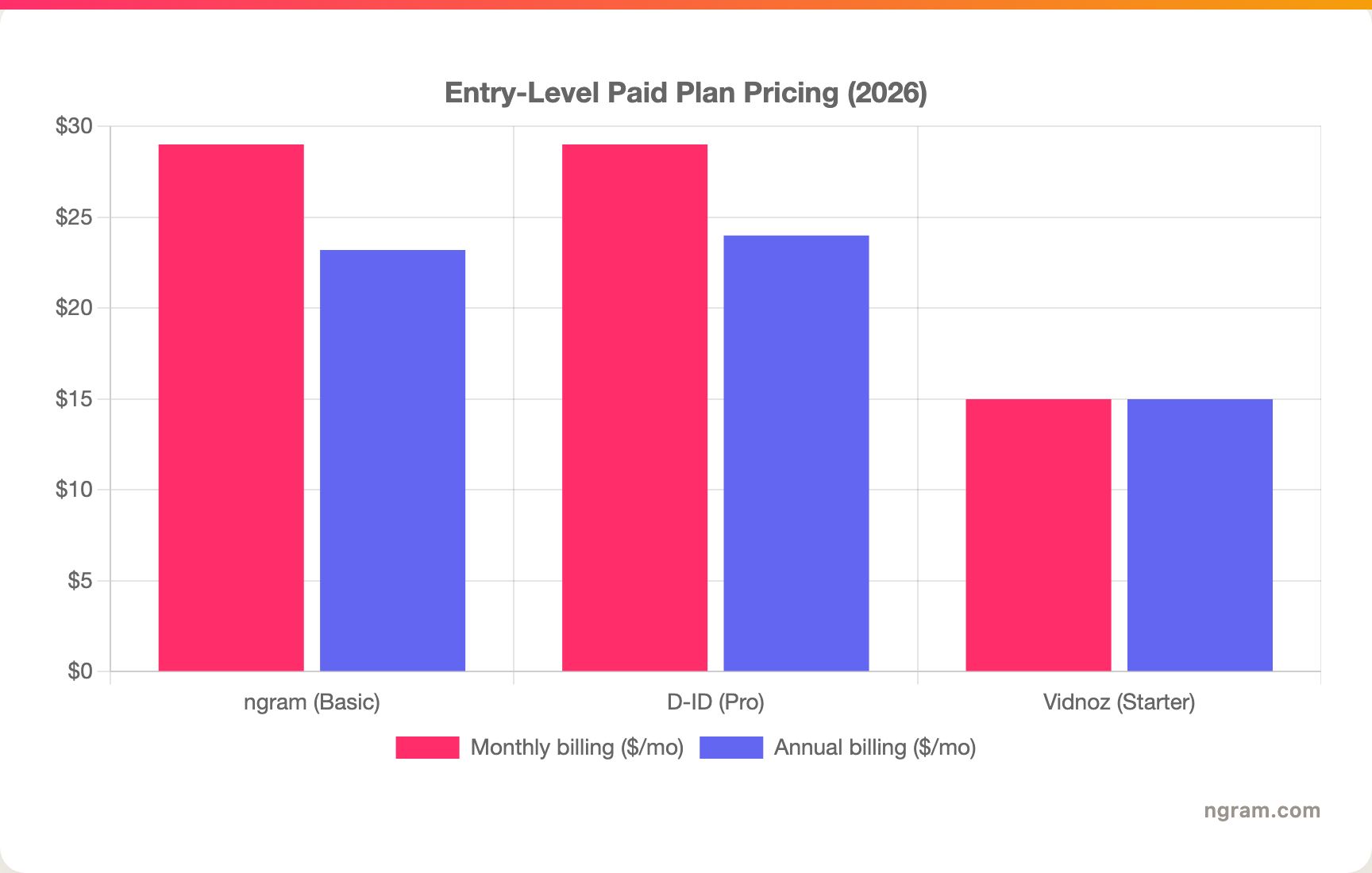
Read the fine print behind those bars. D-ID's $29 Pro is the first plan without a watermark for commercial use, Vidnoz's $14.99 Starter caps you near 15 minutes a month, and ngram's Basic plan includes 3,000 credits a month on a credit model shared across video, editing, and exports. Vidnoz publishes lower annual rates than the monthly figure shown here, so its annual column uses the monthly price as a conservative stand-in. Match the unit to your actual volume before you decide.
Winner: Vidnoz for the lowest paid entry price and the most generous free tier, D-ID for predictable commercial-grade minutes, ngram for the most generous monthly volume on an entry plan.
1. ngram, the better third option for most teams
Watch how ngram turns an idea into a finished video:
ngram does the same core job as D-ID and Vidnoz, generating a video with a presenter and voiceover from a script, and then keeps going where they stop. Instead of starting from a blank script box, you give ngram a prompt, a PDF, a URL, a deck, screenshots, a screen recording, or raw footage, and its agentic chat plans the script, storyboard, scenes, captions, and call to action for you to review before anything renders.
That plan-first workflow is the difference. For the marketing, sales, training, and product teams who make up most "D-ID vs Vidnoz" searches, the real job is rarely "a talking head reading a script." It is a launch video, a product demo, an onboarding walkthrough, or a localized clip that needs screen recordings, callouts, B-roll, branded intros, and MP4 export with separate channel-cut preparation, all on brand.
What makes ngram different
- Source-aware inputs - Start from a prompt, PDF, URL, screenshot, screen recording, raw video, deck, or Shopify product, not just a typed script.
- Plan before render - Review the script and storyboard in chat, fix direction early, then generate. No re-recording a long take.
- Avatars plus everything else - Use the avatar library, a custom face, a talking head with lip sync, or a generated on-brand presenter, then add screen-recording polish, smart zooms, callouts, motion graphics, and B-roll in the same video.
- Brand kits - Logos, colors, fonts, approved and blocked phrases applied automatically to every video.
- Localization built in - Translate script, captions, and on-screen text, generate multilingual voiceover, and re-lip-sync avatars for each language.
- MP4 export - Finished videos export as MP4; separate media tools can derive GIF, WebM, PNG, or JPG from supplied media.
Where ngram is honest about its limits
ngram provides hosted video pages and embeds but has no generally available owner analytics surface, so analytics-heavy buyers should confirm needs first. Its public security certifications are not published yet, so a compliance-bound enterprise program with a strict SOC 2 or ISO requirement may still prefer a vendor that publishes those today. And ngram does not offer a real-time conversational Visual AI Agent, so if you need an embeddable avatar that talks back live, D-ID is the better fit.
Who ngram is best for
ngram fits product marketing, growth, sales, customer success, support, and training teams that turn business material into polished video repeatedly. For current plans and credits, check ngram pricing rather than stale screenshots, and for the direct head-to-heads see the ngram vs D-ID comparison and the ngram vs Vidnoz comparison.
Ready to try ngram? Create your first video from a prompt, doc, URL, deck, screenshot, or recording. Start free
2. D-ID
D-ID is best for enterprises and developers who want avatar video plus real-time conversational AI agents. Public details were checked against D-ID's pricing and product pages for this 2026 comparison.
Key features
- High-fidelity avatars - Stock avatars trained on professional actors with strong lip sync, now up to 4K via V4.
- Visual AI Agents - Embeddable real-time conversational avatars connected to an LLM and your knowledge base.
- Inputs - Generate talking-head video from scripts, images, or documents.
- 120-plus languages - Lip-synced multilingual speech for localized avatar video.
- API and Studio - Self-serve Studio plus an API for programmatic and personalized video at scale.
What users say
Reviewers praise D-ID for fast setup, accurate lip sync, and a helpful support team, and it carries strong ratings on the major review sites. The common cautions are a limited set of standard avatars, restricted control over gestures and body language, short maximum video length, and some latency in real-time agent mode that can break the illusion in pure conversation.
Best for
Choose D-ID when you need interactive avatar agents or API-driven, programmatic avatar video, especially in customer service, sales qualification, and enterprise L&D.
3. Vidnoz
Vidnoz is best for creators and small teams who want fast, low-cost spokesperson videos. Public details were checked against Vidnoz's pricing and product pages for this 2026 comparison.
Key features
- Large avatar library - A big set of AI avatars plus talking-photo creation from a single image.
- Expressive Avatars - Avatars with emotions, gestures, and body language for more lively delivery.
- Voice cloning and TTS - AI voice cloning and text-to-speech across many voices.
- Video translation - Lip-synced AI translation across 140-plus languages.
- Generous free tier - Daily free credits and a few minutes of video a day, no card required to start.
What users say
Users like Vidnoz for the price, the free daily credits, and solid lip sync with broad language support. The recurring complaints are inconsistent output quality across avatars and voices, a free tier that runs out quickly, and billing or support friction reported on consumer review sites, so approach paid upgrades with eyes open.
Best for
Choose Vidnoz when budget matters most and you want to produce quick spokesperson videos without filming, especially for social, marketing, and education.
How we compared these tools
This is not a star rating. It is a decision-weighting model for buyers choosing between two AI avatar tools, with ngram included as the third option many of them actually need.
| Criteria | Weight | What we looked at |
|---|---|---|
| AI capabilities | 30% | Avatar realism, lip sync, voice, translation, and agent depth |
| Features | 30% | Workflow breadth, source support, editing, and export options |
| Ease of use | 20% | Time to a first finished video and learning curve |
| Value | 15% | Public pricing, credit and minute rules, watermarks, and free tier |
| Support and community | 5% | Collaboration, API support, and review reputation |
We reviewed official vendor pricing and product pages, current SERP patterns, and 2026 review-site and Reddit sentiment, and we did not use numerical star ratings because they flatten the real decision: the best tool depends on whether you need interactive agents, cheap spokesperson video, or a full source-to-video workflow.
Common questions
Is D-ID better than Vidnoz?
Neither is better outright. D-ID wins for real-time interactive avatar agents, API-driven video, and top-end lip-sync fidelity, while Vidnoz wins for price, a generous free tier, and avatar variety. Match the tool to the job, and consider ngram if your real need is a finished video built from source material rather than a script-read talking head.
Is Vidnoz cheaper than D-ID?
Yes. Vidnoz's first paid plan is $14.99 a month and it has a usable free daily tier, while D-ID's first watermark-free, commercial plan is $29 a month. That said, Vidnoz Starter caps you near 15 minutes of video a month, so the cheaper headline does not always mean better value once your volume climbs.
What is the best D-ID and Vidnoz alternative?
For teams that need more than a talking head, ngram is the strongest alternative because it plans and builds full videos from prompts, docs, URLs, decks, screenshots, and recordings, then adds avatars, screen-recording polish, captions, and branding. D-ID and Vidnoz remain the specialist picks for interactive avatar agents and cheap spokesperson clips.
Which is better for interactive avatars, D-ID or Vidnoz?
D-ID is the clear pick for interactive avatars because its Visual AI Agents are embeddable, connect to an LLM and your knowledge base, and respond in real time. Vidnoz is built for recorded videos, not live conversation, and ngram also focuses on finished recorded video rather than real-time agents.
Which one should you pick?
The D-ID vs Vidnoz decision is really about the job, not the avatars. If you need an interactive avatar agent that talks back, API access, and enterprise-grade lip sync, pick D-ID. If you want fast, low-cost spokesperson videos and a free tier to start on, pick Vidnoz. If your actual job is turning real business material into finished, branded videos, where the presenter is one scene among screen recordings, callouts, and B-roll, ngram beats both. The mistake is treating every AI avatar tool as interchangeable. In 2026, workflow fit matters more than the category label.
---
Try ngram free, your first video in under 5 minutes. Turn a prompt, doc, URL, deck, or screen recording into a polished, on-brand video without rebuilding it from a blank script. Start free