

Search for "Canva Video vs InVideo" and you land on two AI-forward video makers that promise the same outcome from opposite starting points: a finished video without a pro editor. Canva Video is the video module inside Canva's all-in-one design suite, a free browser-based multi-layer editor that now leans hard on AI helpers like Magic Video, an AI video generator, and one-click captions.
InVideo has rebuilt itself around Agent One, its v4 AI agent, which takes a script, prompt, or idea and orchestrates 200+ third-party models to generate finished video, up to 30 minutes from a single prompt. This guide compares Canva Video vs InVideo across the things that decide the purchase: output and workflow, AI depth, stock and assets, pricing, and ease of use.
It also shows where a third option, ngram, beats both when your real job is a finished, planned business video built from a doc, URL, deck, or recording.
Both tools are genuinely good at what they do. Canva Video rewards design polish and flexibility for people already living in Canva. InVideo rewards prompt-to-video speed for creators who want an AI agent to handle shot composition. The honest answer to "which is better" is "for which job," so we pick a winner per dimension instead of crowning one overall.
Canva Video vs InVideo at a glance
Here is the short version before the deep dive. ngram sits in the table because for many teams comparing these two, the better question is whether you need a design editor or a prompt-to-video agent at all, or a system that plans and builds the whole business video from your source.
| Tool | Best for | Starting price | Main distinction |
|---|---|---|---|
| ngram | Teams turning a doc, URL, deck, or recording into a finished, on-brand business video | Free, paid from $29/mo | Plans the whole video from your source, not just edits or prompts |
| Canva Video | Creators and SMB teams already in Canva who want a flexible design-led editor | Free, Canva Pro about $15 to $18/mo | Multi-layer timeline plus Magic Video AI inside a full design suite |
| InVideo | Creators and teams wanting an AI agent to generate finished video from a prompt or script | Free with watermark, Plus from $25/mo | Agent One prompt-to-video orchestrating 200+ AI models |
Output and workflow
This is the first real split between the two, and it shapes everything downstream.
Canva Video is built around a true multi-layer timeline. You bring clips, photos, templates, and stock, then stack video, text, audio, and graphics tracks, trim with frame-level control, and arrange elements with the same drag-and-drop precision Canva uses for design. Magic Video can take your clips plus a short prompt and draft a 60-second multi-scene edit, but the center of gravity is still you assembling and arranging an asset on a canvas.
InVideo works the other way. With Agent One you type a prompt or paste a script, and the agent plans shots, picks stock or generates footage, adds voiceover, and returns a finished cut you then refine through follow-up prompts and a timeline. It is prompt-first rather than canvas-first, and it is built to produce longer pieces, advertised at up to 30 minutes from a single prompt.
Winner: Canva Video for hands-on design control, InVideo for prompt-to-finished-cut speed. Pick based on whether you want to arrange a video yourself or describe it and refine.
Worth noting for both: you still steer the structure. Canva expects you to design the sequence, and InVideo expects you to prompt and re-prompt until the agent's cut matches your intent. Neither one reads a product doc, a landing page, a slide deck, or a screen recording and proposes the structured business video for you. That gap is where ngram fits, and we cover it below.
AI features
Both tools are AI-heavy now, but they apply it to different parts of the job.
Canva Video layers AI across editing tasks: Magic Video drafts an edit from clips plus a prompt, a built-in AI video generator fills footage gaps with generated clips, image-to-video adds motion to stills, captions are one click, and the AudiOMG audio suite handles voiceover, noise removal, and beat-matching. AI usage is metered through a monthly credit allowance shared across Canva's Magic tools, with an optional AI add-on for heavy months.
InVideo puts AI at the center. Agent One orchestrates 200+ third-party models, including Sora 2, Veo 3.1, and Kling, plus ElevenLabs voices, and adds project memory, real-time multiplayer collaboration, batch editing, and custom agent creation. The trade-off is the credit model: generative output is priced per model and per complexity, so a 4K clip from a premium model can consume far more credits than a stock-based cut, and heavier models drain an allowance faster.
Winner: InVideo for raw generative breadth and long-form AI cuts, Canva Video for AI editing helpers inside a design tool. Match the tool to whether you want generated footage or assisted editing.
A caveat for both: their AI accelerates production, but you still own the plan. ngram inverts that. Its agentic chat plans the script, storyboard, scenes, captions, and call to action from your source first, then you review the plan before anything renders.
Stock, templates, and assets
Finished videos live or die on the assets around your footage, and both tools invest here.
Canva Video draws on the entire Canva ecosystem: millions of design templates, stock footage including Artlist Video, photos, graphics, fonts, and brand assets shared with the rest of your Canva account. If your team already designs decks and social posts in Canva, the video editor inherits all of it.
InVideo bundles a large template library tuned for social, ads, and explainers, plus iStock stock media metered per plan, AI-generated footage when you need shots that do not exist, and an AI voice library. The iStock allowance is capped per tier, so heavy stock use can run out before the month does.
Winner: Canva Video for sheer breadth of design assets, InVideo for AI-generated footage plus metered iStock. More choice is not always better if you just want to ship.
Pricing and value
Pricing is where the two feel most different, because they package value in different ways. Canva bundles video into one Canva Pro subscription that also covers design. InVideo sells AI-minute and generative-credit tiers around how much you generate.
Canva Video is free to use as part of Canva, with premium templates, stock, and the heavier AI features gated behind Canva Pro. For one person in the US, Canva Pro runs in the range of about $15 to $18 per month billed monthly, or roughly $120 to $144 per year on annual billing, depending on the current promotion. The catch is the AI allowance: Pro includes a fixed pool of AI credits shared across Magic tools, and once you exceed it you may need the optional AI add-on.
InVideo offers a free plan that watermarks exports, then paid tiers built on AI minutes and credits. Plus is $25 per month billed monthly, or about $20 per month on annual billing, and includes 50 AI generation minutes a month plus 80 iStock downloads and 2 voice clones. Max is $60 per month billed monthly, or about $48 per month annual, with 200 AI minutes, more iStock, and 4K export. A higher Generative tier around $120 per month bundles premium models like Sora 2 and Veo 3.1.
Here is how the entry paid plans compare in US dollars, on both monthly and annual billing (Canva Pro shown at its current $18 monthly and $12 annual point):
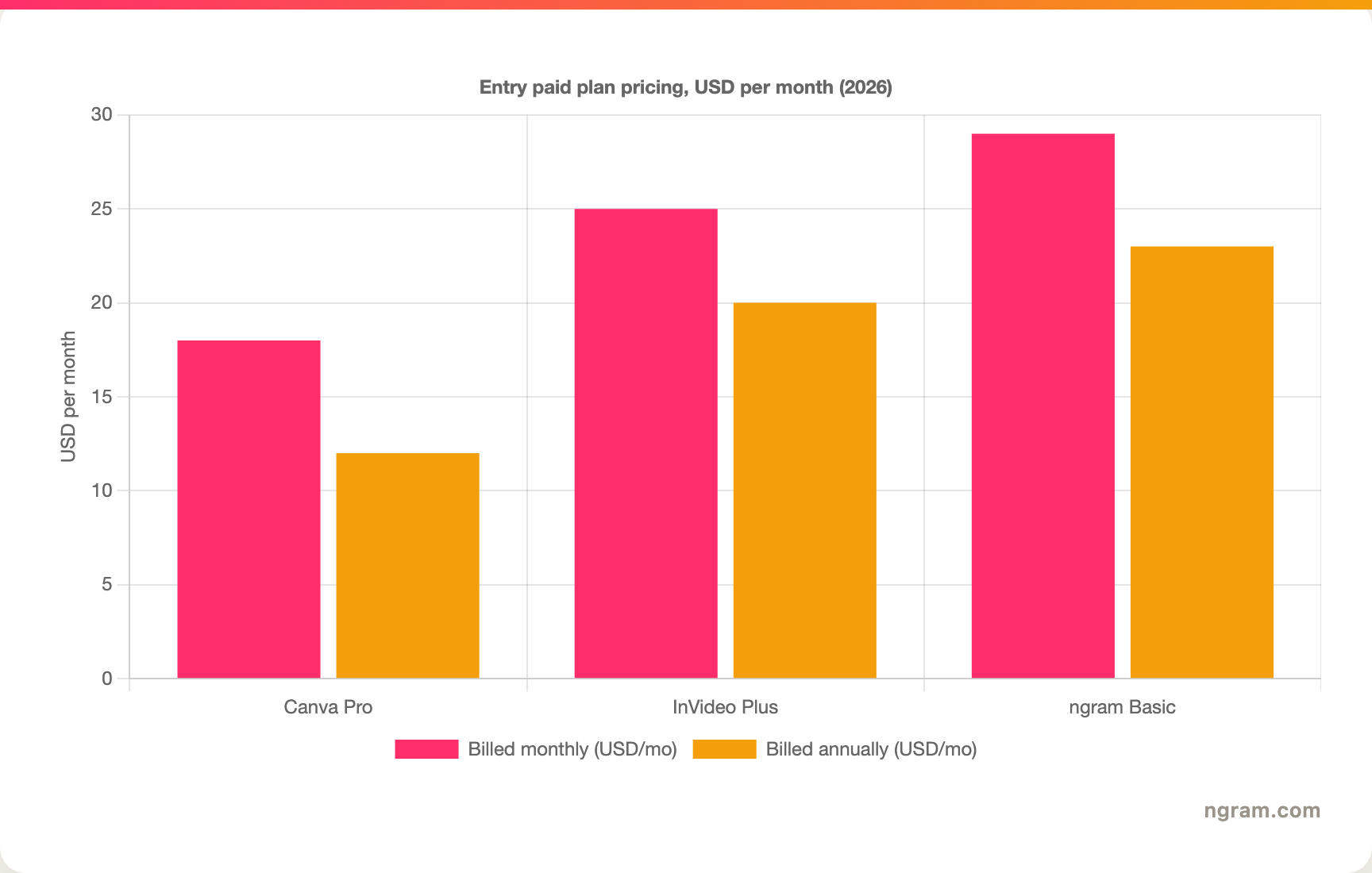
The headline numbers look close at the entry tier, but read the fine print. Canva Pro is the cheaper monthly subscription and bundles design plus video, but meters AI separately through a credit pool. InVideo's Plus is more expensive but built around AI generation minutes, and its credit cost scales with the models you pick, so a Sora 2 or Veo 3.1 cut burns through an allowance fast.
ngram's Basic plan is $29 per month billed monthly, or about $23 per month on annual billing, and includes 3,000 credits a month on a single credit model shared across video generation and editing, with unlimited exports. Match the unit to your actual volume before you decide.
Winner: Canva Video for the lowest bundled entry price, InVideo for the most generative AI capacity per dollar, ngram for the most source-to-finished business video per credit.
Ease of use and time to first video
Both tools are approachable, but they ask different things of you.
Canva Video is gentle to start because most people already know Canva, and the drag-and-drop canvas feels familiar. The trade-off is that a polished multi-scene video still means arranging layers, choosing templates, and editing by hand, which takes longer than a one-line prompt once your video grows beyond a quick clip.
InVideo is faster to a first rough cut because the agent does the assembly: type a prompt, get a draft, then refine. The trade-off is the refine loop. Prompt-to-video rarely nails it on the first pass, so you spend time re-prompting, swapping clips, and fixing voiceover until the agent's interpretation matches yours, and credits tick down while you iterate.
Winner: InVideo for the fastest first draft, Canva Video for predictable hands-on control without a credit meter running.
The shared limitation is the same for both: you are the one deciding what the video should say and how it should flow. Teams whose source is a release doc, a landing page, a slide deck, or a screen recording still have to turn that into a structured video by hand or by prompt before either tool helps. That is the clearest reason buyers comparing Canva Video vs InVideo end up looking at a third option.
1. ngram, the better third option for its slice
Watch how ngram turns an idea into a finished video:
ngram does the same end job as Canva Video and InVideo, producing a polished social or business video, and then changes how you get there. Instead of arranging layers on a canvas or re-prompting an agent, you give ngram a prompt, a PDF, a URL, a deck, a screenshot, a screen recording, or raw footage, and its agentic chat plans the script, storyboard, scenes, captions, and call to action for you to review before anything renders.
That plan-first workflow is the difference. For the marketing, sales, product, and support teams who make up a large share of "Canva Video vs InVideo" searches, the real job is rarely "arrange these clips" or "prompt until it looks right." It is a launch video, a product demo, an onboarding walkthrough, or a social cut built from material you already have, with screen-recording polish, callouts, captions, and branding handled for you.
What makes ngram different
- Source-aware inputs - Start from a prompt, PDF, URL, screenshot, screen recording, raw video, deck, or Shopify product, not a blank canvas or a single prompt box.
- Plan before render - Review the script and storyboard in chat, fix direction early, then generate, instead of re-cutting a timeline or re-prompting an agent.
- Screen-recording polish - Add smart zooms, click emphasis, dead-air trim, step labels, product callouts, and motion graphics in the same video.
- Brand kits - Logos, colors, fonts, and approved or blocked phrases applied automatically to every video.
- Voice and localization - AI voiceover, translated script, captions, and on-screen text, plus multilingual voiceover and re-lip-sync for talking heads.
- MP4 export - Finished videos export as MP4; separate media tools can derive GIF, WebM, PNG, or JPG from supplied media.
Where ngram is honest about its limits
ngram provides hosted video pages and embeds but has no generally available owner analytics surface, so analytics-heavy buyers should confirm needs first. Its public security certifications are not published yet, so a compliance-bound program with a strict SOC 2 or ISO requirement should verify current posture. Its Public API v1 uses self-service bearer API keys with webhook subscriptions for `video.completed` and `video.failed`; Zapier and n8n are available, while Make.com is Coming Soon.
And if your job really is hand-designing a social graphic into a clip, Canva Video keeps everything in one design suite, while if you want an agent to spin up long-form generated footage from one prompt, InVideo's model breadth goes further.
Who ngram is best for
ngram fits product marketing, growth, sales, customer success, support, and training teams that turn business material into polished video repeatedly. For current plans and credits, check ngram pricing rather than stale screenshots, and for the direct head-to-heads see the ngram vs Canva Video comparison and the ngram vs InVideo comparison. If your starting point is usually a prompt or a doc, the ngram text-to-video page covers that workflow in depth.
Ready to try ngram? Create your first video from a prompt, doc, URL, deck, screenshot, or recording. Start free
2. Canva Video
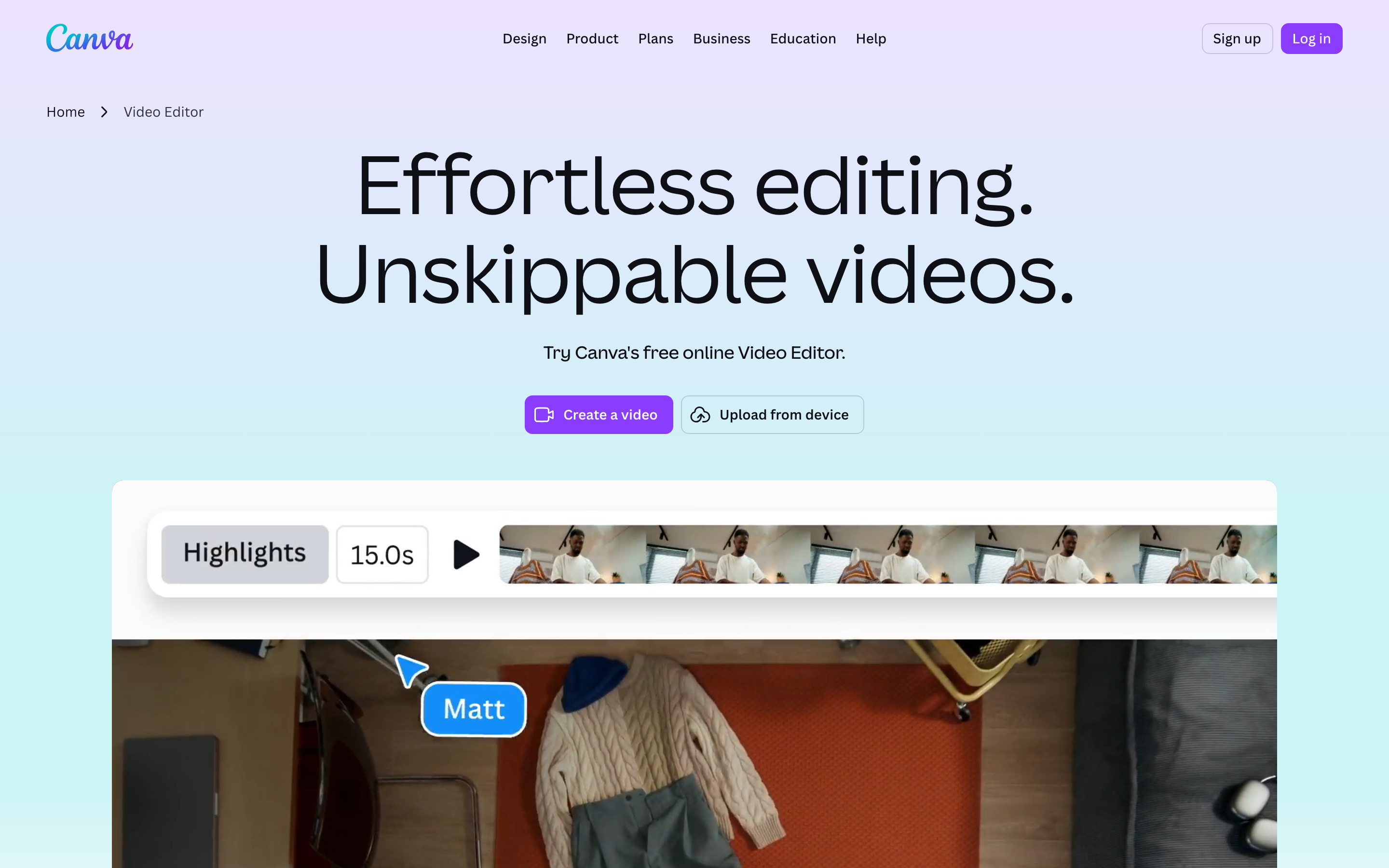
Canva Video is best for creators and SMB teams who want a flexible, design-led editor inside the wider Canva suite. Public details were checked against Canva's video editor and pricing pages for this 2026 comparison.
Key features
- Multi-layer timeline - Stack video, text, audio, and graphics with frame-level trimming and motion effects.
- Magic Video and AI generator - Drafts a 60-second multi-scene edit from clips plus a prompt, and fills footage gaps with AI-generated clips.
- One-click captions and audio suite - Auto captions, voiceover recording, noise removal, and beat-matching through AudiOMG.
- Full Canva asset library - Millions of templates, stock footage including Artlist Video, photos, fonts, and brand assets.
- Tiered AI allowance - AI usage metered by a monthly credit pool, with an optional AI add-on for heavy use.
What users say
Buyers shortlist Canva Video when they already use Canva for design and want video in the same place, and they like the breadth of templates and AI helpers. The common caution is that the AI credit pool can run out mid-project, and the sheer number of options can slow down someone who just wants a quick, simple clip.
Best for
Choose Canva Video when you want design-grade flexibility, deep AI editing, and a shared asset library inside one subscription.
3. InVideo
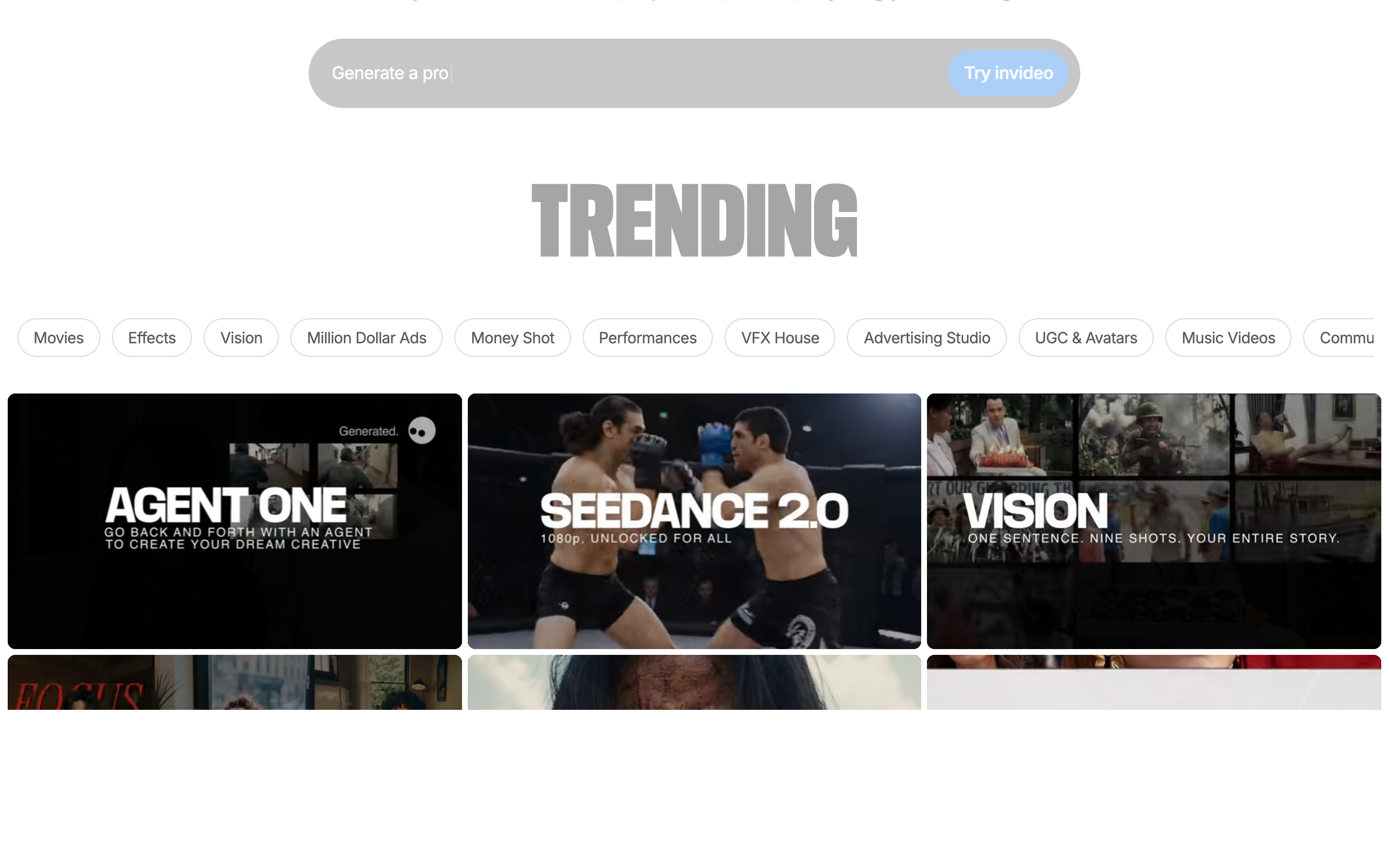
InVideo is best for creators and teams who want an AI agent to turn a prompt or script into finished video, including longer pieces. Public details were checked against InVideo's pricing and help pages for this 2026 comparison. Note that InVideo has rebuilt around Agent One, its v4 agent, so older "InVideo Studio" template walkthroughs describe a different product.
Key features
- Agent One prompt-to-video - Type a prompt or paste a script and the agent plans shots, footage, and voiceover into a finished cut, advertised up to 30 minutes from one prompt.
- 200+ model orchestration - Routes across third-party models including Sora 2, Veo 3.1, and Kling, plus ElevenLabs voices.
- Project memory and collaboration - Long-term project memory, real-time multiplayer editing, batch editing, and custom agent creation.
- Stock and voice cloning - iStock footage metered per plan and a set number of voice clones by tier.
- Credit-based generation - AI minutes and generative credits priced per model and complexity, with no rollover.
What users say
Buyers like how fast InVideo gets to a first draft and the breadth of models behind Agent One. The recurring caution is the credit math: heavier models and 4K output drain allowances quickly, and the prompt-to-video loop can take several passes before the cut matches intent, which costs both time and credits.
Best for
Choose InVideo when you want an AI agent to generate finished video, especially longer pieces, from a prompt or script with minimal hands-on editing.
How we compared these tools
This is not a star rating. It is a decision-weighting model for buyers choosing between an AI-forward design editor and a prompt-to-video agent, with ngram included as the third option many of them actually need.
| Criteria | Weight | What we looked at |
|---|---|---|
| AI capabilities | 30% | Generation, agent orchestration, captions, voiceover, and planning depth |
| Features | 30% | Editing control, source support, stock and assets, and export options |
| Ease of use | 20% | Time to a first finished video and learning curve |
| Value | 15% | Public pricing, AI credit allowances, watermarks, and what each tier unlocks |
| Support and community | 5% | Collaboration, sharing, and team controls |
We reviewed official vendor pricing and product pages, current SERP patterns, and 2026 review-site and Reddit sentiment, and we did not use numerical star ratings because they flatten the real decision: the best tool depends on whether you want design-led editing, prompt-to-video generation, or a full source-to-video workflow.
Common questions
Is Canva Video better than InVideo?
Neither is better outright. Canva Video wins for hands-on design control and a huge shared asset library inside one subscription, while InVideo wins for prompt-to-video speed, long-form AI cuts, and model breadth through Agent One. Match the tool to the job, and consider ngram if your real need is a finished video planned from a doc, URL, deck, or recording rather than clips you arrange or prompts you refine yourself.
Is Canva Video cheaper than InVideo?
Canva Video has the lower entry subscription because video is bundled into Canva Pro, which runs about $15 to $18 per month for one person, and a free tier covers basic editing. InVideo's Plus starts at $25 per month and is built around AI generation minutes. But both meter AI through credits, so heavy generation can narrow or flip the gap: Canva's add-on for extra AI use, and InVideo's per-model credit cost on premium models like Sora 2.
What is the best Canva Video and InVideo alternative?
For teams that have outgrown design editing and prompt-and-pray generation, ngram is the strongest alternative because it plans and builds full videos from prompts, docs, URLs, decks, screenshots, and recordings, then adds screen-recording polish, captions, and branding. Canva Video and InVideo remain the better picks for design-led editing and long-form AI generation respectively.
Which is easier for a complete beginner, Canva Video or InVideo?
InVideo gets a beginner to a first rough cut faster because the agent does the assembly from a prompt. Canva Video is still approachable, especially if you already use Canva, but a polished result means arranging layers yourself. The difference is where the effort lands: InVideo front-loads a prompt then asks you to refine, Canva asks you to design from the start.
Which one should you pick?
The Canva Video vs InVideo decision is really about your workflow, not the AI badges. If you want a flexible, design-led editor with deep AI helpers and a shared asset library, especially if your team already lives in Canva, pick Canva Video. If you want an AI agent to generate finished video, including longer pieces, from a prompt or script with minimal hands-on editing, pick InVideo.
If your actual job is turning a doc, URL, deck, or screen recording into a finished, on-brand business video, where the structure should be planned for you instead of arranged or re-prompted by hand, ngram beats both for that slice. The mistake is treating every AI video tool as interchangeable. In 2026, workflow fit matters more than the category label.
Try ngram free, your first video in under 5 minutes. Turn a prompt, doc, URL, deck, or screen recording into a polished, on-brand video without arranging it clip by clip or prompting it line by line. Start free