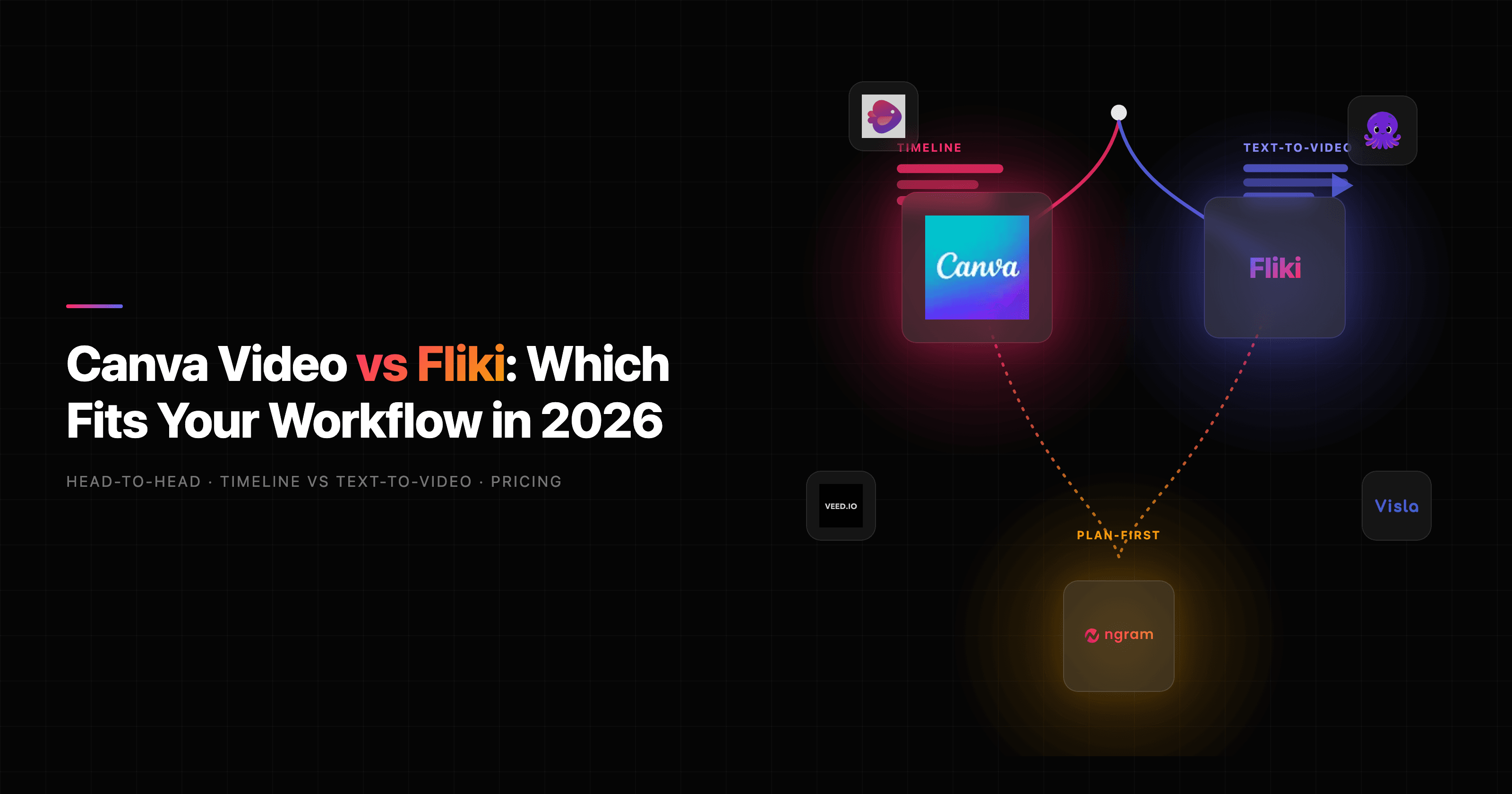


Search for "Canva Video vs Fliki" and you find two popular ways to make a video without a real editor, pulling in opposite directions. Canva Video is the video module inside Canva's all-in-one design suite: a free, browser-based drag-and-drop editor with a multi-layer timeline, a giant template and stock library, and AI helpers like Magic Video and one-click captions.
Fliki is a text-to-video and text-to-speech engine that turns a script, a blog URL, or a slide deck into a finished, AI-voiced video with stock visuals and subtitles, no timeline required. One asks you to arrange a video; the other asks you to write one. This guide compares Canva Video vs Fliki across the things that actually decide the purchase: editing model, AI and voices, stock and assets, pricing, and ease of use.
It also shows where a third option, ngram, beats both when your real job is a finished, planned business video built from a doc, URL, deck, or recording.
Both tools are genuinely good at what they do. Canva Video rewards people who like to lay out a clip visually and already live in Canva for design. Fliki rewards people who would rather paste text and let AI narrate and assemble the whole thing. The honest answer to "which is better" is "for which job," so we pick a winner per dimension instead of crowning one overall.
Canva Video vs Fliki at a glance
Here is the short version before the deep dive. ngram sits in the table because for many teams comparing these two, the better question is whether you need a clip assembler or a text narrator at all, or a system that plans and builds the whole video from your own source.
| Tool | Best for | Starting price | Main distinction |
|---|---|---|---|
| ngram | Teams turning a doc, URL, deck, or recording into a finished, on-brand business video | Free, paid from $29/mo | Plans the whole video from your source, then you review before it renders |
| Canva Video | Creators and SMB teams already in Canva who want a flexible design-led editor | Free, Canva Pro from $15/mo ($120/yr) | Multi-layer timeline plus Magic Video AI inside a full design suite |
| Fliki | Faceless creators and marketers turning scripts and blog posts into AI-voiced videos | Free tier, paid from about $28/mo billed annually | Text-to-video with a very large multilingual AI voice library |
Editing model and how you build a video
This is the first real split between the two, and it shapes everything downstream.
Canva Video gives you a true multi-layer timeline. You stack video, text, audio, and graphics tracks, trim with frame-level control, add motion effects, and arrange elements with the same drag-and-drop feel Canva uses for design. You start from a template or a blank canvas and build the clip scene by scene. That control means you decide the layout, which is great when a video needs more than a templated sequence, and slower when you just want something narrated and done.
Fliki flips the model. You write or paste a script, an idea, or a blog URL, pick a voice, and Fliki breaks the text into scenes, matches stock visuals to each line, adds AI voiceover, and burns in subtitles. There is no timeline to learn, because the text is the timeline. You edit by rewriting lines and swapping the stock clip on a scene, not by dragging layers. For text-first creators that is faster, but you trade away the precise layout control Canva gives you.
Winner: Canva Video for layout control and visual precision, Fliki for the fastest path from a block of text to a narrated clip. Pick based on whether your raw material is footage you want to arrange or words you want narrated.
Worth noting for both: you still arrive with the script or the clips and assemble the video around them. Neither tool reads a product doc, a landing page, or a screen recording and proposes the structured video for you, scene by scene. That gap is where ngram fits, and we cover it below.
AI features and voices
Both tools lean on AI, but they aim it at different parts of the job.
Canva Video aims AI at editing. Magic Video takes your clips plus a short prompt and drafts an edit, a built-in AI video generator fills footage gaps with generated clips, captions are one click, and the audio suite handles voiceover recording, noise removal, and beat-matching. AI usage is metered through a tiered allowance, so heavy AI months can push you toward the optional AI add-on. The strength is breadth across a real editor; the catch is the allowance.
Fliki aims AI at narration and assembly. Its core is text-to-speech with a very large voice library, marketed at 2,000+ voices across 80+ languages, plus voice cloning, AI dubbing, and one-click blog-to-video. If your videos live or die on natural-sounding narration and language coverage, Fliki's voice catalog is one of the largest in the category. The AI does more of the structural work than Canva's, but it is also less flexible once you want to depart from the text-to-scene pattern.
Winner: Canva Video for AI editing breadth inside a flexible editor, Fliki for AI voice variety and language coverage. They optimize for different halves of the same job.
A caveat for both: their AI speeds up the parts you point it at, but you still own the structure. ngram inverts that. Its agentic chat plans the script, storyboard, scenes, captions, and call to action from your source first, then you review the plan before anything renders, and it generates AI voiceover from that script with multilingual variants when you need them.
Stock, templates, and assets
Finished videos live or die on the assets around your footage, and both tools invest here.
Canva Video draws on the entire Canva ecosystem: more than a million design templates, a large stock library of photos, video, and music including Artlist Video, fonts, graphics, and brand assets shared with the rest of your Canva account. If your team already designs decks and social posts in Canva, the video editor inherits all of it.
Fliki leans on a large stock catalog of its own, marketed at over 10 million stock photos, video clips, and music tracks, matched automatically to each line of your script. For someone with no footage who needs a watchable clip from a blog post or an idea, having that stock auto-matched to the narration is the whole point.
Winner: Canva Video for design templates and a shared creative library, Fliki for stock auto-matched to a script. More choice helps if you are designing, while auto-match helps if you are narrating.
Pricing and value
Pricing is where the two feel most different, because they package value in different ways. Canva bundles video into one subscription that also covers design. Fliki sells tiers around minutes or credits of generated video, voice quality, and export length.
Canva Video is free to use as part of Canva, with premium templates, stock, and the heavier AI features gated behind Canva Pro. In the US, Canva Pro for one person is $15 per month billed monthly, or $120 per year, which works out to about $10 per month on annual billing. The catch is the AI allowance: once you exceed your tiered AI usage, you may need the optional AI add-on. Canva Business sits above Pro at $20 per user per month for teams.
Fliki offers a free tier with a small monthly allowance and a watermark, then paid tiers that scale the minutes of video you can generate, unlock the higher-quality voices, and raise export length. Pricing varies by source and shifts between billing terms, so treat exact figures as approximate, but its entry paid plan commonly lands near $28 per month billed annually. The value question is volume: pay for the minutes and voice quality you actually use.
Here is how the entry paid plans compare in US dollars per month, on annual billing where each tool offers it:
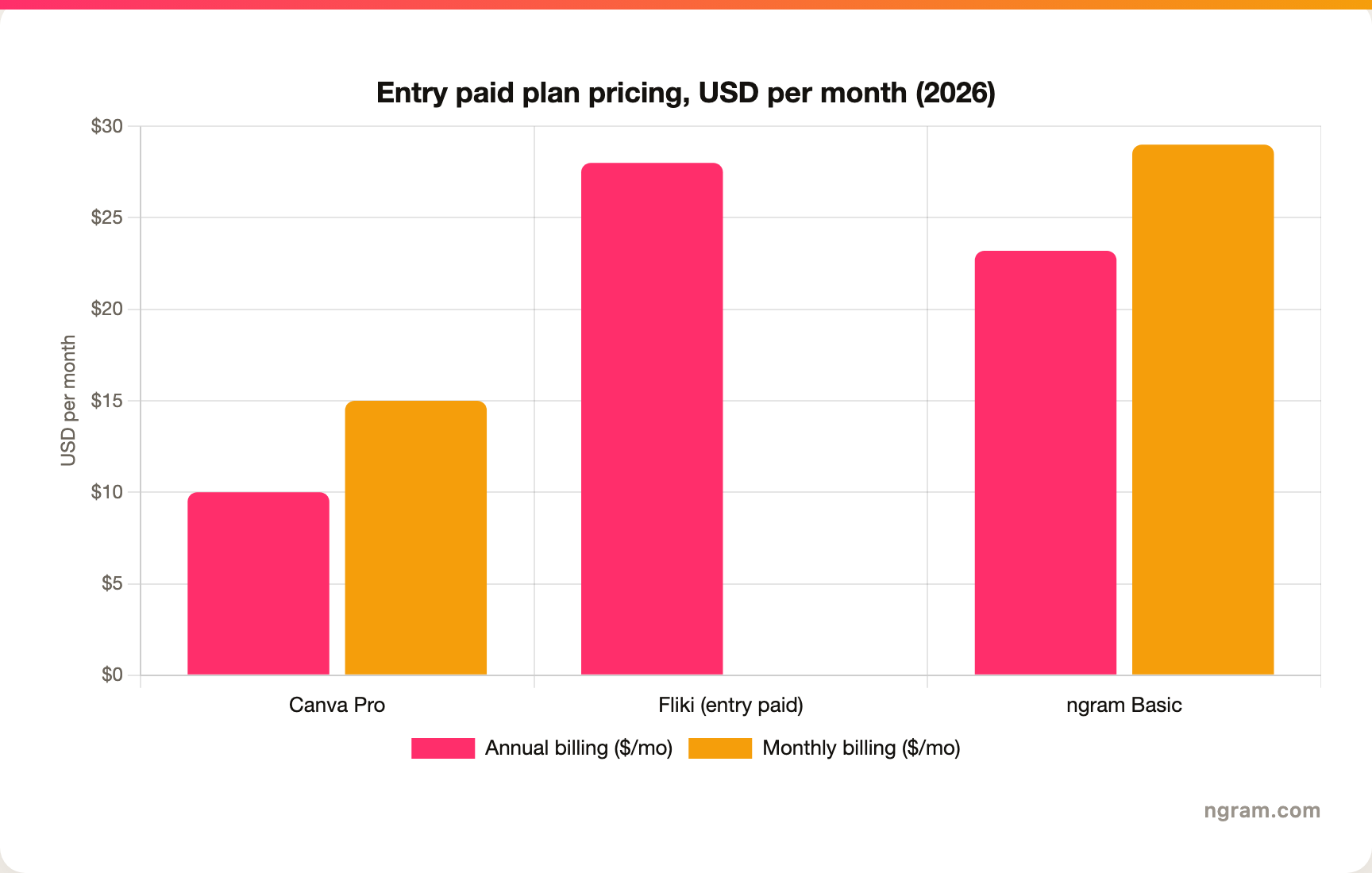
The headline numbers look spread out, but read the fine print. Canva Pro is the cheapest entry at about $10 per month on annual billing, or $15 billed monthly, but it bundles design and meters AI usage separately. Fliki's entry paid plan near $28 per month on annual billing buys you generated-video minutes and the better voices, so the right tier depends on your volume.
ngram's Basic plan is $29 per month billed monthly, or $23.20 per month billed annually, and includes 3,000 credits a month on a credit model shared across video generation and editing, with unlimited exports. Match the unit to your actual volume before you decide.
Winner: Canva Video for the lowest entry price and design plus video in one subscription, Fliki for predictable text-to-video volume.
Ease of use and time to first video
Both tools are beginner-friendly, but they ask different things of you.
Fliki is the faster path to a first finished video if you already have the words. Paste a script or a blog URL, pick a voice, and you get a narrated, subtitled clip in minutes with very little to learn. The trade-off is that everything keys off the text, so departing from the text-to-scene pattern, or making a layout-heavy clip, gets awkward fast.
Canva Video takes a little longer because the timeline and layers offer more, but most people already know Canva, so the curve is gentler than a standalone editor. Once you are comfortable, you can push the visual design much further than Fliki's narration-led flow allows.
Winner: Fliki for the absolute fastest first video from text, Canva Video for a higher visual ceiling at a modest learning cost.
The shared limitation is the same for both: you are the one deciding what the video should say and how it should flow. Teams whose source is a release doc, a landing page, a slide deck, or a screen recording still have to turn that into a script or a layout by hand before either tool helps. That is the clearest reason buyers comparing Canva Video vs Fliki end up looking at a third option.
1. ngram, the better third option for its slice
Watch how ngram turns an idea into a finished video:
ngram does the same end job as Canva Video and Fliki, producing a polished social or marketing video, and then changes how you get there. Instead of arranging layers on a timeline or pasting a script for AI to narrate, you give ngram a prompt, a PDF, a URL, a deck, a screenshot, a screen recording, or raw footage, and its agentic chat plans the script, storyboard, scenes, captions, and call to action for you to review before anything renders.
That plan-first workflow is the difference. For the marketing, sales, product, and support teams who make up a large share of "Canva Video vs Fliki" searches, the real job is rarely "arrange these clips" or "narrate this script." It is a launch video, a product demo, an onboarding walkthrough, or a social cut built from material you already have, with screen-recording polish, callouts, captions, and branding handled for you.
What makes ngram different
- Source-aware inputs - Start from a prompt, PDF, URL, screenshot, screen recording, raw video, deck, or Shopify product, not a blank timeline or an empty script box.
- Plan before render - Review the script and storyboard in chat, fix direction early, then generate, instead of re-arranging a timeline or rewriting scenes one line at a time.
- Screen-recording polish - Cursor smoothing, click emphasis, dead-air trim, smart zooms, step labels, and product callouts applied automatically to a raw recording.
- Brand kits - Logos, colors, fonts, and approved or blocked phrases applied automatically to every video.
- Voice and localization - AI voiceover, translated script, captions, and on-screen text, plus multilingual voiceover and re-lip-sync for talking heads.
- MP4 export - Finished videos export as MP4; separate media tools can derive GIF, WebM, PNG, or JPG from supplied media.
Where ngram is honest about its limits
ngram provides hosted video pages and embeds but has no generally available owner analytics surface, so analytics-heavy buyers should confirm needs first. Among workflow-automation integrations, Zapier and n8n are available, while Make.com is Coming Soon, so confirm the connector you need.
And if your job really is laying out a design-led social clip inside the suite your team already uses, Canva Video keeps everything in one place, while if you just need a blog post narrated into a quick stock video, Fliki's text-to-video flow is lighter.
Who ngram is best for
ngram fits product marketing, growth, sales, customer success, support, and training teams that turn business material into polished video repeatedly. To go deeper, see how ngram handles AI video for marketing teams, and for the direct head-to-heads see the ngram vs Canva Video comparison and the ngram vs Fliki comparison.
Ready to try ngram? Create your first video from a prompt, doc, URL, deck, screenshot, or recording. Start free
2. Canva Video
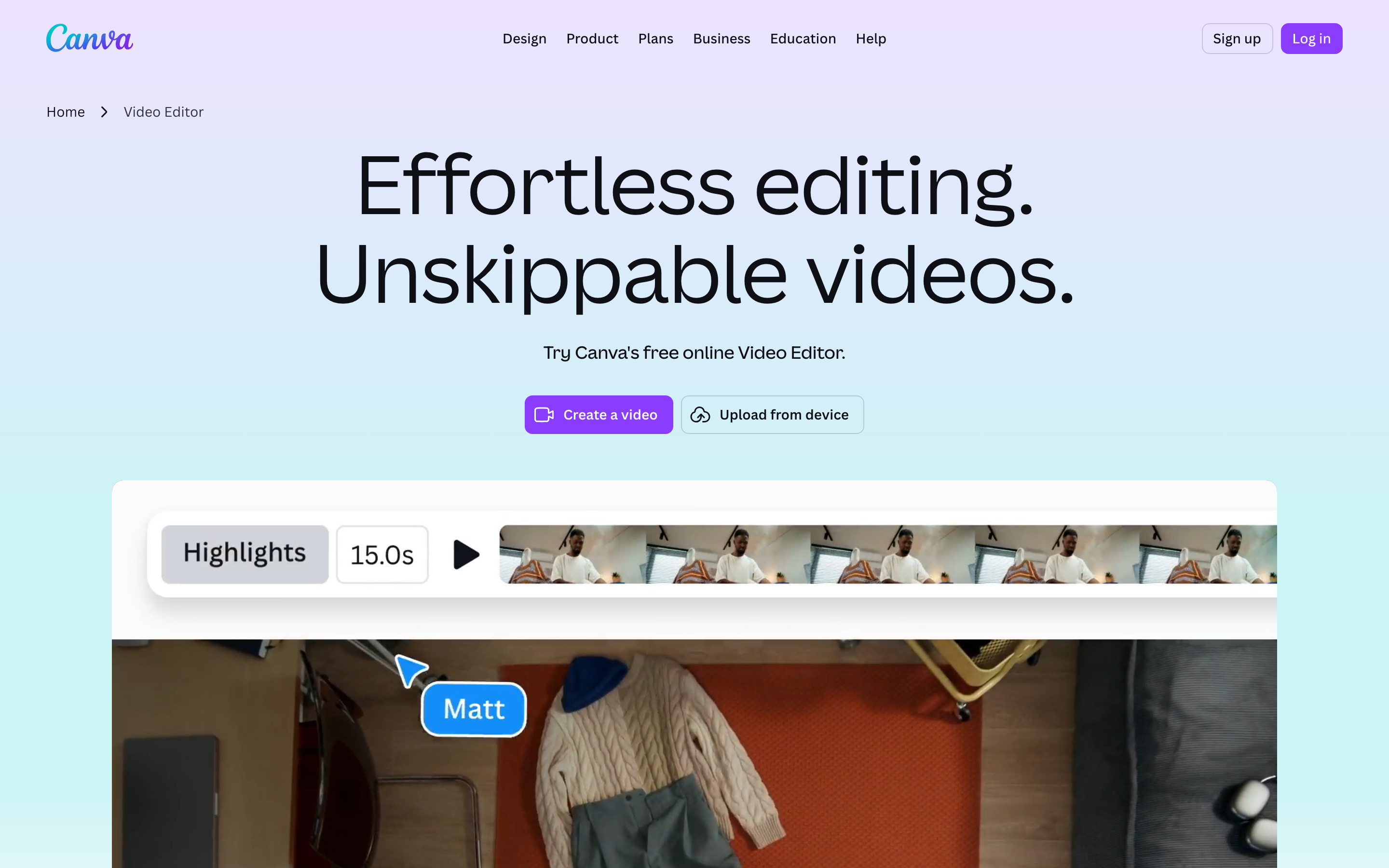
Canva Video is best for creators and SMB teams who want a flexible, design-led editor inside the wider Canva suite. Public details were checked against Canva's video editor and pricing pages for this 2026 comparison.
Key features
- Multi-layer timeline - Stack video, text, audio, and graphics with frame-level trimming and motion effects.
- Magic Video and AI generator - Drafts an edit from clips plus a prompt, and fills footage gaps with AI-generated clips.
- One-click captions and audio suite - Auto captions, voiceover recording, noise removal, and beat-matching.
- Full Canva asset library - More than a million templates, stock footage including Artlist Video, photos, fonts, and brand assets.
- Native mobile apps - Full iOS and Android apps for designing and editing a clip from a phone or tablet.
What users say
Buyers shortlist Canva Video when they already use Canva for design and want video in the same place, and they like the breadth of templates and AI. The common caution is that the AI allowance can run out mid-project, and the sheer number of options can slow down someone who just wants a quick, narrated clip.
Best for
Choose Canva Video when you want design-grade flexibility, deep AI editing, and a shared asset library inside one subscription.
3. Fliki
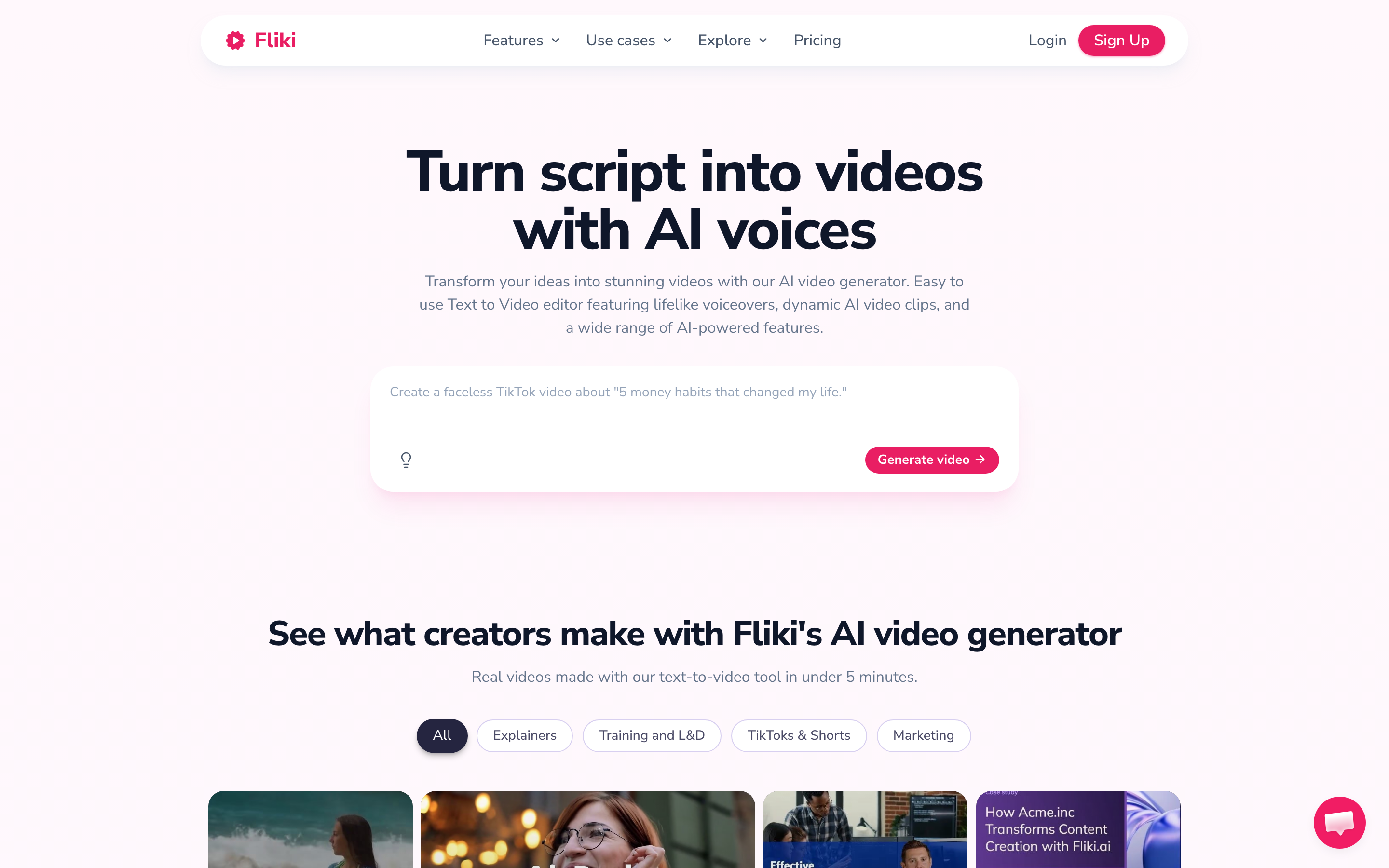
Fliki is best for faceless creators and marketers who turn scripts, blog posts, and decks into AI-voiced videos with no manual editing. Public details were checked against Fliki's product and pricing pages for this 2026 comparison.
Key features
- Text-to-video engine - Turns a script, an idea, a blog URL, or a PowerPoint into a finished, subtitled video with no timeline.
- Large multilingual voice library - Marketed at 2,000+ AI voices across 80+ languages, with voice cloning for a consistent presenter.
- Blog-to-video and stock match - Scrapes a URL, drafts a script, and auto-matches stock from a catalog marketed at 10 million-plus assets.
- AI dubbing and translation - One-click dubbing and translation into many languages for localization volume.
- AI avatars - A library of AI avatars to present a script when you want a face on screen.
What users say
Users praise Fliki for how quickly it turns text into a watchable, narrated clip and for the realism and range of its voices. The common caution is that the text-to-scene model limits fine visual control, and auto-matched stock can feel generic when a video needs a specific look, so people pushing past quick faceless content sometimes feel boxed in.
Best for
Choose Fliki when your input is text, you need natural narration across many languages, and you want a fast faceless video without touching a timeline.
How we compared these tools
This is not a star rating. It is a decision-weighting model for buyers choosing between a design-led video editor and a text-to-video engine, with ngram included as the third option many of them actually need.
| Criteria | Weight | What we looked at |
|---|---|---|
| AI capabilities | 30% | Magic editing, text-to-video, voices, captions, and planning depth |
| Features | 30% | Editing control, source support, stock and assets, and export options |
| Ease of use | 20% | Time to a first finished video and learning curve |
| Value | 15% | Public pricing, AI allowances, watermarks, and what each tier unlocks |
| Support and community | 5% | Collaboration, sharing, and team controls |
We reviewed official vendor pricing and product pages, current SERP patterns, and 2026 review-site and Reddit sentiment, and we did not use numerical star ratings because they flatten the real decision: the best tool depends on whether you want flexible design-led editing, fast text-to-video, or a full source-to-video workflow.
Common questions
Is Canva Video better than Fliki?
Neither is better outright. Canva Video wins for flexible, design-led editing on a real timeline and a huge shared asset library, while Fliki wins for turning text into a narrated video fast with one of the largest AI voice libraries in the category. Match the tool to the job, and consider ngram if your real need is a finished video planned from a doc, URL, deck, or recording rather than clips you arrange or a script you narrate by hand.
Is Fliki cheaper than Canva Video?
Usually not at the entry tier. Canva Pro starts around $10 per month on annual billing, or $15 billed monthly, and bundles the whole design suite, while Fliki's entry paid plan commonly lands near $28 per month on annual billing. But the comparison is not apples to apples: Canva meters AI usage through an allowance, and Fliki sells generated-video minutes, so the cheaper option depends on whether you are designing clips or generating a lot of narrated video.
What is the best Canva Video and Fliki alternative?
For teams that have outgrown arranging clips or narrating scripts by hand, ngram is the strongest alternative because it plans and builds full videos from prompts, docs, URLs, decks, screenshots, and recordings, then adds screen-recording polish, captions, and branding. Canva Video and Fliki remain the better picks for design-led editing and fast text-to-video respectively.
Which is easier for turning a blog post into a video?
Fliki is easier for that specific job because you can paste a blog URL and it scrapes the page, drafts a script, matches stock, and adds AI voiceover in a few clicks. Canva Video can make a richer-looking video from the same content, but you assemble it yourself on the timeline. If you want the structure planned from the post and then polished, ngram ingests the URL and builds the storyboard for you to review first.
Which one should you pick?
The Canva Video vs Fliki decision is really about your raw material, not the brand. If you want a flexible, design-led editor with deep AI and a shared asset library, especially if your team already lives in Canva, pick Canva Video. If your input is text and you want fast, narrated, multilingual video without a timeline, pick Fliki.
If your actual job is turning a doc, URL, deck, or screen recording into a finished, on-brand video, where the structure should be planned for you instead of arranged or narrated by hand, ngram beats both for that slice. The mistake is treating every video tool as interchangeable. In 2026, workflow fit matters more than the category label.
Try ngram free, your first video in under 5 minutes. Turn a prompt, doc, URL, deck, or screen recording into a polished, on-brand video without arranging it clip by clip or narrating it line by line. Start free