

Search for "Camtasia vs Screen Studio" and you find two screen recorders built on opposite philosophies. Camtasia, made by TechSmith, is a mature cross-platform desktop editor: record your screen, webcam, and audio, then edit on a full timeline with effects, annotations, quizzes, and a growing layer of AI tools. Screen Studio is a macOS-only app that takes a raw capture and instantly turns it into a polished, cinematic video with automatic zooms and cursor smoothing, with almost no editing required. This guide compares Camtasia vs Screen Studio across the things that actually decide the purchase: editing depth, ease of use, platform, pricing, and output. It also shows where a third option, ngram, beats both when your real job is a finished business video, not just a captured recording.
Both tools are good at what they set out to do. Camtasia gives you control and breadth; Screen Studio gives you speed and instant polish. The honest answer to "which is better" is "for which job," so we will pick a winner per dimension instead of crowning one overall.
Camtasia vs Screen Studio at a glance
Here is the short version before the deep dive. ngram sits in the table because for many teams comparing these two, the better question is whether you need a recorder and editor at all, or a system that turns your source material into a finished video.
| Tool | Best for | Starting price | Main distinction |
|---|---|---|---|
| ngram | Teams turning prompts, docs, URLs, decks, and recordings into finished branded videos | Free, paid from $29/mo | Plans and builds the whole video, not just the capture |
| Camtasia | Trainers and educators editing detailed tutorials on Windows or Mac | Free trial, paid annual license, geo-priced | Full timeline editor with quizzes and AI add-ons |
| Screen Studio | Mac creators making polished demos with minimal editing | From $9/mo billed annually | Automatic cinematic zooms and cursor smoothing |
Editing depth and output
This is the clearest split between the two tools, and it follows from how each one is built.
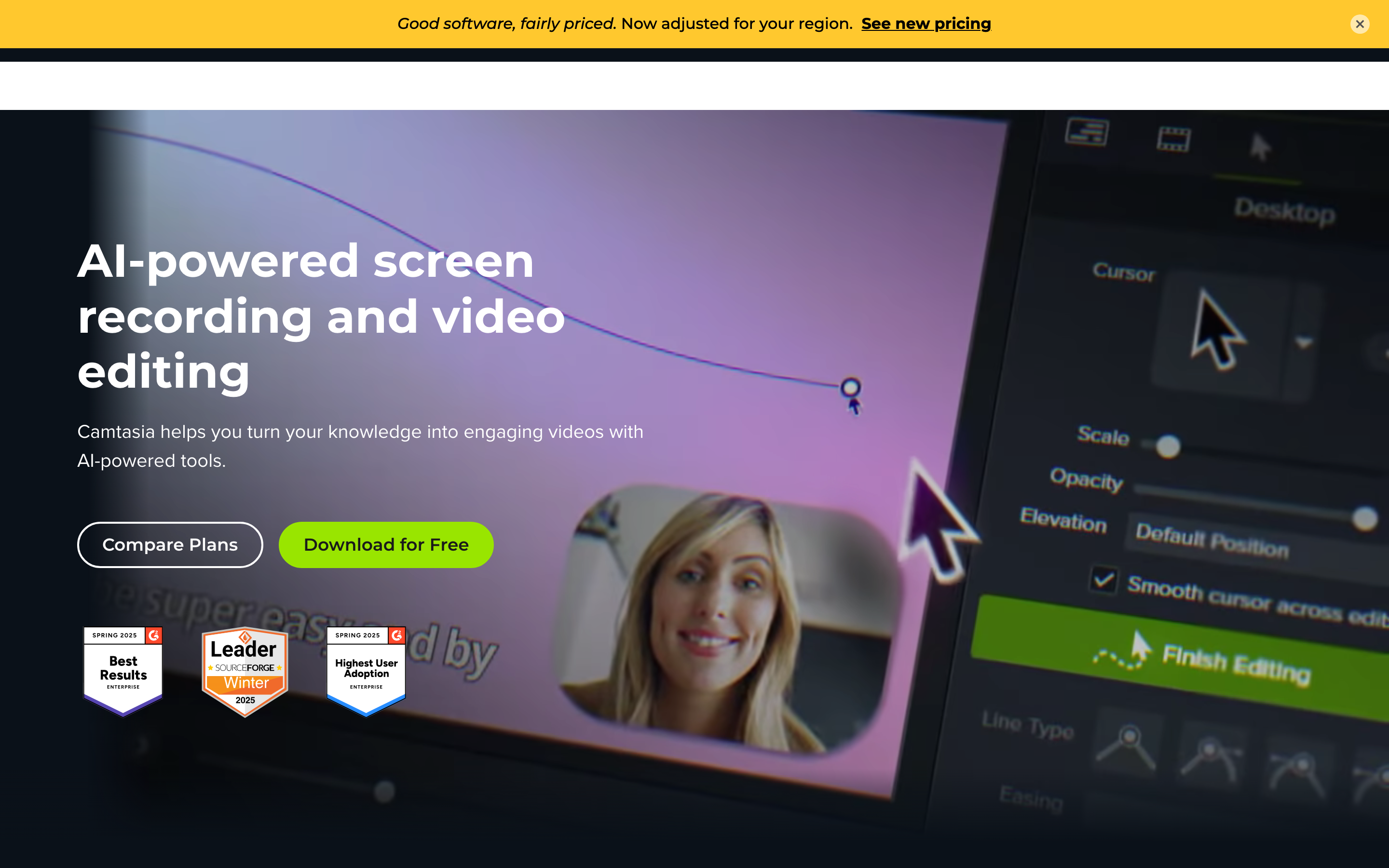
Camtasia is a real editor. After you record, you land on a multi-track timeline with transitions, annotations, behaviors, animations, and interactive quizzes you can embed directly in the video. It also ships AI tools on higher tiers: voiceover generation, audio cleanup, AI avatars, and translated captions. If your tutorial needs callouts layered over several takes, a quiz at the three-minute mark, and a precise cut you control frame by frame, Camtasia gives you that control. Exports go up to high resolution as MP4 and similar formats, with a watermark on the free download until you upgrade.
Screen Studio bets on the opposite idea: most polish should be automatic. Every click you make during a recording triggers a smooth, animated zoom toward the action, and the app smooths the cursor, adds backgrounds and shadows, and normalizes audio without you touching a timeline much. The result looks cinematic out of the box and exports up to 4K at 60fps as MP4 or GIF. The trade-off is depth: there are no embedded quizzes, no avatars, and no deep multi-track compositing, because that is not the job it is built for.
Winner: Camtasia for editing depth and interactive features, Screen Studio for instant polish with no editing. Pick based on whether you want to control every frame or skip editing entirely.
Worth noting for both: each still starts from a screen recording you have to capture and narrate live. Neither plans the video for you or builds scenes from a doc, a URL, or a deck. That gap is where ngram comes in, and we cover it below.
Platform and ease of use
Where you work decides a lot here, and so does how fast you want to finish.
Camtasia runs on both Windows and Mac, which matters for mixed teams and for trainers who cannot dictate everyone's hardware. The interface is far gentler than Adobe Premiere or DaVinci Resolve, and most people find the timeline quick to learn for basic edits. The cost is weight: because Camtasia behaves like a full editor, reviewers consistently flag higher RAM and CPU use, and larger projects with many tracks or effects can feel sluggish on mid-range or older laptops.
Screen Studio is macOS only, so Windows and Linux users are out from the start. For Mac users, though, it is one of the fastest tools to pick up: you are recording within a minute of installing it, and the editing surface is intentionally minimal. The learning curve is shallow precisely because the app makes most decisions for you.
Winner: Camtasia for cross-platform reach, Screen Studio for fastest time to a polished result. A Windows trainer has only one of these choices; a Mac creator who hates editing has the other.
Neither tool removes the underlying ask, though: you record live, you narrate live, and if you fluff a take you record again. ngram changes that loop by letting you plan and edit in chat before anything renders.
Pricing and value
The two tools price in completely different shapes, and that shape matters more than the headline number.
Camtasia is sold as an annual license, and its site is geo-priced, so the exact figure varies by region and TechSmith does not publish a single global USD number. The lineup runs from an entry Starter tier for watermark-free capture, up through Essentials for full editing and transcription, Create for AI voiceover and audio cleanup, and Pro for AI avatars, translated captions, collaboration, and the premium asset library. You pay once per year and own that version's use for the term. Check TechSmith's pricing page for the current rate in your region.
Screen Studio keeps it simple: one plan, every feature included, at $9 a month billed annually (about $108 a year) or $20 a month billed monthly. There are no feature tiers to decode, which is refreshing, though the previous one-time lifetime license has been retired in favor of the subscription.
Here is how the entry-level paid plans compare on monthly and annual billing:
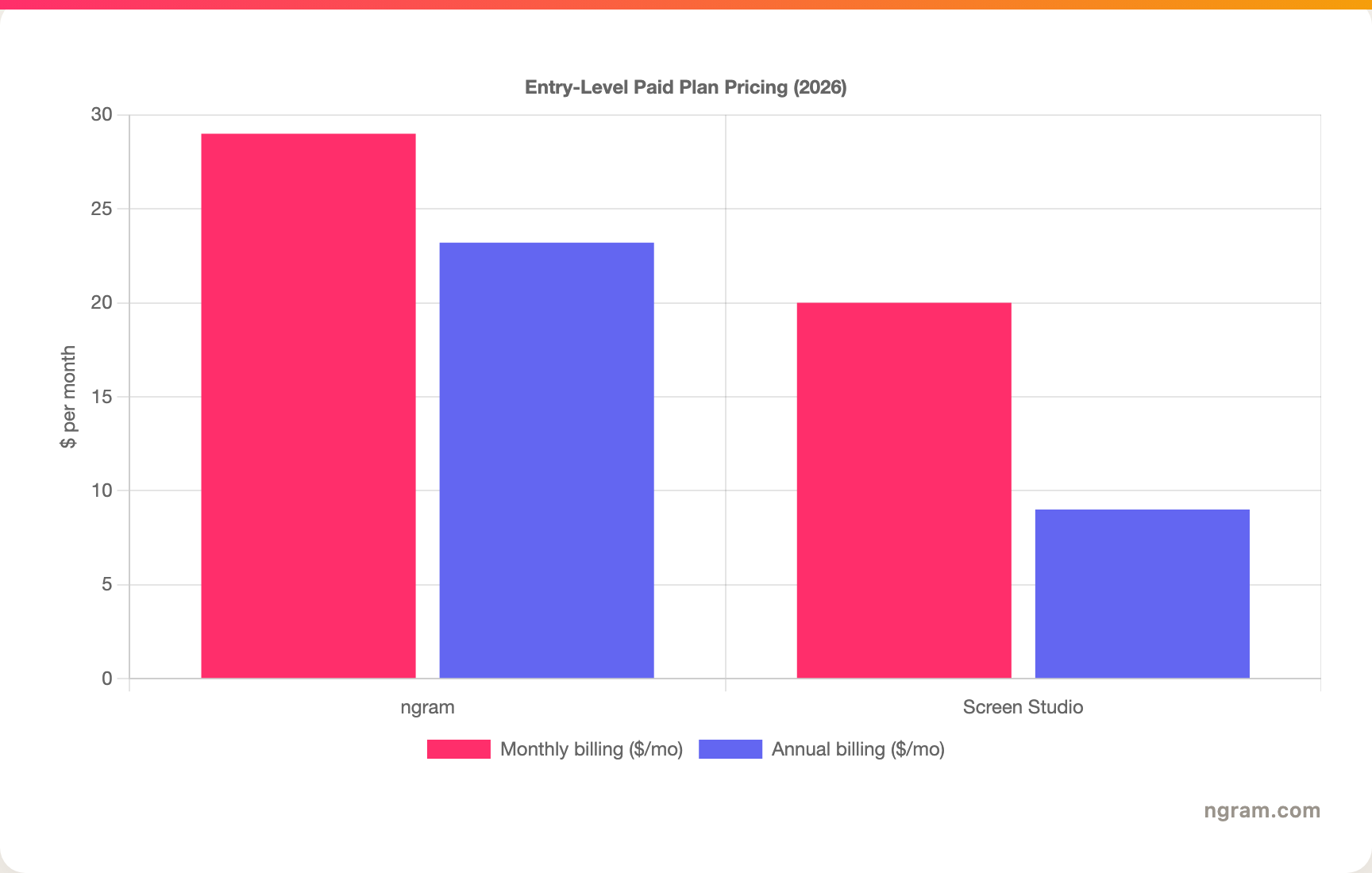
A note on that chart: Camtasia is billed annually only, so the monthly figure is its Essentials annual price divided across twelve months, and the entry Starter tier is cheaper still but limited to watermark removal. Screen Studio bills the same flat plan either way. Match the unit and the feature set to your actual use before you decide.
Winner: Camtasia for a perpetual-style annual license with deep editing, Screen Studio for the simplest all-in pricing, ngram for the most generous monthly credit volume on an entry plan. ngram's Basic plan is $29 a month, or $23.20 billed annually, and includes 3,000 credits a month across video, editing, and exports.
1. ngram, the better third option for most teams
Watch how ngram turns an idea into a finished video:
ngram does the same core job Camtasia and Screen Studio do well, polishing a screen recording into a clean video, and then keeps going where they stop. Instead of recording live and editing afterward, you can give ngram a prompt, a PDF, a URL, a deck, screenshots, a screen recording, or raw footage, and its agentic chat plans the script, storyboard, scenes, captions, and call to action for you to review before anything renders.
That plan-first workflow is the difference. For the marketing, product, customer-education, and training teams who make up most "Camtasia vs Screen Studio" searches, the real job is rarely "a captured recording." It is a product demo, an onboarding walkthrough, a feature announcement, or a help-center clip that needs the recording plus voiceover, callouts, B-roll, branded intros, and MP4 export, all on brand. ngram applies the same cursor smoothing, click emphasis, dead-air trimming, and smart zooms Screen Studio is known for, then adds the production layer Camtasia makes you build by hand.
What makes ngram different
- Source-aware inputs - Start from a prompt, PDF, URL, screenshot, screen recording, raw video, deck, or Shopify product, not just a live capture.
- Plan before render - Review the script and storyboard in chat, fix direction early, then generate. No re-recording a 20-minute take.
- Recording polish plus everything else - Cursor smoothing, click emphasis, dead-air trim, and zooms, then add avatars, AI voiceover, captions, callouts, motion graphics, and B-roll in the same video.
- Brand kits - Logos, colors, fonts, approved and blocked phrases applied automatically to every video.
- Localization built in - Translate script, captions, and on-screen text, generate multilingual voiceover, and re-lip-sync talking heads per language.
- MP4 export - Finished videos export as MP4; separate media tools can derive GIF, WebM, PNG, or JPG from supplied media, plus hosted watch pages and an embeddable player.
Where ngram is honest about its limits
ngram provides hosted video pages and embeds but has no generally available owner analytics surface, so analytics-heavy buyers should confirm needs first. It runs in the browser rather than as a native desktop app, so power users who want offline desktop control may prefer Camtasia. And its public security certifications are not published yet, so a compliance-bound buyer with a strict SOC 2 or ISO requirement should confirm before standardizing on it.
Who ngram is best for
ngram fits product marketing, growth, sales, customer success, support, and training teams that turn business material into polished video repeatedly. For current plans and credits, check ngram pricing rather than stale screenshots, and for the direct head-to-heads see the ngram vs Camtasia comparison and the ngram vs Screen Studio comparison.
Ready to try ngram? Create your first video from a prompt, doc, URL, deck, screenshot, or recording. Start free
2. Camtasia
Camtasia by TechSmith is best for trainers, educators, and customer-education teams who want one cross-platform app to record and edit detailed tutorials. Public details were checked against the TechSmith Camtasia pricing and product pages for this 2026 comparison.
Key features
- Full timeline editor - Multi-track editing with transitions, annotations, behaviors, and animations.
- Cross-platform - Runs on both Windows and Mac.
- Interactive quizzes - Embed multiple-choice, true or false, and short-answer questions directly in the video.
- AI add-ons - Voiceover generation, audio cleanup, AI avatars, and translated captions on higher tiers.
- Premium assets - Access to a large library of templates, music, and stock on the Pro tier.
What users say
Users praise Camtasia as one of the most approachable full editors for tutorials and training, far gentler than Premiere or DaVinci, with quizzes that L&D teams genuinely use. The recurring caution is weight: reviewers note higher RAM and CPU use during editing and exporting, and larger multi-track projects can feel sluggish on older machines. A few also note the annual-license model and geo-priced storefront make budgeting less transparent.
Best for
Choose Camtasia when you need deep editing control, interactive quizzes, and a tool that runs on both Windows and Mac.
3. Screen Studio
Screen Studio is best for Mac creators and product teams who want polished demos and tutorials without learning a timeline editor. Public details were checked against the Screen Studio pricing and product pages for this 2026 comparison.
Key features
- Automatic zooms - Every click triggers a smooth, animated zoom toward the action, generated from your click data.
- Cursor and audio polish - Cursor smoothing and resizing, background noise removal, and voice normalization.
- 4K 60fps export - High-resolution MP4 and GIF output with platform presets.
- On-device transcription - Transcripts generated locally on the Mac.
- Device frames - iPhone and iPad recording with realistic device mockups.
What users say
Reviewers consistently call Screen Studio the fastest way to make a demo look professional on a Mac, praising the auto-zoom and the near-zero learning curve. The trade-offs they cite are the macOS-only requirement, the lighter editing depth compared to a full editor, and the recent shift away from a one-time license toward a subscription.
Best for
Choose Screen Studio when you are on macOS and want cinematic, polished recordings with the least possible editing effort.
How we compared these tools
This is not a star rating. It is a decision-weighting model for buyers choosing between two screen recorders, with ngram included as the third option many of them actually need.
| Criteria | Weight | What we looked at |
|---|---|---|
| Editing and features | 30% | Timeline depth, automatic polish, quizzes, and AI tools |
| Output and breadth | 30% | Source support, export formats, resolution, and sharing |
| Ease of use | 20% | Time to a first finished video and learning curve |
| Value | 15% | Public pricing, license model, watermarks, and tier clarity |
| Platform and support | 5% | Operating systems, collaboration, and resources |
We reviewed official vendor pricing and product pages, current SERP patterns, and 2026 review-site and Reddit sentiment, and we did not use numerical star ratings because they flatten the real decision: the best tool depends on whether you need deep editing, instant polish, or a full source-to-video workflow.
Common questions
Is Camtasia better than Screen Studio?
Neither is better outright. Camtasia wins for deep timeline editing, interactive quizzes, and cross-platform use on Windows and Mac, while Screen Studio wins for instant cinematic polish on macOS with almost no editing. Match the tool to the job, and consider ngram if your real need is a finished video built from source material rather than a captured recording you edit by hand.
Is Screen Studio cheaper than Camtasia?
It depends on the tier. Screen Studio is $9 a month billed annually with every feature included, while Camtasia's entry Starter license only removes the watermark and full editing starts on the higher Essentials tier. Camtasia's site is geo-priced, so check TechSmith's pricing page for the current rate in your region. For an all-in feature set, Screen Studio is often the cheaper path, but only if you are on a Mac.
What is the best Camtasia and Screen Studio alternative?
For teams that need more than a recorder, ngram is the strongest alternative because it plans and builds full videos from prompts, docs, URLs, decks, screenshots, and recordings, then adds recording polish, voiceover, captions, and branding. Camtasia and Screen Studio remain the specialist picks for deep manual editing and fast Mac polish.
Does Screen Studio work on Windows?
No. Screen Studio is a macOS-only application and requires a recent version of macOS. Windows and Linux users should look at Camtasia, which runs cross-platform, or at ngram, which runs in the browser on any operating system.
Which one should you pick?
The Camtasia vs Screen Studio decision is really about how much editing you want to do and what you record on. If you are on Windows or a mixed team and need deep editing, quizzes, and AI add-ons for detailed tutorials, pick Camtasia. If you are on a Mac and want a recording that looks cinematic the moment you stop capturing, with no timeline to learn, pick Screen Studio. If your actual job is turning real business material, a doc, a URL, a deck, or a rough recording, into a finished, branded video where the capture is one part among voiceover, callouts, and B-roll, ngram beats both. The mistake is treating every screen tool as interchangeable. In 2026, workflow fit matters more than the category label.
---
Try ngram free, your first video in under 5 minutes. Turn a prompt, doc, URL, deck, or screen recording into a polished, on-brand video without rebuilding it from a blank timeline. Start free