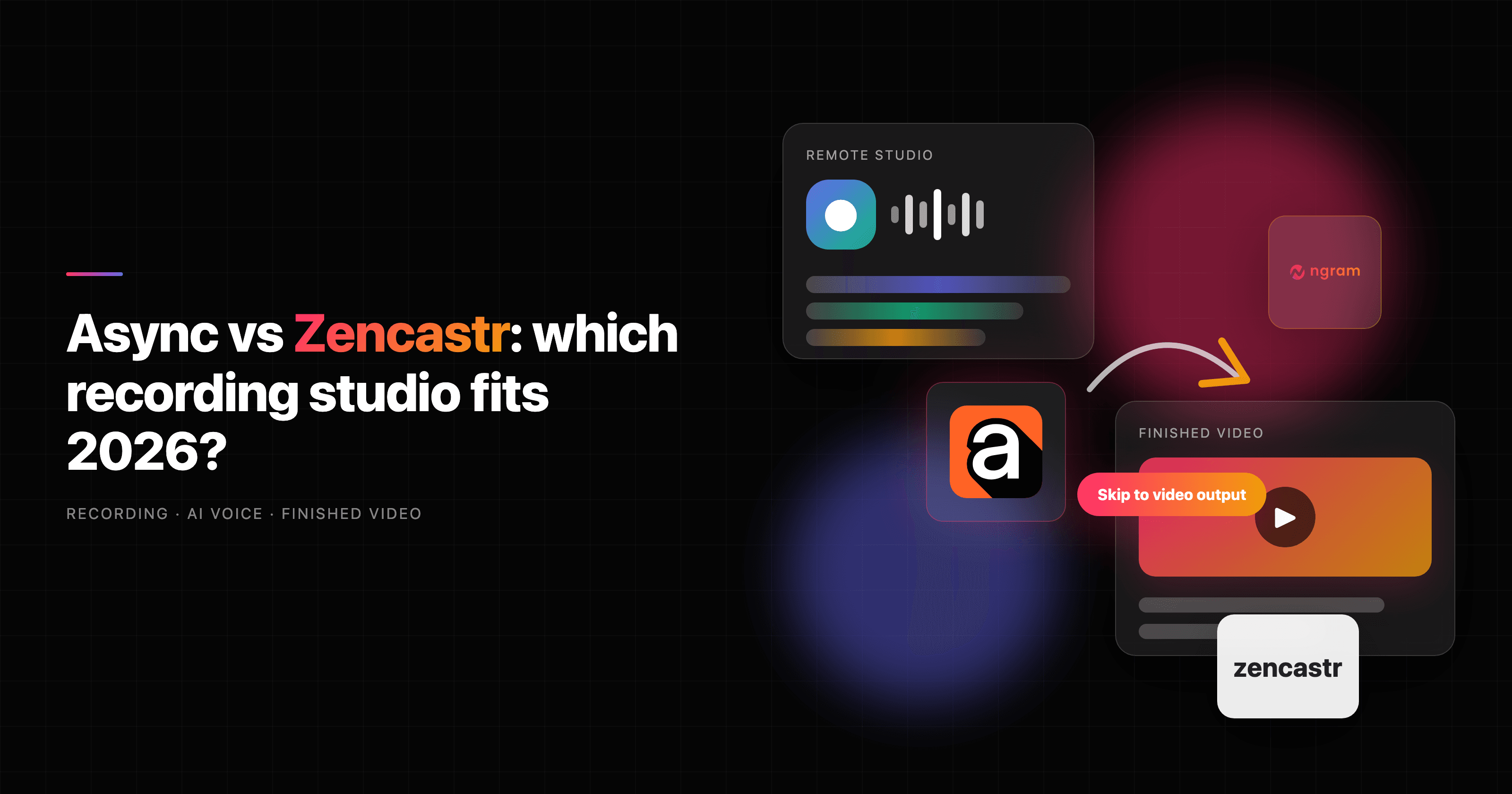


Search "Async vs Zencastr" in 2026 and you are really asking which part of podcast production matters most. Async, formerly Podcastle, is now a broader AI video, sound, and voice platform: record, edit, dub, subtitle, make clips, clone voices, and build with its Voice API. Zencastr is still closer to a remote recording studio for podcasters: get guests in a room, capture clean local tracks, edit the transcript, host the show, and publish clips.
Both tools can belong in a creator stack. They just put the weight in different places. Async is better when you want one AI workspace for recording, cleanup, voice work, dubbing, subtitles, and social repurposing. Zencastr is better when the recording session itself is the center of the workflow, especially remote interviews with separate tracks, easy guest links, hosting, and monetization.
Rebrand note: Async is the live successor to Podcastle. Podcastle rebranded to Async on January 28, 2026, and the old Podcastle name should not be treated as a separate product in this comparison.
There is also a third path. If the recording is already done, or if your source is a doc, URL, PDF, deck, screenshot, or rough screen recording, ngram is the stronger choice for turning that material into a finished, branded business video. ngram is not a remote recording studio and it is not a developer voice API. It is the better pick when the output needs to be a polished explainer, customer update, training video, product demo, or social cut built from source material.
Async vs Zencastr at a glance
| Tool | Best for | Starting paid price | Main strength | Where it is weaker |
|---|---|---|---|---|
| Async | Creators and teams that want recording, AI editing, dubbing, subtitles, clips, voice cloning, and a voice API in one platform | From $11.99/month on its public site | Broad AI audio and video production workflow | Less focused than Zencastr if the only job is a clean remote podcast session |
| Zencastr | Podcasters and interview hosts that want remote recording, separate tracks, hosting, clips, and monetization | Official pricing data includes Standard at $20/month, plus creator growth tiers above that | Remote podcast recording plus hosting | Less useful if you need synthetic voice generation, dubbing, or a broader AI content studio |
| ngram | Teams that need finished business video from recordings, docs, URLs, decks, and prompts | Free plan, paid from $29/month | Script, storyboard, brand, captions, voiceover, and MP4 export in one video workflow | Not a live remote interview recorder, podcast host, or voice API replacement |
Quick verdict
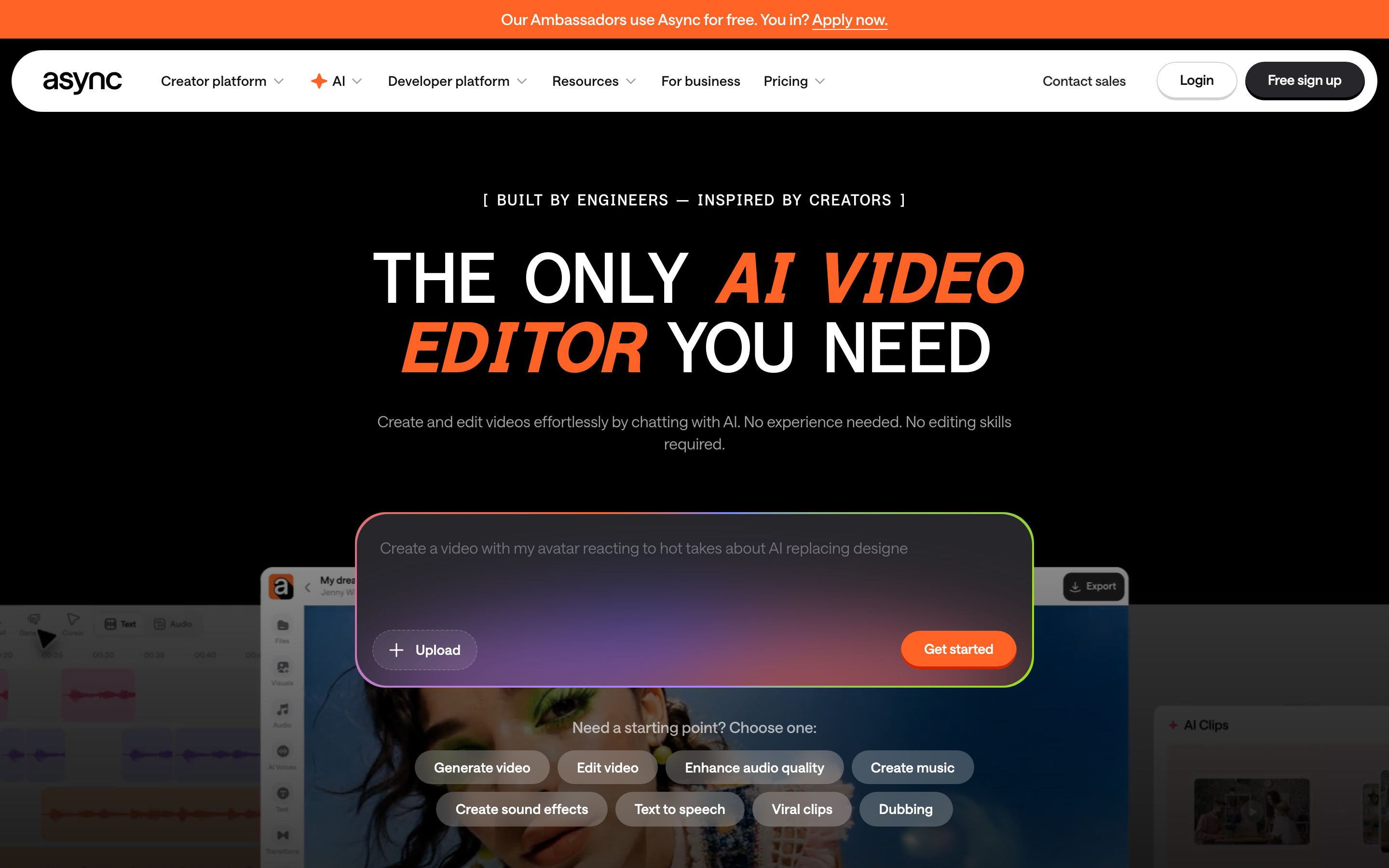
Pick Async if your show or creator workflow now includes more than the recording room. Async is the better fit for AI cleanup, AI video generation, dubbing, subtitles, short clips, text-to-speech, voice cloning, and developer voice infrastructure. Its official homepage positions the product as an all-in-one AI video and audio platform, and the rebrand from Podcastle makes sense when you look at that broader scope.
Pick Zencastr if the recording session is the product. Zencastr records audio and video locally, gives you separate tracks for participants, invites guests by link, and bundles hosting, analytics, social clipping, and monetization. Its product is strongest for people who host interviews and need the cleanest possible raw conversation before post-production starts.
Use ngram if the session has already produced raw material and the next job is a finished business video. Upload the interview, screen capture, or source file and ngram can plan the script, storyboard scenes, apply captions and voiceover, add product callouts, adapt the output for different channels, and export the finished video as MP4.
Core output and workflow
Async starts with a wider creative canvas. Its current site says the platform can generate or record video and audio, edit, dub, subtitle, make clips, and clone voices. The product also highlights an AI video editor, AI music, studio-quality recording, multilingual AI voices, and a Voice API for real-time agents and apps. That makes Async a better fit for creators who want to patch dialogue with synthetic voice, dub an episode into another language, create clips, and keep audio and video production in one browser-based workspace.
Zencastr starts with the show. The product is organized around podcast recording, interviews, hosting, AI editing, AI clipping, and monetization. Zencastr's own homepage calls out 4K recording, 48kHz WAV audio, transcript-style editing, hosting, social clipping, and video plus audio hosting. The mental model is simple: schedule a session, bring guests into the room, record each participant, then publish and promote the episode.
Winner: Async for breadth. Zencastr for a tighter podcast production lane. The difference is not quality versus quality; it is breadth versus focus.
Recording and guest experience
Zencastr is the cleaner pick if remote guest recording decides the purchase. Its recording page says paid plans can step up to 16-bit 48kHz WAV audio, that local recording protects quality when the internet fluctuates, and that video can record up to 4K. It also says hosts can invite up to 11 guests with a single link, without downloads or guest accounts. That combination is exactly what interview producers care about: fewer guest setup problems and better source files.
Async also records audio and video, and its older Podcastle-era feature table still describes up to 10 remote participants with local recording on separate tracks. The difference is emphasis. Async treats recording as one part of a larger creation suite. Zencastr treats recording as the center of the workflow and builds hosting, clipping, and show growth around it.
Winner: Zencastr for remote interviews and guest sessions. Async is still viable for recording, but Zencastr is more purpose-built for the call itself.
Audio, voice, and AI production
Async pulls ahead when the job moves from capture to AI production. Its homepage lists AI dubbing, subtitles, multilingual voices, one-click clips, voice cloning, and a developer Voice API. The Magic Dust page also positions Async around audio cleanup: removing background noise, leveling audio, and improving vocal tone. If your workflow includes a narration patch, localized voiceover, AI subtitle pass, or a voice product integration, Async owns more of that surface.
Zencastr uses AI differently. ZenAI focuses on transcript editing, AI clipping, filler-word removal, chapter and description generation on selected plans, and making podcast clips easier to produce from the recorded episode. That is useful, but it is mostly post-production for real recorded speech rather than synthetic voice creation or a voice API.
Winner: Async for AI voice, dubbing, subtitles, and developer voice use cases. Zencastr for AI that stays close to the recorded podcast workflow.
Editing and repurposing
Async is stronger when you want one workspace for audio, video, subtitles, and social repurposing. Its site positions the platform around creating, editing, and repurposing in one workflow, with AI handling video generation, remote recording, editing, subtitles, dubbing, and clips. That is helpful for creators who do not want to move between a recorder, an audio cleaner, a subtitle tool, a dubbing tool, and a clip maker.
Zencastr is stronger when you want the post-production path tied to podcast publishing. Its AI clipping article says clipping starts with a structured source and that separate-track local recording gives editors control over framing and audio balance. Zencastr's home page also lists hosting, embeddable player, analytics, cloud storage, audio plus video editor, remote recording, monetization, and social clipping as part of the product family.
Winner: Async for broader AI production. Zencastr for recording-to-podcast-publishing continuity.
Pricing and value
The pricing comparison is not as clean as it looks from a single table. Async's public homepage says plans start from $11.99/month, and its pricing page lists Basic, Storyteller, Pro, Teams, and Business-style coverage with AI credits, recording limits, upload limits, AI clips, AI dubbing, AI subtitles, AI image generation, AI music, and AI video generation governed by credits. The price looks lower at the entry point, but the real question is how many AI credits and recording hours your workflow burns.
Zencastr's official pricing page renders plan details through JavaScript, but the pricing payload exposed on the page includes Free, Standard at $20/month, Grow at $30/month, Scale at $50/month, and Business at $100/month, plus annual variants. Standard includes 11 participants, separate audio and video, 1080p video, WAV recording, transcription, cloud storage, hosting, advanced analytics, and a 14-day trial. Higher creator tiers add 4K video, more shows, more team seats, more views, and more publishing features.
ngram is credit-based: Free, Basic at $29/month, Premium at $59/month, Ultimate at $299/month, and Enterprise/custom. The value calculation is different because ngram is not charging for a podcast room. It is charging for video generation, editing, exports, brand workflows, voiceover, captions, and MP4 finished output.
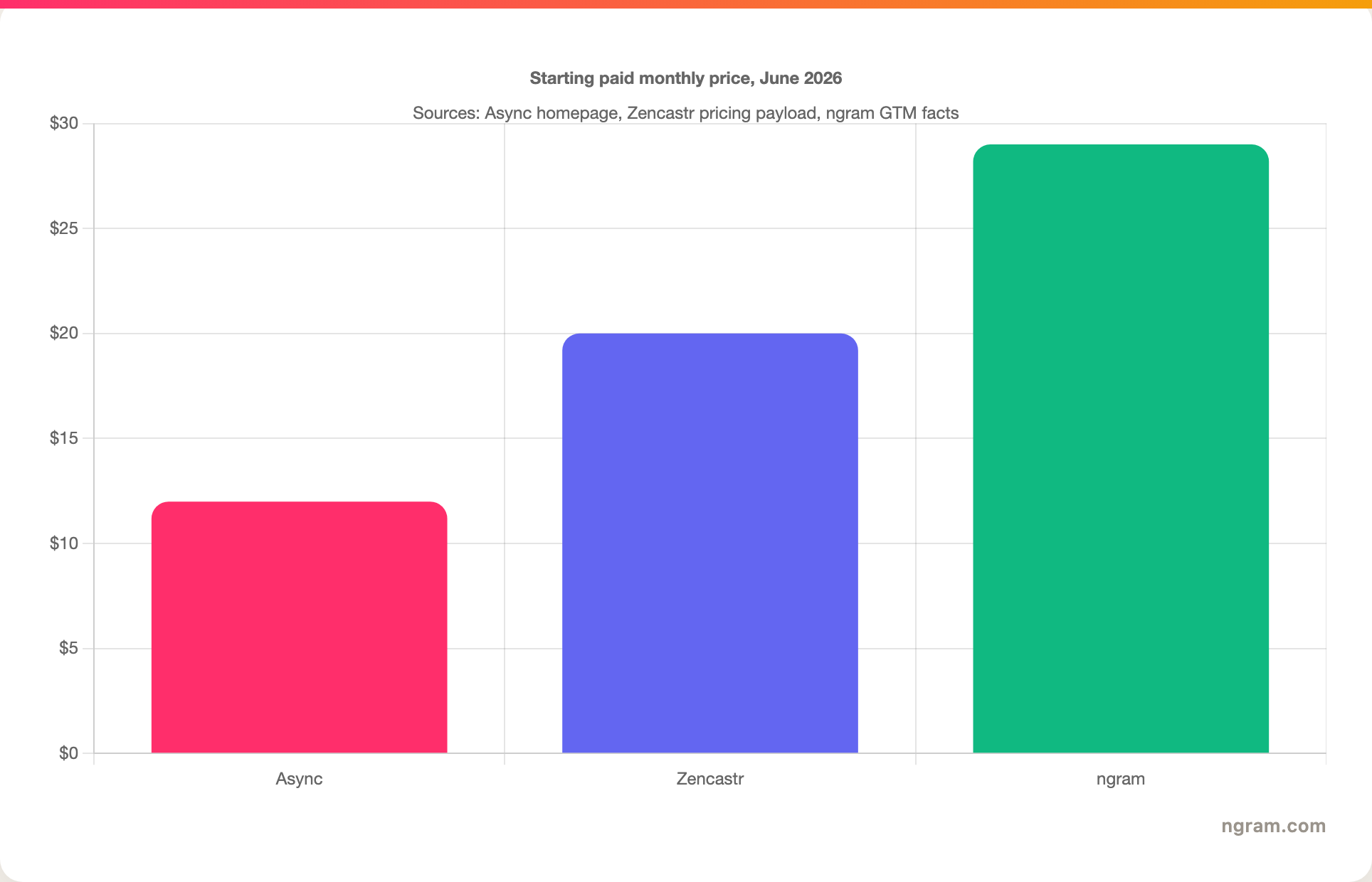
Winner: Async for the lowest public starting price. Zencastr for clearer podcast-studio value once recording and hosting are the reason you are buying. ngram for teams that are paying for finished branded video instead of a recording room.
Where ngram fits
Watch how ngram turns an idea into a finished video:
ngram belongs in this comparison only for the finished-video slice. That boundary matters. If you need to record a remote panel with separate guest tracks, use Zencastr or Async. If you need a voice API, use Async or a specialist voice platform. If you need podcast hosting and monetization, use Zencastr.
But if the source already exists, ngram is the faster path to a video your team can ship. It accepts text prompts, PDFs, URLs, screenshots, screen recordings, raw video, and decks. It generates a script and storyboard, applies captions and AI voiceover, adds product callouts and motion graphics, keeps brand kits in the workflow, and exports finished videos as MP4. That makes ngram stronger for customer education clips, sales enablement videos, product demos, training explainers, and internal updates.
For more detail on the exact overlap, read the single-product comparisons: ngram vs Async and ngram vs Zencastr. If you are starting from a raw recording, the closest conversion workflow is screen recording to video. If you are starting from a podcast or voice file, see audio to video.
Best choice by use case
| Use case | Winner | Why |
|---|---|---|
| Remote podcast interview with guests | Zencastr | Local recording, separate tracks, easy guest links, hosting, and podcast growth tools are central to the product |
| All-in-one creator studio for audio and video | Async | Async covers recording, editing, dubbing, subtitles, clips, voice cloning, and AI generation in one broader workspace |
| AI voice, dubbing, or developer voice API | Async | Async explicitly offers voice cloning, multilingual voices, and a Voice API for real-time apps |
| Podcast hosting, monetization, and show publishing | Zencastr | Zencastr bundles hosting, analytics, embeddable player, monetization, and distribution around the show |
| Finished branded business video from existing material | ngram | ngram plans, scripts, storyboards, styles, captions, narrates, edits, and exports the final video from recordings or source files |
| Lowest visible entry price | Async | Async publishes a $11.99/month starting point, while Zencastr starts higher for paid podcast-studio plans |
Methodology
We compared Async and Zencastr on the buying dimensions that matter for recording-studio software: recording quality, guest workflow, AI editing, voice generation, clipping, hosting, pricing, and post-recording output. Competitor claims come from official Async and Zencastr pages first, then from the current search results around Podcastle vs Zencastr and Zencastr alternatives when official pages did not explain a buyer question.
We did not use star ratings from G2, Capterra, Trustpilot, or review blogs. Those numbers are volatile and often mix old Podcastle reviews with the current Async brand. We also did not score the tools on a single numeric scale, because Async and Zencastr solve adjacent jobs. A podcast host recording remote guests does not need the same product as a marketing team turning an interview into a polished sales video.
Source notes and gaps
Async claims in this post are based on its official homepage, pricing page, business page, Magic Dust page, Voice API messaging, and the January 28, 2026 Podcastle-to-Async rebrand announcement. The public Async pricing page exposes the $11.99/month starting point and the plan/credit table, but some per-plan prices render client-side. For that reason, the post uses the official starting price and avoids over-explaining every Async tier.
Zencastr claims are based on its homepage, recording feature page, AI clipping article, and pricing page payload. Zencastr's public pricing page requires JavaScript for the visible plan cards, so the pricing figures here come from the page's embedded plan data plus Zencastr's own blog note that plans start at $20/month.
ngram claims are limited to the current product-state and GTM facts files in this repository. ngram is not described as a remote recording studio, podcast host, full podcast monetization product, or replacement for Async's developer Voice API. Signed-in users can create self-service bearer API credentials for Public API v1.
FAQ
Is Async the same as Podcastle?
Yes. Podcastle rebranded to Async on January 28, 2026. The product is still live, but the current buying decision should use the Async name and current Async feature set.
Is Zencastr better than Async for podcast recording?
Zencastr is usually better when remote podcast recording is the central job. Zencastr emphasizes local recording, separate participant tracks, easy guest access, 4K video, hosting, analytics, and monetization. Async is better when the recording is one step inside a broader AI production workflow.
Is Async better than Zencastr for AI voice and dubbing?
Async is the better pick for AI voice and dubbing. Async publicly lists multilingual AI voices, voice cloning, dubbing, subtitles, and a Voice API. Zencastr uses AI for podcast editing and clips, but Zencastr does not position itself as a developer voice platform.
Which tool is cheaper, Async or Zencastr?
Async has the lower public starting paid price at $11.99/month. Zencastr's official pricing data includes a Standard plan at $20/month and creator growth tiers above that. Price alone should not decide the purchase, because Async and Zencastr bill for different workflows.
When should I skip both and use ngram?
Use ngram when your goal is a finished branded business video, not the recording session. ngram is strongest after you have a recording, transcript, doc, URL, deck, or rough screen capture and need a polished explainer, demo, training video, social cut, or customer update.
Start with ngram when the recording is only the raw material. Turn interviews, demos, docs, URLs, decks, and screen captures into finished business videos with script, storyboard, captions, voiceover, brand styling, and MP4 export with separate channel-cut preparation.