

Search for "Animoto vs Fliki" and you find two tools that promise the same outcome, a finished video without an editor, reached by two very different roads. Animoto is a template-driven, drag-and-drop video maker: you bring photos, clips, and recordings, drop them into a layout, add licensed music, and download a polished marketing clip. Fliki is an AI text-to-video engine: you paste a script, idea, blog post, or slide deck, and it generates a faceless video with a lifelike voiceover, stock visuals, and subtitles. This guide compares Animoto vs Fliki on the things that decide the purchase: how you start, what you get, ease of use, and pricing. It also shows where a third option, ngram, beats both when your real job is a finished business video built from your own source material.
Both tools are legitimately good at what they do. Animoto is the faster path when you already have the footage and just want it assembled on brand. Fliki is the faster path when you have words but no footage and need volume. The honest answer to "which is better" is "for which job," so we pick a winner per dimension instead of crowning one overall.
Animoto vs Fliki at a glance
Here is the short version before the deep dive. ngram sits in the table because for many teams comparing these two, the better question is whether you need a template assembler, a text-to-video generator, or a system that plans and builds the whole video from what you already have.
| Tool | Best for | Starting price | Main distinction |
|---|---|---|---|
| ngram | Teams turning prompts, docs, URLs, decks, screenshots, and recordings into finished branded videos | Free, paid from $29/mo | Plans the whole video, then builds it from your source |
| Animoto | Marketers assembling social and business video from existing photos and clips | Free, Basic $15/mo annual ($30 monthly) | Template-driven assembly with licensed music and stock |
| Fliki | Faceless creators turning scripts and articles into voiceover video at scale | Free, Standard $28/mo annual ($66 monthly) | Text-to-video with a large voice library across 80+ languages (1,000+ voices on Standard, 2,000+ on Premium) |
How you start: footage vs text
This is the first fork, and it decides almost everything else.
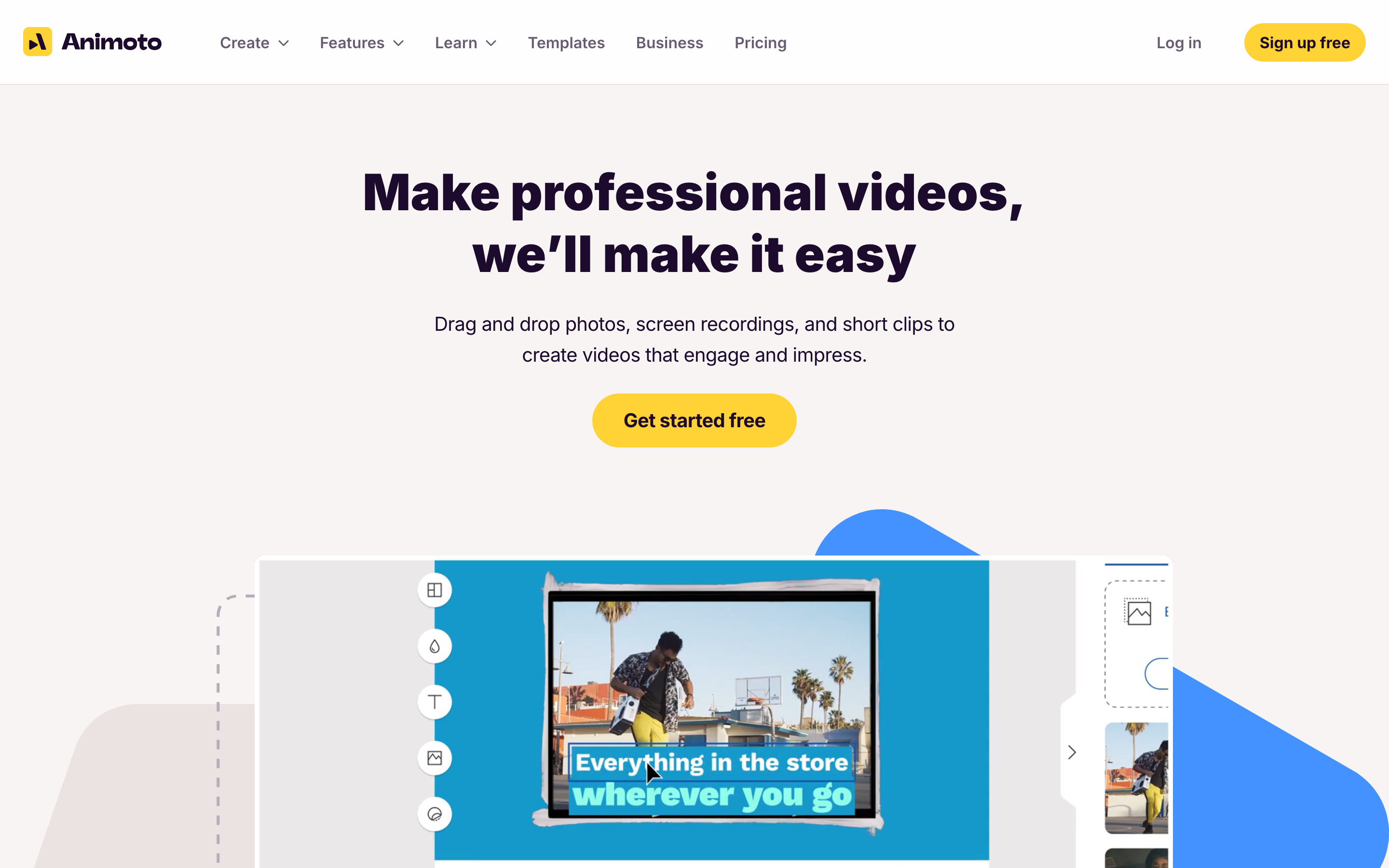
Animoto expects you to arrive with media. You upload photos, short clips, screen or webcam recordings, choose a template, and arrange them on a timeline-style storyboard with text overlays, a licensed-music soundtrack, and stock media from Getty Images. There are AI helpers layered in, including an AI video maker and a script generator, but the core product is a template-driven assembly editor. If you already have the raw material and a clear idea of the layout, Animoto gets you to a clean result fast.
Fliki expects you to arrive with words. You paste a script, a topic idea, a blog article, or a PowerPoint file, and Fliki generates a finished video: it writes or splits the narration, picks stock visuals, lays in music, adds an AI voiceover, and burns in subtitles, with no manual editing required. For a creator who has a content calendar full of scripts but no footage, this is the faster road by a wide margin.
Winner: Animoto if your source is footage you already own, Fliki if your source is text you need turned into video. They are not really competing for the same starting point.
This is also the clearest reason buyers comparing Animoto vs Fliki end up looking at a third option. Most business video jobs start from neither pure footage nor a clean script. They start from a product doc, a live URL, a deck, or a messy screen recording, and the hard part is turning that into a plan. ngram takes any of those as input and plans the script, storyboard, and scenes before it builds, which we cover below.
Output and quality
What actually comes out the other end is where the two tools diverge again.
Animoto produces a polished, template-based marketing video: your media, cut to music, with text animations and transitions. Because you control the footage, the result feels authentic and on brand, and it holds up well for social ads, internal comms, and quick demos. The ceiling is the template system itself; complex, fully custom layouts sit outside its sweet spot.
Fliki produces a faceless video assembled around an AI voiceover. The voices are a genuine strength: a large library across many languages, with voice cloning and AI dubbing available. The trade-off is that the visuals are stitched from stock and AI clips matched to your script, so a Fliki video can look generic if you do not curate the b-roll, and it is built for narrated content rather than footage you shot yourself.
Winner: Animoto for authentic, footage-led marketing clips, Fliki for narrated faceless content at volume. Pick based on whether your video should show your own material or talk over stock.
Worth noting for both: neither tool plans the video for you or works from a business document. Animoto assembles what you give it, and Fliki narrates what you write. If the finished video also needs product screenshots, screen-recording polish, callouts, and branded scenes pulled together from a doc or a URL, that assembly work is on you. That gap is where ngram fits.
Ease of use
Both tools are built for people who are not video editors, and both deliver on that.
Animoto is famously approachable: drag, drop, swap a template, change the music, done. The learning curve is shallow, and a first marketing video is achievable in a single sitting. The structure that makes it easy is also what limits it, so power users sometimes feel boxed in by the templates.
Fliki is just as low-friction for its job: paste text, pick a voice and a format, generate. The speed-to-first-video is excellent for scripted content. The friction shows up later, in tuning visuals and pacing so the auto-matched b-roll actually fits the narration, which can take iteration.
Winner: roughly even. Animoto is easier when you think in footage and layouts, Fliki is easier when you think in scripts and voiceover. Neither asks you to learn an editor.
Pricing and value
Pricing is where you should match the unit to your real volume, because the two tools meter very differently.
Animoto sells tiered seats. There is a free plan with watermarked exports, then the Basic tier at $15 a month billed annually ($30 a month month-to-month) for personal and light business use, with a Professional tier and team plans above that adding more branding, stock, export options, collaboration, and seats. Monthly billing runs noticeably higher than the annual rate.
Fliki sells credits as minutes of generated video. The free plan covers a small monthly minute allowance with basic voices and a watermark. The Standard tier runs $28 a month billed annually ($66 a month month-to-month) for a larger minute pool, 1,000+ voices, and premium features, and the Premium tier ($66 a month annual, $88 monthly) scales minutes, the full 2,000+ voice library, voice cloning, and avatar features up from there. Heavy regeneration eats into your minute pool, so map your output before committing.
Here is how each tool's entry paid tier compares on monthly and annual billing (Animoto at Basic, Fliki at Standard, ngram at Basic). All three bill annually below their monthly rate, so each is shown both ways:
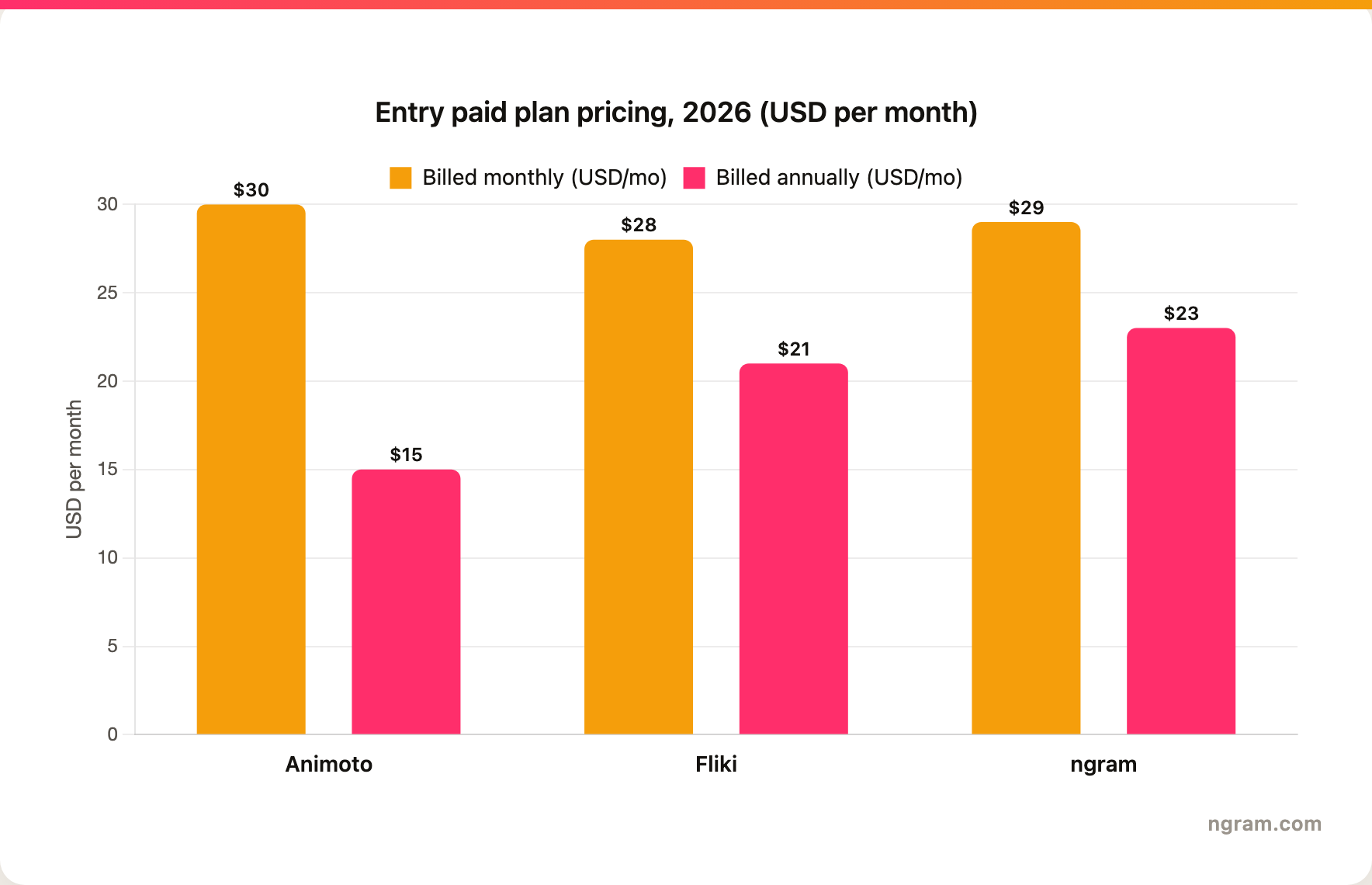
The headline numbers look close, but read the units. Animoto's tiers gate features and seats, not output minutes, so heavy video makers are not metered on volume. Fliki meters generated minutes, which is predictable but can feel tight at scale. ngram's Basic plan includes 3,000 credits a month on a credit model shared across video and editing, with unlimited exports. Match the unit to your actual work before you decide.
Winner: Animoto for the lowest entry price ($15 a month annual) and unmetered output, Fliki for the broadest voice and language library, ngram for the most capable workflow per dollar at $23 a month annual.
1. ngram, the better third option for many teams
Watch how ngram turns an idea into a finished video:
ngram does the same core job as Animoto and Fliki, turning your material into a finished video without an editor, and then keeps going where they stop. Instead of starting from a template you fill in or a script box you paste into, you give ngram a prompt, a PDF, a URL, a deck, screenshots, a screen recording, or raw footage, and its agentic chat plans the script, storyboard, scenes, captions, and call to action for you to review before anything renders.
That plan-first workflow is the difference. For the marketing, sales, product, and training teams who make up most "Animoto vs Fliki" searches, the real job is rarely "assemble these clips" or "narrate this script." It is a launch video, a product demo, an onboarding walkthrough, or a localized clip that needs screen recordings, callouts, b-roll, branded intros, and MP4 export with separate channel-cut preparation, all on brand and built from source material you did not pre-script.
What makes ngram different
- Source-aware inputs - Start from a prompt, PDF, URL, screenshot, screen recording, raw video, deck, or Shopify product, not just uploaded clips or a typed script.
- Plan before render - Review the script and storyboard in chat, fix direction early, then generate. No re-cutting a template or regenerating a whole narration to fix one scene.
- More than assembly or narration - Use an AI voiceover and avatars, then add screen-recording polish, smart zooms, product callouts, motion graphics, and AI-generated b-roll in the same video.
- Brand kits - Logos, colors, fonts, approved and blocked phrases applied automatically to every video.
- Localization built in - Translate script, captions, and on-screen text, generate multilingual voiceover, and re-lip-sync talking heads for each language.
- MP4 export - Finished videos export as MP4; separate media tools can derive GIF, WebM, PNG, or JPG from supplied media.
Where ngram is honest about its limits
ngram provides hosted video pages and embeds but has no generally available owner analytics surface, so analytics-heavy buyers should confirm needs first. Its public security certifications are not published yet, so a strictly compliance-bound buyer should verify current posture. And if your job really is just dropping photos into a template (Animoto) or narrating a finished script into a faceless clip (Fliki), those narrower tools are lighter for that single task.
Who ngram is best for
ngram fits product marketing, growth, sales, customer success, support, and training teams that turn business material into polished video repeatedly. For current plans and credits, check ngram pricing rather than stale screenshots, and for the direct head-to-heads see the ngram vs Animoto comparison and the ngram vs Fliki comparison.
Ready to try ngram? Create your first video from a prompt, doc, URL, deck, screenshot, or recording. Start free
2. Animoto
Animoto is best for marketers and small teams who already have photos, clips, and recordings and want them assembled into a polished, on-brand video fast. Public details were checked against Animoto's pricing and product pages for this 2026 comparison.
Key features
- Template-driven editor - Drag-and-drop assembly with hundreds of layouts for social, ads, and business video.
- Licensed music and stock - A built-in soundtrack library plus stock media from Getty Images.
- AI helpers - An AI video maker and AI script generator layered on top of the core assembly tool.
- Branding and collaboration - Team plans add brand colors, logos, fonts, seats, and shared workspaces.
- Source flexibility - Photos, short clips, and screen or webcam recordings as raw material.
What users say
Users praise Animoto for how quickly a non-editor can produce a clean, professional marketing clip, and for the music and template library. The common caution is the ceiling: once you want fully custom layouts or deeper editing control, the template structure can feel limiting, and monthly billing is markedly pricier than annual.
Best for
Choose Animoto when you have your own footage and want a fast, attractive, template-based marketing or business video without learning an editor.
3. Fliki
Fliki is best for faceless content creators and teams turning scripts, articles, and decks into narrated video at volume. Public details were checked against Fliki's pricing and product pages for this 2026 comparison.
Key features
- Text-to-video - Turn a script, idea, blog article, or PowerPoint file into a finished video automatically.
- Voice library - Up to 2,000+ AI voices across 80+ languages on the Premium tier (around 1,000+ on Standard), with voice cloning available.
- AI dubbing and translation - Localize narrated video into other languages.
- AI avatars - Optional talking-head presenters alongside the faceless format.
- Browser editor - A lightweight editor plus auto subtitles, stock visuals, and music.
What users say
Creators value Fliki for speed and the breadth of its voices, calling it a reliable way to ship faceless TikToks, Reels, and explainer clips from a script. The common caution is the visuals: auto-matched stock and AI b-roll can look generic without curation, so the narration carries more of the quality than the picture.
Best for
Choose Fliki when your source is text and you need high-volume, voiceover-led faceless video across many languages.
How we compared these tools
This is not a star rating. It is a decision-weighting model for buyers choosing between a template assembler and a text-to-video generator, with ngram included as the third option many of them actually need.
| Criteria | Weight | What we looked at |
|---|---|---|
| AI capabilities | 30% | Text-to-video, voice, planning, and scene generation depth |
| Features | 30% | Workflow breadth, source support, editing, and export options |
| Ease of use | 20% | Time to a first finished video and learning curve |
| Value | 15% | Public pricing, seat and minute rules, watermarks, and billing |
| Support and community | 5% | Collaboration, templates, and shared workspace controls |
We reviewed official vendor pricing and product pages, current SERP patterns, and 2026 review-site and Reddit sentiment, and we did not use numerical star ratings because they flatten the real decision: the best tool depends on whether you start from footage, from text, or from business source material that needs planning first.
Common questions
Is Animoto better than Fliki?
Neither is better outright. Animoto wins when you already have footage and want it assembled into a polished marketing clip, while Fliki wins when you have text and need it turned into narrated faceless video at scale. Match the tool to your starting material, and consider ngram if your real need is a finished business video planned and built from a doc, URL, deck, or recording.
Is Fliki cheaper than Animoto?
At the entry level, yes: Animoto's Basic tier ($15 a month billed annually) undercuts Fliki's Standard plan ($28 a month billed annually). The catch is the unit: Animoto's price gates features and seats while Fliki meters generated minutes, so the cheaper headline does not always mean the better value for your volume.
What is the best Animoto and Fliki alternative?
For teams that need more than template assembly or text narration, ngram is the strongest alternative because it plans and builds full videos from prompts, docs, URLs, decks, screenshots, and recordings, then adds voiceover, screen-recording polish, captions, and branding. Animoto and Fliki remain the specialist picks for footage-led assembly and faceless text-to-video.
Which is better for faceless social videos, Animoto or Fliki?
Fliki is the stronger faceless pick because it generates narrated video straight from a script with a large voice and language library, which is exactly what high-volume TikToks and Reels need. Animoto is the better fit when those social videos are built from your own photos and clips rather than stock and voiceover.
Which one should you pick?
The Animoto vs Fliki decision is really a question about your starting point, not the output. If you already have photos, clips, and recordings and want them assembled into a clean, on-brand marketing video fast, pick Animoto. If your source is text, scripts, or articles and you need high-volume faceless video with strong voices across many languages, pick Fliki. If your actual job is turning real business material, a doc, a URL, a deck, or a screen recording, into a finished, branded video that needs planning, screen-recording polish, callouts, and b-roll pulled together for you, ngram beats both. The mistake is treating every video maker as interchangeable. In 2026, workflow fit matters more than the category label.
---
Try ngram free, your first video in under 5 minutes. Turn a prompt, doc, URL, deck, or screen recording into a polished, on-brand video without assembling templates or rewriting a script. Start free