

Search for "Animaker vs Steve AI" and you find a quirk: both products come from Animaker Inc., yet they pull in different directions. Animaker is the hands-on animation studio, where you build cartoon explainers scene by scene with a deep character builder. Steve AI is the text-to-video engine, where you paste a script or a blog post and it generates an animated or live-action video for you. This guide compares Animaker vs Steve AI across the things that decide the purchase: animation control, text-to-video automation, output styles, pricing, and workflow. It also shows where a third option, ngram, beats both when your real job is a finished, narrated, on-brand business video rather than a fast faceless clip or a hand-built cartoon.
Both tools are good at what they aim for, and Steve AI's text-to-video job is the same core job ngram does. The honest answer to "which is better" is "for which job," so we pick a winner per dimension instead of crowning one overall.
Animaker vs Steve AI at a glance
Here is the short version before the deep dive. ngram sits in the table because for many teams comparing these two, the better question is whether you want to hand-build an animation, auto-generate a quick clip, or have a finished business video planned and produced from your source material.
| Tool | Best for | Starting price | Main distinction |
|---|---|---|---|
| ngram | Teams turning prompts, docs, URLs, decks, and recordings into finished narrated videos | Free, paid from $29/mo | Plans the whole video and lets you review the storyboard first |
| Animaker | Custom characters, cartoon explainers, and asset-rich 2D animation | Free, paid from $10/mo annual | Deep character builder and the largest asset library |
| Steve AI | Creators making fast animated or live-action videos from a script or blog post | Free, paid from $10/mo annual | Text-to-video across many output styles in one tool |
Text-to-video automation
This is the dimension that most clearly separates the two, and it is where Steve AI is built to win.
Steve AI is a text-to-video generator first. You paste a script, a prompt, or even a blog post, and it produces a full video with scenes, stock or generated visuals, and voiceover, fast. It now spans several output styles in one place, including animated, live-action stock, generative AI visuals, and talking-head clips, which makes it a popular pick for faceless YouTube channels and high-volume social content. If your goal is to turn text into a watchable video in minutes, Steve AI is the stronger pick.
Animaker is not a one-shot text-to-video tool in the same way. It has AI starts, but its center of gravity is manual assembly: you choose a template, place characters and props, and tune the timeline yourself. That is more work for a quick clip, but it gives you control Steve AI's auto-generation does not.
Winner: Steve AI for fast text-to-video, Animaker for hands-on control. Pick based on whether you want speed or scene-level command.
This is also the dimension where ngram competes head-on, because turning text, a doc, or a URL into a finished video is ngram's core job too. We cover how ngram approaches it differently below.
Animation control and output styles
Beyond automation, the two tools offer different kinds of creative range.
Animaker goes deep on craft. Its character builder offers more than 15 facial features and 10 accessory slots, and its asset library is the largest among these two, so a bespoke brand mascot or a detailed cartoon scene is well within reach. If the animation itself is the deliverable, Animaker gives you the most control.
Steve AI offers more output variety but less depth per style. You can switch between animated, live-action, and generative looks and adjust colors, logos, backgrounds, character actions, and timing, but reviewers note the template pool can feel limited and repetitive, and it lacks advanced animation tools for complex projects. The breadth is the draw, not the finish.
Winner: Animaker for animation depth, Steve AI for output variety. Choose depth in one style or range across many.
Worth noting for both: a fast clip or a polished cartoon is still a self-contained piece. If the finished video also needs to start from a real document, a product URL, or a screen recording and end as a narrated, on-brand business video, neither tool plans that for you. That gap is where ngram comes in.
Ease of use and reliability
Both tools are built for non-experts, and both score well on approachability.
Steve AI is frequently praised as beginner-friendly, with a drag-and-drop editor and a fast path from text to a finished clip, and the 3.0 update is widely described as quicker and smarter. The cautions reviewers raise are reliability and lock-in: a few report buffering or stability issues on time-sensitive work, and because the platform now leans heavily on its generative AI system, some older lifetime-deal users hit access limits on newer features.
Animaker is approachable too, with templates and a drag-and-drop editor, but its depth costs time. The character builder and smart animation tools take learning, and users report the editor can lag past roughly 10 scenes or on longer projects, with a large watermark on the free tier.
Winner: Steve AI for the fastest first video, Animaker once you want fine control. Both are beginner-friendly; the trade-off is speed versus depth.
Pricing and value
Pricing is close at the entry tier, and both meter usage in ways worth reading closely.
Animaker's free plan caps you at a few AI generations and downloads a month with a large watermark. Basic is about $10 a month billed annually and removes the watermark with a small monthly download and asset allowance. Starter is around $19 a month annual and is the popular tier with more asset credits and Full HD export. Pro is roughly $49 a month annual with 4K, and Enterprise is custom. Animaker Voice is sold as a separate subscription.
Steve AI's free plan exists for trials, then Basic is about $10 a month billed annually ($120 a year) for around 100 minutes of AI video, 720p, and roughly 90% human-like voices. Starter is about $45 a month annual for 300 minutes and 1080p, and Pro is about $60 a month annual for 400 minutes, 2K, and 100% human-like voices. Paid tiers remove the watermark and allow unlimited exports, but the per-month video minutes and generative-second credits are the caps to watch.
Here is how the entry-level paid plans compare on monthly and annual billing:
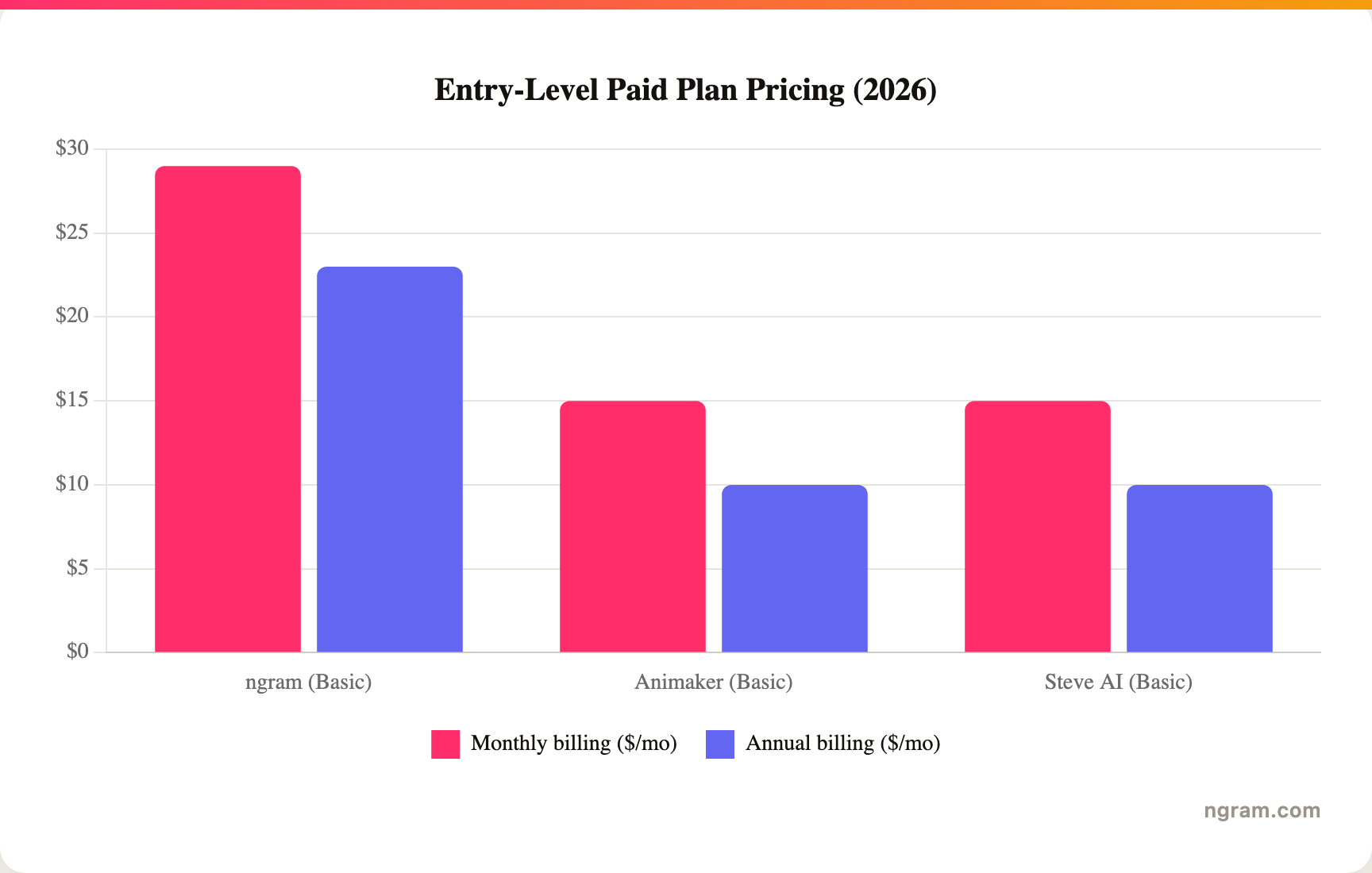
The headline numbers look close, but read the fine print: Animaker's Basic gives only a handful of premium downloads a month, Steve AI's Basic caps you near 100 minutes of video at 720p, and ngram's Basic plan includes 3,000 credits a month on a credit model shared across video, editing, and exports. Animaker and Steve AI show no public monthly Basic price below their annual rate, so each chart uses an approximate month-to-month figure against the lower annual rate. Match the unit to your real volume before you decide.
Winner: Animaker for the lowest annual entry price, Steve AI for the most output minutes per dollar on text-to-video, ngram for the most generous shared credit volume on an entry plan.
Workflow and where the source material lives
The two tools take opposite workflow bets. Animaker asks you to assemble the video by hand for maximum control. Steve AI asks you to hand it text and let it generate the video for speed. Both are valid, and which you prefer depends on whether you want to direct every scene or move fast.
The shared limitation shows up once the source material is more than a clean script. Animaker expects you to arrive with a scene plan; Steve AI expects you to arrive with text. A team whose source is a product release doc, a 30-minute screen recording, a deck, or a live URL still has to distill that into a script, and neither tool plans the storyboard with you or assembles screen recordings, callouts, and B-roll into one branded business video.
This is the clearest reason buyers comparing Animaker vs Steve AI end up looking at a third option.
1. ngram, the better third option for source-to-video teams
Watch how ngram turns an idea into a finished video:
ngram does the same core job as Steve AI, turning text into a video, and overlaps with Animaker on producing a finished, on-brand explainer. Where it differs is the planning layer. Instead of assembling scenes by hand or accepting whatever a one-shot generator produces, you give ngram a prompt, a PDF, a URL, a deck, screenshots, a screen recording, or raw footage, and its agentic chat plans the script, storyboard, scenes, captions, and call to action for you to review before anything renders.
That plan-first, source-aware workflow is the difference. For the marketers, educators, and product teams who make up most "Animaker vs Steve AI" searches, the real job is rarely "a fast faceless clip" or "a hand-built cartoon." It is a product explainer, an onboarding walkthrough, or a launch video that needs voiceover, captions, branded intros, screen-recording polish, and MP4 export, all on brand and built from material they already have. ngram is the strong third option for that, and on the text-to-video slice it competes with Steve AI directly. If your job is specifically a custom cartoon mascot, Animaker still owns that craft; if you want the cheapest high-volume faceless clips, Steve AI is hard to beat on raw minutes.
What makes ngram different
- Source-aware inputs - Start from a prompt, PDF, URL, screenshot, screen recording, raw video, deck, or Shopify product, not just typed text or a blank scene.
- Plan before render - Review the script and storyboard in chat, fix direction early, then generate. No one-shot surprises and no rebuilding a timeline scene by scene.
- Presenters plus production - Use an avatar library, a custom face, a talking head with lip sync, or a generated on-brand presenter, then add screen-recording polish, smart zooms, callouts, motion graphics, and B-roll in the same video.
- Brand kits - Logos, colors, fonts, approved and blocked phrases applied automatically to every video.
- Localization built in - Translate script, captions, and on-screen text, generate multilingual voiceover, and re-lip-sync presenters for each language.
- MP4 export - Finished videos export as MP4; separate media tools can derive GIF, WebM, PNG, or JPG from supplied media.
Where ngram is honest about its limits
ngram is not a hand-animation studio, so a bespoke cartoon character built frame by frame is Animaker's job, not ngram's. It is also not optimized purely for the cheapest high-volume faceless clip count, where Steve AI's minute-based plans can be very economical. ngram provides hosted video pages and embeds but has no generally available owner analytics surface, so analytics-heavy buyers should confirm needs first. Its security certifications are not published yet, so a compliance-bound program with a strict SOC 2 or ISO requirement should verify before standardizing on it.
Who ngram is best for
ngram fits product marketing, growth, sales, customer success, support, and training teams that turn business material into polished video repeatedly. For current plans and credits, check ngram pricing rather than stale screenshots, and for the direct head-to-heads see the ngram vs Animaker comparison and the ngram vs Steve AI comparison.
Ready to try ngram? Create your first video from a prompt, doc, URL, deck, screenshot, or recording. Start free
2. Animaker
Animaker is best for custom characters, cartoon-style explainers, and asset-rich 2D animation. Public details were checked against Animaker's pricing and product pages for this 2026 comparison.
Key features
- Character builder - More than 15 facial features and 10 accessory slots to build unique branded characters.
- Largest asset library - Millions of animated characters, props, icons, and stock media to fill scenes.
- AI voiceovers - Text-to-speech in many languages and accents, sold as a separate Animaker Voice subscription.
- AI and template starts - Text-to-animation, whiteboard and infographic styles, plus 1,000+ templates.
- 4K export - Higher-quality export on upper tiers for agency and client work.
What users say
Users praise Animaker for its character builder and the size of its asset library, and many call it the easiest way to get a branded cartoon mascot without an illustrator. The common cautions are performance and scope: the editor can lag past roughly 10 scenes, the free watermark is large, and buyers who expect one-shot AI video generation sometimes reach for a more automated tool.
Best for
Choose Animaker when custom characters, creative control, and a deep asset library matter most for cartoon-style explainers and classroom or HR content.
3. Steve AI
Steve AI, also built by Animaker Inc., is best for creators making fast animated or live-action videos from a script or a blog post. Public details were checked against Steve AI's pricing and product pages for this 2026 comparison.
Key features
- Text-to-video - Turn a script, prompt, or blog post into a full video with scenes and voiceover.
- Many output styles - Animated, live-action stock, generative AI visuals, and talking-head clips in one tool.
- 250+ AI voices - A large voiceover library with multiple accents and adjustable speed.
- Animated templates - A library of templates and characters for quick scene building.
- Unlimited exports - No watermark and unlimited exports on paid tiers, metered by video minutes.
What users say
Reviewers like Steve AI for being beginner-friendly, fast, and cost-effective, especially for faceless YouTube channels, marketers, and educators producing volume. The trade-offs they raise are a template pool that can feel limited and repetitive, a lack of advanced animation tools for complex work, occasional stability or buffering issues, and access limits some older lifetime-deal users hit after the move to generative AI.
Best for
Choose Steve AI when you want to turn text into watchable animated or live-action videos quickly and at volume without much manual editing.
How we compared these tools
This is not a star rating. It is a decision-weighting model for buyers choosing between two AI video tools, with ngram included as the third option many of them actually need.
| Criteria | Weight | What we looked at |
|---|---|---|
| AI capabilities | 30% | Text-to-video, voice, output styles, and source-to-video depth |
| Features | 30% | Animation depth, asset library, templates, and export options |
| Ease of use | 20% | Time to a first finished video, learning curve, and reliability |
| Value | 15% | Public pricing, video minutes, credits, watermarks, and resolution |
| Support and community | 5% | Collaboration, support responsiveness, and brand controls |
We reviewed official vendor pricing and product pages, current SERP patterns, and 2026 review-site and Reddit sentiment, and we did not use numerical star ratings because they flatten the real decision: the best tool depends on whether you need deep character animation, fast text-to-video at volume, or a full source-to-video workflow.
Common questions
Is Animaker better than Steve AI?
Neither is better outright, and they come from the same company for different jobs. Animaker wins for custom characters, creative control, and a larger asset library, while Steve AI wins for fast text-to-video across many output styles. Match the tool to the job, and consider ngram if your real need is a finished narrated business video planned from a doc, URL, or recording.
Is Steve AI cheaper than Animaker?
The two land at a similar headline entry price, about $10 a month on annual Basic for each. But the units differ: Steve AI Basic includes around 100 minutes of AI video a month, while Animaker Basic limits premium downloads, so the cheaper plan depends on whether you measure value in minutes or in animation depth.
What is the best Animaker and Steve AI alternative?
For teams that need more than a fast clip or a hand-built cartoon, ngram is the strongest alternative because it plans and builds finished videos from prompts, docs, URLs, decks, screenshots, and recordings, with a storyboard you review first, then adds presenters, voiceover, captions, and branding. Animaker and Steve AI remain the specialist picks for custom character animation and high-volume text-to-video.
Which is better for faceless YouTube videos, Animaker or Steve AI?
Steve AI is the stronger faceless-content pick because it turns a script or blog post into an animated or live-action video quickly and meters generously by minutes. ngram is the better fit when the video needs to be planned from real source material and shipped on brand across formats rather than mass-produced.
Which one should you pick?
The Animaker vs Steve AI decision is really about how the video gets made, not the logos. If you want deep character creation and a huge asset library for cartoon-style explainers, pick Animaker. If you want to turn text into fast animated or live-action clips at volume, pick Steve AI. If your actual job is turning real business material into finished, narrated, on-brand videos, with a storyboard you approve before render and screen recordings, callouts, and B-roll in the mix, ngram beats both, and it competes with Steve AI directly on the text-to-video job. The mistake is treating every AI video tool as interchangeable. In 2026, workflow fit matters more than the category label.
---
Try ngram free, your first video in under 5 minutes. Turn a prompt, doc, URL, deck, or screen recording into a polished, on-brand video you plan before you render. Start free