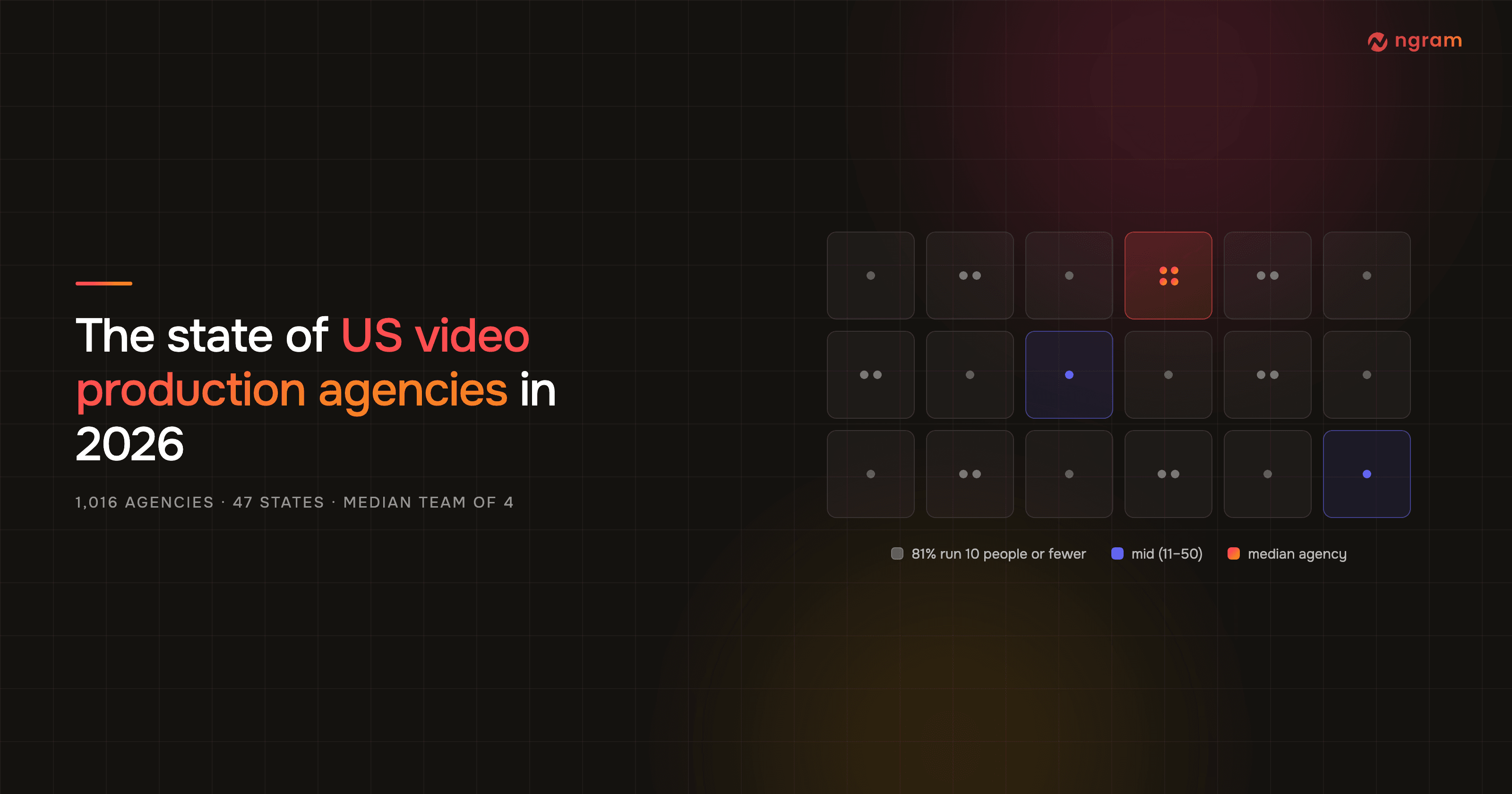

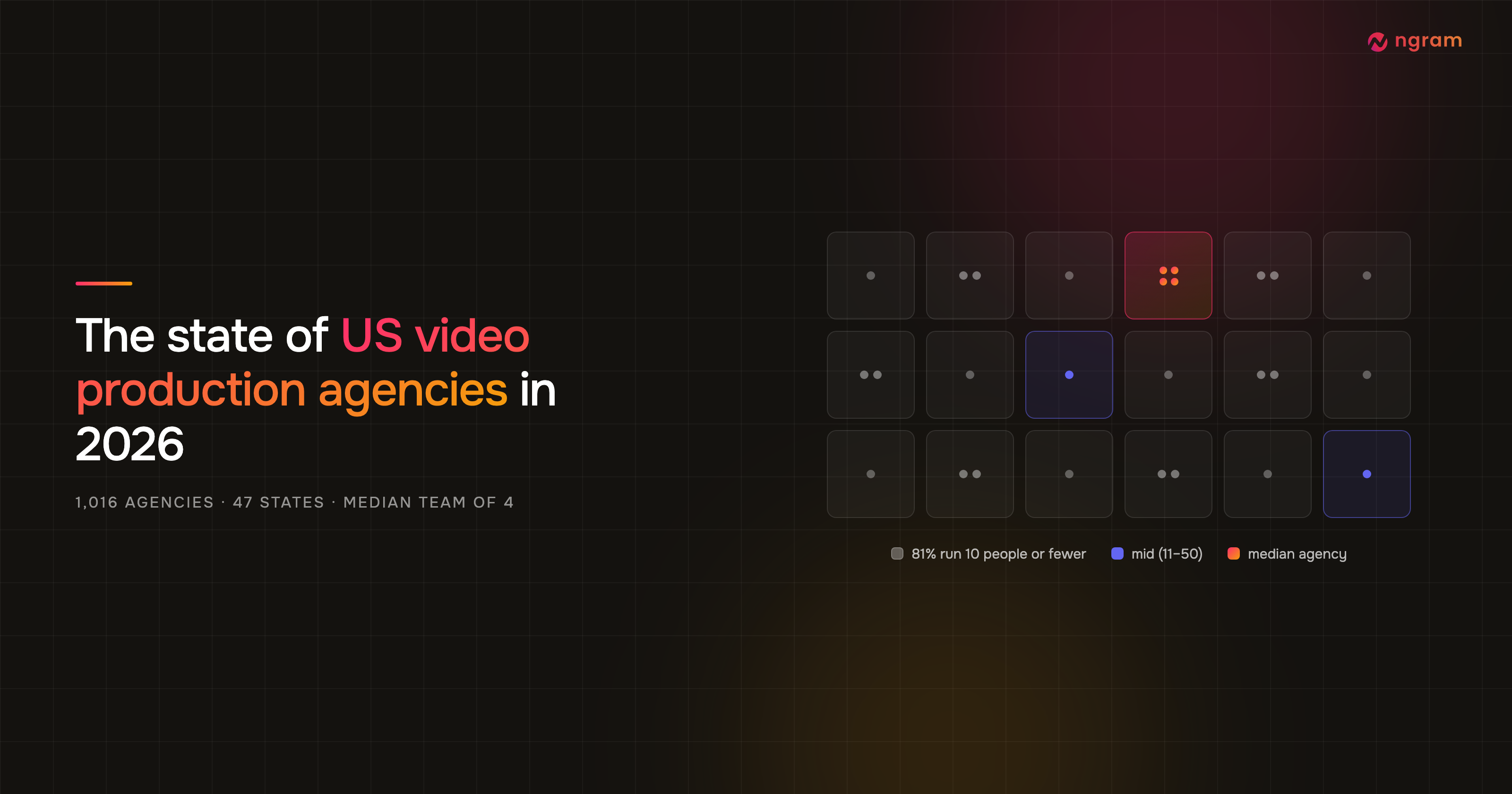
Picture a US video production agency and you probably picture a studio: a soundstage, a grip truck, a roomful of editors. The data says otherwise. We profiled 1,016 real US video production agencies in ngram's directory, and the median one is a team of four people that has been around since 2012 and sells almost six different services off the same website.
This is a data report, not a ranking. The numbers below come from ngram's directory of 1,016 US video production agencies spanning 47 states. Where we cite the broader market, the source is named inline. The point is to show what the industry actually looks like in 2026, and what that means for the small shops that make up most of it.
The headline: the typical US video agency is a 4-person boutique
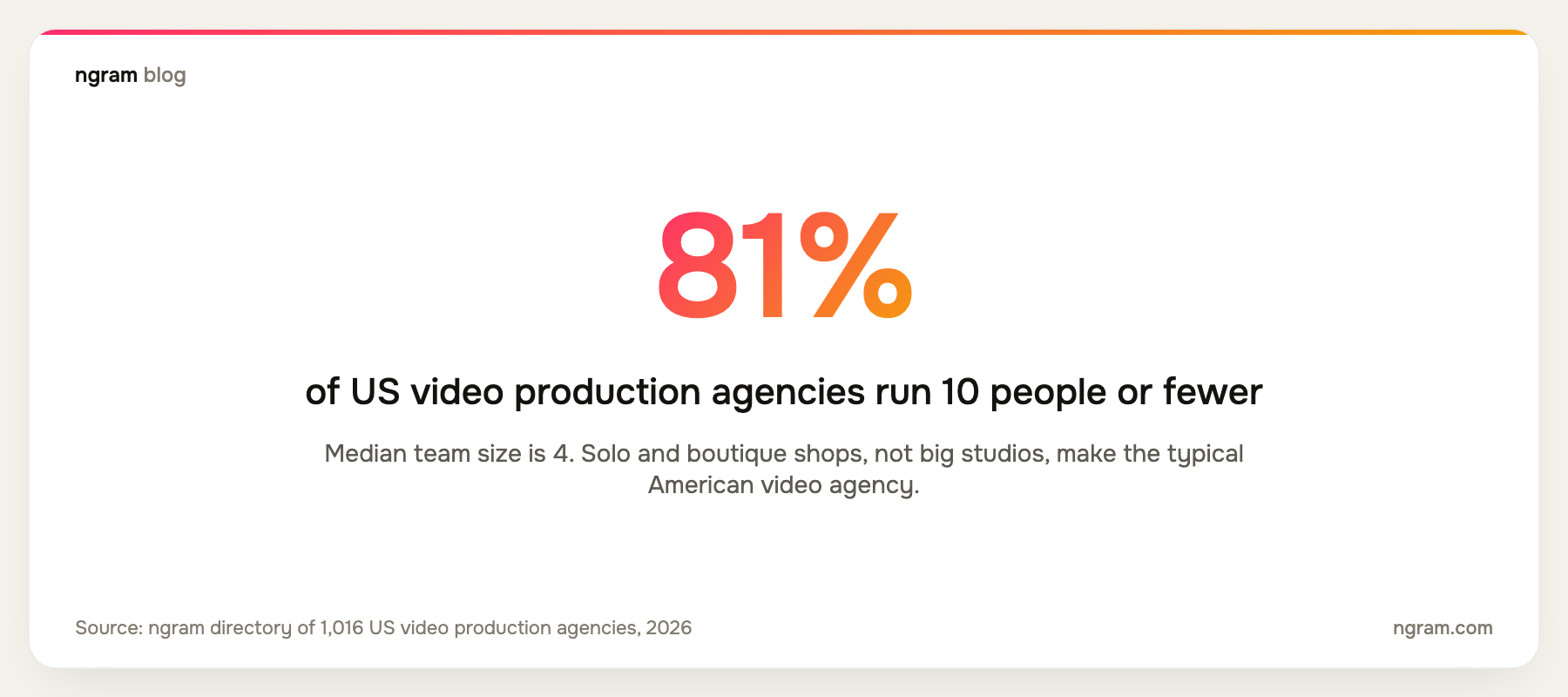
Across the 1,003 agencies that reported a team size, the median is four people. Group them into bands and the shape is stark. Solo and duo shops (1 to 2 people) account for 371 agencies. Boutiques (3 to 10) are the single largest band at 455. Mid-size teams (11 to 50) drop to 159, and only 18 agencies run 50 people or more.
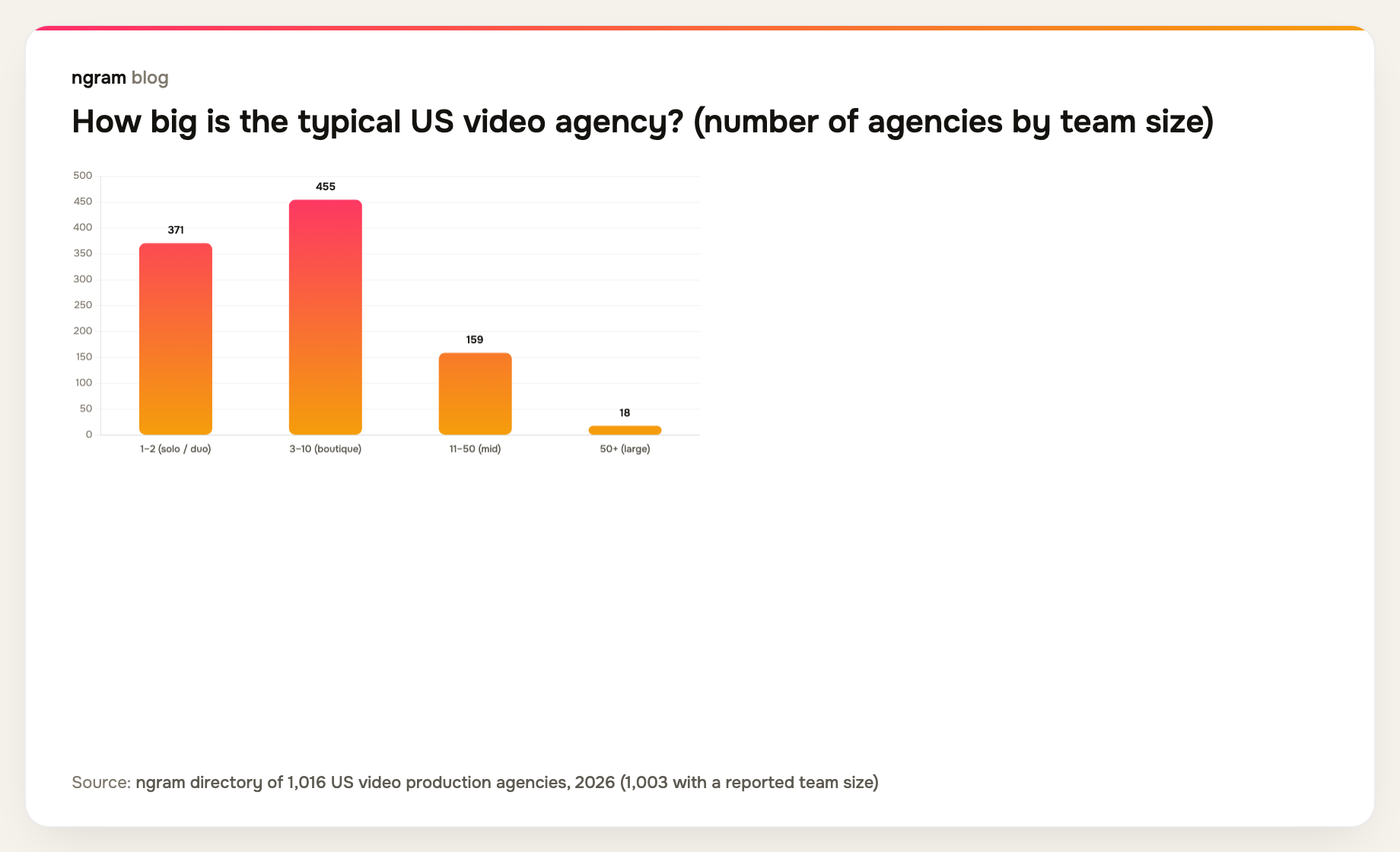
Add the two smallest bands and 81% of US video agencies run 10 people or fewer. The large studio is the exception, not the norm. Most video work in this country is done by a handful of people who shoot, edit, manage clients, and chase invoices, often the same week.
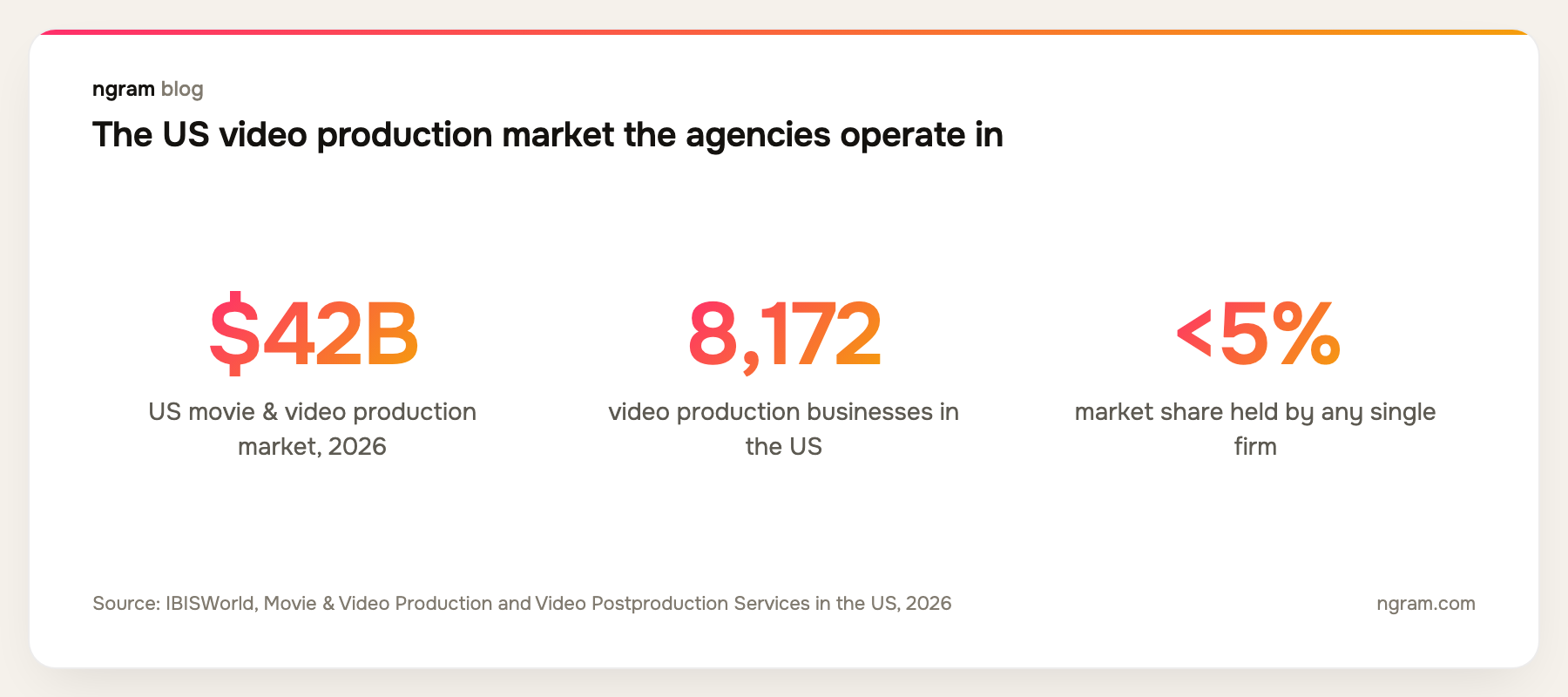
That structure matches the wider market. The US movie and video production industry is worth about $42.0 billion in 2026 across roughly 8,172 businesses, and the video postproduction segment is so spread out that no single firm holds more than 5% of it, per IBISWorld. A fragmented market full of small operators is exactly what our directory shows up close.
Who is still being founded, and when
The oldest agency in the directory dates to 1959. The newest opened in 2025. The median founding year is 2012, which puts the typical agency at about 14 years old. But the formation curve has two peaks worth noting.
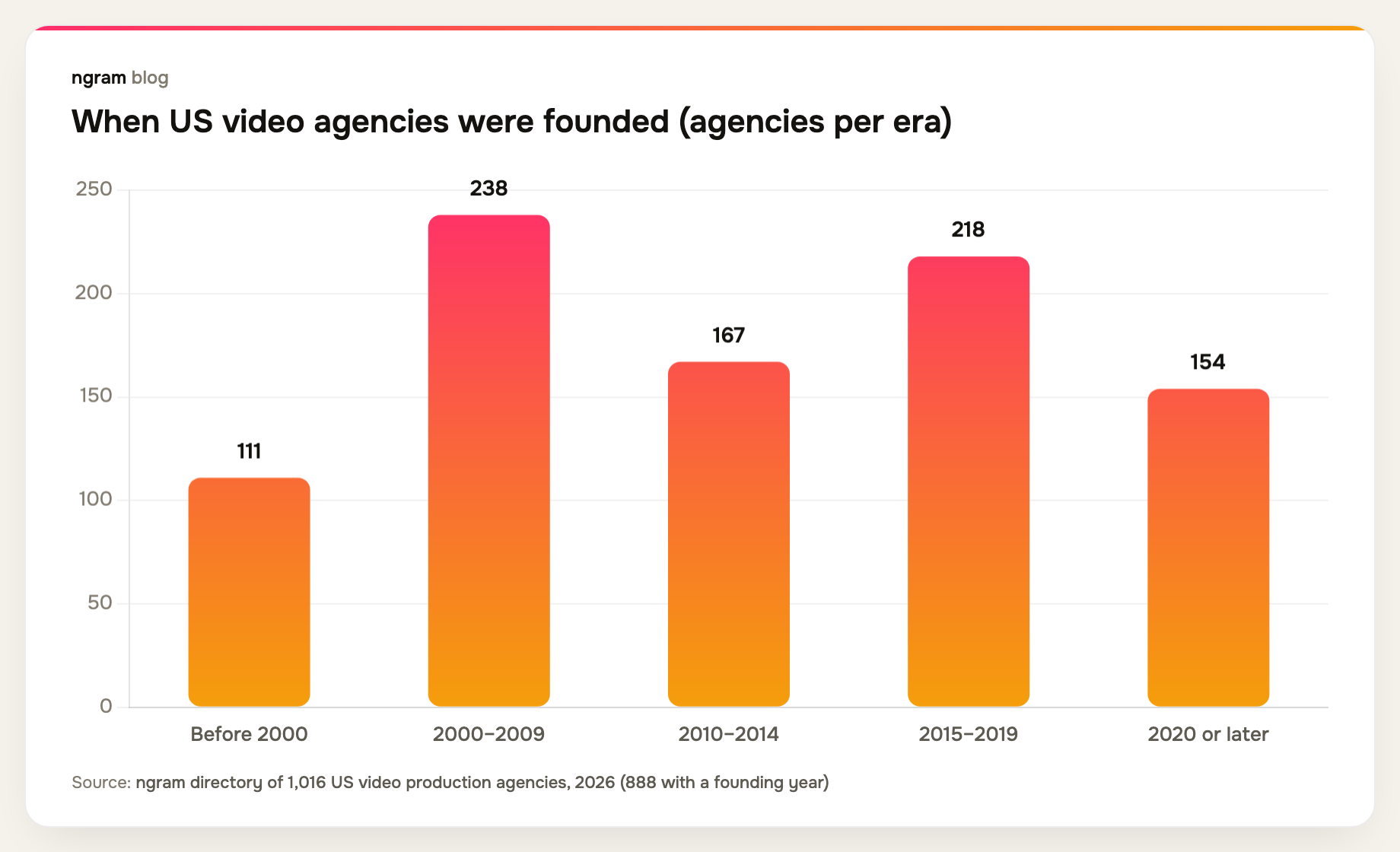
The first wave came in the 2000s, when affordable HD cameras and Final Cut put production within reach of a two-person shop. That decade produced 238 of the agencies still operating, the densest band in the data. The second wave is now: 154 agencies were founded in 2020 or later, despite a pandemic that froze on-site shoots. People kept starting video companies because demand kept climbing.
What the chart does not show is churn. A directory of active agencies only counts the survivors, so the dip in the 2010 to 2014 band (167) versus its neighbors may reflect closures as much as slower formation. Read the founding curve as a floor, not a census.
Geography: four states hold almost half the industry
Video agencies are not spread evenly across the country. They cluster where the clients and the camera crews already are. California leads with 192 agencies, New York follows with 103, then Florida (94) and Texas (75). Those four states alone hold about 46% of every agency in the directory.
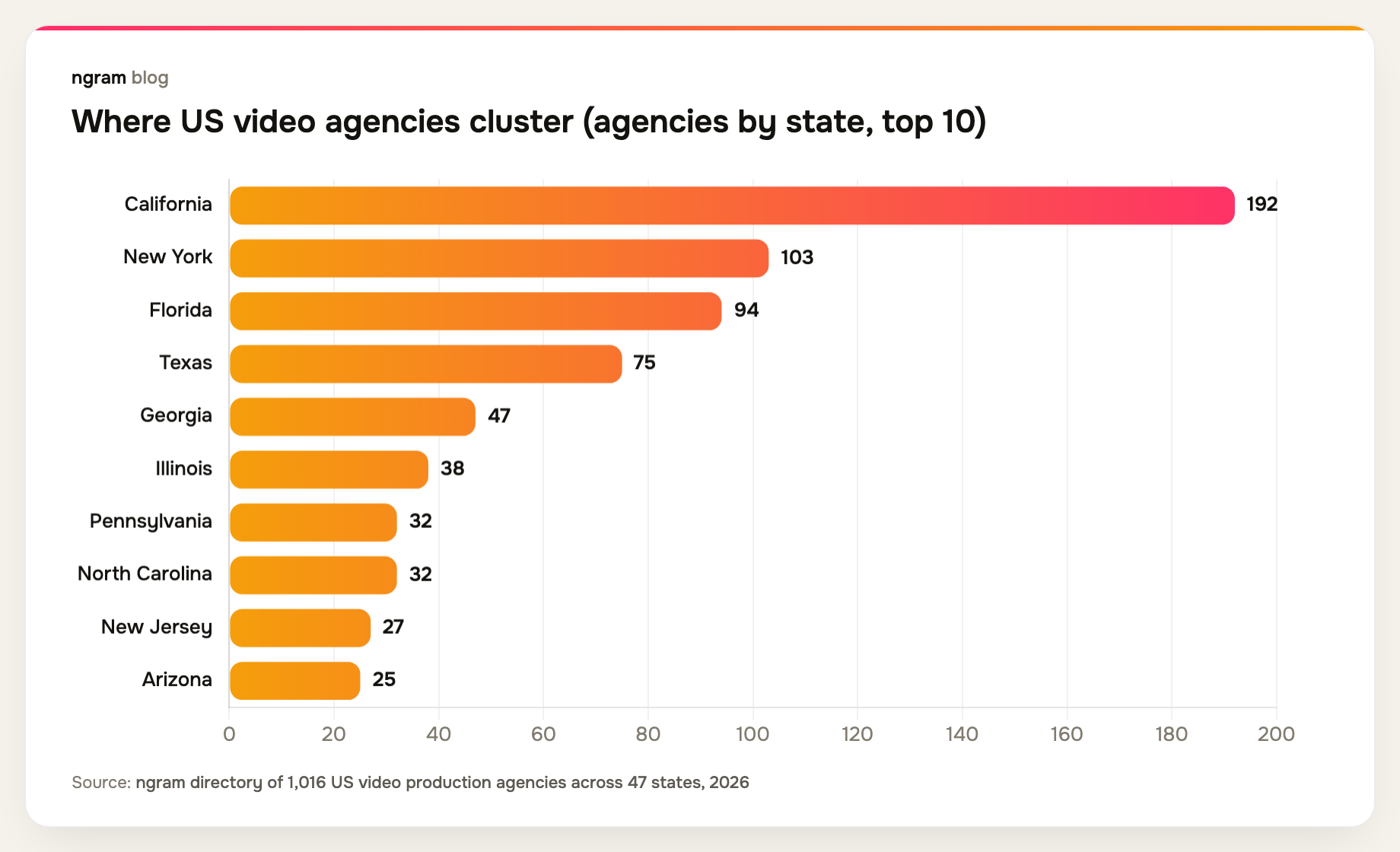
Zoom to the city level and the pull is even tighter. New York City alone is home to 70 agencies and Los Angeles 57, followed by Chicago (26), Atlanta (25), and Miami (23). Atlanta's showing is the one to watch: a decade of film-tax-credit-driven studio buildout has turned Georgia into the fifth-ranked state, ahead of Illinois. If you are hiring a crew, the map tells you where the bench is deep. If you are a buyer outside these hubs, it tells you why your shortlist is thin.
This is also where a directory earns its keep. Buyers do not search nationally, they search locally, which is why the most-used pages tend to be city listings like video agencies in New York and video agencies in Los Angeles. The full set of 1,016 profiles lives in the ngram video agencies directory.
The service mix: generalists, not specialists
If you expected sharp specialization, the data will surprise you. The average agency lists 5.6 services. The four-person shop is not a niche operator. It is a generalist that will shoot your commercial, cut your social clips, and film your conference, often all in the same month.
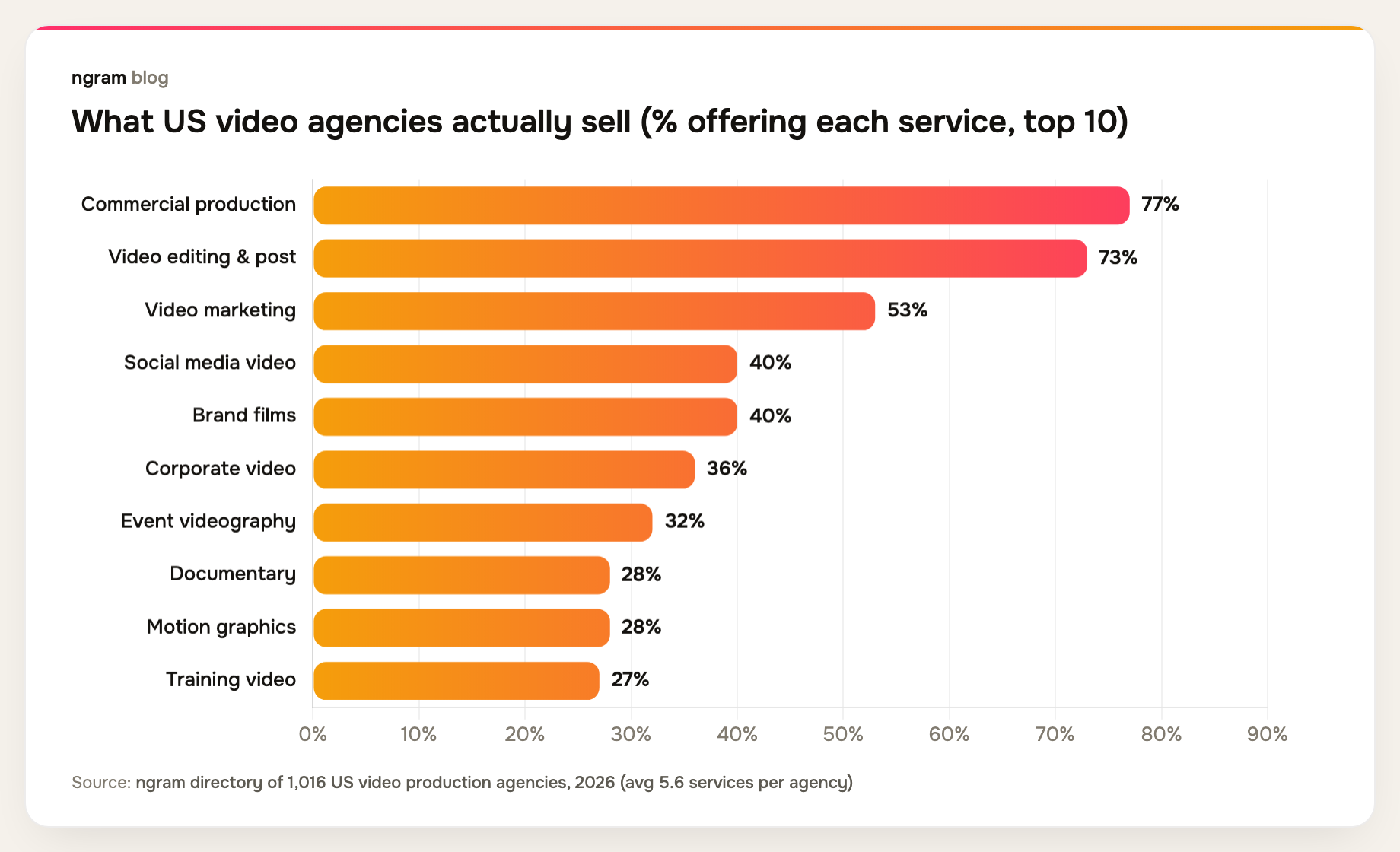
Commercial production is the near-universal offering at 77%, with video editing and post close behind at 73%. After that the list reads like a small business hedging its bets: video marketing (53%), social media video and brand films (40% each), corporate video (36%), and a long tail of event, documentary, motion graphics, and training work. Few agencies bet the firm on a single category. When your team is four people, breadth is how you keep the calendar full between big shoots.
Buyers shop the other way around. Someone who needs a TV spot searches for that, not for a generalist, which is why specialty pages such as commercial production agencies do the matchmaking the agency's own homepage cannot.
What a boutique-dominated industry means for AI
Here is the part the structure of the industry actually predicts. The same trait that makes these agencies fragile to AI also makes them quick to adopt it.
A four-person generalist has no edit bay full of junior editors to protect and no committee to convince. The bottleneck is one person's time. When the same week brings a commercial, a batch of social cuts, and an event recap, the work that pays least per hour is the first cut: the rough assembly, the captions, the social reframes, the second-language version a client asks for late. That is the layer AI is good at now, and it is the layer a small shop most wants off its plate.
We build for that handoff. With ngram, an agency can drop in a brief, a URL, or an existing recording and get a scripted, storyboarded first cut back, with AI voiceover, captions, and channel-specific exports, in minutes rather than days. The agency still owns the taste, the client relationship, and the final grade. AI just takes the first pass off the bottleneck so a small team can say yes to more work without hiring a fifth person.
That is the realistic 2026 picture. Not studios replaced by software, but boutiques using software to do what only studios could before. In a market where 81% of agencies run 10 people or fewer and average 5.6 services each, the winners will be the small teams that let AI handle the repeatable first cut and spend their scarce hours on the work clients actually pay a premium for.
Run a small video shop? ngram turns a brief, a URL, or raw footage into a scripted first cut you can refine and ship. Try it free.
Methodology and limits
The firmographics here come from ngram's directory of 1,016 US video production agencies across 47 states: team size, founding year, location, and self-listed services for each. Team-size figures use the 1,003 agencies with a reported count; founding-year figures use the 888 with a stated year. Service percentages are the share of all 1,016 agencies that list each service.
Two limits to keep in mind. First, a directory of active agencies undercounts the ones that have closed, so the historical founding picture skews toward survivors. Second, 1,016 agencies is a large sample but not the whole universe of US video production businesses, which IBISWorld puts in the thousands. Treat this as a detailed cross-section of working US video agencies, not a national census. Where market-level figures appear, they are cited to IBISWorld inline.
Frequently asked questions
How big is the typical US video production agency?
Small. Across 1,003 agencies in ngram's directory that reported a team size, the median is four people, and 81% run 10 people or fewer. Solo and duo shops (371) plus 3-to-10-person boutiques (455) make up the bulk of the industry. Only 18 of the 1,016 agencies have 50 or more staff.
Which US states have the most video production agencies?
California (192), New York (103), Florida (94), and Texas (75) lead, and together hold about 46% of all agencies in the directory. Georgia ranks fifth with 47, ahead of Illinois, reflecting Atlanta's growth as a production hub. At the city level, New York City (70) and Los Angeles (57) are the densest markets.
What services do video production agencies offer?
Most are generalists, listing 5.6 services on average. The most common offerings are commercial production (77% of agencies), video editing and post (73%), video marketing (53%), social media video (40%), and brand films (40%). Corporate video, event videography, documentary, motion graphics, and training round out the top ten.
Are video production agencies being replaced by AI?
Not replaced, but reshaped. Because 81% of US video agencies run 10 people or fewer, the bottleneck is one person's time, not headcount. The fastest-adopting shops use AI to handle the repeatable first cut (rough assembly, captions, social reframes, alternate-language versions) and keep human judgment for direction, client relationships, and the final grade. That lets a small team take on more work without hiring.
How old is the average video production agency?
The median founding year among the 888 agencies with a stated year is 2012, making the typical agency about 14 years old. The oldest in the directory dates to 1959 and the newest to 2025. Formation peaked in the 2000s (238 agencies) and again from 2020 onward (154 agencies founded since 2020).