
HeyGen is one of the first names buyers shortlist for AI avatars. It is also one of the tools where 2026 buyers are reading the credit rules twice before they standardize a team.
HeyGen deserves credit for digital twins, Avatar IV access, video translation, 175+ languages on paid plans, 4K export on Pro and above, and business collaboration features. But the HeyGen alternatives search in 2026 is not only about replacing one feature. Buyers are comparing credit systems, rendering limits, avatar realism, collaboration, localization, sales workflows, brand control, and whether the tool can turn messy business source material into a finished video.
That shift matters because video is no longer a side asset. Wyzowl's 2026 video marketing report says 91% of businesses use video as a marketing tool, and Grand View Research projects the AI video generator market to reach $3.44 billion by 2033. More teams are making video, and the tolerance for generic output is getting lower.
We refreshed this review on June 1, 2026 using official vendor pages, current SERP structure, Reddit and review-site language, and ngram's live product-state file. The short version: keep HeyGen if its core workflow is exactly what you need. Move to ngram or one of the specialist alternatives below if your actual job is broader.
What is pushing users off HeyGen
HeyGen still has a clear place in the market. The switch usually starts when teams ask it to cover a workflow it was not designed to own end to end.
Credit math can surprise teams - HeyGen Creator, Pro, and Business plans list monthly credits. Buyers need to map regenerations, premium features, and rollout volume before assuming the headline plan fits.
Avatar quality is only part of the job - A realistic presenter is useful, but launch, demo, training, and support videos also need story, product visuals, captions, callouts, and brand control.
Business features sit higher in the stack - SAML/SSO, SCORM, workspace collaboration, integrations, and longer videos are Business or Enterprise territory.
Creator workflows differ from B2B workflows - HeyGen is strong for avatar-led content. Teams starting from release notes, decks, URLs, screenshots, and recordings may need a more source-aware process.
The right alternative depends on whether your bottleneck is speed, avatar realism, training governance, sales workflow, source ingestion, or final polish.
Quick comparison
| Tool | Best for | Current pricing note | Main distinction |
|---|---|---|---|
| ngram | Business teams turning prompts, PDFs, URLs, screenshots, decks, screen recordings, and raw footage into polished branded videos | See ngram pricing | Plan-first video generation |
| Synthesia | Enterprise training, enablement, and localized avatar videos | Free, Starter, Creator, Enterprise | Enterprise avatar scale |
| D-ID | API-first talking-head video and real-time visual agents | Free Trial, Lite, Pro, Advanced, Enterprise | Realtime avatar API |
| DeepBrain AI | AI Studios avatar videos, training content, and multilingual presenter workflows | Free, Personal, Team, Enterprise | Unlimited avatar plans |
| Elai | L&D, interactive video, PowerPoint-to-video, and avatar training content | Free, Creator, Team, Enterprise | L&D interactivity |
| Colossyan | Workplace learning videos with avatars, quizzes, and SCORM-friendly workflows | Free trial, Starter, Business, Enterprise | Learning workflow focus |
| InVideo AI | Prompt-to-video, stock-backed social videos, and creator marketing assets | Free and paid credit plans | Prompt-to-video breadth |
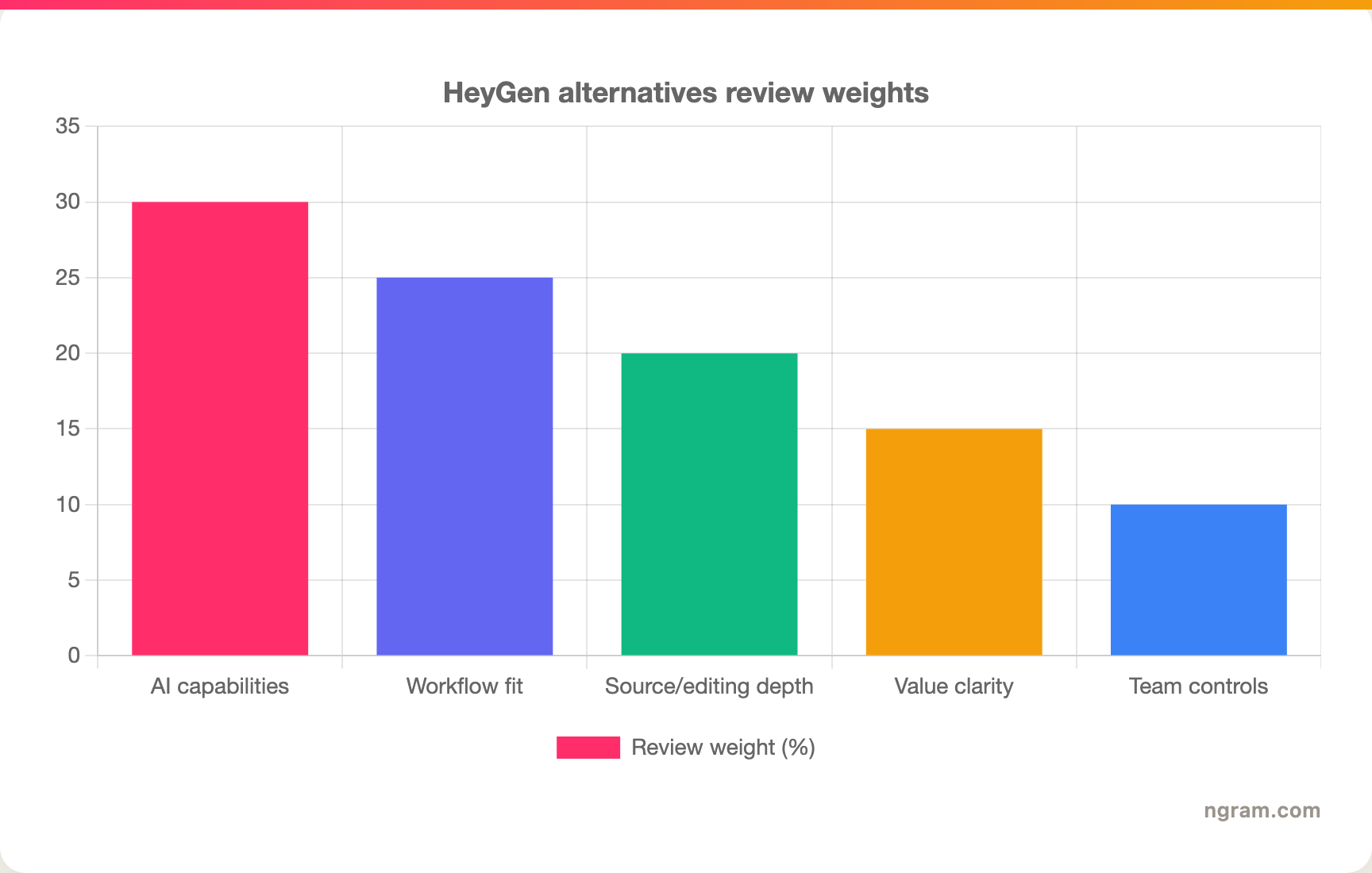
The chart below shows the weighting we used for this HeyGen refresh. These are review criteria, not product ratings.
1. ngram
Watch how ngram turns an idea into a finished video:
ngram is the strongest alternative to HeyGen when your team needs more than a generated talking head or a quick recorder. It is built around an agentic chat workflow: give ngram a prompt, PDF, URL, deck, screenshot, screen recording, raw video, or Shopify product URL, then review the script and storyboard before the video renders.
That plan-first workflow matters for creator, marketing, localization, and business teams trying to understand credits, avatar quality, and workflow breadth. HeyGen can be useful for its core job, but many teams searching for alternatives are really asking for a broader production system. They need captions, voiceover, product callouts, branded intros and outros, screen-recording polish, multi-format export, and plain-language edits without rebuilding the project from scratch.
What makes ngram stand out
- Agentic video creation - Describe the audience, channel, source material, and goal in chat. ngram plans the script, storyboard, scene direction, CTA, voiceover, captions, and visuals before rendering.
- Source-aware inputs - Use text prompts, PDFs, URLs, screenshots, screen recordings, raw video, decks, or Shopify product URLs as source material.
- Screen recording polish - Turn rough product recordings into cleaner walkthroughs with trimming, smart zooms, cursor emphasis, callouts, captions, and background styling.
- Brand kits - Apply logos, colors, fonts, screenshot style, tone controls, approved phrases, and blocked phrases across generated videos.
- Editing by chat and timeline - Change the script, regenerate scenes, edit visually, or use the timeline editor when frame-level control matters.
- Multi-format export - Export MP4, GIF, WebM, PNG, JPG, and PPTX in 16:9, 9:16, and 1:1 formats.
Pros
- Strong fit when the output must be customer-ready, not only recorded
- Starts from existing business material instead of a blank editor
- Keeps storyboard review before render so teams can fix direction early
Cons
- Heavier than a quick one-click recorder for casual internal notes
- Detailed performance analytics beyond view counts are still roadmap, so analytics-heavy buyers should verify needs before switching
Who is ngram best for?
ngram is best for product marketing, growth, sales, customer success, support, HR, and training teams that turn business material into polished video repeatedly. If your team only needs a fast internal recording, a narrower recorder may be lighter. If you need the same source material to become a launch video, demo, social cut, training clip, and localized version, ngram is the better fit.
For current commercial terms, check ngram pricing rather than relying on stale plan screenshots.
Ready to try ngram? Create your first video from a prompt, doc, URL, deck, screenshot, or screen recording. Start free
2. Synthesia
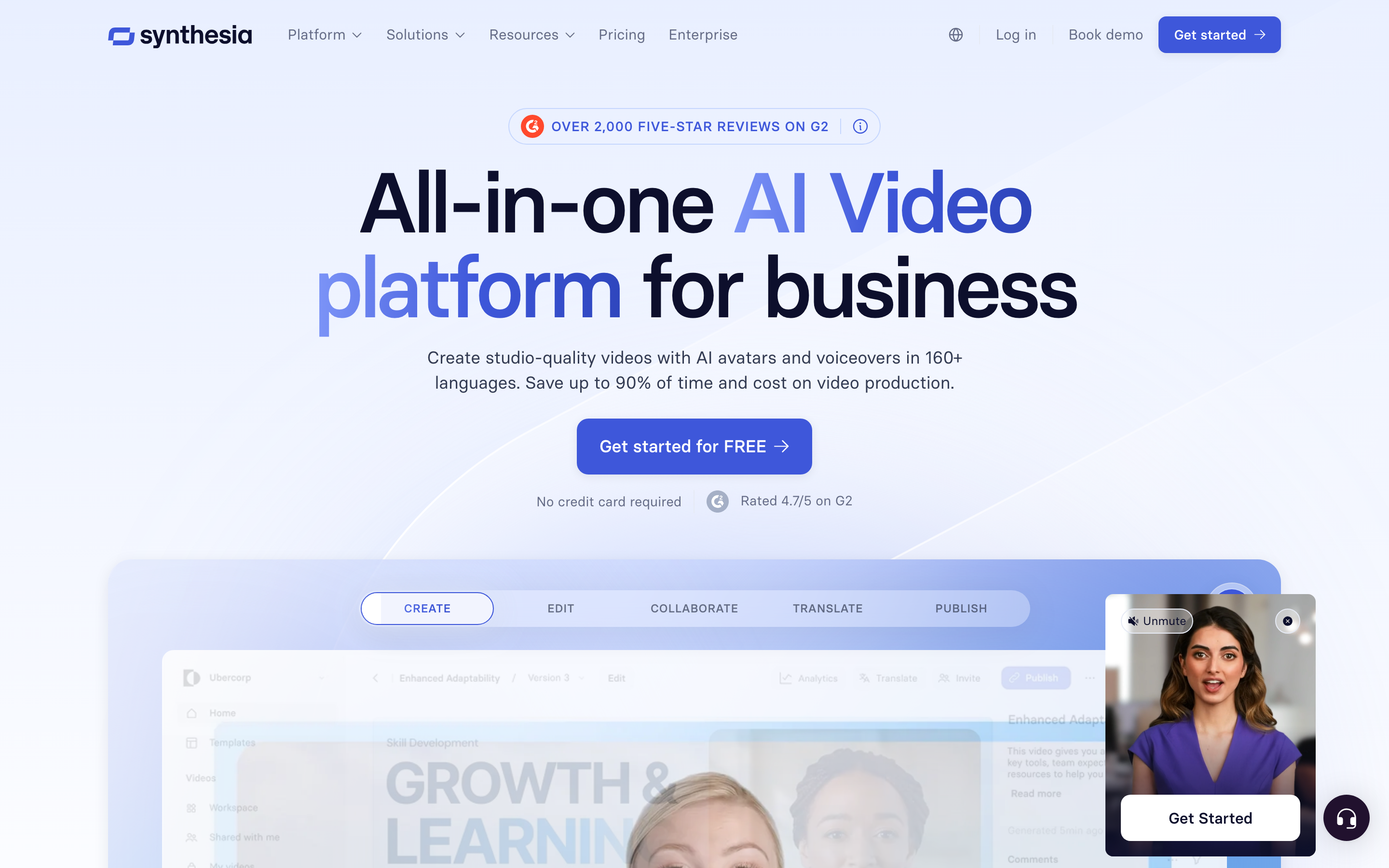
Synthesia is best for enterprise training, enablement, and localized avatar videos. Public details were checked against Synthesia source material for this June 2026 refresh. Compared with HeyGen, Synthesia is strongest for governed training and enablement programs that need avatar presenters at scale.
Key features
- AI avatars - Synthesia lists 240+ AI avatars on Enterprise and smaller avatar sets on self-serve plans.
- Training workflow - Strong fit for L&D, HR, compliance, and enablement content.
- Localization - Enterprise includes one-click translations into 80+ languages.
- SCORM export - Useful for LMS-backed training programs.
- Collaboration - Creator and Enterprise add more review and workspace features.
What users say
Buyers consistently shortlist Synthesia when training quality, governance, localization, and enterprise review matter. The tradeoff is that the product is oriented around structured avatar video, so quick social edits or rough screen-recording polish can feel outside the sweet spot.
The positive pattern is clear: buyers like Synthesia when the workflow lines up with the product's center of gravity. The caution is also clear: teams replacing HeyGen should check whether Synthesia handles planning, source ingestion, editing depth, brand controls, collaboration, and export needs before migrating a whole team.
Pros
- Strong fit for enterprise training, enablement, and localized avatar videos.
- Clearer workflow than broad video suites when the use case matches.
- Mature enough to appear repeatedly across review-site and SERP research.
Cons
- Less complete than ngram when the job starts from mixed business source material.
- Pricing, credits, or workflow limits need careful review before a team rollout.
Best for
Choose Synthesia for governed training and enablement programs that need avatar presenters at scale.
3. D-ID
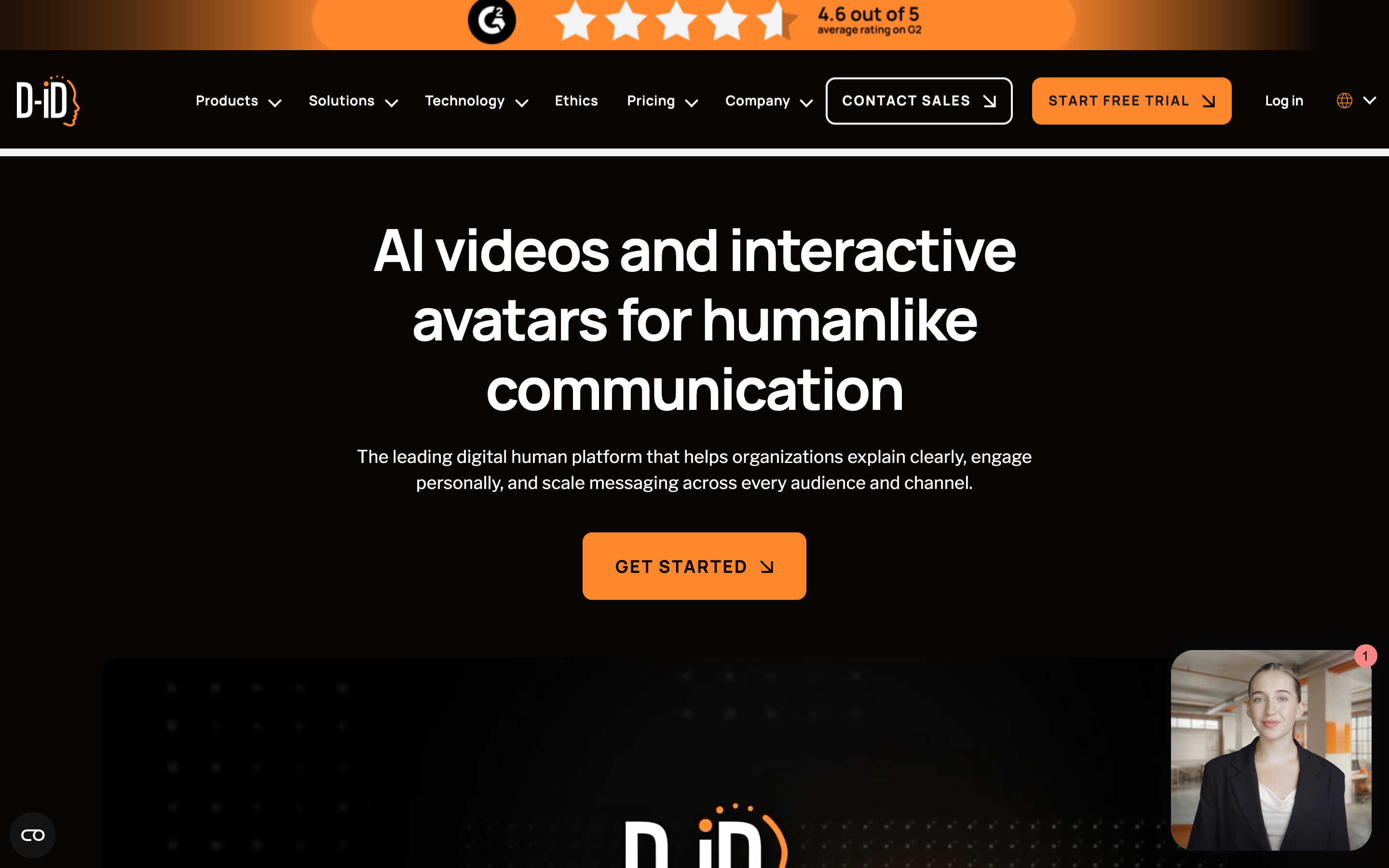
D-ID is best for api-first talking-head video and real-time visual agents. Public details were checked against D-ID source material for this June 2026 refresh. Compared with HeyGen, D-ID is strongest when your team needs generated faces inside an app, bot, or custom workflow.
Key features
- Creative Reality Studio - A visual interface for turning scripts, audio, and images into generated presenter videos.
- API workflow - Studio and API plans are separate buying motions for developers and creators.
- V4 Expressive Visual Agents - D-ID announced real-time, LLM-connected expressive avatars in March 2026.
- Credit and minute model - D-ID support docs say monthly credits or minutes renew and unused balances do not roll over.
- Enterprise use cases - The product is strong for conversational agents, education, and embedded generated people.
What users say
D-ID is respected by technical teams that need an API and real-time digital-human experiences. Nontechnical buyers often compare it against studio-first tools because a simple talking-head pipeline is only one part of a finished business video.
The positive pattern is clear: buyers like D-ID when the workflow lines up with the product's center of gravity. The caution is also clear: teams replacing HeyGen should check whether D-ID handles planning, source ingestion, editing depth, brand controls, collaboration, and export needs before migrating a whole team.
Pros
- Strong fit for api-first talking-head video and real-time visual agents.
- Clearer workflow than broad video suites when the use case matches.
- Mature enough to appear repeatedly across review-site and SERP research.
Cons
- Less complete than ngram when the job starts from mixed business source material.
- Pricing, credits, or workflow limits need careful review before a team rollout.
Best for
Choose D-ID when your team needs generated faces inside an app, bot, or custom workflow.
---
Need a video tool that starts from your actual material? ngram turns prompts, docs, URLs, decks, screenshots, and recordings into branded videos. Try ngram free
---
4. DeepBrain AI
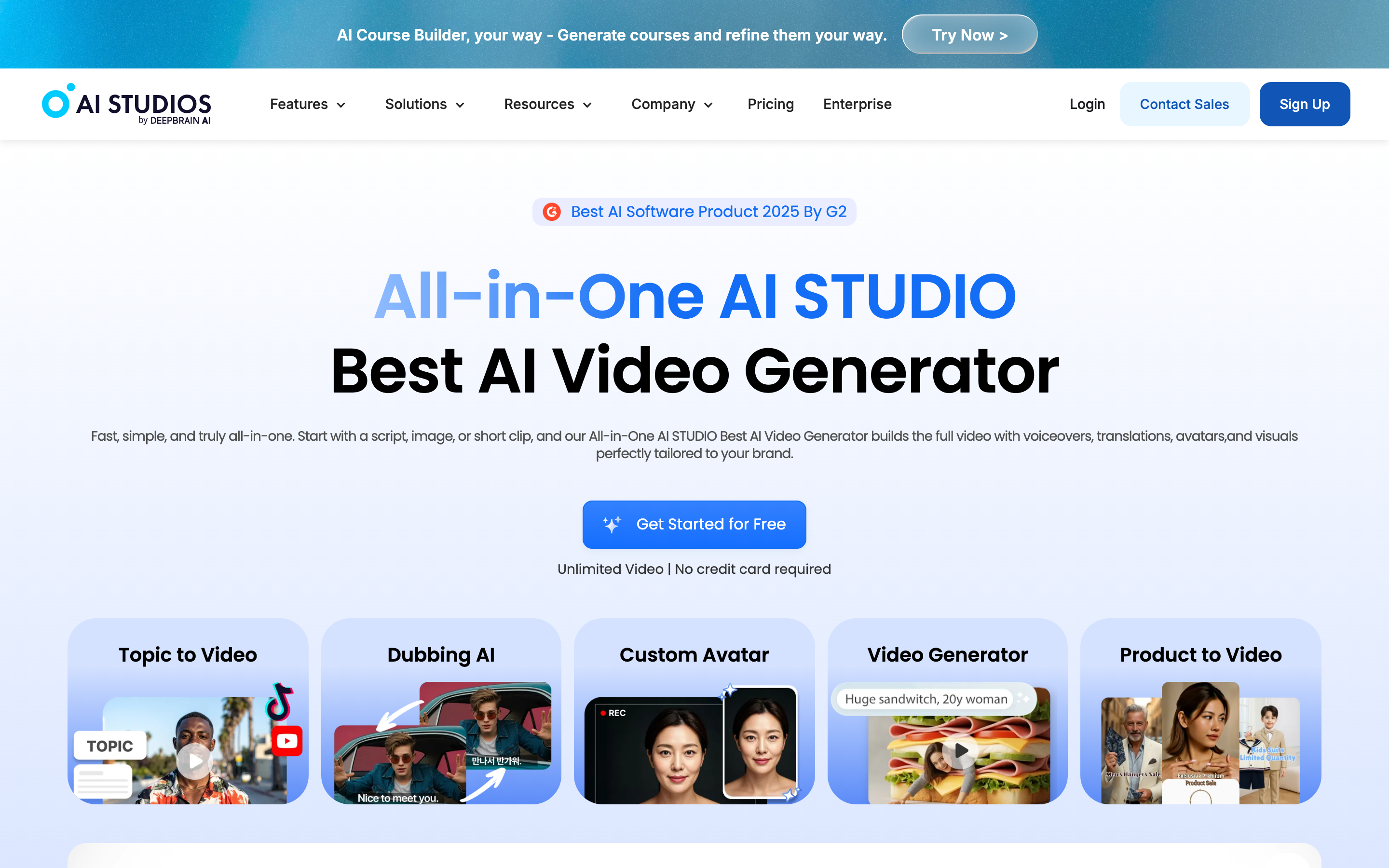
DeepBrain AI is best for ai studios avatar videos, training content, and multilingual presenter workflows. Public details were checked against DeepBrain AI source material for this June 2026 refresh. Compared with HeyGen, DeepBrain AI is strongest when avatar quantity, language range, and longer generated presenter videos are the priority.
Key features
- Unlimited plan model - DeepBrain says Personal and Team plans moved to unlimited video creation with per-video length limits.
- AI Studios 4.0 - The 2026 update adds stronger image/video generation, image-to-video animation, and more language controls.
- Large avatar library - AI Studios 4.0 references 2,000+ AI-generated avatars.
- Voice and language coverage - DeepBrain lists 110+ languages and 1,000+ AI voices.
- 4K export - Team and Enterprise users get 4K avatar video export.
What users say
Teams like DeepBrain AI when they want a presenter-led studio with a generous unlimited framing. The caution is around queues, priority processing, and add-on generative credits, which buyers should understand before moving high-volume production there.
The positive pattern is clear: buyers like DeepBrain AI when the workflow lines up with the product's center of gravity. The caution is also clear: teams replacing HeyGen should check whether DeepBrain AI handles planning, source ingestion, editing depth, brand controls, collaboration, and export needs before migrating a whole team.
Best for
Choose DeepBrain AI when avatar quantity, language range, and longer generated presenter videos are the priority.
5. Elai
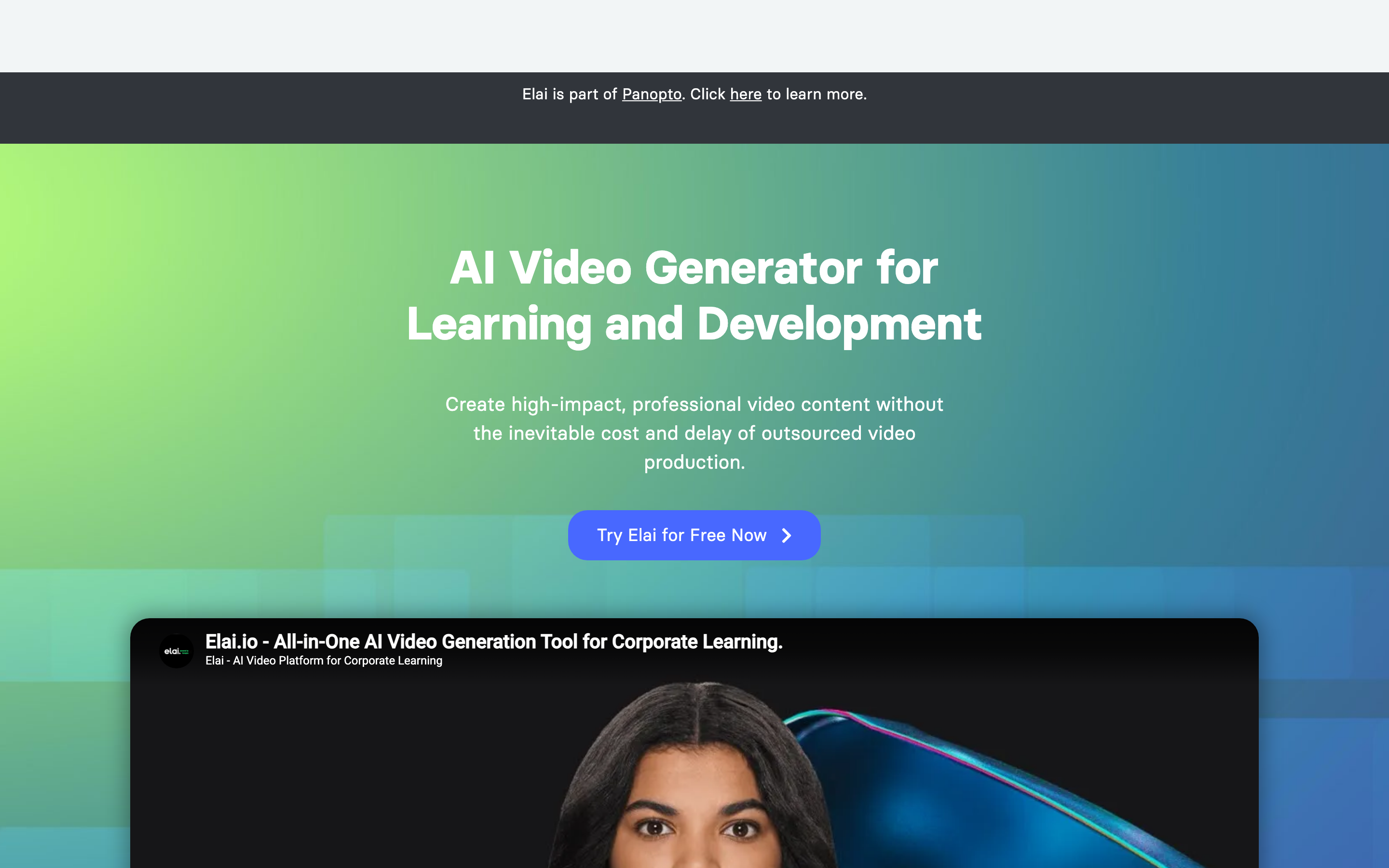
Elai is best for l&d, interactive video, powerpoint-to-video, and avatar training content. Public details were checked against Elai source material for this June 2026 refresh. Compared with HeyGen, Elai is strongest when interactive training video is the center of the requirement.
Key features
- Avatar library - Elai lists 80+ avatars across plans.
- Creator plan - The public pricing page lists 15 minutes per month on Creator.
- Team plan - Team adds more minutes, editors and guests, 4K, premium voices, and a selfie avatar plus voice clone.
- Interactive content - Branching, buttons, hotspots, and quizzes support training use cases.
- Enterprise controls - Enterprise lists unlimited users, SSO, workspaces, brand kit, and premium support.
What users say
Elai gets attention from training teams that want avatars plus interactivity without a complex enterprise rollout. Buyers should check minute limits carefully because training libraries can burn through rendering capacity quickly.
The positive pattern is clear: buyers like Elai when the workflow lines up with the product's center of gravity. The caution is also clear: teams replacing HeyGen should check whether Elai handles planning, source ingestion, editing depth, brand controls, collaboration, and export needs before migrating a whole team.
Best for
Choose Elai when interactive training video is the center of the requirement.
6. Colossyan
Colossyan is best for workplace learning videos with avatars, quizzes, and scorm-friendly workflows. Public details were checked against Colossyan source material for this June 2026 refresh. Compared with HeyGen, Colossyan is strongest when training video production is the main workflow.
Key features
- Training orientation - Colossyan positions around creating, updating, and localizing training videos.
- AI avatars - Starter includes 70+ avatars and Business lists 170+ avatars.
- Unlimited Business minutes - Business includes unlimited minutes on its NEO model with per-video limits.
- Interactive videos - Business includes interactive videos with quizzes and branching scenarios.
- Translation - Business includes monthly auto translations.
What users say
Colossyan is often liked by L&D teams because it speaks their language: avatars, comments, branching, and learner-facing video. It is less broad than tools built for marketing, sales, and source-to-video workflows across many business moments.
The positive pattern is clear: buyers like Colossyan when the workflow lines up with the product's center of gravity. The caution is also clear: teams replacing HeyGen should check whether Colossyan handles planning, source ingestion, editing depth, brand controls, collaboration, and export needs before migrating a whole team.
Best for
Choose Colossyan when training video production is the main workflow.
7. InVideo AI
InVideo AI is best for prompt-to-video, stock-backed social videos, and creator marketing assets. Public details were checked against InVideo AI source material for this June 2026 refresh. Compared with HeyGen, InVideo AI is strongest for social-first prompt-to-video when stock footage and fast drafts matter most.
Key features
- v4 agent - InVideo says paid plans include access to an agent that can create up to 30 minutes of video from a prompt.
- Model access - Paid plans list access to 200+ image, video, audio, and music models.
- Stock providers - InVideo includes access to providers such as iStock and Storyblocks.
- Credits - Credits act as platform currency and unused credits do not roll over.
- Social formats - Strong fit for marketing clips, YouTube, Instagram, TikTok, and ad-style content.
What users say
Users like InVideo AI when they want to start with a prompt and get a fast social draft. Complaints in recent Reddit threads cluster around regeneration quality, credit usage, and the gap between a generated draft and a finished business asset.
The positive pattern is clear: buyers like InVideo AI when the workflow lines up with the product's center of gravity. The caution is also clear: teams replacing HeyGen should check whether InVideo AI handles planning, source ingestion, editing depth, brand controls, collaboration, and export needs before migrating a whole team.
Best for
Choose InVideo AI for social-first prompt-to-video when stock footage and fast drafts matter most.
How we compared these tools
We refreshed this HeyGen alternatives review on June 1, 2026. The scoring framework is not a star rating. It is a decision-weighting model for buyers comparing AI video tools.
| Criteria | Weight | What we looked at |
|---|---|---|
| AI capabilities | 30% | Avatar quality, prompt-to-video depth, voiceover, translation, scene generation, and edit automation. |
| Workflow fit | 25% | Whether the product solves the actual switching job: avatar realism, credits, translation, collaboration, and business-video source support. |
| Source and editing depth | 20% | Support for docs, URLs, decks, screen recordings, raw video, transcript editing, callouts, and regeneration. |
| Value clarity | 15% | Public pricing, credit/minute rules, rollovers, watermark limits, and plan boundaries. |
| Team controls | 10% | Collaboration, brand controls, SSO, workspaces, review, publishing, and export options. |
We also reviewed official vendor pages, current SERP patterns, Reddit language, review-site themes, and the live ngram product state. We did not use numerical star ratings because they flatten the real decision: the best tool depends on whether you need a generated avatar, a social-video editor, a sales-video system, or a business-video production workflow.
Common questions
What is the best HeyGen alternative in 2026?
The best HeyGen alternative for most business teams is ngram because it turns prompts, docs, URLs, decks, screenshots, screen recordings, and raw video into planned, branded videos. Synthesia is stronger when you specifically need enterprise training, enablement, and localized avatar videos.
Is there a free HeyGen alternative?
Several tools in this list offer a free plan or trial, including ngram, Synthesia, and D-ID. Free plans are useful for testing workflow fit, but production teams should check watermark, minute, credit, export, and collaboration limits before standardizing.
How does HeyGen compare to Synthesia?
HeyGen is strongest for AI avatars, digital twins, translation, and creator-friendly video generation. Synthesia is better for governed training and enablement programs that need avatar presenters at scale. ngram is different from both because it plans and creates business videos from mixed source material, not only from a narrow editor or avatar workflow.
Which HeyGen alternative is best for training videos?
Synthesia, Colossyan, Elai, and DeepBrain AI are strong training-video options when avatar presenters and localization are central. ngram is the better fit when training content starts from SOPs, PDFs, decks, URLs, or screen recordings and needs storyboard planning plus branded export.
Which HeyGen alternative is best for sales or product demos?
ngram is strongest for polished product demos because it can use screen recordings, screenshots, URLs, and docs, then add script, storyboard, captions, callouts, voiceover, and brand treatment. Vidyard, Sendspark, Dubb, and Hippo Video are better when the main job is sales outreach and CRM-connected sending.
Can I migrate old HeyGen projects into another tool?
Usually you can export finished videos and reuse scripts, screenshots, recordings, and decks, but project-level migration is rarely clean across AI video tools. The practical path is to move reusable source assets into the new workflow and recreate priority videos first.
Final verdict
If HeyGen still solves the exact job you bought it for, there is no reason to switch just to chase a longer feature list. But if your team now needs videos that start from business context, reuse source assets, stay on brand, and ship in multiple formats, ngram is the most complete alternative in this set.
For sales-specific sending, pick a revenue-video platform. For governed training, shortlist the L&D avatar tools. For social-first editing, choose a browser editor or prompt-to-video product. The mistake is treating every AI video tool as interchangeable. In 2026, the workflow fit matters more than the category label.
Ready to create a polished business video from the material you already have? Start with ngram.