

The Remotion skill is an official set of instructions that helps AI coding agents write and review Remotion video code. Remotion's current documentation installs the package with `npx skills add remotion-dev/skills`; the canonical remotion-best-practices listing showed more than 440,000 installations when rechecked on August 5, 2026. The rest of this article preserves the launch story and its March 2026 leaderboard snapshot.
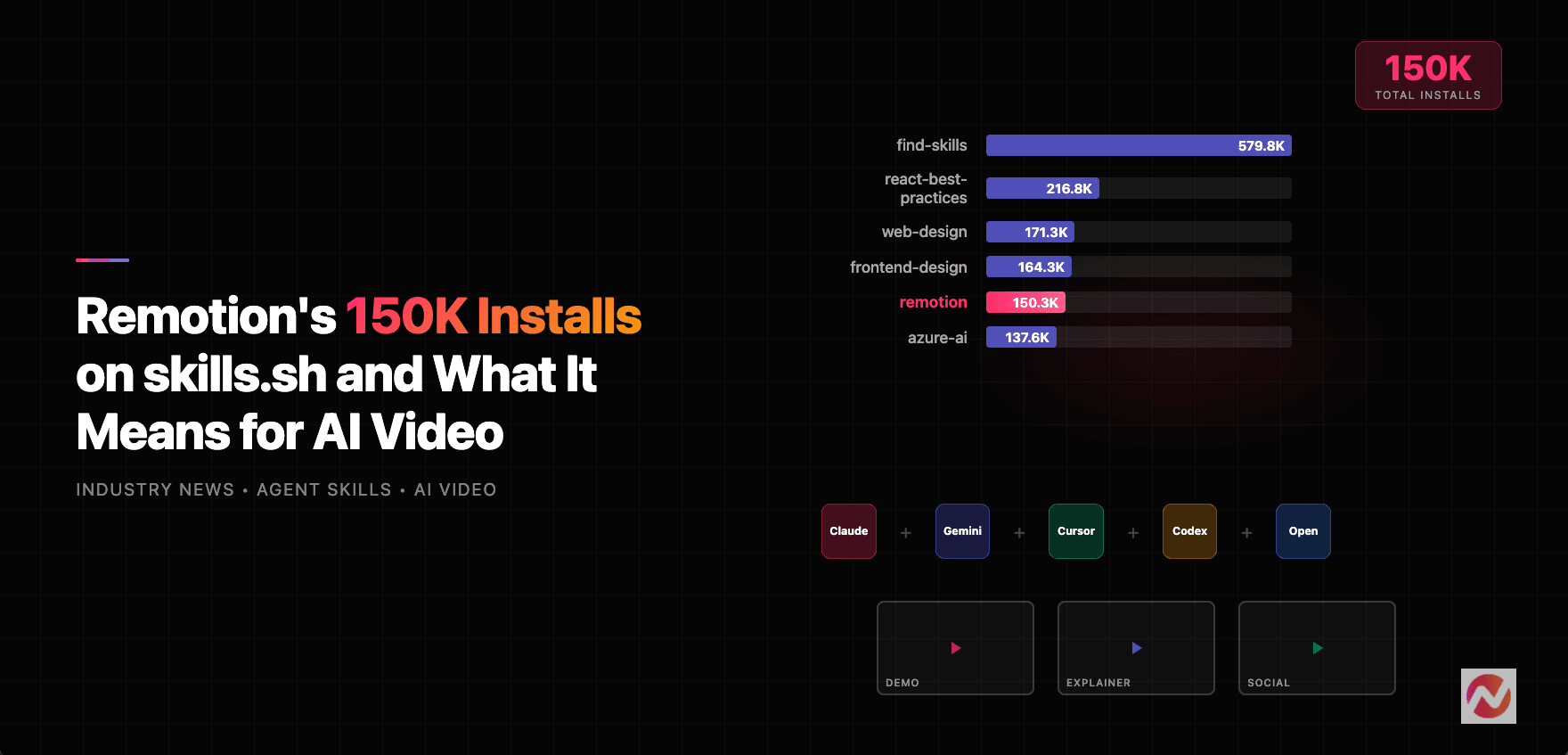
On January 20, 2026, the React-based video framework launched an agent skill for Claude Code. Within 48 hours, the demo video had 6 million views on X. Eight weeks later, the skill had reached 150,000 installs on skills.sh - the open directory for AI agent skills.
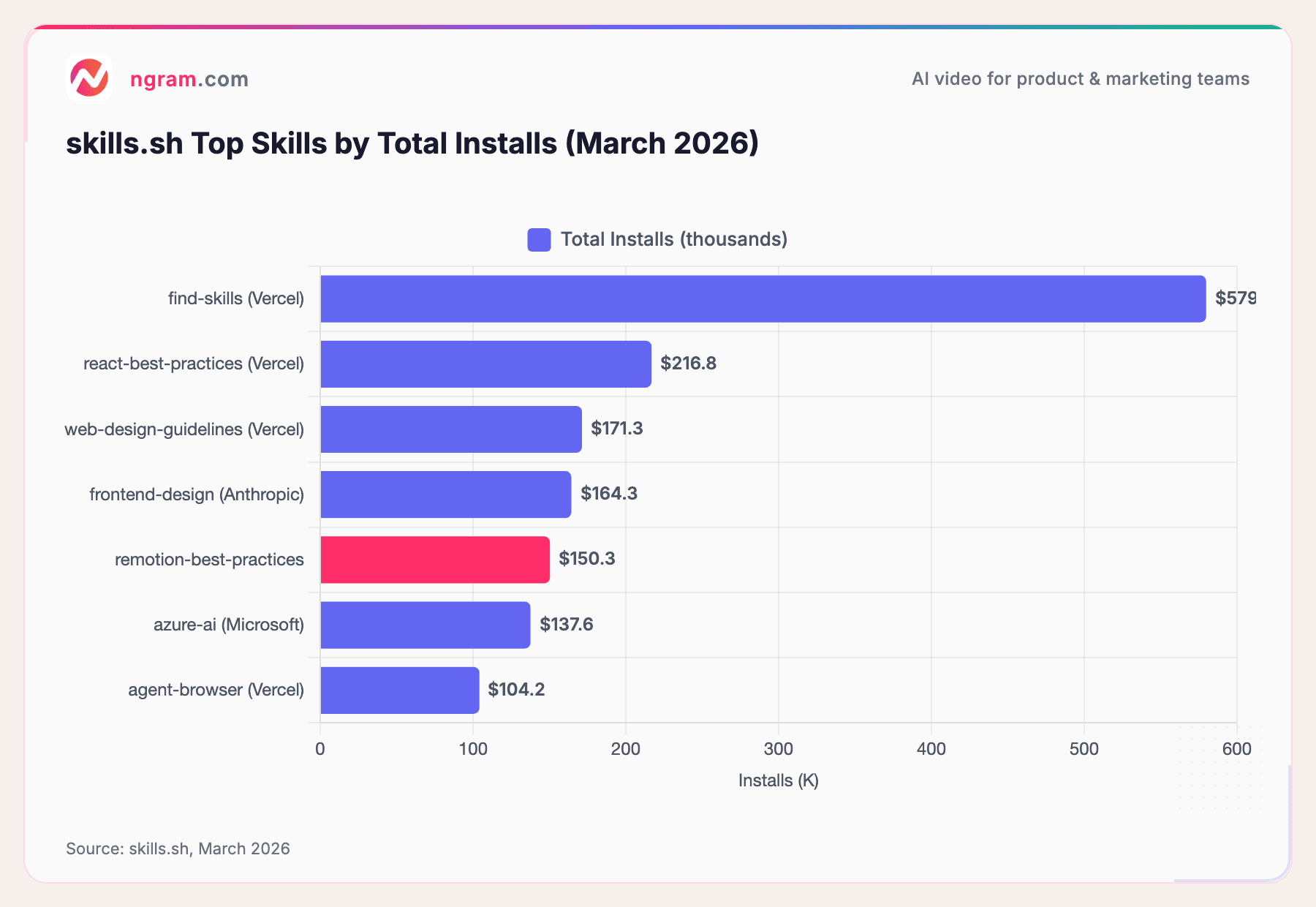
In that March 2026 snapshot, it was the #5 most-installed skill overall, and the #1 skill not made by a platform company like Vercel, Anthropic, or Microsoft.
For a tool that turns English prompts into programmatic React video code, those numbers are wild. And they tell a bigger story about where AI video creation is headed.
The March 2026 skills.sh leaderboard snapshot
To understand why Remotion's numbers matter, you need context on the skills.sh ecosystem.
skills.sh launched on January 20, 2026, as Vercel's open directory for AI agent skills - reusable capability packages that teach coding agents like Claude Code, Codex, Cursor, and Gemini CLI how to do specialized tasks. Think of them as domain-specific knowledge packs.
The ecosystem exploded immediately. According to a data analysis published on Hugging Face, the number of listed skills grew 18.5x in just 20 days, reaching over 40,000 total skills by early February 2026.
But installs tell the real story. Most of those 40,000 skills get almost no traction. The top of the leaderboard is dominated by platform-official skills from Vercel, Anthropic, and Microsoft. And then there's Remotion.
Here's the current leaderboard:
Source: skills.sh, March 2026
Remotion's position is notable. Every skill above it is made by the company that built the platform (Vercel), the AI model (Anthropic), or a cloud giant (Microsoft). Remotion is a 25,000-star open-source project from a small team in Zurich, led by founder Jonny Burger. And it's outpacing Microsoft's Azure skill.
What Remotion Actually Is (and What the Skill Does)
For the unfamiliar: Remotion is a framework that lets you create videos using React and TypeScript. Instead of dragging clips on a timeline, you write components that describe what appears on each frame. The framework renders those components into MP4 files.
It's been around since 2020 and has built a solid developer following - 25,300 GitHub stars and 169,900 weekly npm downloads.
The agent skill is what changed the game. Before the skill, using Remotion with AI agents was hit-or-miss. Claude might generate Remotion code, but it would often misuse APIs, get timing calculations wrong, or produce animations that didn't render correctly.
The Remotion best-practices skill packages 28+ modular rule files covering:
- Animations, spring physics, and easing curves
- Audio syncing and voiceover integration
- Captions and subtitle timing
- 3D content via Three.js
- Data visualization patterns
- Parametrizable videos with Zod schemas
When you install the skill (`npx skills add remotion-dev/skills`), it loads relevant rules dynamically based on what you're building. Ask Claude to create a video with captions? The captions rules load. Working with 3D? The Three.js rules activate. This keeps the token footprint small while giving the agent deep domain knowledge.
The result: you describe a video in plain English, and Claude generates correct, idiomatic Remotion code that actually renders.
Why It Went Viral: The 6 Million View Demo
The Remotion team posted a demo on X on January 20, 2026. It showed a complete animated video created entirely from a text prompt via Claude Code. That post hit 6 million views in days.
Developers started sharing their own results immediately:
- Talley (@__Talley__): "Made this video for Polymarket in 30 minutes. Only took 4-5 prompts."
- Musharraf (@musharrafff): "Made this video about our latest product using Remotion in under 1 hour."
- Shubham Saboo (LinkedIn): "I typed a single prompt. Claude Code generated a complete animated video."
- Riley Brown called it "the ChatGPT moment for video creation."
The enthusiasm was contagious. But the honest takes were just as telling.
As one reviewer noted: "One video - easier with traditional tools. One hundred videos - easier with Remotion." Another pointed out that the skill is "powerful for the right person. You might not be that person yet" - highlighting that React knowledge still helps when you need fine-grained control.
This is an important distinction. Remotion + Claude Code isn't "AI video generation" like Sora or Runway, which create photorealistic footage from text. It's AI-assisted code generation for programmatic, motion-graphics-style video. Product demos, data visualizations, animated explainers, social clips - that's the sweet spot.
It's Not Just Claude Code: Cross-Platform Adoption
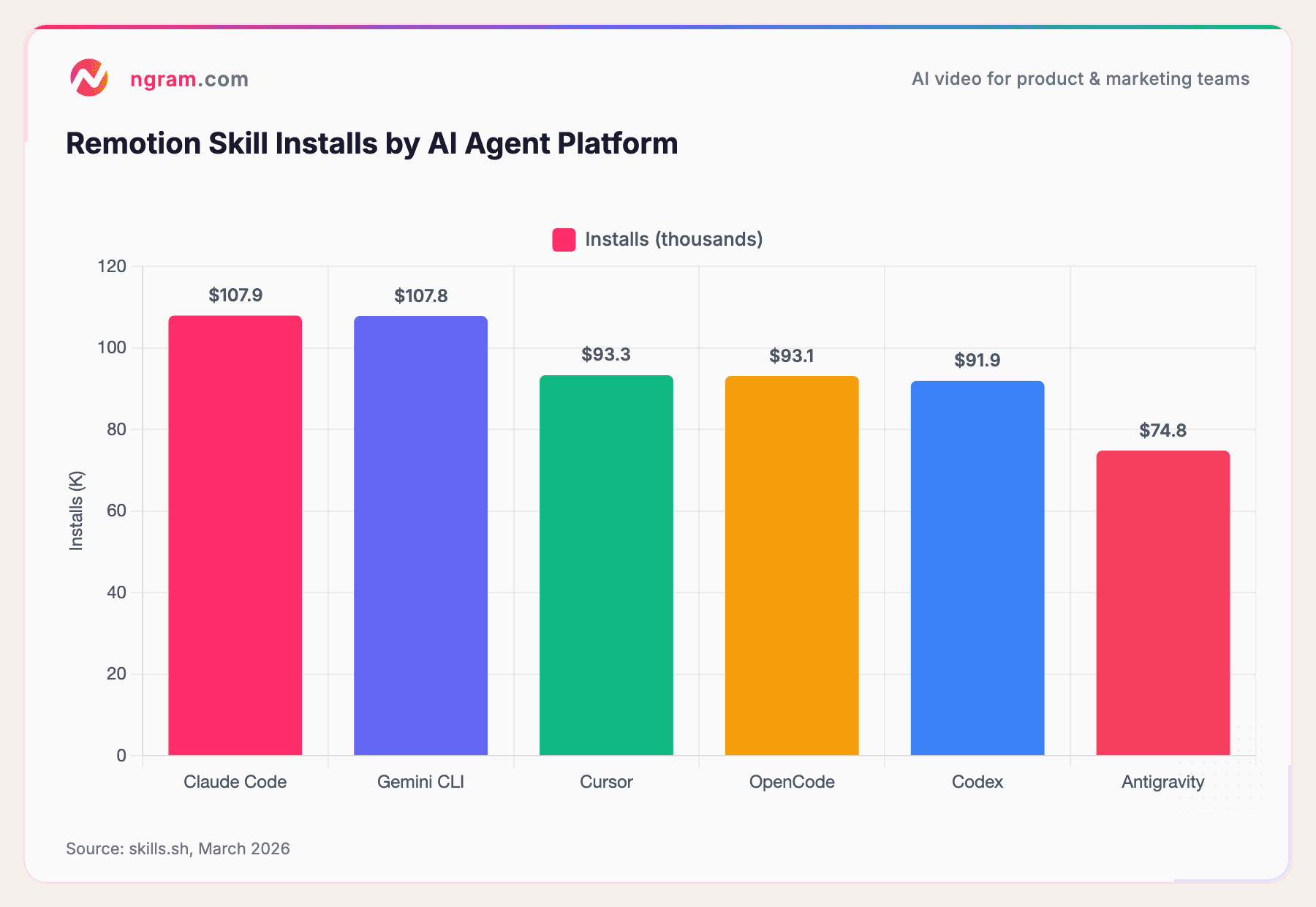
One of the most interesting data points about the Remotion skill is where people are installing it. It works across six major AI coding agents, and adoption is surprisingly even.
Source: skills.sh, March 2026
Claude Code and Gemini CLI are nearly tied at ~108K installs each. Cursor, OpenCode, and Codex all hover around 92-93K. Even Antigravity, a newer entrant, has 74.8K installs.
This cross-platform spread matters. It means the demand for AI-powered video creation isn't tied to one AI model or one IDE. Developers across the entire ecosystem want this capability. The SKILL.md open standard - which makes skills portable across agents - is working exactly as intended.
The Bigger Picture: AI Video Creation Is Going Mainstream
Remotion's skill didn't go viral in a vacuum. It landed at the exact moment that AI video creation hit an inflection point.
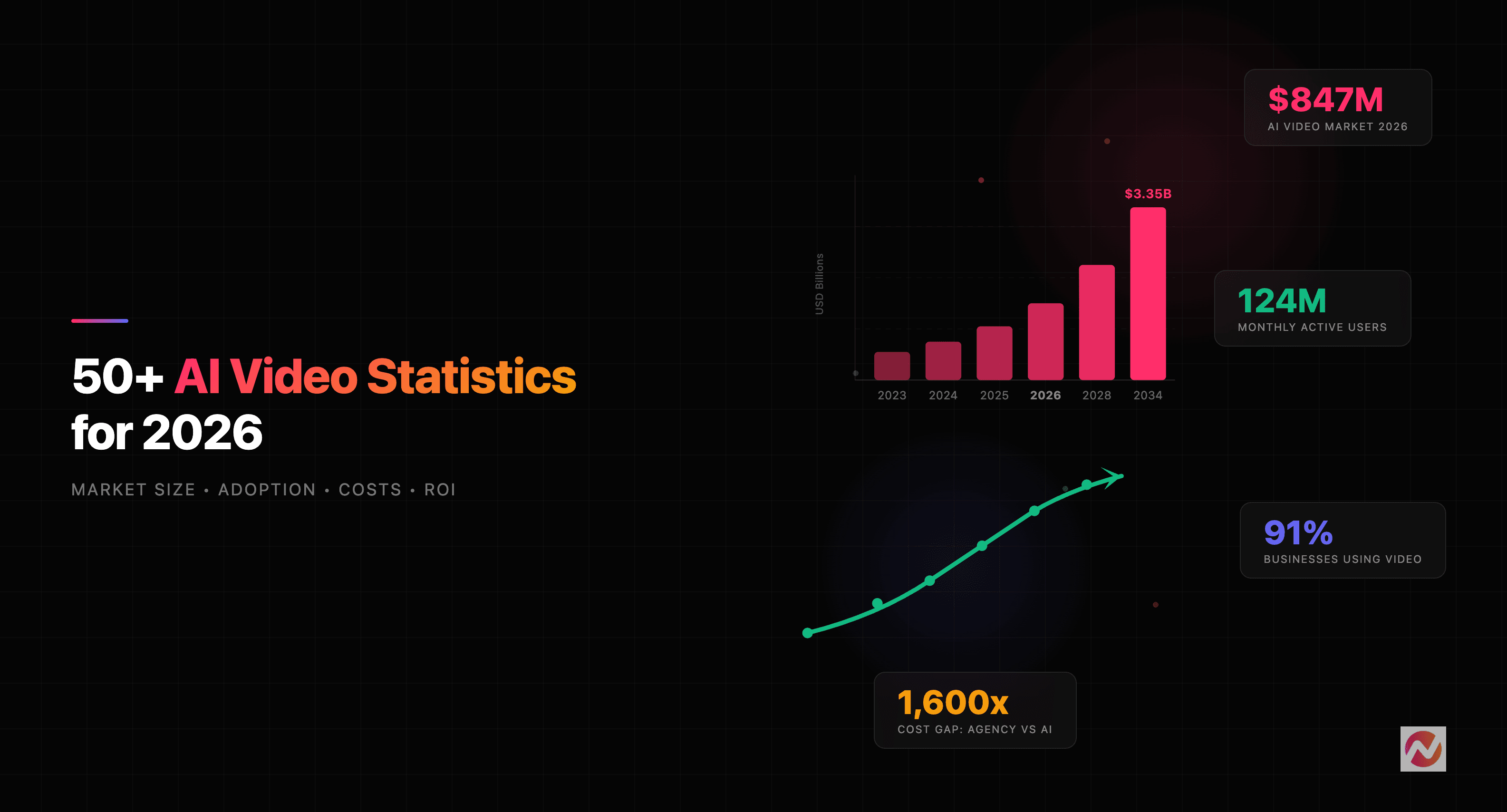
The numbers tell the story. According to recent industry data, the global AI video generation market is projected to hit $18.6 billion by the end of 2026, growing at a 34.2% CAGR from a base of $5.1 billion in 2023.
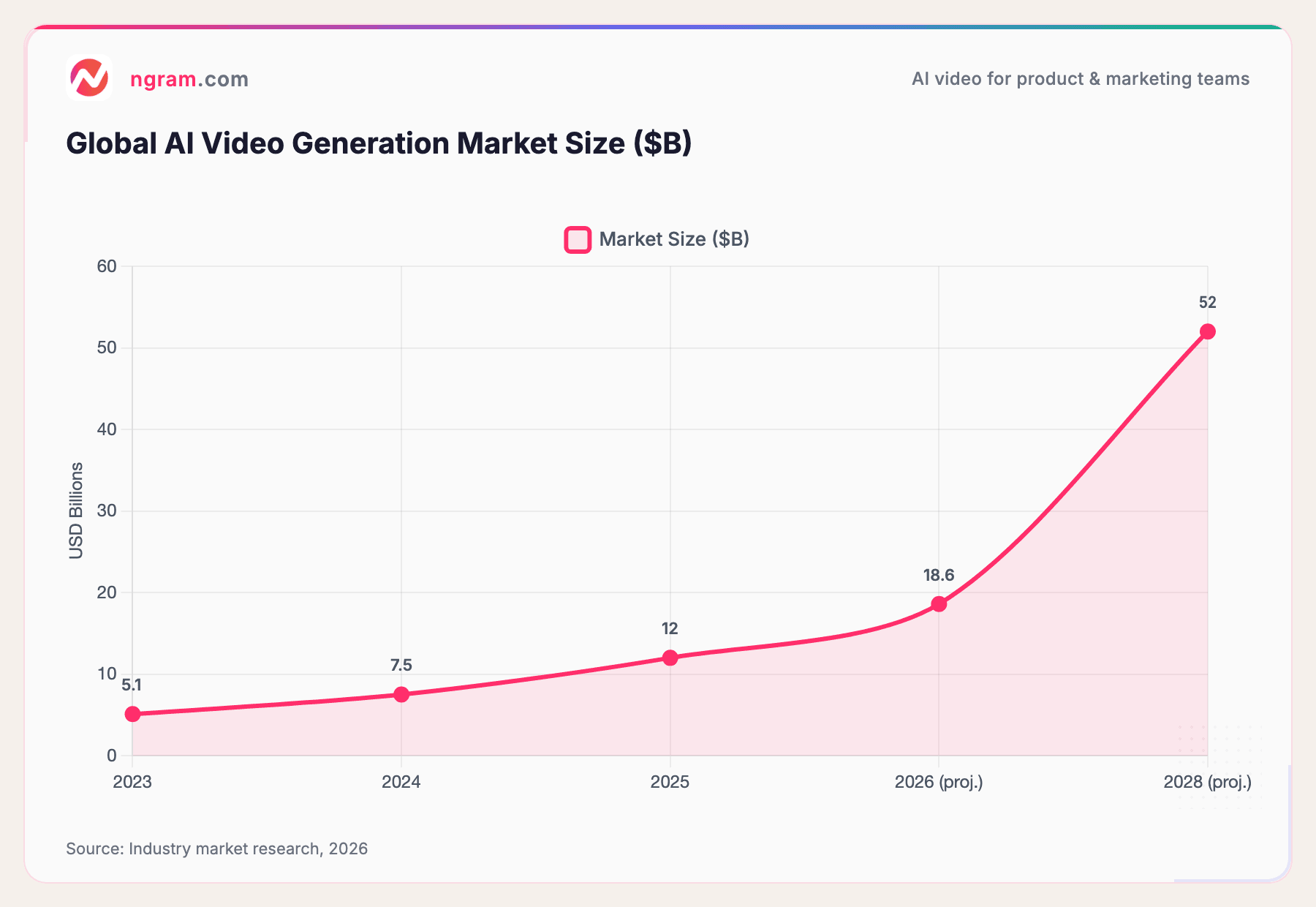
Source: Industry market research, 2026
But market size is just one dimension. Adoption is the real signal:
- 78% of marketing teams now use AI-generated video at least quarterly
- 73% of Fortune 500 companies have integrated AI video tools into their workflows
- 840% growth in AI video generation volume from January 2024 to January 2026
- 124 million monthly active users across AI video platforms globally
The cost story is equally dramatic. Traditional video production runs about $4,500 per finished minute. AI-powered production brings that down to roughly $400 per minute - a 91% reduction. Production time for a 60-second video dropped from 13 days to 27 minutes (per industry benchmarks).
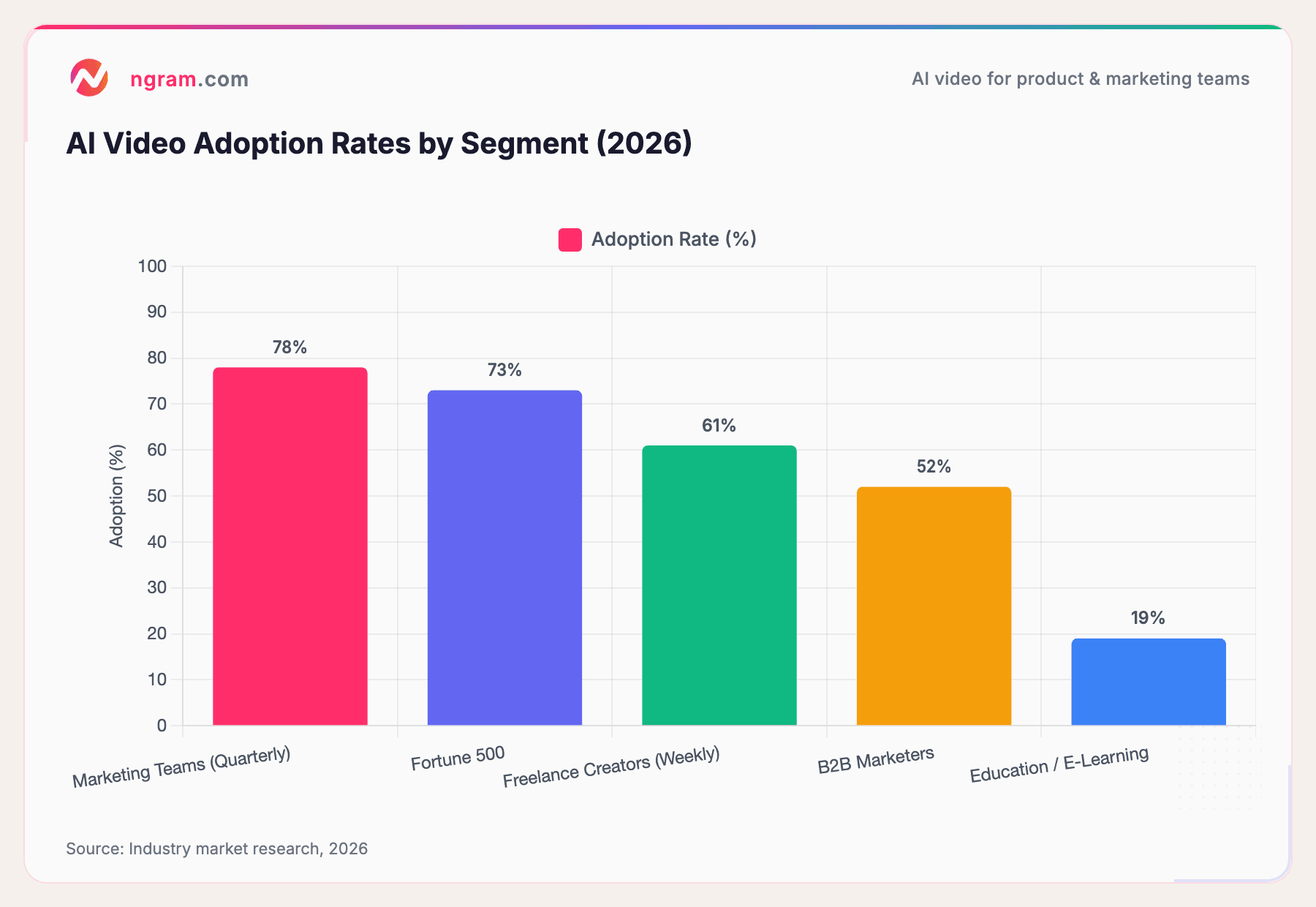
Source: Industry market research, 2026
The convergence is clear: AI video creation has moved from experimental to mainstream. Remotion's skill riding this wave is not a coincidence - it's a direct response to demand.
The Honest Take: Who Is This Actually For?
Here's where we get real. The Remotion skill is genuinely impressive, but it's not for everyone.
It works best for:
- Developers who ship product videos - demo videos, changelog animations, tutorial walkthroughs. If your team already codes and needs recurring video output, this is a productivity multiplier.
- High-volume programmatic video - localized ads, data report videos, personalized outreach clips. When you need 100 variations, code-based video wins over timeline editing.
- Data visualizations - animated charts, dashboard summaries, metrics presentations. The React ecosystem makes data-to-video a natural fit.
It doesn't replace:
- Traditional editing for one-off creative work - a brand film, a wedding video, a documentary. Those need human creative judgment that no agent skill can replicate.
- No-code video tools for non-developers - if you don't know React, the Remotion skill won't magically make you a video producer. You'll be copying code you don't understand.
- AI video generators like Sora or Runway - those create photorealistic footage from text. Remotion creates motion graphics from code. Different tools for different jobs.
This matters because the viral hype sometimes blurs these lines. As one developer put it: "The skill is powerful for the right person. You might not be that person yet."
For the majority of marketing teams, product managers, and founders who need video but don't write code, the answer isn't learning React - it's tools that bring Remotion's power to a no-code workflow. That's exactly what we've built at ngram. Our Remotion integration runs the same React-based rendering engine under the hood, but you never see a line of code. Just describe your video, choose "Motion Graphics" as your animation style, and ngram's AI writes the Remotion components for you - complete with 23+ text animations, data visualizations, and word-level voiceover sync.
If you're building explainer videos, product demos, or feature announcements, ngram handles the script generation and Remotion-powered motion graphics without writing a line of code. We covered the full integration in our recent product update: Remotion Without Code: Try It Directly in ngram.
What This Signals for the Future of Video Creation
The Remotion skill's success is a leading indicator of three bigger shifts.
1. Video creation is becoming a developer workflow
For years, video lived in creative tools - After Effects, Premiere, Final Cut. The idea that a developer would "commit a video" the way they commit code was niche at best.
Now, with Claude Code generating $2.5 billion in annual revenue (Business of Apps) and 29 million daily VS Code installs, the developer workflow is expanding into creative territory. Video is becoming another artifact that code can produce - alongside websites, APIs, and mobile apps.
2. Agent skills are the new package managers
The skills ecosystem grew from roughly 50 skills in mid-2025 to over 40,000 by February 2026. But not all growth is healthy. The Hugging Face analysis found that 46.3% of skills are duplicates or near-duplicates, and 9% carry critical security risks (arbitrary code execution, financial control, root access).
The skills that survive this shakeout will be the ones maintained by domain experts - like Remotion maintaining the Remotion skill, not random community forks. Quality and security audits will matter more as the ecosystem matures.
3. The line between "developer tool" and "creative tool" is dissolving
Remotion proves that with the right AI bridge (the agent skill), a purely technical tool can become accessible to any developer, even one who's never touched video before. The same pattern will likely apply to other creative domains - design, audio, 3D modeling.
The question isn't whether AI will change video creation. That's already happening across the board - from Remotion for developers to tools like ngram for product marketers and non-technical teams. In fact, ngram already runs Remotion under the hood - you just select "Motion Graphics" as your animation style and the same React rendering engine powers your video, no terminal required. The question is how fast the rest of creative production follows.
Frequently Asked Questions
What is the Remotion agent skill for Claude Code?
It is Remotion's official instruction package for AI coding agents. The package teaches agents how to structure React-based video projects and routes them to guidance for topics such as composition, animation, audio, captions, and rendering. The canonical skill is remotion-best-practices, with additional focused skills published in the same official source.
How do you install the Remotion skill?
Run `npx skills add remotion-dev/skills` in your terminal. It works with any agent that supports the SKILL.md format, including Claude Code, Codex, Cursor, and Gemini CLI. You can also get it during project setup with `bun create video`.
Can non-developers use Remotion to create videos?
Not directly - Remotion generates React/TypeScript code, so using it standalone requires JavaScript knowledge. But there's a shortcut: ngram runs Remotion under the hood, so you get the same code-driven motion graphics quality without writing any code. Just choose "Motion Graphics" as your animation style in ngram, and the AI writes the Remotion components for you. See how it works in our guide: Remotion Without Code: Try It Directly in ngram.
What's the difference between Remotion and AI video generators like Sora?
Remotion creates motion-graphics-style videos from code (animated text, data visualizations, product demos, UI animations). Sora and Runway generate photorealistic video footage from text descriptions. They solve different problems: Remotion is deterministic and programmable, while generative AI video is creative and unpredictable.
Where did Remotion rank on skills.sh in March 2026?
In the article's March 2026 snapshot, remotion-best-practices ranked fifth overall at roughly 150,000 installs and was the highest-ranked independent video skill. That leaderboard is historical; by August 5, 2026, its canonical listing showed more than 440,000 installations.
Can you use Remotion without coding?
Yes. ngram integrates Remotion directly into its video creation platform. Instead of writing React components yourself, you describe your video in plain language, select "Motion Graphics" as the animation style, and ngram's AI generates the Remotion code behind the scenes. You get the same deterministic, brand-exact rendering - 23+ text animation types, native data visualizations, word-level voiceover sync - without any developer setup. The full walkthrough is in our product update: Remotion Without Code: Try It Directly in ngram.
How much does it cost to create videos with Remotion?
Remotion itself is open source but requires a company license for commercial use. The main costs are compute - rendering videos locally is free but slow, while cloud rendering (via AWS Lambda) accumulates per-render costs. The AI agent subscription (Claude Code, Codex, etc.) is a separate cost. For high-volume use cases, the per-video cost is significantly lower than traditional production.