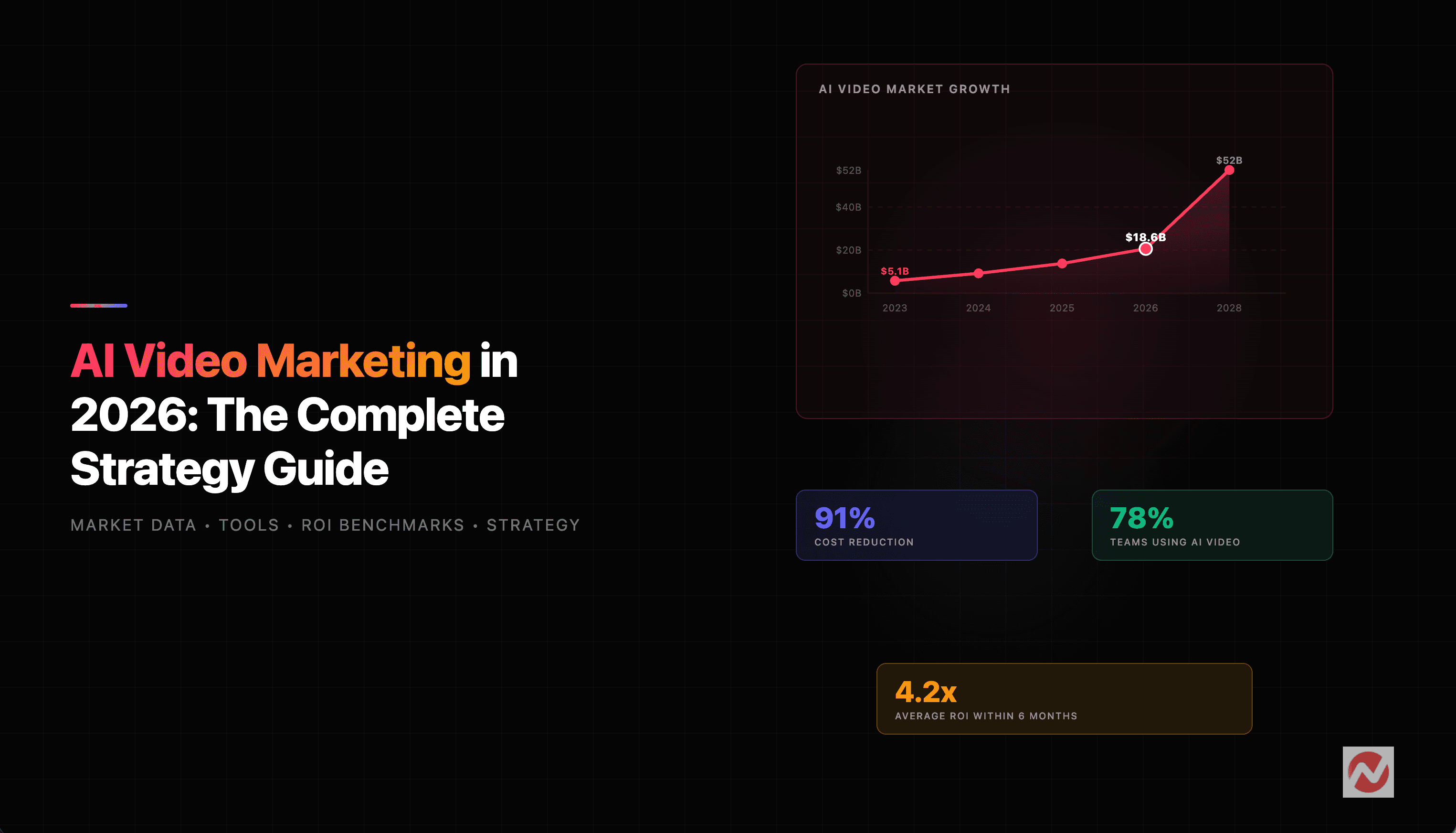


AI video marketing isn't a trend anymore. It's a $18.6 billion market, and according to Wyzowl's 2026 report, 91% of businesses now use video as a marketing tool. What changed? AI made video production 91% cheaper and roughly 30x faster.
But here's the thing - the companies winning with AI video in 2026 aren't the ones producing the most content. They're the ones with the sharpest strategy behind it.
This guide breaks down how AI video marketing actually works today: the market data, the tools worth using, real company examples with real results, and a practical framework for building your own AI video strategy. Whether you're a product marketer shipping feature launches, a growth marketer running ad campaigns, or a founder doing everything yourself, this is the playbook.
The State of AI Video Marketing in 2026
The numbers tell a clear story: AI video has gone from experimental to essential in under three years.
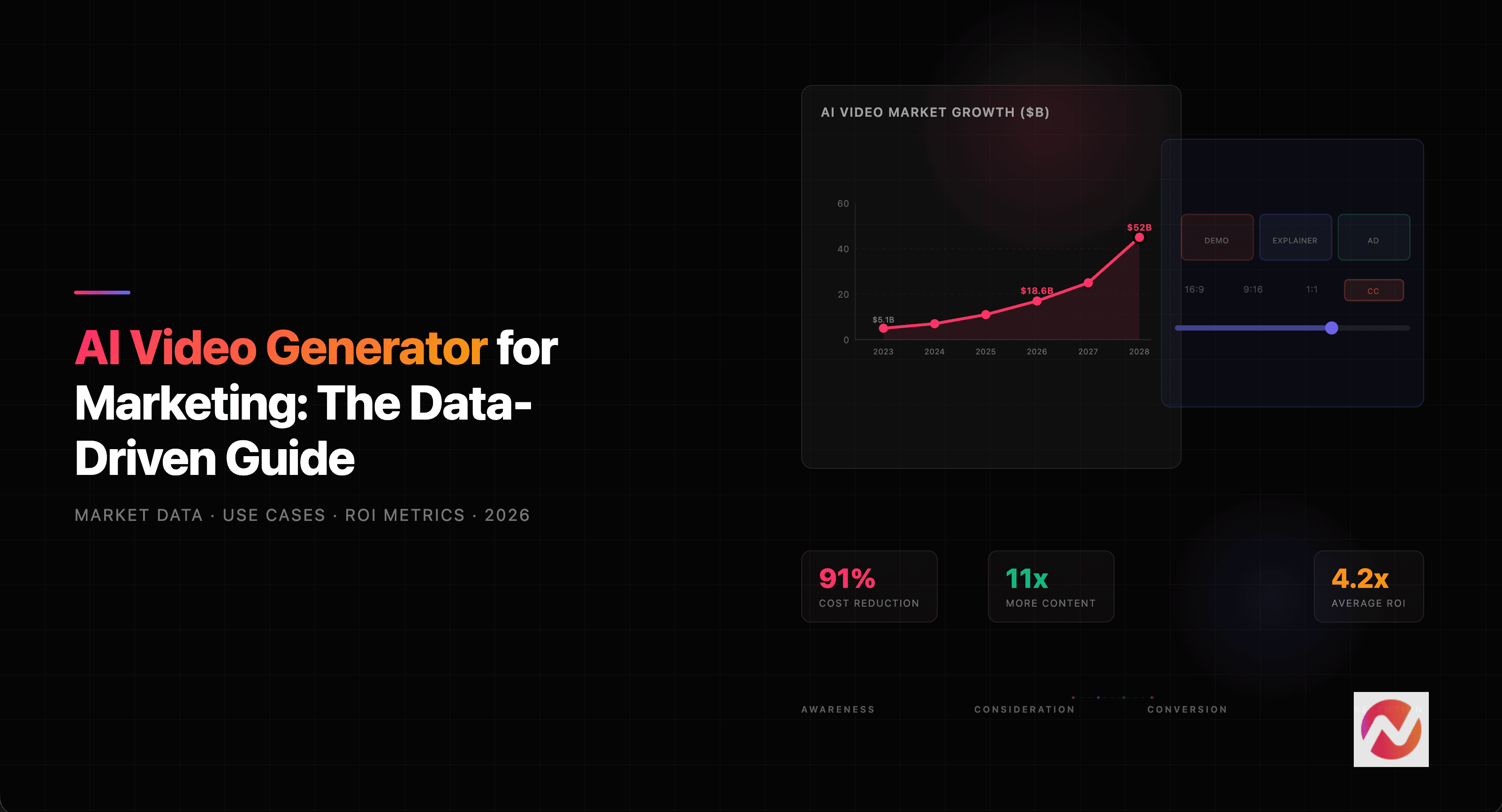
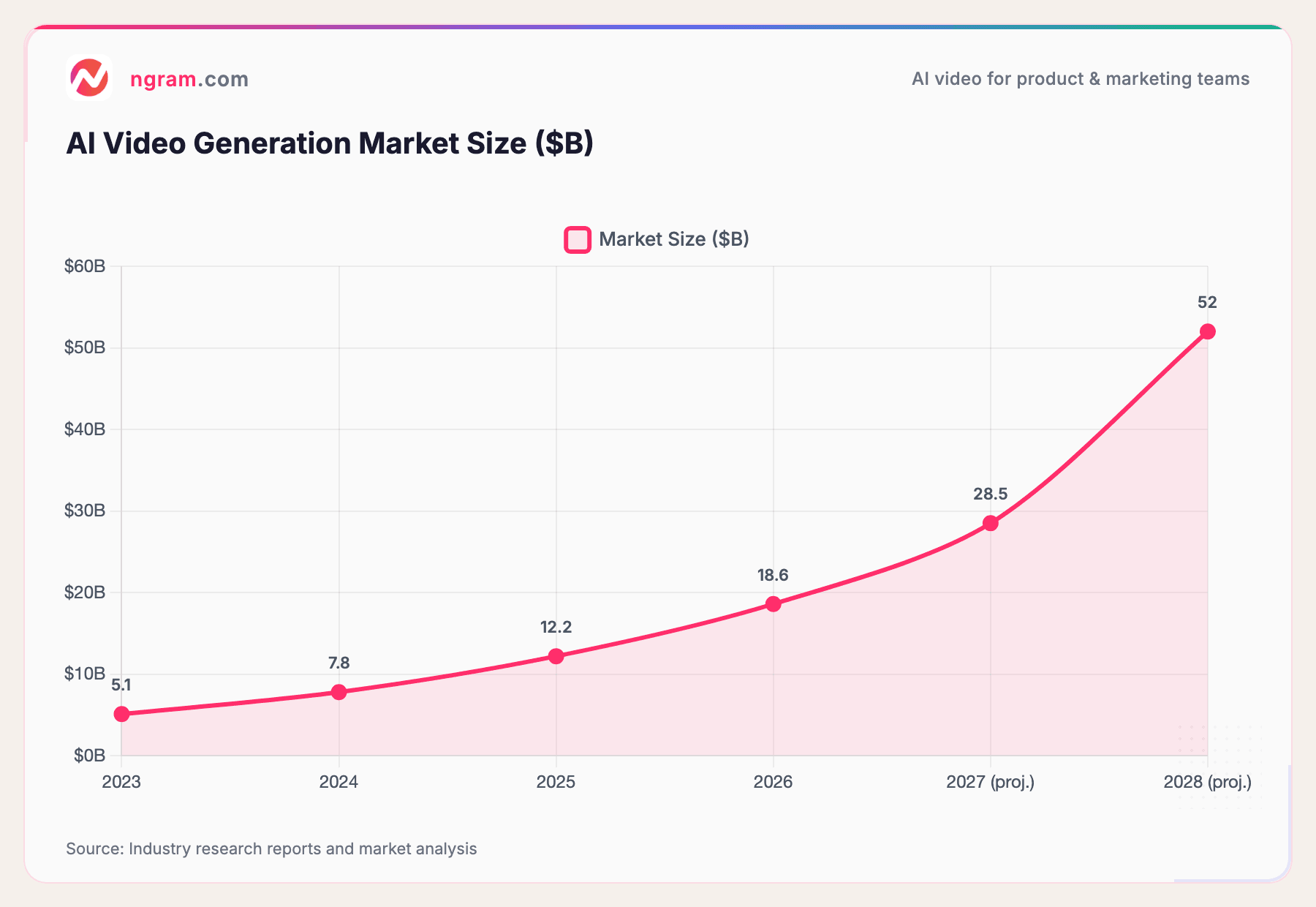
The global AI video generation market hit $18.6 billion in 2026, up from just $5.1 billion in 2023 - a compound annual growth rate of 34.2%, according to industry research. Venture capital poured $4.7 billion into AI video startups in 2025 alone, a 189% increase from 2023.
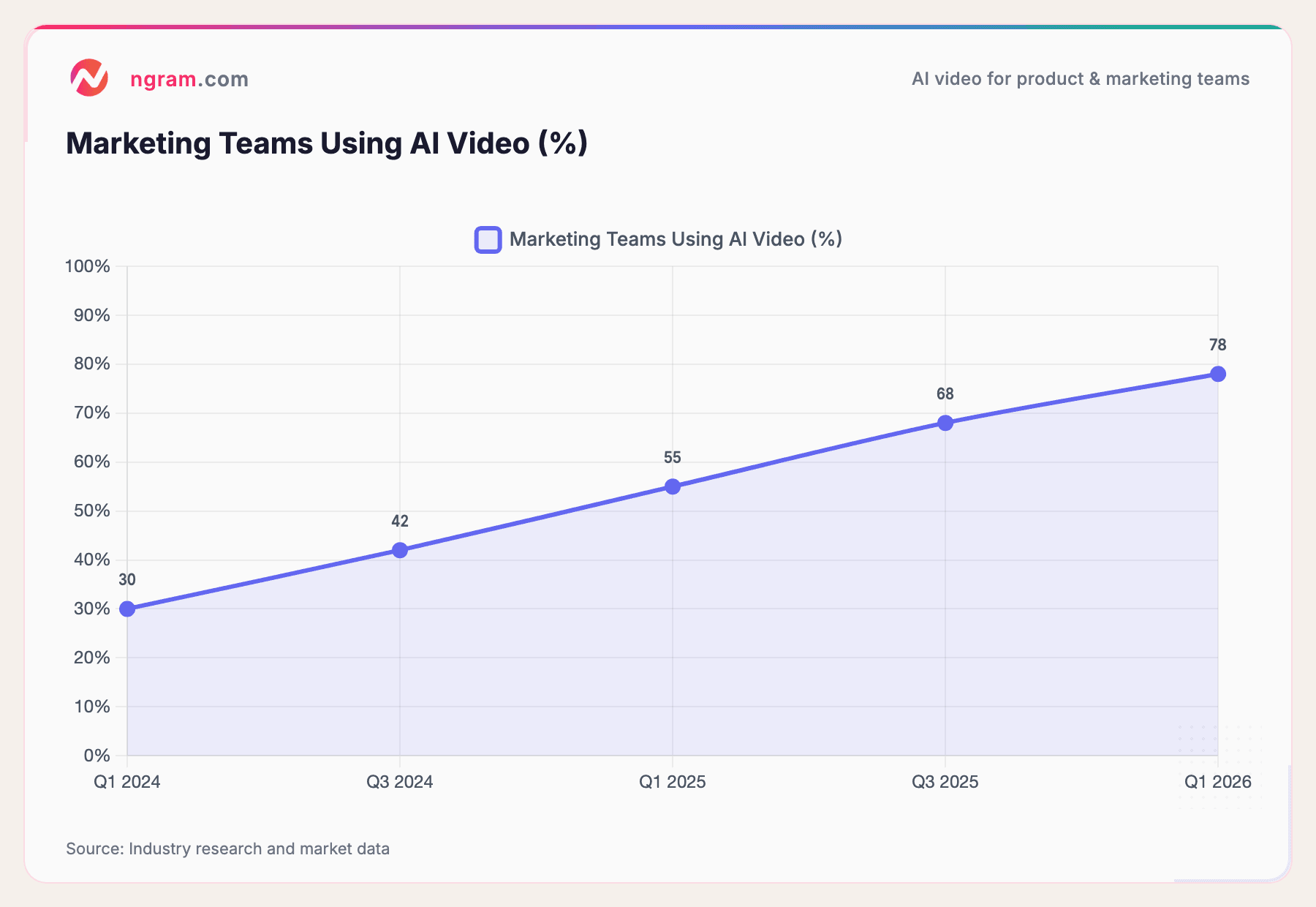
But the real shift is in adoption. AI video generation volume grew 840% between January 2024 and January 2026. Today, 78% of marketing teams use AI-generated video in at least one campaign per quarter, and 73% of Fortune 500 companies have integrated AI video tools into their content workflows.
The cost equation changed everything. Traditional video production runs roughly $4,500 per minute. AI-assisted production brings that down to about $400 per minute - a 91% cost reduction, according to recent industry data. And the average time to produce a 60-second marketing video dropped from 13 days to 27 minutes.
Here's how that market growth looks over time:
Source: Industry research reports and market analysis
The trajectory is steep. By 2028, the market is projected to reach $52 billion - nearly 10x what it was in 2023. That's not incremental growth. That's a fundamental shift in how businesses produce content.
How Companies Are Actually Using AI Video
So where is all this AI video going? The use cases break down across a few clear categories.
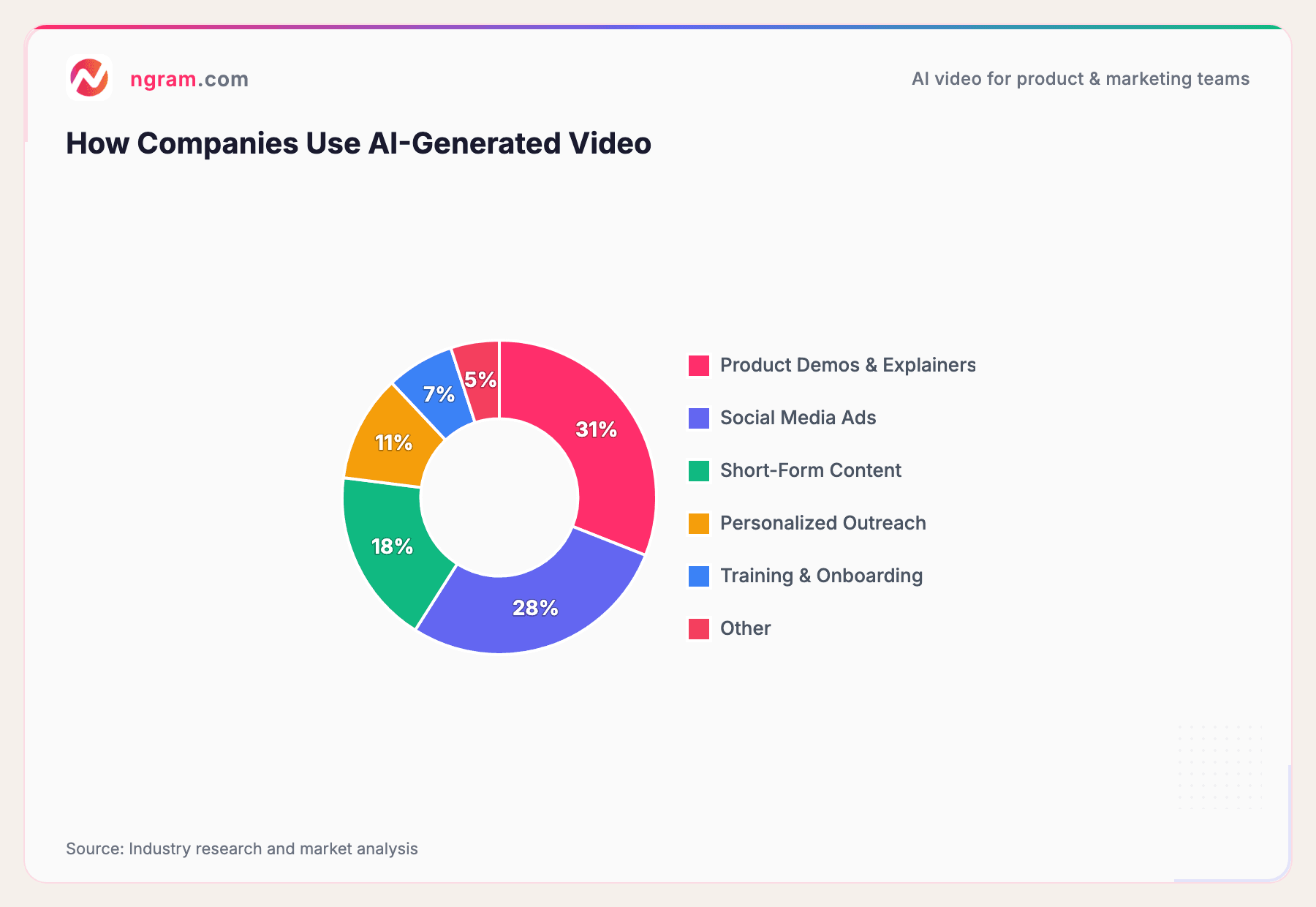
Product demos and explainer videos lead the pack at 31% of all AI-generated video output. Social media ads come in at 28%, followed by short-form content (under 60 seconds) at 18%. The fastest-growing segment is personalized outreach - one-to-one videos tailored to specific prospects or customer segments, according to industry benchmarks.
Source: Industry research and market analysis
The average AI-generated marketing video is just 42 seconds long, and 59% are produced in vertical (9:16) format - up from 31% in 2024, reflecting the dominance of social-first distribution.
Real Company Examples
The case studies are getting more interesting as companies get bolder.
Kalshi, the financial prediction market platform, ran an AI-generated commercial during the NBA Finals in June 2025. The surrealistic ad cost just $2,000 to produce, took two days from concept to final cut, and generated over 3 million views on X alone, according to Superside's AI marketing campaign analysis. Compare that to the $7 million average for a traditional NBA Finals ad spot.
H&M created 30 hyper-realistic AI digital twins of fashion models in early 2025, using them to generate diverse, scalable marketing assets across multiple campaigns and channels. The approach let them produce campaign visuals at a fraction of the time and cost of traditional photo shoots.
Coca-Cola and Sephora have both integrated AI video into their marketing workflows, and companies like Heineken, DuPont, Zoom, and Reuters are working with AI video production studios for their content needs.
One pattern stands out across these examples: the companies getting results aren't using AI to replace their creative teams. They're using it to give those teams superpowers - producing 11x more video content monthly with the same team size, according to industry data.
If you're exploring ad creative videos for your own campaigns, the tools and workflows have matured significantly in the past year.
The ROI of AI Video Marketing
Let's talk numbers, because the ROI case for AI video is strong - and getting stronger.
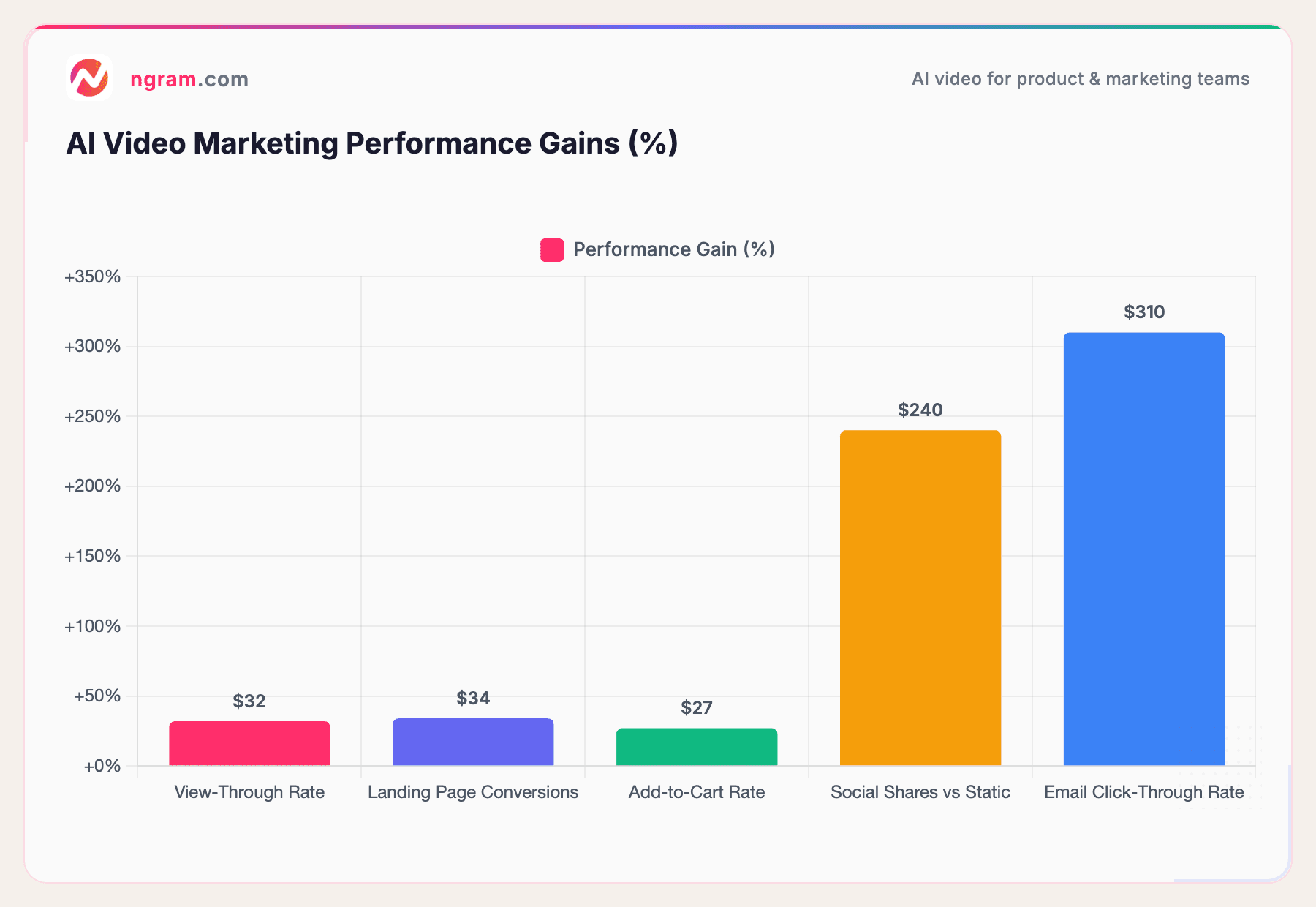
Teams that adopt AI video tools see an average 4.2x return on investment within their first six months, according to industry research. Landing pages with AI-generated explainer videos see 34% higher conversion rates. Personalized video emails drive a 4.1x higher click-through rate compared to standard emails.
The performance gap between AI video and static content is widening across every major channel:
Sources: Industry research, Wyzowl Video Marketing Statistics 2026
AI video ads see a 62% view-through rate compared to 47% for traditional video ads. Posts with AI-generated video get 3.4x more shares than static images. And 82% of marketers who adopted AI video tools report reallocating their freed-up budget toward distribution and paid amplification - meaning the cost savings compound.
Perhaps the most telling stat: A/B testing video variations now costs 96% less with AI tools. You can test five different hooks, three different CTAs, and two different pacing styles for the cost of a single traditional video revision. That iterative capacity changes the entire game for performance marketers.
Want to calculate the potential impact for your team? Check out ngram's video ROI calculator for a quick estimate.
Top AI Video Marketing Tools for Business Teams
The tool landscape in 2026 is mature but fragmented. There's no single "best" tool - the right choice depends on what you're making and who it's for. Here's how the market breaks down by use case.
For Ad Creatives and Performance Marketing
Creatify leads this category. It specializes in turning product URLs into short-form ad videos, with built-in A/B testing and format optimization for paid social. If your primary need is cranking out ad variations for Meta, TikTok, and YouTube Shorts, this is where most performance marketers land.
For Corporate and Training Content
Synthesia remains the most mature platform for talking-head style videos using AI avatars. It's the go-to for enterprise training, internal communications, and localization - their platform supports over 140 languages with lip-synced AI presenters. Companies like Heineken and DuPont use it for scaled internal video production.
For Pure Video Generation Quality
Google Veo 3.1 currently sits at the top for raw generation quality. It generates synchronized audio alongside video in a single pass, and its prompt adherence is the tightest in the market, according to Zapier's 2026 AI video generator comparison. Kling 3.0 is the Reddit community favorite, offering the best price-to-performance ratio with a freemium model that gives 66 free daily credits.
For Personalization at Scale
HeyGen carved out a strong niche for personalized and translated videos. Sales teams use it for one-to-one prospect outreach, and marketing teams use it for localized campaigns across global markets.
For Intent-Aware, Brand-Consistent Marketing Video
This is where ngram takes a different approach. Most AI video tools start with either a blank prompt (generation tools) or a template (quick-edit tools). ngram starts with intent - you define your audience, goal, and channel first, then bring whatever assets you already have: docs, screenshots, recordings, URLs. ngram generates a script and storyboard before any rendering happens, so you're reviewing the plan, not just the output.
For product marketing teams shipping feature launches, product demos, or competitive content, this intent-first approach means every video is built for a specific audience and channel - not just templated and hoped for the best. A brand kit (logo, colors, fonts, intros, and outros) is applied automatically, so output stays on-brand as the whole team scales production.
For Quick Template-Based Content
InVideo offers 5,000+ templates for fast text-to-video workflows. CapCut provides free AI video generation and editing with no watermarks. Both are solid for high-volume, lower-stakes content like social clips and internal updates.
The Multi-Tool Reality
The honest truth is that most enterprises aren't using just one tool. According to ViVideo's research, the average enterprise uses 3.2 different AI video tools simultaneously. Reddit communities echo this: the consensus across r/aivideo and r/Marketing points toward building modular "stacks" where specific tools serve distinct stages of the production pipeline.
Building Your AI Video Marketing Strategy
Tools are the easy part. Strategy is what separates the teams getting real results from the ones just adding noise.
Here's a five-step framework based on what's working for marketing teams in 2026:
Step 1: Define Intent Before You Touch Any Tool
Before choosing a tool or writing a prompt, answer three questions: Who is this video for? What should it achieve? Where will it live?
A product demo for enterprise prospects on your website requires a completely different structure, tone, and length than a feature announcement clip for LinkedIn. A sales follow-up video has different pacing than an onboarding walkthrough. The format changes because the intent changes.
This is where most teams get it wrong. They pick a tool, generate something that looks nice, and then try to find a use for it. The teams getting 4.2x ROI start from the other direction - they define the communication job, then use AI to execute it.
Step 2: Start From What You Already Have
You don't need to start from scratch. Your team already has the raw material: product docs, feature specs, release notes, support articles, Slack threads, recorded meetings, screenshots, decks. The best AI video workflows turn existing content into video, not create from nothing.
71% of creators use AI for first drafts and then refine manually, according to industry data. That's the right mental model - AI as an accelerant for your existing ideas and assets, not a replacement for them.
Step 3: Script and Storyboard Before You Generate
The number one mistake in AI video marketing is skipping the plan. Jumping straight from idea to generated video is like publishing a blog post without an outline - you might get lucky, but you'll probably waste time on revisions.
Review the script. Review the storyboard. Fix direction at the cheapest point in the process (before rendering), not the most expensive (after).
Want to see this in action? ngram generates a script and storyboard before rendering, so you review the plan first, not just the output. Try it free.
Step 4: Test and Iterate Aggressively
With AI, A/B testing video costs 96% less than traditional methods. You can test different hooks, CTAs, visual styles, and pacing - then let the data tell you what works.
This is a genuine paradigm shift. In the traditional model, you produced one video and hoped it worked. In the AI model, you produce five variations and know within days which performs best.
Step 5: Measure What Matters
Track the metrics that actually connect to business outcomes:
- View-through rate - Are people watching to the end?
- Click-through rate - Are they taking the next step?
- Conversion rate - Are views turning into signups, demos, or purchases?
- Cost per video - How does your per-video cost compare to pre-AI benchmarks?
- Time to publish - How fast can you go from idea to live video?
82% of video marketers report good ROI from video, according to Wyzowl's 2026 survey. But the teams who know their exact numbers - cost per view, conversion lift per video type, production time per format - are the ones scaling confidently.
Marketing Team Adoption Is Accelerating
The adoption curve tells its own story. Just two years ago, only 30% of marketing teams used AI video regularly. Today, that number is 78% and climbing.
Source: Industry research and market data
Enterprise spending on AI video platforms grew 127% year-over-year in 2025, and 52% of B2B marketers named AI video as their top new technology adoption for the year. The projected AI video ad spend for 2026 is $9.1 billion globally - roughly 12% of all digital video advertising.
LinkedIn saw a 310% increase in AI-generated video content shared on the platform in 2025. E-commerce companies report a 156% engagement increase when using AI video for product showcases. And 85% of AI-generated videos now include auto-generated captions - a best practice that's become the default.
The shift isn't just about cost anymore. It's about speed, iteration, and the ability to produce the right video for every message, every channel, and every audience segment.
Common Mistakes to Avoid
AI video marketing fails when teams treat it as a content firehose instead of a precision tool. Here are the most common mistakes we see:
Skipping the strategy phase. Generating video without defining who it's for and what it should achieve produces polished-looking content that doesn't convert. The tool doesn't know your audience - you do.
Ignoring brand consistency. When every team member generates videos with different tools, styles, and tones, your brand fragments fast. A brand kit - defined fonts, colors, logos, intros, outros - keeps everything cohesive as you scale.
Using one tool for everything. The Swiss Army knife approach rarely works. A tool built for talking-head training videos probably isn't ideal for punchy social ads. Match the tool to the use case.
Not measuring results. 82% of marketers say video gives them good ROI, but far fewer can tell you the exact conversion lift by video type. Without measurement, you can't iterate, and iteration is the whole point of AI-powered production.
Over-producing, under-distributing. AI makes production cheap, which tempts teams into making more videos than they can distribute well. A single well-distributed video outperforms ten that sit on a YouTube channel with 12 subscribers.
Frequently Asked Questions
How do you create marketing videos with AI?
Start by defining your video's purpose: the audience, goal, and distribution channel. Then choose a tool that fits the use case - ad creative tools for paid social, avatar tools for training, intent-aware tools like ngram for product marketing. Upload your existing assets (text, images, recordings), review the generated script or storyboard, refine it, and export. Most AI video tools can produce a finished marketing video in under 30 minutes.
How much does AI video marketing cost?
AI-assisted video production costs roughly $400 per finished minute, compared to $4,500 per minute for traditional production - a 91% reduction. Many tools offer free tiers or plans starting at $7-35 per month. Enterprise teams typically spend $100-500 per month per seat across their tool stack.
What are the best AI video tools for marketers?
It depends on your primary use case. Creatify leads for ad creatives, Synthesia for training and localization, HeyGen for personalized outreach, Kling 3.0 and Google Veo 3.1 for raw generation quality, and ngram for intent-aware marketing videos built from existing assets. Most marketing teams use 2-4 tools in combination.
Is AI-generated video good enough for professional marketing?
Yes. 89% of consumers can't distinguish AI-generated video from traditionally produced content, according to industry research. AI video ads achieve a 62% view-through rate compared to 47% for traditional video ads. The quality gap has essentially closed for most marketing use cases, especially short-form social content and product explainers.
How do you measure ROI of AI-generated marketing videos?
Track view-through rates, click-through rates, and conversion rates per video. Compare your per-video production cost and time-to-publish before and after AI adoption. Teams that measure rigorously see an average 4.2x ROI within six months. The key is attributing outcomes to specific videos, not just measuring overall video performance in aggregate.
Can AI video replace human video editors?
71% of creators use AI for first drafts and refine manually - and that's the right model. AI handles the heavy lifting of assembly, pacing, and initial editing. Human judgment handles the creative direction, brand tone, and final polish. The most effective teams use AI to eliminate grunt work so their creative people can focus on strategy and storytelling.
AI video marketing in 2026 isn't about choosing the fanciest tool or producing the most content. It's about building a repeatable system that turns your existing assets and ideas into on-brand, on-message videos for every channel and audience that matters to your business.
The market data is clear: video outperforms every other content format, and AI just removed the cost and time barriers that kept most teams from producing it consistently.
Ready to make AI video part of your marketing strategy? ngram turns your existing assets - docs, screenshots, recordings, URLs - into polished, on-brand videos in minutes. Define your audience, goal, and channel, and get a strong first cut fast. Get started free.